Google, Advertising, Money and Piracy. A History of Wrongdoing Exposed.

Readers of this blog will know that we’ve been gaining attention and awareness on brand sponsored piracy. We’ve noted how 50 Major Brands are Supporting Music Piracy. When that information is paired with The LA Times and The New York Times reports from the USC Annenberg Innovation Lab’s Transparency Report on Advertising Networks financing piracy we see a very clear picture emerging.

It is very clear that online piracy is a mass scale, for profit, enterprise level commercial business. There is a lot of money changing hands. Google is said to make approximately $30 Billion a year, with 97% of the money coming from advertising revenue. All of Google’s other products combined only account for less than 3% of it’s annual earnings.

So we can see that there are a lot of people making a lot money from the unauthorized, illegal infringement of artists and creators work. This is no longer about individual “sharing.” This is about businesses exploiting artists for profit, and not paying the artists a penny. We do not know of one cent being paid to artists from sites like The Pirate Bay, 4Shared and Filestube just to name a few of the major offenders.

So where does Google fit into this? Why do so many artists rights advocates focus so intently on Google? Simply because public documents have exposed Google as having knowledge of wrong doing and doing nothing about it – until they got busted, red handed, twice.

In 2011 Google paid $500,000,000 (that’s half a billion dollars) in a non-prosecution settlement agreement to avoid criminal prosecution. Yes, Google paid half a billion dollars to avoid criminal prosecution and the documents in the case revealed that knowledge of wrongdoing went all the way to the top, to none other than Larry Page himself. The story caught the attention of many mainstream media outlets including CNN.

The Wall Street Journal Reported:

“Larry Page knew what was going on,” Peter Neronha, the Rhode Island U.S. Attorney who led the probe, said in an interview. “We know it from the investigation. We simply know it from the documents we reviewed, witnesses that we interviewed, that Larry Page knew what was going on” . . .

Harvard Law Associate Professor Ben Edelman continues;

These admissions and the associated documents confirm what I had long suspected: Not only does Google often ignore its stated “policies”, but in fact Google staff affirmatively assist supposed “rule-breakers” when Google finds it profitable to do so…

In June I observed that Google’s bad ads span myriad categories beyond pharmaceuticals — charging for services that are actually free, promising free service when there’s actually a charge, promoting copyright infringement, promoting spyware/adware, bogus mortgage modification offers, work-at-home scams, investment rip-offs, identify theft, and more.

Note that Edelman reports the problem is much larger than just the illegal advertising of drugs.  It appears to even extend into such black markets as human trafficking. This issue was even met with a Change.Org petition as well as being reported on here and here.

So if Google has been caught lying about their knowledge of wrong doing in the past, and violating their actual practices versus policies, than what else do they know and what else are they doing? How many other of their own policies do they not follow, or worse, aid others in circumventing them? All reasonable questions to ask given the publicly available information.

The profiting from illegal behavior was also reported by Ars Technica ,

When the sting began in 2009, Google had in place policies designed to block illicit pharmaceutical advertising. Whitaker’s orders were initially rejected under those policies. But Whitaker says Google sales reps helped him tweak his sites to skirt the rules.

“It was very obvious to Google that my website was not a licensed pharmacy,” Whitaker told the Journal. “Understanding this, Google provided me with a very generous credit line and allowed me to set my target advertising directly to American consumers.”

All of this brings us back to where we are now regarding Google’s non-denial regarding financing commercial scale infringement sites. There is a history of this behavior with Google that dates back further. In May of 2011 The Copyright Alliance noted the following regarding the 2007 case of EasyDownloadCenter.com and TheDownloadPlace.com.

Indeed there is even publicly documented history of Google knowingly and purposefully working with pirate websites to increase traffic to such websites and profits to Google from the Sponsored Links/Adwords programs. In conjunction with the settlement of a copyright infringement lawsuit brought by the major Hollywood studios against Luke Sample, Brandon Drury and their companies for operation of subscription based websites devoted to helping consumers find and download pirated copyrighted works, Sample’s Affidavit was filed by one of the defendants testifying to the fact that Google worked directly with the illegal website to drive traffic to it and increase Google’s revenues from its participation in the sponsored links program.

This is the part below really gives us pause, reported not just by The Copyright Alliance, but also many tech publications and outlets such as DailyTech.

In fact, Google’s ad teams even made suggestions designed to optimize conversion rates by using keywords targeted to pirated content – such as suggesting downloading films still in theatrical release, that obviously were not available yet in any authorized format for home viewing.

According to PCWorld this added up to some decent money…

EasyDownloadCenter.com and TheDownloadPlace.com generated US$1.1 million in revenue between 2003 and 2005, and Google received $809,000 for advertising, the Journal reported.

So the question today is what does Google actually know about how it’s advertising practices are financing the destruction of the creative community by supporting these unauthorized, illegally operating, commercial infringers? How much has really changed?

Keep in mind that although Google pays it’s “partners” a revenue share on YouTube for claimed content, the company makes no such offer to artists and creators on the advertising that it still appears to be serving to pirate sites. This is further demonstrated by the lack of ability for the company to make a definitive statement that Google does not serve any ads, to any pirate sites (or at least the 43,000 listed in the companies own transparency report).

Also central to this conversation is that the way consumers access the unauthorized, illegal and infringing sites which usually starts with a Google search itself. In fact according to Google’s own public transparency report there are over 13 million infringing links being removed from Google’s search engine monthly by rights holders. Those 13 million infringing links represent over 43,000 infringing sites.

Wouldn’t the rational and logical solution be to create a joint review board the represents the interests of all stakeholders that can negotiate penalties or the removal of bad actors?
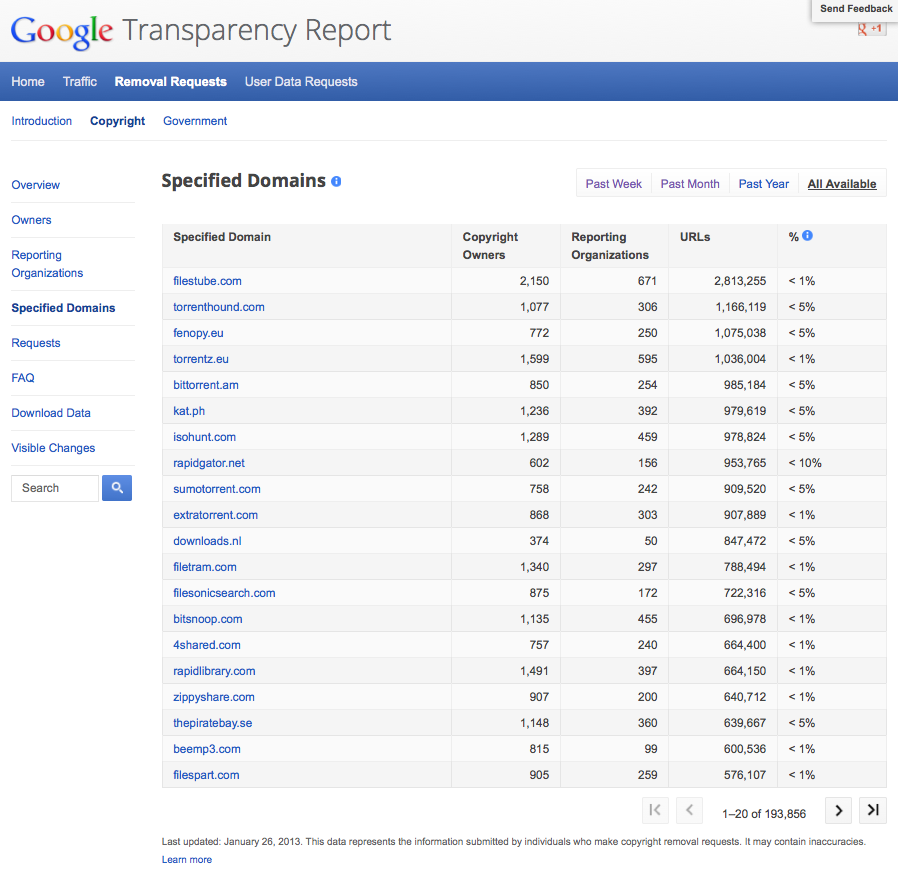

GoogleTransparencyReport

Of Foxes and Henhouses…

Music Technology Policy

[Editor Charlie sez: This post orginally appeared on December 15, 2011 and in light of Gary Shapiro’s recent  editorial–still looking for that copyright law that passes the CEA purity test–we thought it might be time for a reprise.  See also David Israelite’s excellent op ed responding to Shapiro.  Yes, like Diogenes, Gary Shapiro wanders the earth in search of “reform” he can support.  To paraphrase Saul Alinsky, when they stop asking for reform, you’ll know they finally have the bullets.]

We are reviewing the public statements of the lobbyist Gary Shapiro, a leading voice in the anti-copyright lobbying crowd for over a decade.  Why?  Because his speeches have a Groundhog Day aspect making me think “I swear I’ve heard this before.”  And it turns out that I have.  Many of the same phrases keep showing up in his public language, and not just once or twice–but for a decade.

Here’s a little…

View original post 2,145 more words

Internet Pay To Play: Payola’s Revenge – Guest Post by Robert Rial of Bakelite78

Guest Post by Robert Rial of the band www.bakelite78.com. (Posted by permission, copyright in the author.)

I just read David Lowery’s Letter to Emily White, got righteously indignant and wanted to rant, so…

My Seattle band Bakelite 78 is not mainstream.  Our genre, which I’ll just call Gothic-Cabaret-Infused-Jazz/Americana, is a bit esoteric, perhaps. We are unsigned, we have no agent or manager, are trying the D.I.Y. thing, have paid for three albums ourselves out of pocket, pooling band income, and I have put in my personal money on occasions.

Our recent album “What The Moon Has Done” had received some good reviews locally, airplay on KCBS, and we were keen on trying to get some exposure with new markets.  So we decided to pay an inordinately large sum (almost enough to record the next album) for an online [REDACTED COMPANY] publicity campaign for the 12 weeks surrounding the release and CD Release Party, to attempt to get the attention of the Inter-Web-Blogosphere.

It was a huge expense and we were hoping for massive exposure and to reap a bunch of downloads/CD Baby sales.  We did get play on some internet radio stations, and interviewed on a couple podcasts.  But the more I understood what was going on, the more pissed off I was getting.  On a lot of the sites, I had to forego my rights as a songwriter, composer, and musician, and allow the internet radio station or podcast in question to play my music and not compensate my BMI blanket publishing entity for each song played.  Apparently the rules have changed and it is supposedly in my best interest to bend over and give my shit away if I ever want anyone to like it enough to buy it.  But the problem is they don’t buy it.  So we were on these blogs/webcasts/internet radio stations.  How many people actually listened?  How effective was an online publicity approach?

After our well attended CD Release Party at Columbia City Theater, and the [REDACTED COMPANY] campaign concluded, we sat back and waited for the online sales.  And after all the time and money we spent on studio time, mixing/mastering, design/layout, replication, and [REDACTED COMPANY] publicity, sales did not allow even a small recoupment of our investment.  I know we don’t suck that bad.

The model is designed to take all the money from musicians while giving them almost nothing back.

For instance, in addition to the [REDACTED COMPANY] campaign, we had been paying online elsewhere on sites like Sonicbids and Reverb Nation, to submit our electronic press kit to potential venues and festivals (to no avail), and to place Facebook advertisements to get more “Likes”.  None of this crap had enough effect.  And I found myself more broke, not on tour, sitting in front of this macbook more and more, instead of playing my tenor banjo, or listening to some old Emmett Miller 78 r.p.m. record, or going out to a show, or being a member of the real community, the real world, the real scene.  My creativity and focus wasted, burning my retinas, to try to do what?

Blow up the internet.  Let’s go back to the old form of PAYOLA.

[EDITORS NOTE: You can listen 90 seconds of all of the songs, and buy the album here at iTunes.]

robertrial

Insightful analysis from Music Tech Policy on today’s New York Times Story “Playing Whac-a-Mole With Piracy Sites

Music Technology Policy

As some of you may know, I again will be moderating the Global Forum at Canadian Music Week this year.  They keynote speakers I will introduce will be Chris Ruen, author of Freeloading: How our insatiable hunger for free content starves creativity, and David Lowery, the founder of Cracker and Camper Van Beethovan and editor of The Trichordist.  The topic of the keynotes as well as the famous structured table discussions among the 200+ worldwide industry leaders will be brand sponsored piracy.

The New York Times coverage today of how brands sponsor piracy is timely, largely on target and will provide us with further supporting documentation for answering what I perceive to be one of the central questions in the corrupt “unholy alliance” among brands, ad agencies, ad networks, search engines and thieves:

If the brands don’t stop funneling money to sites they know are unauthorized, should artists…

View original post 1,443 more words

Simple math FAIL on YouTube revenue… Good Grief…

Music Technology Policy

According to the Washington Post’s Caitlin Dewey in her reporting about Google’s January 22 Q4 earnings call:

Youtube has become one of the biggest forces behind Google’s growth, said Nikesh Arora, Google’s chief business officer.

Viewers watched an average of 4 billion hours of video a month in 2012. Gangnam Style, the most-watched video of all time, earned $8 million in advertising revenue — or roughly 65 cents a play, Quartz calculates.

So let’s see–the “Gangnam Style” official video has as of a few minutes ago gotten 1,238,957,445 views on YouTube.  This doesn’t count all the unofficial monetized versions of the video which also have a bunch.

So let’s see–$8,000,000 divided by 1,238,957,445–even without doing the math, a simple country lawyer like me can see that it’s not possible for the per-view payment to be anything remotely close to $0.65.  (And given that a single track mp3 download on…

View original post 1,344 more words

Grammy Award Nominated Black Keys Exploited by… American Express Delta Airlines Card, AT&T, Dish Network, M&M’s (Mars), Nissan and others…

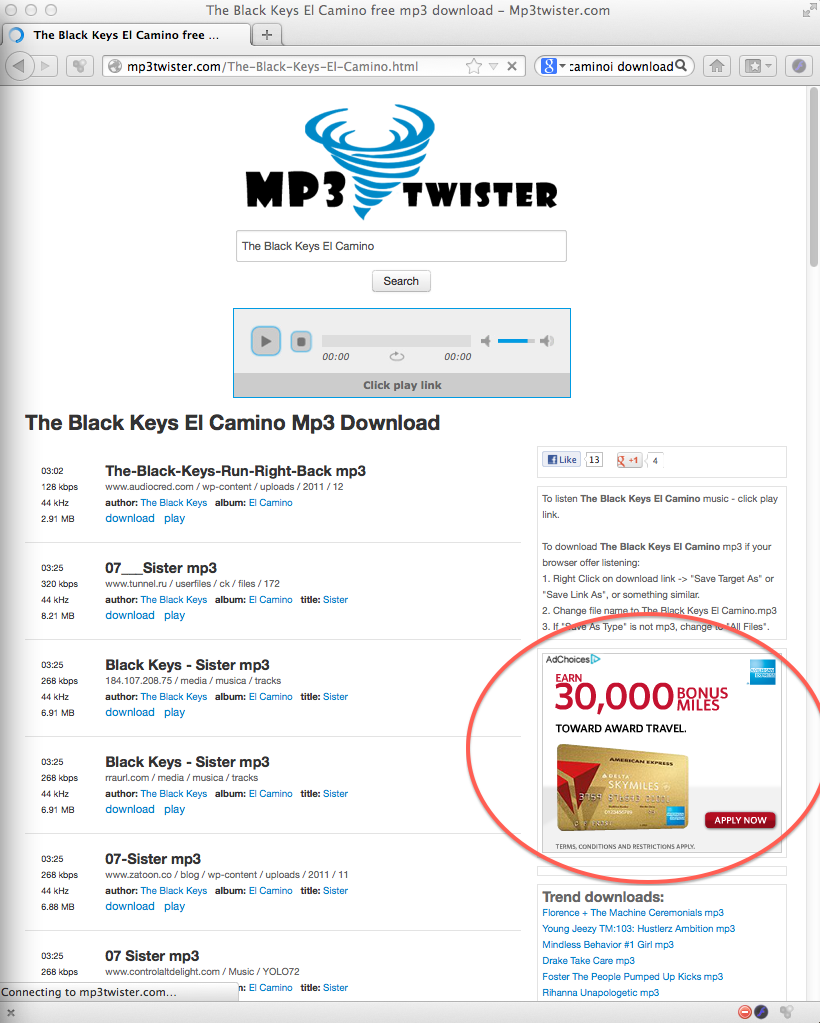
The Black Keys have been very vocal about their opposition to the payment and revenue models of new streaming services like Spotify, but we wonder how the band will feel when seeing their music generating ad revenue for commercial level infringing websites like Filestube, Mp3 Twister, Share Beast and Mp3 Boo all as from a simple Google Search.

We also wonder if any of these brands will be advertising during the Grammy Awards for which the band is nominated for Best Album. These are major brands such as American Express, Delta Airlines, Dish Network, Nissan and M&Ms. All of whom we’ve seen running television advertising campaigns for their products and services.

Here’s a quick look at a random sampling of sites from searching Google. This is despite what might be hundreds or more likely thousands of delisted links from legitimate DMCA notices. Mind Boggling…

American Express Delta Airlines Card on Mp3 Twister
AT&T on Mp3 Twister
Dish Network on Mp3 Twister
M&M’s (Mars) on Share Beast
Nissan on Mp3 Boo
Movie 43 (Relativity Media) on Mp3 Boo
Exposed Webcams on FilesTube

googleblackkeystorrents

Despite the amount of delisted links, presumably to the largest infringers, the pirate bay can still top the search results listed. Also interesting is that the reach of the ad networks seems to go very deep into a long tail of very dispersed infringing sites like Mp3 twister. It appears that as brands and agencies are learning of their ads appearing on infringing and illegal sites, the ads are starting to migrate down stream to perhaps previously less visited sites.

bk_mp3twisterAMEXDELTA

bk_mp3twisterATT

bk_mp3twisterDISH

bk_sharebeastMMS

bk_mp3booNISSAN

bk_mp3booMovie43

What is disturbing about the ad above for Movie 43 on Mp3 Boo is that it is for a film by Relativity Media, a Hollywood film production and distribution company. It’s entirely possible if we looked for this film it may already be leaked and pirated, and if not, most certainly will be within hours on the day it is theatrically released.

bk_filestuneEXPOSEDWEBCAMS

Also of interest in this batch are the porn site ads on FilesTube. Isn’t this some kind of public safety issue that minors under 18 years of age who are visiting these infringing sites to get free music illegally are being exposed to pornographers showing girls who are barely legal themselves at just 18 years old?

Is this really acceptable to our representatives on Capital Hill?

Kim Dotcom’s “End Of Piracy”, that was easy…

In the anticipation of the announcement of the new Mega launch, Pat Pilcher at The New Zealand Herald wrote an article titled “Kim Dotcom on Ending Piracy” in which the journalist listed Mr.Dotcom’s five steps to ending piracy. Pilcher writes,

As ironic as that may sound, Kim Dotcom’s logic is inescapably robust. Here’s what his end to piracy manifesto says:

1. Create great stuff
2. Make it easy to buy
3. Same day worldwide release
4. Fair price
5. Works on any device

Looking at what Kim is saying, the 5 points seem pretty obvious, although each could quickly get bogged down once Hollywood gets involved.

So let’s look at these one by one.

1. Create Great Stuff
Well, that’s a no brainer. The content industries create the most prized and sought after “stuff” in the world including films such as Avatar, The Avengers, and The Dark Night Rises as well as franchises like Iron Man, Transformers, Harry Potter and others. Music artists include the likes of Adele, The Black Keys, Taylor Swift, The Beatles and countless others. Making great stuff has never been a problem.

2. Make It Easy To Buy
Another no brainer. Perhaps a decade plus ago this might have been an argument, but not today. There are over 500 legal and licensed music services alone. For the film industry there are services like Netflix, Vudu and Cinemanow as well as other direct to home video on demand providers that give consumers more access to more content across more platforms than at any time in history.

3. Same Day World Wide Release
For music this is more less the standard now and is also more and more common for feature film releases as well. This is a common practice for the largest and most anticipated releases of music and films, the “stuff” that is the most aggressively pirated. For smaller indie releases this may not always be possible but than again I’m not sure that the problem we are combating is in Nigeria on indie rock albums and movies that are more or less film festival darlings.

4. Fair price
Done. Netflix is $7.99 a month for unlimited access to it’s entire library of films and tv shows. Spotify is $9.99 for unlimited access to it’s entire library which consist of probably 95% of every known recording in print. Add to this the cost of a song download is 99 cents. Less than the cost of a candy bar. Renting a movie from a video on demand service ranges from 3.99 to 5.99. Price is no longer an issue and has not been for years.

5. Works on Any Device
Music is DRM free and has been for at least half a decade. Streaming Services such as Netflix and Spotify are also available on every major platform including not only Mac and PC computers, but also mobile devices such as smart phones and tablets by a variety of manufacturers. Additionally most new video game consoles and blu-ray players also include many of these same apps.

So there you have it, the end of piracy. Even Pat Pilcher at The New Zealand Herald agrees a referring to a similar response from the New Zealand record industry. He writes,

Well there it is, RIANZ’s response in full. I can’t argue with much that they’ve said, as they’ve pretty much complied with most of Kim’s 5 points.

So Kim Dotcom’s five suggestions have been fulfilled and yet, I don’t think we’ll see an end to piracy anytime soon. There is still one thing piracy offers that legal, licensed and legitimate services do not, and that is compensation to the artists, musicians, filmmakers and creators which requires that consumers actually do pay the fair price asked.

It’s all pretty simple and by Kim Dotcom’s own suggestions and admission it’s pretty clear where the problem is from here on out, and it’s not in his five suggestions…

And, of course, let us not forget this classic… Kim Dotcom Parody Video Appears on YouTube

Artists Rights Watch – Sunday Jan 20, 2013

Grab the coffee!

Recent Posts:
* Well this is Embarrassing, a Tunecore Ad on 4Shared…
* Don’t Get IRFA’d: Westergren’s Fake “Tour Support”
* Golden Globe Winner Adele Exploited by American Express, AT&T, British Airways, Target and Nissan

From Around The Web:

COPYRIGHT ALLIANCE:
* The Silver Lining of the SOPA Debate

ADLAND:
* Youtube and Google have money problems

GRAPHIC LEFT OVERS:
* Creatives Stunning Revolt Against Big Bad Business

As best I can determine, none of the creators of these images were asked to participate in a program that paid them peanuts (a one time payment of $12) and gives away their work hundreds of thousands of times. This is a great deal for Google and its users and a complete disaster for the photographers who participate against their will.

“D-Day” (Deactivation Day) is set for February 2nd and a growing number of contributors are pledging to deactivate their portfolios or pull large numbers of images until the one million image mark is met.

MICROSTOCK POSTS:
* Photographers plan to remove images from iStockphoto

THE CURTIS AGENCY:
* More Horror Stories from the Digital Book Bazaar

I have often written that piracy is the biggest threat to the e-book business. (visit Pirate Central). This is a good instance why. – Richard Curtis

DIGITAL MUSIC NEWS:
* Study: A Majority of Americans Would Support Moderate Piracy Enforcement…

MEDIABISTRO:
* How to Stop Piracy: Carnegie Mellon Professor Michael Smith at DBW

“The shutdown of Megaupload caused a statistically significant increase in digital sales,” he said, comparing numbers between countries with high Megaupload usage to countries with low Megaupload usage.

LAS VEGAS REVIEW JOURNAL:
* At adult expo, fans hunt autographs while pros battle piracy

PHILSTAR.COM:
* TFC Japan all-out in its anti-piracy campaign

“We have an office here that provides em- ployment as it serves the community it is in. We are grateful that the new anti-piracy laws in Japan recognize the ‘sensur- round’ value of the busi- ness that we bring and the empowering impact of the content that we deliver to our target audience,” says Olives.

“There are naysayers who said that piracy is an unwinnable war,” narrates Lopez. “But we believed that piracy should be treated like a disease that needs to be eliminated. You always start effective disease preven- tion through mass information. People need to know what the disease is and what it does. And you need partners who share the same faith in the cause. We found one in OMB chairman Ronnie Ricketts.”

SE TIMES.COM:
* Balkans need better intellectual property protection

“Potential investors are not much interested to invest in a country where intellectual rights are not protected,” Blagojevic said, adding that infringement of these rights has caused substantial losses to Serbia’s economy.

Citing International Data Corporation statistics, Blagojevic said the value of pirated software in Serbia in 2011 was estimated at nearly 87 million euros.

“If the piracy rate would be dropped 10 percent, the state budget revenues could increase $20 million [14.9 million euros] and some 10,000 jobs could be opened, primarily in the IT industry,” Blagojevic said.

AD AGE:
* If Pandora Can’t Monetize Mobile, Can Anyone?

MUSIC TECH POLICY:
* What’s all this then? Google’s “Ad Cops” Are Missing the Point
* How the Rate Court Cottage Industry is Leading to the Destruction of Collective Licensing
* Brand Sponsored Piracy and Award Shows: British Airways Delivers the ultimate insult to Adele

TECH CRUNCH:
* Keen On… Incubus: Limousines, Feeling Dirty and Being Kicked In The Balls (TCTV)

HYPEBOT:
* Ted Cohen On Music Tech And The Music Industry [INTERVIEW]

Do you still favor subscription over advertising-based music services?

Yes, I do. I don’t think that the advertising model so far has proved to be sustainable. I think that we have undervalued subscription. I am paying $150 a month for cable. I watch 20 or 30 hours of TV a week. I probably listen to 50 to 60 hours of music a week. I’d argue with you that music is worth more than $10 a month subscription service.

The labels were so concerned about (piracy)—and I was there at the time—that we had to come up with a price that was just a little bit more than free to convince people that they should pay. So far, we have not been able to raise the price. I think that music is worth at least $20 or $25 a month.

THE PRECURSOR:
* The Google Lobby Defines Big Internet’s Policy Agenda

READ WRITE:
* Is Kim Dotcom’s New Site, Mega, The Wild West Of Piracy?

UPDATE FROM THE CES “PRO-ARTIST” PANEL:

CES Panel Moderator and CNET writer Declan McCullagh discloses artists and creators representatives were not actually invited despite CES claiming they were. As we reported, the panel was comprised of anti-artist and anti-copyright publicly acknowledged Google paid shills.

MARIA BUSTILLOS:
* Yes and No (Lessig, Swartz and Society)

Golden Globe Winner Adele Exploited by American Express, AT&T, British Airways, Target and Nissan

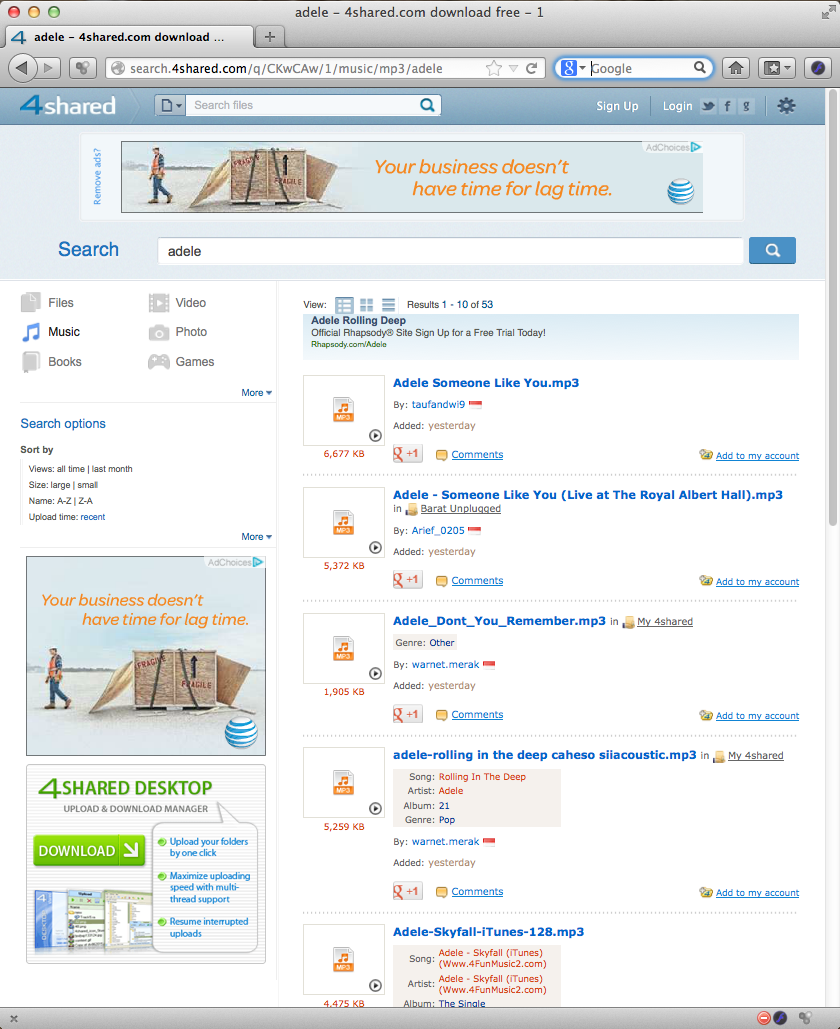
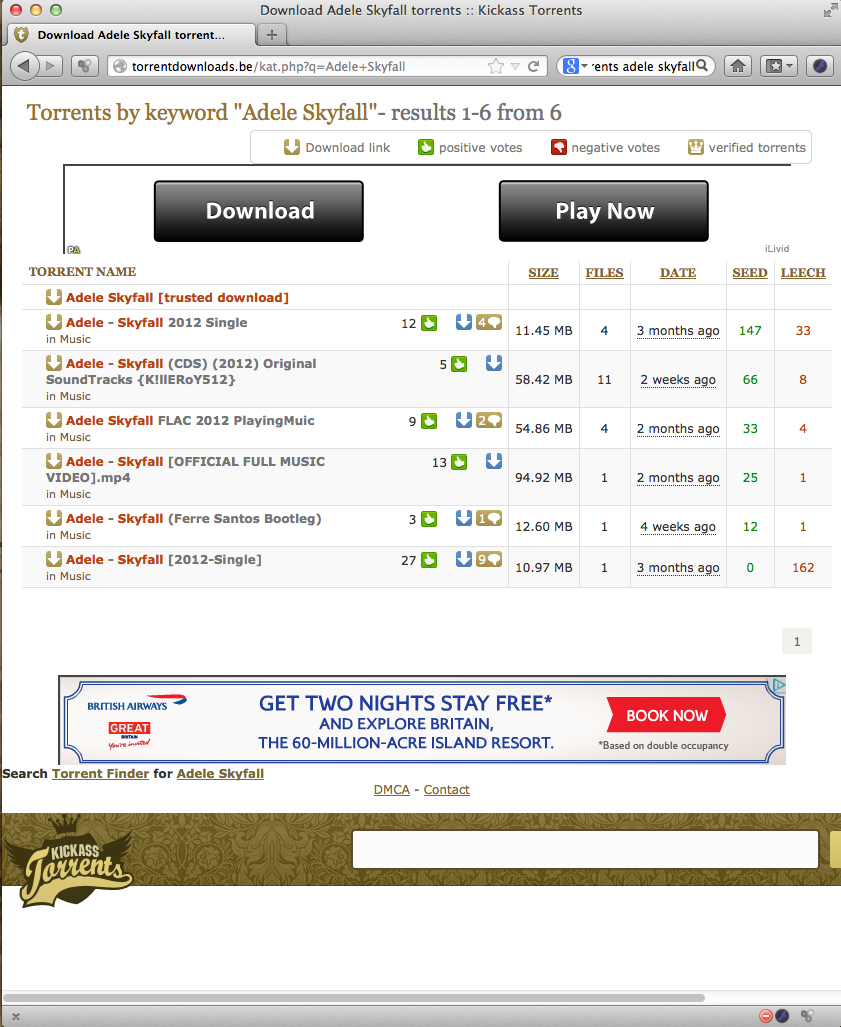
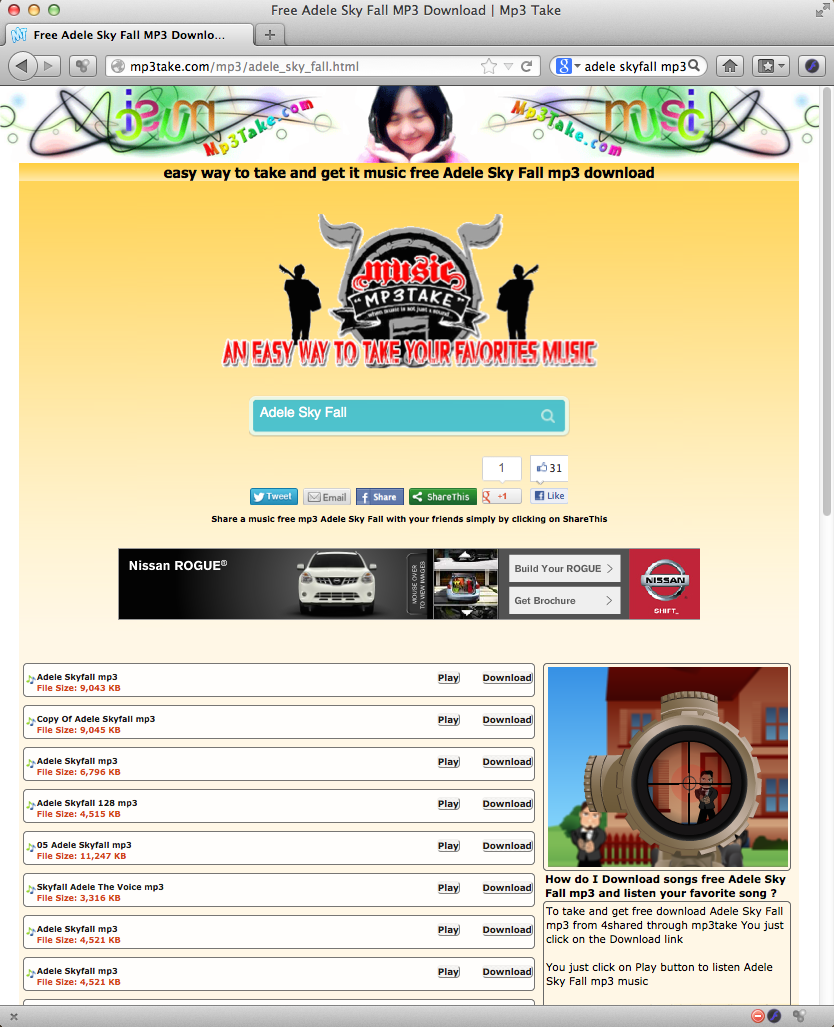
On Sunday January 13th, Adele won the Golden Globe for the Best Song In a Motion Picture for her song “Skyfall” in the latest James Bond film of the same name. So we thought we’d take a look and see which brands are advertising on both the Golden Globes Awards Show and also on the pirate sites giving away the song that had just won the award.

It’s interesting to note who doesn’t show up on pirate sites as well. For example we’ve seen no ads by L’Oreal (as yet) on pirate sites. L’Oreal had a very strong presence running ads during the Golden Globes, as did Target (who unfortunately also shows up frequently on pirate sites).

Here’s what we found in just a few minutes… this is like shooting fish in a barrel. Who will advertise on the Academy Awards and Grammys who is also funding piracy? We wonder…

AdeleTargetMp3Ape

AdeleAT&T4shared

adeleamex4shared

adeleBristishAirmp3crow

AdeleKATbritAir

AdeleNissonmp3take

British Airways is interesting in this batch. Adele is British. James Bond is British. Have to wonder how smart these ad networks are getting in their targeting of consumers based on interests and other relational values.