Below is a letter from Tim Westergren, Founder of Pandora (NASDAQ: P) urging consumers to help him discriminate against musicians by attempting to reduce his royalty obligations.
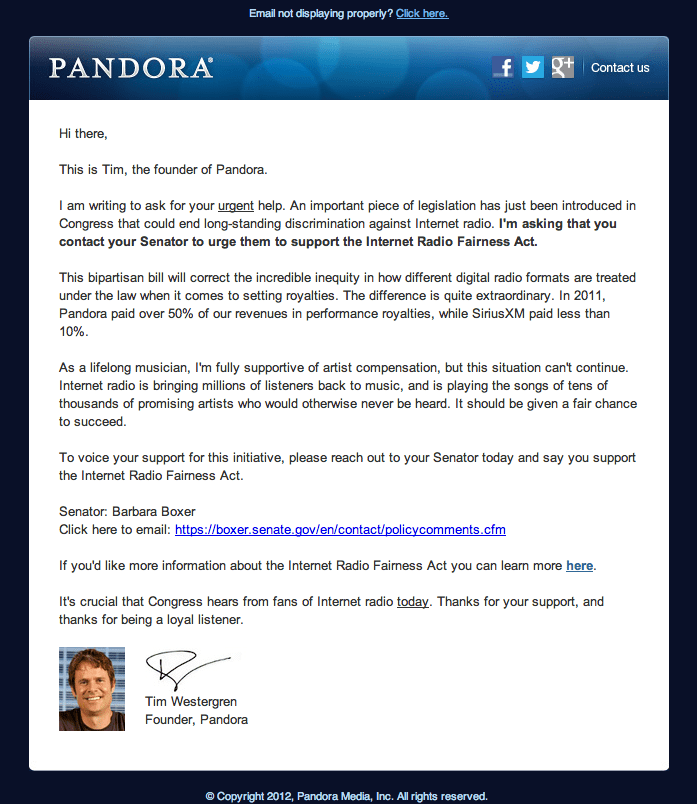
This letter is highly misleading. Pandora is not Radio!! Pandora is a near-on demand streaming service. Having a subscription to Pandora is like virtually owning every album on earth. (This is complex and we try to talk it through on a high level later in this post.) Pandora should and does pay higher royalties than XM radio for that reason! It is completely manipulative of Mr. Westergren to compare his royalties to radio royalties. Shame on him. Shame on him for trying to get his subscribers to manipulate our government into screwing musicians. I am sad to see that Pandora has come to this:
Just another Silicon Valley firm who can’t make their business model work asking for a bailout from the US government and Musicians. -David Lowery
We all love Pandora, we love that it pays on time and is honest in its approach and it provides a great platform for independent music. In fact, we’ve seen some estimates that 30% of Pandora’s spins are independent music.
Here’s what the lawyer for the webcasters said about the statutory webcasting rates at the time of the last settlement (and he never mentions artists, by the way):
In sum, while far from a perfect deal that webcasters would have selected on their own, this deal does provide another option for webcasters with substantial advantages in many area to those that qualify for treatment under this deal. While no doubt the fight will continue over the standards that should be used to determine royalties in future proceedings, so that parties don’t need to enter into these after-the-fact settlements [which is not happening now because the 2009 deal is in place until 2015] when one party has a substantial bargaining advantage with a favorable decision already in hand, SoundExchange [including the artist unions] should be credited for agreeing to reach this deal when there was no compulsion that they do so. This deal presents certainty for many webcasters – eliminating further litigation and negotiation costs while setting rates at which a class of webcasters can go on with their operations.
But what’s happening now ain’t personal, it’s just business. Pandora apparently doesn’t like paying artists a fair royalty–at a rate that Pandora negotiated and was all happy with a few years ago–and now is lobbying in Washington to use their political influence to force artists to take lower rates. Pandora compares itself to Sirius:
Consider this: last year Pandora generated $274MM of gross revenue, and paid $136MM of performance royalties — approximately 50 percent of the total revenue. In the same year, SiriusXM, on revenues of $2.7B paid $205M in royalties, or 7.5 percent. Radio delivered over cable television pays 15 percent of revenue. Radio delivered over the FM/AM spectrum pays nothing to performers.
This is, unfortunately, slight of hand–SiriusXM is primarily a subscription service and Pandora is primarily an ad supported service. Apples and oranges aside from low artist royalties–we have issues with Sirius, too, but that’s another story. The fact that over the air radio pays nothing is not exactly something to be proud of as we will spin out a bit in this post. But here’s the point we think is important: If Pandora wants to compare apples to apples and feels it is unfairly penalized by the rate setting procedure, it ain’t exactly like they weren’t represented in the past or now.
If Pandora would like artist support for some changes that would help them be more profitable going forward without reducing rates to artists, then all they have to do is ask and if what they want really is fair, they’d probably get artist support. But we didn’t hear that ask and we don’t see that proposal. What we see is the typical Big Tech Washington cronyism that artists simply can’t compete with.
You’re going to hear a lot of talk about “fairness” and “stifling innovation” as Pandora spends big lobbying bucks to grease the skids for the Congress to set price controls in its favor. Just remember–Pandora gets those big lobbying bucks from a wildly successful initial public offering of the company’s stock. And the reason Pandora had a wildly successful IPO is because they make a great product that is 100% dependent on your music. No music, no Pandora.
This is why the musicians union president recently called out Pandora founder Tim Westergren about this end run around artists–
Of course, this technological innovation moves much faster than the laws out of Washington, which still treat each radio platform a little differently. That means some radio platforms, like Pandora, compensate artists when they play their recordings, while regular over-the-air “terrestrial” radio stations don’t pay musicians a dime for playing those same recordings.
That’s not fair to musicians that depend on those performance royalties to put bread on the table. And it’s not fair to expect some radio companies to pay while others get a free pass.
It sounds like Pandora never picked up the phone to discuss their beef with either the musicians union or the singers union (now SAG-AFTRA). This was a major oopsie for Pandora founder and Chief Strategy Officer Tim Westergren, an ex-record producer .
Unlike American Federation of Musicians President Ray Hair, Westergren ain’t elected and he only represents Pandora–even though Time Magazine says Tim is one of the 100 most influential people in the world. So it seems that when you have that kind of influence, you don’t need to call a mere elected union president whose members supply your company with its only product, but whose members had their bargaining rights taken away by the compulsory webcasting license. No strikes–just the way they like it in the Valley.
This is important because Pandora now wants to reduce their already low rates royalty rates to even lower rates. This is just like when Sirius and their PR machine wanted you to focus on how bad things were for Sirius Radio a few years ago when Sirius got a 50% off deal on their royalties. Now Sirius and their lobbyists and lawyers want you to ignore that Sirius suddenly has an extra $1,000,000,000 in cash–that’s right, a BILLION IN CASH. When the bad times came, the artists gave Sirius a deal. Sirius has no intention of returning the favor in the good times. We applaud their success, but where is the love?
The joke is that things are so bad for Pandora, they just went public. So don’t expect any love from Pandora, either.
Because just like Sirius, Pandora doesn’t answer to the artists for their 100% dependence on music.
Pandora answers to Wall Street, which is to be expected for a public company.
So we say to Tim Westergren, we love you, man, but face facts–you are The Man 2.0. Don’t fool yourself into thinking that Time Magazine knows anything about the music business. It’s really OK, we get you, we’re used to dealing with The Old Boss and The New Boss.
You made your choice, so just be honest about who you are when you are moving the goal posts.
Pandora’s Backstory
You’ve probably heard how difficult it is for “innovators” to license music because the major labels ask for big up front payments. This can be confusing because different types of music services qualify for different types of licenses. Here’s where Pandora, Sirius and lots of other Internet radio and satellite music services get a real advantage over other types of competing digital music services. (Digital radio licensing is a complex area, so we’re going to give you the high points and stay out the weeds.)
Back in 1995, the U.S. Congress effectively took away the artist’s and record company’s right to negotiate private deals with Internet radio when Congress established the limited public performance right for sound recordings. Due to a quirk of US law, recording artists were never paid for radio play unlike songwriters. The US Congress partly changed that in 1995.
So quick—how many of you thought all these years that the artists got paid when a song was played on over the air radio? (Call it “broadcast radio” to distinguish it from Internet and satellite radio, call those “digital radio”.)
Well, you’d all be wrong. Except for digital radio. (The most important difference between a Spotify-type service and Pandora is that Spotify allows you to choose which tracks you want to listen to (“on demand” or “interactive” and less like broadcast radio) and Pandora and Sirius “choose” them for you–“non-interactive” and more like broadcast radio. There’s also a bunch of other government mandated restrictions called the “sound recording performance compliment”–too much to go into here. Although we would argue that Pandora’s music genome allows it to be “near-on demand” but that’s another story.)
The compulsory license for digital radio does not cover broadcast radio or on-demand services. So far, artists have not been able to move that needle to include broadcast, although we’ve tried. Hard. Going up against the broadcast radio lobby is like going up against Google—limitless lobbying budgets, tremendous political influence, control over a significant portion of the dissemination of news. There is, after all, a radio station in every Congressional district. And most of all, an unbridled willingness to crush anyone who gets in their way. Like artists, for example.
This is a good time to mention a key fact—almost every other country in the world requires broadcasters to pay artists for performances on both broadcast and digital radio. (“Almost” because North Korea and China don’t.) So it is American broadcasters who get out of paying the artists, including American artists. This is why the broadcasters (including digital radio like Pandora) don’t like the Internet radio rates.
Even so, the digital radio royalty and statutory license have actually worked, which is more than you can say for the DMCA. What that means is that no one can refuse to license for digital radio and the royalty rates are set by the government. More on that later.
These SoundExchange royalties are split 50/50 between the sound recording owners on one hand and the featured artists, session vocalists and session musicians on the other. And—if the royalties are paid through SoundExchange (the non-profit that collects and administers the compulsory license), the artist money is paid directly to the artists on a nonrecoupment basis, meaning that the artists keep 100% of their digital radio royalty regardless of whether they are recouped under their record deals, current or historical. (Remember, SoundExchange receives royalties at many different rates, takes out some administration fees and then splits the money 50/50. This is too complicated to go into here, but take a look at the SoundExchange website for more information.)
Spotify, for example, had to license recordings and songs piecemeal because Spotify’s on-demand service doesn’t qualify for the digital radio royalty. That’s why it took so long for them to launch in the US. (Although Spotify launched a side-by-side statutory digital radio service at the end of 2011 as a companion to their on-demand service.)
Pandora has leveraged this government-mandated compulsory license to get its business going. Unlike Spotify, all Pandora had to do to get its content licensed was send a notice to the Copyright Office and to SoundExchange, get blanket licenses for the songs and they were in business. No piecemeal negotiations with anybody, no advances to anybody, just send the notice, build their technology and get going. Artists get paid, labels get paid, innovators can form companies without paying any advances.
Of course, Pandora lead the charge in 2009 against the digital radio royalty rates. But they paid up when they got the deal they wanted. Or the deal that they wanted long enough for the company to bring to market an initial public offering of its stock.
Now they want a different deal.
And as the Bard sayeth, therein lies the rub.
This Time, It’s About Money. Period.
Remember—Pandora has great technology, superior technology even. Pandora is a highly innovative and music driven company. We love Pandora. But because it is music driven it has one product—music.
Pandora last negotiated licensing rates for the music they profit from in 2009. That was a long and painful process. We heard sanctimony from Pandora’s Tim Westergren at every turn about how Pandora was going to go out of business if they couldn’t get cheap licensing rates on music.
A lot of people said privately that they’d like to know where it was written that Pandora was guaranteed the right to stay in business when musicians weren’t. But Pandora looked like a promising investment, so artists invested in the company the way artists usually invest—do the same work for less money. Pandora got a special deal on royalties and they stayed in business.
That 2009 deal comes to an end in 2015 and new rates are now being litigated. (The current “pureplay” webcaster rate for nonsubscription services that we understand Pandora qualifies for is a formula, the greater of 25% of US gross revenues or a per-play rate of $0.00110 ($0.0020 for subscription/bundled services like Pandora), going to $0.00120 in 2013, $0.00130 in 2014 and $0.00140 in 2015. (Subscription/bundled services are a little higher per play rates.) Maybe–things are so good that Pandora may be about to shift into the 25% of gross revenues part of the formula and that’s the beef?)
Now Pandora are back again with the same song—they want to pay even less. So what happened? They must be having a really hard time like last time, right? Scraping by?
No, actually what happened between 2009 and now was that the company “went public” in 2011 with a billion dollar-plus valuation, the dream of every Silicon Valley entrepreneur. The founders and their VCs cashed out. We’re happy for them and glad to see a stand-alone digital music service trading on the New York Stock Exchange.
Westergren is apparently not as rich as Daniel Ek (the 10th richest man in the music business), but surely he got a nice payday when Pandora went public (which we think he totally deserved for years and years of hard work, by the way). Pandora has a market cap roughly that of a major label. But now that it’s public, Pandora has to make its revenue numbers to keep Wall Street happy. So there’s a couple different ways they can do that.
One way is to throw all their resources at growing their revenues. That’s what most people will do.
The other way is to decrease their costs. Like their royalty costs, for example. It is simple math: Every dollar that Pandora pays in royalties is a dollar less for Wall Street. The fastest way for Pandora to increase its profits—and theoretically its stock price–is to pay lower royalties to artists.
And when you look around the Pandora board meeting, there’s a face at the table to oppose cutting every cost item–except one.
This will be familiar to artists—it’s the same fight that artists are having with Spotify. And just like Spotify, we don’t see Pandora coming to the artists and offering to pay a bonus to everyone who gave them a deal on royalties so that Pandora could be successful and go public.
For years we’ve heard from Westergren about how artists should aspire to be middle class, to make a good middle class living, don’t expect too much, be happy with what you have. Lowering expectations.
Meet the new boss.
Pandora’s Box
Now we know why. The other shoe is dropping now, and Pandora’s true agenda is becoming obvious. Rather than devote themselves to growing their revenues to satisfy Wall Street, instead they want to spend their resources on lobbying the government to force artists to accept lower rates knowing that the artists on whom they depend cannot compete with lobbying dollars of their own.
The Greek name “Pandora” translates into she who received gifts from all. And boy does that ever fit this company.
Here’s the deal—Pandora gets the gift of certainty in licensing, certainty in rates and low startup licensing costs. This gift allows them to devote their resources to innovating delivery and discovery of music which they have done masterfully.
What do they give back for this gift? We don’t get equity in their company, so when they went public, we got nothing while they joined the Valley elite. (Just like artists won’t get anything when Spotify goes public.)
And now Pandora wants even more gifts. And they want to use their public company political clout to force artists to accept less so Pandora’s shareholders can get more.
And yes, it is a zero sum game and yes it is that simple. Pandora keeps Wall Street happy while they get rich from our gifts and now they take their riches to lobby the Congress to pay them even more of our money.
So at the end of the day there is very likely going to be another Big Tech driven SOPA-style hissy fit over digital radio rates. And remember, it was Pandora that originated the hissy-fit technique that Google perfected with SOPA so expect that threat just any day now from one of the Most Influential People in the Known Universe.
But this time—don’t let them fool you into thinking that somehow they are doing this to protect the “middle class artist” or “innovation”.
Because they are not.
This time it’s just about money and we won’t get fooled again.
____________
Updated 9/22/12 to include clarification on “near on-demand”, SoundExchange splits, Pureplay rates and Oxenford quote.

 The Trichordist
You must be logged in to post a comment.