Don’t forget tomorrow—Artist Rights Roundtable on AI and Copyright at American University in Washington DC

Artist Rights Roundtable on AI and Copyright: 
Coffee with Humans and the Machines     

Join the Artist Rights Institute (ARI) and American University’s Kogod’s Entertainment Business Program for a timely morning roundtable on AI and copyright from the artist’s perspective. We’ll explore how emerging artificial intelligence technologies challenge authorship, licensing, and the creative economy — and what courts, lawmakers, and creators are doing in response.

This roundtable is particularly timely because both the Bartz and Kadrey rulings expose gaps in author consent, provenance, and fair licensing, underscoring an urgent need for policy, identifiers, and enforceable frameworks to protect creators.

 🗓️ Date: September 18, 2025
🕗 Time: 8:00 a.m. – 12:00 noon
📍 Location: Butler Board Room, Bender Arena, American University, 4400 Massachusetts Ave NW, Washington D.C. 20016

🎟️ Admission: Free and open to the public. Registration required at Eventbrite. Seating is limited.

🅿️ Parking map is available here. Pay-As-You-Go parking is available in hourly or daily increments ($2/hour, or $16/day) using the pay stations in the elevator lobbies of Katzen Arts Center, East Campus Surface Lot, the Spring Valley Building, Washington College of Law, and the School of International Service

Hosted by the Artist Rights Institute & American University’s Kogod School of Business, Entertainment Business Program

🔹 Overview:

☕ Coffee served starting at 8:00 a.m.
🧠 Program begins at 8:50 a.m.
🕛 Concludes by 12:00 noon — you’ll be free to have lunch with your clone.

🗂️ Program:

8:00–8:50 a.m. – Registration and Coffee

8:50–9:00 a.m. – Introductory Remarks by KOGOD Dean David Marchick and ARI Director Chris Castle

9:00–10:00 a.m. – Topic 1: AI Provenance Is the Cornerstone of Legitimate AI Licensing:

Speakers:

  • Dr. Moiya McTier, Senior Advisor, Human Artistry Campaign
  • Ryan Lehnning, Assistant General Counsel, International at SoundExchange
  • The Chatbot

Moderator: Chris Castle, Artist Rights Institute

10:10–10:30 a.m. – Briefing: Current AI Litigation

  • Speaker: Kevin Madigan, Senior Vice President, Policy and Government Affairs, Copyright Alliance

10:30–11:30 a.m. – Topic 2: Ask the AI: Can Integrity and Innovation Survive Without Artist Consent?

Speakers:

  • Erin McAnally, Executive Director, Songwriters of North America
  • Jen Jacobsen, Executive Director, Artist Rights Alliance
  • Josh Hurvitz, Partner, NVG and Head of Advocacy for A2IM
  • Kevin Amer, Chief Legal Officer, The Authors Guild

Moderator: Linda Bloss-Baum, Director, Business and Entertainment Program, KOGOD School of Business

11:40–12:00 p.m. – Briefing: US and International AI Legislation

  • Speaker: George York, SVP, International Policy Recording Industry Association of America

🎟️ Admission:

Free and open to the public. Registration required at Eventbrite. Seating is limited.

🔗 Stay Updated:

Watch this space and visit Eventbrite for updates and speaker announcements.
Senator Cruz Joins the States on AI Safe Harbor Collapse— And the Moratorium Quietly Slinks Away

Silicon Valley Loses Bigly

In a symbolic vote that spoke volumes, the U.S. Senate decisively voted 99–1 to strike the toxic AI safe harbor moratorium from the vote-a-rama for the One Big Beautiful Bill Act (HR 1) according to the AP. Senator Ted Cruz, who had previously actively supported the measure, actually joined the bipartisan chorus in stripping it — an acknowledgment that the proposal had become politically radioactive.

To recap, the AI moratorium would have barred states from regulating artificial intelligence for up to 10 years, tying access to broadband and infrastructure funds to compliance. It triggered an immediate backlash: Republican governors, state attorneys general, parents’ groups, civil liberties organizations, and even independent artists condemned it as a blatant handout to Big Tech with yet another rent-seeking safe harbor.

Marsha Blackburn and Maria Cantwell to the Rescue

Credit where it’s due: Senator Marsha Blackburn (R–TN) was the linchpin in the Senate, working across the aisle with Sen. Maria Cantwell to introduce the amendment that finally killed the provision. Blackburn’s credibility with conservative and tech-wary voters gave other Republicans room to move — and once the tide turned, it became a rout. Her leadership was key to sending the signal to her Republican colleagues–including Senator Cruz–that this wasn’t a hill to die on.

Top Cover from President Trump?

But stripping the moratorium wasn’t just a Senate rebellion. This kind of reversal in must-pass, triple whip legislation doesn’t happen without top cover from the White House, and in all likelihood, Donald Trump himself. The provision was never a “last stand” issue in the art of the deal. Trump can plausibly say he gave industry players like Masayoshi Son, Meta, and Google a shot, but the resistance from the states made it politically untenable. It was frankly a poorly handled provision from the start, and there’s little evidence Trump was ever personally invested in it. He certainly didn’t make any public statements about it at all, which is why I always felt it was such an improbable deal point that it was always intended as a bargaining chip whether the staff knew it or not.

One thing is for damn sure–it ain’t coming back in the House which is another way you know you can stick a fork in it despite the churlish shillery types who are sulking off the pitch.

One final note on the process: it’s unfortunate that the Senate Parliamentarian made such a questionable call when she let the AI moratorium survive the Byrd Bath, despite it being so obviously not germane to reconciliation. The provision never should have made it this far in the first place — but oh well. Fortunately, the Senate stepped in and did what the process should have done from the outset.

Now what?

It ain’t over til it’s over. The battle with Silicon Valley may be over on this issue today, but that’s not to say the war is over. The AI moratorium may reappear, reshaped and rebranded, in future bills. But its defeat in the Senate is important. It proves that state-level resistance can still shape federal tech policy, even when it’s buried in omnibus legislation and wrapped in national security rhetoric.

Cruz’s shift wasn’t a betrayal of party leadership — it was a recognition that even in Washington, federalism still matters. And this time, the states — and our champion Marsha — held the line. 

Brava, madam. Well played.

This post first appeared on MusicTechPolicy

@human_artistry Campaign Letter Opposing AI Safe Harbor Moratorium in Big Beautiful Bill HR 1

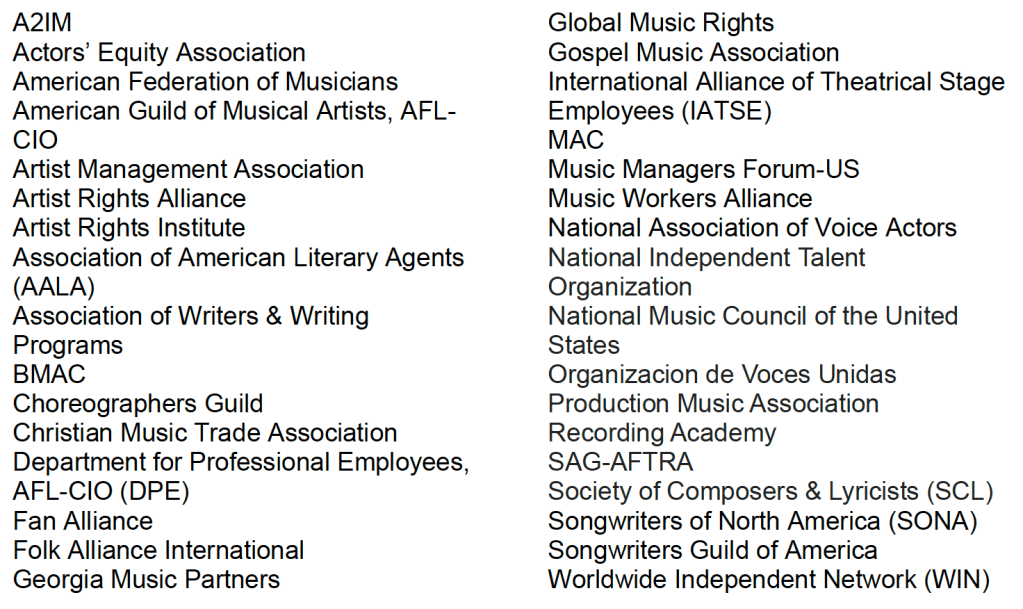
Artist Rights Institute is pleased to support the Human Artistry Campaign’s letter to Senators Thune and Schumer opposing the AI safe harbor in the One Big Beautiful Bill Act. ARI joins with:

Opposition is rooted in the most justifiable reasons:

By wiping dozens of state laws off the books, the bill would undermine public safety, creators’ rights, and the ability of local communities to protect themselves from a fast-moving technology that is being rushed to the market by tech giants. State laws protecting people from invasive AI deepfakes would be at risk, along with a range of proposals designed to eliminate discrimination and bias in AI. For artists and creators, preempting state laws requiring Big tech to disclose the material they used to train their models, often to create new products that compete with the human creators’ originals, would make it difficult or impossible to prove this theft has occurred. As the Copyright Office’s Fair Use Report recently reaffirmed, many forms of this conduct are illegal under longstanding federal law. 

The moratorium is so vague that it is unclear whether it would actually prohibit states from addressing construction of data centers or the vast drain on the power grid to implement AI placement in states. This is a safe harbor on steroids and terrible for all creators.

Martina McBride’s Plea for Artist Protection from AI Met with a Congressional Sleight of Hand

This week, country music icon Martina McBride poured her heart out before the Senate Judiciary Subcommittee on Privacy, Technology, and the Law. Her testimony in support of the bipartisan NO FAKES Act was raw, earnest, and courageous. Speaking as an artist, a mother, and a citizen, she described the emotional weight of having her voice—one that has offered solace and strength to survivors of domestic violence—exploited by AI systems to peddle messages she would never endorse. Her words echoed through the chamber with moral clarity: “Give me the tools to stop that kind of betrayal.”

The NO FAKES Act aims to create a federal property right over an individual’s name, image, and likeness (NIL), offering victims of AI-generated deepfakes a meaningful path to justice. The bill has drawn bipartisan support and commendation from artists’ rights advocates, child protection organizations, and even some technology companies. It represents a sincere attempt to preserve human dignity in the age of machine mimicry.

And yet, while McBride testified in defense of authenticity and integrity, Congress was quietly advancing legislation that was the opposite.

At the same time her testimony was being heard, lawmakers were moving forward with a massive federal budget package ironically called the “Big Beautiful Bill” that includes an AI safe harbor moratorium—a sweeping provision that would strip states of their ability to enforce NIL protections against AI through existing state laws. The so-called “AI Safe Harbor” effectively immunizes AI developers from accountability under most current state-level right-of-publicity and privacy laws, not to mention wire fraud, wrongful death and RICO. It does so in the name of “innovation,” but at the cost of silencing local democratic safeguards and creators of all categories.

Worse yet, the economic scoring of the “Big Beautiful Bill” is based on economic assumptions that rely on productivity gains from AI ripping off all creators from grandma’s baby pictures to rock stars.

The irony is devastating. Martina McBride’s call for justice was sincere and impassioned. But the AI moratorium hanging over the very same legislative session would make it harder—perhaps impossible—for states like Florida, Tennessee, Texas, or California to shield their citizens from the very abuses McBride described. The same Congress that applauded her courage is in the process of handing Silicon Valley a blank check to continue the vulpine lust of its voracious scraping and synthetic exploitation of human expression.

This is not just hypocrisy; it’s the personification of Washington’s two-faced AI policy. On one hand, ceremonial hearings and soaring rhetoric. On the other, buried provisions that serve the interests of the most powerful AI platforms in the world. Oh, and the AI platforms also wrote themselves into the pork fest for $500,000,000 of taxpayers money (more likely debt) for “AI modernization” whatever that is. At a time that the bond market is about to dump all over the U.S. economy. Just another day in the Imperial City.

Let’s be honest: the AI safe harbor moratorium isn’t about protecting innovation. It’s about protecting industrialized theft. It codifies a grotesque and morbid fascination with digital kleptomania—a fetish for the unearned, the repackaged, the replicated.

In that sense, the AI Safe Harbor doesn’t just threaten artists. It perfectly embodies the twisted ethos of modern Silicon Valley, a worldview most grotesquely illustrated by the image of a drooling Sam Altman—the would-be godfather of generative AI—salivating over the limitless data he believes he has a divine right to mine.

Martina McBride called for justice. Congress listened politely. And then gave her to the wolves.

They have a chance to make it right—starting with stripping the radical and extreme safe harbor from the “Big Beautiful Bill.”

[This post first appeared on MusicTechPolicy]

Massive State Opposition to AI Regulation Safe Harbor Moratorium in the ‘One Big Beautiful Bill Act’ (H. Con. Res. 14)

As of this morning, the loathsome AI Safe Harbor is still in the ‘One Big Beautiful Bill Act’ (H. Con. Res. 14) as far as we can tell. There is supposed to be a “manager’s amendment” released this morning yet which will include any changes that were made in last night’s late night session. Watch this space at House Rules for when that managers amendment is released. You will be looking for Section 43201 around page 292. As far as we can tell, the safe harbor is still in there, which is not surprising as it is coming from David Sacks the Silicon Valley Viceroy and White House Crypto Czar.

But the safe harbor—a 10-year moratorium on state and local regulation of artificial intelligence (AI)—has ignited significant opposition from a broad coalition of state officials, lawmakers, and organizations. As you would expect, opponents argue that this measure would undermine existing protections and hinder the ability of states to address AI-related harms. Despite the fact that it was snuck through in the middle of the night, opposition is increasing all the time, but we cannot relent for a moment as Silicon Valley is at it again and wants to hang an AI safe harbor in the lobbyists hunting lodge, right next to the DMCA, Section 230 and Title I of the Music Modernization Act.

State-Level Opposition

A bipartisan group of 40 state attorneys general have voiced strong opposition through NAAG to the AI regulation moratorium. In a letter to Congress, they emphasized that the moratorium would disrupt hundreds of measures being both considered by state legislatures and those that have already passed in states led by Republicans and Democrats. They argue that, in the absence of comprehensive federal AI legislation, states have been at the forefront of protecting consumers.

Organizational Opposition

Beyond state officials, a coalition of 141 organizations—including unions, advocacy groups, non-profits, and academic institutions—have expressed alarm over the proposed safe harbor moratorium. In a letter to Congressional leaders, they warned that the provision could lead to unfettered abuse of AI technologies, undermining critical safeguards such as civil rights protections, privacy standards, and accountability for harmful AI applications.

Notable organizations opposing the moratorium include:

  • Alphabet Workers Union
  • Amazon Employees for Climate Justice
  • Mozilla
  • American Federation of Teachers
  • Center for Democracy and Technology 

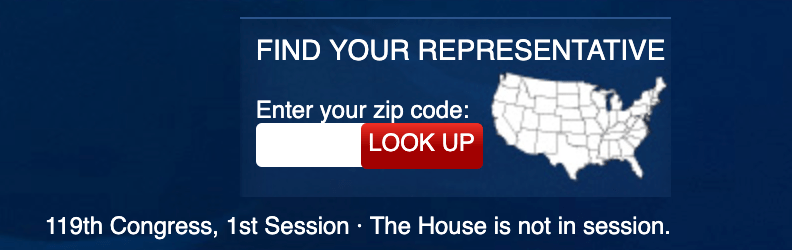
We don’t ask you pick up the phone and call your Congress representative very often, but this is one of those times. If you’re not sure who your representatives are, you can go to the House of Representatives website here and look at the upper right hand corner for this box:

You can also go to the 5calls webpage opposing the safe harbor moratorium which is here. They have developed some collateral and talking points for you to draw on if you like.

This is a big damn deal. Let’s get it done. We’ve all done it before, let’s do it again.

@Artist Rights Institute Newsletter 3/24/25

The Artist Rights Institute’s news digest Newsletter

New Survey for Songwriters: We are surveying songwriters about whether they want to form a certified union. Please fill out our short Survey Monkey confidential survey here! Thanks!

Songwriters and Union Organizing

RICO and Criminal Copyright Infringement

AI Piracy

@alexreisner: Search LibGen, the Pirated-Books Database That Meta Used to Train AI (Alex Reisner/The Atlantic)

OpenAI and Google’s Dark New Campaign to Dismantle Artists’ Protections (Brian Merchant/Blood in the Machine)

Alden newspapers slam OpenAI, Google’s AI proposals (Sara Fischer/Axios)

AI Litigation

French Publishers and Authors Sue Meta over Copyright Works Used in AI Training (Kelvin Chan/AP)

DC Circuit Affirms Human Authorship Required for Copyright (David Newhoff/The Illusion of More)

OpenAI Asks White House for Relief From State AI Rules (Jackie Davalos/Bloomberg)

Microsoft faces FTC antitrust probe over AI and licensing practices (Prasanth Aby Thomas/Computer World)

Google and its Confederate AI Platforms Want Retroactive Absolution for AI Training Wrapped in the American Flag(Chris Castle/MusicTechPolicy)

AI and Human Rights

Human Rights and AI Opt Out (Chris Castle/MusicTechPolicy)

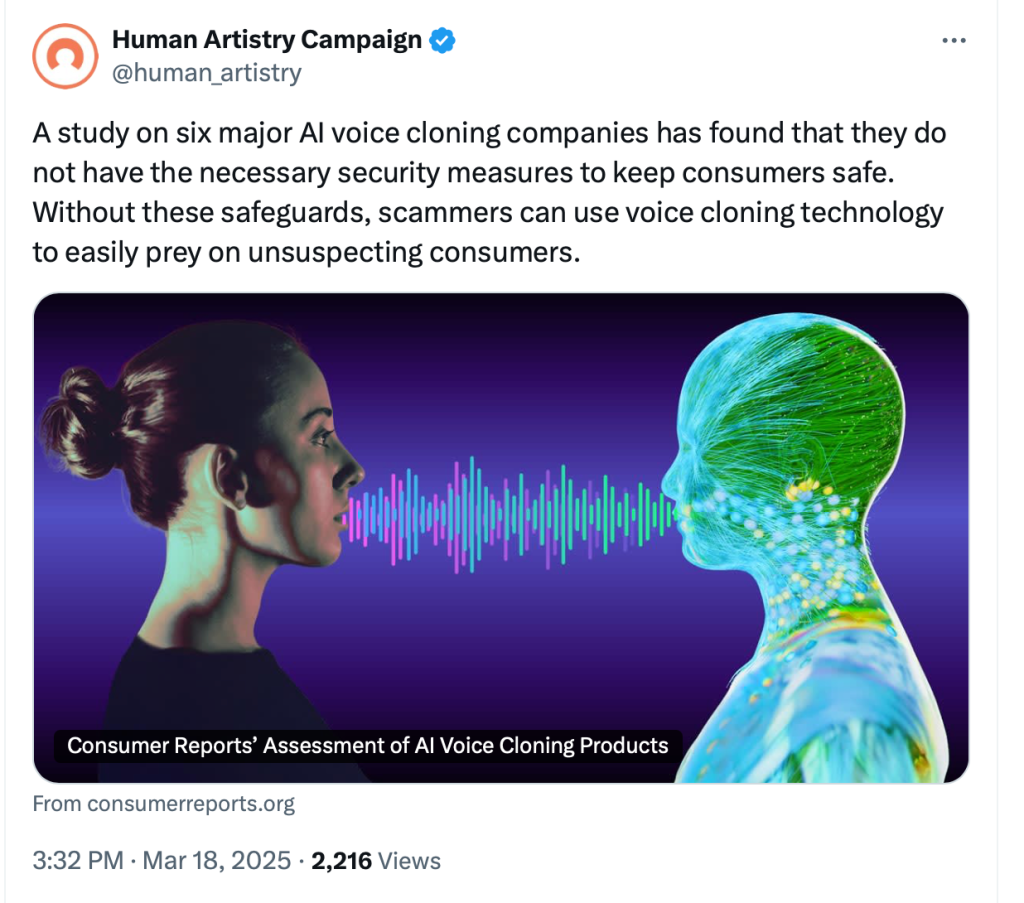
@human_artistry Calls Out AI Voice Cloning

Here’s just one reason why we can’t trust Big Tech for opt out (or really any other security that stops them from doing what they want to do)

@ArtistRights Institute Newsletter 3/17/25

This image has an empty alt attribute; its file name is ari-basic-logo-3.jpg

The Artist Rights Institute’s news digest Newsletter

Take our new confidential survey for publishers and songwriters!

UK AI Opt-Out Legislation

UK Music Chief Calls on Ministers to Drop Opposition Against Measures to Stop AI Firms Stealing Music

Human Rights and AI Opt Out (Chris Castle/MusicTechPolicy) 

Ticketing

New Oregon bill would ban speculative ticketing, eliminate hidden ticket sale fees, crack down on deceptive resellers (Diane Lugo/Salem Statesman Journal-USA Today)

AI Litigation/Legislation

French Publishers and Authors Sue Meta over Copyright Works Used in AI Training (Kelvin Chan/AP);

AI Layoffs

‘AI Will Be Writing 90% of Code in 3-6 Months,’ Says Anthropic’s Dario Amodei (Ankush Das/Analytics India)

Amazon to Target Managers in 2025’s Bold Layoffs Purge (Anna Verasai/The HR Digest)

AI Litigation: Kadrey v. Meta

Authors Defeat Meta’s Motion to Dismiss AI Case on Meta Removing Watermarks to Promote Infringement

Judge Allows Authors AI Copyright Infringement Lawsuit Against Meta to Move Forward (Anthony Ha/Techcrunch)

America’s AI Action Plan Request for Information

Google and Its Confederate AI Platforms Want Retroactive Absolution for AI Training Wrapped in the American Flag (Chris Castle/MusicTechPolicy)

Google Calls for Weakened Copyright and Export Rules in AI Policy Proposal (Kyle Wiggers/TechCrunch) 

Artist Rights Institute Submission

Faux “Data Mining” is the Key that Picks the Lock of Human Expression

The Artist Rights Institute filed a comment in the UK Intellectual Property Office’s consultation on Copyright and AI that we drafted. The Trichordist will be posting excerpts from that comment from time to time.

Confounding culture with data to confuse both the public and lawmakers requires a vulpine lust that we haven’t seen since the breathless Dot Bomb assault on both copyright and the public financial markets. 

We strongly disagree that all the world’s culture can be squeezed through the keyhole of “data” to be “mined” as a matter of legal definitions.  In fact, a recent study by leading European scholars have found that data mining exceptions were never intended to excuse copyright infringement:

Generative AI is transforming creative fields by rapidly producing texts, images, music, and videos. These AI creations often seem as impressive as human-made works but require extensive training on vast amounts of data, much of which are copyright protected. This dependency on copyrighted material has sparked legal debates, as AI training involves “copying” and “reproducing” these works, actions that could potentially infringe on copyrights. In defense, AI proponents in the United States invoke “fair use” under Section 107 of the [US] Copyright Act [a losing argument in the one reported case on point[1]], while in Europe, they cite Article 4(1) of the 2019 DSM Directive, which allows certain uses of copyrighted works for “text and data mining.”

This study challenges the prevailing European legal stance, presenting several arguments:

1. The exception for text and data mining should not apply to generative AI training because the technologies differ fundamentally – one processes semantic information only, while the other also extracts syntactic information

2. There is no suitable copyright exception or limitation to justify the massive infringements occurring during the training of generative AI. This concerns the copying of protected works during data collection, the full or partial replication inside the AI model, and the reproduction of works from the training data initiated by the end-users of AI systems like ChatGPT….[2] 

Moreover, the existing text and data mining exception in European law was never intended to address AI scraping and training:

Axel Voss, a German centre-right member of the European parliament, who played a key role in writing the EU’s 2019 copyright directive, said that law was not conceived to deal with generative AI models: systems that can generate text, images or music with a simple text prompt.[3]

Confounding culture with data to confuse both the public and lawmakers requires a vulpine lust that we haven’t seen since the breathless Dot Bomb assault on both copyright and the public financial markets.  This lust for data, control and money will drive lobbyists and Big Tech’s amen corner to seek copyright exceptions under the banner of “innovation.”  Any country that appeases AI platforms in the hope of cashing in on tech at the expense of culture will be appeasing their way towards an inevitable race to the bottom.  More countries can be predictably expected to offer ever more accommodating terms in the face of Silicon Valley’s army of lobbyists who mean to engage in a lightning strike across the world.  The fight for the survival of culture is on.  The fight for survival of humanity may literally be the next one up.  

We are far beyond any reasonable definition of “text and data mining.”  What we can expect is for Big Tech to seek to distract both creators and lawmakers with inapt legal diversions such as trying to pretend that snarfing down all with world’s creations is mere “text and data mining”.  The ensuing delay will allow AI platforms to enlarge their training databases, raise more money, and further the AI narrative as they profit from the delay and capital formation.


[1] Thomson-Reuters Enterprise Centre GMBH v. Ross Intelligence, Inc., (Case No. 1:20-cv-00613 U.S.D.C. Del. Feb. 11, 2025) (Memorandum Opinion, Doc. 770 rejecting fair use asserted by defendant AI platform) available at https://storage.courtlistener.com/recap/gov.uscourts.ded.72109/gov.uscourts.ded.72109.770.0.pdf (“[The AI platform]’s use is not transformative because it does not have a ‘further purpose or different character’ from [the copyright owner]’s [citations omitted]…I consider the “likely effect [of the AI platform’s copying]”….The original market is obvious: legal-research platforms. And at least one potential derivative market is also obvious: data to train legal AIs…..Copyrights encourage people to develop things that help society, like [the copyright owner’s] good legal-research tools. Their builders earn the right to be paid accordingly.” Id. at 19-23).  See also Kevin Madigan, First of Its Kind Decision Finds AI Training Is Not Fair Use, Copyright Alliance (Feb. 12, 2025) available at https://copyrightalliance.org/ai-training-not-fair-use/ (discussion of AI platform’s landmark loss on fair use defense).

[2] Professor Tim W. Dornis and Professor Sebastian Stober, Copyright Law and Generative AI Training – Technological and Legal Foundations, Recht und Digitalisierung/Digitization and the Law (Dec. 20, 2024)(Abstract) available at https://papers.ssrn.com/sol3/papers.cfm?abstract_id=4946214

[3] Jennifer Rankin, EU accused of leaving ‘devastating’ copyright loophole in AI Act, The Guardian (Feb. 19, 2025) available at https://www.theguardian.com/technology/2025/feb/19/eu-accused-of-leaving-devastating-copyright-loophole-in-ai-act

@Abbie_Llewelyn: UK Government defeated in House of Lords over protecting copyright from AI data scraping

Good news on the AI fight posted by the @artistrights Institute’s ArtistRightsWatch.com]

The Government has been defeated in the Lords over measures to protect creatives from having their copyrighted work used to train AI models without permission or remuneration. [The House of Lords is the “upper chamber” of the UK Parliament, similar to the US Senate.]

Peers [Members of the House of Lords] voted 145 to 126, majority 19, in favour of a package of amendments to the Data (Use and Access) Bill aiming to tackle the unauthorised use of intellectual property by big tech companies scraping data for AI.

Proposing the amendments, digital rights campaigner Baroness Kidron said they would help enforce existing property rights by improving transparency and laying out a redress procedure.

The measures would explicitly subject AI companies to UK copyright law, regardless of where they are based, reveal the names and owners of web crawlers that currently operate anonymously and allow copyright owners to know when, where and how their work is used.

Read the post on PA Media