
Did you know that artists have never been paid when their recordings are played on terrestrial (over the air) radio?
Sign the petition to support fair pay for musicians and stop the free ride for Big Radio!
Did you know that artists have never been paid when their recordings are played on terrestrial (over the air) radio?
Sign the petition to support fair pay for musicians and stop the free ride for Big Radio!
House IP Subcommittee slated to hold American Music Fairness Act hearing on Wednesday, June 26th, watch at this link.
WASHINGTON D.C. (June 20, 2024) – Country music icon Randy Travis and SoundExchange CEO and President Michael Huppe will testify before the House Judiciary Committee’s Subcommittee on Courts, Intellectual Property, and the Internet, next Wednesday, June 26, for a hearing entitled, “Radio, Music, and Copyrights: 100 Years of Inequity for Recording Artists.” Travis and Huppe will take questions from lawmakers on the American Music Fairness Act (H.R. 791) – bipartisan, bicameral legislation that will close a century-old loophole and require AM/FM radio stations to pay artists royalties when their songs are played on the air. Travis will also be in Washington advocating for protecting music creators around the advancement of Artificial Intelligence (AI).
The two issues are especially relevant for Travis, who suffered a stroke in 2013 that has prevented him from continuing to keep up a rigorous touring schedule that had been a primary source of income for decades. Last month, Travis released his first new song since the stroke, “Where That Came From,” with the use of groundbreaking – and artist-sanctioned – AI tools.
“Royalties are critical for survival in today’s music industry, and that’s especially true for working class musicians and performers who are not able to tour,” said Travis. “The American Music Fairness Act will make a real difference in the lives of working musicians – not just big-name artists, but folks all around the country who play on albums or sing backup vocals on top of a nine-to-five job. I’m looking forward to this hearing and talking about the urgent need for Congress to pass this bill and level the playing field for creators.”
AM/FM radio remains the most popular music delivery platform in the U.S., reaching nearly 300 million people (88% of the country) each week while playing an estimated 967 million songs each year.
“I’m honored to testify alongside Randy Travis, a true legend in the history of American music,” added Huppe. “Randy has faced incredible challenges throughout his career, and his resilience in the face of adversity is a model to all of us. The American Music Fairness Act would end a 100 year era of unfair treatment to the creators of the music that feeds the most popular music delivery platform in our country.
The American Music Fairness Act was introduced in the U.S. House by U.S. Representatives Darrell Issa (R-CA) and Jerry Nadler (D-NY), and in the U.S. Senate by Senators Alex Padilla (D-CA) and Marsha Blackburn (R-TN). The legislation offers a balanced solution that ensures music creators are fairly compensated when their songs are played on AM/FM radio and that small, independent broadcasters are able to thrive. The legislation enjoys support from a diverse coalition of artists, broadcasters, labels, and music lovers:
• Broadcasters, such as the Alliance for Community Media, Common Frequency, Media Alliance, the National Federation of Community Broadcasters (NFCB), Prometheus Radio Project, and REC Networks – which represent a broad coalition of community broadcasters – also support AMFA.
• Artists from Gloria Estefan to Dionne Warwick to David Byrne to Common to Sammy Hagar – and thousands more – have voiced their support for AMFA.
• Every Democratic and Republican administration since President Carter has supported a performance right for sound recordings in the U.S.
• Americans support passing a law to give artists performance royalties for AM/FM radio plays by a 4:1 ratio.
Broadcasters set the example followed by Google, YouTube, Spotify and now TikTok. Let’s tell Congress broadcasters have to pay reasonable royalties in the bi-partisan American Music Fairness Act.
Please join the fight and sign the petition at the MusicFirst Coalition!
We’re still looking for the phalanx of industry leaders making this point about the irony of broadcasters enriching themselves at the expense of songwriters when they don’t pay artists–so far it’s just Mr. Huppe who has been here with us before. Complete Music Update has the story: iHeartMedia confirms incoming $100 million pay day as a result of BMI sale
The boss of US record industry collecting society SoundExchange has used the news that iHeartMedia will make $100 million from the sale of BMI to again call for politicians to back the American Music Fairness Act.
SoundExchange CEO Michael Huppe wrote on Twitter: “The irony of a radio giant profiting millions while underpaying performers is yet another reason why the American Music Fairness Act is so vital for #MusicFairness”.
[T Editor sez: Remember how we have all fought alongside #IRespectMusic, Blake Morgan and MusicFirst to get artists paid for radio play of their recordings on terrestrial radio? Remember how iHeartMedia and the rest of the National Association of Broadcasters used their lobbying muscle to block our heroes in Congress like Reps. Jerry Nadler, Ted Deutch, and Darrell Issa and Senators Marsha Blackburn and Alex Padilla from passing the American Music Fairness Act? And are blocking it to this day? Well, adding insult to injury, the broadcasters who apparently own BMI, the for-profit PRO, are making serious bank for selling their shares to Google and private equity fund New Mountain. You know, Broadcast(er) Music, Inc.? Thus screwing songwriters, but screwing artist/songwriters TWICE. Who are they? According to the most recent BMI annual report we could find they are probably the same companies with board seats which are these smiling faces:
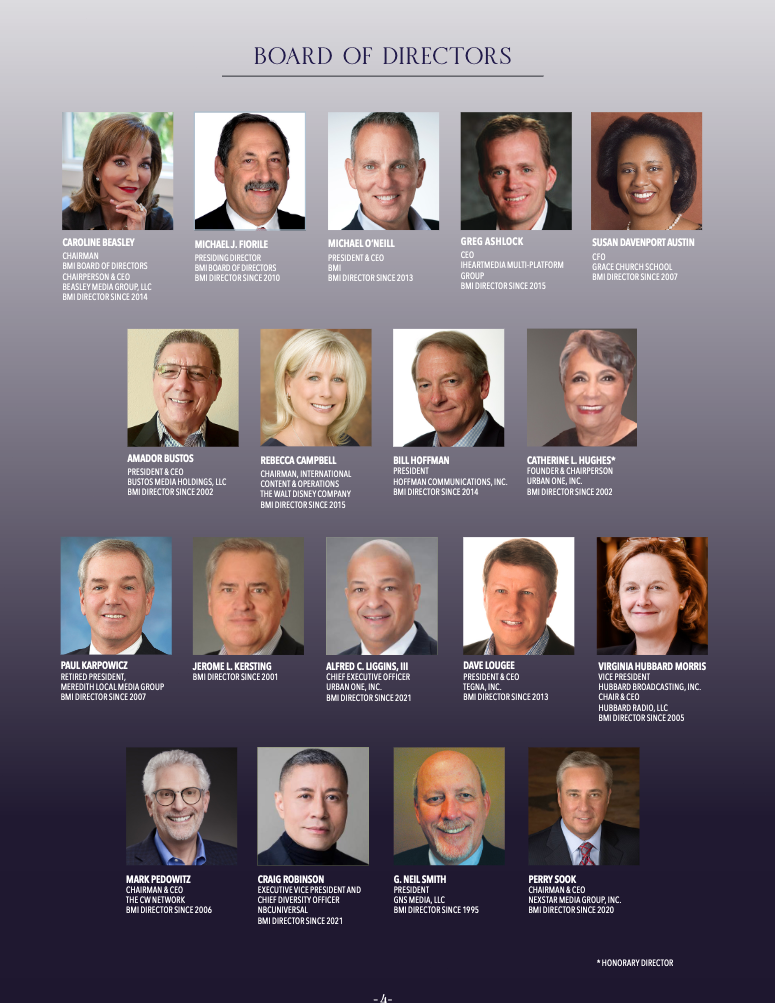
Bruce Hougton at Hypebot fills us in on the details of just how profitable the sale for Google’s blood money really is for one stockholder owner of BMI, iHeart Media (formerly Clear Channel). iHeart is, of course, the largest radio station owner in the US and poster child for media consolidation and screwing artists. iHeart profits from blood money stealing from artists and then does it again stealing from songwriters. And if iHeart is doing it, the rest of the BMI owners are, too. Of course you can complain to your songwriter-board member of BMI…oh wait, you don’t have any. Unlike ASCAP and SoundExchange. Of course, the question is whether those Members of Congress who worked so hard on the American Music Fairness Act and its predecessors will exercise their oversight role and investigate the sale. As well as the series of moves that lead to Google acquiring songwriter personal data that we don’t think belonged to BMI in the first place. It may not just be insulting, it may also be illegal. And answer the musical question, how big is your black box?]
In an ironic twist, iHeart Media, the largest owner of broadcast radio stations in the US, will receive $100 million from the sale of BMI to New Mountain Capital [and Google’s CapitalG venture fund]. The windfall is a result of iHeartMedia’s equity interest in BMI.
Guest post By Mike Huppe
President & CEO at SoundExchange
Creators – whether they be writers, actors, or musicians – are the heart of the entertainment industry. They inspire us with their words, move us with their performances, and get our blood pumping with their beats.
Now two of the major unions representing creators – the Writers Guild of America (WGA) and the Screen Actors Guild (SAG-AFTRA) – have gone on strike to make the case for better pay and residuals, improved working conditions, fairer treatment in the age of streaming, and protections against the widespread use of artificial intelligence to replace creators.
This is the first time that writers and actors have gone on strike at the same time since 1960, and it has brought the movie and TV industry to a virtual standstill. After cable increased content to fill a new crop of channels, streaming platforms fueled an explosion of new series and features to feed a new business model. Now, production has ground to a halt and the availability of new movies and shows will dwindle in the coming days, weeks, and months.
At its core, this dispute is about ensuring that, even as business models evolve and change, creators are treated fairly so they can continue to do the work that brings meaning to them and joy to us.
At SoundExchange, we love creators. We champion their work. We’ve seen the music industry go through technology-driven disruption (just as the motion picture industry is now), and we were created to ensure that streaming music business models enable creators to make a living doing what they do best. We’ve been fighting for 20 years to build a fairer, simpler, and more efficient music industry – by successfully increasing royalty rates across a variety of platforms; by holding accountable those who seek to cheat creators; by increasing the speed and transparency of payments, and by scoring a big win for music creators with the Music Modernization Act in 2018 (which provide comprehensive music licensing reform).
And we continue to fight these battles.
As streaming matures and new royalty models are debated, and as technology platforms evolve in Web3 and the metaverse, SoundExchange will remain a strong and vocal voice to ensure creators are fairly compensated. As artificial intelligence improves and matures at an astounding rate, SoundExchange became a founding member of the Human Artistry CampAIgn to demand that the rights of human creators are at the center of any copyright and intellectual property decisions, and we are proud that both SAG-AFTRA and the Writers Guild of America (WGA) are among the coalition’s members.
And it’s worth noting that music performers are still not compensated – at all — for their work when played on AM/FM broadcast radio. For this reason, SoundExchange is a driving force in the effort to convince Congress to act on the American Music Fairness Act, which would require multi-billion-dollar radio corporations to pay performance royalties like digital streaming platforms do.
So, to the creators out there on strike, we say this. We stand with you and hope that these disputes can be resolved quickly in a way that supports fair treatment, compensation, and protections for creators. And for those of you who are registered with SoundExchange, we will continue to work every day to make sure that you receive the digital royalties that you are due in a timely manner.
We know this mission matters more now than ever.
[This post first appeared on LinkedIn]
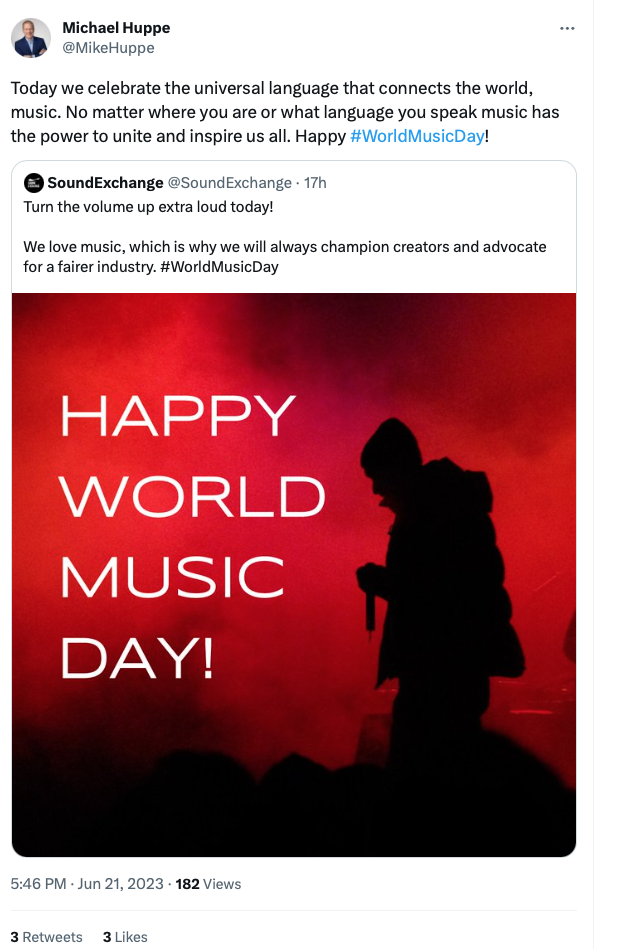
[Editor Charlie sez: And call Congress to tell your representative to support the American Music Fairness Act!]
The US is still the only Western democracy that stiffs artists on royalty payments for radio airplay. Let’s fix that!
[Editor Charlie sez: Anyone who tells you that artists can’t pass legislation to get fair pay for radio play is either a charlatan or full of shit and they are not on our side of the football.]
U.S. Senators Marsha Blackburn (R-Tenn.) and Alex Padilla (D-Calif.), along with Senators Thom Tillis (R-N.C.) and Dianne Feinstein (D-Calif.), introduced the bipartisan American Music Fairness Act to ensure artists and music creators receive fair compensation for the use of their songs on AM/FM radio. This legislation will bring corporate radio broadcasters in line with all other music streaming platforms, which already pay artists for their music.
Congressmen Darrell Issa (R-Calif.) and Jerry Nadler (D-N.Y.) led the legislation in the U.S. House of Representatives.
“From Beale Street to Music Row to the hills of East Tennessee, Tennessee’s songwriters and artists have undeniably made their mark,” said Senator Blackburn. “However, while digital music platforms compensate music performers and copyright holders for playing their songs, AM/FM radio stations only pay songwriters for the music they broadcast. This legislation takes a long overdue step toward leveling the music industry playing field and ensuring creators are fairly compensated for their work.”
“California’s artists play a pivotal role in enriching and diversifying our country’s music scene, but for too long, our laws have unfairly denied them the right to receive fair compensation for their hard work and talent on AM/FM radio broadcasts,” said Senator Padilla. “As we celebrate the accomplishments of our musical artists at the Grammy Awards in Los Angeles this weekend, we must commit to treating them with the dignity and respect they deserve for the music that they produce and that we enjoy every day.”
“Protecting one’s intellectual property is the signature right of every American who dares to invent. Every artist who first picked up a drumstick, sang to their mirror, or wrote lyrics from the heart did so because they had a dream and wanted to share it with the world. I look forward to working with stakeholders and colleagues to achieve this overdue reform,” said Congressman Issa.
“The United States is an outlier in the world for not requiring broadcast radio to pay artists when playing their music, while requiring satellite and internet radio to pay,” said Chairman Nadler. “This is unfair to both artists and music providers. I’m proud to sponsor the American Music Fairness Act which would finally correct this injustice. This is what music creators want and deserve.”
“It’s clear that the movement for music fairness continues to gain momentum, bringing us closer than ever before to ending Big Radio’s ability to deny artists the fair pay they deserve. This week’s House and Senate introductions of the American Music Fairness Act is evidence of that. We thank Senators Padilla and Blackburn and Representatives Issa and Nadler for their leadership in the effort to secure economic justice for our nation’s music artists and creators, and look forward to working together to drive continued progress in the coming months,”said Congressman Joe Crowley, Chairman of musicFIRST.
“Music creators have been forced to give away their work for far too long. It is time for Congress to demonstrate that they stand behind the hard-working Americans that provide the music we all love by finally passing the American Music Fairness Act. This bill has the broad support of artists, labels, small broadcasters, unions, and others because it strikes a fair balance by respecting creators for their work and protecting truly local broadcasters. No more excuses, no more waiting in line for their turn. Music creators demand the economic justice AMFA provides,” said Michael Huppe, President and CEO of SoundExchange.
“As we prepare to focus our attention on celebrating music this weekend at the GRAMMY Awards, the Recording Academy also renews its commitment to ensuring music creators are always compensated fairly for their work. We applaud Reps. Issa, Nadler, McClintock, and Lieu and Senators Padilla, Blackburn, Feinstein, and Tillis for reintroducing the American Music Fairness Act and look forward to working with them to build on the historic progress we made last year on this important legislation,” said Harvey Mason jr., CEO of the Recording Academy.
“The American Music Fairness Act is practical compromise legislation that has already passed the House Judiciary Committee with bipartisan support last Congress. It takes a smart, calibrated approach towards solving a decades old problem in the radio industry. When enacted into law, AMFA will ensure recording artists and copyright owners are paid fairly for recorded music regardless of the technology used to broadcast it while carefully protecting small and noncommercial stations to preserve truly local radio our communities depend upon,” said Mitch Glazier, Chairman and CEO of the Recording Industry Association of America.
“For far too long, our broken and unfair system has let AM/FM radio stations — many of which are owned by just a few massive media corporations — get away with refusing to pay artists when they play their music. While these big corporate broadcast companies gobble up billions upon billions in advertising dollars, the session and background musicians, whose work makes all of it possible, receive no compensation whatsoever for their creations. It’s time to right this wrong, and the American Music Fairness Act aims to do just that. It’s vital that Congress protects the livelihoods of those who create the music we know and love,” said Ray Hair, International President of the American Federation of Musicians.
“I want to thank Congressman Jerry Nadler, Congressman Darrell Issa, Senator Alex Padilla and Senator Marsha Blackburn for their leadership on this crucial legislation. When you consider the billions of dollars the big radio corporations generate in revenue and profits, it’s shocking that recording artists, vocalists and musicians don’t receive a penny when their work is played on AM/FM radio. Since when do workers in America get exploited without pay? This is an unfair and egregious loophole especially since both streaming and digital services pay for the use of artists’ work. AM/FM radio has had a free ride for decades and it’s time to put a stop to it! I urge Congress to fix this outdated practice by passing the American Music Fairness Act,” said Fran Drescher, President of SAG-AFTRA.
“We are grateful that our champions are making it crystal clear that the fight for fairness continues in this new Congress. By reintroducing the American Music Fairness Act, Senators Blackburn and Padilla, along with Representatives Issa, Nadler, McClintock, and Lieu, as defenders of property rights and supporters of artistic expression, have put the mega broadcasting conglomerates on notice that it is time to erase their stain on America’s history,” said Dr. Richard James Burgess, President and CEO of the American Association of Independent Music.
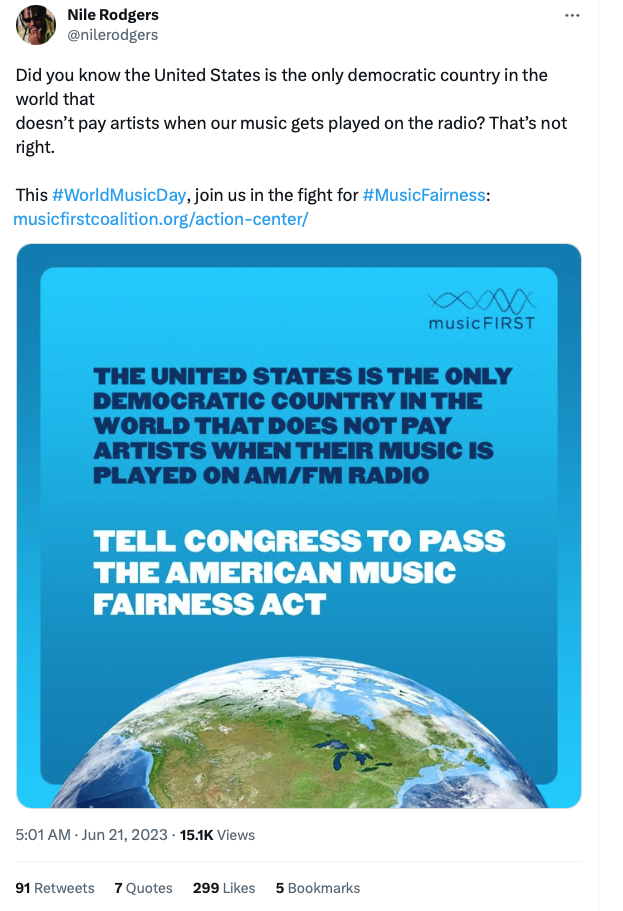
Currently, the United States is the only democratic country in the world in which artists are not compensated for the use of their music on AM/FM radio. By requiring broadcast radio corporations to pay performance royalties to creators for AM/FM radio plays, the American Music Fairness Act would close an antiquated loophole that has allowed corporate broadcasters to forgo compensating artists for the use of their music for decades.
In recognition of the important role of locally owned radio stations in communities across the U.S., the American Music Fairness Act also includes strong protections for small, college, and non-commercial stations.
The American Music Fairness Act will positively impact artists and the music industry at large by:
The American Music Fairness Act is endorsed by: the AFL-CIO, the American Association of Independent Music (A2IM), the American Federation of Musicians, the Recording Academy, the Recording Industry Association of America (RIAA), SAG-AFTRA and SoundExchange.
Full text of the bill is available here.
###
We have a chance to make history today––the American Music Fairness Act, our bi-partisan congressional bill, is on the runway to pass but we need the support of just one Senator who is holding it up:
Call @SenatorLeahy and tell him to support The American Music Fairness Act: (202) 224-4242
We don’t ask you to take time out of your day to support legislation very often, but this is one of those times and YOUR CALL MATTERS!
We have all worked together on the #IRespectMusic campaign towards this moment for years, and our moment has finally arrived. Make your voices heard, please call @SenatorLeahy and urge him not to turn his back on American artists in our hour of need!
DID YOU KNOW the USA is the only democratic country in the world where artists don’t get paid for radio airplay? DID YOU KNOW only Iran & North Korea share the USA’s position on this issue? Tell Senator Leahy that it is time to get America off this list!

 The Trichordist
You must be logged in to post a comment.