
[Editor Charlie sez: And call Congress to tell your representative to support the American Music Fairness Act!]
[Editor Charlie sez: And call Congress to tell your representative to support the American Music Fairness Act!]
The US is still the only Western democracy that stiffs artists on royalty payments for radio airplay. Let’s fix that!
[Editor Charlie sez: Anyone who tells you that artists can’t pass legislation to get fair pay for radio play is either a charlatan or full of shit and they are not on our side of the football.]
U.S. Senators Marsha Blackburn (R-Tenn.) and Alex Padilla (D-Calif.), along with Senators Thom Tillis (R-N.C.) and Dianne Feinstein (D-Calif.), introduced the bipartisan American Music Fairness Act to ensure artists and music creators receive fair compensation for the use of their songs on AM/FM radio. This legislation will bring corporate radio broadcasters in line with all other music streaming platforms, which already pay artists for their music.
Congressmen Darrell Issa (R-Calif.) and Jerry Nadler (D-N.Y.) led the legislation in the U.S. House of Representatives.
“From Beale Street to Music Row to the hills of East Tennessee, Tennessee’s songwriters and artists have undeniably made their mark,” said Senator Blackburn. “However, while digital music platforms compensate music performers and copyright holders for playing their songs, AM/FM radio stations only pay songwriters for the music they broadcast. This legislation takes a long overdue step toward leveling the music industry playing field and ensuring creators are fairly compensated for their work.”
“California’s artists play a pivotal role in enriching and diversifying our country’s music scene, but for too long, our laws have unfairly denied them the right to receive fair compensation for their hard work and talent on AM/FM radio broadcasts,” said Senator Padilla. “As we celebrate the accomplishments of our musical artists at the Grammy Awards in Los Angeles this weekend, we must commit to treating them with the dignity and respect they deserve for the music that they produce and that we enjoy every day.”
“Protecting one’s intellectual property is the signature right of every American who dares to invent. Every artist who first picked up a drumstick, sang to their mirror, or wrote lyrics from the heart did so because they had a dream and wanted to share it with the world. I look forward to working with stakeholders and colleagues to achieve this overdue reform,” said Congressman Issa.
“The United States is an outlier in the world for not requiring broadcast radio to pay artists when playing their music, while requiring satellite and internet radio to pay,” said Chairman Nadler. “This is unfair to both artists and music providers. I’m proud to sponsor the American Music Fairness Act which would finally correct this injustice. This is what music creators want and deserve.”
“It’s clear that the movement for music fairness continues to gain momentum, bringing us closer than ever before to ending Big Radio’s ability to deny artists the fair pay they deserve. This week’s House and Senate introductions of the American Music Fairness Act is evidence of that. We thank Senators Padilla and Blackburn and Representatives Issa and Nadler for their leadership in the effort to secure economic justice for our nation’s music artists and creators, and look forward to working together to drive continued progress in the coming months,”said Congressman Joe Crowley, Chairman of musicFIRST.
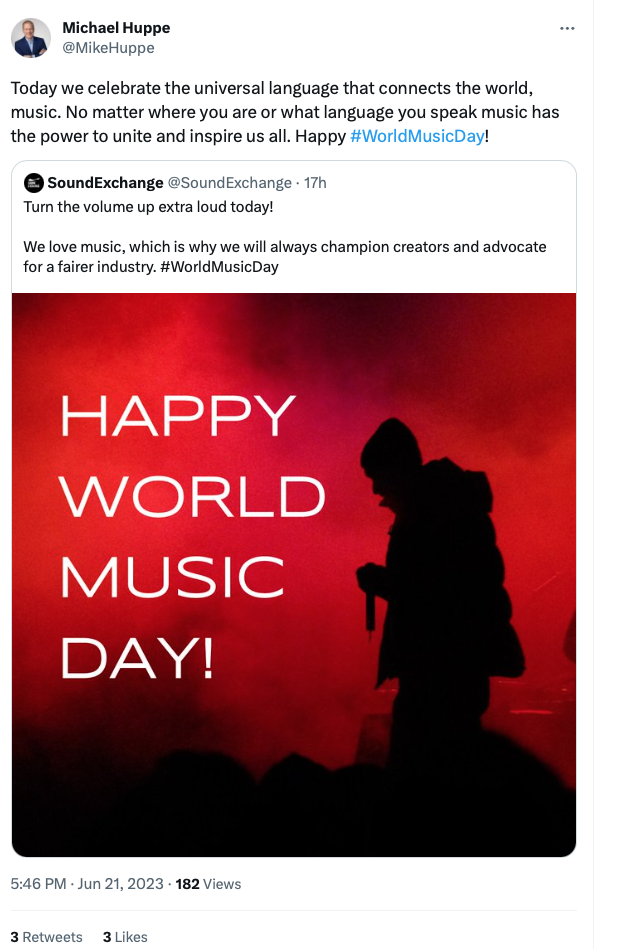
“Music creators have been forced to give away their work for far too long. It is time for Congress to demonstrate that they stand behind the hard-working Americans that provide the music we all love by finally passing the American Music Fairness Act. This bill has the broad support of artists, labels, small broadcasters, unions, and others because it strikes a fair balance by respecting creators for their work and protecting truly local broadcasters. No more excuses, no more waiting in line for their turn. Music creators demand the economic justice AMFA provides,” said Michael Huppe, President and CEO of SoundExchange.
“As we prepare to focus our attention on celebrating music this weekend at the GRAMMY Awards, the Recording Academy also renews its commitment to ensuring music creators are always compensated fairly for their work. We applaud Reps. Issa, Nadler, McClintock, and Lieu and Senators Padilla, Blackburn, Feinstein, and Tillis for reintroducing the American Music Fairness Act and look forward to working with them to build on the historic progress we made last year on this important legislation,” said Harvey Mason jr., CEO of the Recording Academy.
“The American Music Fairness Act is practical compromise legislation that has already passed the House Judiciary Committee with bipartisan support last Congress. It takes a smart, calibrated approach towards solving a decades old problem in the radio industry. When enacted into law, AMFA will ensure recording artists and copyright owners are paid fairly for recorded music regardless of the technology used to broadcast it while carefully protecting small and noncommercial stations to preserve truly local radio our communities depend upon,” said Mitch Glazier, Chairman and CEO of the Recording Industry Association of America.
“For far too long, our broken and unfair system has let AM/FM radio stations — many of which are owned by just a few massive media corporations — get away with refusing to pay artists when they play their music. While these big corporate broadcast companies gobble up billions upon billions in advertising dollars, the session and background musicians, whose work makes all of it possible, receive no compensation whatsoever for their creations. It’s time to right this wrong, and the American Music Fairness Act aims to do just that. It’s vital that Congress protects the livelihoods of those who create the music we know and love,” said Ray Hair, International President of the American Federation of Musicians.
“I want to thank Congressman Jerry Nadler, Congressman Darrell Issa, Senator Alex Padilla and Senator Marsha Blackburn for their leadership on this crucial legislation. When you consider the billions of dollars the big radio corporations generate in revenue and profits, it’s shocking that recording artists, vocalists and musicians don’t receive a penny when their work is played on AM/FM radio. Since when do workers in America get exploited without pay? This is an unfair and egregious loophole especially since both streaming and digital services pay for the use of artists’ work. AM/FM radio has had a free ride for decades and it’s time to put a stop to it! I urge Congress to fix this outdated practice by passing the American Music Fairness Act,” said Fran Drescher, President of SAG-AFTRA.
“We are grateful that our champions are making it crystal clear that the fight for fairness continues in this new Congress. By reintroducing the American Music Fairness Act, Senators Blackburn and Padilla, along with Representatives Issa, Nadler, McClintock, and Lieu, as defenders of property rights and supporters of artistic expression, have put the mega broadcasting conglomerates on notice that it is time to erase their stain on America’s history,” said Dr. Richard James Burgess, President and CEO of the American Association of Independent Music.
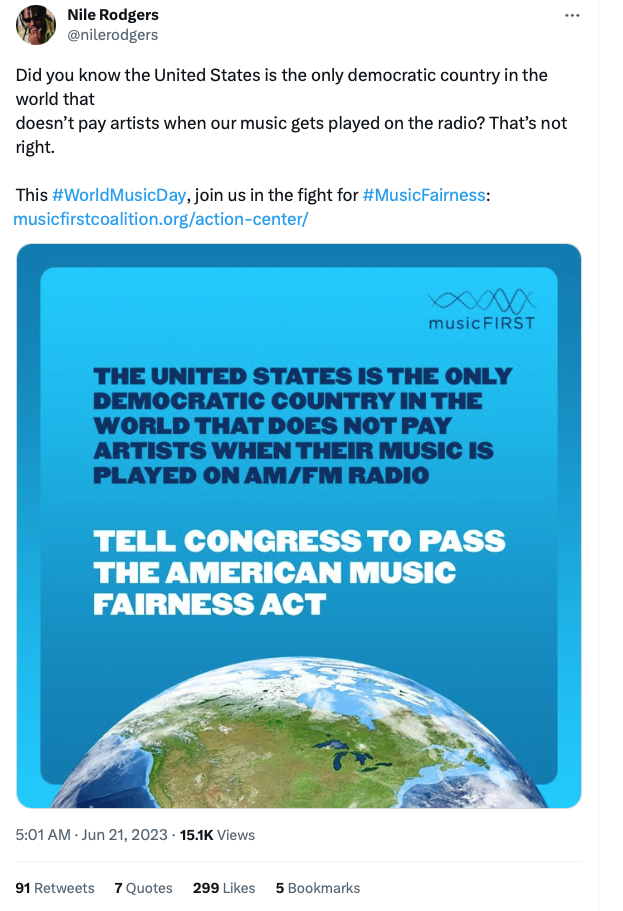
Currently, the United States is the only democratic country in the world in which artists are not compensated for the use of their music on AM/FM radio. By requiring broadcast radio corporations to pay performance royalties to creators for AM/FM radio plays, the American Music Fairness Act would close an antiquated loophole that has allowed corporate broadcasters to forgo compensating artists for the use of their music for decades.
In recognition of the important role of locally owned radio stations in communities across the U.S., the American Music Fairness Act also includes strong protections for small, college, and non-commercial stations.
The American Music Fairness Act will positively impact artists and the music industry at large by:
The American Music Fairness Act is endorsed by: the AFL-CIO, the American Association of Independent Music (A2IM), the American Federation of Musicians, the Recording Academy, the Recording Industry Association of America (RIAA), SAG-AFTRA and SoundExchange.
Full text of the bill is available here.
###
We have a chance to make history today––the American Music Fairness Act, our bi-partisan congressional bill, is on the runway to pass but we need the support of just one Senator who is holding it up:
Call @SenatorLeahy and tell him to support The American Music Fairness Act: (202) 224-4242
We don’t ask you to take time out of your day to support legislation very often, but this is one of those times and YOUR CALL MATTERS!
We have all worked together on the #IRespectMusic campaign towards this moment for years, and our moment has finally arrived. Make your voices heard, please call @SenatorLeahy and urge him not to turn his back on American artists in our hour of need!
DID YOU KNOW the USA is the only democratic country in the world where artists don’t get paid for radio airplay? DID YOU KNOW only Iran & North Korea share the USA’s position on this issue? Tell Senator Leahy that it is time to get America off this list!

Starting with Frank Sinatra on December 12, 1988–nearly 34 years ago to the day–artists have campaigned for fair treatment in line with the rest of the world and get a performance royalty for broadcast radio. The House Judiciary Committee led by the stalwart Rep. Jerry Nadler moved that goal a little closer this week by passing HR 4130, the American Music Fairness Act, out of committee.
Almost as significant as the vote was the comments by Rep. Jim Jordan and Rep. Darrell Issa (the remaining author of the bill after the wonderful Rep. Ted Deutch announced he would not run for reelection). Given the party change in the House next session, Rep. Jordan is the front runner for Chair of the House Judiciary Committee. He was very clear that the committee will be taking up the bill if it doesn’t pass in the lame duck, because it is time to resave this unfairness. Rep. Darrell Issa summed it up: It is time for bipartisan compromise so that America is not in the same category as North Korea, Cuba and Iran, and whatever the right number is it is not zero.
This is not where we needed up before on prior versions of the legislation. We are in a much, much better place than before. I would say that’s for two reasons. First, because the legislation itself addresses radio’s objections and makes the NAB’s mean-spirited lobbying tactics ring hollow and cheap. That dog just won’t hunt anymore.
The other reason is because of a superb messaging effort by the MusicFirst Coalition under new management. MusicFirst under Joe Crowley took their job seriously and understood their job to be very simple: We win, they lose. Too often, lobbyists view their job as perpetuating the conflict so the money keeps flowing. You can tell when you are in one of those because the organization doesn’t seem to quite get it that when you have fewer points when the clock runs out, we call that losing. Even in Washington.
Turning this beast around was a tough job and the entire MusicFirst team deserves recognition and appreciation. We’re not done–there may still be some magic tricks left in this session. But as Congressmen Jordan and Issa said, if the bill doesn’t pass this session, they are committed to taking it up early next session and getting it passed in the House.
Godspeed to everyone who has worked so hard for so long to make this a reality for all of our artists and musicians who need it. It’s what Frank would do.

[Introducing AMFA in the Senate is a huge thing and a major win by MusicFirst over the evil NAB and their $50 handshake. The bipartisan legislation has to pass both Senate and House to become law.]
Since the dawn of radio, the United States has been and remains the only major country in the world where terrestrial radio pays no royalties to performers or recorded-music copyright owners of the songs it plays — a situation that is largely due to the powerful radio lobby’s influence in Congress. While the more than 8,300 AM and FM stations across the country pay royalties to songwriters and publishers, they have never paid performers or copyright holders, although streaming services and satellite radio do.
On Thursday morning, Senators Alex Padilla (D-Calif.) and Marsha Blackburn (R-Tenn.) introduced the bipartisan American Music Fairness Act, which aims to rectify that situation by “ensur[ing] artists and music creators receive fair compensation for the use of their songs on AM/FM radio. This legislation will bring corporate radio broadcasters up-to-speed with all other music streaming platforms, which already pay artists for their music.”
Hooray! The @AFLCIO’s 12.5 million members have joined the fight to pass the American Music Fairness Act. The USA is the only democratic country in the world where artists don’t get paid for AM/FM radio airplay. This act will change that. #IRespectMusic https://t.co/CoGJtoWSbk — Blake Morgan (@TheBlakeMorgan) June 20, 2022 Really great news, the largest […]
AFL-CIO Backs Artist Play for Radio Play and the American Music Fairness Act #irespectmusic — Music Tech Solutions
Really great news, the largest union organization in the US has joined the fight for fairness for the world’s recording artists and session performers!
MusicFirst leader Joe Crowley said:
We applaud the AFL-CIO for standing by artists and music creators and lending the strength of its 12.5 million members to fight for passage of the American Music Fairness Act.
This legislation will benefit artists across the country – including the tens of thousands who are members of SAG-AFTRA, the American Federation of Musicians and other AFL-CIO unions – by correcting a decades-long injustice fueled by corporate greed that has left artists uncompensated for their use of their songs on AM/FM radio.
Get more info and materials here
TPR Music Artist Forum | In Partnership with SLATT Management
Musicians of all ages are invited to a networking workshop and panelist discussion dedicated to understanding the future of music technology, copyright law, entertainment law, obtaining royalties, and navigation of music streaming services.
Address:
321 W. Commerce St, San Antonio, TX 78205
Doors open at 6:30pm.
Panelist discussion will take place at 7:00pm.
Guest Panelists:
Ondrejia Scott | 7:00pm – 7:10pm
Chris Castle | 7:10pm – 7:20pm
Krystal Jones | 7:20pm – 7:30pm
Dr. Steven Parker | 7:30pm – 7:40pm
Linda Bloss-Baum | 7:40pm – 7:50pm
Food and drinks will be provided.
Musicians are welcome to submit an original track to be featured on our TPR Music Artist Forum playlist:
Professional headshots will be offered free of charge by Oscar Moreno.
We will be ending out the night with a special live performance by J. Darius live in the Malú and Carlos Alvarez Theater.
RSVP here to reserve your spot for this free event!

By Chris Castle
We’ve all heard the talking points from Big Radio’s shillery the National Association of Broadcasters about how it’s perfectly fine for American radio stations to deny recording artists and session musicians fair compensation–because exposure, don’t you know. Big radio delivers huge audiences for music and we should all be grateful and work for free for the ever-more-consolidated broadcasting industry.
The other talking point we don’t hear so much from these characters is that media ownership rules are bad and that greater and greater concentration of influence and wealth to control the public airwaves is good. That’s right, it’s not the corporate airwaves, it’s the public’s airwaves. But you wouldn’t know that by looking, right?
So the latest version of this “bigger is better” guff is happening right now at the Federal Communications Commission that licenses radio stations. The NAB is poormouthing to the FCC about how radio and TV stations have trouble competing with Google and Facebook (in particular) for advertising. Oh, no. Google is grinding them into bits? Say it ain’t so!
We know a little bit about what it’s like to have soulless Silicon Valley oligarchs using their political and financial muscle to get a free pass to jack with your livelihood without repercussions from the guys with badges. If Big Tech is really the problem for Big Radio, I’m sure there would be some support for going after them together. But playing nice with others would require the soulless media oligarchs to stop acting like wankers and make a fair deal for artists and musicians. That is not happening. No, no, the solution to the broadcasters’ Google problem is to relax media ownership rules for even MORE concentrated radio ownership, you see. Plus these monopolists want an antitrust exemption for which they have presented no evidence other than even more shillery.
But see what they did there? MusicFirst certainly did and wrote to the FCC to make sure the FCC did, too (letter is here):
The National Association of Broadcasters, in seeking relaxed broadcast radio ownership rules, is asking the FCC to accept arguments directly contrary to those it makes in opposing the American Music Fairness Act.
In fighting the AMFA, the NAB continues to claim airplay has “promotional value” that eliminates the need for radio broadcasters to pay recording artists for the music the stations use to derive millions of advertising dollars. The promotion argument has never been a valid justification for refusing to pay musicians. Such a rationale could swallow all of copyright, as any use of content can be called “promotional.” But even the NAB’s own arguments before the FCC are showing the flaws with its promotion claim.
For example, the NAB argues in this proceeding that radio broadcasters need increased economies of scale to compensate for the significant audience share broadcast radio has lost. Yet, if radio broadcasters have lost so much audience share that they need government intervention, the promotional value they claim to provide recording artists cannot be adequate compensation.
The NAB also applies the promotion claim inconsistently. In addition to its argument about loss of broadcast radio audience, the NAB alleges here that broadcasters need increased economies of scale because online platforms refuse to fairly compensate broadcasters for content the platforms use to derive advertising revenue. The NAB is similarly arguing that platforms’ inadequate compensation warrants passage of the Journalism Competition and Preservation Act [the antitrust exemption for monopolists].
The musicFIRST Coalition agrees with the NAB that distributors should adequately compensate content providers. But what is good for the goose must be good for the gander. Online distribution of broadcaster content can also be claimed to be promotional. If the NAB finds inadequate the combination of online promotion and the money online platforms do pay broadcasters, the alleged value of broadcast radio promotion combined with the lack of any money the radio broadcasters pay recording artists cannot possibly be adequate.
The shills at the NAB should try being reasonable just once instead of doing their usual blunt force trauma. Here’s the reality: Nobody is buying what they’re selling because it’s just more snake oil.
[Editor Charlie sez: When you read this cautionary tale for artists, remember that like so many other artists we look up to, Astrud never got a penny from radio performances of her records in the US which would have given her a direct payment outside of her recording agreement through SoundExchange.]
“The Girl from Ipanema” was one of the seminal songs of the 1960s. It sold more than five million copies worldwide, popularised bossa nova music around the world and made a superstar of the Brazilian singer Astrud Gilberto, who was only 22 when she recorded the track on 18 March 1963.
Yet what should be an uplifting story – celebrating a singer making an extraordinary mark in her first professional engagement – became a sorry tale of how a shy young woman was exploited, manipulated and left broken by a male-dominated music industry full, as she put it, of “wolves posing as sheep”.


You must be logged in to post a comment.