Tell Congress to Honor Aretha, Pass #AMFA #IRespectMusic

It’s time.

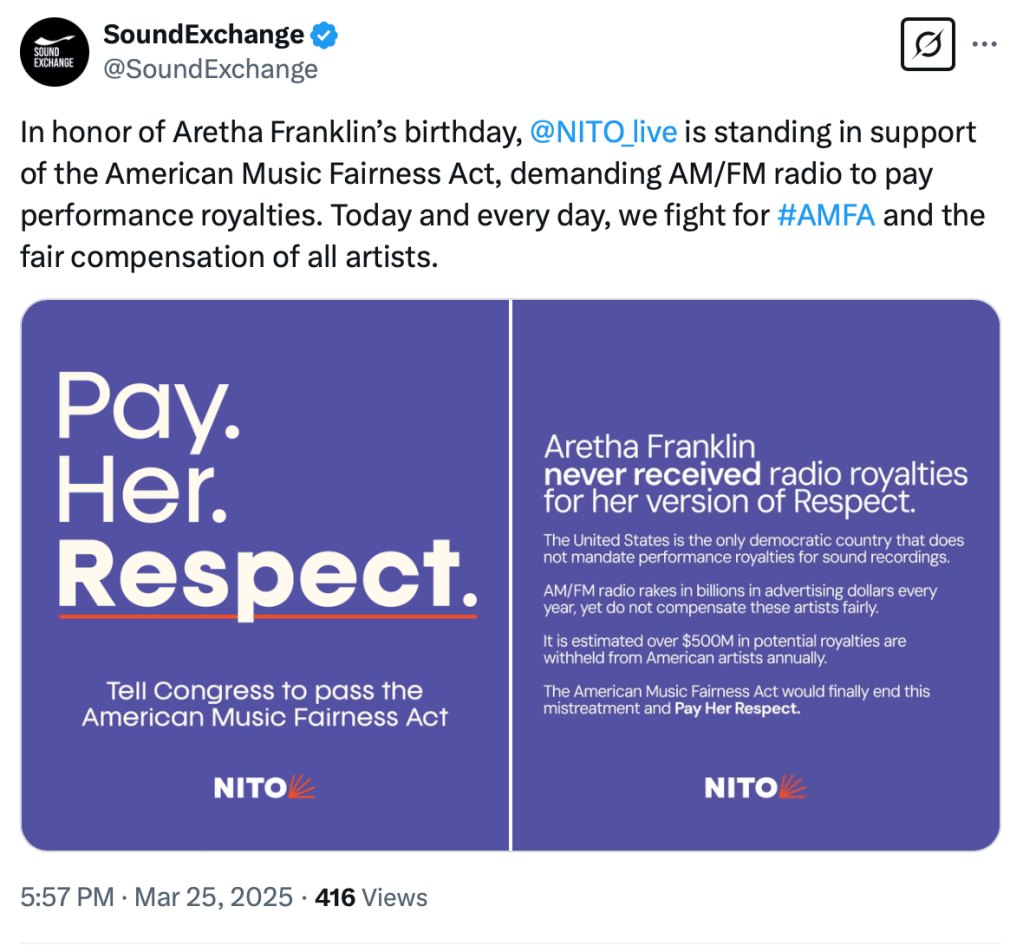
We join our friends Blake Morgan, #IRespectMusic, SoundExchange, the National Independent Talent Organization (NITO) and many, many others in asking you to join the fight to support artist pay for radio play by passing the American Music Fairness Act. Find out how you can help here, or find your representative in Congress here.

@ArtistRights Institute Newsletter 2/17/25

The Artist Rights Institute’s news digest Newsletter

#FreeJImmyLai: Update on Chinese Communist Party Free Speech Enemy No. 1: Jimmy Lai, the Hong Kong publisher of Apple Daily

Why case of jailed Briton Jimmy Lai is major sticking point for [UK Prime Minister] Keir Starmer’s relations with China (Sky News/Alix Culbertson)

American Music Fairness Act

@MARSHABLACKBURN, @REPDARRELLISSA, COLLEAGUES REINTRODUCE AMERICAN MUSIC FAIRNESS ACT TO ENSURE ARTIST PAY FOR RADIO PLAY #IRESPECTMUSIC #AMFA (MusicTechPolicy/Editor Charlie)

Copyright Royalty Board

What Must be Done in CRB 5? (MusicTechSolutions/Chris Castle)

Copyright

The MTP Interview: Attorney Tim Kappel and Abby North Discuss Vetter v. Resnick with Chris Castle

First of Its Kind Decision Finds AI Training Is Not Fair Use (Copyright Alliance/Kevin Madigan)

‘Mass theft’: Thousands of artists call for AI art auction to be cancelled. (The Guardian/Dan Milmo)

Artificial Intelligence in China

Featured Translation:  China’s most humble profession is being squeezed out by Artificial Challenged Intelligence(ChinaAI/Jeffrey Ding)

Great Power Competition in AI

It’s Not Just Technology: What it Means to be a Global Leader in AI (Just Security/Kayla Blomquist and Keegan McBride)

AI, Great Power Competition & National Security (MIT Press/Daedalus/Eric Schmidt)

AI at a Geopolitical Crossroads: The Tension Between Acceleration and Regulation (US Institute for Peace/Andrew Cheatham)

Press Release: @RandyTravis and @MikeHuppe to Testify on Capitol Hill June 26th on Artist Pay for Radio Play #IRespectMusic

House IP Subcommittee slated to hold American Music Fairness Act hearing on Wednesday, June 26th, watch at this link.

WASHINGTON D.C. (June 20, 2024) – Country music icon Randy Travis and SoundExchange CEO and President Michael Huppe will testify before the House Judiciary Committee’s Subcommittee on Courts, Intellectual Property, and the Internet, next Wednesday, June 26, for a hearing entitled, “Radio, Music, and Copyrights: 100 Years of Inequity for Recording Artists.” Travis and Huppe will take questions from lawmakers on the American Music Fairness Act (H.R. 791) – bipartisan, bicameral legislation that will close a century-old loophole and require AM/FM radio stations to pay artists royalties when their songs are played on the air. Travis will also be in Washington advocating for protecting music creators around the advancement of Artificial Intelligence (AI).

The two issues are especially relevant for Travis, who suffered a stroke in 2013 that has prevented him from continuing to keep up a rigorous touring schedule that had been a primary source of income for decades. Last month, Travis released his first new song since the stroke, “Where That Came From,” with the use of groundbreaking – and artist-sanctioned – AI tools.

“Royalties are critical for survival in today’s music industry, and that’s especially true for working class musicians and performers who are not able to tour,” said Travis. “The American Music Fairness Act will make a real difference in the lives of working musicians – not just big-name artists, but folks all around the country who play on albums or sing backup vocals on top of a nine-to-five job. I’m looking forward to this hearing and talking about the urgent need for Congress to pass this bill and level the playing field for creators.”

AM/FM radio remains the most popular music delivery platform in the U.S., reaching nearly 300 million people (88% of the country) each week while playing an estimated 967 million songs each year.

“I’m honored to testify alongside Randy Travis, a true legend in the history of American music,” added Huppe. “Randy has faced incredible challenges throughout his career, and his resilience in the face of adversity is a model to all of us. The American Music Fairness Act would end a 100 year era of unfair treatment to the creators of the music that feeds the most popular music delivery platform in our country.

The American Music Fairness Act was introduced in the U.S. House by U.S. Representatives Darrell Issa (R-CA) and Jerry Nadler (D-NY), and in the U.S. Senate by Senators Alex Padilla (D-CA) and Marsha Blackburn (R-TN). The legislation offers a balanced solution that ensures music creators are fairly compensated when their songs are played on AM/FM radio and that small, independent broadcasters are able to thrive. The legislation enjoys support from a diverse coalition of artists, broadcasters, labels, and music lovers:

• Broadcasters, such as the Alliance for Community Media, Common Frequency, Media Alliance, the National Federation of Community Broadcasters (NFCB), Prometheus Radio Project, and REC Networks – which represent a broad coalition of community broadcasters – also support AMFA.
• Artists from Gloria Estefan to Dionne Warwick to David Byrne to Common to Sammy Hagar – and thousands more – have voiced their support for AMFA.
• Every Democratic and Republican administration since President Carter has supported a performance right for sound recordings in the U.S.
• Americans support passing a law to give artists performance royalties for AM/FM radio plays by a 4:1 ratio.

The Broadcasters are Still Free Riding on Artists #IRespectMusic

Broadcasters set the example followed by Google, YouTube, Spotify and now TikTok. Let’s tell Congress broadcasters have to pay reasonable royalties in the bi-partisan American Music Fairness Act.

Please join the fight and sign the petition at the MusicFirst Coalition!

@mikehuppe on American Music Fairness Act #IRespectMusic

We’re still looking for the phalanx of industry leaders making this point about the irony of broadcasters enriching themselves at the expense of songwriters when they don’t pay artists–so far it’s just Mr. Huppe who has been here with us before. Complete Music Update has the story:  iHeartMedia confirms incoming $100 million pay day as a result of BMI sale

The boss of US record industry collecting society SoundExchange has used the news that iHeartMedia will make $100 million from the sale of BMI to again call for politicians to back the American Music Fairness Act.

SoundExchange CEO Michael Huppe wrote on Twitter: “The irony of a radio giant profiting millions while underpaying performers is yet another reason why the American Music Fairness Act is so vital for #MusicFairness”.

BMI’s Insult that Keeps On Insulting! @hypebot: Radio doesn’t pay performers, but iHeart will get $100M from BMI sale to Google/Private Equity

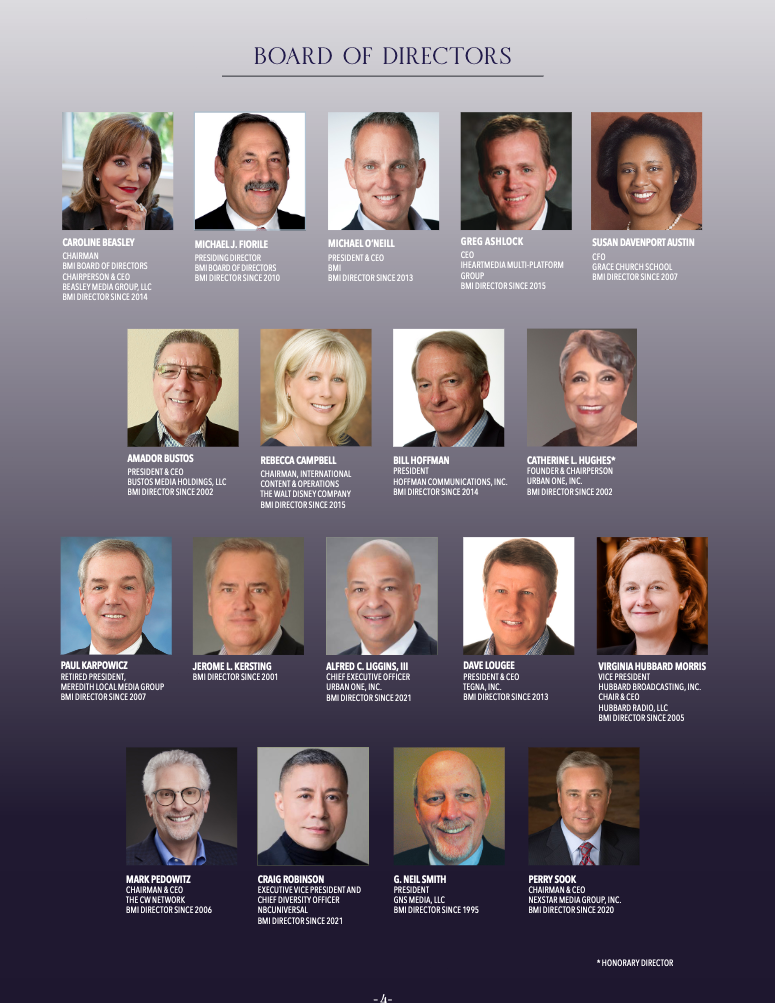
[T Editor sez: Remember how we have all fought alongside #IRespectMusic, Blake Morgan and MusicFirst to get artists paid for radio play of their recordings on terrestrial radio? Remember how iHeartMedia and the rest of the National Association of Broadcasters used their lobbying muscle to block our heroes in Congress like Reps. Jerry Nadler, Ted Deutch, and Darrell Issa and Senators Marsha Blackburn and Alex Padilla from passing the American Music Fairness Act? And are blocking it to this day? Well, adding insult to injury, the broadcasters who apparently own BMI, the for-profit PRO, are making serious bank for selling their shares to Google and private equity fund New Mountain. You know, Broadcast(er) Music, Inc.? Thus screwing songwriters, but screwing artist/songwriters TWICE. Who are they? According to the most recent BMI annual report we could find they are probably the same companies with board seats which are these smiling faces:

Bruce Hougton at Hypebot fills us in on the details of just how profitable the sale for Google’s blood money really is for one stockholder owner of BMI, iHeart Media (formerly Clear Channel). iHeart is, of course, the largest radio station owner in the US and poster child for media consolidation and screwing artists. iHeart profits from blood money stealing from artists and then does it again stealing from songwriters. And if iHeart is doing it, the rest of the BMI owners are, too. Of course you can complain to your songwriter-board member of BMI…oh wait, you don’t have any. Unlike ASCAP and SoundExchange. Of course, the question is whether those Members of Congress who worked so hard on the American Music Fairness Act and its predecessors will exercise their oversight role and investigate the sale. As well as the series of moves that lead to Google acquiring songwriter personal data that we don’t think belonged to BMI in the first place. It may not just be insulting, it may also be illegal. And answer the musical question, how big is your black box?]

 In an ironic twist, iHeart Media, the largest owner of broadcast radio stations in the US, will receive $100 million from the sale of BMI to New Mountain Capital [and Google’s CapitalG venture fund]. The windfall is a result of iHeartMedia’s equity interest in BMI.

Read Bruce’s post on Hypebot

@MikeHuppe: Protecting the Creative Class

Guest post By Mike Huppe
President & CEO at SoundExchange

Creators – whether they be writers, actors, or musicians – are the heart of the entertainment industry. They inspire us with their words, move us with their performances, and get our blood pumping with their beats. 

Now two of the major unions representing creators – the Writers Guild of America (WGA) and the Screen Actors Guild (SAG-AFTRA) – have gone on strike to make the case for better pay and residuals, improved working conditions, fairer treatment in the age of streaming, and protections against the widespread use of artificial intelligence to replace creators. 

This is the first time that writers and actors have gone on strike at the same time since 1960, and it has brought the movie and TV industry to a virtual standstill. After cable increased content to fill a new crop of channels, streaming platforms fueled an explosion of new series and features to feed a new business model. Now, production has ground to a halt and the availability of new movies and shows will dwindle in the coming days, weeks, and months.

At its core, this dispute is about ensuring that, even as business models evolve and change, creators are treated fairly so they can continue to do the work that brings meaning to them and joy to us.

At SoundExchange, we love creators. We champion their work. We’ve seen the music industry go through technology-driven disruption (just as the motion picture industry is now), and we were created to ensure that streaming music business models enable creators to make a living doing what they do best. We’ve been fighting for 20 years to build a fairer, simpler, and more efficient music industry – by successfully increasing royalty rates across a variety of platforms; by holding accountable those who seek to cheat creators; by increasing the speed and transparency of payments, and by scoring a big win for music creators with the Music Modernization Act in 2018 (which provide comprehensive music licensing reform).

And we continue to fight these battles.

As streaming matures and new royalty models are debated, and as technology platforms evolve in Web3 and the metaverse, SoundExchange will remain a strong and vocal voice to ensure creators are fairly compensated. As artificial intelligence improves and matures at an astounding rate, SoundExchange became a founding member of the Human Artistry CampAIgn to demand that the rights of human creators are at the center of any copyright and intellectual property decisions, and we are proud that both SAG-AFTRA and the Writers Guild of America (WGA) are among the coalition’s members.

And it’s worth noting that music performers are still not compensated – at all — for their work when played on AM/FM broadcast radio. For this reason, SoundExchange is a driving force in the effort to convince Congress to act on the American Music Fairness Act, which would require multi-billion-dollar radio corporations to pay performance royalties like digital streaming platforms do.

So, to the creators out there on strike, we say this. We stand with you and hope that these disputes can be resolved quickly in a way that supports fair treatment, compensation, and protections for creators. And for those of you who are registered with SoundExchange, we will continue to work every day to make sure that you receive the digital royalties that you are due in a timely manner. 

We know this mission matters more now than ever.

[This post first appeared on LinkedIn]