Victims of IP theft need better protection By Reps. Judy Chu and Tom Marino | The Hill

Stopping IP theft should not be this difficult, or so costly, to the individual artist, who is ultimately the victim.

In the first six months of 2013, the largest search engine received more than 100 million DMCA takedown notices. The numbers are staggering, but don’t reflect the reality that most indie and small creators struggle to keep up with issuing notices and have simply given up trying to prevent illegal profiting from their work. Independent artists cannot afford employing an entire legal department to monitor the unauthorized use of their content on a daily basis.

And the profits are staggering — a recent study by the Digital Citizens Alliance estimates that the top 596 pirate sites raked in $227 million in advertising revenues last year. These sites had a profit margin of between 80 and 94 percent. Content thieves rely on stealing the rights-protected work of others and distributing on low-cost sites. It’s a low-risk, high-reward business.

This week, the House Judiciary subcommittee on Intellectual Property will examine the “Notice and Takedown” process, and to us, it is clear that a very hard look is necessary.

READ THE FULL STORY AT THE HILL:
http://thehill.com/opinion/op-ed/200630-victims-of-ip-theft-need-better-protection

The Internet Empowered Artist? What 1 Million Streams Means To You! #sxsw

Is this the future of music? We continue to explore artist revenue streams.

Here’s what 1 million streams looks like from different revenue perspectives on the two largest and mainstream streaming services.

Service  Units Per Unit  Total  Notes 
Spotify 1,000,000 $0.00521 $5,210.00 Gross Payable to Master Rights Holder Only
Spotify same million units as above $0.00052 $521.00 Gross Payable to Songwriter/s & Publisher/s (est)
YouTube 1,000,000 $0.00175 $1,750.00 Gross Payable for All Rights Video, Master & Publishing
YouTube CMS Master Recording (Audiam / AdRev) 1,000,000 $0.00032 $321.00 Gross Payable to Master Rights Holder Only
STREAMING TOTALS  3,000,000 $7,802.00 TOTAL REVENUE EARNED FOR 3 MILLION PLAYS ON SPOTIFY AND YOUTUBE 
Itunes Album Downloads 1,125 $7.00000 $7,875.00 Gross payable including Publishing

Here are some compelling stats on the break down of what percentage of videos on YouTube actually achieve breaking the 1 million play threshold, only 0.33%

CHART OF THE DAY: Half Of YouTube Videos Get Fewer Than 500 Views | Business Insider

Some 53% of YouTube’s videos have fewer than 500 views, says TubeMogul. About 30% have less than 100 views. Meanwhile, just 0.33% have more than 1 million views.

That’s not a huge surprise. But it highlights some of the struggles Google could have selling ads around all those unpopular videos, despite the money it has to spend to store them.

An artist needs to generate THREE MILLION PLAYS on the two largest and most popular streaming platforms to equal just 1,125 album downloads from Itunes. This is an important metric to put in context. In 2013 only 4.8% of new album releases sold 2,000 units or more. So if only 4.8% of artists can sell 2,000 units or more, how many artists can realistically generate over four million streams from the same album of material?

in 2013 there were 66,565 new releases, only 3,237 sold more than 2,000 units = 4.8% of new releases sold over 2,000 units

in 2013 there were 915,482 total releases in print, only 14,856 sold more than 2,000 units = 1.6% of ALL RELEASES in print sold more than 2,000 units.

This is even more important when you start to consider that many artists feel that growing a fan base of just 10,000 fans is enough to sustain a professional career. Note we said solo artists because these economics probably need to be multiplied by each band member added for the revenue distribution to remain sustainable. So a band of four people probably need a sales base of 40,000 fans to sustain a professional career for each member of the band.

Each 10,000 albums sold on iTunes (or 100,000 song downloads) generates $70,000 in revenue for the solo artist or band. To achieve the same revenue per 10,000 fans in streams, the band has to generate 30 million streaming plays (as detailed above) if they are distributing their music across the most common streaming services including Spotify and YouTube.

In 2013 the top 1% of new releases (which happen to be those 620 titles selling 20k units or more) totaled over 77% of the new release market share leaving the remaining 99% of new releases to divide up the remaining 23% of sales.

This appears to confirm our suspicion that the internet has not created a new middle class of empowered, independent and DIY artists but sadly has sentenced them to be hobbyists and non-professionals.

Meanwhile the major artists with substantial label backing dominate greater market share as they are the few who can sustain the attrition of a marketplace where illegally free and consequence free access to music remains the primary source of consumption.

What’s worse is that it is Silicon Valley corporate interests and Fortune 500 companies that are exploiting artists and musicians worse than labels ever did. New boss, worse than the old boss, indeed.

So whose feeling empowered?

RELATED:

If the Internet is working for Musicians, Why aren’t more Musicians Working Professionally?

Artists, Know Thy Enemy – Who’s Ripping You Off and How…

Over 50 Major Brands Funding Music Piracy, It’s Big Business!

Artist Revenue Streams : Streaming Marketshare By Volume and Revenue (includes YouTube and Spotify) #sxsw

Is this the future of music? We continue to look at artist revenue streams.

Now that we’ve been blessed with a few data sets we’re going to be digging deeper into cross referencing them in the hopes of building a much better overall view of the marketplace for independent musicians. This is especially true in the area of music streaming rates and royalties.

We hoping to provide as much open and transparent information as we can get on artists revenue streams. Through the release of these posts offering per play rates, relative market share of these companies, and the distribution tiers at different unit thresholds we hope artists will use these tools to model a better understanding of their revenue potential on digital platforms.

Service Market Share Streams Market Share $$$
Spotify 61% 69%
YouTube* 32% 12%
Deezer 2% 4%
Amazon Cloud 2% 0%
Rhapsody 1% 3%
Muve Music 1% 1%
Rdio 0% 1%
Xbox Music 0% 2%
MediaNet 0% 1%
Google Play 0% 2%
Nokia 0% 0%
simfy 0% 0%
MySpace Music 0% 0%
Amazon MP3 0% 5%
eMusic 0% 1%
VerveLife 0% 0%
TOTAL 100% 100%

* These YouTube numbers are not directly comparable to the rest of the numbers as the information comes from a different data set of considerably less titles than the larger data set.

That being said there are still a few important take-a-ways in looking at this data even on a percentage of market share basis. If we doubled the amount of YouTube Streams to match the amount of Spotify streams (48% YouTube Streams and 47% Spotify Streams) the revenue disparity still places Spotify 3x’s higher at 62% of overall revenue market share versus YouTube’s only 21% of market share revenue. Simply said, you have to stream at least 3x’s more on YouTube to equal the same amount of revenue generated from YouTube.

Service  Market Share Streams Market Share $$$
YouTube (x’s2) 48% 21%
Spotify 47% 62%
Deezer 2% 3%
Amazon Cloud 1% 0%
Rhapsody 1% 2%
Muve Music 0% 1%
Rdio 0% 1%
Xbox Music 0% 2%
MediaNet 0% 1%
Google Play 0% 2%
Nokia 0% 0%
simfy 0% 0%
MySpace Music 0% 0%
Amazon MP3 0% 4%
eMusic 0% 1%
VerveLife 0% 0%
TOTAL  100% 100%

Our conclusion is that this is a very compelling reason to remove as much of your music from YouTube as you possibly can and redirect streaming music consumers to Spotify where you will earn at least 3x’s more for the same amount of streams.

Of course, creators and musicians are not given this type of consent over the use of their music on YouTube and the new CMS Services like Audiam exist only to monetize illegal and unlicensed user generated content (UGC) uploads to YouTube, and at significantly lower per play rates than the ones we’ve been tracking that pay 100% of earned revenue.

This just confirms what we’ve known all along. Google not only profits greatly from the illegal and unlicensed uploads of an artists work to YouTube, but artists are more and more powerless over having their work exploited against their will.

Here are some compelling stats on the break down of what percentage of videos on YouTube actually achieve breaking the 1 million play threshold, only 0.33%

CHART OF THE DAY: Half Of YouTube Videos Get Fewer Than 500 Views | Business Insider

Some 53% of YouTube’s videos have fewer than 500 views, says TubeMogul. About 30% have less than 100 views. Meanwhile, just 0.33% have more than 1 million views.

That’s not a huge surprise. But it highlights some of the struggles Google could have selling ads around all those unpopular videos, despite the money it has to spend to store them.

What would be welcomed would be an Audiam like service that also allows artists the ability to use CMS to remove as much of their content from YouTube as they can, and not just have a gun to their head to monetize it or lose the money that is being made from Google monetizing it against their will.

Why does this just feel like just so much more extortion and exploitation?

Only 0.33% of YouTube Videos Generate 1 Million or more views… #SXSW

Only one third of one percent of all videos uploaded to YouTube generate 1m or more views. Tell us again about this internet empowerment…

Half Of YouTube Videos Get Fewer Than 500 Views | Business Insider

YouTube’s most-watched-video lists are full of viral hits and popular music videos. But the majority of videos uploaded to Google’s (GOOG) video site are hardly watched by anyone.

Some 53% of YouTube’s videos have fewer than 500 views, says TubeMogul. About 30% have less than 100 views. Meanwhile, just 0.33% have more than 1 million views.

And here’s another interesting stat, music is the #1 category accounting for over 30% of all views.

Inside YouTube Videos : Exploring YouTube videos and their use in blogosphere | Sysomos

Main highlights:

Music is the most popular category with 31% of all analyzed videos, followed by Entertainment (15%) and People & Blogs (11%).

There is no clear correlation between the rating of the video on YouTube and how often it is viewed. Videos with a rating more than 4 out of 5 usually have fewer views than those with medium rating score between 2 to 3.

Average length of a YouTube video is 4 minutes and 12 seconds.

The average number of views for the YouTube videos we analyzed is 99,160.

If there is an authoritative source of more current stats than these please let us know in the comments.

Streaming Price Index : Now with YouTube pay rates! #SXSW

Is this the future of music? We continue to look at artist revenue streams.

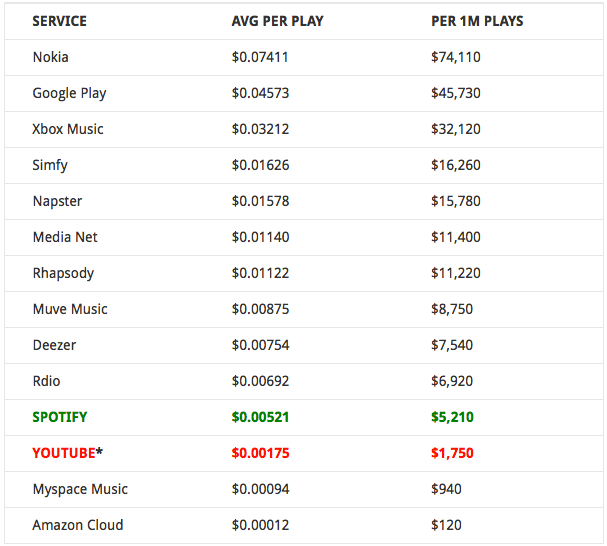
If you’re heading out to any panels at SXSW this week, you might want to keep this handy when you’re being told how much money you can make… And if the services at the top of the list like Nokia, Google Play and Xbox Music can pay more per play, why can’t the services at the bottom of the list like Spotify and YouTube?

We’ll give you a hint, the less streams/plays there are the more each play pays. The more plays there are the less each stream/play pays. Tell us again about how these services will scale. Looking at this data it seems pretty clear that the larger the service get’s, the less artists are paid per stream.

So do you think streaming royalty rates are really going to increase as these services “scale”? No, we didn’t either.

StreamingPriceIndexwYOUTUBE

* YouTube payment includes gross payable to single party uploader claiming 100% of rights including video, master and publishers. There should also be additional PRO money earned however we haven’t been able to get any reporting to date.Our YouTube pay rate calculations can be found here:What YouTube Really Pays… Makes Spotify Look Good!

What YouTube Really Pays… Makes Spotify Look Good! #sxsw

Is this the future of music? We continue to look at more artist revenue streams.

We’ve been waiting for someone to send us this kind of data. This info was provided anonymously by an indie label (we were provided screenshots but anonymized this info to a spreadsheet). Through the cooperative and collaborative efforts of artists such as Zoe Keating and The Cynical Musician we hope to build more data sets for musicians to compare real world numbers.

In our on going quest for openness and transparency on what artists are actually getting paid we’d love to hear from our readers if their numbers and experience are consistent with these numbers below. At the very least, these numbers should be the starting point of larger conversations for artists to share their information with each other.

Remember, no music = no business.

whatyoutubereallypaysFor whatever reason there appear to be a lot of unmonetized views in the aggregate. So let’s just focus on the plays earning 100% of the revenue pool in the blue set. These are videos where the uploader retains 100% of the rights in the video including the music, the publishing and the video content itself.

Plays  Earnings  Per Play
2,023,295 $3,611.84 $0.00179
1,140,384 $2,155.69 $0.00189
415,341 $624.54 $0.00150
240,499 $371.47 $0.00154
221,078 $313.47 $0.00142
TOTALS TOTALS AVERAGE
4,040,597 $7,077.01 $0.00175

So it appears that YouTube is currently paying $1,750 per million plays gross.

We understand that people reading this may report other numbers, and that’s the point. There is no openness or transparency from either Spotify or YouTube on what type of revenue artists can expect to earn and under what specific conditions. So until these services provide openness and transparency to musicians and creators, “sharing” this type of data is going to be the best we’re going to be able to do as East Bay Ray comments in his interview with NPR.

As we’re now in a world where you need you need a million of anything to be meaningful here’s a benchmark of where YouTube ranks against Spotify.

Service  Plays  Per Play  Total  Notes 
Spotify To Performers/Master Rights 1,000,000 0.00521 $5,210.00 Gross Payable to Master Rights Holder Only
Spotify To Songwrtiers / Publishers This revenue is for the same 1m Plays Above 0.000521 $521.00 Gross Payable to Songwriter/s & Publisher/s (estimated)
YouTube Artist Channel 1,000,000 0.00175 $1,750.00 Gross Payable for All Rights Video, Master & Publishing
YouTube CMS (Adiam / AdRev) ** 1,000,000 0.00032 $321.00 Gross Payable to Master Rights Holder Only

The bottom line here is if we want to see what advertising supported free streaming looks like at scale it’s YouTube. And if these are the numbers artists can hope to earn with a baseline in the millions of plays it speaks volumes to the unsustainability of these models for individual creators and musicians.

Meet the New Boss: YouTube’s Monopoly on Video | MTP

It’s also important to remember that the pie only grows with increased revenue which can only come from advertising revenue (free tier) and subscription fees (paid tier). But once the revenue pool has been set, monthly, than all of the streams are divided by that revenue pool for that month – so the more streams there are, the less each stream is worth.

All adrev, streaming and subscription services work on the same basic models as YouTube (adrev) and Spotify (adrev & subs). If these services are growing plays but not revenue, each play is worth less because the services are paying out a fixed percentage of revenue every month divided by the number of total plays. Adding more subscribers, also adds more plays which means that there is less paid per play as the service scales in size.

This is why building to scale, on the backs of musicians who support these services, is a stab in the back to those very same artists. The service retains it’s margin, while the artists margin is reduced.

[** these numbers from a data set of revenue collected on over 8 million streams via CMS for an artist/master rights holder]

RELATED:

Streaming Price Index Updated 2014 : Per Stream Pay Rates

Music Streaming Math, Can It All Add Up?

YouTube Shares Ad Revenue With Musicians, But Does It Add Up? | NPR