Music Artists Take On the Business, Calling for Change | New York Times

The New York Times quotes representatives of the artists rights movement including Blake Morgan of the #irespectmusic campaign, Melvin Gibbs of C3Action.Org (Content Creators Coalition), David Lowery of the Trichordist as well as musicians Zoe Keating, David Byrne and others.

“None of these companies that are supposedly in the music business are actually in the music business,” Mr. Gibbs said. “They are in the data-aggregation business. They’re in the ad-selling business. The value of music means nothing to them.”

READ MORE AT THE NEW YORK TIMES:
http://www.nytimes.com/2015/08/01/business/media/music-artists-take-on-the-business-calling-for-change.html

“User Pirated Content” Is Core Internet Advertising Model (Which is Why Streaming Rates Can’t Increase Until Piracy is Decreased)

Google’s YouTube is a business built on infringement as a model. So called “User Generated Content” is really just code for what the majority of the high value media on YouTube really is, “User PIRATED Content“.

In other words there’s nothing internet advertising loves more than illegally monetizing the work of professional creators, and thus driving down the true fair market rates for those works (keep this in mind when thinking about Spotify and streaming services!).

Below are excerpts from emails discovered during the Viacom Vs. YouTube lawsuit and published  by DailyFinance:

• A July 29 email conversation about competing video sites laid out the importance to YouTube of continuing to use the copyrighted material. “Steal it!” Chen said , and got a reply from Hurley, “hmmm, steal the movies?” Chen’s answer: “we have to keep in mind that we need to attract traffic. how much traffic will we get from personal videos? remember, the only reason our traffic surged was due to a video of this type.”

And this is not the only smoking gun, here’s a quote from DailyTech regarding Google’s Ad Sales and the site EasyDownloadCenter: 

In fact, Google’s ad teams even made suggestions designed to optimize conversion rates by using keywords targeted to pirated content – such as suggesting downloading films still in theatrical release, that obviously were not available yet in any authorized format for home viewing.

According to PCWorld this added up to some decent money…

EasyDownloadCenter.com and TheDownloadPlace.com generated US$1.1 million in revenue between 2003 and 2005, and Google received $809,000 for advertising, the Journal reported.

Both YouTube and Google Search function similarly by monetizing infringing “User Pirated Content” with advertising. On YouTube users upload infringing music and videos of all varieties which attract the consumers to the globally dominant and monopolistic video streaming site.

Remember the email above where the YouTube founders admit “how much traffic will we get from personal videos? remember, the only reason our traffic surged was due to a video of this type”. And by “this type” they mean professionally produced and created media by artists, musicians, filmmakers and other creative professionals that are of high value in attracting an audience – an audience that can then be monetized with advertising.

Google Search operates in very similar way (no coincidence) by monetizing (mostly with advertising) millions infringing URLs on sites primarily dedicated to distribution of copyrighted works via p2p networks and bittorrent.

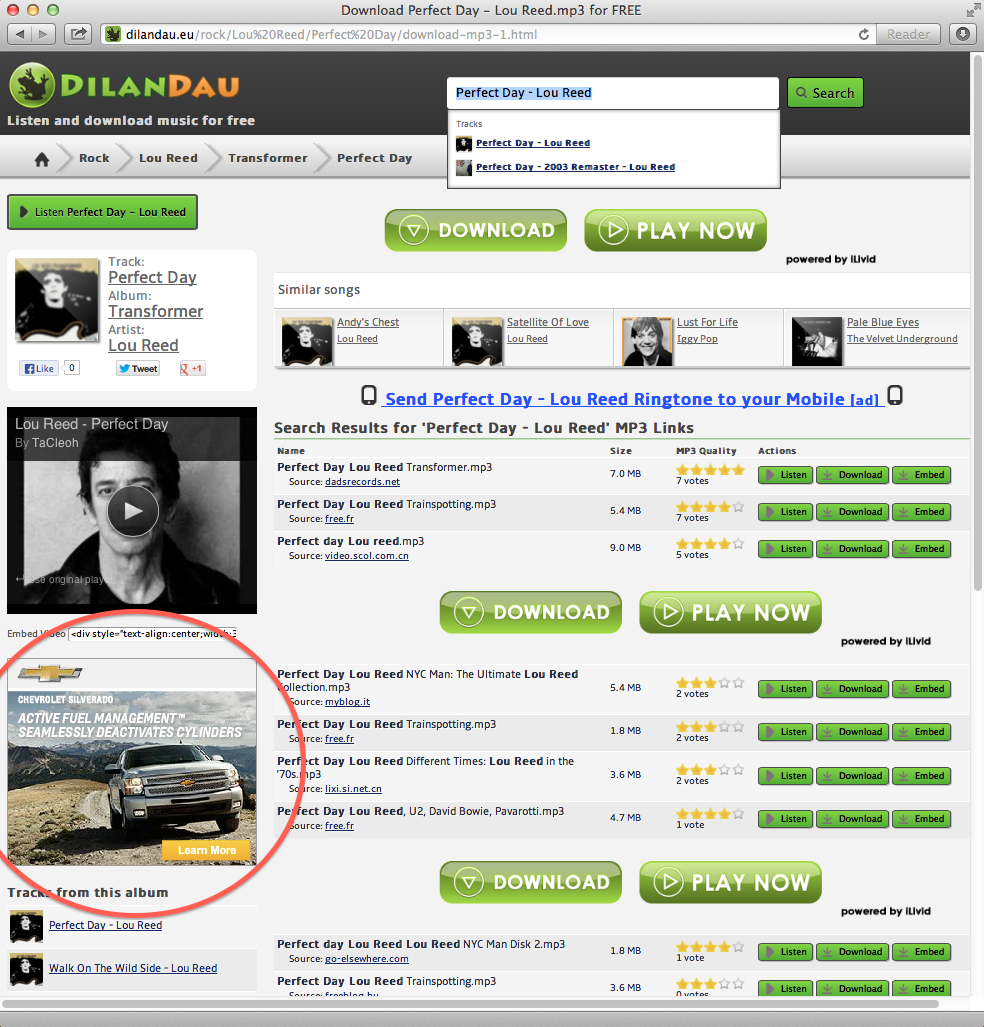
Over 50 Major Brands Funding Music Piracy, It’s Big Business!

LouReedCHEVY

But don’t take our word for it, here’s a report from DigiDay (owned by The Economist):

According to AppNexus CEO Brian O’Kelley, it’s an easy problem to fix, but ad companies are attracted by the revenue torrent sites can generate for them. Kelley said his company refuses to serve ads to torrent sites and other sites facilitating the distribution of pirated content. It’s easy to do technically, he said, but others refuse to do it.

“We want everyone to technically stop their customers from advertising on these sites, but there’s a financial incentive to keep doing so,” he said. “Companies that aren’t taking a stand against this are making a lot of money.”

What about the removing infringing material with a DMCA notice you ask? Well, we’re glad you did… here’s how it “works”…

https://vimeo.com/94514834


DMCA “Takedown” Notices: Why “Takedown” Should Become “Take Down and Stay Down” and Why It’s Good for Everyone | Nova Edu


Safe Harbor Not Loophole: Five Things We Could Do Right Now to Make the DMCA Notice and Takedown Work Better


Why .002 is Greater than .001 and Why 90 Days is Better than Forever…

There’s been a lot of talk and understandable dissent surrounding Apple’s free tier payment of the reported .002 per play during each consumers 90 day free trial period. We now live in a world of lessor evils.

Here are three things that we may want to keep in mind…

One:

Eliminating the Unlimited Free, Ad-Supported, On-Demand Access to Music is Job #1. Apple Music and Tidal are both positive steps in that direction.

Two:

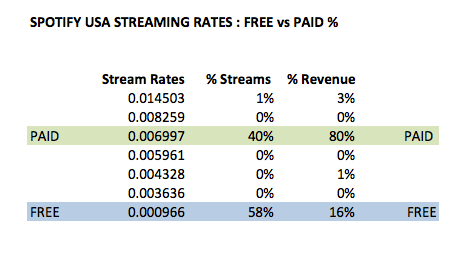
.002 is DOUBLE .001 which is what Spotify is paying on it’s ad-supported free tier (see chart below). Yes, we’d love Apple to pay the full ride. Yes, Apple can afford to pay the full ride. Yes, we support any action that influences Apple to pay the full ride – but as a compromise we could be doing worse, and in fact we have been for over five years since the Spotify launch.

Three:

90 Days is Limited. Ad-Supported is forever. This is the big problem. Even if  Spotify was limiting their ad-supported free tier to 90 Days, Apple is still paying DOUBLE. But the real problem is that Spotify is FREE FOREVER. It’s time to keep the eye on the prize here.

Three Steps to a Sustainable Digital Music Ecosystem:

1) Eliminate the Unlimited Free, Ad-Supported, On-Demand Access to Music

2) Windowing

3) Tiered Pricing, based on Access and Consumer Value Proposition

That’s really it. It’s not really any harder than this and we can already see these models working for the Film and TV businesses.


Streaming Is the Future, Spotify Is Not. Let’s talk Solutions.


Why Spotify is not Netflix (But Maybe It Should Be)


Why Digital Exec’s ARPU is Bad Math and also Bad Philosophy for Artists.

Why Apple Music and Tidal are the right business models with the wrong optics.

Since Spotify launched in 2010 the music business has been in an existential crisis. Convinced that ad-supported unlimited free access to on-demand music would ultimately grow recorded music revenues the major labels opted into what may be their worst decision ever. This decision aided by an estimated 18% (or more) equity position in Spotify has not grown overall music revenues over the past five years. In fact, for the year ending 2014 global revenues reported by the IFPI stated that revenues were at the lowest point in decades. So what to do?

For starters the first and most obvious solution would be to eliminate the unlimited ad-supported free access to on-demand music. This is the model that made ad funded, for profit piracy so popular on over half a million infringing links from unlicensed businesses served by Google search and delivered to your inbox by Google Alerts complete with social media sharing buttons. These unlicensed businesses are receiving hundreds of millions of DMCA notices annually from artists and rights holders. Let us not forget that this is also the same model that Daniel Ek helped to perfect as the CEO of u-torrent the worlds most installed bit-torrent client. Ek has said he’d rather shut down Spotify than give up his failed ad supported business model.  We thought Spotify was built on converting ad supported (where Spotify board member Google makes money serving ads) to subscription (where artists make money).  So much for that.

And this is who the record business is taking notes from? Perhaps that’s why Universal is restructuring.  This may have seemed like a good idea to some senior executives but it turned out to be a complete disaster.  Time to change.

Despite moves in the right direction by Tidal and Apple Music the optics for both of these companies at launch of their respective streaming models have been somewhere between missteps and an absolute disaster. Dismissing for a second that both Apple and Tidal could be the targets of public relations campaigns by competing corporations such as Spotify, Pandora and Google (YouTube) let’s look at what each is offering. Tidal and Apple Music offer no unlimited ad-supported free access to on-demand music. That means no business to those selling advertising… like, Google.

There is nothing more important to the future of the recorded music ecosystem than removing the unlimited ad-supported free access to on-demand music.

For all intents and purposes even free streaming is ownership and here’s how you can tell. If you can chose it, and access it, you essentially own it whether you pay for it or not. Streaming replaces ownership at the consumer level but does not compare to ownership on price. At some point there needs to be a market correction to properly value music consumption.

The launch of Tidal should have been a rallying cry for all artists to support a business model that limited free streaming, incentivized paid subscriptions through exclusive offerings and diversified consumer experiences with higher quality streaming formats. This is the model we should be focused on. As the Buddhist saying goes, “trust the teaching, if not the teacher.” In other words it doesn’t matter if you don’t like Jay-Z and Madonna.  And securities laws makes the whole stock issue so difficult that Tidal would have been far better off saying they’d pay all participating artists a bonus in the cash from the company’s own stock sales rather than get down the rabbit hole of who gets stock and who doesn’t.

Unfortunately the celebrity that could have united a community, instead divided it through messaging that most would acknowledge appeared to be less than inclusive. Worse, the optics appeared to be elitist whereby those already rich and famous seemed to be more focused on their own fortunes as opposed to a sustainable ecosystem for the next generation of musicians.

Perhaps if each of the artists at the Tidal launch would have appeared with a developing artist they were supporting the messaging and optics would have been more inclusive and more about community than celebrity.

We have to acknowledge what kind of business we want going forward. Clearly, unlimited ad-supported free access to on-demand music is not working. Both Tidal and Apple Music do NOT have unlimited ad-supported free access to on-demand music. So what’s the problem?

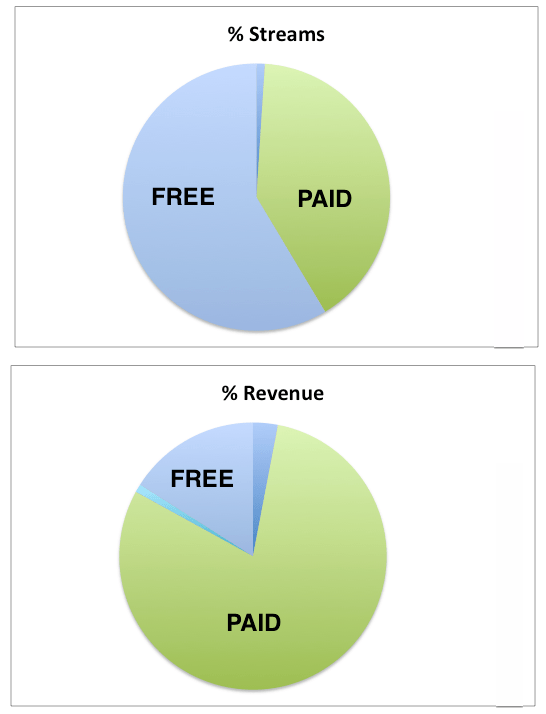
Following the Apple Music launch Spotify announced it had achieved 75m global users (we love that, “users” no kidding) and 20m paid subscribers. So let’s look at the numbers in relationship to what Apple Music could bring to the market place. Keep in mind that 55m of Spotify’s user base are NOT paying for the service. Based on reporting we’ve been provided the free tier accounts for 58% of plays which is only 16% of the total revenue.

With all the back and forth between Apple and labels and the announcement last week by NMPA of the publisher’s deal—freely negotiated without government “help” by the way–it’s pretty clear that Apple announced Apple Music without all their ducks in a row contractually.  This opened up an opportunity for haters who are just gonna hate.  Now that the picture is becoming a bit clearer, we feel more confident than ever that most of the noise is coming from competitors who would like to create yet another consent decree situation but this time for artists and record companies.

So there are a few questions we need to ask about the launch of Apple Music to evaluate the trade-off for eliminating the unlimited ad-supported free access to on-demand music. But before we ask those questions, we need to understand the mechanics of the Apple Music ecosystem.

First, the 90 days free without payment at launch requires the understanding that all consumers will get 90 days free at Apple Music whether they sign up at launch or at any other point later. This means that some people will opt in at launch, some will opt in at some later time. Based on what we have seen of how these streaming subscription services scale we have to ask a few questions.

How many people will have access to opt into Apple Music Streaming on launch? We’ll assume it’s the entire installed user base who upgrade into iOS 8.4. Here’s some back of the napkin math from the iPhone 6 launch when Apple dropped that U2 album into everyone’s Itunes.

According to CBS News 33 Million people of the 500 Million Global Itunes users “experienced” the U2 album. That’s just 6.7 percent of Apple’s reported consumer base.

So what kind of adoption and conversion rate could one expect from the launch of Apple Music? 10 million paid subscribers? 20 million paid subscribers? 50 million paid subscribers? It’s hard to know, but anything north of 20 million pretty much beats Spotify on paid subscribers.  And if you are looking for the company that has defined a paid music service, who you gonna call?  Apple or Spotify?  Who do you trust going forward?

What if Apple is able to convert 30 million or more consumers to paid streaming in only four months when it has taken Spotify five years to acquire 20 million paid?


BREAKING NEWS AT PRESS TIME. APPLE WILL PAY ARTISTS DURING THE FREE TRIAL PERIOD!
Apple Reverses Course, Will Pay Artists During Apple Music Free Trial | Mac Rumors


Of course, Apple should use a couple of bucks from it’s 178 billion dollars in cash reserves to compensate musicians for the consumption of their music during the initial 90 day launch of Apple Music. This would  incentivized artists to promote the service as being both fair and artist friendly and give Apple the thumbs up from the people that matter the most, the artists themselves. Apple’s purchase of Beats was a three billion dollar acquisition, so surely there’s enough money in those coffers to pay artists something.

To put these numbers into perspective Spotify claimed to have paid artists and rights holders two billion dollars globally from it’s initial launch in 2008 through October of 2014.

Here’s some more perspective from asymco.com: In 2012, global music revenues were reported at $16.5 billion, with $5.6 billion coming from digital music. Of that $5.6 billion in music downloads, Apple paid labels $3.4 billion for iTunes sales, which is about 60% of the total digital revenues industry wide—IN LESS THAN ONE YEAR.

In 2012, Apple’s transactional digital model created more revenue for artists and rights holders in less than a year in then it took for Spotify to earn almost 6 years.

If we want to break the death spiral of unlimited ad-supported free access to on-demand music we have to embrace the trade-off of offering limited free trial periods as an incentive for consumers to make the switch.

And by the way—compare the classy way that Eddie Cue of Apple handled Taylor Swift compared to Daniel Ek who comes off like a semi-stalker.  Who understands artist relations the best?

The problem with ad-supported unlimited free access to on-demand music is illustrated below showing Spotify domestic streams and revenues. It’s just math and it’s time to move on. Apple Music and Tidal are showing us the way.

 

DMN Says It’s Unlikely Spotify Pays More to Rights Holders Than Apple Does

In the dust up surrounding the Apple Music Launch and the leaked agreement that lead to speculation that Apple was paying indies less than the often heard 70% to rights holders an interesting thing happened.

Industry executives and commenters at Digital Music News reported that Spotify was also paying indies less than 70% and closer to the 58%, or less than Apple.

Update to June 15th, and Apple is not only stating that they are paying 70%, but a more aggressive 71.5% to 73% of revenues depending on territory.

But what makes this that much more interesting is that Spotify has now been outed as NOT paying the commonly accepted 70% of revenues and also has NOT responded to the claims being made at Digital Music News…

So how much is Spotify actually paying? So much for openness and transparency…

RutOh...

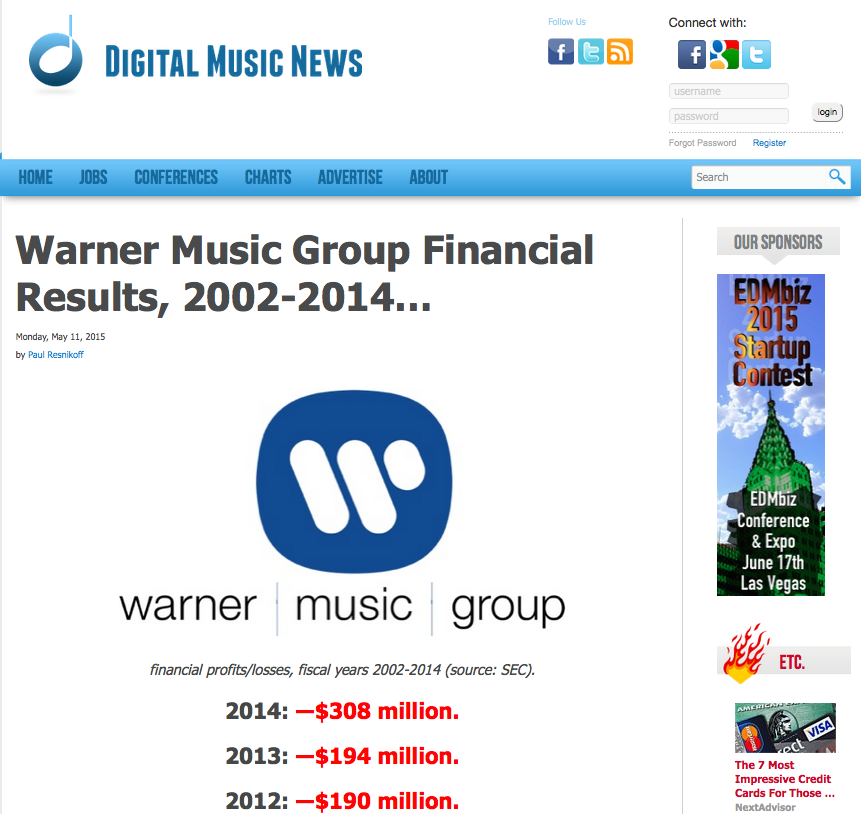
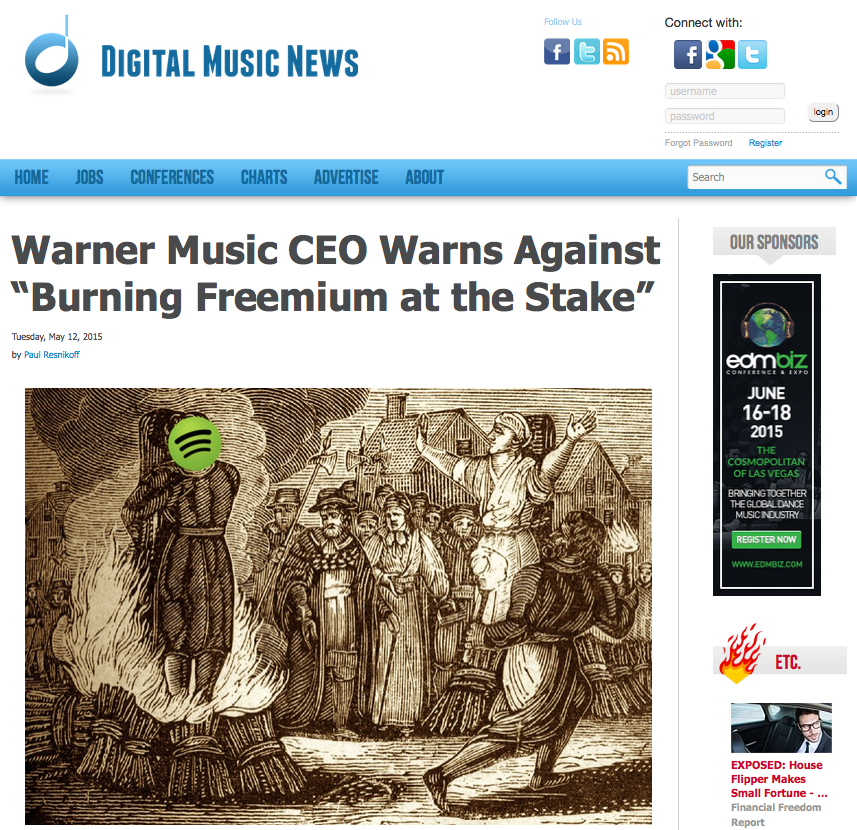
Warner Music Group Free Streaming Advocates Lose Another $100m in 2014… Can’t Make This Up…

We can’t help but think these two things are related. Read the full stories at DMN… Here and Here

WarnerMusicGroupLosses


WarnerMusicFreeStreaming

So how’s that $3.00 per “user” annual ARPU working out from free streaming?

It’s amazing to us that the current conversation and controversy is still focused on the free tier. We’re not entirely certain that Spotify can even work at $10 a month / $120 per yer, per subscriber. The number of subscribers needed to replace the revenue from transactional sales exceeds those of any current mature subscription business.

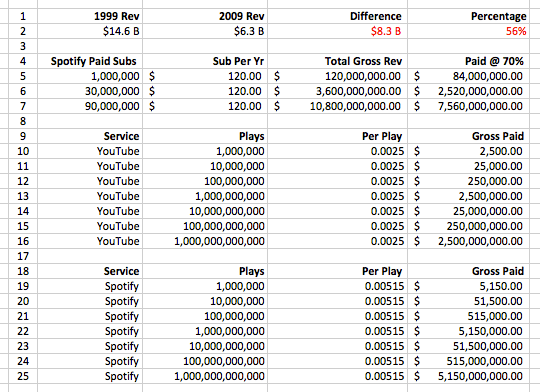
It will take  60 Million PAID subscribers at $10 a month to generate about $7.2b in gross revenues annually. It takes another 30 Million (or 90 Million PAID Total) to come up with $7.5b payable to rights holders. Ninety Million. Paid…

Here’s some context for the chart above. Netflix only has 36m subscribers in the US, no free tier, and massive limitations on available titles of both catalog and new releases. Sirius XM, 26.3m in the US as a non-interactive curated service installed in homes, cars and accessible online. Premium Cable has 56m subscribers in the US paying much more than $10 a month and also with many limitations. Spotify… 3m paid subscribers in the US after four years. Tell us again about this strategy of “waiting for scale.” Three Million Paid… Three…

* 3m Spotify Subs Screen Shot
* 26.3m Sirius XM Subs Screen Shot
* 36m Netflix Subs Screen Shot
* 56m Premium Cable Subs Screen Shot
* $7b Music Business Screen Shot

It’s just math.


Streaming Is the Future, Spotify Is Not. Let’s talk Solutions.

Music Streaming Math, Can It All Add Up?

Spotify is the Problem, Not Labels. (Well, Mostly…)


Why Digital Exec’s ARPU is Bad Math and also Bad Philosophy for Artists.

ARPU. Do you know what that is? It’s Average Revenue Per User. Not withstanding the insulting connotation of referring to fans as “users” this is just bad on a number of different levels.

Leaked Sony emails suggest that digital music executives confuse per-capita with ARPU. One of the items we’ve found cruising wikileaks has digital music execs explaining the digital landscape ARPU as follows:

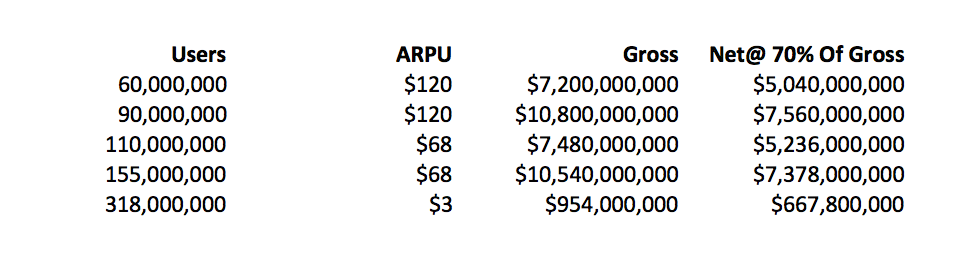
$120 Streaming Subscription

$68 Downloads

$3 Ad-Supported Streaming

We’ll get into the fallacy of the $68 Downloads vs the $120 Streaming Subscriptions in a minute. But first, let’s just look at the fact the industry digital execs actually clocked ad-supported ARPU at $3 per user per year and did it anyway! Seriously? Really? Who thinks going from $68 to $3 is a good idea and then doubles down on trying to get sell in on it? Wow, just wow.

Ok, now back the $68 Downloads ARPU. The question that never seems to be qualified in these ARPU valuations is how many users exactly contribute to the revenue pool to end at up an average of $68 per user? The next question would be how many of those “average” users are paying significantly more than $68? Hell, how many are paying significantly more than $120 per year?

In a basic 80/20 model we would expect that 80% of the revenue would come from 20% of the consumers (er, um… “users”). This means the most valued “users” are now being artificially flattened DOWN to $120 per year.

Streaming Subscription fees as a representative of ARPU doesn’t work, because there are only TWO numbers that can be worked into the average, $120 and zero. So now you have the problem of trying to raise the causal user up to $120 per year while you’ve flattened down your best costumer (er, user). This is the crazy rational behind dropping streaming subscriptions down below $120… But wait… wouldn’t that just also artificially flatten the overall market even lower than the $120 ARPU? Yeah… you bet it would.

It’s truly astounding the lack of ability to use calculators and do simple math. We’ve pointed this out again and again. Even at 90 Million Paid Subscribers at $120 per year, that only generates $7.5b in industry revenue. Ninety Million Paying Subscribers. Just keep saying that over and over until it sinks in.

Subscriptions artificially flatten the market and require extremely high (and largely unrealistic) subscriber numbers because the actual number of “users” consuming music is probably at least double 90 million in the USA. That’s where an ARPU of $68 starts to make sense, somewhere around 110-155 million consumers, but most likely even higher. So, here’s the rub – who really believes that Spotify (or all subscriptions streaming services combined) are going to convert 10s of millions of casual consumers/users into $120 per year ARPU’s? They’re not and that’s why this model is screwed.

ARPUisBAD

For streaming to truly mature the industry needs to embrace tier based, value pricing, so that a truly dynamic and flexible ARPU can be restored. The one size fits all Streaming Subscription ARPU is a lie, and the math shows us why.


Has music missed its ‘Netflix moment’? | Music Business Worldwide

Subscription streaming movie service Netflix announced earlier this week that it has reached 62m users around the world – almost exactly the same number as Spotify.

Big difference is, four times as many of Netflix’s customers pay a subscription each month: 60m of them, or 97% of its total consumer base.

READ THE FULL STORY AT MUSIC BUSINESS WORLDWIDE:

Has music missed its ‘Netflix moment’?


Why Spotify is not Netflix (But Maybe It Should Be)


Streaming Is the Future, Spotify Is Not. Let’s talk Solutions.


BUT SPOTIFY IS PAYING 70% OF GROSS TO ARTISTS, ISN’T THAT FAIR? NO, AND HERE’S WHY…

Apparently Billboard Doesn’t Want Jay Z at Billboard Music Awards, Pimps for Spotify! @S_C_

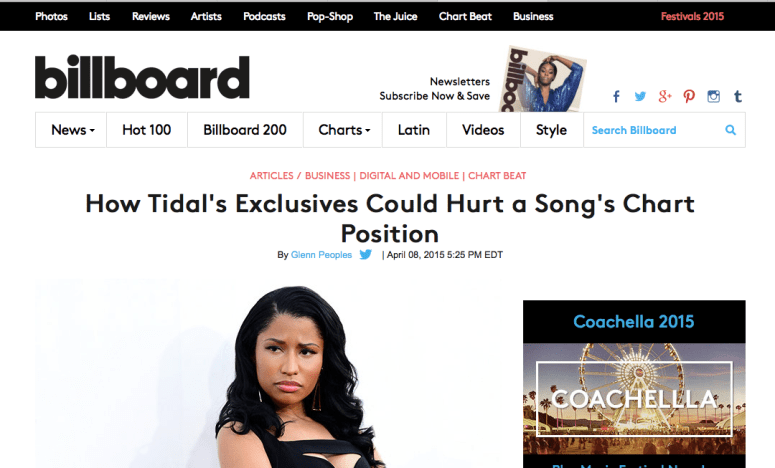
Why on earth is Glenn Peoples and Billboard warning artists not to go exclusive with Jay Z’s Tidal?   Is Billboard pimping for Spotify?    We’ve long suspected this. Glad it’s almost out in the open.

Screen Shot 2015-04-09 at 2.45.06 PM


The ‘Zero Effect’: Do New Consumption Charts Penalize Compilation Records and Artists Who Window?


New Math $.00666 : Billboard’s New “Consumption” Chart, Free Streams and the End Of Meaningful Metrics?