Spotify Desperately Doubles Down on Dumb Bad Math… Free Doesn’t Pay, It’s Just Math.

Bring out your shills… It’s no surprise that Spotify has once again enlisted it’s shills and PR machinery to defend it’s exploitation of artists, bad business model, and horrible royalties. The latest offensive comes as the major labels have announced that the unlimited free tier is not working for them (go figure, free doesn’t pay?).

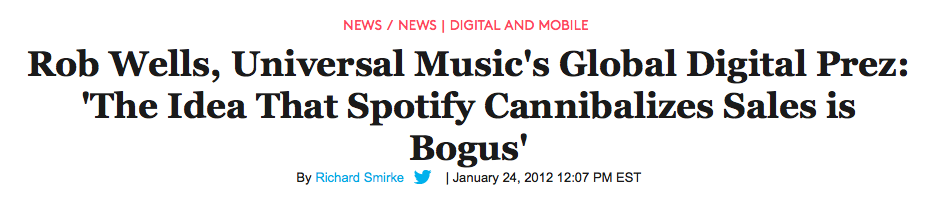
Last year we wondered out loud, Who will be the First Fired Label Execs over Spotify Fiasco & Cannibalization? In February of this year we found out when Rob Wells exited his post at UMG. Around the same time public comments were made by Lucian Grainge for the need to get more paid subscription revenue. He also noted that the free tiers are not creating the type of performance required for a sustainable ecosystem of recorded music sales. Sony music chief Doug Morris has also come to the party stating, “In general, free is death.

Generally speaking we’re not often fans of major labels (remember they have 18% equity in Spotify) but we’re glad they’ve gotten out the calculators. Right now, the three major labels are currently reviewing their licenses with Spotify which are up for renewal this year. This is the time for the major labels to renegotiate those licenses to be more fair for artists.

We’ve detailed the math here, Music Streaming Math Can It All Add Up? In that post we look at the numbers based only upon paying subscribers. The bottom line is that even at the current rate of $9.99 (per month, per subscriber) it’s going to take a lot more paying subscribers to even get close to the type of revenue earned from transactional sales. Free, ad supported revenue, not even close.

Here’s a couple more things to keep in mind that we’ve detailed:

* Spotify Per Stream Rates Drop as Service Adds More Users…

– and –

* USA Spotify Streaming Rates Reveal 58% of Streams Are Free, Pays Only 16% Of Revenue

But perhaps the worst part of Spotify was outlined by Sharky Laguna’s editorial, “The Real Reason Why The Spotify Model Is Broken.” The well written piece details how the artist you play, may not be the artist who get’s paid due to the fixed revenue pool and market share distribution of revenues.

Now keep in mind we’re not anti-streaming. We completely believe that streaming is the future of music distribution and delivery. None of our arguments here are anti-streaming or anti-technology.

Our arguments are anti-exploitation and anti-bad business models. Technology and economics are different issues. We detailed our thoughts for moving forward with potential solutions in our post Streaming Is The Future, Spotify Is Not, Let’s Talk Solutions. We look at five practices that can make streaming music economics viable for all stakeholders and generate the revenue required for a sustainable ecosystem.

When a Spotify rep says, “We think the model works” keep this in mind as we review the Spotify Time Machine…

* 2010 A Brief History Of Spotify, “How Much Do Artists Make?” @SXSW #SXSW

Back in 2010 during Daniel Ek’s Keynote Speech an audience member who identified themselves as an independent musician asked how much activity it would take on Spotify to earn just one US Dollar. The 27 year old wunderkind and CEO of the company was stumped for an answer… Five years later we have a pretty good idea why.

– and –

* 2012 A Brief History Of Spotify, “It Increases Itunes Sales”… @SXSW #SXSW

Ek strenuously denied that his streaming service cannibalises sales of music through services such as Apple’s iTunes.

“There’s not a shred of data to suggest that. In fact, all the information available points to streaming services helping to drive sales,” he said.

Of course, that was until this past year when Itunes sales are reported to have declined by 13-14% and that is pretty much directly attributed to the cannibalization done by Spotify. Hello…

It is said that one of the definitions of insanity is to keep doing the same thing while expecting different results. Our suggestion to the those in positions of power is simply this, if  you want something different, you have to be willing to do something different.

Sure, Spotify was a grand experiment but after half a decade we now have the data to know if that experiment is working out (or not). In the end, it’s just math and free doesn’t pay…


Streaming Is the Future, Spotify Is Not. Let’s talk Solutions.


Spotify Per Stream Rates Drop as Service Adds More Users…
 

USA Spotify Streaming Rates Reveal 58% of Streams Are Free, Pays Only 16% Of Revenue

Dead Kennedys’ East Bay Ray: The ‘Free Internet’ Will Not Set You Free | NY Observer

These Internet theorists also invariably fail to distinguish between the profound moral difference between sharing something with a friend and distributing, without permission, other people’s files for profit. It’s a crucial distinction.

One of the reasons that this distinction is not brought up is because the Internet corporations don’t want you to see much discussion about the enormous riches being made on the Internet from both the consensual and nonconsensual selling of your information to advertisers, as if it didn’t matter. The advertising system has money and money is power. Ask yourself: Are you gaining real power over your destiny from the Internet, or just stuff?


2012 A Brief History Of Spotify, “It Increases Itunes Sales”… @SXSW #SXSW

Stop us if you’ve heard this one before… Spotify doesn’t cannibalize Itunes sales it actually increases them… Uh huh. That was the rap they wanted us to believe. Smart and cautious artists and labels seem to have been right by avoiding Spotify.

In 2014 Itunes sales are reported to have declined by 12-14% and that is pretty much directly attributed to the cannibalization done by Spotify.

So here’s what they said in 2012…


Spotify Plays Can Increase iTunes Sales. Here’s Proof! | TechCrunch

… there’s no evidence of Spotify or other streaming services negatively impacting music sales. More data like this could encourage artists and labels to promote their streaming music presences, and push acts like The Black Keys and Paul McCartney who’ve pulled their catalogues from Spotify to come back.


Spotify launches new apps, as Universal again defends the service| CMU

Paul Smernicki did some more defending at a Guardian conference. According to Music Ally, Smernick told the conference: “We’ve looked really really hard for evidence of cannibalisation, almost unobjectively. Across the business, we’ve been unable to find that evidence. And in [European] markets where Spotify has launched, the growth in the digital business has been about 40%, in territories where it doesn’t it’s around 10%. There’s a healthy ecosystem and it can be served by many of those services”.


Spotify chief: streaming services boost music sales | The Telegraph UK

Speaking to digital music site Evolver.fm in a pre-Grammys interview, Ek strenuously denied that his streaming service cannibalises sales of music through services such as Apple’s iTunes.

“There’s not a shred of data to suggest that. In fact, all the information available points to streaming services helping to drive sales,” he said.


Does Streaming Cannibalize Albums? | Billboard

Wilson points out that the number of digital downloads has increased-up 15% for albums and 6% for tracks in the first 46 weeks of 2012, according to SoundScan-suggesting that the widespread availability of free on-demand streaming hasn’t led to a sales apocalypse.

Rhapsody chief executive Jon Irwin says, “The only thing streaming music cannibalizes is piracy.”


So there you have it.  Three years later and meanwhile back on earth the actual effects of Spotify on the transactional sales of recorded music have been a disaster. Which is why there are major changes happening at the major labels as Spotify licenses come up for renewal.

2010 A Brief History Of Spotify, “How Much Do Artists Make?” @SXSW #SXSW (Shill By Shill West)

SXSW Rewind… Back in 2010 during Daniel Ek’s Keynote Speech an audience member who identified themselves as an  independent musician asked how much activity it would take on Spotify to earn just one US Dollar. The 27 year old wunderkind and CEO of the company was stumped for an answer… Five years later we have a pretty good idea why.

2010… #SXSW Rewind…


Live Blog: Spotify CEO Daniel Ek Says Music Service Now Has 320,000 Paid Subscribers | TechCrunch

Q: How many plays equals one dollar?
A: Depends on the type on contract with the publisher/record labels. We share the rev we bring in. You can’t really equate to ‘per play’ we look at all our ad rev. Creates a bucket. For instance how do you account for a purchase of a song. There is no easy answer to your question. Over time our ad revs are growing, number of downloads growing. Amount of rev we bring in is growing.


Will Spotify Be Fair to Artists? | Technology Review

I couldn’t help noticing, however, Ek’s artful dodge to the question of how artists are paid by his service. The subject was broached by an audience member, who identified himself as an independent musician and thanked Ek profusely for the great application. He wanted to know how much he would be paid.

“It’s complicated,” was, in essence, Ek’s reply. But he did reveal that it’s a revenue sharing model; artists get paid a proportion of whatever Spotify gets paid, presumably based on the number of plays on the site they receive.

Ek’s reply was disappointing because this is the million dollar question for many music sites.


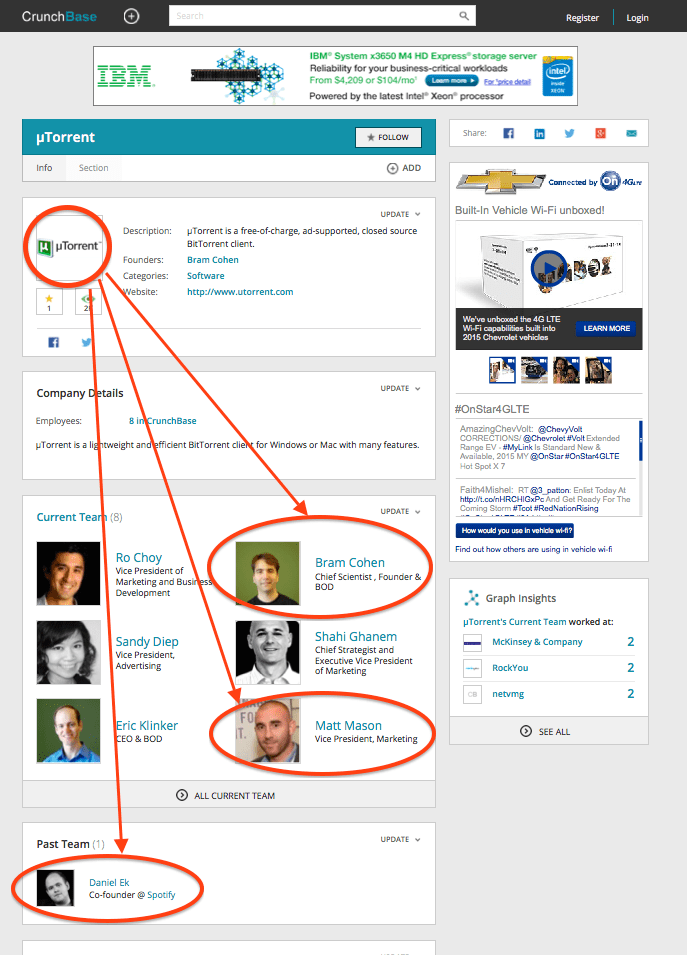
Dodgy from the start. What do you expect from one of the co-founders of U-Torrent… Economics only a pirate could understand?


A Tale of Two Pirates? Daniel Ek (uTorrent) and Kim Dotcom (Megaupload)


USA Spotify Streaming Rates Reveal 58% of Streams Are Free, Pays Only 16% Of Revenue


How to Fix Music Streaming in One Word, “Windows”… two more “Pay Gates”…

If Streaming is the “Solution” to Piracy, What Happens When Piracy is Streaming? Rot Oh… #sxsw

A big talking point of streaming, particularly of the Spotify variety has been that streaming is a solution to piracy, and that “access over ownership” models are the future.

Well… ok… but that assumes that piracy (of the corporately sanctioned, ad funded variety) remains a download business, while consumers migrate to the easier more accessible (free tiered, ad funded) music streaming models.

We’re told that the ad-supported free tier is the only way to attract consumers from piracy to legality. To be clear we’re not opposed to free trial periods. Free trials of 30 days, maybe even 60 days should give the consumer the ability to fully experience the value a streaming service offers. We just don’t see how the economics of ad-supported free streaming can create a sustainable revenue model for musicians and songwriters.

But here’s the bigger question. What happens when the pirates migrate to streaming over storing? Now we’re back to square one. A decade ago iTunes and later Amazon provided an legal solution to piracy that was superior in every way except one, price.

Why would anyone think that streaming would combat piracy any better than transactional downloads? Well, for the same reason piracy is, was and remains the primary source of music consumption, price. So the conversation and controversy over streaming is not one about the method of distribution, or technology. The conversation is the same as it has been for a over a decade, price.

Essentially Spotify appears to be designed to model ad-funded piracy whereby the company who can capture the largest market share would have ability to legally devalue music by delivering it to consumers for free. This math just doesn’t work. We can’t even see where the math on paid subscriptions will ever get to scale or revenue at a price point of $9.99 a month per subscriber.

So the inevitable question becomes if streaming is the solution to piracy, what happens when piracy is streaming? There are already multiple applications that are available or in development that reportedly enable users to stream music directly from BitTorrent as opposed to the need to download files to a local hard drive.

So explain to us again exactly how streaming is a solution to essentially the same service? Oh, they both need to compete on the same price point, which is free. Well, guess what, ad-supported free distribution of music is not sustainable.

YouTube is the largest free ad-supported free streaming distribution platform and it can not create the type of revenue required for the sustainability of the recorded music business. If we believe what they say, YouTube isn’t even a profitable business for Google!

So here’s the bottom line. Spotify, YouTube, Pandora and other ad-supported free streaming services are a side show to take the conversation away from the core problem, piracy. Internet piracy is big business and these side shows distract the conversation away from the fundamental truth of our economic reality… Free doesn’t pay. It’s just common sense and it’s just math…


Spotify Doesn’t Kill Music Sales like Smoking Doesn’t Cause Cancer…


BUT SPOTIFY IS PAYING 70% OF GROSS TO ARTISTS, ISN’T THAT FAIR? NO, AND HERE’S WHY…


Apple Announces Itunes One Dollar Albums and Ten Cent Song Downloads | Sillycon Daily News


YouTube’s Content ID : $375.00 Per Million Views… aka “Block In All Countries”…

We’ve been supplied nearly a year’s worth of Content ID data from a mid-sized indie label. Over the course of about a year here’s what the data shows:

Content ID

After nearly a year and 80 million plays, the net average per play amounts to less than $375.00 per MILLION Plays on YouTube. Ok, that’s just for the sound recording, there are two other parts to the uploaded copyright, the musical composition and the video content itself. Assuming each of the three parts earns an equal share (why would they not, but how would we know given YouTube’s usual secrecy sauce?), then the full amount payable by YouTube for 1 Million plays via Content ID would be $1,125, or $.001125 per play (on average).

We know that on directly uploaded videos where the creator or rights holder is claiming all three copyrights they are being paid more than $1,125 per million plays on average. So why is the revenue reduced when claimed on Content ID?

The other interesting thing about this data is that there is ZERO consistency on what one play is worth. For example, in what world, and under what circumstances is nearly 70,000 plays worth less than $.30? We’ve heard that the major labels may have a per play floor (or indirectly get the equivalent in off the books “breakage”), but after reviewing this data even that is hard to believe.

The lack of openess, transparency and consistency makes it virtually impossible to determine what the true value of a play is within a single category like a Sound Recording let alone comparing the comparable rates paid for Song Writing and the Video itself. Oh yeah, and there’s no audit clauses either – how convenient.

It is still shocking and amazing to us that after a decade YouTube is still not profitable and is being subsidized by Google’s monopoly money from search and data scraping, and yet digital music executives have been trying to sell us on this as the future of revenue for musicians. How is it that after a decade YouTube can not make a profit? If this is the new financial standard for record labels we can see that it’s starting to work! Is this the genius business model labels are embracing? No profit for a decade? If this is the new standard then we suppose everything is fine…

YouTube’s Content ID presents the same problems and challenges of virtually every other ad-supported streaming platform – it’s just math, and it doesn’t work.

There is an even darker side to YouTube that is exposed in Content ID. Even though the video pictured below was eventually removed from YouTube (via a manual DMCA claim) it illustrates the core problem of YouTube in general.

Here’s the music of Jack White being used to sell Sex Tourism and perhaps even Human Trafficking and Sex Slavery.

Note the Ads by Google with the fine print asking YouTube users to “chat now” or “send gift” for asian girls in Thailand and China as well as filipinocupid.com.

Artists have no consent over where their music is being used, or for what their music is impliedly endorsing or selling. It’s not a big leap from the above to political uses where an artist’s song can be exploited to endorse political candidates, ideologies and issues to which the artist is philosophically opposed.  Like human trafficking.

We have a hard time believing artists would lend their consent to these types of videos (if they knew at all), but then again, you never know when dangling that carrot of thirty cents of revenue in front of them…

So in a world where Spotify is paying about $5,000 per million plays on sound recordings, YouTube by comparison is paying less than $375 for the same million plays. So let’s add this up.

On YouTube artists have no consent and are granted no licenses for the (infringing) distribution for the majority of their work and they’re paid less than 1/10th of what Spotify pays for the same sound recording. Wow, just wow. Ya’ll doing the math on this?

If you thought that Spotify was problematic as an ad-supported streaming platform one has to wonder what could possibly be attractive about YouTube… Oh, you don’t have a choice. You do what YouTube and Google tell you to do as we saw with Google’s “notice and shakedown” practices with Zoë Keating and indie labels. The great decade long experiments of ad-supported streaming are a disaster for artists and rights holders while cannibalizing transactional revenues that once sustained the industry.  Not to mention Google taking down an eye popping 180 million infringing videos from YouTube.

Although streaming is no doubt the future of distrbution, the mismanagement of this transition may well be the worst planned in the history of the industry.

Our advice to artists, particularly artists who own their recordings, is it’s time to take a pass on that $375 per million views and toggle your Content ID setting to “Block In All Countries.” How about adding a little scarcity and reality back into the economics of online music distribution? If YouTube wants to monetize your work maybe they can come up with a fair license.

It’s just math. Just say no…

Block_In_All_Countries

OK, let’s review, you can enable Content ID and make $375 per 1 million views, or you can Block In All Countries. The choice seems pretty obvious, doesn’t it? It’s pretty stunning when Spotify start to look like the good guys.


It’s Just Math : Digital Music Execs Exit, But will the Pivot to Paid Subs Be Enough To Save The Record Biz?

Back in October of 2014 we asked the question “Who will be the First Fired Label Execs over Spotify Fiasco & Cannibalization?“. Now we know. In one week, two senior major label digital music execs have resigned. First Rob Wells on Monday, and on Friday David Ring followed.

Screen Shot 2015-02-24 at 12.18.56 AM

We don’t know if these resignations are related to the realization that Spotify actually is cannibalizing transactional revenues, or that YouTube Music Key will do more and worse, but the timing is suspect given recent statements by label chief Lucian Grange.

“We want to accelerate paid subscriptions… Ad-funded on-demand is not going to sustain the entire ecosystem of the creators as well as the investors” – Lucian Grange

Spotify has been a disaster from bad artist relations to the catalyst for declining transactional revenues. We celebrate the move for more aggressive positioning to paid subscriptions, but even at current rates of $9.99 a month it’s hard to see subs gain the marketshare and revenue needed to compensate for the rapidly declining transactional revenues. In 2014 Itunes revenues dropped by double digits with Apple reporting a decrease of 13%-14% year to year. This following a decrease in overall digital revenues in 2013 (the first decrease ever in digital format sales since their inception).

So that’s two consecutive years of reduced revenue in what should be a growing market segment. So what went wrong? In a word, Spotify. Two more, YouTube.

In other words, Free Doesn’t Pay…

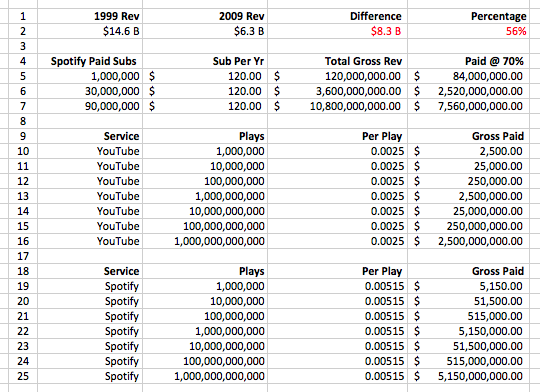
We’ve said it before and we’ll say it again, it’s just math. Below is a table we first published two years ago in February of 2013 when we asked the question, “Music Streaming Math, Can It All Add Up?”.

streamingmath

Although the aggressive move to paid subscriptions is a very positive one, we’re still concerned when looking at the numbers in the tables above when put in the context of the current state of the mature subscription based businesses (see below).

Netflix only has 36m subscribers in the US, no free tier, and massive limitations on available titles of both catalog and new releases. Sirius XM, 26.3m in the US as a non-interactive curated service installed in homes, cars and accessible online. Premium Cable has 56m subscribers in the US paying much more than $10 a month and also with many limitations. Spotify… 3m paid subscribers in the US after four years. Tell us again about this strategy of “waiting for scale.” Three Million Paid… Three…

* 3m Spotify Subs Screen Shot
* 26.3m Sirius XM Subs Screen Shot
* 36m Netflix Subs Screen Shot
* 56m Premium Cable Subs Screen Shot
* $7b Music Business Screen Shot

Of course none of this is to say that streaming can’t work. It can. It’s that Spotify (and YouTube) are just really bad music business models that have unsustainable economics and exploit artists because they are financial instruments and not a music companies.

Let’s be clear about this. We do believe that streaming is the future of music delivery and distribution, but thus far the transition has been horribly mismanaged. What is needed is clear leadership to define the models and value propositions that work for all stakeholders. We’ve made some suggestions in our common sense post “Streaming Is the Future, Spotify Is Not. Let’s talk Solutions.

We’re open minded about new business models, but before people get ahead of themselves with wild claims about a $100 Billion Record Business based on magic unicorn math we need to get back to earth, and get out the calculators.

It’s just math.


Liar Liar Streams On Fire #4: Percentage of College Students Buying Zero Music Rises Dramatically

We’ve got data.  Lots of data.  We have two different consumption surveys of college students and one of the broader population.  We’ve also got the details of 2014 digital revenues from a moderately sized independent catalogue.

While everyone else wildly speculates we’re gonna show you our data.  All this week.

Is our data definitive? No, but it’s also not pie in the sky projections involving “connected” refrigerators from the VPs of digital “strategy.”   This is what is really happening out there in the real world.

And why did we trust these “digital” record label  executives anyway? Aren’t these the guys with the HUGE salaries and tiny revenue streams?   Let’s see how that worked out this last week.

Drake:  >500,000 in sales = >$4.5 million to rights holders

Drake 27 million streams on Spotify =  $135,000

“Yeah but steams will continue week after week it’s incremental income”

Really?  Let’s do the math on that and check. It’s just math. What are you so afraid of?
So let’s suppose that  Drake sold ZERO albums after this week. In order for streaming income to catch up to sales this would require Drake to get 27 million streams for the next 34 weeks.   But that is only if Drake doesn’t sell anymore albums.  Taylor Swift has sold nearly 8 million albums.  The first week she sold 1.3 million albums.  Drake is gonna sell A LOT  more albums.  Let’s be completely pessimistic and assume he only sells an additional 500,000 this year. This would require Drake to be the TOP streamed artist on Spotify for 68 weeks.  Or 1 year and 3 months.   Unlikely.

“But wait there will be residual streams over the next few years, decades even”

Yes and there will be residual sales over the next few years and decades.  At current rates streaming revenue will never catch up…

But I digress.  Let’s look at todays little nugget of real data:

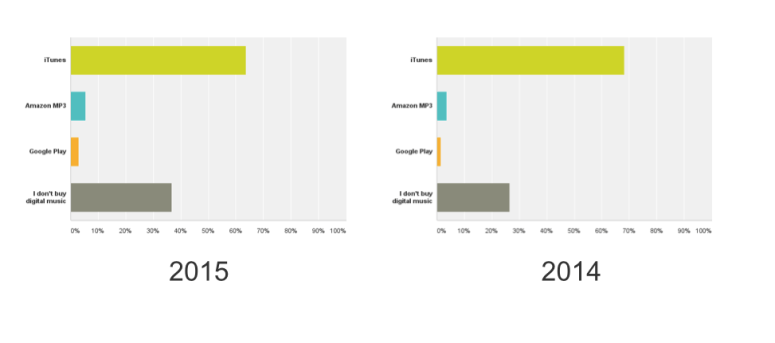
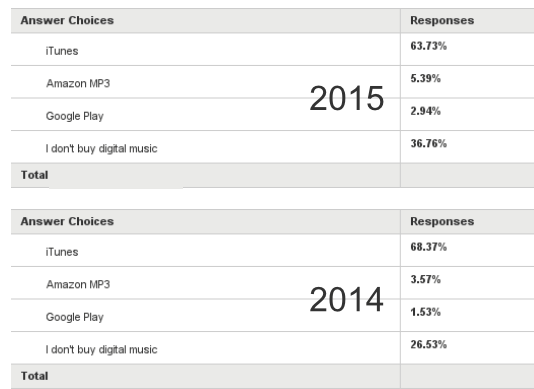
The percentage of college students in our survey that DO NOT buy digital music has risen from 26.5%  in 2014 to 36.7% in 2015.  This corresponds to reports of drops in sales of digital music elsewhere.  Is this the result of the widespread adoption of streaming?  We don’t know for sure…but 200 years of economics suggest that consumers don’t buy things they already get for free.  It strains credulity to insist that streaming does not cannibalize sales.  For this would require  these 18-24 year olds to suddenly behave differently than all other consumers we have ever known.

Screen Shot 2015-02-24 at 10.41.27 PM

Screen Shot 2015-02-24 at 11.06.39 PM


Searching for answers from Google about Google | The Hill | East Bay Ray

In 2001, a journalist named Bethany McLean posed a simple question in Fortune Magazine: “How exactly does Enron make its money?”

Neither company executives nor outside analysts could give her a simple answer. Her one question is now seen as the drip that opened the floodgates that drowned Enron. By 2006, the one-time Wall Street darling was closed, companies that enabled the fraud had failed, and executives were imprisoned. All this happened because Bethany McLean got the chance to ask a question.

The only way we’re going to learn about what Google is doing is through legal challenges like that of AG Hood.  I don’t see any Congressional hearings looking into Google’s practices (especially with Google spending almost $17 million on lobbying this past year). I don’t hear President Obama asking about Google (see previously mentioned $17 million). While there are European leaders and governments pushing Google to be more transparent, I don’t know why we’ve outsourced an investigation we ourselves should be doing.  I worry that if Google can block a state’s top law enforcement officer from even asking questions, then who is there to stand up and search for the answers we clearly should be seeking?

READ THE FULL STORY AT THE HILL:
http://thehill.com/blogs/congress-blog/technology/232681-searching-for-answers-from-google-about-google

East Bay Ray is the guitarist, co-founder and one of two main songwriters for the band Dead Kennedys. He has been speaking out on issues facing independent artists—on National Public Radio, at Chico State University, and on panels for SXSW, Association of Independent Music Publishers, California Lawyers for the Arts, SF Music Tech conferences, Hastings Law School and Boalt Hall Law School. Ray has also met with members of the U.S. Congress in Washington, D.C. to advocate for artists’ rights.