If you’ve been following the heated controversy around the frozen mechanicals crisis, you’ll know that the Copyright Royalty Board has received a proposal from the NMPA, NSAI and the major labels to freeze the statutory rate for songwriter mechanical royalties on physical (like CDs and vinyl) and permanent downloads (like iTunes) for another five years. That proposal mentions a settlement to establish the frozen rates (which extends the rates that were first frozen in 2006 for another 5 years) and a memorandum of understanding between the NMPA and the major labels for something, we’re not quite sure what.
Filing comments with the CRB is not quite as simple as filing comments with the Copyright Office and it takes a bit of time–comments close on July 26, so do not leave setting up your account until July 26, or even July 25. I would do it today. You can set up your account before you file your comments so that the account part is all ready to go.
Here are some steps you will probably go through to set up your account:
Go to app.crb.gov. Look for “Register for an account” (the one in small print at the bottom of the list)
2. “Register for an account” will take you to a sign up page. Scroll down to “User Information”. You only need to complete the required fields with a red star (so ignore the bar number, etc.)
There is a pull down menu under “Register as” with a few different roles listed. The one you want is “Commenter”
Then complete the form completing only the required fields.
3. The CRB will then authenticate your account and send you an email confirmation. That part goes pretty quickly. However, once your account is authenticated, make sure you log on. You should be taken to a dashboard, but the question is whether your dashboard looks like this:
Note that the dashboard does not have a button to “File a comment”. If this is what you see when you log into your account, you are not done. Contact the CRB support people ecrbsupport@egov.com and tell them that your account has not been activated to comment.
4. Your account should look like this:
The comment you want to file is for Phonorecords IV. You can ignore the other dockets. It took me several trips to the support desk to get the correct filing tabs on my account, hopefully you won’t have that problem. But–just in case, don’t be running around crazy on July 26 trying to file the comment you slaved over because you left the account to the last minute.
Mansplaining, anyone? If you remember Spotify’s 2014 messaging debacle with Taylor Swift, we always suspected that the Spotify culture actually believed that artists should be grateful for whatever table scraps that Spotify’s ad-supported big pool model threw out to artists. They were only begrudgingly interested in converting free users to paid subscribers, which still pays artists nothing due to the big pool’s hyper-efficient market share revenue distribution model.
And then there was another one of Spotify’s artist and label relations debacles with Epidemic Sound–Spotify’s answer to George Orwell’s “versificator” in the Music Department that produced “countless similar songs published for the benefit of the proles by a sub-section of the Music Department.”
The common threads of most of Spotify’s crazy wrong turns–and they are legion–is what they indicate: An incredible heartless arrogance and an utter failure to understand the business they are in. A business that ultimately turns on the artists and the songwriters. As long as there is an Apple Music and the other music streaming platforms, artists can simply walk across the street–which is why Taylor Swift could make Daniel Ek grovel like a little…well, let’s just leave it at grovel.
But–this long history of treating artists and especially songwriters poorly is what makes it so important to preserve Apple Music as a healthy competitor to Spotify and the only thing that stops Spotify from becoming a monopolist. A fact that seems entirely lost on their boy Rep. David Cicilline’s anti-Apple bill that “seems aimed directly at Apple and has Spotify’s litigation against Apple written all over it.” (Mr. Cicilline runs virtually unopposed in his Rhode Island elections, which if you know anything about Rhode Island politics is just the way the “Crimetown” machine likes it.)
Why are ostensibly smart people given to such arrogance? Mostly because they are rich and believe their own hype. But never has that reality been on such public display in all its putridness than in a truly unbelievable exchange at the Sync Summit in 2019 in New York between home town independent artist Ashley Jana and former Spotify engineer Jim Anderson who was being interviewed by Mark Freiser who runs that conference (and who doesn’t exactly come off like a prize puppy either).
Ashley recorded the entire exchange in (what else) a YouTube video and Digital Music News reported on it recently. Here’s part of the exchange between Ashley and Mr. Anderson after Ashley had the temerity to bring up…money!
Jana: We’re not making any money off of the streams. And I know that you know this, and I’m not trying to put you on the spot. I’m just saying, one cent is really not even that much money if you add 2 million times .01, it’s still not that much. And if you would just consider —
Anderson: Oh, I’m going to go down this road, you know that.
Interviewer (Mark Frieser): This is really not a road we’ve talked about before, but I’m gonna let him do this —
Jana: Thank you again.
Anderson: Do you want me to go down this road? I’m gonna go down this road.
Frieser: Well, if you need to.
Anderson: Wait, do I go down the entitlement road now, or do I wait a minute?
Frieser: Well, you know what, I think you should do what you need to do.
Anderson: Should we do it now?
Frieser: Yeah, whatever you feel you need to do.
Anderson: So maybe I should go down the entitlement road now? Or should I wait a few minutes?
Frieser: Do you want to wait a few minutes? Maybe take another question or two?
Anderson: [to the audience] Do you guys want to talk about entitlement now? Or do we talk about —
[Crowd voices interest in hearing the answer from Anderson]
Jana: I don’t think it’s entitlement to ask for normal rates, like before.
Anderson: Normal rates?
Jana: No, the idea is to make it a win-win situation for all parties.
Anderson: Okay, okay. So we should talk about entitlement. I mean, I have an issue with Taylor Swift’s comments. I have this issue with it, and we’ll call it entitlement. I mean, I consider myself an artist because I’m an inventor, okay? Now, I freely give away my patents for nothing. I never collect royalties on anything.
I think Taylor Swift doesn’t need .00001 more a stream. The problem is this: Spotify was created to solve a problem. The problem was this: piracy and music distribution. The problem was to get artists’ music out there. The problem was not to pay people money.
You really should listen to the entire video to really comprehend the arrogance dripping off of Mr. Anderson’s condescension.
Nik Patel, David Lowery, and Chris Castle feature in this podcast where they discuss the current issues of artists’ rights in the music industry. Find the Artist Rights Watch on your favorite podcast platform here https://linktr.ee/artistrightswatchpod Please subscribe, rate and share!
On the first episode of the Artist Rights Watch, Nik Patel, David Lowery, and Chris Castle sit down with Ivors Academy Chair, Crispin Hunt to talk about the frozen mechanical royalties crisis currently playing out in the United States and how it threatens UK songwriters and indeed songwriters around the world.
Crispin gives us his invaluable analysis of how the frozen mechanicals crisis affects songwriters around the world and the highly effective #brokenrecord and #fixstreaming campaigns that Ivors Academy supports in the UK that has lead to a parliamentary inquiry and legislation introduced in the UK Parliament.
The “frozen mechanicals” crisis is rooted in a private deal between big publishers and their big label affiliates to essentially continue the freeze on the already-frozen U.S. mechanical royalty rate paid by the record companies for CDs, vinyl and permanent downloads. The private deal freezes the rate for another five years but does not even account for inflation. Increasing the royalty rate for inflation, does not actually increase songwriter buying power.
The major publishers and labels have asked the Copyright Royalty Board in the US to make their private deal the law and apply that frozen rate to everyone.
In the past, the music industry has experienced a $0.02 mechanical royalty rate that lasted for 70 years, and with the current mechanical royalty rate of $0.091 being set in 2006, advocates hope it’s not a repeat of the past.
In this Artist Rights Watch episode, we cover its numerous implications and consequences such as controlled compositions clauses, the Copyright Royalty Board, CPI and fixed increases, how the UK compares, and potential resolutions.
Below are some links for further reading on frozen mechanicals and Crispin Hunt:
Blake Morgan helped to launch the American Music Fairness Act on June 24 in Washington along with Dionne Warwick, Sam Moore, a host of other artists and the bill’s sponsors Rep. Ted Deutch and Rep. Darrell Issa. We asked Blake about his impressions.
Rep. Ted Deutch and Blake Morgan at the AMFA launch
Chris Castle: I see you were back in Washington supporting new legislation to create a performance right for artists on terrestrial radio, how did that feel? Getting the band back together?
Blake Morgan: You know, it felt great. There’s a new spirit in the air, a new energy to this fight. Everyone at the launch event could feel it. It was aspirational. How can one not feel that way for something called the American Music Fairness Act?
Janita, Rep. Ted Deutch, Blake Morgan, Tommy Merrill
Any particular insights from the event?
Perhaps the one at the top of the list is that everyone was so happy––to see each other, to band together, to renew our vows to each other so to speak. To recommit ourselves in a new way to securing fair payment for artists on terrestrial radio. It was emotional. The fight for justice always is, and let’s make no mistake: this is a fight for basic fairness and justice. There’s an unmistakable excitement about the new bill, and our job––together––is to turn that excitement into volition, then into momentum, and finally into victory.
There was a quote in the recent Supreme Court ruling against the NCAA that jumped out at me: “Nowhere else in America can businesses get away with agreeing not to pay their workers a fair market rate on the theory that their product is defined by not paying their workers a fair market rate.” That’s not exactly analogous to broadcast radio, but it’s close, don’t you think?
Absolutely. Nothing could be more American than being paid fairly for one’s work. Nothing should be more American than being paid for one’s work. When it comes to music, where else in the American economy are working people told they won’t be paid for their work because instead, they’re going to receive “exposure.” That’s what AM/FM radio does. What’s more, broadcast radio can take our music without our permission, broadcast it, sell advertising around it, profit from it, and not pay the artists anything for it! As Sam Moore said at the bill’s launch event at The Capitol, “Pay us! Be nice!”
You were an active supporter of the CLASSICS Act that required pre-72 recordings be given equal treatment on digital performances. I was pleased that Rep. Deutch and Rep. Issa invited several generations of artists to the American Music Fairness Act event, will the pre-72 artists also be protected by AMFA?
Definitely, that’s such an important part of what this bill does. My godmother was Lesley Gore, the iconic 60’s hitmaker who sang the classics “It’s My Party” and “You Don’t Own Me,” among others. She died in 2015, after having never been paid one damn dime for those hits being played on AM or FM radio. AMFA may be too late for her, but I’m committed to making sure we get this passed in time for other iconic hitmakers and legends who have helped weave the very fabric of this country with their music. Who could possibly look any of those artists in the eye and tell them they shouldn’t be paid fairly. For shame.
What can the #irespectmusic community do to support the legislation?
We can do what we do best––bring music makers and music lovers together, tell people to stop wringing their hands and start rolling up their sleeves, and get active in supporting AMFA. We’re going to set up mechanisms in the coming weeks to make our voices heard with congressional members, with broadcasters (an increasing amount of which support this legislation, in fact), and with those who haven’t yet joined the push. We’re going to work hard, we’re going to work smart, and we’re going to pull ourselves closer and closer to victory with this in mind: it always seems impossible until it’s done.
Over the last six weeks, the Trichordist has chronicled the frozen mechanicals saga occurring at the Copyright Royalty Board in the government’s rate setting for the compulsory mechanical license commonly called “Phonorecords IV.” (Congress mandated that these government rate settings occur every five years and are numbered sequentially.)
Songwriters, independent music publishers, music lawyers and advocates have penned articles and contacted their representatives in Congress to express their concerns about the private party settlement which would extend the existing freeze on the statutory mechanical rate with respect to physical products and permanent downloads for yet another five years. That private party settlement among the Big Three record companies, the National Music Publishers Association and the Nashville Songwriters Association International is expected to be opened to public comment later today. (Friday news dump?) These entities then submitted that settlement to the Copyright Royalty Board asking the CRB to impose the terms of that private settlement on the rest of the world. And it now appears that these secret deals may be backfiring.
The frozen rate most prominently applies to permanent downloads and physical sales like vinyl. Why the Big Three want to freeze mechanical royalty rates on the booming vinyl business is anyone’s guess.
The sticking point for most people commenting in the Trichordist is that the terms of the private settlement are not disclosed to the CRB or to the public, especially a side deal between the Big Three and the NMPA. Songwriters around the world have no way of knowing the terms of these deals unless the Copyright Royalty Board forces their disclosure.
These entities who are before the CRB in Phonorecords IV, along with those vocal in opposition against their private party settlement have been in this arena for far longer than I. When the Phonorecords I proceeding occurred in 2006, I was merely a freshman in high school — and I was completing my final year of law school as the Phonorecords III proceeding began. Needless to say, there has been a significant amount of information and procedure to digest.
Upon learning of the settlement by the Big Three labels, the NMPA and the NSAI, several thoughts came immediately to mind:
1) The settlement and side agreement referenced must be disclosed immediately.
2) How can this freeze be rationalized, especially during the midst of a worldwide vinyl resurgence?
3) Why would an organization representing songwriters agree to such a freeze? (As an aside, as I was teaching a course on copyright and songwriter revenue streams to 30 older songwriters two weeks ago, they were shocked and moreover disheartened to learn this — as physical sales, not streaming revenue, pays their bills. One said: ”I can stand out on the street in Smithville, Texas, with my guitar and a tip jar and earn more in a couple hours than I will ever earn from streaming”).
4) This is perfect ammunition for the streaming services to use to justify their already abysmally-low mechanical “rates.”
While there is much to say on points 1-3, the focus here is on point 4. Chris Castle echoed the same sentiments on June 1:
“Streaming Royalty Backfire: If you want to argue that there is an inherent value in songs as I do, I don’t think freezing any rates for 20 years gets you there. Because there is no logical explanation for why the industry negotiators freeze the rates at 9.1¢ for another five years, the entire process for setting streaming mechanical rates starts to look transactional. In the transactional model, increased streaming mechanicals is ultimately justified by who is paying. When the labels are paying, they want the rate frozen, so why wouldn’t the services use the same argument on the streaming rates, gooses and ganders being what they are? If a song has inherent value—which I firmly believe—it has that value for everyone. Given the billions that are being made from music, songwriters deserve a bigger piece of that cash and an equal say about how it is divided.” (link: https://thetrichordist.com/2021/06/01/healing-with-sunlight-a-rate-based-solution-for-the-frozen-mechanicals-dilemma/)
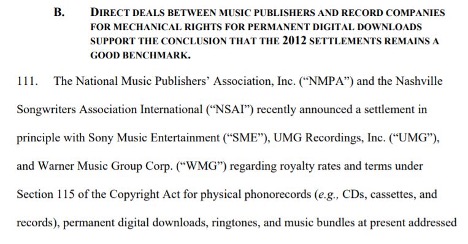
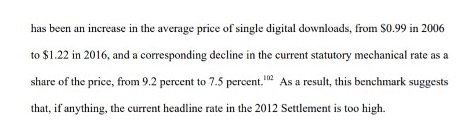
It did not take a soothsayer to foresee this result; the private settlement opened Pandora’s box – begetting misery for every songwriter. Since the CRB has been quiet for the last month with respect to this proceeding, yesterday, I began delving through some of the more recent Phonorecords III remand filings. And much to my unsurprise, I came across a statement from Pandora Media’s expert witness, Professor Michael Katz, who understandably used the proposed settlement as evidence that the streaming rates were fine as is. Katz’s statement was filed on April 4 – two months before songwriters became aware of the quiet filing of the private settlement and began speaking out. Here’s the link to Professor Katz’s testimony and you’ll find the text below beginning on page 65: https://app.crb.gov/document/download/23858 .
Pandora not only used the settlement to make the case that the streaming mechanicals rate in the 2012 settlement was a “good benchmark,” but also, even more disastrously, used this argument to rationalize the 2012 rate being TOO HIGH.
This is what happens when there are only a select few gatekeepers, privileged with endless resources and far removed from the plight of independent songwriters, making decisions that affect literally every songwriter’s future. This is why CRB proceedings must be more easily accessible for independent songwriters and their staunch advocates. This is the consequence of the “willing buyer” and “willing seller” appearing on different sides of the same corporate coin – (and if anyone wishes to challenge me on this point be ready for some “interlocking board” remarks based on extensive research into conflicts of interest). Songwriters deserve better than to have this crucial revenue stream frozen – especially immediately following an eighteen-month-long worldwide pandemic.
After the release of misery and misfortune with the private settlement, hope remained at the bottom of pandora’s box—hope that the CRB would allow the songwriters affected by the private settlement to at least have an opportunity to be heard in the exclusive and expensive environment of the Copyright Royalty Board. Once the CRB publishes their request for public comments (on the Friday before the July 4 weekend), songwriters may at last have their chance.
And I firmly believe that by the CRB providing every songwriter the opportunity to express how this settlement and the proposed regulations freezing mechanicals for another five years fails to represent her interest, it will exbibit to all the inherent value of songs and restore hope that every voice matters.
[Editor Charlie sez: Our great allies Ted Deutch and Darrell Issa are introducing a law to guarantee the key object of the #IRespectMusic campaign–artist pay for radio play!]
Reps. Deutch and Issa will be joined by legendary artists Dionne Warwick, Sam Moore, and others to introduce legislation to ensure music creators are fairly compensated when their songs are played on AM/FM radio
(Washington) On Thursday, June 24 at 1:15 pm ET, Rep. Ted Deutch (D-FL) and Rep. Darrell Issa (R-CA) are hosting a national press event alongside artist-advocates like Dionne Warwick and Sam Moore to introduce the American Music Fairness Act.
Members of the press can register here. This event will be live-streamed here.
After COVID-19 disrupted artists’ financial stability, it is more important than ever that legislation is passed to ensure music creators are compensated when their music plays on FM/AM radio stations. The American Music Fairness Act will require that performing artists are paid for the use of their songs on FM/AM radio — just like they already do on digital streaming services.
This bipartisan bill is a response to the Local Radio Freedom Act championed by the National Association of Broadcasters.
WHAT: A national press event announcing the American Music Fairness Act
WHO: · Rep. Ted Deutch (D-FL) · Rep. Darrell Issa (R-CA) · Dionne Warwick · Sam Moore · Additional artist-advocates
WHEN: Thursday, June 24, 1:15pm ET
WHERE: House Triangle, United States Capitol, Washington, DC
The Copyright Royalty Board has announced its decision on webcasting rates under §114 for 2021-25 and it’s good news for non-featured artists, featured artists and sound recording copyright owners. The rates are set for 2021, paid retroactively to January 1.
Service
New Rate Per Performance 2021
Old Rate Per Performance 2020
Increase
Commercial Nonsubscription
$0.0021
$0.0018
+17%
Commercial Subscription
$0.0026
$0.0024
+8%
Noncommercial Webcaster (Non-educational)
$1000 per station or channel up to 159,140 Aggregate Tuning Hours/month Overage at $0.0021 per performance
$500 per station or channel up to 159,140 Aggregate Tuning Hours/month. Overage at $0.0018 per performance
Per-station: +100% Overage: +17%
After 2022, these rates are adjusted by the Consumer Price Index (CPI-U for the geeks).
The Copyright Royalty Judges shall adjust the royalty fees each year to reflect any changes occurring in the cost of living as determined by the most recent Consumer Price Index for All Urban Consumers (U.S. City Average, all items) (CPI-U) published by the Secretary of Labor before December 1 of the preceding year.
So it is clear that the CRB can come up with reasonable rates when they’re asked. It’s also a great example of the power of strong bargaining groups including SoundExchange, the unions, indie and major record companies, and a broad cross-section of music users.
Rates for noncommercial educational webcasters, satellite radio, audio for business establishments and some others — are decided in a different process. Their 2021 rates for these service are on the SoundExchange website.
Since the 2000s, the development of download platforms, then streaming services, has both contracted and expanded the music market. However, despite recently accelerating growth, the value thus created is not shared fairly. Indeed, the performers whose music creates this value receive little or no revenue when their recordings are used online with relatively few exceptions.
The implementation of the fundamental principles set out below is essential to, at last, guarantee the payment of a fair remuneration to music performers for the value transfer from their work. Such implementation must, in particular, rely on the proven mechanisms of collective management or collective bargaining.
1. Right to a fair remuneration
All music performers, whether featured or non-featured, should receive fair remuneration for each online use of their recordings, regardless of the technology used to access or distribute them.
Any act that does not meet the conditions for a download (choice of track + choice of time + choice of location) should not be covered by the right of Article 10
2. Scope of the right of making available on demand
The right of making available on-demand (article 10 of the WIPO Performances and Phonograms Treaty) provides performers with “the exclusive right of authorizing the making available to the public of their performances fixed in phonograms, by wire or wireless means, in such a way that members of the public may access them from a place and at a time individually chosen by them”.
This right was formulated at the time of the transition from physical to digital distribution by download. The technological evolution that has allowed the development of streaming offers since 2008 was in no way anticipated when the WPPT was adopted in 1996. Article 10 could never have been the subject of a consensus if the community of performers had measured the risk of its erroneous application to all the uses offered by streaming platforms.
The right of making available on-demand is designed for cases where end-users choose what music they want to listen to, when to listen to it and where to listen to it. Thus, any act that does not meet the conditions for a download (choice of track + choice of time + choice of location) should not be covered by the right of Article 10.
In particular, it should not apply when a selection of tracks made by a third party (a natural person or an algorithm) is offered for listening to the consumer, following a personalization based on the choice of a style, an atmosphere, an artist or any other criterion leading to a limited and pre-established “playlist”.
3. Adaptation of remuneration schemes
Performers’ economic precariousness – highlighted during the COVID-19 pandemic – demonstrates that the exclusive right of making available on-demand (art. 10 of the WPPT), which can be assigned individually without any real compensation, is in itself unfit for embracing the current technological environment. The unilateral choice of platforms and the phonographic industry to apply this right to all forms of streaming, regardless of their level of interactivity or personalization, obviously serves the interests of these industries.
Non-featured performers generally receive a one-time, often purely symbolic, lump-sum payment in return for the transfer of their exclusive rights to the producer. Such unfair practices deprives them of a fair share of the revenue and value generated by their creative contribution. This structurally unbalanced contractual relationship can be corrected by resorting to collective bargaining.
More generally, collective bargaining constitutes a legitimate and effective means of improving the conditions for the transfer of a performer’s exclusive rights and their remuneration once assigned to the producer.
As grassroots protests by performers illustrate, the status quo is untenable. The streaming economy must switch paradigms to ensure fair remuneration for all performers and all types of online uses. Concerning non-interactive or partially interactive uses (playlists), the right to remuneration under Article 15, WPPT, which leads to an equal split of the equitable remuneration received from broadcasters and other users, constitutes a relevant reference model and precedent.
4. Transparency and access to information
All performers must receive and be able to access detailed information concerning the use of their recordings and the payments to which they are entitled. Payment of sums due to the artist must occur on the dates specified, must be subject to a compliance examination of platforms by performers to help assure correct payments, and must be accounted for regardless of the amount and without payment thresholds. National laws must include provisions guaranteeing the exercise of these rights.
5. Value of Music
Price competition between platforms and the priority they give to enterprise market valuation (as reflected in share price) over revenue may induce a devaluation of music in a race to the bottom on royalty payments while share price is booming. Access to a repertoire through output licenses set to grow endlessly for a flat-rate subscription – which has remained at the essentially same price point for more than ten years – does not seem capable of providing long-term sustainability for the creative sector given the dominant pro-rata royalty model.
6. User-centric model
In the vast number of cases, the pro-rata distribution of streaming revenues does not remunerate the featured artists’ right of making available, even when their contract provides (after the transfer of this right) for the payment of royalties. Instead, it creates a hyper-efficient market share distribution of revenue. This is not acceptable. It is also not acceptable for end-users to pay for music that they do not listen to, or that the music they listen to does not generate commensurate income for the artists concerned. This lack of direct correlation between listening and payment is a fundamental problem. Only the universal adoption of the “user-centric” distribution model can redress this injustice to both the fan and the performers. By allowing “niche” recordings, works or styles to generate remuneration, it also supports diversity and promotes local cultures. It should therefore be implemented, and the economic models adapted accordingly.
7. Duration of reference for the count of plays
The length of the tracks varies considerably according to the genre of music. Durations can range from less than two minutes for a variety track to several tens of minutes for a jazz or classical music track. The count of plays entitled to payment should take these differences into account by introducing a dose of proportionality. A longer track should trigger several payments as listening reaches certain thresholds to be negotiated.
By limiting the economic return on very short tracks, such an adaptation would avoid an excessively uniform offer. It would also positively affect diversity by partly redirecting payments towards less popular musical genres such as jazz or classical music. More generally, artistic creativity could be expressed more freely, without time constraints motivated by profitability objectives.
The Ivors Academy joins the campaign against frozen mechanical royalties for songwriters by the Copyright Royalty Board in the US. Ivors is the UK’s independent professional association for music creators and is a community of diverse, talented songwriters and composers across all styles. Their talent creates the music that the world loves. The organization was formerly known as the British Academy of Songwriters, Composers and Authors, and is home to the Ivors Awards named after Ivor Novello. Ivors Academy are leading advocates for songwriters across Europe and are leading the #BrokenRecord and #PaySongwriters campaigns that have resulted in an inquiry into music streaming by the UK Parliament. Follow them at @IvorsAcademy.
The post is a very illuminating look inside the CRB process that many find mysterious, and also is a good demonstration of some of the concerns expressed by writers on The Trichordist on this subject. The three accomplished Nashville songwriters add some color commentary to the proceedings, particularly for those who may have been in high school or college during the 2006 CRB frozen mechanical rate setting that many think caused the problem.
The songwriters express a good deal of frustration and passion which is as understandable as the frustration and passion of those who feel that the CRB process is as inequitable, unwieldy and prohibitively expensive as these songwriters seem to be telling us that it is. Someone may want to do a point by point discussion of the many good issues that the three Nashville songwriters raise, but a couple things jump out.
First, they defend the streaming mechanical rate from the last CRB. No one criticized the streaming mechanical rate in the last CRB proceeding that is currently under appeal. If the rate survives the appeal and reworking at the CRB, and makes its way through the MLC, every songwriter should expect to see the promised increase in their streaming royalty check. That would be a great thing and everyone no doubt thanks everyone involved for the effort. The topic, though, was primarily the frozen mechanical not the streaming mechanical.
Also, who paid the $20 million cost for “our side” to participate in the CRB that the three Nashville songwriters refer to? Surely the publishers did not ask the songwriters to open up their own pocketbooks, even though each has been extraordinarily successful in their genre.
We couldn’t find any discussion by the three Nashville songwriters of what terms are in the private settlements referred to in their own filing. The point that many have made about public commentary about the private settlements is that the Copyright Royalty Judges can decide on who is “bound” by the settlements and that it is the motion at issue as filed that gets commented on unless the Judges ask that it be supplemented. Commenters said the “who” should be broadly construed. They also said that the “what” is crucially important. Many have made the point that public commentary about the settlements requires that all the terms of the settlements are made public. Until made public, the terms are private. The only thing we know about the settlements from the three Nashville songwriters’ own CRB filing is the terms that are disclosed—frozen rates. Even though their filing refers to settlements, we still don’t know anything further. Maybe we will in coming days. Any additional terms that exist may not be remarkable, but they might be. Presumably this is the kind of thing that important people in the negotiation process would know due to their special position. We just don’t know.
The three Nashville songwriters apparently believed they had a mandate to make decisions about what was worth pursuing in the CRB. If they did have that belief, presumably they base that belief on some kind of vote. Since their CRB settlement impacts every songwriter in the world, that’s the magnitude of decision that some might think is deserving of a vote of their membership, not just a board vote if that’s what happened—we just don’t know. It’s a real privilege to be in the position to make those kinds of decisions, so you might well think that it’s the kind of thing you wouldn’t want to take on by yourself or with only the approval of a limited number of people. But maybe not.
Be sure to read this post and thank these songwriters for their service to the community. They certainly deserve it.




 The Trichordist
You must be logged in to post a comment.