Texas Bar Section Announces Nominations are Open for the Cindi Lazzari Artist Advocate Award — Artist Rights Watch

[Thanks to Chris Castle for this post.]

We’re pleased to help get out the word that nominations are open for the Cindi Lazzari Artist Advocate Award for “heroes and heroines” involved with artist advocacy in all Texas communities.  For Texas readers, there’s info below about how to nominate.  If you’re not in Texas you may want to look into whether your community has a similar award.  If not, you might consider starting one.

If you would like to nominate someone for the award, you may use this form.

PRESS RELEASE:

The State Bar of Texas Entertainment and Sports Law Section (TESLAW) announced that nominations for the Cindi Lazzari Artist Advocate Award are open now until 11:59 pm Central Time on October 1, 2019.  The award is named for the late Cindi Lazzari, a leading Texas attorney who went far beyond the call of duty in her efforts to protect the rights of artists in the music industry.

In these challenging times for Texas musicians, TESLAW wants to hear about the exciting heroes and heroines who carry on the tradition of Cindi’s good works in all the music communities across Texas.  Nominees need not be attorneys.

Previous recipients of the Lazzari Award include Juan Tejeda (musician, arts administrator and activist), Robin Shivers (artist manager and founder of the Health Alliance for Austin Musicians), Texas Accountants and Lawyers for the Arts, SIMS Foundation, Nikki Rowling (co-founder of Austin Music Foundation and author of the Austin Music Census), Casey Monahan (the first head of the Governor’s Music Office) and Margaret Moser (the journalist and long-time music editor for the Austin Chronicle).

Nominations for the 2019 Lazzari Award will be accepted through October 1, 2019 and should be sent by e-mail only to law@amyemitchell.com. The nomination email should include (1) the nominee’s name and contact information; (2) a one-page statement as to why the nominating individual believes the nominee should receive the award; and (3) a biography of the nominee.

TESLAW will present the Cindi Lazzari Artist Advocate Award at the annual Entertainment Law Institute, to be held in Austin November 20-22, 2019.

For further information, please see TESLAW’s web page at http://teslaw.org/awards/cindi-lazzari-artist-advocate-award/

via Texas Bar Section Announces Nominations are Open for the Cindi Lazzari Artist Advocate Award — Artist Rights Watch

@Hypebot Posts Claim Forms for PledgeMusic Bankruptcy

Thanks to the good work by Bruce Houghton at Hypebot, we now have the form you need to file if you are owed money by PledgeMusic (which of course Pledge didn’t bother to post) and an email address to send it to.

This is good for fans who pledged but believe their money never got to the artist, the artists who are owed money by Pledge and of course the vendors who are owed money for goods they made or services rendered for Pledge campaigns (like Bandwear that is apparently owned $200,000).

Here’s the info from Hypebot:

“On the subject of filing a claim for monies due, Insolvency Examiner Erica Baker wrote:

“If you are owed money by the company then you should arrange for a Proof of Debt form to be submitted as soon as possible – I will ask the case officer to send you a form.”

While lacking a firm deadline, the form is fairly straightforward. Any artist, label or fan affected should fill out the form and send it in with any receipts or proof asap. Download it here.

UPDATE: The form can be returned via email to Sultana.Begum@insolvency.gov.uk

We’d love to hear from artists and others their experiences with the Insolvency Service.”

We would love to hear, too, so if you want to leave a comment and we will post them.

You can read the full Hypebot post here.

How to Contact the Court in PledgeMusic Case

PledgeMusic had posted this information on their website when we checked today:

As a result of the making of the order, the Official Receiver becomes liquidator of the company. Any enquiries should be forwarded to LondonB.OR@insolvency.gov.uk, quoting reference LQD5671373.

We gather that what that means is that if you are (1) an artist who is owed money by PledgeMusic, (2) a fan who gave money to an artist who you think did not receive your money from PledgeMusic, or (3) a vendor who didn’t get paid because PledgeMusic didn’t pay your artist, then you should write to that email address which we assume is for the “Official Receiver” who is now in charge of running the case.  (OK, that does sound like a character out of Harry Potter, but that’s how it is.)

We also assume because Pledge didn’t say that there is a deadline for submitting your claim there probably is one.  That’s probably why PledgeMusic didn’t say what the deadline was, a fact they almost certainly know very well.  Because if you fail to get your claim in on time, there’s more for them in the pot.  Ponzi to the very end.

You should take legal advice about what you should say and how to handle it, but if you can’t afford a lawyer you could say in your email that you think you are owed money, how much and why, and ask them what you should do about it.  It probably wouldn’t hurt to tell them what you have done to try to collect your money from Pledge and the approximate or exact dates you tried to get their attention.

And be sure to tell the Official Receiver if you think Pledge breached its obligations to you or otherwise did you wrong, threatened you, or any other bad stuff.

The Official Receiver probably frequently deals with people who are owed money and have no lawyer so don’t be shy about it.  The Insolvency Service (who actually appoints the Official Receiver) also responded to Chris Castle on Twitter:

Insolvency Service 1

We will keep you posted with more information as we find out.

Guest Post: “Spotify Untold (“Spotify Inifrån”) the Corporate Bio Book is a View Into Daniel Ek’s State of Mind

By Chris Castle

Ever heard the expression, “you’re making my argument?”

You may have seen the book reviews of “Spotify Untold” (or in Swedish “Spotify Inifrån”). The book is currently only available in Swedish and has not been released in the US, but in a new marketing twist the authors are on a book tour in the US promoting their book in Swedish to an English language audience.  Must be nice.

The writers not only seemed to have missed the streaming gentrification part, which is of great consequence to artists, songwriters, and especially MP/TV composers–but those groups are pretty clearly not the authors’ audience.  They are also peddling a ghoulish yarn about Steve Jobs that gives far more insight into Daniel Ek’s midnight of the soul than anything else.  A simple fact check should have made one inquire further in my view.

If their interview with Variety is any indicator, the story line of “Spotify Untold” revolves around (1) music is a commodity (with no discussion of Spotify’s role in the commoditization of what is now openly called “streaming friendly music” not unlike “radio friendly” music–both equally loathed by artists whose name does not begin with “Justin”; and (2) Daniel Ek is a heroic genius (despite the resemblance to Damian in his teen pictures they are also handing out–he thankfully shaves his head).

But most importantly (3) Ek was pursued by Steve Jobs, the evil giant whose company he just happens to have filed a competition complaint against who was aided by the equally evil Sony and Universal as they were all in on it to keep our hero from entering the fabled land of Wall Street.  Yes, a yarn straight out of Norse mythology as retold by Freud; perhaps a little too much so.

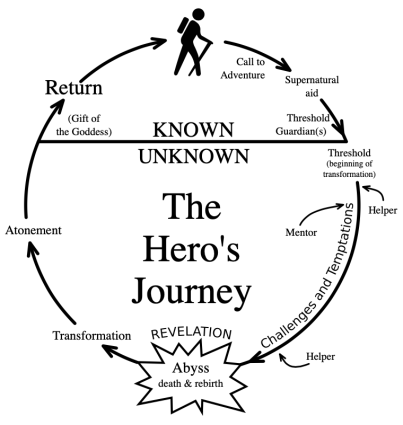
But the book may also be a corporatized version of Joseph Campbell’s hero’s journey from The Hero With A Thousand Faces aka Star Wars).  You can plug Daniel Ek into the hero’s role pretty easily:
campbell heros journey

As reported in Variety:

Barely a page into the book “Spotify Untold,” Swedish authors Jonas Leijonhufvud…and Sven Carlsson paint an odd scene. The year is 2010 and Spotify co-founder and CEO Daniel Ek [the hero] is facing a succession of obstacles [the Threshold Guardians] gaining entry into the U.S. market [the region of supernatural wonder] — or, more specifically, infiltrating the tightly-networked and often nepotistic to a fault music industry. [Unwelcoming of the stranger from Asgard, so unlike Silicon Valley.]  As stress sets in [Challenges and Temptations], Ek becomes convinced that Apple’s Steve Jobs is calling his phone just to breathe deeply on the other end of the line, he purportedly confesses to a colleague[a Helper].

There’s a saying, “don’t speak ill of the dead.”  That’s probably a bit superstitious for the authors, but is good advice.  It’s unbecoming and Spotify should denounce it, although it’s highly unlikely that they will given their fatal attraction to PR disasters.

There’s also a saying, “don’t mock the afflicted,” so before you laugh hysterically at the story, realize that Steve Jobs caring enough about Daniel Ek to do such a thing (which assumes Steve knew Daniel Ek existed) was something that was very important to Daniel Ek.  Or in a word–is Daniel Ek more Loki than Thor?

What is really objectively and factually odd about the authors’ 2010 Steve Jobs story about heavy breathing phone calls is that Steve got a liver transplant in 2009 and was very, very sick throughout 2010–the year they say these calls occurred.

Steve left Apple for good in August 2011 and passed in October 2011. It is implausible to me that he was even paying attention to Daniel Ek in 2010, assuming that Steve even knew or cared who Daniel Ek was. Aside from the fact that at that time Spotify was small potatoes, Steve had many more important things on his mind like staying alive. Plus, in my experience if Steve was going to leave you a testy voicemail or phone call, you knew exactly who it was. Exactly.

I for one think that the entire anecdote simply does not scan and is unsubstantiated by the authors’ own admission. Bizarre. Freudian. Not to mention a crass and thoughtless smear against a man who really did change the world. Who can’t defend himself because he is dead.

Variety reports that the authors were not able to confirm this rather insulting and perverse allegation.  But don’t let that stop anyone from publishing gossip.

What Variety does report is this statement from the authors:

To us, Ek’s claim is as a reflection of how paranoid and anxious he must have felt in 2010, when Spotify was being denied access to the U.S. market, in large part due to pressure from Apple. The major record companies seem to have been quite loyal to the iTunes Music Store, and to Jobs personally….Because Spotify was hindered by Steve Jobs [it’s called competition], it forced the company to sweeten its deals with the record companies [also called competition]….Spotify is challenging Apple on a legal level right now.We address Spotify’s constant struggle with Apple in our book. If Ek were to talk about such sensitive topics in book form, [Spotify would] do it in their own way with full control.

The first thing I thought of when reading the story of “Spotify Untold” was that very competition claim that Spotify is pursuing in Europe right now.  That claim appears to have been scripted–Spotify pursued it with the Obama competition authorities a few years ago.  And then of course there was the New York and Connecticut state competition claim that curiously came out the same time as Apple Music launched in the US, apparently manipulated by Spotify’s very own Clintonista lobbying operative who was a political ally of Eric Schneiderman the former (ahem) New York Attorney General.  (Spotify tried to drag Universal into that one, too–so this is a movie script that Spotify pulls down every so often for a polish and sometimes changes the supporting characters.)

While the authors claim that they spoke to many Spotify executives but not Ek, the book still has curious timing–as does the authors’ disclaimer that the book is not connected to Spotify directly, the plausible deniability that is the hallmark of black bag operations.

And if you believe as I do that Daniel Ek actually hates the major labels (read the Spotify DPO filing and you’ll get the idea), it’s only natural that he would try to twist Sony and Universal into the story.  He just didn’t know that his major label negotiation experience was garden variety stuff and not unusual in any way.  They didn’t get stock in iTunes so they damn well would in everything that came after iTunes.  Daniel Ek was not singled out–rather, he opted in.

I would be very curious to know why the authors of “Spotify Inifrån” came away from their research thinking that the major labels were “quite loyal” to iTunes and to Steve Jobs.  While that may have been true of certain executives, the reason that the labels required licensees to sell in Windows Media DRM (i.e., the format nobody wanted) was because they wanted to encourage competition with iTunes.

The labels eventually ended that failed policy after Steve called them out and suggested that they drop the DRM part (about which I strongly agreed in one of the first posts on MusicTechPolicy in 2006).  Even after the labels dropped that failed idea, record companies large and small did not want a single digital retailer dominating the online market.  So the idea that they colluded with Steve Jobs and Apple to make life difficult for a poor little hacker boy from Sweden is so inconsistent with reality to be laughable.

In fact, one could argue that were it not for Steve asking for more competition with iTunes Music Store (and in fairness, sell more iPods and later iPhones), there may never have been a Spotify at all.  What that does not include is the accelerating failing belief in one of Spotify’s major selling point–the free service converts users from piracy to a paid service.  That didn’t happen at anything like the rates that Spotify sold,  nobody believes it anymore and it was unbelievable in the first place. But exactly what you’d expect a hacker to say.

And here’s some other research that got left out:  Spotify’s psychographic data profiling is largely based on the work of Dr. Michael Kosinski, whose work also inspired the techniques of Cambridge Analytica and the Internet Research Agency.  See Kosinski et al, The Song Is You: Preferences for Musical Attribute Dimensions Reflect Personality (2016).  More on this influence another time.

So why would these authors be slinging this unlikely brew?  It’s possible that the book is an answer to “Spotify Teardown,” funded by a grant and published (in English) earlier in 2019 with a much less mythological and much more recognizable approach to a Spotify reality according to an NPR review:

[“Spotify Teardown”] argues that Spotify isn’t a media company per se – and…asserts that it’s structurally much closer to a Facebook or Google, particularly in its digital business model.  Indeed, Spotify was never really so much a music company as an Internet brand. “Spotify’s business model never benefited all musicians in the same manner but rather appeared — and still appears — highly skewed toward major stars and record labels, establishing a winner-takes-all market familiar from the traditional media industries.”

You won’t find that in a corporate bio.  That sounds like the streaming gentrification reality and definitely wasn’t written by anyone named Justin.  So while I don’t know what motivated the “Spotify Inifrån” authors, I do think that there’s a definite whiff of Astroturf in a book that tells a story that fits almost perfectly with the hero’s journey that Spotify would like to be telling competition authorities.  I think the authors are aware of this, hence their disclaimers.

And I’m still waiting for the last leg of Daniel Ek’s hero’s arc, the transformation and atonement.  Which is the part that makes the hero a hero.  As the authors tell us, “[Spotify] would probably rather tell their story themselves than have us do it for them, but I think they understand our role as journalists.”

I just bet they do.

But look–credit where credit’s due.  Ek used the music to make himself rich and he changed the economics of the music industry to keep making himself even richer.  He gets million dollar performance bonuses when he doesn’t meet his performance targets.  There are a growing number of niche and cultural artists who hate him. He’s also changed the way that fans interact with music online through the use of personality traits and data profiling instead of genre or artist based selection.  And he invented “streaming friendly music” to the great joy of elevator operators everywhere.

For all his idiosyncrasies, Steve is largely revered and recognized as someone who really did change the world. Or as Daniel Ek tweeted when Jobs passed in 2011–after supposedly being harassed by Steve:

“Thank you Steve. You were a true inspiration in so many parts of my life, both personal and professional. My hat off to our time’s Da Vinci.”

Exactly.  That Danny is a complex little man.

Remember those Mac/PC ads?  You could just as easily run the same ad campaign for Spotify/Apple Music with only a few tweaks.   And when it comes to marketing, what should be keeping Ek up at night is not devising sick stories he can tell about Steve Jobs but rather very justified fear of what will happen when Apple turns its marketing team loose on Spotify.  He ain’t seen nothing yet.

If you think this is paranoid, watch this video from the distinguished journalist Sharyl Attkisson.  Let’s just say I don’t put anything past these guys.


Attorney Chris Castle Talks About What is Happening at Pledgemusic on the Music Biz Weekly Podcast and Reading List

What are the chances that PledgeMusic will just disappear into the night, never file bankruptcy/administration, never pay back the artists, fans and vendors and never disclose how much money they owe the artists?  The less they talk about Pledge’s misdeeds, the more likely that Pledge is simply never pursued by anyone and the statute of limitations will run.

What PledgeMusic should do is voluntarily publish their financials and bank statements from the beginning until today so that all the artists and consumers can tell what what in the world was going on and be able to compare it to what they were told by Pledge and who was on the board when the problems first arrived.  It would also be nice if they published all their board minutes (assuming they have any).

If that seems aggressive–understand this:  The longer Pledge is allowed to delay (and they’ve managed to delay for nearly a year) the more likely it is that they will say the books were “lost” and no one will ever know.

No government is looking into what happened as far as we know, and nobody else can afford to pursue them.  We agree with UK Music that called for a government investigation into the apparent shenanigans at Pledge as Billboard reported:

Following the news that PledgeMusic had declared bankruptcy, Michael Dugher, ceo of umbrella organization UK Music, demanded a government investigation into the troubled UK-based crowdfunding platform.

On Thursday (May 9), Dugher wrote a letter to small business and consumer minister Kelly Tolhurst, imploring her to look into PledgeMusic’s “speculated collapse” as the company heads into administration, and refer the case to the UK’s Competition and Markets Authority (CMA). “As a consequence, creators who used PledgeMusic’s services are likely to lose money if it goes into administration without resolving its outstanding debts,” he writes.

“Emerging musicians often rely on crowdfunding platforms to raise capital to support album recording costs, music video costs and other capital expenditures,” he adds. “Musicians should be able to trust crowdfunding platforms to fulfill their obligation of delivering money pledged by fans and supporters.”

UK Music Letter


Pledge Music Reading List:

Guest Post by Iain Baker of @jesusjonesband on the PledgeMusic Situation (MusicTechPolicy)

Guest Post by Iain Baker of @jesusjonesband: An update on the PledgeMusic Debacle (MusicTechPolicy)

Guest Post by Hattie Webb: The day I broke into the PledgeMusic office (@hrdwebb) (MusicTechPolicy)

Crowdfunding Site PledgeMusic Was an Antidote to Music Biz Middlemen—Until It Cheated Artists Out of Millions (Pitchfork)

PledgeMusic’s Failed Promise Leaves Artists in Limbo and the Future of Music Crowdfunding in Jeopardy (Billboard)

Paste Media Group Acquires NoiseTrade From Embattled Crowdfunding Platform PledgeMusic (Billboard)

Where Was the Board? Some Thoughts on Potential Legal Issues in Pledge Music “Administration” Bankruptcy (MusicTechPolicy)

Another Loose End: PledgeMusic’s Non Profit Messaging But For Profit Motive (ArtistRightsWatch)


Pledge Music Fiasco is Weirder Than You Think PT II: Who is behind Panama company Dolan Services Inc?

It’s been awfully quiet over at Pledge Music.  After declaring in May they were going into administration (UK equivalent of bankruptcy) I can find no reporting that indicates Pledge has even started the process.

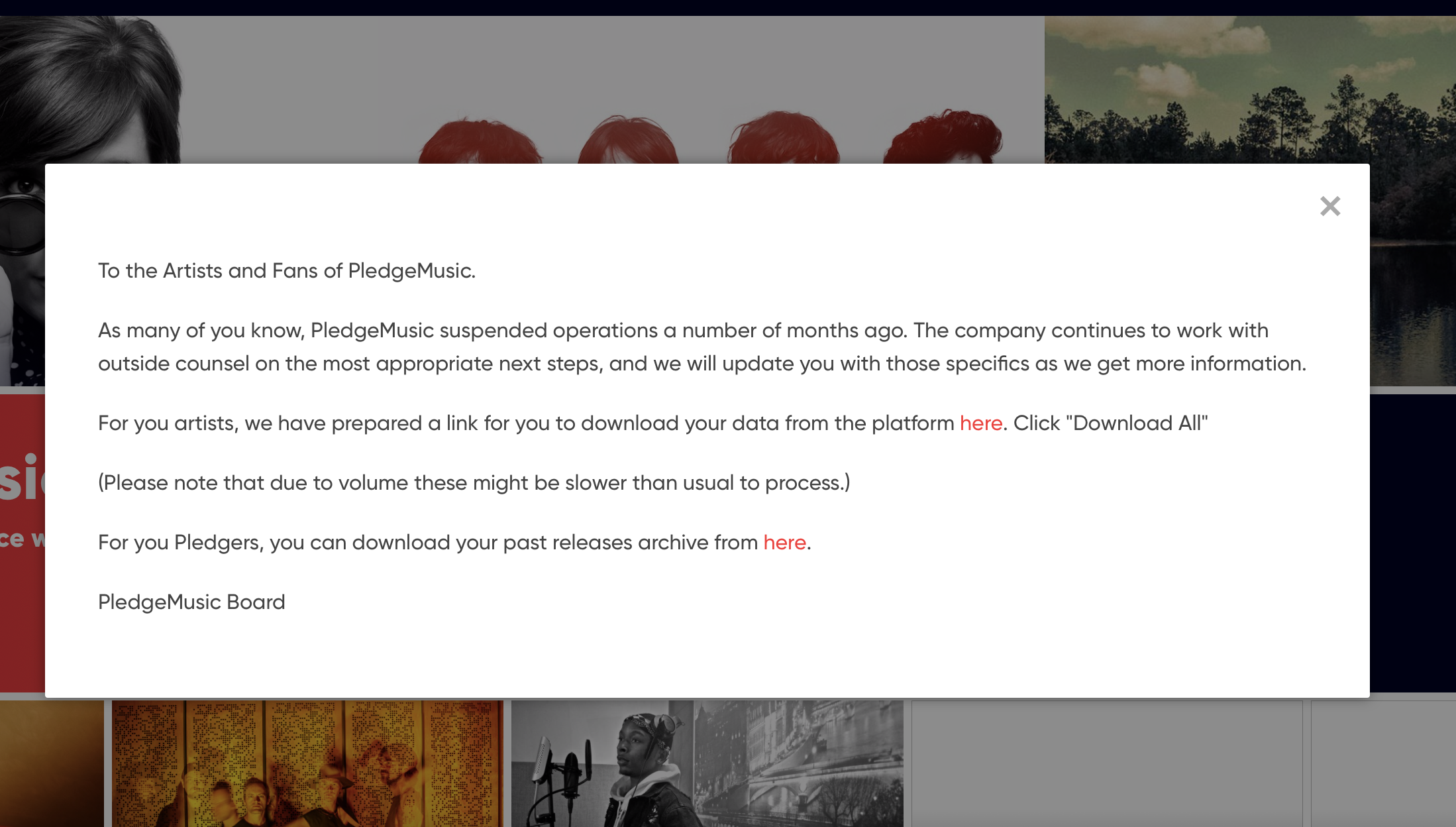
Here is the current website notice. Completely lacking in specifics. Nothing about administration. Maybe this is normal. Maybe it’s not. I will say that publicly available documents indicate the financial history of Pledge Music is extraordinarily complex.  And if I were an administrator or creditor I would have a lot of questions. This could be the reason for the delay.

My colleague here at the Trichordist, David Lowery published this extensive overview of the Pledge Music fiasco two months ago. In the article he goes beyond the SEC charges against one of Pledge Music’s current owners and looks into the strange structure of the company; the multiple sub companies; the related entities; the offshore “panama papers” shell companies; and an SPIV (special purpose investment vehicle).  Quite a complex structure for a company of its size.

Go read the piece: The Pledge Music Fiasco is Weirder Than You Think.

I’ve been looking at another loose end with Pledge Music.  Who was the original investor that funded the company?  Here is an excerpt of an April 2015 interview that Benji Roger (Co-founder of Pledge Music) did with Andrew Warner of Mixergy.

Andrew: Where did you find the angel investors who funded this and allowed you to actually bring it to fruition.

Benji: It was somebody I knew. I basically pitched them the idea and I said, “Who should I send this to?” I sent out, I think, five business plans originally and I said, “Who would you send this to? Who do you think this is a good idea for?” One guy wrote back and he was like, “I love this. This reminds me of how Obama was elected.”

Andrew: Who was the guy?

Benji: He was just a friend. He’s a private guy. He doesn’t want to–

Andrew: He doesn’t want–can you tell us what he does for a living that he can suddenly do this? Is he a musician? Is he an entrepreneur?

Benji: No. He’s in a totally other space. He’s in a totally other space. He’s a very private lad. I don’t want to–

Andrew: But you can’t even say what his background is?

Benji: No. He went to business school.

Andrew: That’s it?

Benji: That’s what I will say.

Andrew: Is it his dad’s money? His parents money?

Benji: No. It’s his.

Interesting.  Go to the UK website where UK companies file required corporate documents. Look up Pledge Music LTD. By process of elimination (all the other original investors are listed by real name) it seems the silent investor is represented by an anonymous Panamanian company called Dolan Services Inc. This is from the 2010 Shareholder list.

Here is one installment of the money coming into the company. This document was filed March 25th 2009.  

Notice the share amount matches Dolan Services Inc.  So it’s reasonable to conclude this is the “silent” investor, and clearly the source of the startup capital for Pledge Music. So who is Dolan Services? An archive of the Panamanian Corporate registry seems to provide an answer. Notice the company was formed approximately 3 months before Pledge Music declared the investment and shortly after Pledge incorporated. And this seems to be the company’s only investment.

So It’s these folks right?


Probably wrong.  These corporate officers are listed on hundreds if not thousands of Panamanian companies.  This is a classic shell company registration operation. Just drill down on one of the officers.

He is listed on all of theses companies as an officer. This is only a partial list. Hundreds of companies.

I’m using this archive of the Panamanian companies because I can’t seem to find Dolan Services in the Panamanian registry any longer.  It’s possible that I’m not searching properly as I do not speak Spanish. Strange. (Any help here is appreciated).

Dolan Services Inc. continues to be listed as the largest Shareholder in Pledge Music until late 2015.  Then the filings at the UK Company House become a mess.  At one point UK officials target Pledge Music with a form of “delisting.” Probably for not filing proper paperwork. But as far as I can tell Dolan Services seems to disappear from the Pledge Music financial documents after 2016. I could be wrong. Like I said the filings are a mess.

I don’t know what any of this means.  And I’m not implying anything, other than the fact Pledge Music was originally funded by an anonymous Panama registered company that seems to have disappeared.

PLEASE CORRECT ME IF I AM WRONG. Leave comment if you have more information.


Guest Post by @poedavid: “Dance Like Nobody’s Paying?” Spotify isn’t

by David Poe

Spotify’s disastrous “dance like nobody’s paying” ad campaign has now been demolished in the national press, garnering negative coverage in Newsweek, Billboard, NME, Hypebot, and more. Sometimes big corporations slip up and show us what they really think of us, and this was one of those times.

6a00d83451b36c69e20240a4bb7b77200b-450wi

But what’s Spotify’s plan?  Here, Variety’s Patrick McGuire suggests Spotify’s intent is to divide listeners and musicmakers:

Similar to the way many people bite into a cheeseburger with no consideration for the cow and farm of its origin, campaigns like Spotify’s widens the growing divide between listeners and creators. Audiences intellectually understand that music doesn’t magically materialize out of nothingness for the exclusive purpose of entertaining them, but as music continues its irreversible transition to all things digital, listeners are becoming less aware and interested in how artists create, record, produce, and share music. With a 2017 Nielsen Music report showing that, on average, Americans now spend over 32 hours a week listening to music, it’s clear that music is hugely important in the lives of listeners — just not in ways that provide meaningful visibility and support to musicians.

Ever heard that song “Put another nickel in / In the Nickelodeon”? It’s from 1950 (written by Stephen Weiss & Bernie Baum.)

Everyone loves streaming. But more than half a century later, most streaming services contend that a song isn’t worth a penny. I respectfully disagree.

Because a song isn’t really a song until someone listens to it, no  musicmaker should be faulted for utilizing all available platforms. But streaming in 2019 forces music makers and fans into the middle of a moral hazard. Music enthusiasts should be able to listen to streaming music without having to compromise their scruples, or that of their favorite bands.

Despite the lack of transparency in the music industry, The Trichordist has managed to cobble together an annual Streaming Price Bible.  It is the most credible summary I’ve found on what each streaming service pays, which may impact where Spotify listeners choose to put their dough-re-mi:

2018_streamingbible

How Bad Is it for Music Makers?

You can easily see from the chart what each service pays for recordings.  At about $0.003 per stream, Spotify pays little but has the greatest market share.  At about $0.0002 per stream, Google/YouTube is even worse.

Very different companies. Their commonality: free music, which has made them rich from ad revenue and data scraping, but mostly from their stock price increasing at the expense of musicmakers.

Let’s put this in context.  To earn a monthly US minimum wage, an artist on Spotify would need 380,000 streams by some estimates.

To make the same monthly salary as the average Spotify employee, a songwriter would need 288,000,000 streams.

Frozen Mechanicals

For reference, the statutory rate for a song on a CD or download is 9.1 cents — 4.1 cents more than ye olde Nickelodeon of the 1950s.

FROZEN MECHANICALS 1909-1977

You might say that’s better than the old days—but it isn’t as good as it looks, because the song rate was frozen for 68 years before it began gradually increasing … only to be frozen again in 2009, where it will stay until 2022.

FROZEN MECHANICALS 2009-2022

Clearly, streaming has all but replaced CDs and downloads, but without replacing revenue from songs to musicmakers.

Money is being made from streaming if you look at it on an industry-wide basis.  But—due to the hyper efficient market share distribution of the “big pool” revenue share accounting instead of a user-centric model (or the “ethical pool,”) individual music makers are far worse off.  More than ever, streaming revenue is not paid to music makers who don’t share in the big advances or Spotify stock.

You Can’t Compete With Free

The vast majority of Spotify users are in the “free tier”. By offering free access, Spotify artificially distorts the streaming market and disallows competition amongst streaming companies. As musicians have learned the hard way, you can’t compete with free.

Spotify likes to say it’s artist-friendly, a tool for music discovery.

Guilty of chronic copyright infringement, Spotify was founded by a former pirate.  It’s a corporate ethos built on theft.  The Music Modernization Act essentially gave Spotify a new safe harbor, but its tactics haven’t changed.

There’s additional shadiness here: allegations of gender discrimination and equal pay violation,expensive, state-subsidized offices, executive  bonuses,corporate lobbyists,a dicey DPO and of course, the “fake artist” scandal.

Spotify’s ongoing lobbying campaign against artist rights continues despite the unanimous passage of the Music Modernization Act in Congress last year (and the jury is out on the MMA and Spotify’s safe harbor).  Shocker—Spotify apparently reneged on agreements it made to accept the Copyright Royalty Board’s mandated increase in songwriter pay.  Another bonehead move that was publicly rebuked by songwriters from Spotify’s “secret geniuses” charm offensive, including Nile Rodgers and Babyface.

Spotify was joined by Amazon, Google, and Pandora in “suing songwriters” to appeal the Copyright Royalty Board’s ruling that increased the paltry streaming mechanical rate, which Spotify lawyer Christopher Sprigman argued against in court.

Apple Music does not have a free tier and yet was the only major streaming service that did not challenge the new royalty (44% more, which means 0.004 instead of 0.003, which is still bullshit.)  

This may be because Apple recognizes that music helped save its ass from financial ruin 20 years ago. Math is not my strong suit, but numbers indicate music (via the iPod, a now-obsolete door stop) generated nearly half of Apple’s accumulated wealth not to mention introducing a new audience to Apple’s other awesome products.

Or it could just be that Apple understands creators and may actually like us.  There’s a thought.  We were early adopters—Macs have been in every recording studio and creative department for decades.   

Apple Music’s intent to increase artist pay to a penny per side is its best yet, but now long overdue.   Which is a shame, because a trillion dollar market cap company could afford to redistribute some wealth.  If Apple offered a fair alternative, most would run screaming from the competition.

The Generational Problem

There are many who are more expert than me, some quoted in this post. I’d rather be staring into space strumming guitar and writing a song than here discussing music and money.

But I’m concerned for the next generation of artists, especially the musical innovators. Here’s why:

There used to exist a sort of musical middle class. Artists in all mediums expected financial struggle but there was the possibility of making a living and even growing as an independent artist.  That might include a record deal or selling CDs at a gig in order to make it to the next town.

Songwriters could get an album cut and get by or even do well if the album sold (Jody Gerson has a great explanation of this.)  Musicians of quality could see a light at the end of the tunnel.

Streaming has “disrupted” all of that.

Light’s out.

Bands’ streaming access may—may—help build an audience that may somehow convince talent buyers to book gigs that route your tour, which is awesome. But sustaining a career is still cost-prohibitive for many.

Thus the Top 40 is full of the children of the affluent.

Not children of millionaires: Stevie. Dylan. John & Paul. Aretha.

Those of us who have been making music for awhile will remember the optimistic, 1990s-era “monetize the back end” argument: bands on the road can make up income lost to streaming by selling merch.

I tour, too. I wish the best to every band who does so.

But not every musician can travel … or got into music to sell a fuckin hat.

Another common sense rebuttal to “shut up and tour:” INCOME FROM LIVE SHOWS WAS NEVER MEANT TO REPLACE THAT OF MUSIC SALES — plus both have investment costs and overhead to produce.

Gas costs what gas costs.

Mics cost what mics cost.

Streaming doesn’t pay what music costs.

Sorry to yell. Just sick of this lie that to make up for streaming losses all recording artists, especially senior citizens, should tour forever. Or the assumption they are all rolling in dough! Tell that to the punk rock drummer, alto player, the cellist, the songwriter.

Note: It’s almost impossible to buy a new car or laptop that plays a CD. Low income streaming has effectively replaced higher income physical sales.

So if streaming is to be the primary method of music distribution — if not the only one — then pay artists fairly.  Or it really will be lights out, if not for the huge artists who regularly celebrate stupidity then for the ones whose songs you want played at your funeral.

Without musicmakers, Spotify has nothing. When Spotify says “dance like nobody’s paying,” it’s because they don’t.

Given support from listeners and lawmakers, this era of economic injustice via streaming may one day be a footnote.  Fans should not be paying for music they don’t listen to which is what has been happening and is a hallmark of streaming gentrification.

Now, listeners must demand fair pay for musicians they claim to love, whether it is higher streaming royalties or a user-centric royalty allocation—or both.

#IRespectMusic

[This post first appeared on MusicTechPolicy]

Guest Post @musictechpolicy: Another Bad Artist Relations Week for Spotify

By Chris Castle

Spotify released one of their groovy ad campaigns last week.  This time celebrating their freebie subscription campaign.

D_SMUJEW4AAwd6c

You really do have to wonder where they find the people who come up with these things.

Blake Morgan, David Lowery and David Poe all laid into Spotify with their own tweets.  Just like Lowery’s seminal “Letter to Emily” post, but much faster, social media began driving traditional media with the story.

Billboard, Newsweek, Variety and New Music Express all picked up the story in 24 hours, and many others are also picking up the story.  I did a short post that Hypebot connecting the dots from the giveaway campaigns to user-centric royalties.

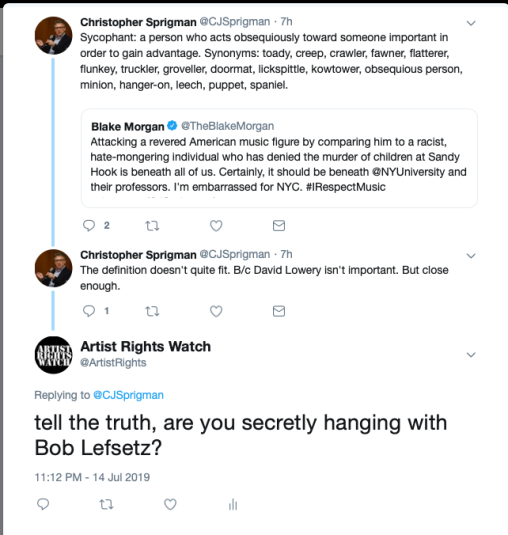
But the capper was the Godwin’s Law moment when Spotify’s lawyer and NYU professor Christopher Sprigman went after both Blake and David Lowery on Twitter for reasons that are frankly lost on me.  Professor Sprigman had something of a bizarre moment when he compared Lowery to Alex Jones which culminated in this exchange (recall that Alex Jones was deplatformed):

Sprigman 1

It should not be lost on anyone that Professor Sprigman supported Professor Lessig’s losing argument in the Eldred v. Ashcroftcase and apparently was co-counsel with Lessig in another losing argument in the Kahle v. Gonzalescase.  It also must be said that David Lowery and Melissa Ferrick’s class action against Sprigman client Spotify and Lowery’s case against Rhapsody were probably among the most consequential copyright cases (along with BMG v. Cox)  in the last five years.  Some would say that the Lowery cases set the table for the Music Modernization Act (and it should come as no surprise that David was asked to serve on one of the committees).

So while Professor Sprigman may find that Lowery “isn’t important”, there is a crucial difference between Professor Sprigman’s big copyright cases and David’s.  Want to guess what it is?

Some are speculating that Sprigman is retaliating on Blake and David Lowery for their successful commentary on his client Spotify–but I’d want to see a lot more proof.  Until then, you’d have to say Charlie has a point when he says that Sprigman is kind of an academic Bob Lefsetz.

Sprigman 2

And Spotify stumbles across the finish line of another bad media week of dissing artists.  Whew. Thank God it’s Monday, right?

Google Doxx: Google Funded Groups in 2017 Illegal Doxxing of FCC Chairman

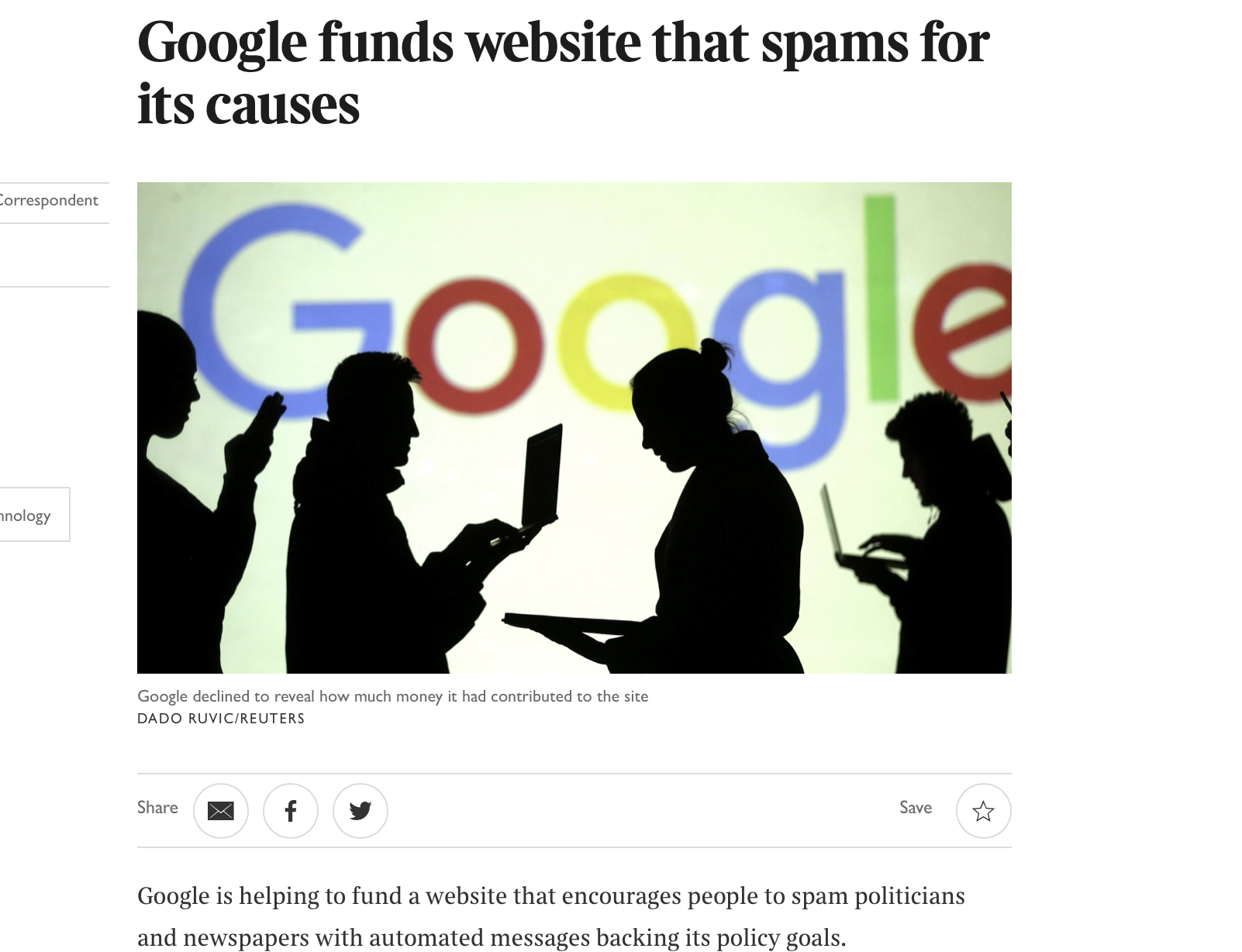
Editors note #1 – Over the last year, this blog has been reporting on Google’s apparent use of proxies in an attempt to intimidate members of the EU parliament into voting against the proposed EU Copyright Directive. The Copyright Directive requires social media platforms above a certain size to do more to counter copyright infringement and to fairly negotiate licensing deals with creators. We focused in on the Google-funded/directed Canadian “engagement network” (whatever that is), Open Media and its subsidiary New/Mode.  Newspapers like The Times of London and Frankfurter Allgemeine Zeitung followed up with damning stories of their own here and here.  We now go back and look at something slightly off topic for us: the doxxing and harassment of FCC Chairman Pai because it involves many of the same actors and bears a striking similarity to what happened in Europe.

Editors note #2. UPDATE: Thanks to a tipster we found a note in The Schmidt Family Foundation tax returns that seems to tie Eric Schmidt, the then Chairman of Google directly to one of these groups.


Eric Schmidt then CEO of Google personally gave Fight For The Future money to do education on something to do with fossil fuels during the net neutrality fight. Yeah sure. As far as we can tell Fight for the Future doesn’t do this sort of work. This sure looks like a false statement to federal authorities about the purpose of a contribution.  Isn’t this similar to what Martha Stewart did? 

+++++++++++++++++++++++++++++++++++

Google Doxx: Google funded groups in 2017 illegal

doxxing of FCC Chairman
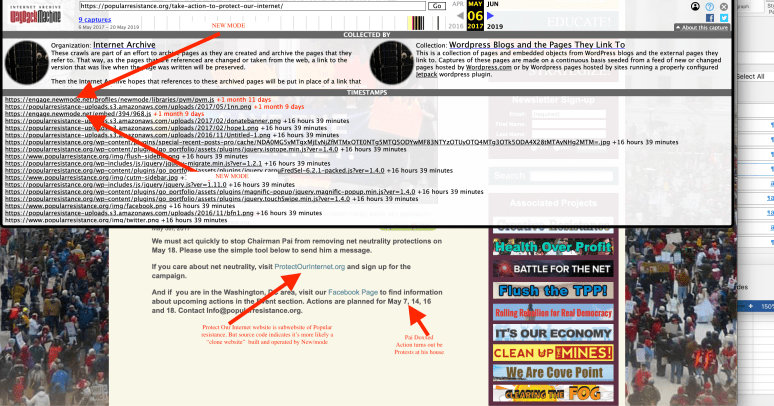
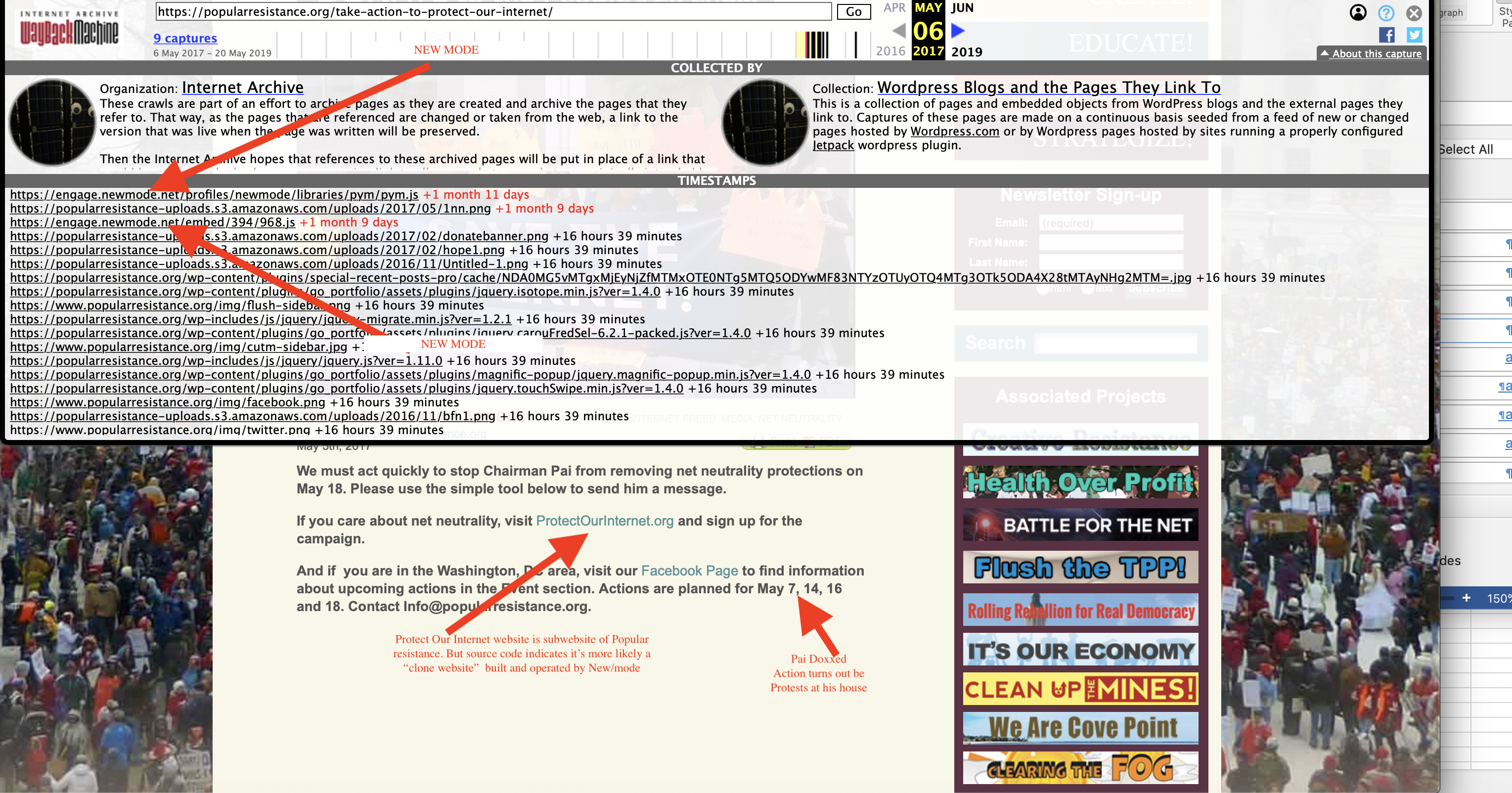
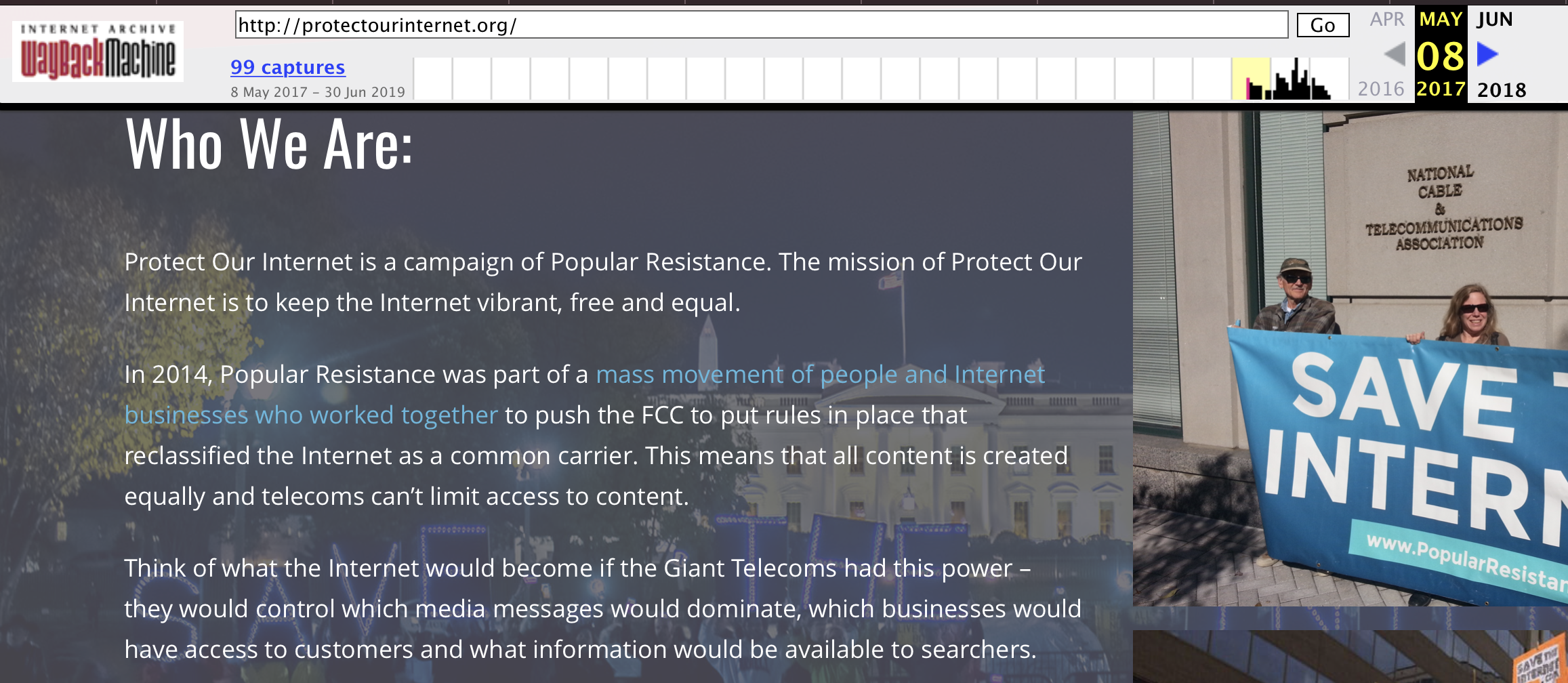
Wayback Machine archives of Popular Resistance Website a couple days before they doxxed Ajit Pai and sent protestors to his house. A tiny clue in the referenced URLs led us to Google funded websites 

Huh what? FCC? Ajit Pai? Title II Net Neutrality?

Yes, we rarely cover the topic because it doesn’t directly relate to copyright and the music community. We have kept an eye on the net neutrality issue for one reason only: the same Google proxies, non-profits, and astroturfers that oppose us on copyright legislation desperately want Title II FCC oversight of Net Neutrality restored.

There are several groups with direct or (barely) indirect funding from Google that come to mind; Fight for The Future (former Google lobbyist/outside consultant Marvin Ammori is on the board), Open Media (Directly funded by Google, board of advisors includes ex-Google policy chief for Canada, Jacob Glick), Public Knowledge (named on the Oracle v Google “Shill list”), and Free Press (Ammori was general counsel until 2010). These groups work in lockstep with Google on copyright and other public policy issues important to Google’s bottom line. Tight little circle there.


FCC Title II enforcement of Net Neutrality is one such issue.  For Google, a Title II net neutrality regime ensures Google’s data intensive network of (often unwanted) display, videos ads and other services continue to “free ride” on the bandwidth consumers purchase.

A little background: Until 2015, a less strict version of Net Neutrality was voluntarily observed by most internet service providers. Occasionally there would be reports of abuses but public outrage or threats to pursue antitrust type actions against ISPs seemed to largely keep abuses in check. Not always, but mostly. It wasn’t perfect but most people generally enjoyed their internet experience. Hence its popularity.

And it was the popularity of streaming television and the paid prioritization of traffic for services like Netflix that began to cause concern. I’m a Title II net neutrality skeptic but I rate these concerns legitimate. Were ISPs behaving in an anti-competitive manner by forcing (or allowing?) streaming services to pay for “fast lanes?” Companies like Google didn’t like this development either. They didn’t want to pay for “fast lanes” to deliver their data intensive services to the public. They preferred to enjoy what amounts to a free ride. Paying would surely hurt their bottom line.

I get that. Google is, after all a for-profit company.

However, it gets weird. Fast. Google was extremely close to many folks in the Obama Administration.  And eventually the Obama Administration bought into Google’s argument for FCC enforcement of Net Neutrality and began to pressure the FCC.

White House visitor logs seem to indicate that Obama’s senior internet advisor David Edelman met with 30 net neutrality activists weeks before Obama announced his net neutrality plan. On the day Obama unveiled the plan, several of the activists who met with Edelman at the White House six weeks prior blocked then-FCC Chairman Tom Wheelerfrom leaving his driveway.

Many of these organizations were/are still funded by Google. Basically, it appears the Obama officials coordinated with Google funded activists to lobby the FCC, and in Wheeler’s case, prevent him from leaving his own driveway. The problem is that legally, the FCC is supposed to be independent of the White House. While it might be technically legal for the White House to coordinate with activists who, then on their own decide to harass the FCC, it’s definitely “not cool, man.”   And the activists with whom the White House coordinated did some pretty disruptive things at FCC hearings and events. The FCC eventually caved under this pressure and the result is the FCC Title II Net Neutrality regulatory regime that prevailed 2015-2018.

In the end, most consumers didn’t notice the change. But the move was controversial in some camps. Obviously broadband providers like Comcast, Verizon and AT&T were upset by what they saw as heavy-handed regulation and a disincentive to invest in their networks. Whether Tittle II caused broadband providers to stop investing in their networks or not is hotly disputed.

However, there were also more nuanced concerns from network experts.  Many questioned whether consumers really wanted “strong” net neutrality.  Do you want your ISP holding up that new Orville Peck video you want to watch because “neutrality” requires it to wait for data packets from the sketchy Moldovan auto-roll video advertisement trying to play in a pop-up browser window? Probably not. (No offense Moldavians.)

Others pointed out that many young consumers liked “zero rating,” a practice actvists argued violates strict Title II Net Neutrality.  Zero rating is, for instance when a mobile service provider does something like allow you to stream Spotify or Netflix without it counting towards your mobile data allowance. Under Title II neutrality, zero rating is seen as favoring some services. I personally think it’s good that mobile services, their customers, streaming companies and content creators are experimenting with new ways of delivering and monetizing content over communications networks. It also just seems anti-innovation that the FCC would want rules that forbid packaging experiments.

Finally, there is also the very real concern that Title II regulation gave  unelected FCC bureaucrats extraordinary control over the internet. Am I the only one that finds it ironic that many anti-Trump activists now also insist the (Trump) FCC continue to strictly regulate the internet through Title II?.

You see, Net Neutrality is a much more complex issue than you might think.

++++++++++++++++++++++++++++++++++++

Skip forward now to 2017 when Republicans took control of the executive branch.  Ajit Pai became head of the FCC.  Pai immediately began talking about ending Title II authority and rolling back regulation of the internet to the pre 2015 status quo. Many people, rightly or wrongly, took this to mean “ending” Net Neutrality. Either way it was a reversion to the pre 2015 status quo. Which IMHO was not that terrible. However…

MASSIVE FUCKING FREAKOUT by all the Google aligned astroturfs.  Especially those groups that were in the aforementioned Obama White House meetings.  Groups like Fight for the Future, EFF, FreePress, Open Media and Public Knowledge were particularly strident in their calls to keep the FCC (a Trump FCC mind you) in control of Net Neutrality.  It is understandable in some ways as these Google funded astroturfers had worked very hard to put FCC Title II Net Neutrality in place.

Fight for the Future and FreePress  were particularly harsh in public statements towards Ajit Pai. For example, FreePress.net had this (sort of weird thing) to say about the (Indian-American) Chairman:

“That the Trump administration peddles lies and propaganda to prop up its hateful agenda is well known.Trump’s FCC chairman, Ajit Pai, is no exception — this year he’s stooped to incredible lows in his attempt to justify his repeal of Net Neutrality and a plethora of other consumer protections.”

This from a FreePress blog post titled “Ajit Pai’s biggest lies of 2018.”

Evan Greer (she/her) spokesperson for Fight for the Future simply tweeted “Fuck Ajit Pai.” Greer, at the time was often a featured speaker alongside US Senator Markey (D-MA) at Net Neutrality events in DC.  Greer also attended the White House meeting with Edelman. The point is, Greer is not a random person on Twitter, but a key player at a Google related astroturf. She’s also pretty radical: In 2012, Greer campaigned on behalf of an Al Qaeda terrorist.

Vitriolic and hyperbolic? Sure. A little weird linking “Trump Hate” (we all know what that means) to the Indian American guy? Yes. But hey they never seemed to cross the line into outright harassment and intimidation.
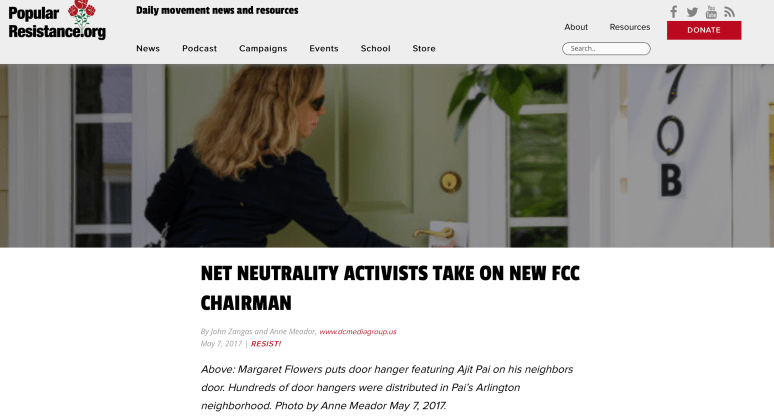
Margaret Flowers from Popular Resistance led a group of protestors to the FCC Chairman’s house. Popular Resistance then escalated the harassment by posting the Chairman’s address on its website. Pai has young children and Flowers, a pediatrician was clearly aware of that. Go figure.

No, the folks that crossed the line, the folks who actually broke the law were an outfit named PopularResistance.org (Sometimes operating as Protect Our Internet). What did they do?  They sent protestors to the home of Ajit Pai. Repeatedly.  And when that didn’t seem to make him change his mind, they then posted his address on their websites. Obviously, I’m not giving out the link but here is a partial screenshot. They also posted it on a now deleted Facebook event.
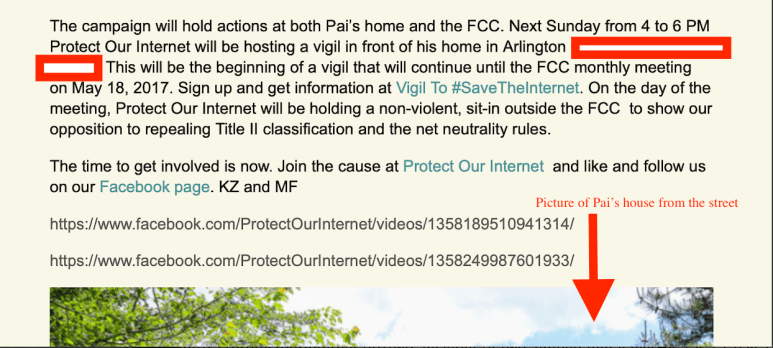
This isn’t just annoying and scary. It’s actually a federal crime as it is considered a form of cyberstalking.

From a DOJ document describing Doxxing:

“Posting personal information publicly with the intent to shame, defame, harass or endanger is illegal. It places the doxed individual in a potentially dangerous situation. The federal law often utilized to address doxing is 18 U.S.C. § 2261A:”

I would argue it’s even more serious. Since the intent is to make the guy about to vote on something fearful for the safety of his family if he votes the wrong way, I’d argue it’s a form of political terrorism as it was clearly designed to achieve a political end.

The environment in which all of this was happening was already supercharged with dire warnings (“It will destroy the internet”) and hysterical proclamations (“end of democracy”). It would be an understatement to say emotions were running high. The doxxing of Ajit Pai by Popular Resistance was like throwing gasoline on the fire.  And then predictable happened.

In November 2017 The Washington Post reported, “FCC chairman Ajit Pai says his children are being harassed over net neutrality.” The Post noted there were pretty offensive and threatening signs posted in front of his house. I won’t reproduce them here. There were death threats. One federal official noted the frequency of threats reached the frequency of threats the President receives. Around the time all this was happening, I read a story about it in Variety. I was shocked to see the story had at least half a dozen comments that approved of the threats or made additional ones. Some of the commenters appeared to have used real names! The coordinated campaign against Pai normalized death threats against him.

Eventually the police arrested (and later convicted) a man that had made several threats to kill Pai’s family.  The man plead guilty and later admitted he did it just to frighten Pai into changing his mind (see political terrorism comment above.)

The day of the vote there were two separate bomb threats to the FCC. The first was an email to the Washington Post from someone claiming to be from the hacking collective Anonymous. The person claimed to have sensitive private information on the FCC staff and that Anonymous had wired the FCC with explosives. For whatever reason, this threat wasn’t taken seriously.

The second bomb threat was regarded as more serious. Just as the commissioners were going to vote, a Net Neutrality supporter and serial bomb hoaxer phoned in a threat. The room was briefly evacuated, bomb sniffing dogs were brought in but eventually the vote was taken.

The last part of the story has a terrible twist. The man who was eventually arrested and convicted for calling in the FCC bomb threat turned out to be a for-hire “swatter” who had swatted a father of two in Wichita, Kansas who was  shot to death by police when he opened door. 

Sure, unpopular politicians occasionally get threats, but they don’t simultaneously have their addresses posted online and have unhinged protestors in their yards.  They are generally not subjected to months of vitriol and venom from a corporate funded network of astroturf groups.

There is a very bright line between political demonstration and purposely trying to stir up violent mobs or dangerous lone wolves. This is just my opinion and I’ll go into it more later, but I think Popular Resistance and their fellow Google-funded “Ajitators” (their word not mine) Free Press, Fight For The Future, EFF and Public Knowledge knew what they were doing and they all tacitly approved the doxxing.

A few weeks after Pai was doxxed, a gunman showed up at a practice for the Congressional Baseball Game and shot and critically wounded Rep Scalise (R-LA). This had nothing to do with Net Neutrality but this was the political environment at the time all of this was going on. When Popular Resistance doxxed Pai and his family, the intention was to not let the man live in peace.  Given the Scalise shooting and the superheated environment, something bad seemed much more likely to happen. Popular Resistance and their allies clearly knew this and exploited it. They intended to terrorize Pai into changing his vote.

This is an insane development for democracy like ours. Terroristic threats changing the way politicians vote because they are concerned for their own safety? Whether you agree with Pai or not you should be very frightened if this becomes the norm. Especially if you are on the progressive left (as Popular Resistance claims they are), as generally those on the extreme right have a lot more guns. (Ed note – um…not always).  We can’t let this sort of intimidation become the norm for political discussions.  But I digress.

Popular Resistance should have been sent a bill for all the extra local, state and federal manpower devoted to protecting Pai after targeting and doxxing created higher probability of threats translating into violence. Surely the security costs were significant. Pai canceled a speech at the Consumer Electronics Show because CES couldn’t afford the extra security required to protect Pai. And that was just one day.  Now imagine months of extra security.

Also, does anyone enjoy the irony that so called  “free speech” advocates like Free Press limited Pai’s ability to freely express himself?

Eventually Google stalwarts Free Press and Public Knowledge knew the whole thing had gone too far.  The groups issued statements condemning the racist attacks, threats of violence, and general harassment that Pai and his family had been subjected to. Somewhat disingenuously in my opinion.

All three groups set out to create the impression of an existential crisis and they carefully directed the public’s anger at a single government official. Just because it was Popular Resistance that crossed the line, doesn’t mean Free Press, EFF and Public Knowledge should get a pass.  Besides, it’s pretty clear all these groups coordinated with Popular Resistance.

Popular Resistance: Harmless Progressives? Violent Marxists? Cyberlibertarians? Corporate Shills? All of the Above? 

First, let’s try to figure out exactly what Popular Resistance is?  Progressive do-gooders? Radical Marxists? Cyber-libertarians?  Putin’s useful idiots? Mercenary Protestors? Google 5th columnists?  Performance Artists?  I can make an argument for all the above.

So who/what are Popular Resistance? The website states:

“With the corporate takeover of federal and state governments, growing state violence and oppression, a widening wealth gap and the climate crisis, more people are becoming politically active in new and creative ways.

A growing culture of resistance is utilizing nonviolent direct action and civil disobedience as primary tactics, and is forming real democratic organizations to empower local communities—as opposed to working within the corrupt government dominated by a two-corporate party system and within an unfair, big finance, capitalist economy.

PopularResistance.org is a resource and information clearinghouse for this movement of movements. We provide a daily stream of resistance news from the United States and around the world, and a national events calendar. Follow us by signing up for our Daily Digest or subscribe to our free weekly newsletter.”

They also have a weird habit of reporting on themselves via themselves via their (literally) fake news bureau that seems to be staffed by the members of Popular Resistance.

Okay we know the type of organization: A standard, professional lefty, anti-capitalist group. But hey, their views seem no different than many of my musician friends.  Nothing new to me. Still, let’s dig a little deeper.
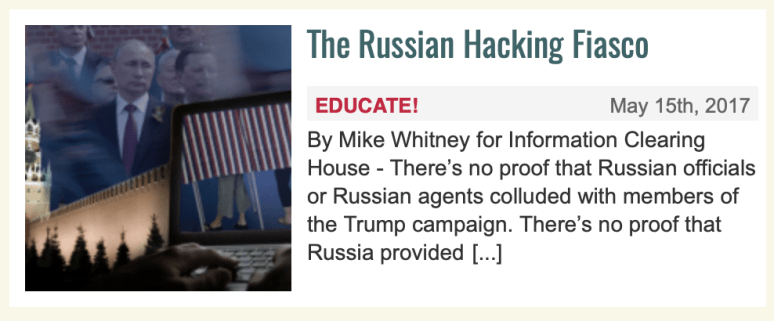
Well that’s different. I read this wrong at first.  I thought they wanted an investigation of Russian interference in US elections.  Whatever your opinion of Russian collusion story, you have to agree this is not your typical progressive lefty grassroots organization.

And this….

Oh dear. Here are members of Popular Resistance defending Venezuelan dictator Maduro by occupying the Venezuelan embassy in Washington, D.C. to prevent the internationally recognized Government from taking control of the embassy.

At this point, these folks are beginning to diverge from the views held by my typical lefty musician friends. I don’t know a single one that thinks it’s reasonable to defend Maduro. Especially if they are animal lovers.

However, as U.S. citizens they have a right to their opinions and a right to protest. I certainly disagree with them, but they have their rights to do this. And at least they are non-violent. Or are they?

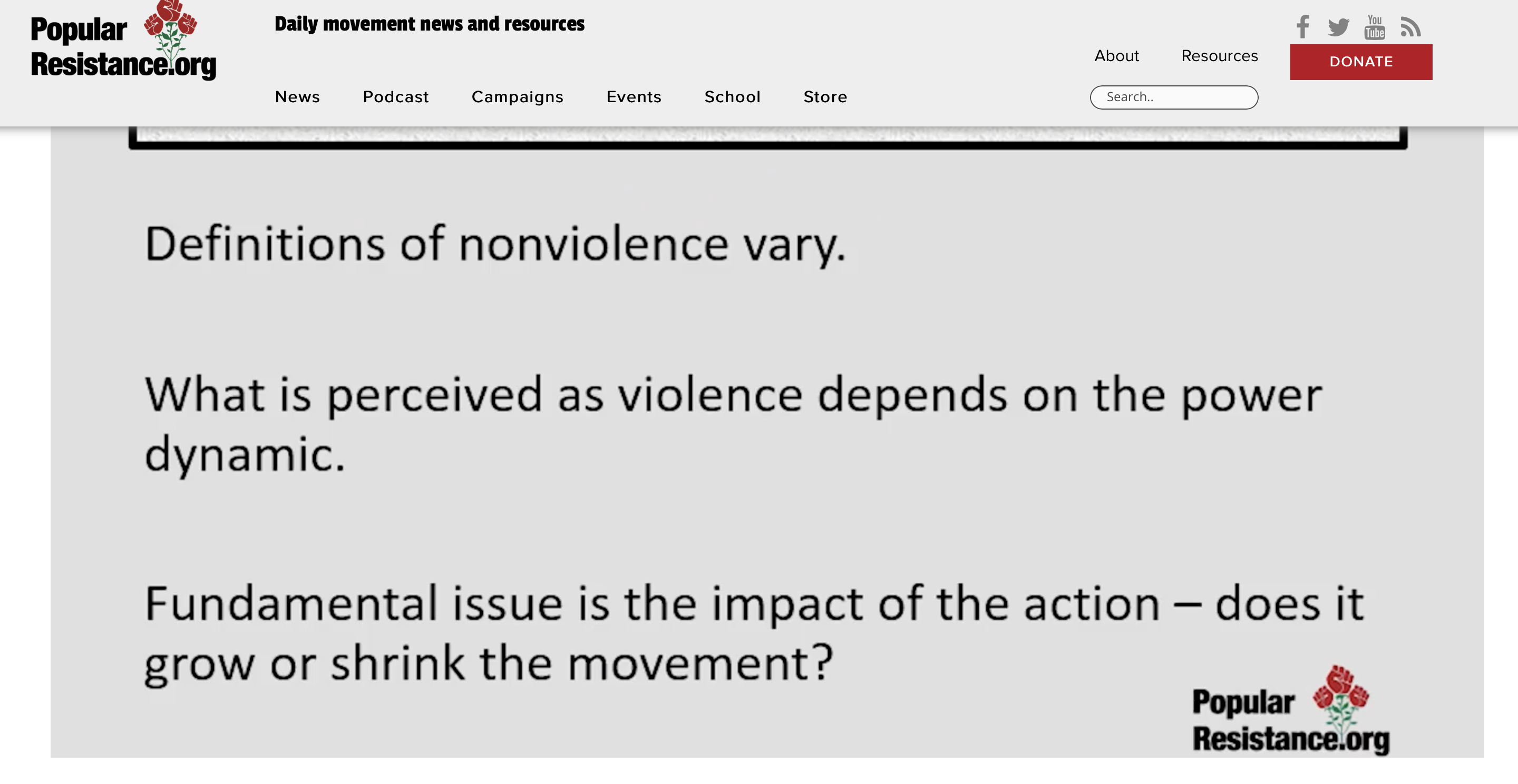
Well here is a still from one of their training videos on YouTube.

My summary: So it depends on who is defining violence, and violence is generally discouraged because most of the time it doesn’t expand movement, but sometimes it does and then it’s okay?

Did I get that right? Pretty sure I did.

Okay, radical far left revolutionary Marxist organization. Again, what’s new? I think my UC Santa Cruz student run food coop actually styled themselves a revolutionary Marxist collective. I may have even been a member. For all I know, I may even have revolutionary Marxists in my own band. It’s not illegal to hold these views and Popular Resistance is a legal organization, at least until they commit actual violence, the FCC Chairman files a doxxing complaint against them or….
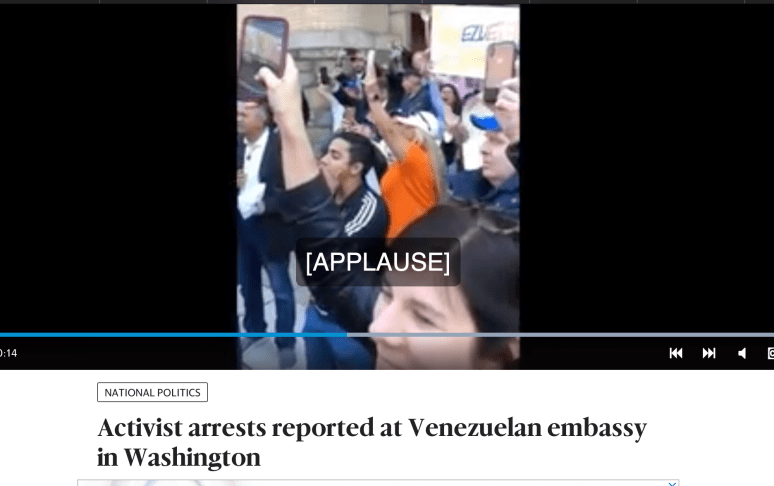
..until they illegally occupy the Venezuelan Embassy and are arrested by US Secret Service (with actual Venezuelans cheering and applauding the DC police and Secret Service).
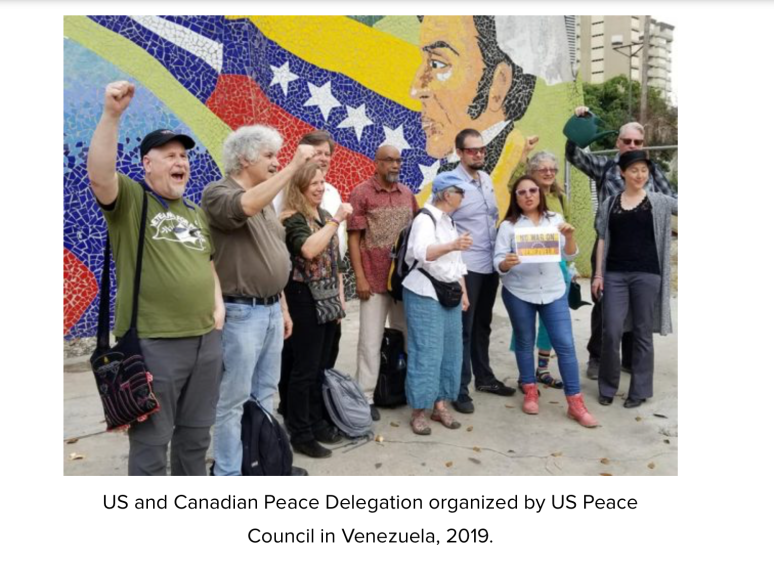
Countering the argument that these really are hardcore pro-Maduro revolutionary Marxists is the above photo. Those are the most pathetic revolutionary solidarity fists I’ve ever seen! Hard to brandish an AK-47 convincingly with a tepid fist like that.

Except for the guy on the far left with the baseball cap. I want him on my Venezuelan Civil War reenactment team!


But if they are revolutionary Marxists what’s all the above bullshit about? This is a post to one of their websites during the Net Neutrality debate. They seem care a fuck of a lot about technology startups considering they are anti-capitalists. Aren’t venture funded technology startups the very definition of wild west capitalism?  “Comrade, so nice to see you shaking the invisible hand of the venture capital marketplace!”

And here they are arguing for free markets. Not something you see every day from solidarity-fist-raising-Maduro-supporting-revolutionary-Marxists. And the use of the term “crony capitalism?” That is what real capitalists complain about when they see the government creating subsidies for pseudo capitalist corporations like Fannie Mae or Tesla. I think Popular Resistance needs to establish a tribunal to root out the reactionary capitalist running dog in their midst! Find him/her/them and gulag them.

Popular Resistance Creates New Project “Protect Our Internet”  Or do they?

And then Popular Resistance claims to do something quite extraordinary. On May 8th 2017 they announce the creation of a new Popular Resistance project called  “Protect Our Internet.”  This website appears to be used to manage their Net Neutrality mailing list, protests and doxxing events. They even created a special URL  ProtectOurInternet.org.

The only problem with this claim?  It is not quite true. Protect Our Internet domain was created by someone else. Not a member of popular resistance. It’s still owned by this person. It’s never clear how this was ever “their” website. Or if they did any management of the website.

The website was recently wiped and replaced with a generic WordPress blog with two very generic posts. So to really view it you have to use The Wayback Machine.  It also recently changed domain registrars and perhaps someone forgot to put the anonymization proxy service back in place? Oops. That’s how I got this information.

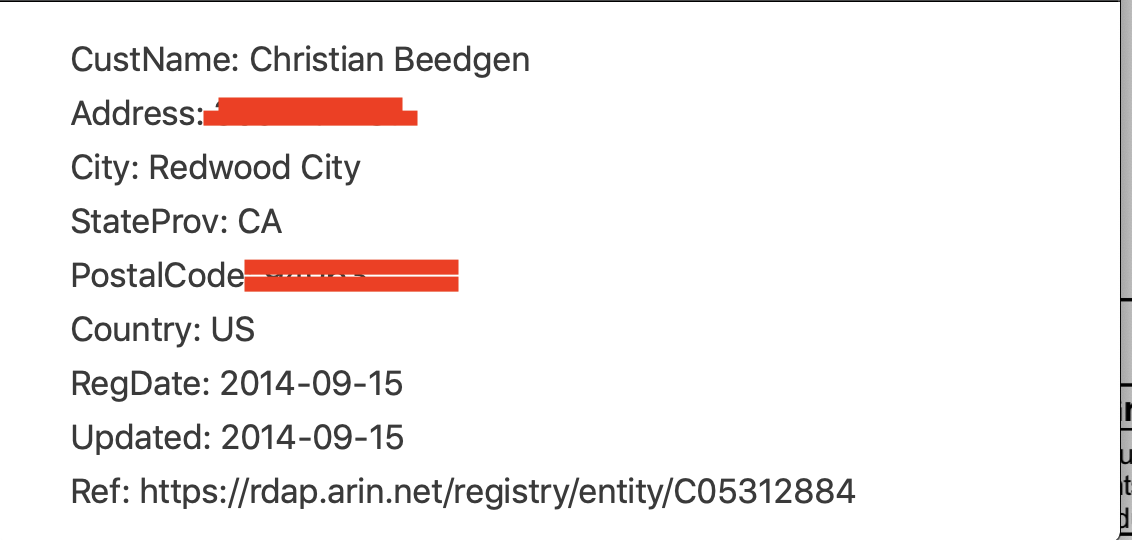
Protect Our Internet appears to have been created in 2014 right before the White House meeting with Net Neutrality activists.  It was not created in response to Ajit Pai’s repeal of net neutrality. It was created under the Obama administration by someone named Christian Beedgen of Redwood City or possibly someone spoofing him. I reached out to Mr. Beedgen for comment and have not received a response.

There is a fairly well known internet entrepreneur named Christian Beedgen at that address in Redwood city.  He is the co-founder of Sumo Logic. One of the newest Silicon Valley “unicorns” (privately valued at more than $1 billion). I’m not positive it’s the same person, but when I used Google street view to navigate to the address, I found a building that proudly displays the Sumo Logic logo. Could be someone has decided to impersonate him.  If so, it is an inspired choice. The Crunchbase profile for Sumo Logic indicates the investors are a veritable who’s who of Silicon Valley venture capital. If Protect Our Internet is really a project of a radical far left group like Popular Resistance, why does the website belong to this internet entrepreneur guy and not one of the members of Popular Resistance?  Why was the website registered 2 1/2 years before Popular Resistance created this “project?”
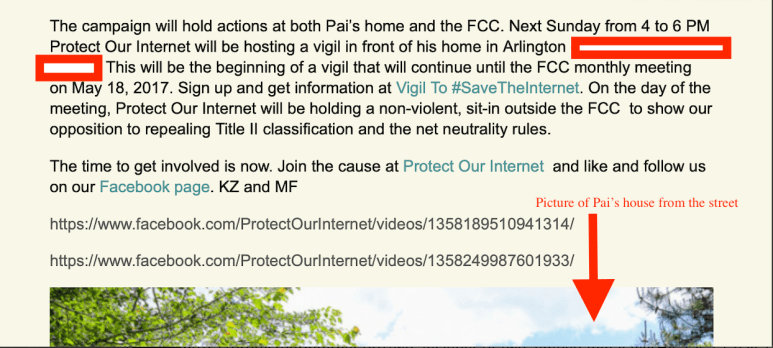
Also, since Popular Resistance says the protest at Pai’s house (address listed) is a Protect Our Internet event, does this mean Beedgen is responsible for the event?  If I was Beedgen, I would immediately get a really good lawyer. This seems to make him a co-conspirator in the doxxing of a federal official in an attempt to intimidate him into changing a vote. Dude needs to straighten this shit out if he has nothing to do with it. When you have as much money as the Beedgen apparently has, there’s bound to be a clever litigator out there that will want to make him the deep pockets. Not Popular Resistance.

Seriously, what is really going on here? This is absolutely nuts.

Let’s leave it as a weird loose end for now, and I’ll get back to it in a minute.

+++++++++++++++++++++

I showed this Popular Resistance bullshit to a friend of mine and he joked, “it makes more sense as a government run domestic spying operation, disguised as a ‘resistance action clearing house.’ Check to see if these folks do business with Palantir.”

Pretty funny if you know anything about Palantir.

A more plausible explanation? Protect Our Internet is just a wing of Google’s far flung influence peddling operations. Let’s examine that now.


What’s the Google connection?

“Free Press began building a broad coalition of groups to petition the FCC for Title II reclassification under a campaign called “Save the Internet.” Aaron was quick to give props to more than another 40 groups, such as Demand Progress, Popular Resistance, Electronic Frontier Foundation (EFF) and Fight For The Future (FFTF). “We kept plugging away at Net Neutrality and filed hundreds of pages of detailed comments with the FCC,” he said.” –Popular Resistance Website May 11 2017


This comment from the Google funded Free Press caught my eye.  There is no way Free Press was not at least aware of Popular Resistance’s doxxing. It is their only real contribution to the Net Neutrality fight. It’s basically the only song on the Popular Resistance Greatest Hits Record.

If you go to the Popular Resistance concert the crowd sounds like this:

“Doxx Pai”

“Doxx Pai”

“Freebird!”

“Doxx Pai!”

And again, a reminder about the other groups Free Press mentions:

  • (UPDATED) Fight for The Future is run by a former(?)Google lobbyist and former(?)outside counsel. Also in 2016 Eric Schmidt, the Chairman of Google personally gave Fight For the Future $30,000for “Raising awareness around environmental impacts of fossil fuels.” I can find no evidence that Fight for the Future ever did such work. (I suggest Mr. Schmidt and Fight for the Future amend their tax returns as we intend to contact relevant non-profit and tax authorities).
  • Electronic Frontier Foundation has received millions from Google. And its apparent lobbying for Google has twice made it the subject of judicial scrutiny.  In Oracle v Googlethe court forced Google and Oracle to disclose “paid bloggers.”  Guess who appears on that “shill list?” And in Frank v Gaos the Supreme Court of the United States was being asked whether Google could really be “punished” by forcing it to pay a cy pres award to EFF seeing as it was funded by Google in the first place and sides with the search monopolist almost 100% of the time.
  • Public Knowledge also appears on that “shill list.”
  • Demand Progress has Marvin Ammori from Fight for the Future on the Board. And Mike Masnick, who also appears on the so-called “shill list,” and whose Copia Institute is funded by… Google.

Eric Schmidt, then CEO of Google personally gave Fight For The Future money to do education on something to do with fossil fuels during the net neutrality fight. Yeah sure. This sure looks like a false statement to federal authorities about the purpose of a contribution.  Isn’t this similar to what Martha Stewart did? 

It’s all so fucking fake.  Fake grassroots activists getting contributions for fake work. Fake consumer rights organizations. Fake think tanks. Fake websites. Fake revolutionaries.

Still, none of this means that Google was directly coordinating with Popular Resistance. And Popular Resistance and Fight for the Future were keen to make sure everyone knew this. Popular Resistance website:

“Ammori said that the groups weren’t talking directly to each other so the key was to coordinate them. He focused on pulling together startups in the business community.”

Never mind this contradicts what Free Press says in the previous quote.

“Shut up Free Press! We weren’t coordinating, I swear! You’re so stupid”

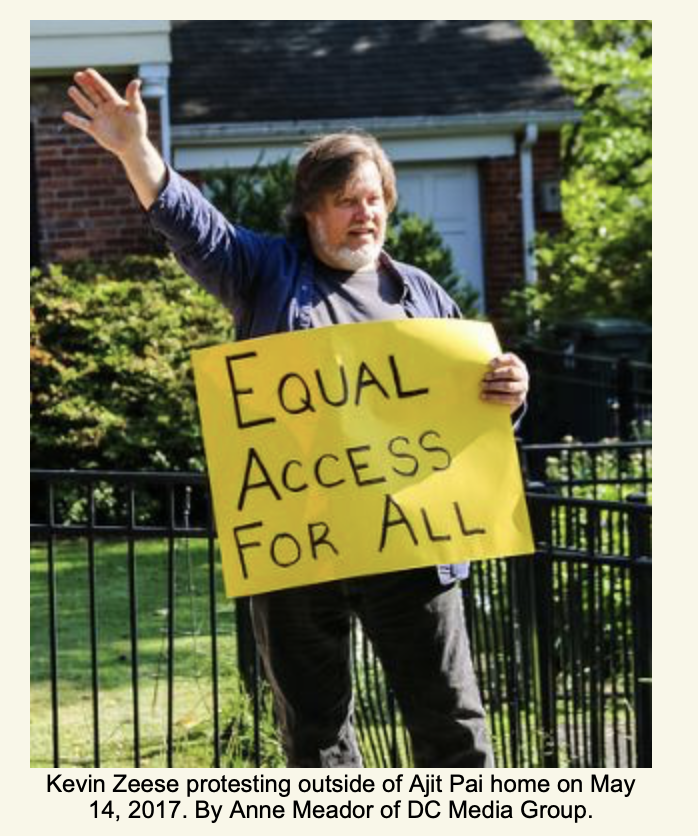
Does anyone really believe they weren’t coordinating? Aside from their guilty consciences, who was asking the question?  If no one was asking the question why anticipate the question? And why does he make a point of saying this to Kevin Zeese at www.dcmediagroup.us which is the press bureau staffed by Popular Resistance?

And these guys know we can just look at the Facebook event and see who went/was interested/was invited to the protest at Pai’s house. Right? “Dear FBI/Secret Service: here is a list of people to interview”

Lame. Lame. Lame.

These guys are terrible conspirators.

As an aside, Dylan Petrohilos who actually went to the Popular Resistance protest in front of Pai’s house is a particularly nasty piece of work. In 2009, Petrohilos was charged with criminal damage to property after surveillance photos showed him jumping on the back of a police car and kicking out its window. When he was arrested, police found what appeared to be a plastic bag full of feces in his backpack.

Screenshot from the Popular Resistance website. There they go again writing about themselves as if they are a disinterested third party. 

As interesting as all of that is, this turns out to be the long way around to making the case Google was involved.

It is much easier to make a direct case that Google, or at least a Google funded group under the command and control of a Google public policy team, aided Popular Resistance.  It turns out all you have to do is look at the web archives and source code for ProtectOurInternet.org.

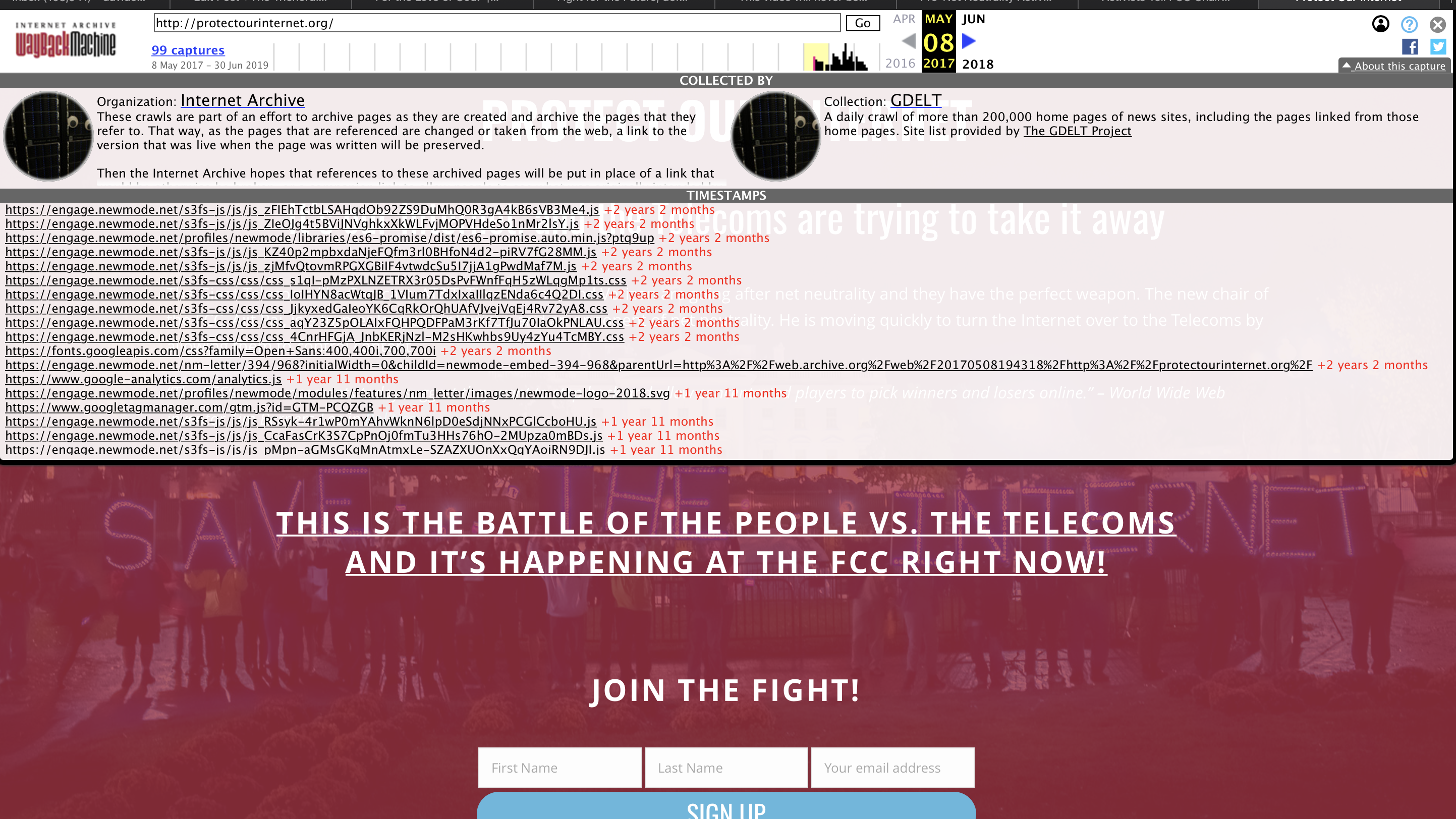
Here it is. May 8th just as Pai was doxxed.
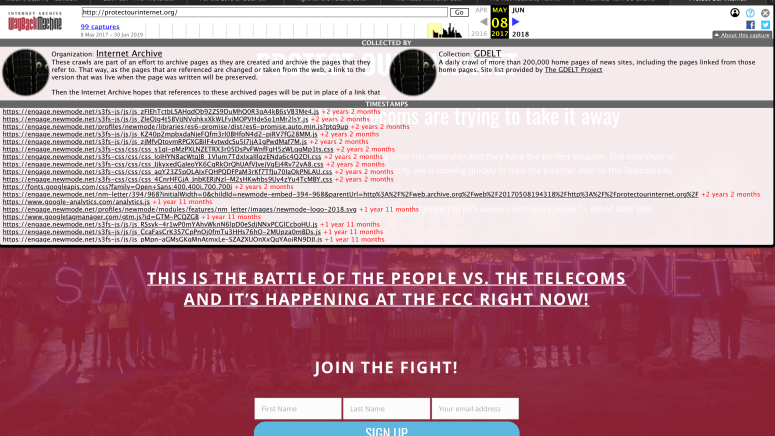
Even non-technical folks can tell can tell looking at only the “external links view” that this page is 90%+ generated with elements that come from another website.  A website called New/Mode.  What’s the significance of this?

Who is New Mode?

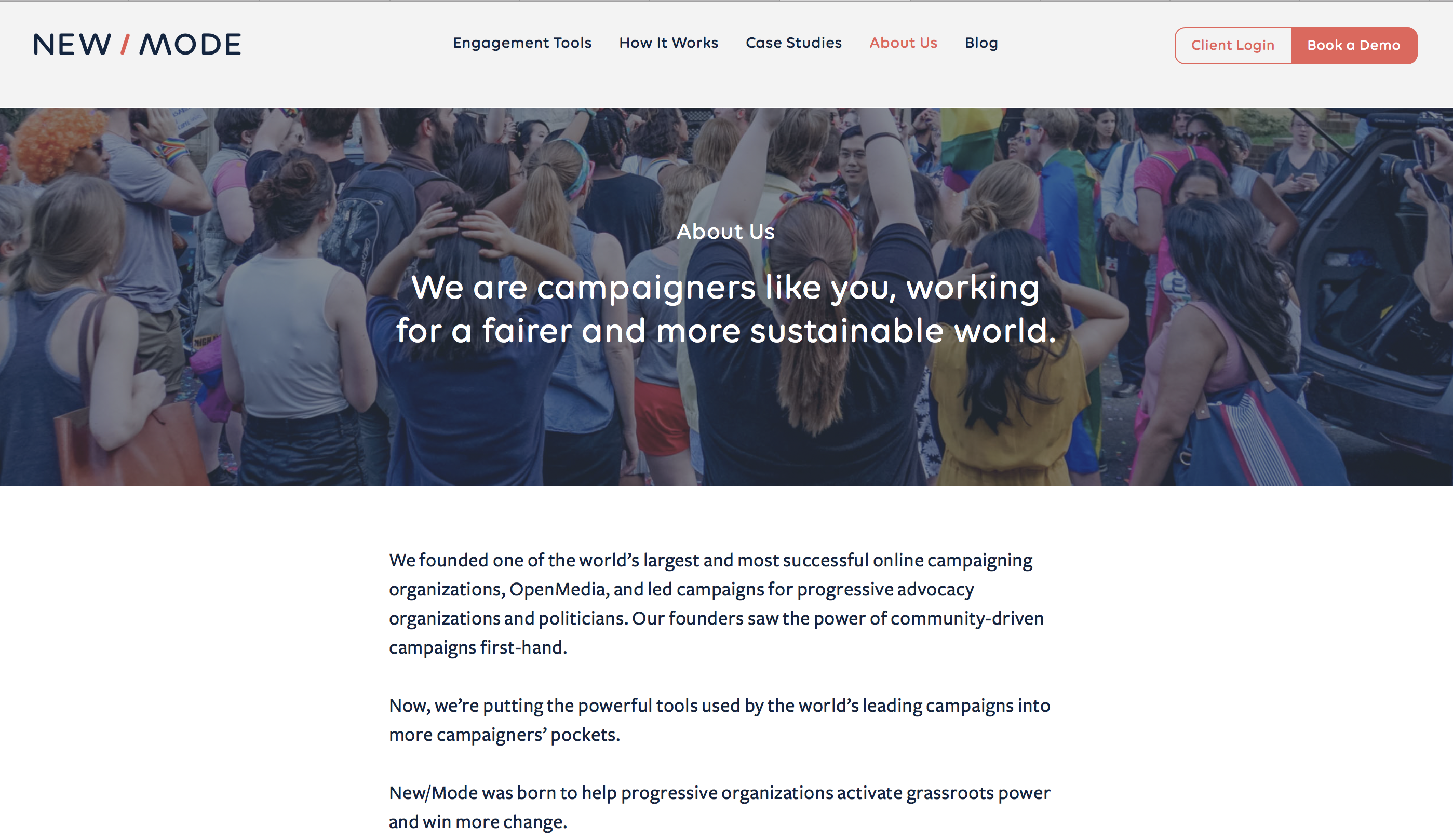
According to Times of London New/Mode is an engagement platform that Open Media helped to found in 2016 and“New/Mode boasts that its one-click tools allow campaigns to ‘flood targets with public messages’ on social media and ‘blanket local media with stories from your supporters’”

However….
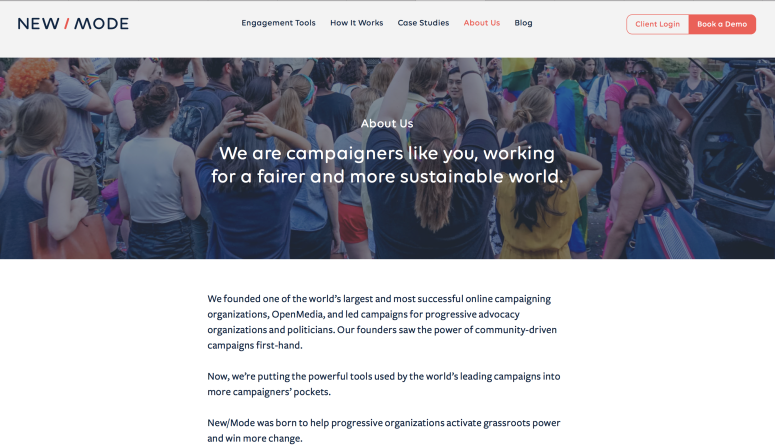
…the New/Mode website back in 2018 claimed they founded Open Media (claim since deleted), and…

New/Mode CEO, Steve Anderson is introduced as “Senior advisor Open Media Co-founder of New Mode.” This at 2017 Net Squared Conference in Vancouver. Jesus guys, try to keep your stories straight. Is there also an olive oil company in the mix somewhere as well?

All kidding aside, the statements taken together, plus now deleted 2016 financial statements lead to the conclusion New/Mode and Open Media are for all practical purposes, the same organization. If this were a RICO case (and I’m not saying it isn’t) the prosecutors would treat them all as the same organization.

So who is Open Media?

Open Media was founded in 2014, and Jacob Glick was one of its founders. Glick previously worked for Google in Canada and the USA in the areas of public policy and government relations. He worked there long enough and at a high enough level that I wouldn’t be surprised if he has significant stock or stock options. He still serves on OpenMedia’s board today.

OpenMedia is partially funded through donations, but the enterprise also has “sponsors.” The company’s “platinum sponsors” include Google, Mozilla and the Office of the Privacy Commissioner of Canada (WTF?).  Sponsors in the platinum category have paid more than 20,000 Canadian dollars, but it is not clear whether this relates to one-off or repeat payments. Nor are the exact amounts donated known. Open Media is a Canadian non-profit. Which doesn’t mean jack shit. In Canada, what we call non-profits are called “charities.”  Open Media is just a company that doesn’t make a profit. Unlike non-profits in the U.S., Canadian “charities” are not really required to disclose their finances. It’s essentially a black box.

+++++++++++++++++++++++++++++

Now lets’ return to the screwy ownership of the Protect Our Internet website. Popular resistance did not register the website. They still don’t own it. It wasn’t transferred to any of the members.  So how did they manage the website?  I mean even if it’s hosted on WordPress, the owner needs to set that up for whoever is using it. The inescapable conclusion is someone else built, managed and operated the website.

So the million dollar question in the Doxxing of FCC chairman Pai is “who managed the website?”

Some of the most important bits (if not all) of the website is running on New/Mode code. This includes management of mailing lists; distribution and posting news (including of doxxing of FCC Chairman Pa) and alerts for protests at Pai’s house. The finger seems to be pointing at New/Mode & Open Media. These are exactly the services that New/Mode advertises they provide.

And remember Open Media (New/Mode) were running their own campaign against Pai at the time. See below.
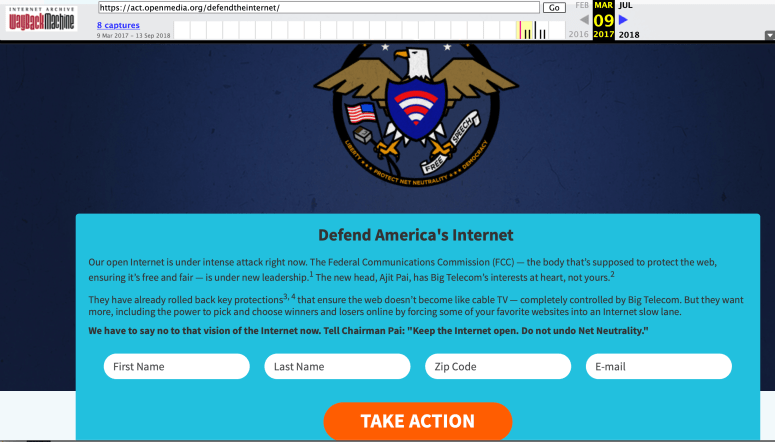
Regardless of who was running it, Google funded organizations appear to have provided material support to Popular Resistance in the doxxing and months of harassment directed at the FCC, the FCC chairman and his family. They were complicit.

The billion dollar question?

What did Google public policy know?

Is it really plausible that the Google public policy team did not know this was happening?

I suppose it’s possible Jacob Glick at Open Media/NewMode and Marvin Ammorri at Fight For The Future weren’t communicating with former bosses on Google’s #1 policy issue that year. It just seems unlikely.

I also suppose it’s possible Free Press, Demand Progress and Fight for the Future weren’t letting an important funder know what was happening as all three happily collaborated on a Google priority.

Someone somewhere knows who set up and ran that Protect Our Internet website.  Start by asking this guy.