Jonathan Taplin @ Forum on Internet Governance June 21st Washington DC

Jonathan Taplin will keynote the inaugural Forum On Internet Governance

The Forum on Internet Governance
June 21, 2018
Landmark E Street Cinema
555 11th Street N.W. Washington, D.C. 20004

From our friend Will Buckley Founder / Executive Director, FarePlay, Inc.

The Forum on Internet Governance is in response to the mounting call for internet reform from policy makers and the media. The Forum will explore the socio-economic challenges created when powerful internet companies are allowed to self-regulate.
After a long public love affair with the internet, things changed last fall as reports began to surface about Russian interference and false advertising during the presidential election. Washington was finally being forced to turn their attention to those internet companies who have been derelict in taking responsibility for what has been taking place on their platforms.

It came as no surprise when internet powerhouses Google, Facebook and Twitter were easily invaded by Russian hackers. After all, for decades they have been fighting off all attempts by legislators to put controls in place to address criminal and abusive activity on their platforms.

Now, with recent revelations about Facebook and Cambridge Analytica and legislative hearings with CEO Mark Zuckerberg, the discussion about the need for internet governance has come sharply into focus.
The Forum is a half day event (8:30 AM to 12:30 PM) bringing together a diverse group of thought leaders and experts to discuss their concerns about the most pressing problems on the internet and to make recommendations for addressing those problems.

Sessions will include discussions on privacy, transparency, user safety, fake news, safe harbor abuse, the lack of ethical practices, and other areas of public concern.
Jonathan Taplin, author of Move Fast and Break Things: How Facebook, Google and Amazon Have Cornered Culture and Undermined Democracy will be the keynote speaker.

–William Buckley Jr.

Tix here:

https://www.eventbrite.com/e/the-forum-on-internet-governance-tickets-5881468631

Agenda
 8.30 – 9.00 AM
Registration / Continental Breakfast

9:05- 9:35AM
Session 1: Keynote speech
Title: Is the internet breaking the creative eco-system?
Description: In his latest book, ‘Move Fast & Break Things – How Facebook, Google, and Amazon Cornered Culture and Undermined Democracy’, film producer and academic, Jonathan Taplin, documents the monopolization of the Internet by Google, Facebook and Amazon, and proposes a new future for musicians, journalists, authors and filmmakers in the digital age.
Speaker: Jonathan Taplin

9:45 AM – 10:45 AM Session 2
Panel Discussion Title: Whose Safe Harbor?
Description:
Safe harbors were meant to provide a balance between access to content and the liability of internet platforms. Yet, in the US, like in Europe, or Australia, safe harbors have essentially allowed digital service providers to build massive businesses with little accountability about the content that they provide access to. So who are these safe harbors really protecting? How can a better balance be achieved between the normal aspiration to access content and the rights of content providers? What are the key points for safe harbor reform?
This session will feature representatives from the creative sector who will discuss the impact of the safe harbor regime on their businesses and what’s needed to achieve better copyright protection in the digital eco-system.

11:00 AM – 12:00 PM
Session 3: Panel Discussion
Title: The call for Internet Governance
Description:
A couple of decades ago, the digital promise was to bring additional freedom and new ways to apprehend the world through connectivity and new tools. But have these promises been kept? What kind of environment did the digital revolution foster for mankind in general and the creative community specifically? Should the internet be more regulated? Academics and creative industry experts debate on the ethics of this brave new world.
Panelists will discuss what needs to happen to ensure the internet is a safe environment for users while providing a level economic playing field for non-internet companies and creatives.
Topics will include: Privacy, Fake News,Terrorism and Safe Harbor abuse and the role played by Google, Facebook, Amazon and other major internet platforms.

> 12:05 PM – 12:25 PM Closing 

On Classics Act Sen Wyden Taps Into Portland’s Peculiar Anti-Union Rich Man’s Progressivism


Sen Ron Wyden shown here when he was the trombone player for”The Shyllz” an early 80’s Palo Alto new wave band. 

A few months ago I came across an article on Portland, Oregon’s mixed history with labor unions despite it long being a bastion of progressivism. Andrew Bulkeley writing in Oregon Business in 2017:

“But even as social responsibility goes mainstream, organized labor remains an outlier among many [Oregon] companies that self-identify as progressive enterprises. To be sure, unions have something of a foothold in government and legacy industries — the grocers QFC and Kroger, manufacturers like Vigor Industrial and Daimler Trucks North America. Among many young companies and new business models, however, the union presence is tenuous at best.”

Portland’s Nike has long had its union problems. But it’s vague commitments to diversity and support of milquetoast social issues hardly make it a bastion of progressivism and is thus not the perfect case study.

Perhaps the more illustrative story of progressive Portland’s anti-unionism concerns the city’s beloved Powells Books.  In the 1990s the book shop management and progressive democratic owner Michael Powell fought a decade long battle against its employees efforts (and right) to unionize.  Even today Sontz the CEO of Powells Books still seems bothered by the fact her employees are unionized. In the same article in Oregon Business she says:

“[A union] slows you down,” Sontz says. “It makes you less entrepreneurial.”

Unions also tend to give workers a living wage so they can say support a family. Or own a home. Something increasingly difficult in Portland. Workers could easily argue that Powells books could be “more entrepreneurial” by paying its CEO less.  Use that money to invest in new technology. Ah ,but it’s always been so much easier to blame those pesky union workers for the company’s woes. Union bashing is usually the “look like you’re doing something” strategy when you don’t actually have a management strategy.

Sen Ron Wyden seems to be following in this peculiar Portland tradition.  He seems to have issues with pre-1972 performers (music workers) and the American Federation of Musicians and whether digital services (the bosses) have to pay them at all. And yes you read that right.

Specifically, Sen Ron Wyden is trying to sink a bill (The Classics Act) that is designed to plug a loophole in the interaction between state and federal copyright law that allows big companies like Google, Spotify, and Sirius to avoid paying royalties to performers and union side musicians that had the misfortune to record before Feb 15 1972. This is particularly galling because his opposition to the act would seem to benefit one company more than any other:  Sirius XM.

Sirius XM market cap is currently more than 30 plus billion dollars and last reported net profits running at 22% of revenue. This is a company with no other satellite radio competitors. It relies almost exclusively on licenses imposed on music rights holders by the federal government.  And the regulations that govern the setting of royalties actually mandates below market rates. Its net profit margins are quite extraordinary when you consider it is stagnant business.  Rent seeking and crony capitalism, two great tastes that taste great together!

And this is not Wyden’s first rodeo. He can’t be forgiven for not understanding the issues.  It is a pattern. This is his second attempt to cut pay to performers in a way that benefits digital services. The second time in less than a decade! In 2012 he proposed the Orwellian named Internet Radio Fairness act which would have slashed pay to performers up to 70%.   We’re not talking a minor adjustment to federally mandated rates.

But it doesn’t end there. Protecting the billionaires that own these digital companies is so important to Wyden, he has just introduced a kind of “poison pill” bill (ACCESS Act) that seems specifically designed to gut the CLASSICS legislation (Contrary to what Wyden claims It reduces existing copyright terms on many songs originally protected by state copyright laws).

I often wonder what it is Wyden has against musicians? Is it like that old SNL skit which “reveals” biographer Albert Goldman’s hatred of John Lennon and Elvis stems from the fact he’d once been The Beatles trombone player. (Spoiler Alert) Elvis came to a Beatles show and convinced John Lennon to fire him.

Finally referring to an organized multi-company effort to set performer prices at zero as a “loophole” is very generous to Wyden. It more like price fixing. (Where is that FTC investigation?)  Further there was no loophole in copyright law until Sirius and Pandora decided to stop paying the royalty in 2012.  They have litigated and appealed ever since to keep the loophole open. More ethical (and better run) companies like Apple continue to pay this royalty. I assume because like most reasonable people, they look at the law and see that congress never intended there be a “gotcha” loophole. It’s more likely Sirius and Pandora will lose their cases eventually.  So Wyden is not just for preserving a loophole, he’s trying to protect companies that are likely breaking the law, and screwing unions at the same time.

Now that’s a very peculiar kind of “progressivism” isn’t it? Welcome to Portland.

P.S. BTW does anyone know if all those Silicon Valley data centers out in The Dalles hire union workers?  Cause usually Silicon Valley is quite anti-union.  But boy do they love Ron Wyden! 

Goliath Never Learns: Watch Out for Music Choice Duping Artists for Music Modernization Act in Senate — Music Technology Policy

Remember when Blake Morgan called out Tim Westergren for sending emails to artists trying to get them to write their Member of Congress to support the Internet Radio Fairness Act (IRFA) and lower royalties for Pandora?  “Million-a-month” Tim really stepped in it that time because he didn’t expect the artists to figure out he was both pushing a deceptive deal on them and treating them like they were idiots. And that started the #irespectmusic campaign.

patrick stewart

So now there’s yet another email campaign targeting artists to act against their own interest.  This time it’s about preserving a subsidy for Music Choice’s cable music service.  If you still have cable, you’ll probably find Music Choice in the highest numbered channels.

Here’s how the subsidy works–which you should know because it’s paid with your money.  Music Choice (like Pandora) gets to take advantage of the statutory license created by the Congress in 1998 for the use of your recordings in “noninteractive” digital services.  This statutory license is a huge benefit for everyone who uses it as they can avoid individual negotiations, get streamlined royalty accounting to SoundExchange and never have to pay–clutching pearls–artist advances.

Because the license is statutory, the government also has to set the royalty rate you get through a process now conducted by the Copyright Royalty Judges.  The CRJs are supposed to set a market rate based on economic analysis and the services using the statutory license pay those rates.

But–some services are more equal than others.  Back in 1998, the Congress was trying to encourage investment in a new market for digital music services and so certain named services were given special treatment by the government to protect them from what’s called the “willing buyer/willing seller” standard that more closely tracks market rates.  This special treatment was to give certain services that were already up and running in 1998 a break on royalty rates–your royalty rates–through what is effectively a government subsidy that you finance.  This was because these “preexisting services” had started their businesses in reliance on the subsidized rates–and guess what, they kind of got to liking that subsidy.

Three of those preexisting services still exist today:  SiriusXM, Musak and Music Choice.  All three of these companies have enjoyed the break you gave them on your royalty rates for 20 years.  However–the reason to give them that break has long passed.

MTP readers will remember this issue came up with IRFA in 2012.  As we noted then, SiriusXM’s then-CEO Mel Karmazin told CNBC’s Jim Cramer in an interview about the merger of Sirius and XM Radio, both of which got the same subsidy as Music Choice:

Free cash flow is what enables you to buy back your stock, make acquisitions, pay down debt. And I believe free cash flow is an important metric. Our free cash flow now, is growing– it’s extraordinary. Before the merger we had negative free cash flow of $500 million. Negative free cash flow. This year we will have $700 million of free cash flow. We haven’t given guidance for next year. Analysts have us at a billion of free cash flow and continuing to grow. So it’s a great start.

The Music Modernization Act would switch these three subsidized services onto the same royalty rate as the thousands of other services that somehow seem to get by with the unsubsidized “willing buyer/willing seller” rates.  And Music Choice is leading the charge to keep that subsidy that you’re giving them, Musak and SiriusXM.  Presumably this is because Music Choice is more sympathetic than the cash-rich goliath SiriusXM.

To the point—Music Choice is evidently sending out an email to some artists (possibly through intermediaries like distributors) to lobby the Senate Judiciary Committee to preserve the Music Choice subsidy.  Why?  The Music Choice letter they want you to sign tells you:

Many of us have had our careers explode because of the exposure we got first on Music Choice which is critically important to the artist community.

Really.  That’s news to me.

And then there’s this:

Being played on just one Music Choice channel is like being played on every radio station in the country serving a particular music format.

No it’s actually nothing like that.

And here’s my personal favorite:

None of the streaming services provide anywhere near the level of promotion and support that we have received from Music Choice.

Exposure bucks, baby.  It’s so 1999–back to the future with Music Choice.  Where’s that flux capacitor when you need it?

Exposure Bucks

Preserving Music Choice’s subsidy would be a material change in the bill that might be enough to derail the coalition that backed it in the House and that was clearly influential on the Senate Judiciary Committee in the recent hearing.  Remember–the Senate version of the Music Modernization Act has to pass the Senate before it becomes law.  It also has to pass in essentially the same form as the House version which already passed the House unanimously.  Continuing the subsidy to these three services is a material change to the bill that could cause the whole bill to fail.  

Which, of course, would be just fine with Music Choice, SiriusXM and Musak because that would also preserve their subsidy.

So heads up–they’re running the old IRFA play all over again.  Don’t get duped.

But don’t let that stop you from supporting the Kickstarter campaign to buy a DeLorean DMC-12 for Music Choice so they can get back to the future in the style to which they have become accustomed.

Emails Suggest Long Time Google Advocate Behind “Gang of 40” IP Profs Letter Against Classics

The 9th Circuit was effectively told by Google counsel they were engaging in conspiracy theories. Then they were forced to produce documents by the court. Turned out court was right. #ConspiracyFacts

On the morning of April 25 less than 24 hours after the Music Modernization Act passed the House 415-0. Mark Lemley a professor at Stanford wrote the following letter to a group of IP Lawyers:

“I think this term extension is unnecessary. I am thinking of putting together a short professors letter arguing that if Congress is to create a sound recording digital public performance right, it should expire when a corresponding copyright would naturally have expired and should be subject to the same limitations and defenses as copyright law. If you are interested in helping put together such a letter, please let me know. Time is short. If you think I am misreading this for some reason, I’d like to know that too.”[1]

This is significant for two reasons. This email appears to be the basis of the “Gang of 40” IP professors letter in opposition to the Classics Act.  Opponents of the Classics Act (mostly Google funded EFF and Public Knowledge) have used this letter to try to block or gut the legislation, by shopping the debunked claim of copyright term extension to Senate staff.

Second according to the a court document commonly referred to in press as a “shill list” (Oracle v Google) Lemley has acted (continues to act?) as outside counsel for Google. He is a long time advocate for Google’s policy positions.  He also features prominently in the “Google Academics Inc”, report published by Google Transparency Project.  This report details Google’s funding for academic institutions and research, and notes how it appears to have predictable results on the research conclusions produced by academics. That is, the research conclusions generally support Google’s public policy positions. Some have criticized the inclusion of certain professors in this report, but Lemley’s inclusion appears uncontroversial. Lemley unlike many other professors does not seek to hide his connections to Google.

To be clear, Lemley is doing nothing illegal or unethical.  However if you put the Gang of 40 letter in the context of the greater public policy debate around The Classics Act this letter is extremely problematic for Google. For this letter appears when Google, through its trade policy group DiMA, was telling congress that they were negotiating in good faith with performers, songwriters and other rights holders. They held (and still hold) a public position in support of The Classics Act. Yet the letter appears to have been produced by Google outside counsel.  This would seem to imply negotiators for DiMA were unwittingly being undermined by their own side, or (more likely IMHO) negotiators were in on it and are continuing to play a double game.  That is not acting in bad faith, it is acting in terrible-fuck-you-extra-googley-bad-faith.  For a second time.

Senate Staff should look into this.

[1]This email was provided by multiple sources.  Further the published excerpt was verified by yet another recipient of the email.

Law Professor Opposing Classics Act Engages in some “SLAPP Stick” With Lowery

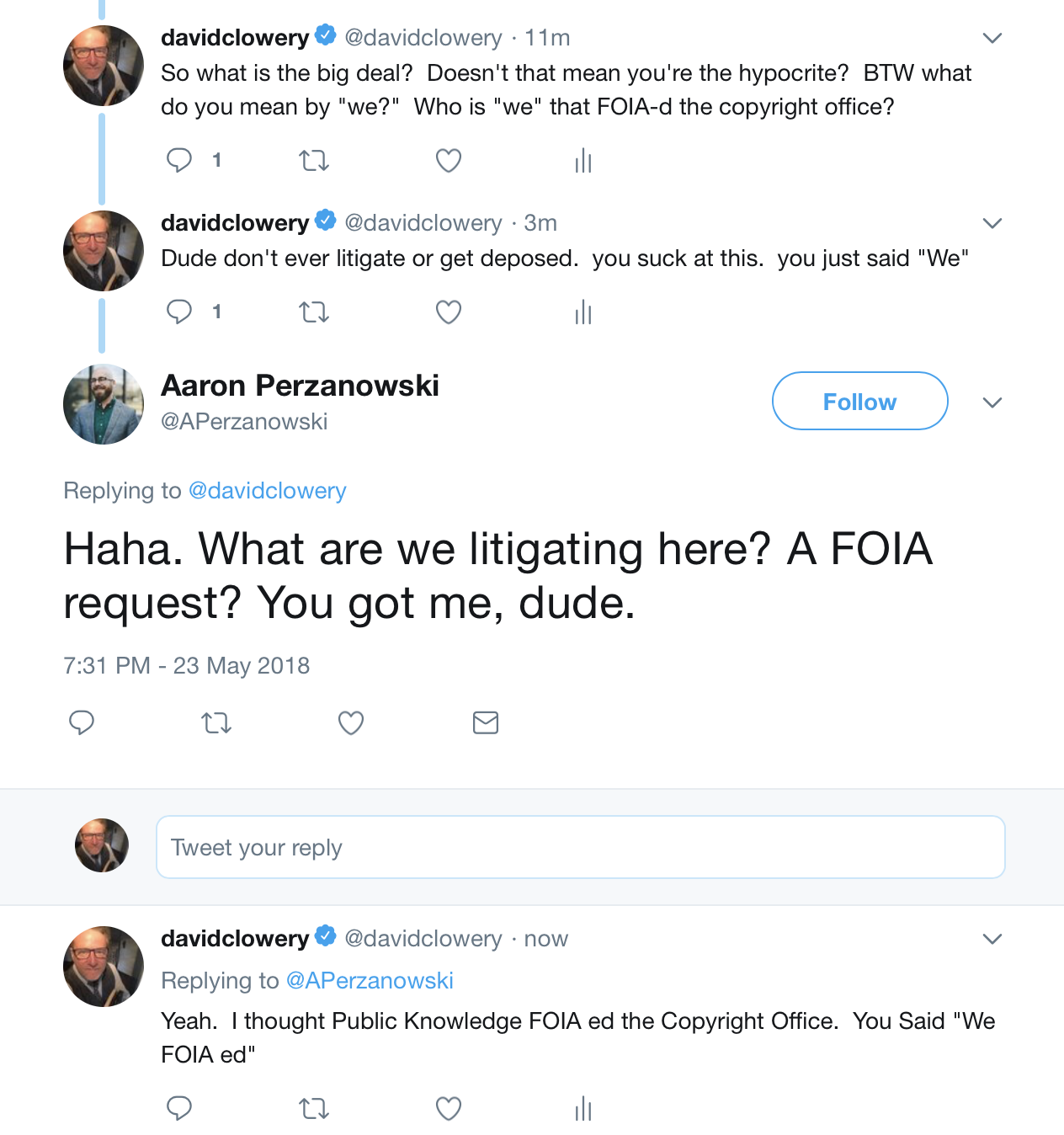
40 IP Law Professors wrote a letter to the US Senate opposing The Classics Act. Most of the claims in the letter have been previously debunked by Terry Hart here.   Google funded astroturf Public Knowledge has distributed the letter. This raised some eyebrows. Lowery was trying to get at least one of the 40 Law Professors to reveal who actually authored the letter.  Lowery was repeatedly stonewalled.  One of the signers Law Prof Aaron Perzanowski seemed to threaten Lowery with a defamation suit, for previously noting that Prof Perzanowski appears in the Google Academics Inc report.  Perzanowski (a lawyer) was clearly attempting to dissuade Lowery from pursuing this line of questioning.

From Wikipedia:

A strategic lawsuit against public participation (SLAPP) is a lawsuit that is intended to censor, intimidate, and silence critics by burdening them with the cost of a legal defense until they abandon their criticism or opposition.[1] Such lawsuits have been made illegal in many jurisdictions on the grounds that they impede freedom of speech.

BTW Lowery eventually found other sources that report the letter was proposed and organized by Google outside counsel Mark Lemley and Stanford Prof Phillip Malone.  It’s still not clear who wrote the text.

This isn’t some petty twitter dust up. There is an important public policy concern, because the U.S Senate was presented the letter as if it was a spontaneously organized letter by a group of independent IP Law Professors. The story seems to be much more complex.  If Google did have a hand writing this letter, or encouraging it, Senate staff should be advised.


<Gif deleted>


15 of the 40 IP Law Professors Opposing Classics Act Likely Benefitted from Google Funding

Public Knowledge is a well known Google astroturf group. They were also listed in a court document often referred to as “the Google Shill list”. Public Knowledge organized and submitted a letter to the US. Senate urging rejection of copyright reform language that would close the pre-1972 sound recording loophole that allows a small handful of companies to avoid paying royalties to pre-1972 performers. The loophole – if it is a loophole at all- came to public attention in 2012 when a handful of digital broadcaster simultaneously stopped paying royalties older performers (Apple and other “good” tech companies still pay this royalty). The loophole has subsequently been challenged in court. The US congress noting the arbitrariness of the pre-1972 distinction has proposed language to close this loophole.  To bolster their case against the closure of the loophole, Public Knowledge has manufactured an argument that claims a return to the status quo is somehow a copyright term extension. PK then they managed to somehow get their letter  signed by “40 IP law professors.”  That’s right 40 academics have decided to help a handful of tech billionaires to continue to stiff pre-1972 artists. Sadly this type thing has become all too common in academia.

We would like to note that 15 of these professors appear to have benefitted from or continue to benefit from  Google funding.

To be clear.  We are not saying they were all paid directly. But as money is fungible, significant funding from Google to their institution, center or non-profit likely helped support their work and contributed significantly to their academic career.

9 of these professors are named in the Academics Inc report by Google Transparency Project.

6 others work/worked for institutions that are/were significantly funded by Google. And I don’t mean a few dollars here and there. We are talking hundreds of thousands if not millions of dollars.

Let’s face it. Opposition to the Classics Act is being coordinated by Public Knowledge and a small group of professors that mostly have Google in common. Someone should ask why is that?  If Google won’t comment ask Michael Beckerman at the Internet Association. I bet he knows.

Here are the 16 professors.

Michael Carrier Rutgers Law School

Michael W. Carroll
American University Washington College of Law

Paul J. Heald
University of Illinois College of Law

Mark A. Lemley Stanford Law School

Mark McKenna
Notre Dame Law School

Aaron Perzanowski
Case Western Reserve University School of Law

Matthew Sag
Loyola University Chicago School of Law

Pamela Samuelson
UC Berkeley School of Law

Jason Schultz
New York University School of Law

Lawrence Lessig
Harvard Law School
(Vast sums donated by Google to associated foundations and non-profits)

Jessica Silbey
Northeastern University School of Law
(Berkman affiliated faculty, Berkman receives Google Funding,)

Rebecca Tushnet
Harvard Law School
(Berkman, Berkman receives Google Funding,)

Eric Goldman
Santa Clara University School of Law
(Santa Clara University School of Law received Google Buzz cy pres for Ethics Center )

Brian Love
Santa Clara University School of Law
(Santa Clara University School of Law received Google Buzz cy pres for Ethics Center )

Tyler T. Ochoa
Santa Clara University School of Law
(Santa Clara University School of Law received Google Buzz cy pres for Ethics Center )

40 Law Professors Stop Suckling at Federal Teat to Write Senate Letter Urging No Pay for Artists

Classics_Act_IP_Professors_Letter_5.14.18

This has gotten completely out of hand. Here is another letter using the same arguments against The Classics act that Terry Hart previously debunked.

No, the CLASSICS Act is not a “term extension”

This makes my blood boil because many of these folks are paid (federally subsidized) salaries of over a quarter million dollars a year. To do what? Sit around and teach maybe a class or two every other semester.  Moan about how it’s so fucking unfair that the billionaire owners of various digital services might actually have start paying royalties to pre-1972 artists again cause their little crony capitalist loophole might get closed. Poor babies.

Remember when professors weren’t regressive crony capitalist ass lickers?

Here are the professors that want to keep the pre-1972 royalty loophole open.
Many of their salaries are publicly available. If you want to make your blood boil look em up.

Melissa B. Alexander
University of Wyoming College of Law

John R. Allison
McCombs School of Business at The University of Texas at Austin

BJ Ard
University of Arizona James E. Rogers College of Law

Derek E. Bambauer
University of Arizona James E. Rogers College of Law

Mark Bartholomew
University at Buffalo School of Law

Robert Brauneis
George Washington University Law School

Michael Carrier Rutgers Law School

Michael W. Carroll
American University Washington College of Law

Ralph D. Clifford
University of Massachusetts School of Law

Thomas Cotter
University of Minnesota Law School

Brian Frye
University of Kentucky College of Law

Kristelia A. Garcia
Colorado University Law School

Shubha Ghosh
Syracuse University College of Law

Jim Gibson
University of Richmond School of Law

Eric Goldman
Santa Clara University School of Law

Paul J. Heald
University of Illinois College of Law

Stacey Lantagne
The University of Mississippi School of Law

Mark A. Lemley Stanford Law School

Lawrence Lessig Harvard Law School

David Levine
Elon University School of Law

Yvette J. Liebesman
Saint Louis University School of Law

Jessica Litman
University of Michigan Law School

Lydia P. Loren
Lewis & Clark Law School

Brian Love
Santa Clara University School of Law

Glynn Lunney
Texas A&M University School of Law

Mark McKenna
Notre Dame Law School

Mike Mireles
University of the Pacific, McGeorge School of Law

Ira S. Nathenson
St. Thomas University School of Law

Tyler T. Ochoa
Santa Clara University School of Law

Aaron Perzanowski
Case Western Reserve University School of Law

Jorge Roig
Touro Law Center

Matthew Sag
Loyola University Chicago School of Law

Zahr Said
University of Washington School of Law

Pamela Samuelson
UC Berkeley School of Law

Sharon Sandeen
Mitchell Hamline School of Law

Jason Schultz
New York University School of Law

Lea B. Shaver
Indiana University McKinney School of Law

Jessica Silbey
Northeastern University School of Law

Kevin L. Smith
University of Kansas School of Law

Katherine J. Strandburg
New York University School of Law

Rebecca Tushnet Harvard Law School

Alfred C. Yen
Boston College Law School


Lessig is so Wrong on Classics Act He Should Retire

After yesterday’s epic piece on Lessig, I’m surprised to find myself blogging about him today. But the self described “copyright expert” clearly doesn’t understand copyright and the compulsory licenses so here I am again.  In a piece published in Wired magazine we find Lessig fear mongering about the proposed Classics Act:

Archives with recordings of music from the 1930s or 1940s would now have to clear permission before streaming their music content even if the underlying work was in the public domain.  Yet there is no registry anywhere.

Actually no. For non-interactive streaming there exists a compulsory blanket license for post 1972 sound recordings.  Non-interactive streaming services essentially notify the copyright office that they are going into the non-interactive streaming business and pay royalties through the federally established SoundExchange.  SoundExchange has a database it maintains.  ONCE CLASSICS passes user pre-1972 will be brought under this post 1972 compulsory licensing scheme.

Currently because pre-1972 recordings are in most cases protected by state copyright and state common law.  Federal copyright rules do not apply.  The compulsory blanket license for post -1972 recording is not available. Without the CLASSICS ACT a streaming service currently must go state by state and song by song to obtain a license.  And currently in some cases state copyright is perpetual, something that Lessig should really hate.

Lessig has the whole thing backwards. The Classics Act addresses and fixes the things he is complaining about.

Did he not bother to read the act?

There is so much more he doesn’t understand or incorrectly asserts in this article. Most of it seems to be the result of him not understanding that pre-1972 works are covered by a patchwork of State and common law. Harmonizing the rules under a single federal statute is actually a good thing for his beloved archives. You got to wonder if he just looked at someone’s twitter feed to get his “facts” about the Classics then wrote an article in Wired.

So sad.  The guy needs to retire.


Poker the Bear: The Sad Unraveling of Lawrence Lessig

Harvard Professor and author of copyright skeptical tomes like “In Defense of Piracy” and “Free Culture” defends himself from accusations of shillery. Lowery digs deep and discovers there is a lot more to this story than meets the eye. 

+++++++++++++++++++++++++

This story is of particular importance to artists because Google’s support of ad supported piracy (MegaUpload) and YouTube’s “whac-a-mole” takedown policy have been a financial disaster for artists.  Much of the the intellectual arguments (some would say propaganda) in defense of Google’s practices arise from the work Lessig has done at Harvard, Stanford’s Center for Internet and Society and Creative Commons. Whether artists know it or not Lawrence Lessig has shaped, if not defined the debate over artists rights and the internet.

Lawrence Lessig has posted a long Medium post defending himself against claims made by Jonathan Taplin (and others myself included) that he has effectively acted as a “shill” for Google and other Silicon Valley interests. Don’t get me wrong, I think it is great that Lessig has finally responded to accusations that his research, litigation and advocacy seems to benefit Google while at the same time the institutions with which Lessig is associated receive substantial money from Google and other Silicon Valley interests. The world is a complicated place. No one can ever avoid every appearance of impropriety.  And to be clear I am not accusing Lessig of actual impropriety. The problem is Lessig has not been forthright (as I shall demonstrate) in his answers. Lessig is less than candid about the breadth of the funding,  and continually downplays the importance of his work to Google and others who exploit artists. But most importantly by defensively denying that there is even an appearance of impropriety, he raises more questions than he answers. The   esteemed professor, his work, his finances and foundations deserves a thorough examination.

First let’s consider the enormous amount of Google funding which seems to surround Lessig and associated institutions like a cloud of stale cigar smoke.

The list of institutions with which Lessig has been formally associated is too long to reproduce here. So lets just look at the most prominent. All of the following are tied to Google in three ways:Google funding; Support of Google in amicus briefs/litigation; and other public support of Google policy priorities including op-eds, academic papers or other public statements.

Center for Internet and Society Stanford University
Electronic Frontier Foundation
Public Knowledge
Creative Commons/iCommons
Free Press (Perhaps most notable for it’s praise of Hugo Chavez’s press restrictions)

Lessig lately has fancied himself a political operative. And as a result two other notable Lessig related enterprises have received heavy Silicon Valley funding including Google.

MayDay SuperPac
Lessig for President 2016

(Yes he ran for President of the United States.  But let’s leave all of that for a later post.)

The reason so many of us involved in advocating for the rights of artists find it hard to believe that Lessig is impartial is precisely because of his numerous ties to Google funded institutions.  It strains credibility for Lessig to maintain he is an impartial player when it comes to copyright issues that impact the bottom line of Google and other Silicon Valley companies. For these companies, their employees and shareholders have long been benefactors of institutions with which Lessig is associated. This is a well established pattern going back nearly two decades. Despite his claims to the contrary there is scant evidence he has ever opposed Google on any substantive issue.

Let’s start with the Stanford Center for Internet and Society

You can tell Lessig is now sweating the partnership between Google and CIS because of the logical gymnastics he engages to maintain the idea he did not benefit financially from this relationship.

From his recent blogpost:

“I have never worked for Google. I have never been paid by Google. I got my job at Stanford before Google was giving money to anyone. My job at Stanford did not include the obligation of raising money for anything. The Dean at the time, Kathleen Sullivan, allowed me to found the Stanford Center for Internet and Society, and agreed to fund it and its work while I was at Stanford. Google became a funder of Stanford to support the work of the Center after that. That was not my doing (again, I didn’t raise money at Stanford), that didn’t benefit me (my salary and the Center’s budget was set and independent of law school fundraising), and it didn’t stop me from doing lots of work that really pissed off Google (see, e.g., “For the Love of Culture”). Google didn’t fund my work at Harvard. It doesn’t fund anything I work on now. And yes, Google has taken policy positions consistent with my own, but most of the important positions were ones I took long before there was a Google policy shop.”

Now let’s look at the announcement from Stanford at the time:

https://web.archive.org/web/20180520181855/https://law.stanford.edu/press/google-inc-pledges-2m-to-stanford-law-school-center-for-internet-and-society/

Stanford Law School today announced that Google Inc. has pledged to contribute $2M to help fund the Center for Internet and Society (CIS) at the law school. The Center, founded in 2000 and located in the heart of Silicon Valley, is a public interest technology law and policy program focused on emerging technologies and the law. The collaboration of Google and CIS seeks to establish a balance between the right to access and use information and the ownership of information.

“This is an ideal partnership,” said Larry Kramer, Richard E. Lang Professor of Law and Dean. “One that stands to benefit not just our two institutions but also the world around us. The work done at CIS, exploring how to enhance availability of knowledge and information while supporting its producers and owners, addresses one of the most important questions of our time. And Google is unique in private industry for the depth of its commitment to finding fair and workable solutions to this same question.”

“This support from Google will be critical to achieving a healthy balance between copyright protection and creative license. We will use this support to build a network of legal resources to achieve in practice the balance that copyright law and the First Amendment intend,” stated Lawrence Lessig, Founder and Director of the Center for Internet and Society, Director of the Fair Use Project and the C. Wendell and Edith M. Carlsmith Professor of Law.

This seems to tell a different story. Lessig seems to clearly understand what he was expected to do with this corporate support. Read between the lines: he is to equivocate in a manner that moves the perceived center of the debate towards Google. This is some real “merchants of doubt” shit.  For those of you not in the copyright policy world, all creators know what a “healthy balance” between copyright protections and first amendment issues really means:  The “right” of commercial third parties like YouTube to profit from infringing content while hiding behind their “users.”  It is at this crucial moment in 2006 we begin the horror of whac-a-mole copyright infringement takedown abuse by YouTube. Songwriters and other creators have not been impoverished by digital disruption rather it is this questionable legal maneuver by Google (and a ideologically compliant 9th circuit) that has created the massive market failure for music in the digital marketplace.  Lessig and CIS were right there from the very beginning to support YouTube.

Shortly after this funding event,  Lessig fully engages in a very public fight on behalf of YouTube without ever disclosing any Google funding.  As Robert Levine writes in Free Ride(2011):

Five days after Viacom filed its suit [Against YouTube/Google], the law professor Lawrence Lessig argued in the opinion pages of the New York Times that Viacom was trying to get a court to overturn the Digital Millennium Copyright Act and darkly warned that such a decision would stifle innovation.”The internet will now face years of uncertainty before this fundamental question about the decade-old legislative deal gets resolved,” Lessig wrote, in an essay that mostly took YouTube’s point of view.  He neglected to mention that Google which had just bought YouTube, had recently given $2 million to the Stanford Center for Internet and Society, which Lessig founded and ran when the donation was paid.

Levine continues:

Google announced its gift to the Stanford center on November 28, 2006, two weeks after closing its deal to buy YouTube. (Lessig says he didn’t disclose the donation since the money didn’t directly benefit him and he had no role in raising money at Stanford.) The company knew its acquisition of the video-sharing site could draw litigation: it set aside $200 million to deal with lawsuits.  But Google also apparently wanted some academic firepower on its side.  Although the center’s policy allows only unrestricted gifts that can be used for any purpose, it announced that Google’s donation would be used to “establish a balance between the right to access and use information and the ownership of information”-presumably by the center’s Fair Use Project [Lessig]. While the center says it “avoids litigation” involving Google, much of its work involves challenging copyright laws in ways that would benefit the company.  Further this in turn could help Stanford: John Hennessy, the dean, serves on Google’s board of directors, and the company has given stock to the university.

Now it’s helpful to take a pause here and note that Lessig is the former director of the Edmond J. Safra Center for Ethics at Harvard University 2009-2015.  That’s right the “ethics professor” was carefully parsing his language to Levine when he denied he should have disclosed the financial ties in his op-ed. Most people would regard this as unethical. But this is par for the course for Lessig. It is built into his ethical DNA. Lessig has constructed a very unique view of his ethical responsibilities as an academic and lawyer.  It’s certainly more contorted and restricted than what most individuals would view as their ethical responsibilities. You be the judge. He helpfully provides a detailed overview in the disclosure statement on his personal website:

It begins:

The simple version is just this:

I do not shill for anyone.
The more precise version is this:
I never promote as policy a position that I have been paid to advise about, consult upon, or write about.
If payment is made to an institution in a way that might fairly and reasonably be said to benefit me indirectly, then I will either follow the same rule, or disclose the payment.

The precise version need to be precisely specified, but much can be understood from its motivation: “Corruption” in my view is the subtle pressure to take views or positions because of the financial reward they will bring you. “Subtle” in the sense that one’s often not even aware of the influence. (This is true, I think, of most politicians.) The rule is thus designed to avoid even that subtle force.

Lessig would seem to continually violate his own rules.  The problem is that Lessig doesn’t see it that way and thus follows the above simple statement with a series of definitions, delimitations and exceptions that seem to eviscerate the above paragraph. As well as any normal understanding of ethics.  For example:

“that I have been paid “: “Paid” means directly or indirectly. “Directly” would be direct compensation to me, or support for my research, or other funding I otherwise wouldn’t have been entitled to.

“Indirectly” means compensation to an entity that I am responsible to raise money for from an easily identified interest. This line is hard to draw in many cases, but relatively easy to draw as it applies to me: I am not hired to fundraise for my law school. Thus, if you give a substantial amount of money to Harvard, you don’t, in my view, indirectly benefit me — because you have not made my life any different from how it was before you gave that money. (Indeed, given the hassle that usually runs with such gifts, you’ve likely made my life more difficult.) [emphasis added]

First, Lessig is relying on a dodgy loophole of his own creation to avoid violating his own rules. In his own words, just because he isn’t “responsible” for asking donors for money, a donor like Google can give money to an institution for which he works, and by his carefully delimited definition he doesn’t directly or indirectly benefit?  See how that works? Also “easily identified interest?”  What is the point of that exception?  One could read that as an advertisement to wash money through third parties.  Right?

Second, Lessig is surely smart enough to understand that money is by definition fungible. A donation that can only be used for staff, building, travel and events, frees up funds that can then be used for his salary.  You see that he leans on this distinction in his latest blog post.  Further when a company like Google gives money to an academic center you run, this raises your academic profile, and likely raises your marketability and salary down the road.  Lessig does not address these ancillary benefits that are decidedly financial. Third in the case of Stanford Law the money was given to support his work.  He doesn’t use that as his helpful example in his “disclosure” now does he?

I have to say it again. Lessig is the former director of the Edmond J. Safra Center for Ethics at Harvard University.

But it gets worse.  Let’s look at how he defines “promote”

“I never promote as policy a position“: This is meant to distinguish work as a lawyer from work as an advocate. I don’t typically do legal work for money. But everyone should understand that when a lawyer speaks for his client, he speaks for his client. The corruption I am targeting is a lawyer or academic speaking not for a client, but presumptively, for the truth.

“promote” means in any public forum — so an op-ed, testimony, or a lecture.

I frankly don’t quite understand this.  But let me make a stab at it. He is an academic so he doesn’t really have any clients as a lawyer.  So this essentially let’s him “advocate” on behalf of a donor like Google without disclosing the donation as long as it’s the truth? I’m not sure I’m right on this. (I’m glad to be corrected on this one). Although I may not understand exactly what he’s trying to say, I do know a Mack Truck sized loophole when I see it.  This is basically a boilerplate escape valve to let him do whatever he wants. This also appears to be a post facto justification of his failure to disclose his funding in the NY Times op ed.

This time let’s say this all together: Lessig is the former director of the Edmond J. Safra Center for Ethics at Harvard University 2009-2015.

I’m a curious person.  And I did what anyone might do when contemplating Lessig’s curiously delimited disclosure ethics.  I stuck some full paragraphs of his disclosure into a search engine to see what came up.  I got this blog:

https://jpalfrey.andover.edu/2010/07/11/guest-blog-post-lawrence-lessig/

Strange.  It’s a guest blog written by Lawrence Lessig hosted on the Andover academy website?!?  The blog is hosted by John Palfry a fellow at the Google-funded Berkman Klein center and also Head of School at Phillips Academy Andover. (For Brits think Eaton).  At first I thought Lessig was defending himself from something to do with his copyright positions.  Oddly, no. He was in fact defending himself from an seemingly unrelated appearance of impropriety. The Register (UK) reported that his iCommons foundation received money from an online poker tycoon. This was his response.

Wait what?! Online poker? What on earth does this have to do with copyright? Good question. In a nutshell The Register article explains that at least one Lessig affiliated institution (iCommons) appeared to have indirectly benefitted from the infamous for-profit piracy website MegaUpload.

And this is the moment the public image that Lessig has so carefully constructed begins to unravel. For if you follow the story all the way down, Lessig looks less a virtuous defender of liberty, free speech and the rule of law and more like a run of the mill academic/civil society huckster looking for money.

One may be forgiven for wondering at this point if Lessig has more to worry about than looking like a cats paw for Google.  This is criminal conspiracy stuff after all.

Indeed, court documents show that Google, through it’s subsidiary Adsense, AdBrite and an outfit called PartyGaming PLC helped MegaUpload generate hundreds of millions in revenues. From the Mega conspiracy indictment:

Before any video can be viewed on Megavideo.com, the user must view an advertisement. Originally, the Mega Conspiracy had contracted with companies such as AdBrite, Inc., Google AdSense, and PartyGaming plc for advertising.

And as Andrew Orlowski reported in 2010 this is how the money went into the Lessig affiliated foundation:

Shortly after [US anti-] gaming legislation was passed, iCommons received three large donations. Two were from newly-formed and secretive offshore trusts,  while the third was from the founder of PartyGaming, Russ DeLeon.

The first of the trusts was called IETSI, the International Electronic Trade and Services Initiative (IETSI) which made a substantial $1m donation to iCommons. IETSI describes itself as promoting e-commerce regulation, operating under Manx regulation, with a website registered in Gibraltar. But who was it a lobbying vehicle for? On its website, in addition to the Lessig vehicles its only other declared affiliation is with the Remote Gambling Association, the voice of online gambling.

The other donation was from the Kasuma Trust, a Gibraltar-based charitable trust devoted to at-risk children, educational work… and internet initiatives. Kasuma was set up by Anurag Dikshit and Soma Pujari in early 2007

It’s not really clear why the online poker tycoons contributed to iCommons. But obviously the donors had their reasons. Maybe some kind of shared unregulated internet ideology? Regardless shortly after his donation to iCommons, Dikshit cut a plea for violations of US online gambling laws and paid a $300 million dollar fine to the US Treasury. That’s a criminal plea.

Naturally the ethics professor directed iCommons to return the money.

No.

This time lets sing this all together in Queen Bohemian Rhapsody style harmony: Lessig is the former director of the Edmond J. Safra Center for Ethics at Harvard University 2009-2015.

++++++++++++++++++++++++++++++++++

It makes me slightly queasy to type this final section.  It’s one thing to point out the hypocrisy of someone like Lessig based on the logic of his own arguments.  It’s another to point out that there is something deeply wrong and off kilter about the tone of his response to the Register article. Yet I must. This is the man who clearly established the shape of the debate as “artists v internet.”  Therefore his character is important. In his response to Orlowski Lessig is completely unapologetic and constructs elaborate even implausible self-referential justifications for why his actions are “correct.” He is particularly concerned that the public know his actions are completely consistent with his “disclosure” policy.  He can’t seem to admit his own fallibility. Yet nobody can live up to the standards they set for themselves, Lessig thinks that he has to pretend he does. It is sad and suggests to me an unraveling.  Read his response for yourself.  Here.  You’ll never see Lessig the same way again.

I’ve reproduced a portion of it here,as I suspect the Palfry blog will soon disappear:

Seventh, and most critically, iCommons.org is not a “for profit” entity. It is a not-for-profit entity. And it is not simply “registered in London.” It is a British Charity. Its first Chairman was Japanese. Its second Chairman was Brazilian. Its first Executive Director was British. Its second was South African. The majority of the board (I believe, but have not checked) has always been non-American. It is not subject to the jurisdiction of US law, except to the extent that it engages in activities here in the US. Since being launched as a UK charity, iCommons has never held any event in the United States.

I say all that to throw into relief the central confusion at the core of Orlowski’s essay. The nub of his charge against me is that I should have engineered the return of contributions to the iCommons charity because one of the two entities that contributed to it has pled guilty to violating US law.

Ok, but remember: iCommons is a UK entity. Whether or not Dikshit violated US law, neither he nor the founders of IETSI have been charged with violating UK law. I know Orlowski has US envy, but I should think THE REGISTER would recognize that the UK is neither a state nor a colony of the United States. And so why an alleged violation of US law should obligate a UK charity to return a charitable contribution is completely beyond me. If BP had advertised on The Register’s site, would The Register be obligated to return the advertising fee?

The most troubling bit of Orlowski’s piece, however, was the part he didn’t include. He ends his piece with the sanctimonious “[p]erhaps it’s naive to expect academics to uphold the values they preach.”

One might expect then that if he was charging me with not upholding the values I preach, he would at least mention what those values are. In my email to him, I had referred him to my “disclosure which states my “values.” Orlowski omitted that link in his essay. As that disclosure makes clear, my “values” are that I will not “promote as policy” positions for people who pay me, or who give a significant amount to a non-profit for which I have fundraising obligations.

Have I lived up to those values?

First, neither IETSI nor Dikshit ever paid me anything. Zero.

But second, the gift to iCommons plainly would trigger the obligation that I not “promote as policy a position” in the commercial interests of IETSI or Dikshit. That’s because I had a fundraising obligation to iCommons, and IETSI and Dikshit helped relieve that obligation through their gifts.

Orlowski nonetheless suggests that I violated this policy. But as I advised him by email (another bit of my email that he omitted from his essay), I had explicitly told the founders of IETSI and Mr. Dikshit before they gave their gifts that their funding iCommons would mean that I would not become involved in any policy debate that would advance their commercial interests. And indeed, I have not. I have never testified publicly, or promoted privately, any change in policy with respect to online gambling or poker. Instead, my behavior with respect to both of these contributors is precisely consistent with “the values [I] preach.”

Orlowski knew this all this, yet he wrote an essay that states precisely the opposite.

I don’t know what explains his fabrication. It may simply be the product of an extraordinarily sloppy mind. But the pattern here may suggest something more.

This piece is just the latest in a series of sloppiness or slander by Orlowski. The first was published almost a decade ago. In that piece, Orlowski apparently fabricated a quote he had attributed to my assistant. When she came to me in tears, I asked him to correct it. He refused, but invited me to dinner instead. I told him I was not interested in dinner with him; I simply wanted him to correct his error. He didn’t. Three years ago, he reported on a speech I gave at CISAC. That piece too was filled with apparently fabricated quotes, attributed to me. When I posted a blog entry that included snippets from a recording of the speech, demonstrating the fabrications, The Register cleaned up the quotes, but defended the piece by claiming — you can’t make this up — that Orlowski had invited me to dinner the night before the talk.

The good news about this latest is that at least this slander came with no invitation to dinner. For that I am grateful.

 

Before You Fire Off That Angry Email: Feinstein Supports the MMA Package!!

Just a quick note here.  Seems like there has been some confusion in the artist community about Sen Feinstein’s position on the MMA, specifically whether she supports the Pre-1972 provisions.  There should be no confusion. The ranking member clearly supports all three elements of the bill.

In her own words:

I’m proud to sponsor [the AMP Act] with Chairman Grassley which would for the first time provide federal copyright protection to the sound engineers and producers for the royalties to which they are entitled.

I know Smokey Robinson is here but we will do a more formal introduction in a few moments.

I want everybody to know that I’m pleased to support legislation to ensure artists are paid for their works that were recorded before 1972. One of the bills before us today would erase an arbitrary distinction under current law that provides the same copyright protections for digital streaming for all artists.

I also strongly support establishing new licenses that will make it easier for digital music companies to broadcast more music to larger audiences. The at the same time it’s important that the pass legislation that we don’t create unintended consequences.

Now the Senator did make some comments about the composition of the governing boards and treatment of unclaimed royalties that could be regarded as critical. But I think some folks have misinterpreted her comments as overall hostility to the act. This is ridiculous.  I suggest you look at the transcripts yourself, or better yet watch the hearings. The body language suggests a love fest.

For the tl/dr crowd here is the key section from Feinstein:

I’ve heard some estimates that the unclaimed royalties could be in the hundreds of millions of dollars.  This is indeed a very big deal and requires a good long look.  When looking at how to treat such a significant sum we need to ensure that the legislation does enough to find a songwriter that wrote the music… Are these individuals properly protected and are there sufficient incentives in place to find the people that the money belongs to?  And that is the great question I have in mind.

The Senator is echoing the same concerns voiced by dozens of songwriters on the division of unclaimed royalties. The Senator would appear to be an ally of songwriters on this issue. What other way is there to interpret this?  If anything she may be intending to provide more accountability and transparency to the unclaimed royalty process.  If you’re gonna send an email to Sen Feinstein, it should simply say “Thank you.”