The Hudson Valley enjoys a long and diverse relationship with the arts. Speaking as one artist, a resident, and a Democrat, I wish I could be enthusiastic about the candidacy of Zephyr Teachout. Her campaign says, “We can have a fair economy that puts the middle class back at its center,” and certainly this is a goal I support.
But for a segment of the middle class that includes artists and creative professionals, there is a corporate agenda working against our interests — one that is less visible than business tax avoidance or lobbying. It’s Silicon Valley’s assault on copyright; and Zephyr Teachout has played a significant role in furthering that agenda as an executive at the organization Fight for the Future.
There’s a classic scene in the book The Hitchhikers Guide to the Galaxy where a race of beings called the Magratheans create a super computer called Deep Thought to calculate the answer to the ultimate question of Life, The Universe, and Everything. After 7.5 million years of mulling it over, the answer, as it turns out is “42”.
As you can imagine, the Magratheans are not pleased.
To which Deep Thought responds:
“Only when you know the question will you know what the answer means”.
This is of course the state at which we find ourselves in the music industry. We all seem to know the answer is “DATA” but I’m not sure anyone yet understands what the question is.
——
My company recently became a founding member of the Open Music Initiative. An attempt at bringing academics, music industry members, and technology companies together to solve…well I’ll let them explain it:
THE MISSION OF THE OPEN MUSIC INITIATIVE IS TO PROMOTE AND ADVANCE THE DEVELOPMENT OF OPEN SOURCE STANDARDS AND INNOVATION RELATED TO MUSIC, TO HELP ASSURE PROPER COMPENSATION FOR ALL CREATORS, PERFORMERS AND RIGHTS HOLDERS OF MUSIC.
NEW TECHNOLOGIES CAN BE APPLIED TO RADICALLY SIMPLIFY THE WAY MUSIC RIGHTS OWNERS ARE IDENTIFIED AND COMPENSATED, RESULTING IN SUSTAINABLE BUSINESS MODELS FOR ARTISTS, ENTREPRENEURS AND MUSIC BUSINESSES ALIKE.
I met with Panos Panay, one of the founders of the project, on several occasions and was encouraged and impressed by the broader tent that was being pitched, but I was sold on the idea of participating after learning Jonathan Taplin (a hero of mine) would be participating. That’s a pretty bold and brave move, and I’m hopeful this will therefore not be “business as usual”.
I’m interested in this project because my hope is we can actually progress some ideas into meaningful change. Now as with many efforts like this that I’ve seen over the years, I have some concerns and reservations, but hopeful we can address them and find a solution. While I don’t yet know the structure of our first meeting, I thought I’d share some ideas I would like to see us address in the coming months.
—–
Now for many the belief is that simply solving an issue of data or creating a central and transparent repository of rights in the music industry will solve most of the issues when it comes to money and the speed at which it finds its way back to the creators.
But if the answer is “data”, what is the question?
Now I’m not here to talk about my own project, but I do want to take a moment to address my own search for this ultimate question. Three years ago I had a germ of an idea inspired by my co-founder, Rupert Hine. I had had some experience in the music industry from back when I did a project at Discovery Channel, where I conceived of, designed, and launched a music site. After that experience (less creative work and more legal work), I vowed never to work with the music industry again, and yet here I was leaping even deeper into the abyss.
The abyss in this instance, however, wasn’t just about music, but more of an existential concern about us all. I had fundamental questions I had been thinking about for several years, of who we were as a society and ultimately caring about the quality of our culture.
So we took this idea around to countless meetings with creators and stakeholders of all kinds (music, images, text, video), and I spent a year just researching how we might reimagine an ecosystem that gave everyone (rights owners, developers, and citizens) what they wanted, knowing that each party might have to give a little, in which to get a lot. Every difficult question I was asked I needed to find an answer for. It was a year of deep thought, before I wrote a single line of code.
Our methodology was guided by some basic principles:
We have to respect all creators, that includes visual, sound, and word.
We need to find new markets and build new marketplaces beyond advertising.
End animosity between rights owners, developers, and citizens.
Show citizens through action the value of their own ideas.
Make copyright compatible, regardless of laws or borders or nations.
Change our culture by providing a better alternative.
The reason I tell you this story is because, like the Magratheans, I knew the answer (we all know the answer), but I needed a framework to help us discover the question.
Now many competing ideas have been proposed for solving the issues surrounding data, but simply using a word like “transparency” is not a solution. I know very well just how complex the music industry is (I’m neck deep in data, copyright, anti-competition laws, regional issues, rights complications) and a change isn’t as simple as proclaiming “blockchain is the answer,” because frankly, many of the problems are issues involving human nature and behavior, and technology won’t magically solve this.
But I do have some ideas on where we might start.
1. Godzilla vs King Kong. It is important to ensure this doesn’t simply become a battle of giants (music vs tech), who aren’t interested in listening or working on actual solutions with the smaller voices in the group. While I applaud many smaller participants are invited and the goal is to have diverse opinions, if ideas are put forth yet those in power decide to shut everything down they feel isn’t in their interest, we’ll fail rather rapidly. Frankly, if all the giants in the room had the answers, we wouldn’t be here to begin with. It can’t just be about what best serves any individual company, but ensuring the best ideas can rise to the top and then supporting those ideas. At the end of the day we’re trying to improve the lives of creators, and we can’t lose sight of that.
2. Methodology to Prevent Madness. Better data can improve efficiencies, but we need to address another elephant in the room, which is that “transparency” does not change the fact that culturally we’ve created a society that does not value paying for music or asking permissions. The average 18-34yr old will pay over $1k a year for specialty coffee, but feels somehow asking for $120 a year for all the music in the world is too much.
So we can increase efficiencies to squeeze a tiny bit of juice out of a $15B lemon, or we can also give some thought as to how that $15B lemon can become a pitcher of lemonade. Data and transparency alone won’t solve this issue, it requires methodology as well.
3. Slow and Steady. We need to postpone the immediate urgency to create a central repository of rights, and especially the urge to move it to the blockchain (whichever blockchain). I know, I know, no one wants to hear this, especially if you are working on a blockchain solution. However, this constant talk about how blockchain solves all the data issues is nonsense. Blockchain as a database is still just a repository of data, no matter how fancy you make it. Bad data in is bad data out. Bad input processes lead to bad data. So you don’t start with the storage, you solve the processes first, data storage second. I’ve designed and repaired a lot of databases over the years and if you don’t have a solid process for how things go into it, you create problems that will be harder to fix later…especially if that database is immutable. We need to decide on “how” before we decide on “where”. The number one reason we have bad data is because we have bad processes in place and we should work to change/solve those first.
4. Getting to 42. I agree with Benji Rogers who has been banging the drum of the need for a minimal viable data set (MVD) to accompany a work and a recording. That said, a MVD is not a process, it is an outcome. You need to first decide how this happens. Therefore I suggest the following:
5. No Data/No Money. It isn’t simply that we have a fragmented music industry built on old tech, but we also have fundamental failures that occur because humans don’t do the work they are suppose to. I think we need to draw a line in the sand stating from THIS DAY FORWARD (TBD), no musical recording can be accepted into a system that will pay a royalty towards said recording unless it has a MVD. AND that data includes there is at least one corresponding publishing identifier linked to that recording. If DSPs and the companies that supplied them did this one simple task of refusing any recording that does not have this data associated with it, we could solve vast issues affecting problems with data and the speed of payments on the publishing side. I’m not talking about legacy, but a date in the near future where we “flip” this switch.
6. Blockchain. Quick, name one successful large scale blockchain company everyone is using today. Right. Saying a technology can do something, and then actually doing it are not the same thing. If we take some of the above steps first, and postpone the rush to create a central repository of data, we give ourselves room to see how that technology evolves (especially blockchain) over the coming year or two that it needs to mature. Even blockchain experts have said we’re looking at several years before this tech is fully ready. As Benji Rogers has mentioned before, there are perhaps 20 different competing companies “charging into this blockchain and music space”.
I would also remind you that financial companies (Fintech) are rapidly throwing money into blockchain development, and their ability to drive or steer said development vastly outweighs the power and influence of the music industry. We’re talking about organizations that control likely $100 Trillion in assets, and a total segment of investment that is reportedly in the tens of billions. The money they dump into this space may negatively effect what we’re trying to accomplish.
Being pragmatic with our approach allows us to take the process we create and test it first. Then we roll it out. Not rushing into a global decentralized database won’t kill the music industry, but fucking it up certainly will. If you don’t fix the above, the database you end up with is shit and we’ve made the problem worse.
This also means tabling the discussion of smart contracts and punting it down the road a bit. Again, I’ve been studying these issues and working with the data and on solutions for 3 years. The complexities involved in adding “rights expression” into metadata or a smart contract is immense and further complicates other types of licensing we need to get right across other systems. If even one aspect of this is incorrect it sets off a chain that breaks a lot of shit.
7. Short Term Goals Lead to Bigger Ideas. I’ve worked in technology for over 25 years, around 15 of which I wrote about technology for many leading tech publications. I’ve seen a lot of initiatives go absolutely nowhere, and I’ve seen them go nowhere fast the moment you start to discuss standards, codecs, file formats, etc. It took the W3C roughly 3 years to release the draft for HTML5, but another 3 years to release the final spec. Why? Well for one thing, like the music industry, it was pretty complex with lots of moving parts. Oh and politics certainly had something to do with it. One way to hopefully avoid industry politics is (to my point above) understanding the question to the answer. So let’s take some small but impactful first steps.
8. Build for Today, Plan for Tomorrow. Any and all first steps need to be compliant with today’s technology, not just looking towards tomorrow (because we don’t know what tomorrow looks like). What I mean by that is it is supremely difficult to get massive adoption of any new initiative and ensure it is unified and accepted. If any major player in any part of the space fails to implement this, the whole thing can fall apart. Not to mention, many of the parties that sign on to this project (or don’t), might have their own ideas on how to do things. As I often say, check the pool for water before diving in.
9. This Isn’t Just A Music Industry Problem. We are going to need massive buy in from a massive ecosystem. This is going to be tough. We’re not just talking labels, artists, songwriters, publishers, DSPs and so forth. We’re talking about many other ancillary industries that interact with the music industry. That means we cannot act as if we are an island, since other industries are reliant on music. We should be inviting others outside of music to the table. That means photographers, videographers, authors, publishers (not music), and so on.
10. The Music Industry Isn’t Broken
The Music Industry Isn’t Broken
-With Love,
Your Fans
At the end of the day, your amazing technology is not what drives adoption, it is the punter, the fan, the listener. The biggest mistake I see again and again from just about everyone trying to solve these issues is forgetting that without them, there is no point in making a better system for yourself. They put the money into the system you are trying to make more efficient. So in order for any of this to work, it can’t affect the customer in any negative manner that pushes them away.
Consider the experience of today’s music lover. Walking down the street, when they push play, the music plays. For a fan, they live in a near-utopian world where almost anything is available within seconds. Within a year or two this will be the expectation of almost everyone, including us old farts. Add to that, incremental improvements in experience from DSPs over the next year or two, means that whatever you want to accomplish to make a better experience for the rights owner, better not fuck with that user experience one bit. It better work on day one exactly as it does today…I push play…it plays. In fact I suggest you better make it amazing, or you are going to have a tough time getting tech to adopt it.
Remember, when you only view this from the rights owner perspective, you fail to see that the fan doesn’t think the music industry is broken. All they hear is a bunch of whiney artists complaining they aren’t making any money (just read any comments on any social media story about music). They don’t care about transparency, data, reporting, or speed of payments. They don’t even really care about giving you money directly and likely won’t care about fair trade, except as a passing idea. They want what they want the instant they want it. So remember the wisest words any sage has ever spoken:
“Don’t fuck it up.”
-Ru Paul
——
Again, I think it is a positive sign having all of these parties in a room together to address these issues, and I applaud even attempting this at all. I know it took Panay and the OMI group a lot of work to get this far. But it would be a damn shame if one year from now, we’ve got nothing to show but an even more fragmented industry and find ourselves back at “42”. None of us want that, but it is up to us all to make that a reality.
This is how you know the Artists Rights movement has hit critical mass, two astroturf Google proxies have created their own artists rights website. While the total cost to run the Trichordist is less than $50 dollars a year, how much do you think these DC corporate apparatchiks spent on this piece of propaganda?
In case you missed it, songwriters are currently in a rate court at the Copyright Royalty Board (Copyright Royalty Judges) to set the compulsory mechanical royalty rate for songs. All the interested parties are participating in the rate court to persuade the technocrats at the Copyright Royalty Board of what a free market rate would be for mechanicals. (The shorthand for the hearing is “Phonorecords III” or the Determination of Rates and Terms for Making and Distributing Phonorecords. Docket No. 16-CRB-0003-PR (2018-2022).)
Don’t miss the irony about Phonorecords III–there has never been a free market for mechanical royalties under a compulsory license. This makes the entire enterprise yet another laughable rule imposed on songwriters with the government’s boot on our throats.
David has already taken issue with the National Music Publishers Association on this, so here’s some more color commentary on why David is right and why the “settlement” is yet another real puzzle that seems to benefit the wrong people.
Frozen Mechanicals
If you’re a songwriter born after 1975 and are not a student of history, then the name Hoyt Axton probably doesn’t mean much to you. You may not fully realize the long-term harm of frozen mechanical rates. You also probably don’t realize that the main reason that the compulsory license rate is so low at 9.1¢ is primarily because of the extraordinarily low rates that came before it–from 1909 to 1977 the government set the “free market” compulsory mechanical royalty at 2¢.
That’s right–the government froze the compulsory mechanical rate at 2¢ for 68 years. And we let them do it.
After tremendous effort and years of fighting, the mechanical rate was not increased, but it was indexed to inflation (the Consumer Price Index) in the 1976 revision of the U.S. Copyright Act. The rate began to gradually increase due to the indexing. (But indexing really just preserves buying power. While it is better than a cut, indexing is a sop for the government wanting you to think they are actually giving you something that improves your life.)
That indexing to CPI started in 1978 with the 2¢ rate on a go forward basis rather than a retroactive increase to 1909 which would have been the fair thing to do. We’re not blaming Hoyt Axton, he did the best he could under the circumstances.
If the rate had been indexed to 1909, the current rate would be something like 48¢–and that is no actual increase in value, just matching the buying power of 2¢ in 1909 to the same value in 2016 in current dollars according to the Bureau of Labor Statistics.
But–that indexing stopped in 2006 for reasons that are unclear. That’s why the mechanical rate has been frozen at 9.1¢ for ten years. These frozen rates have an indirect relative impact on all other statutory rates. When the government freezes wages but imposes a compulsory license, they also identify songwriters as a class of people who the government has decided are not entitled to negotiate for any value-based increase in their compensation.
We’re Not Even Where We Were in 1909
Here’s something else about the mechanical rate. Even with the government’s boot on our throats, the rate has never been cut in over 100 years. It may not have increased, and as David points out the rate has effectively been cut by stopping the indexing. Had the 9.1¢ rate been indexed it would now be approximately 11¢–which is why David says 9.1¢ in 2006 dollars is actually not worth 9.1¢ in current dollars…because it isn’t.
And when you compare the historical rate of 2¢ to increases in the CPI from 1909 to 1978 when indexing started, the 1978 mechanical would have been a negative 11¢. So at the current 9.1¢ rate, songwriters haven’t broken even yet compared to 1909. And remember–that’s just to get the same buying power as the rate had in 1909. It’s not an increase.
Even so, for all of the government overreach and oppression of songwriters, the government never actually CUT our mechanical royalty in over 100 years. If the government ever did, we like to think that songwriters would revolt.
The Current Crisis
Given the secrecy surrounding the NMPA’s “settlement” with two major publishers that was announced via Billboard, it’s hard to know what is what with the NMPA’s “settlement.” Here’s what we have been able to determine so far:
Who is Against Us: According to Billboard: “A list of petitions to participate in the rate setting proceeding at the CRB website shows mostly digital services like Rhapsody, SoundCloud, Spotify, Pandora, Omniphone, Google, Deezer, Apple, Amazon and the Digital Media Association.” The Digital Media Association is the locus of evil when it comes to fair treatment for songwriters–its members include Google, Amazon, Apple, Rhapsody, Slacker, Microsoft and Pandora. All of these companies and organizations are out to cut the mechanical rate to songwriters.
The First Cut is the Deepest: Apparently, the negotiating team is afraid that mechanicals will be cut for streaming services. This is because of the BS argument that these services make that they cannot make a profit due to high payouts of royalties. They can afford a $300,000,000 debt, but they can’t afford to pay fair royalties.
We know by looking at their financials is that the reason they can’t make a profit is because they overpay executives and have expensive offices, plus they are expanding too fast (especially Spotify). Pandora and Spotify have also taken on massive debt for which they are overpaying. Anyone with a passing acquaintance with stock analysis could figure this out.
Lack of profit at digital services is NOT because of royalty payments and it definitely is NOT because of songwriter royalties. Spotify, Rhapsody and Google are being sued for NOT paying songwriters, so it can’t be that.
If mechanicals were cut, that would be the first time in 100 years that there was an actual cut. Who in the music industry leadership wants to be the goat who presided over the government’s first actual cut in songwriter royalties?
What’s Good for the Goose: We are at a loss to understand why freezing the already frozen mechanicals for record companies until 2022 is going to better the bargaining position against digital services. Wouldn’t that strengthen the services’ argument that they should at least be treated the same as record companies and have their streaming mechanicals frozen, too? Or that they should get a cut because see, the record companies can’t afford those expensive songwriters either!
This is How Rates Stayed Frozen for 68 Years: Remember–the current mechanical rate has already been frozen for 10 years. In Phonorecords III, the rate will be frozen until 2022 for a total of 16 years. And you wonder how the rates stayed at 2¢ from 1909 to 1976? Because someone let them stay frozen.
There’s an easy answer to why the government set songwriter wages with no increase for 68 years. They didn’t do that to anyone else they tell what they can charge for their work.
The government got away with it because nobody fought back.
According to Billboard Wednesday June 8th the National Music Publishers Association announced an agreement with two of the three major labels to hold mechanical royalty rates at 9.1 cents until 2022.
While this may not seem like a big deal, it is. If you take into account inflationthis amounts to somewhere between a 6% and 12% cut for songwriters based on a range of predicted inflation. More than any other group in the music industry, songwriters have seen their revenue streams decimated during the transition to digital. Much of the blame for the reduction in revenue can be laid at the feet of the so-called “grown-ups” in the music industry. Time after time, the major rights holders and trade groups have agreed to deals that effectively make the pie smaller for songwriters.
Meanwhile I don’t see any of the executives taking pay cuts.
Further as part of the NMPA settlement WMG and UMG have agreed to sit out the upcoming Copyright Royalty Board hearings. Early it was announced that the two groups that represent “independents” Merlin and A2IM will also sit out the proceedings. This leaves underpaid songwriters to fend for themselves at the CRB hearings against Rhapsody, SoundCloud, Spotify, Pandora, Omniphone, Google, Deezer, Apple, Amazon and the Digital Media Assn.
On top of this NMPA has now established a precedent that will allow streaming services to argue to the CRB that streaming mechanicals should be cut.
It’s time that songwriters hold David Israelite, the NMPA, A2IM and Merlin accountable for their actions. (Remember Merlin cut the deal with Pandora that ended up being evidence for the CRB ruling that cut rightsholders pay on non-interactive a billion dollars over 4 years see here: https://thetrichordist.com/2016/03/16/billboard-finally-agrees-the-pandora-merlin-deal-will-cost-rights-holders-a-billion-dollars-in-soundexchange-royalties/)
Is the Trichordist the only entity looking out for the interests of songwriters? And how the fuck did that happen?
Irving Azoff’s keynote at NMPA annual meeting highlights unity: “The music industry has never been more powerful and popular and we as an industry have never done a shittier job of rallying together as one industry,” Azoff said. “We should work together to solve the root of the problem” — fair compensation.
The audit clause in Pandora’s new publishing license takes a sharp turn away from their positions in Web IV which not only is great news for songwriters and publishers, but also gives artists and sound recording owners a strong benchmark for the appeal of Web IV. via Pandora Sees the Light On Audit Rights — Music Tech […]
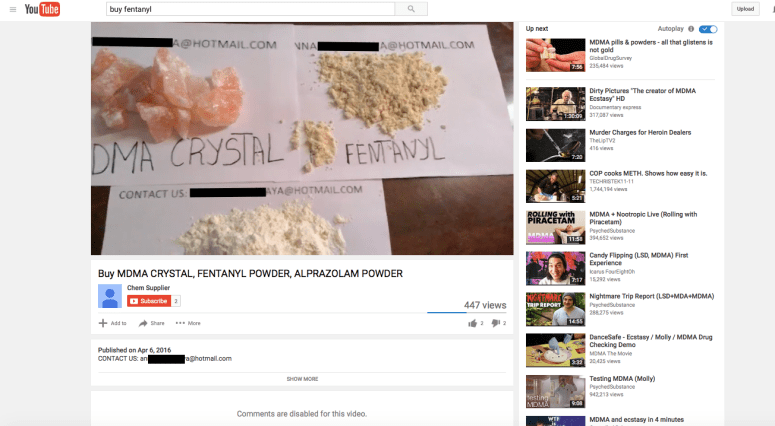
This is a screenshot form earlier today. YouTube hosts dozens of videos like these advertising the illegal sale of the Prince killing drug Fentanyl. Mississippi Attorney General Hood is right on YouTube: They continue to enable advertising for illegal drug trafficking.
Just saw this on MTP:
Google Facilitates the Sale of the Drug that Killed Prince
Songwriters and performers have a legal rights to choose with whom they do business. If I don’t like Coors I don’t have to license my music for their commercials. If I you don’t like the particular views of a political candidate you don’t have to let them use your music.
Well, what about a company that hosts advertisements for illegal sales of drugs, hate rock videos, terrorist recruitment videos and thousands of other abominations. Artists don’t want to support a business like this do they?
Well, because YouTube abuses the DMCA takedown process, and interprets it as a game of “Whack-a-mole” there is no practical way to keep your music off of YouTube. We are forced to go into business with a deeply amoral company?
++++++++++++++++++++++++++++++++++++++++++
We have carefully documented over the years all the nasty crap Google/YouTube hosts:
A big Silicon Valley company and their big Silicon Valley law firm are suing independent photographer Kalliope Amorphous for having the temerity to tell them to stop stealing her photographs.

 The Trichordist
You must be logged in to post a comment.