
“Progressive” Democratic congressional candidate for Woodstock NY Zephyr Teachout is director of an astroturf organization that takes regressive copyright positions that harm artists and favor major Silicon Valley corporations like Google. In 2013 Fight For the Future mounted a massive copyright infringement campaign against the MLK estate over the “I Have a Dream Speech.”
+++++++++++++++++++++++++++++++++++++++++++++++++++++++++
Musicians often support left/progressive politicians that undermine their rights
In the UK the Green Party tends to enjoy solid support from musicians and other creators, yet last year (among other things) they proposed to legalize p2p file sharing and roll back copyright protection length to 14 years or less. In 1710 when average lifespans were less than 40 years, The Statute of Anne gave authors a copyright length of 14 years. This is so regressive it prompted me to write a letter to the UK Greens that suggested this compromise:
Dear UK Green Party:
We authors will accept your early 18th century version of copyright if you and your members promise from this day forward to rely only upon dental and medical techniques from the same period.
Of course it is even worse in the EU parliament where the Pirate Party is in alliance with European Green Party. As a result the EU Green Party incorporated a five year copyright term into their platform!
But it’s not just small parties the like Euro Greens and Pirate Party lunatics attempting to erode artists copyright protections. In the US it is becoming increasingly apparent “progressive” Democrats are exhibiting these same tendencies. Despite years of reliable (if unwise) support from musicians, songwriters, authors, actors, directors, screenwriters and media executives, progressives appear to be tilting towards technology companies when it comes to copyright protections afforded artists.
I suppose it’s amusing in ugly sort of way: Progressives are essentially going against a largely democratic unionized industry (Hollywood) while embracing the agenda of an anti-union and libertarian industry (Silicon Valley). The Author Thomas Frank should write a follow-up to his “What’s the Matter with Kansas?” and call it “What’s the Matter with Hollywood?”
There is no better example of this than the current darling of the progressive movement Zephyr Teachout. Teachout is running for Congress in NY-19 as a Democrat. At first glance Teachout appears appealing to the majority of Americans (left and right) who want to reform American politics and rid our election system of the corrupting influence of money. These are certainly worthy goals. But if you do a little digging, Teachout is not who she appears to be.
Why did Teachout move to the NY 19th congressional district from metro NYC?
Teachout appears to have “shopped” for a congressional district in which to run. NY-19 is a marginally Republican district with a retiring Republican incumbent. She has no roots in the sprawling 19th congressional district. Teachout a law professor at Fordham University in NYC moved to Dutchess County 9 months before entering the race after a lot of online progressive speculation that she should run for congress. There were already perfectly good local candidates running for the seat, a liberal Democrat, farmer Will Yandik and three Republicans. But hey this is politics and we all know politics is ugly. No surprise right?
One of the things that gives Teachout a shot in this Republican leaning congressional district is the cluster of counter culture progressive democrats in places like Woodstock. This is largely the legacy of the music business economic cluster that developed here in the late 1960s and continues to generate considerable economic activity throughout the Hudson Valley. The list of musicians, songwriters, engineers producers and managers associated with Woodstock and the Hudson Valley is impressive.
I imagine that Teachout will want to draw support from this important community, and my guess is that many in this community will reflexively support her. Unfortunately this would not be in their interest. Why? Teachout is the director of an astroturf organization called Fight For The Future. Why is that important? Well first you need a little background.
The problem for artists: “Notice and Takedown”
Under the 1998 Digital Millennium Copyright Act (DMCA), Internet corporations like Google and Facebook are given a “safe harbor” against copyright infringement committed by their users as long as they promptly comply with requests from artists and other copyright owners for removal of infringing content. This process is informally called “Notice and Takedown.” When the law was enacted, no one imagined that companies like Google/YouTube would interpret the law as a game of “whack a mole.” That is, once the offending file was removed online service providers could let the exact same file pop right back up on their servers and copyright owners are forced to notify the service again. This effectively gives companies like YouTube a free “DMCA safe harbor license” for virtually every song and recording in the world. Although major corporations like Sony and Universal Music Group have been able to effectively keep certain hit songs off of these platforms for a few weeks or even months, it requires extraordinary human and technical resources, and there is virtually no recourse (except expensive federal lawsuits) if the user who uploaded the song falsely “counter claims” that they have the right to upload the song.
Particularly hard hit are the independent, middle class and legacy artists that do not have resources (financial and technical) to police vast platforms like YouTube or SoundCloud. As a result platforms like YouTube are able to generate revenue from advertising and data mining that is not shared with artists. Further the fact that virtually every song is available on YouTube has undermined the value of songs and recordings across the entire digital marketplace. Why buy a song when it’s on YouTube? Why pay for a premium subscription streaming service when YouTube is free? And why do artists put up with the shitty royalties from streaming services? Because the alternative, YouTube is even worse. YouTube, SoundCloud and other services that have abused the DMCA takedown process have created a market failure.
After piracy sites like the Pirate Bay, YouTube and its “DMCA safe harbor license” is the next biggest revenue drain for artists. Legendary producer Jimmy Iovine (now at Apple Music) estimated that while YouTube represents as much as 40 percent of all music consumption, it is only 4% of the revenue. And it’s getting worse. In 2015 YouTube views increased 101% but revenues to rights holders increased only 31%.
Artists propose a solution: “Notice and Stay down”
In order to fix this problem, artists and rights holders have proposed “Takedown and Staydown.” That is, once an online platform is notified that a particular file is infringing, and there is no valid counterclaim from a user, they would block that exact same file. This is a pretty mild proposal. It’s not designed to block someone using a snippet of a song in a home video or a critical review that also uses a song snippet. It might not even block the upload of the same song in a different format (AIFF rather than MP3) or at a different bitrate. It’s still a whack-a-mole game but the odds are a little more in the artists favor. Naturally the companies that benefit from the DMCA safe harbor are opposed to this change.
US Copyright Office consultation
Unlike other federal agencies the US Copyright office doesn’t have enforcement powers. However they periodically review aspects of copyright law and often make recommendations for changes to the law. Their recommendations usually carry considerable weight. In this case the Copyright Office began by conducting a public consultation on changes to the “Notice and Takedown” provision in the DMCA. The Copyright Office asked for comments and papers from interested parties. Comments were supposed to be posted to a special page on the Regulations.gov website. The deadline was midnight April 1st.
Teachout’s organization opposes take down stay down, Coordinates with YouTube channel to hijack consultation process.
On the afternoon of March 31st Teachout’s organization Fight For The Future suddenly launched the Takedownabuse.org website (registered domain name at 2:30pm) and with the help of a teen oriented YouTube Channel (Channel Awesome) began to bombard the Regulations.gov website with identical bot generated comments in opposition to the Takedown Stay down proposal. Fight For The Future even bragged to the press that they had “taken down” the Copyright Office website.
Read our detailed coverage here:
https://thetrichordist.com/2016/04/03/hacking-democracy-googleyoutube-proxy-group-fight-for-the-future-crashes-us-copyright-office-website-during-crucial-comment-period/
https://thetrichordist.com/2016/04/19/exactly-86000-identical-comments-the-illegal-comment-bombing-of-dmca-notice-takedown-review-by-google-proxy-fight-for-the-future/
Did Teachout and Fight For The Future break the law?
Violate the law? Fight For The Future created a “comment bot” that bombed the Regulations.gov website with identical, anonymous and most likely fraudulent multiple comments to the Copyright Office. Consider the following:
- Fight for the Future bragged to it’s supporters that their “campaign” (actually a comment bot) crashed the Copyright Office website. If this claim is true how is this not a “denial of service” attack on a federal government server?
- If this claim is false, why is FFTF asking for donations using this false claim? False advertising?
- The rules for submission of comments to the Regulations.gov website clearly state that comments must be made to their website, not made to the FFTF website and then submitted by robots to the regulations.gov website.
- 47,418 of the comments submitted by FFTF to the regulations.gov website did not disclose first and last name as required. Many are anonymous and clearly fake names like “Fuck DMCA” or “Screw DMCA.” Why did regulations.gov post these comments? These do not meet federal requirements and should not have been accepted.
- FFTF partnered with Channel Awesome on YouTube to generate comments. This channel is largely oriented to teens and pre-teens. This was essentially a political advertisement to children. The FTC has generally required much higher standards when it comes to exaggerations and dubious claims when ads are directed to children. Even if this is not illegal (I’m not an expert), I think it is totally insane (and creepy) to push hysterical misinformation on a channel directed at children and then direct them to make comments on a third party website that then posts these comments to government website where they are required to identify themselves! What kind of people get minors involved in something that may turn out to be an illegal activity? Where are the grownups?
- My test of the FFTF comment bot indicated that it accepted comments from IP addresses outside of the United States.
- My test of the FFTF comment bot indicated that one could simply reload the page and post over and over again. Thus allowing fraudulent multiple comments.
- My test of the FFTF comment bot indicated that it did not verify email addresses or names of those commenting and yet posted these comments to the regulations.gov website.
- A suspiciously round number of comments were identical (86,000) and used the FFTF template (see screenshots). Sure that’s not proof of bots, but it is statistically unlikely.
Read more of our coverage here:
https://thetrichordist.com/2016/04/03/hacking-democracy-googleyoutube-proxy-group-fight-for-the-future-crashes-us-copyright-office-website-during-crucial-comment-period/
Fight For The Future advocates (and continues to advocate) mass copyright infringement against MLK estate.
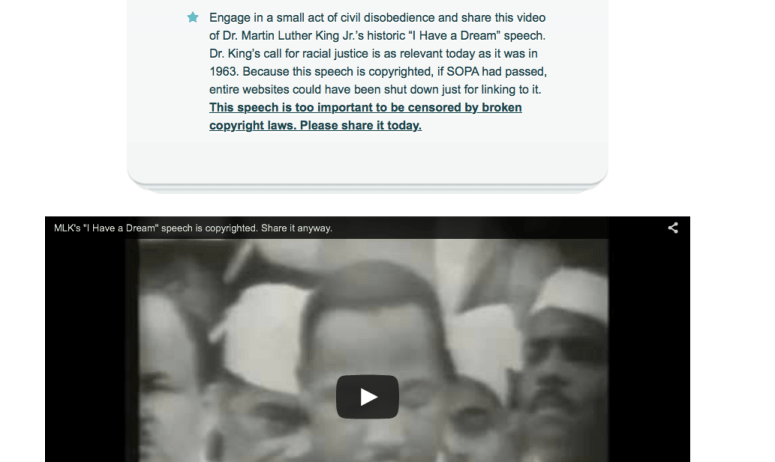
This is live right now on the InternetFreedomDay website, which is controlled by FFTF. This means Teachout as director of FFTF is advocating mass copyright infringement at this very moment. There is also the question that the group is making a false claim. Licensed versions of “I Have a Dream Speech” are widely available on the internet! For instance you can buy it on iTunes for as little as $2.99. What the entitled “progressives” at FFTF are really saying is they don’t want to pay for it.
Perhaps, more troubling is the fact that in 2012 Fight for the Future organized a mass copyright infringement campaign against the MLK estate to celebrate “Internet Freedom Day.” Put aside the sheer arrogance of FFTF and Teachout equating the 1960’s civil right struggle with a bunch of entitled brats that think they have a right to post anything to YouTube, this the world first anti-civil rights civil disobedience campaign. Further, I can think of about a million much more classy ways to celebrate “Internet freedom day” than to mount a mass copyright infringement campaign against the MLK estate.
Read our coverage here:
https://thetrichordist.com/2016/05/12/uncivil-rights-astroturf-organization-protesting-copyright-hearings-organized-mass-copyright-infringement-campaign-against-mlk-estate/
https://thetrichordist.com/2016/05/13/can-you-have-law-license-and-act-as-director-of-group-that-organizes-mass-copyright-infringement/
Total Hypocrisy: Teachout opposes “black box” and corporate money in politics yet Fight For The Future gets almost all of its money from black box foundations and technology firms.
This is a story best told with pictures.

This doesn’t look sketchy at all! Fight For The Future Received almost $200k from London Trust Media a mysterious company that lists its address in this industrial park in Michigan. FFTF Financials Here

A search of Michigan State Records indicates no company by this name is registered in Michigan.

London Trust Media also owns PrivateInternetAccess.com which according to Ip2Location.com was geo-located in Hong Kong on May 1st 2016. It’s not clear that London Trust Media is a US entity.
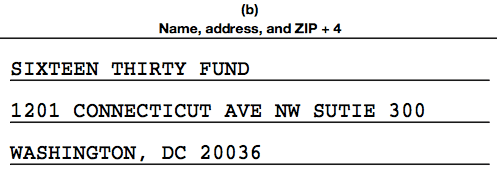
According to tax records this mysterious black box fund claims to be an “Environmental quality, protection and Beautification” fund. Fight For The Future has no projects or efforts that are remotely related to environmental protection. Yet this fund gave Fight For The Future $230k. This contribution is likely in violation of IRS rules.

Chicago Instructional Tech Foundation which is really based in Boulder Colorado and is now called Voqal (Mispelled above) gave Fight For The Future $105,000. Again what does Fight For the Future have to do with “instructional tech?”
Corporate money supporting Fight For The Future includes venture capital behemoths like Union Square Ventures and Silicon Valley firms like NameCheap and Yelp. The Consumer Electronics Association (now Consumer Technology Association) figures prominently in FFTF finances. The Consumer Electronics Association now largely represents Silicon Valley companies like Google.
You can read more of our coverage here:
https://thetrichordist.com/2016/05/01/anti-copyright-fight-for-the-future-and-their-1-grassroots/
https://thetrichordist.com/2016/05/12/list-of-corporations-and-foundations-funding-astroturf-fight-for-the-future-free-speech-graveyard/
https://thetrichordist.com/2016/05/13/astroturf-fight-for-the-future-is-toast-anti-copyright-protest-gets-9-rsvps-on-facebook/
https://thetrichordist.com/2016/05/13/confirmed-astroturf-zero-fight-for-the-future-takedown-abuse-protestors/
Teachout Hypocrisy on SuperPACs and Irregularities at MayDay PAC
Finally it should be noted that Teachout until recently served as the leader of the MayDay SuperPac. This PAC was founded by the famous copyleft author and failed presidential candidate Lawrence Lessig. Lessig famously wrote a Wall Street opinion piece entitled “In Defense of Piracy.” He has twice challenged the constitutionality of aspects of copyright law at the US Supreme Court (he lost both times). The MayDay superPAC was ostensibly designed by Lessig to support candidates that wanted to get the big money out of politics. Instead it was widely criticized (on left and right) for being just another way for Silicon Valley billionaires to exert political influence in races far from home and was accused of a host of campaign irregularities.
Read more here:
http://www.politico.com/story/2015/07/zephyr-teachout-larry-lessig-mayday-pac-2016-120660
http://irregulartimes.com/2014/07/02/questions-about-the-mayday-pac/
http://www.newyorker.com/magazine/2014/10/13/embrace-irony
http://irregulartimes.com/2014/07/30/mayday-pac-leadership-not-alone-core-overlaps-with-other-political-corporations/
http://irregulartimes.com/2014/10/02/confirmed-mayday-pac-mystery-money-props-up-conservative-stark360-slate-and-leaders/
http://www.wsj.com/articles/scott-blackburn-not-even-reformers-can-follow-campaign-finance-law-1420503172
http://www.campaignfreedom.org/2014/11/20/fec-complaint-mayday-pac-violated-campaign-finance-laws/






 The Trichordist
You must be logged in to post a comment.