Our friend and long time music marketing consultant Jay Gilbert sits down with Chris Castle to discuss release planning and strategies on Part 3 of the Artist Rights Institute’s Record Release Checklist. You may have seen Jay on podcasts like Your Morning Coffee, Behind the Setlist (with Glenn Peoples) and Michael Brandvold’s Music Biz Weekly.
Jay discusses his excellent Release Planner and made a copy available for download on the Artist Rights Institute Artist Financial Education vertical. You can also listen to the podcast on The Artist Rights Watch podcast.
Don’t miss Parts 1 and 2 on getting your record ready with legal and business issues available on the Financial Education Vertical here and here and checklist for YouTube videos here.
The Artist Rights Watch podcast returns for another season! This week’s episode features Chris Castle on An Artist’s Guide to Record Releases Part 2. Download it here or subscribe wherever you get your audio podcasts.
New Survey for Songwriters: We are surveying songwriters about whether they want to form a certified union. Please fill out our short Survey Monkey confidential survey here! Thanks!
The Artist Rights Watch podcast returns for another season! This week’s episode features AI Legislation, A View from Europe: Helienne Lindvall, President of the European Composer and Songwriter Alliance (ECSA) and ARI Director Chris Castle in conversation regarding current issues for creators regarding the EU AI Act and the UK Text and Data Mining legislation. Download it here or subscribe wherever you get your audio podcasts.
New Survey for Songwriters: We are surveying songwriters about whether they want to form a certified union. Please fill out our short Survey Monkey confidential survey here! Thanks!
The Artist Rights Watch podcast returns for another season! First episode is Tim Kappel discussing the Vetter v. Resnik landmark copyright termination case. Follow us wherever you get your podcasts.
New Survey for Songwriters: We are surveying songwriters about whether they want to form a certified union. Please fill out our short Survey Monkey confidential survey here! Thanks!
New Survey for Songwriters: We are surveying songwriters about whether they want to form a certified union. Please fill out our short Survey Monkey confidential survey here! Thanks!
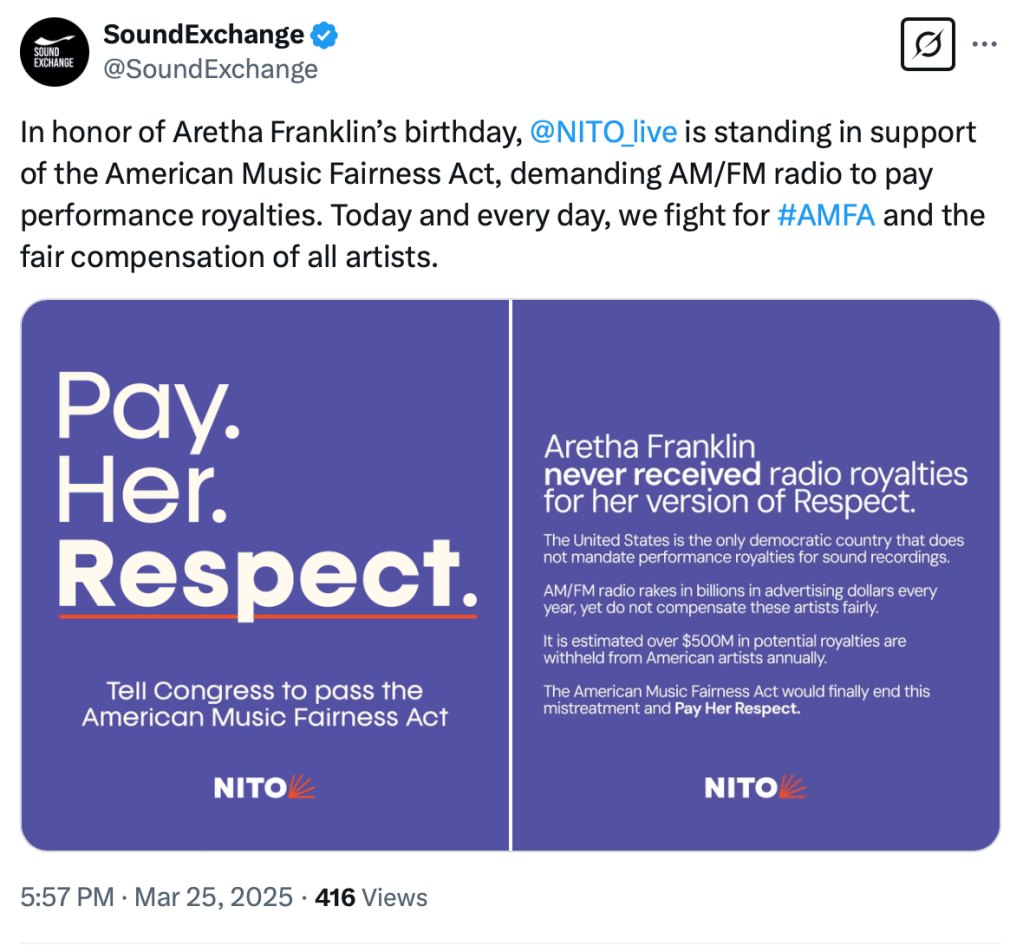
In honor of Aretha Franklin’s birthday, @NITO_live is standing in support of the American Music Fairness Act, demanding AM/FM radio to pay performance royalties. Today and every day, we fight for #AMFA and the fair compensation of all artists. pic.twitter.com/xFHnZjs5gN
We join our friends Blake Morgan, #IRespectMusic, SoundExchange, the National Independent Talent Organization (NITO) and many, many others in asking you to join the fight to support artist pay for radio play by passing the American Music Fairness Act. Find out how you can help here, or find your representative in Congress here.
New Survey for Songwriters: We are surveying songwriters about whether they want to form a certified union. Please fill out our short Survey Monkey confidential survey here! Thanks!
We’ve reported for years about how data centers are a good explanation for why Senators like Ron Wyden seem to always inject themselves into copyright legislation for the sole purpose of slowing it down or killing it, watering it down, or turning it on its head. Why would a senator from Oregon–a state that gave us Courtney Love, Esperanza Spalding, The Decemberists, Sleater-Kinney and the Dandy Warhols–be so such an incredibly basic, no-vibe cosplayer?
Easy answer–he does the bidding of the Big Tech data center operators sucking down that good taxpayer subsidized Oregon hydroelectric power–literally and figuratively. Big Tech loves them some weak copyright and expanded loopholes that let them get away with some hard core damage to artists. Almost as much as they love flexing political muscle.
Senator Wyden with his hand in his own pocket.
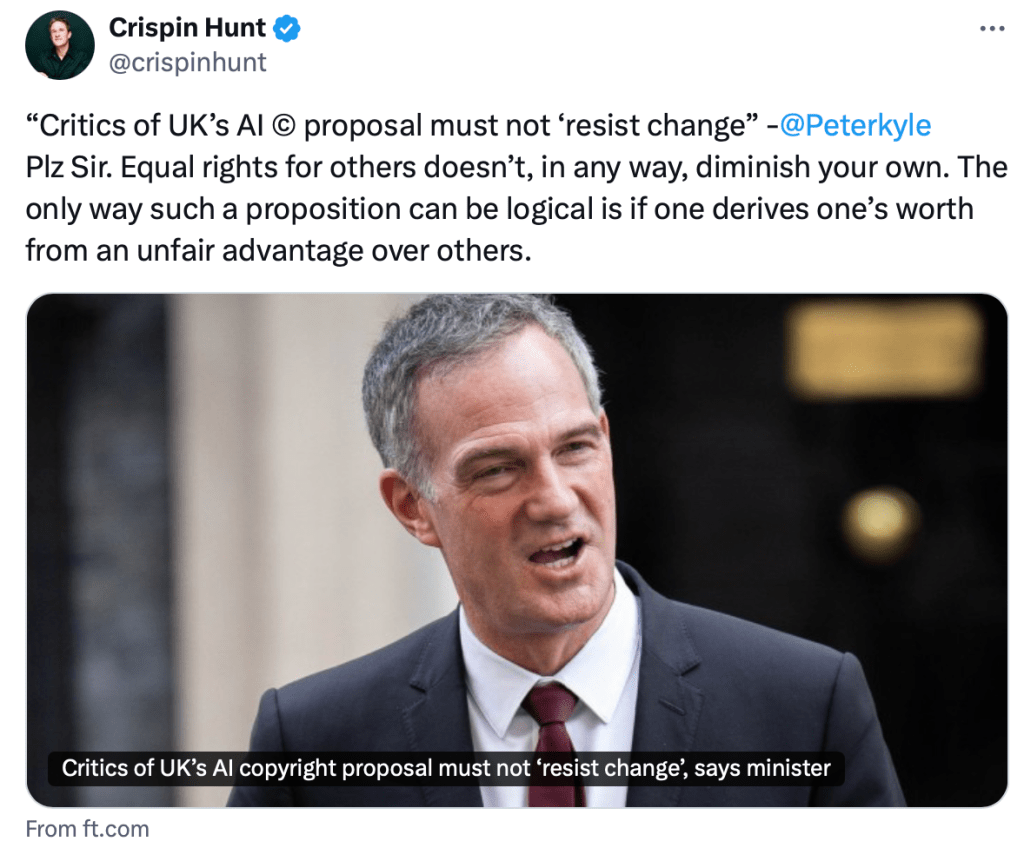
This is coming up again in the various public comments on artificial intelligence, which is the data hog of data hogs. For example, the Artist Rights Institute made this point using Oregon as an example in the recent UK Intellectual Property Office call for public comments that produced a huge push back on the plans of UK Prime Minister Sir Kier Starmer to turn Britain into a Google lake for AI, especially the build out of AI data centers.
Google Data Center at The Dalles, Oregon
The thrust of the Oregon discussion in the ARI comment is that Oregon’s experience with data centers should be food for thought in other places (like the UK) as what seems to happen is electricity prices for local rate payers increase while data centers have negotiated taxpayer subsidized discounts. Yes, that old corporate welfare strikes again.
Oregon Taxpayers’ Experience with Crowding Out by Data Centres is a Cautionary Tale for UK
We call the IPO’s attention to the real-world example of the U.S. State of Oregon, a state that is roughly the geographical size of the UK. Google built the first Oregon data centre in The Dalles, Oregon in 2006. Oregon now has 125 of the very data centres that Big Tech will necessarily need to build in the UK to implement AI. In other words, Oregon was sold much the same story that Big Tech is selling you today.
The rapid growth of Oregon data centres driven by the same tech giants like Amazon, Apple, Google, Oracle, and Meta, has significantly increased Oregon’s demand for electricity. This surge in demand has led to higher power costs, which are often passed on to local rate payers while data centre owners receive tax benefits. This increase in price foreshadows the market effect of crowding out local rate payers in the rush for electricity to run AI—demand will only increase and increase substantially as we enter what the International Energy Agency has called “the age of electricity”.[1]
Portland General Electric, a local power operator, has faced increasing criticism for raising rates to accommodate the encroaching electrical power needs of these data centers. Local residents argue that they unfairly bear the increased electrical costs while data centers benefit from tax incentives and other advantages granted by government.[2]
This is particularly galling in that the hydroelectric power in Oregon is largely produced by massive taxpayer-funded hydroelectric and other power projects built long ago.[3] The relatively recent 125 Oregon data centres received significant tax incentives during their construction to be offset by a promise of future jobs. While there were new temporary jobs created during the construction phase of the data centres, there are relatively few permanent jobs required to operate them long term as one would expect from digitized assets owned by AI platforms.
Of course, the UK has approximately 16 times the population of Oregon. Given this disparity, it seems plausible that whatever problems that Oregon has with the concentration of data centers, the UK will have those same problems many times over due to the concentration of populations.
Will AI Produce the Oregon Effect Internationally?
So let’s look at a quick and dirty comparison of the prices that local residents and businesses pay for electricity compared to what data centers in the same states pay. We’re posting this chart because ya’ll love numbers, but mostly to start discussion and research into just how much of an impact all these data centers might have on the supply and demand price setting in a few representative state and countries. But remember this–our experience with Senator Wyden should tell you that all these data centers will give Big Tech even more political clout than they already have.
The chart shows the percentage difference between the residential rate and the data center rate for energy in each state measured. The percentage difference is calculated as: ((Residential Rate – Data Center Rate) ÷ Residential Rate) × 100. When we say “~X% lower” we mean that the data center price per kilowatt hour (¢/kWh) is approximately X% lower than the residential rate, all based on data from Choose Energy or Electricity Plans. We don’t pretend to be energy analysts, so if we got this wrong, someone will let us know.
On a country by country comparison, here’s some more food for thought:
As you can see, most of the G7 countries have significantly higher electricity prices (and therefore potentially higher data prices) than the US and Canada. This suggests that Big Tech data centers will produce the Oregon Effect in those countries with higher residential energy costs in a pre-AI world. That in turn suggests that Big Tech is going to be coming around with their tin cup for corporate welfare to keep their data center electric bills low, or maybe they’ll just buy the electric plants. For themselves.
Either way, it’s unlikely that this data center thumb on the scale and the corporate welfare that goes with it will cause energy prices to decline. And you can just forget that whole Net Zero thing.
If you don’t like where this is going, call your elected representative!
New Survey for Songwriters: We are surveying songwriters about whether they want to form a certified union. Please fill out our short Survey Monkey confidential survey here! Thanks!
Big Tech’s “Text and Data Mining” Lobbying Head Fake
George York of Digital Creators Coalition and RIAA gives an excellent overview of international AI Text and Data Mining (TDM) loopholes and how to plug them. Nov. 20, 2024 Artist Rights Symposium, Washington, DC. Watch the Symposium playlist here.







You must be logged in to post a comment.