
Category: Artist Rights Institute
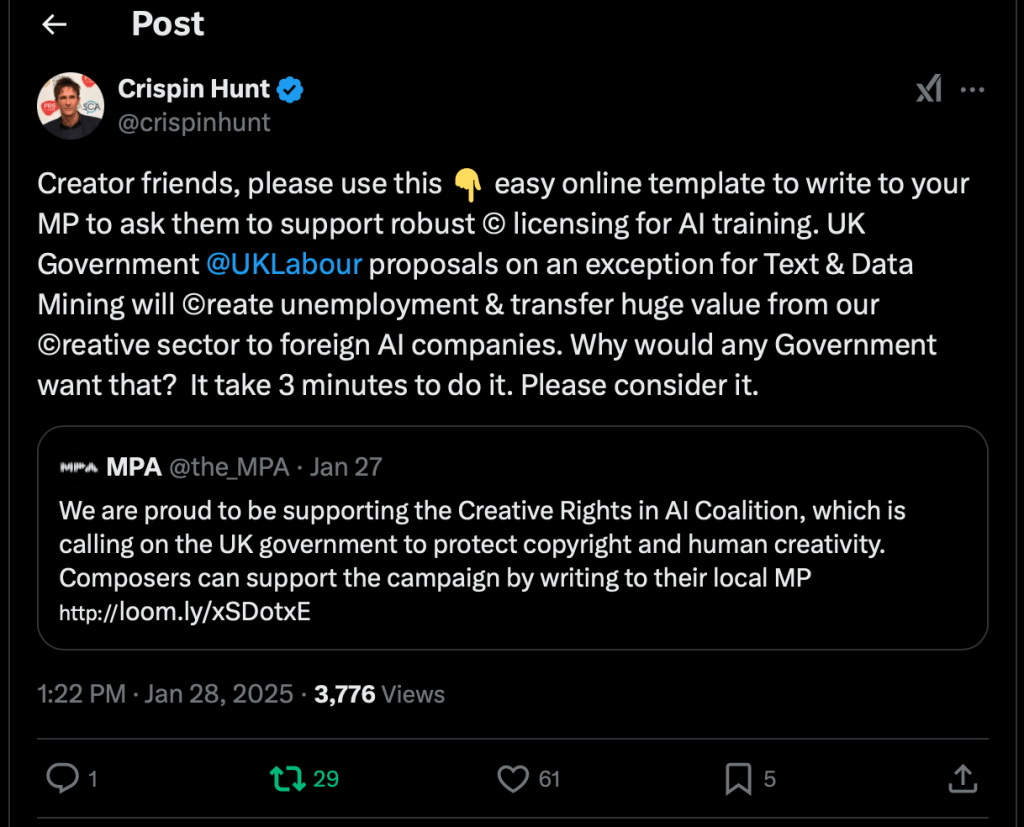
@Abbie_Llewelyn: UK Government defeated in House of Lords over protecting copyright from AI data scraping
Good news on the AI fight posted by the @artistrights Institute’s ArtistRightsWatch.com]
The Government has been defeated in the Lords over measures to protect creatives from having their copyrighted work used to train AI models without permission or remuneration. [The House of Lords is the “upper chamber” of the UK Parliament, similar to the US Senate.]
Peers [Members of the House of Lords] voted 145 to 126, majority 19, in favour of a package of amendments to the Data (Use and Access) Bill aiming to tackle the unauthorised use of intellectual property by big tech companies scraping data for AI.
Proposing the amendments, digital rights campaigner Baroness Kidron said they would help enforce existing property rights by improving transparency and laying out a redress procedure.
The measures would explicitly subject AI companies to UK copyright law, regardless of where they are based, reveal the names and owners of web crawlers that currently operate anonymously and allow copyright owners to know when, where and how their work is used.
Updates for Nov. 20 @ArtistRights Symposium at @AmericanU @KogodBiz in Washington DC

We are announcing the time schedule and speakers for the 4th annual Artist Rights Symposium on November 20. The symposium is supported by the Artist Rights Institute and was founded by Dr. David C. Lowery, Lecturer at the University of Georgia Terry College of Business.
This year the symposium is hosted in Washington, DC, by American University’s Kogod School of Business at American’s Constitution Hall, 4400 Massachusetts Avenue, NW, Washington, DC 20016. We are also pleased to have a Kogod student presentation on speculative ticketing as part of the speaker lineup.
Admission is free, but please reserve a spot with Eventbrite, seating is limited!
The symposium starts at 8:30 am and ends with a reception at 4:30pm. The symposium will be recorded as an audiovisual presentation for distribution at a later date, but will not be live-streamed. If you attend, understand that you may be filmed in any audience shots, questions from the floor or still images. The symposium social media hashtag is #ArtistRightsKogod.
Schedule
8:30 — Doors open, networking coffee.
9:00-9:10 — Welcome remarks by David Marchick, Dean, Kogod School of Business
9:10-9:15 — Welcome remarks by Christian L. Castle, Esq., Director, Artist Rights Institute
9:15-10:15 — THE TROUBLE WITH TICKETS: The Challenges of Ticket Resellers and Legislative Solutions:
Kevin Erickson, Director, Future of Music Coalition, Washington DC
Dr. David C. Lowery, Co-founder of Cracker and Camper Van Beethoven, University of Georgia
Terry College of Business, Athens, Georgia
Stephen Parker, Executive Director, National Independent Venue Association, Washington DC
Mala Sharma, President, Georgia Music Partners, Atlanta, Georgia
Moderator: Christian L. Castle, Esq., Director, Artist Rights Institute, Austin, Texas
10:15-10:30: NIVA Speculative Ticketing Project Presentation by Kogod students
10:30-10:45: Coffee break
10:45-11:00: OVERVIEW OF CURRENT ISSUES IN ARTIFICIAL INTELLIGENCE LITIGATION: Kevin Madigan, Vice President, Legal Policy and Copyright Counsel, Copyright Alliance
11:00-12 pm: SHOW ME THE CREATOR – Transparency Requirements for AI Technology:
Danielle Coffey, President & CEO, News Media Alliance, Arlington, Virginia
Dahvi Cohen, Legislative Assistant, U.S. Congressman Adam Schiff, Washington, DC
Ken Doroshow, Chief Legal Officer, Recording Industry Association of America, Washington DC
Moderator: Linda Bloss-Baum, Director of the Kogod School of Business’s Business & Entertainment Program
12:00-12:30: Lunch break
12:30-1:30: Keynote: Graham Davies, President and CEO of the Digital Media Association, Washington DC.
1:30-1:45: Coffee break
1:45-2:45: CHICKEN AND EGG SANDWICH: Bad Song Metadata, Unmatched Funds, KYC and What You Can Do About It
Richard James Burgess, MBE, President & CEO, American Association of Independent Music, New York
Helienne Lindvall, President, European Composer & Songwriter Alliance, London, England
Abby North, President, North Music Group, Los Angeles
Anjula Singh, Chief Financial Officer and Chief Operating Officer, SoundExchange, Washington DC
Moderator: Christian L. Castle, Esq, Director, Artist Rights Institute, Austin, Texas
2:45-3:15: Reconvene across street to International Service Founders Room for concluding speakers and reception
3:15-3:30: OVERVIEW OF INTERNATIONAL ARTIFICIAL INTELLIGENCE LEGISLATION: George York, Senior Vice President International Policy from RIAA.
3:30-4:30: NAME, IMAGE AND LIKENESS RIGHTS IN THE AGE OF AI: Current initiatives to protect creator rights and attribution
Jeffrey Bennett, General Counsel, SAG-AFTRA, Washington, DC
Jen Jacobsen, Executive Director, Artist Rights Alliance, Washington DC
Jalyce E. Mangum, Attorney-Advisor, U.S. Copyright Office, Washington DC
Moderator: John Simson, Program Director Emeritus, Business & Entertainment, Kogod School of Business, American University
4:30-5:30: Concluding remarks by Linda Bloss-Baum, Director of the Kogod School of Business’s Business & Entertainment Program and reception.

NAME, IMAGE AND LIKENESS RIGHTS: New Speaker Update for Nov. 20 @ArtistRights Symposium at @AmericanU @KogodBiz in Washington DC
We are announcing more topics and new speakers for the 4th annual Artist Rights Symposium on November 20, this year hosted in Washington, DC, by American University’s Kogod School of Business at American’s Constitution Hall, 4400 Massachusetts Avenue, NW, Washington, DC 20016. The symposium is also supported by the Artist Rights Institute and was founded by Dr. David Lowery, Lecturer at the University of Georgia Terry College of Business.
We’re pleased to add an overview of artificial intelligence litigation in the US by Kevin Madigan, Vice President, Legal Policy and Copyright Counsel from the Copyright Alliance and an overview of international artificial intelligence-related legislation by George York, Senior Vice President International Policy from RIAA. We’re also announcing our fourth panel and speaker line up:
NAME, IMAGE AND LIKENESS RIGHTS IN THE AGE OF AI: Current initiatives to protect creator rights and attribution
Jeffrey Bennett, General Counsel, SAG-AFTRA, Washington, DC
Jen Jacobson, Executive Director, Artist Rights Alliance, Washington DC
Jalyce E. Mangum, Attorney-Advisor, U.S. Copyright Office, Washington DC
Moderator: John Simson, Program Director Emeritus, Business & Entertainment, Kogod School of Business, American University
Panels will begin at 8:30 am and end by 5 pm, with lunch and refreshments. More details to follow. Contact the Artist Rights Institute for any questions.
Admission is free, but please reserve a spot with Eventbrite, seating is limited! (Eventbrite works best with Firefox)
Previously confirmed panelists are:
Keynote: Graham Davies, President and CEO of the Digital Media Association, Washington DC. Graham will speak around lunchtime.
CHICKEN AND EGG SANDWICH: Bad Song Metadata, Unmatched Funds, KYC and What You Can Do About It
Richard James Burgess, MBE, President & CEO, American Association of Independent Music, New York
Helienne Lindvall, President, European Composer & Songwriter Alliance, London, England
Abby North, President, North Music Group, Los Angeles
Anjula Singh, Chief Financial Officer and Chief Operating Officer, SoundExchange, Washington DC
Moderator: Christian L. Castle, Esq, Director, Artist Rights Institute, Austin, Texas
SHOW ME THE CREATOR – Transparency Requirements for AI Technology:
Danielle Coffey, President & CEO, News Media Alliance, Arlington, Virginia
Dahvi Cohen, Legislative Assistant, U.S. Congressman Adam Schiff, Washington, DC
Ken Doroshow, Chief Legal Officer, Recording Industry Association of America, Washington DC
Moderator: Linda Bloss-Baum, Director of the Kogod School of Business’s Business & Entertainment Program
THE TROUBLE WITH TICKETS: The Economics and Challenges of Ticket Resellers and Legislative Solutions:
Kevin Erickson, Director, Future of Music Coalition, Washington DC
Dr. David C. Lowery, Co-founder of Cracker and Camper Van Beethoven, University of Georgia
Terry College of Business, Athens, Georgia
Stephen Parker, Executive Director, National Independent Venue Association, Washington DC
Mala Sharma, President, Georgia Music Partners, Atlanta, Georgia
Moderator: Christian L. Castle, Esq., Director, Artist Rights Institute, Austin, Texas
SHOW ME THE CREATOR – Transparency Requirements for AI Technology: Speaker Update for Nov. 20 @ArtistRights Symposium at @AmericanU @KogodBiz in Washington DC
We’re pleased to announce more speakers for the 4th annual Artist Rights Symposium on November 20, this year hosted in Washington, DC, by American University’s Kogod School of Business at American’s Constitution Hall, 4400 Massachusetts Avenue, NW, Washington, DC 20016. The symposium is also supported by the Artist Rights Institute and was founded by Dr. David Lowery, Lecturer at the University of Georgia Terry College of Business.
The four panels will begin at 8:30 am and end by 5 pm, with lunch and refreshments. More details to follow. Contact the Artist Rights Institute for any questions.
Admission is free, but please reserve a spot with Eventbrite, seating is limited! (Eventbrite works best with Firefox)
Keynote: Graham Davies, President and CEO of the Digital Media Association, Washington DC. Graham will speak around lunchtime.
We have confirmed speakers for another topic!
SHOW ME THE CREATOR – Transparency Requirements for AI Technology:
Danielle Coffey, President & CEO, News Media Alliance, Arlington, Virginia
Dahvi Cohen, Legislative Assistant, U.S. Congressman Adam Schiff, Washington, DC
Ken Doroshow, Chief Legal Officer, Recording Industry Association of America, Washington DC
Moderator: Linda Bloss-Baum, Director of the Kogod School of Business’s Business & Entertainment Program
Previously announced:
THE TROUBLE WITH TICKETS: The Economics and Challenges of Ticket Resellers and Legislative Solutions:
Kevin Erickson, Director, Future of Music Coalition, Washington DC
Dr. David C. Lowery, Co-founder of Cracker and Camper Van Beethoven, University of Georgia
Terry College of Business, Athens, Georgia
Stephen Parker, Executive Director, National Independent Venue Association, Washington DC
Mala Sharma, President, Georgia Music Partners, Atlanta, Georgia
Moderator: Christian L. Castle, Esq., Director, Artist Rights Institute, Austin, Texas
Keynote and Speaker Update for Nov. 20 @ArtistRights Symposium
We’re pleased to announce the speakers for the 4th annual Artist Rights Symposium on November 20, this year hosted in Washington, DC, by American University’s Kogod School of Business at American’s Constitution Hall, 4400 Massachusetts Avenue, NW, Washington, DC 20016. The symposium is also supported by the Artist Rights Institute and was founded by Dr. David Lowery, Lecturer at the University of Georgia Terry College of Business.
The four panels will begin at 8:30 am and end by 5 pm, with lunch and refreshments. More details to follow. Contact the Artist Rights Institute for any questions.
Admission is free, but please reserve a spot with Eventbrite, seating is limited! (Eventbrite works best with Firefox)
Keynote: Graham Davies, President and CEO of the Digital Media Association, Washington DC. Graham will speak around lunchtime.
The confirmed symposium panel topics and speakers are:
THE TROUBLE WITH TICKETS: The Economics and Challenges of Ticket Resellers and Legislative Solutions:
Kevin Erickson, Director, Future of Music Coalition, Washington DC
Dr. David C. Lowery, Co-founder of Cracker and Camper Van Beethoven, University of Georgia
Terry College of Business, Athens, Georgia
Stephen Parker, Executive Director, National Independent Venue Association, Washington DC
Mala Sharma, President, Georgia Music Partners, Atlanta, Georgia
Moderator: Christian L. Castle, Esq., Director, Artist Rights Institute, Austin, Texas
SHOW ME THE CREATOR – Transparency Requirements for AI Technology, moderated by Linda Bloss-Baum, Director of the Kogod School of Business’s Business & Entertainment Program
CHICKEN AND EGG SANDWICH: Bad Song Metadata, Unmatched Funds, KYC and What You Can Do About It, moderated by Chris Castle
NAME, IMAGE AND LIKENESS RIGHTS IN THE AGE OF AI: Current initiatives to protect creator rights and attribution, moderated by John Simson, Program Director Emeritus, Business & Entertainment, Kogod School of Business, American University
Additional confirmed speakers to be announced soon.
Artist Rights Institute: Estimated 2025 Inflation Adjustment for Physical and Vinyl Mechanicals
A backgrounder for artists and songwriters from the Artist Rights Institute
Summary: The fight over frozen mechanicals continues to pay off as songwriters log another cost of living increase for physical/downloads while streaming falls farther behind.
The Copyright Royalty Board adjusted the US statutory mechanical royalty for physical carriers like vinyl, CDs and downloads annually during the current rate period. This is entirely due to the success of public comments by the ad hoc songwriter bargaining group that persuaded the Copyright Royalty Judges to reject the terrible “frozen mechanicals” settlement negotiated with the NMPA, NSAI and RIAA.
As it turned out, once the judges rejected the freeze as unfair, the labels quickly agreed to a fair result that increased the physical/download rate from a 9.1¢ base rate to the 12¢ rate suggested by the Judges which went a long way to making up for the 15 year freeze at 9.1¢. In fact, if it had just been presented to the labels to begin with, a tremendous amount of agita could have been saved all round.
Crucially, not only did the base rate increase to 12¢, the judges also approved a prospective cost of living adjustment determined by a formula using the Consumer Price Index. The end result is that unlike streaming mechanicals paid by the streaming services like Spotify (i.e., not the labels) the value of the increase from 9.1¢ to 12¢ has been protected from inflation during the rate period (2023-2027).
Unfortunately, the streaming services were allowed to reject a cost of living for streaming mechanicals, notwithstanding the Judges’ and the services’ acceptance of an COLA-type adjustment to the multimillion dollar budget of the Mechanical Licensing Collective. That COLA is ased on a government measurement of inflation (the Employment Cost Index) comparable to the CPI-U that is used to increase the services’ financing of salaries and other costs at the Mechanical Licensing Collective. So those who are paid handsomely to collect and pay songwriters get a better deal than the songwriters they supposedly serve.
What is the increase in pennies this year for the physical/download mechanical rate? The Judges determine the inflation-adjusted rate every year during the five year rate period (2023-2027). The calculation is made in December for physical/download with reference to the CPI-U rate announced by the Bureau of Labor Statistics as of December 1, which means the rate published on November 11. The new rate goes into effect on January 1, 2025.
At this point, there does not seem to be any indication that there will be a large spike in inflation between now and November 11, so we can use the September rate (just announced in October) to make an educated guess as to what the 2025 statutory rate increase will be for physical/downloads (rounded down):

So we can safely project that the base rate will increase from 12.4¢ for 2024 to about 12.6¢ in 2025 without firing a shot. If you have a 10 x 3/4 rate controlled compositions clause, that means the U.S. controlled pool on physical will be approximately 94.5¢ instead of the old frozen rate of 68.25¢.
It’s important to note a couple things about the relevance of CPI-U as a metric for protecting royalty rates from the ravages of inflation. First of all, the CPI-U is a statistical smoothing of the specific rates for particular goods and services that it measures and doesn’t reflect the magnitude of changes of some components.
For example, the September CPI-U increased by 0.2% on a seasonally adjusted basis. However, the shelter index and the food index increased at higher rates:
The shelter index rose by 0.2%, and the food index increased by 0.4% Together, these two components contributed over 75% of the monthly increase in the all items index.
Moreover, the MLC itself receives an increase that is tied to the lesser of 3% or the Employment Cost Index (which was approximately 4.5% for the trailing 12 months ending June 30):

Chris Castle said, “These are good benchmarks to keep in mind as we head into a new rate setting period in a year or so when I expect songwriters to demand a COLA for streaming mechanicals. No more poormouthing from the services. If they can give it to MLC, they can give it to the songwriters, too.”
Are Your Hard Drives Turning to Bricks? Steve Harvey Takes Us Inside Iron Mountain
One day shortly after the sale to PolyGram, I got a call from Cheryl Engels with a problem she needed help with. Cheryl at the time was A&M’s post-production director in mastering. Among other things Cheryl supervised our audio assets storage room (which was mostly tape assets at the time) and also supervised mastering of new releases for other labels and artists such as U2.
Cheryl had received a call from some putz in PolyGram Special Markets demanding our best quality masters be shipped to some place in New Jersey to be made into yet another stupid compilation record to be sold as God knows what kind of tchotchke. In other words, our recordings were going to be used for the sole purpose of commoditizing music and being yet another place outside of A&M where our artist’s recordings could be purchased.
Cheryl had told this putz that he didn’t need our precious masters and that she’d be happy to run him off a DAT for his one track. So why was she calling me? Because of what he said next: “We’re the parent and you’re the child and the child doesn’t tell the parent what to do.”
I said just leave this with me. I called the guy and said, “Hi, my name is Chris Castle. You don’t know me but I’m calling to explain to you why you’re not getting what you want, Mr. SVP of Bullshit. So first thing, I’ve been to your tape storage facility—are you going to store our masters by the broken water pipe or the space heaters? Near the open window or in the car park? And when would we get our tape back?”
After some back and forth, he accepted that this time it was different at least with A&M. He apparently thought that Cheryl had been difficult with him. I explained to him that he just needed to learn how things were done. I explained to him that in Cheryl’s area the way things were done was the way Cheryl wanted them to be done—because she was correct. I suggested to him that it worked for Herb Alpert, Bono, Sting and many other top artists and mastering engineers so maybe it could work for him, too. And more importantly for him at that moment, it worked for me and I was backing Cheryl 100% with no daylight.
In signing off, I said, “and by the way, if we have a “parent” at A&M, his name is Jerry Moss and I’d be happy to transfer you to him right now if you have any questions.”
And as they say, that was that. Another thing about Cheryl was that she kept track of the tape library which means that she knew where all of the original rolls and rolls and rolls of audio tape were that included outtakes, rough mixes, etc., etc., that are created as part of making a record, especially a high profile record.
Even with Cheryl Engels TLC, the media eventually wear out, whether it’s sticky shed syndrome for magnetic tape, or other degrading phenomenon for hard drives.
Steve Harvey writing in Mix Magazine has a very serious wakeup call coming our way:
[F]or the past 25 or more years, the music industry has been focused on its magnetic tape archives, and on the remediation, digitization and migration of assets to more accessible, reliable storage. Hard drives also became a focus of the industry during that period, ever since the emergence of the first DAWs in the late 1980s. But unlike tape, surely, all you need to do, decades later, is connect a drive and open the files. Well, not necessarily. And Iron Mountain would like to alert the music industry at large to the fact that, even though you may have followed recommended best practices at the time, those archived drives may now be no more easily playable than a 40-year-old reel of Ampex 456 tape.
This is why post production directors like Cheryl Engels were so insistent about quality control for the last 30 years. The problem came up when we were working on a lot of 5.1 mixes in the 2002 era and it’s coming up again with immersive as Steve Harvey points out. It will keep coming up as new mixing techniques required going back to the original multitracks. And 5.1 emulation is not the same as true 5.1.
Read Steve Harvey’s article—it’s very important to prepare for hard drive hell. Thankfully, Iron Mountain has some techniques up the sleeve to help, but trust me we are way past baking tapes in a hard drive reality. For unlike a magnetic recording that at least might allow one pass over the tape heads to transfer it to a new storage medium, hard drives may end up just being bricks. Assuming that tape wasn’t stored under a dripping water pipe in a basement, parents and children being what they are.
[This post first appeared on Artist Rights Watch]
Save the Date: 4th Annual Artist Rights Symposium on Nov. 20 in Washington DC
We’re excited to announce that the 4th Annual Artist Rights Symposium will be held on November 20, this time in Washington DC. We have some big surprises in store that will be announced soon with new partners and speaker lineups.
The topics we plan on covering will be ticketing, song metadata and black box issues, creator rights of publicity and transparency for artificial intelligence.
Watch this space!
Black Box Rebellion: Comments of the @ArtistRights Institute To @Copyright Office on Renewal of The MLC, Inc. as MLC
The Artist Rights Institute takes on the pressing public policy issue of The MLC, Inc.’s investment of “hundreds of millions of dollars” of the black box and asks the Copyright Office to decide the legality of the MLC’s “Investment Policy.”
 The Trichordist
You must be logged in to post a comment.