The American Federation of Musicians is drawing a line between the record labels’ AI licensing deals and the musicians whose performances made those deals valuable in the first place.
The American Federation of Musicians (AFM) launched its Human Made, Human Paid campaign this week, calling on the major record labels to recognize a fundamental principle: Musicians should have a say in whether their performances are used to train generative AI systems, and they should be compensated when those performances are exploited.
The campaign comes as the AFM prepares to resume negotiations with Universal Music Group, Sony Music, Warner Music and Disney’s Hollywood Records on November 3 over a new Sound Recording Labor Agreement (SRLA), the collective bargaining agreement governing employment conditions for musicians who perform on recordings.
The union’s demands are straightforward: consent, credit and compensation. Musicians should be able to approve or reject AI uses of their performances, receive appropriate attribution and participate financially when the labels license recordings to AI companies.
But the dispute is about considerably more than another royalty provision. It goes to the heart of who has the authority to license the human performances embedded in sound recordings and whether the owners of recording copyrights can bargain away interests that belong to individual performers.
The record companies originally sued the AI developers for copyright infringement, alleging unauthorized copying of protected sound recordings. But as the companies moved toward settlements and commercial licensing arrangements, the performers whose work was captured in those recordings faced a very different question: Where was their compensation?
AFM International President Tino Gagliardi put the union’s position succinctly: “The record labels cannot pocket profits built on the backs of human artistry while cutting working musicians out of the equation.”
The AFM argues that the labels cannot simply collect AI licensing revenue while disregarding obligations to the session musicians who performed on those records.
The missing rights in the AI licensing debate
The AFM campaign also highlights an important distinction that has been largely overlooked in the AI licensing debate.
A record label may own the copyright in a sound recording, but that does not necessarily mean it owns every right implicated by the use of that recording to train or operate a generative AI system.
Performers may possess independent contractual rights, rights of publicity or other protections relating to their voices, identities and performances. Those interests do not automatically transfer to the record company simply because the performer participated in a recording session.
This becomes particularly important when an AI system can imitate not only a composition or recording but the recognizable characteristics of an individual performer, including vocal timbre, phrasing or instrumental technique.
The AFM’s demand for consent therefore addresses a question that cannot necessarily be resolved by negotiating a copyright license with a record label.
Digital replica protections are a subset of performer identity protections, not a substitute for them. Whether the exploitation involves a digital replica or some other appropriation of a performer’s identity, the underlying rights are distinct from copyright. Ownership of a sound recording, including ownership under a work-for-hire agreement like the SRLA, does not itself convey the performer’s right of publicity. A copyright license is not a license of personal identity.
The Artist Rights Symposium V is coming on October 19 at Tweed Recording in Athens, GA hosted by the University of Georgia Terry College of Business Music Certificate Program and the School of Policy and International Affairs, and the Artist Rights Institute. More about the Symposium here and register on Eventbrite here.
We’ll be posting panel overviews to introduce you to the speakers, starting with the ticketing panel. From nonexistent World Cup tickets to a growing state-by-state push for resale reform, the ticketing debate is moving quickly. “Ghost Busters: How Fans, Artists, and Venues Are Fighting Back Against Speculative Tickets” will examine what artists, venues and lawmakers can do about ghost tickets, predatory resale and a secondary market increasingly disconnected from the artists who create the event.
The panel begins at 11:30 a.m. on October 19 at Tweed Recording with these experts:
Randy Nichols, a board member of the National Independent Talent Organization, leads NITO research and policy efforts addressing predatory resale practices. A longtime artist manager and entrepreneur, his advocacy draws on two decades of experience in the live-music business.
Jay Gilbert, co-founder of Label Logic and co-host of Your Morning Coffee, brings decades of music-industry experience, including executive roles with Universal, Sony and Warner and marketing campaigns for artists ranging from Nirvana and The Police to Bob Marley and Johnny Cash.
Moderating is Mala Sharma, co-founder and president of Georgia Music Partners, whose career spans record labels, artist management, entertainment banking, the Atlanta Symphony Orchestra and public policy.
The conversation: Who should control a ticket after it goes on sale—and how do we stop people from selling tickets they never owned in the first place?
For millions of soccer fans, attending a FIFA World Cup match is a dream. But for a growing number of ticket buyers, that dream has turned into a costly nightmare—and now the state of Texas is getting involved.
The Problem
It should come as a shock to no one that Texas Attorney General Ken Paxton has announced a formal investigation into StubHub over the massive number of fan complaints tied to 2026 FIFA World Cup ticket purchases. The only surprise in Paxton’s investigation is that it’s just him. Like so many other unfortunate ticket buyers before them, fans report that their tickets were either never delivered, canceled at the last minute, or were significantly inferior to what they originally paid for.
There is a fan class action case pending in New York federal court, but…The proposed class action filed by World Cup fans in the Southern District of New York will likely face an important threshold procedural issue before the merits are ever reached. As readers will recall from our coverage of the Kaiser v. StubHub case (also in SDNY), one issue to watch is whether StubHub seeks to enforce its online arbitration agreement and class-action waiver. Consumer platforms routinely invoke arbitration clauses to move disputes out of court and into individual proceedings, and StubHub may well attempt the same strategy here.
Whatever the outcome of the class action and StubHub’s challenges, that procedural defense is unavailable against a state enforcement action. A lawsuit brought by the Texas Attorney General under state consumer protection laws proceeds in court regardless of private arbitration agreements, potentially allowing public discovery, broader injunctive relief, and judicial scrutiny that individual consumer claims might never receive. This procedural distinction helps explain why state attorney general investigations can play a uniquely important role in policing mass-market online platforms, even when private class actions are already pending. And remember, Paxton has gotten over $1 billion from each of Google and Meta on privacy cases.
At the heart of Paxton’s investigation is speculative ticketing aka “ghost tickets” — where sellers list tickets they don’t actually possess, collect payment, and then cancel orders when they can’t deliver or cover their promise to deliver tickets. This seedy practice is not new to readers and we’ve been harping on it for years. According to Paxton’s press release, consumer complaints suggest this isn’t an isolated issue but a broader, systemic pattern. Ya think?
“In many cases, attending a World Cup match is a once-in-a-lifetime experience,” Paxton said. “If StubHub is ghost ticketing Texans out of that experience, my office will use every tool available to hold them accountable and help fans who have been wronged.”
One Fan’s Story
Edgar Correa’s wife wanted to make his World Cup dream come true. She purchased tickets through StubHub on June 11 for the Bosnia-Switzerland match at Los Angeles Stadium on June 18. The couple booked a hotel, paid for parking, and Edgar took the day off work.
Then came the devastating message from StubHub: “Unfortunately, your order was not processed. This means the transaction was not completed and, therefore, no tickets were reserved for you.”
After scrambling, Correa managed to find replacement tickets directly through FIFA’s official platform—but they cost more and placed him at the very top of the stadium, far from the seats he’d originally paid for.
The Finger-Pointing
StubHub has blamed the cancellations on “transfer problems” tied to FIFA’s ticketing platform, stating that “the issues fans have experienced at this World Cup are largely due to performance failures in the event organizer’s own ticketing infrastructure, which has caused transfer errors across all resale platforms.”
FIFA isn’t having it. A spokesperson fired back: “The official FIFA ticketing platform for the FIFA World Cup 2026 operates reliably and at scale, as demonstrated by the more than 4.6 million spectators who have attended matches to date, with tickets purchased, delivered, resold, transferred, and successfully validated through FIFA systems.” FIFA explicitly rejected any suggestion that third-party platform failures are the result of its infrastructure.
The Industry Pushback
Paxton isn’t the only one sounding the alarm. On June 18—just days into the tournament—the National Independent Venue Association (NIVA) and Fan Alliance sent a joint letter to congressional leadership demanding a federal ban on speculative ticket sales. The letter, signed by NIVA Executive Director (and ARS panelist) Stephen Parker and Fan Alliance Executive Director Donald Cohen, includes nearly two dozen exhibits documenting first-hand fan accounts of ghost ticketing (another name for spec tickets) from just the first week of the World Cup.
The groups have been warning about this exact scenario for years. As they wrote: “We warned that consumers would purchase tickets that did not exist. We warned that families would travel thousands of miles only to discover their tickets could not be delivered. We warned that refunds would not make consumers whole after airfare, hotels, rental cars, parking, and other travel expenses. Unfortunately, every one of those warnings has become a reality on the world’s biggest sporting stage.”
Their proposed fix is aggressive. They’re asking Congress to ban ghost ticketing outright, impose price gouging caps on resale, levy fines of at least $10,000 per listing per day, and require platforms like StubHub to disclose data on fulfillment rates, refunds, and consumer complaints—information the platforms have repeatedly declined to make public.
Notably, the letter takes direct aim at the TICKET Act currently before Congress, arguing it would still permit the very ghost ticketing that’s victimizing fans right now. The groups point to states like Maryland, Minnesota, Oregon, Connecticut, and Nevada, which have already banned speculative sales and closed the loopholes that let resellers rebrand the practice as “concierge” or “ticket procurement” services (which also confused Colorado Governor Jared Polis when he vetoed a ban on spec ticking).
The letter also makes a point that often gets lost in the World Cup headlines: this same consumer harm plays out every day at independent venues, theaters, and comedy clubs across the country. Unlike FIFA or the NFL, these small businesses can’t absorb the reputational damage when fans blame the venue for a scalper’s fraud.
The Securities Question
One open question: StubHub is now a publicly traded company (NYSE: STUB) following its September 2025 IPO. If ghost ticketing cancellations represent a material volume of failed transactions—and the lawsuits and state investigations suggest they might—does StubHub face disclosure obligations around the scope of unfulfilled orders, pending litigation exposure, and potential regulatory liability? At least one investor rights firm has already flagged a lead plaintiff deadline tied to StubHub’s IPO disclosures, suggesting the securities angle may not be far behind the consumer protection one.
What You Can Do
If you purchased World Cup tickets through StubHub and didn’t receive them—or received tickets significantly different from what you paid for—the Texas Attorney General’s Consumer Protection Division is encouraging you to file a complaint.
FIFA’s own FAQ is blunt: for any ticket sold through another platform, buyers must contact that platform directly. FIFA cannot access or manage those tickets. The organization recommends buying tickets only through its official site. Well, it’s a little late for that.
The Takeaway
The 2026 World Cup has been a spectacular global event, but the secondary ticket market has exposed serious consumer protection gaps. Whether this is a case of ghost ticketing, platform infrastructure failures, or something in between, one thing is clear: fans are paying the price. With a state attorney general now on the case, StubHub may soon face real accountability for the broken promises left in its wake.
If you saw the adverb “forever” in a contract, would it give you pause? It would me—I would wonder who allowed that to slip through. As text-to-audio generative AI models desperately try to normalize their shoot-ready-aim ingestion of likely stolen works to support their next round of financing (or in some cases perhaps a VC exit by IPO), it’s likely that we will see some efforts at “licensing” reminiscent of the Napster era. “Licenses” that actually paper over the main act—stop the lawsuit before they start. What will that look like and what should we look for buried in the not so fine print?
Generative AI companies are coming to the negotiating table with “music licensing agreements” (and probably other artists’ too). That sounds encouraging — it suggests they want to do the right thing and pay for the content they use. Trust me, they don’t. What they want is to get away with it.
Not every document titled “license” actually functions like one. Some of these deals are better described as litigation insurance dressed up in licensing language, and if you sign one without reading the small print, you may be giving away far more than you realize. Because as Tom Waits taught us in the classic Step Right Up, the large print giveth and the small print taketh away.
Here’s a practical checklist of red flags to watch for if you want to look past the hype:
☐ Check Whether the “License” Actually Includes a Perpetual “Covenant Not to Sue”
A quick definitional note: a covenant not to sue is a contractual promise in which you agree in advance never to bring a legal claim against the other party — regardless of what happens, regardless of whether you even know you have a claim, and often regardless of whether the conduct at issue would otherwise be something you could sue for or get a court to stop (like with an injunction). Unlike a license, which grants permission and can expire, a covenant not to sue can be a permanent waiver of your right to seek a remedy. It’s the difference between handing someone a key to your house and signing a contract promising you’ll never call the police no matter what they do inside.
A real license gives someone permission to use your work under defined conditions, and when the term ends, so does the permission. Watch out for agreements that include a separate clause in which you irrevocably promise — both during and after the term — never to bring any claim against the company or even its users. If the covenant not only covers copyright, publicity rights, moral rights, defamation, and lawsuits over issues that may not exist yet, you are not licensing your work. You are surrendering your right to enforce your rights, permanently. Or you know, “forever.” Make sure you understand the difference before you sign.
☐ Beware a “Non-Exclusive” License That Binds Your Co-Writers
Remember the 100% licensing debacle back in 2016? Tenants-in-common co-ownership of a copyright means any co-owner can grant a non-exclusive license without the others’ consent — but that principle can be weaponized. If an agreement requires you to represent and warrant that no third-party consent is needed, and that you will not encourage your fellow songwriters to take any position inconsistent with the deal (again with the censorship), you may be dragging your co-writers into an arrangement they never agreed to. Worse, if the covenant not to sue extends to all contributors, your co-writers’ enforcement rights could be compromised by a deal they had no say in. Before you sign, make sure the AI platform isn’t leveraging TIC principles to bind people who aren’t at the table. Here’s why this matters in practice: under TIC co-ownership, a non-exclusive license granted by one co-owner is generally binding on all co-owners, even without their consent. That means if you grant a non-exclusive license — or, more critically, a covenant not to sue — covering the full composition, your co-writer may be unable to bring an infringement claim against the same company for the same use, because the company can point to your grant as a complete defense. The co-writer’s right to sue isn’t technically extinguished, but it’s rendered practically worthless. The result is that one publisher’s signature can neutralize enforcement rights across an entire song’s ownership chain. Ask your lawyer.
☐ Look for a Sweeping Pre-Signing Release
Some agreements bury a broad release of all claims arising before the effective date — known and unknown, suspected and unsuspected. That’s not a license, it’s a preemptive settlement masquerading as a license. Worse, they may ask you to preemptively waive protections like California Civil Code Section 1542, which exists specifically to protect people in this exact situation. The statute prevents people from accidentally releasing claims they don’t yet know about. If an AI company has been training on your catalog without permission for years, a release like this could function like a contractual safe harbor and eliminate any leverage you had to seek compensation for that unauthorized use, or better yet an injunction. You know, kind of like the Music Modernization Act. Ask yourself: why does a forward-looking license need a backward-looking release? Aside from wanting a pony.
☐ Make Sure “Training Rights” Aren’t Irrevocable in Practice
A license to include your works in a training corpus sounds civilized, but look closely at the removal mechanics (and take a class in “machine unlearning“). If the company is only required to retrain its model a limited number of times per year — say, twice — then even if you pull your catalog, your works may remain embedded in the AI model for months or even “forever”. There are no guarantees that “retraining” will actually remove your works from the model and, in fact, the literature suggests it won’t. And if the covenant not to sue survives the term for anything created while the deal was active (or before the deal was active), the training that already happened is effectively locked in. You may be inadvertently granting a right for yourself and maybe your co-writers that you can never meaningfully take back.
☐ Don’t Pre-Approve a Statutory Streaming License They May Not Be Entitled To
Some AI music platforms aspire to become full on-demand streaming services — and their agreements may include language contemplating exactly that expansion, with provisions stating the company will simply obtain a blanket mechanical license from the Mechanical Licensing Collective under 17 U.S.C. § 115(d). But whether a generative AI platform that creates synthetic music qualifies for the statutory compulsory license designed for traditional on-demand streaming is a genuinely open legal question. If you agree to terms that treat this expansion as a foregone conclusion — or worse, if your covenant not to sue or conditional authorization greenlights streaming functionality by default — you may be conceding the argument before it’s ever litigated. Don’t let an agreement’s assumptions about statutory eligibility become your assumptions. That question should be tested, not waived.
There’s a deeper problem here, too. The Section 115 compulsory license has always contained an anti-piracy prerequisite: you cannot obtain a compulsory license to use a musical composition if the sound recording you’re working from was not lawfully fixed or authorized by the sound recording’s copyright owner. If an AI platform trained its model on sound recordings it ingested without authorization (as is currently being litigated), its entire statutory license theory may be built on a foundation of infringement. The compulsory license was never designed to launder unauthorized use of sound recordings into lawful use of the compositions they embody. By agreeing to terms that treat the platform’s eligibility as settled, you may be implicitly conceding that the platform’s use of those sound recordings was authorized — a concession likely worth far more than anyone is probably paying for it and that can get you sideways with the sound recording owners.
☐ Scrutinize “Guardrail Failure” Safe Harbors
Technical safeguards — input filters, output filters, vocal classifiers — are only as good as the consequences for failure. Be wary of provisions that excuse the AI company from breach liability when its guardrails fail, so long as the failures are characterized as “inadvertent” and “de minimis” which are in the eye of the beholder and just buying a lawsuit. If the agreement treats guardrail failures as non-breaches by default, you’ve effectively agreed that the company can produce unauthorized outputs of your works without meaningful accountability, as long as it promises to try to fix the problem after the fact with no stick if it fails.
☐ Watch Who Owns the AI Model — and Learned “Insights”
Ownership clauses in AI agreements often go further than you’d expect. The company may claim ownership not just of the AI model, but of all “insights” it learns which can be damn near anything. That “learning” is including those developed using your content. That language could be read to mean that everything the AI extracts, learns, or derives from your catalog belongs to the platform. Make sure you are not inadvertently ceding ownership of the creative intelligence embedded in your works.
☐ Don’t Let a Third Party’s Binding Calculation Determine Your Payment
I am no fan of market share revenue share deals, particularly when the revenue pool is a fixed number. Some revenue pool deals delegate the calculation of your market share — and therefore your payment — to a third party, and then declare that calculation to be binding on you, even if you had nothing to do with calculating either your market share (under the “license” not in general) or your share of the revenue or minimum guarantee. If you have no right to challenge the methodology or the math, or to audit that third party, you could be found to have agreed to be paid whatever someone else decides you’re owed, with no recourse if they get it wrong.
☐ Trace the Revenue Through Every Deduction Before Celebrating the Rate
A headline royalty rate means nothing if it’s applied to a revenue base that has already been carved down by layers of deductions including off the top fees, advertising costs, technical fees, inference compute costs, app-store commissions, performance royalties, and more. Each deduction may sound reasonable in isolation, but stacked together, they can reduce the revenue pool to a fraction of what you’d expect. Always model your actual payout, not just the stated percentage.
☐ Beware Conditional Authorizations That Expand the Deal Without Your Active Consent
Some agreements include provisions for future features such as API access, enterprise customer pricing, new product versions, downloads, or interactive streaming that automatically activate once a majority of other rightsholders sign on. If the trigger is what other labels or publishers do rather than what you approve, you may find that the scope of the license has expanded well beyond what you agreed to, without any additional negotiation or compensation. And remember what they say about if everyone else was running off a cliff.
☐ Censorship Clauses: Don’t Agree to Never Contradict the Deal
Representation and warranty sections sometimes include a covenant that you will not take, or encourage your artists or songwriters to take, any position at any time (whether during or after the term and whether or not truthful) that is inconsistent with the hoorah narrative about AI or the applicable license. Read that carefully. It could be interpreted to prevent you — or your writers — from ever publicly criticizing the deal, advocating for stronger protections, or supporting legislation that conflicts with the agreement’s framework, even years after it expires even if the AI platform is in breach. Aside from censoring your freedom of speech, this has nothing, and I mean nothing, to do with a license.
☐ Understand What Walled Garden Actually Means for Your Writers
A service that restricts AI-generated content to a “walled garden” with no downloads sounds contained. But if users can generate unlimited content using your works, share tracks or links to tracks across social media, and the company retains the right to expand into other product lines (including non-AI product lines like an on-demand streaming service) all within the same agreement, any “walled garden” may be pretty ephemeral.
☐ Confirm That Your Minimum Guarantee Is Actually Guaranteed
A minimum guarantee that is “fully recoupable” against future royalties is not a floor — it’s an advance. If the service underperforms, you keep the advance, but if it succeeds, the guarantee is just an interest-free loan. Make sure you understand whether the guarantee represents real minimum compensation or simply front-loaded royalties you would have earned anyway. Also, plan for both failure and success—if you’re a publisher or label, how on earth are you going to be able to account to your songwriters or artists while you’re recouping any minimum guarantee or afterwards?
☐ Demand Flow-Down Protections in the Platform’s Terms of Service
An AI platform’s Terms of Service are where your contractual protections actually meet the end user — and if the ToS doesn’t carry your rights forward, your rights may exist only on paper, if at all. Before you sign, confirm that the agreement requires the platform’s user-facing ToS to include, at a minimum:
An ownership disclaimer — users must acknowledge they acquire no copyright or ownership interest in AI outputs that embody your works.
A reverse-engineering prohibition — users must be prohibited from extracting, reconstructing, or isolating your works from the model’s outputs.
A downstream training restriction — users must be barred from using AI-generated outputs containing your works to train their own AI models.
User indemnification that flows to you — if a user misuses your works, you shouldn’t have to rely solely on the platform to make you whole.
A meaningful commercial-use definition and enforcement mechanism — if the deal says “personal, non-commercial use only,” the ToS needs to define what that means and impose real consequences for violations, not just account revocation. Remember, “non-commercial” has been used for text and data mining exceptions in various countries that are huge and unintended exceptions to copyright.
An anti-circumvention clause — users should be explicitly prohibited from attempting to bypass input/output filters and guardrails, not just prevented by technology that may fail.
Publisher review and approval rights over ToS language — if the agreement references ToS protections as part of your deal, you should have the right to review and approve the actual language implementing them.
If the platform isn’t required to flow these protections down to users, then the guardrails in your agreement are a ceiling, not a floor.
☐ Ask Whether Any Other Rightsholders Are Getting Equity — and Whether You Are, Too
If the agreement includes an MFN clause promising you’ll receive the “most favorable economic terms” offered to any other licensor, ask the obvious follow-up: are large rightsholders receiving equity stakes in the AI platform as part of their deals like the majors and Merlin did with Spotify? We’ve seen this movie before. When streaming platforms launched, labels negotiated equity positions that dramatically increased the total value of their agreements — value that was never shared with publishers or songwriters. If an AI company is offering stock, warrants, or other equity consideration to labels while offering publishers only cash royalties and a minimum guarantee, then the MFN clause is cosmetic. The “most favorable economic terms” aren’t favorable at all if they exclude the most valuable component of the deal. Before you accept the premise that you’re being treated equally, ask what the royalty rate would look like if nobody were getting equity. That’s the number that tells you whether the cash terms are fair on their own — or whether they’re subsidized by equity you’ll never see.
Now What: When an AI company presents you with a “licensing agreement,” read it like a litigator, not a dealmaker. (When presented with a contract, dealmakers look at the money, litigators look at the remedies.). The title of the document matters far less than what’s inside it. If the agreement includes a perpetual covenant not to sue, a retroactive release of claims, and an ownership clause that captures everything the AI learns from your work, what you’re being offered isn’t a license — it’s capitulation with a royalty attached.
Know what you’re signing. Read it yourself, don’t buy the hoorah.
Readers of this blog know we’ve spent years supporting the American Music Fairness Act and its predecessor legislation, as well as the tireless efforts of the MusicFIRST Coalition and Blake Morgan’s #IRespectMusic campaign to modernize U.S. law. The argument has always been simple: the United States is virtually alone among developed nations in refusing to pay recording artists when their music is played on AM/FM radio. We’ve long argued that this is unfair to American performers.
Now it may become something even worse.
On July 8, an unusually broad coalition representing virtually every corner of the American music industry—including performers, musicians, independent labels, collecting societies, unions, songwriters’ organizations, managers, and the Recording Academy—sent a letter to U.S. Trade Representative Jamieson Greer warning that the European Commission has indicated it may consider legislation that could use this gap in U.S. law as the basis for reducing or denying royalties to American performers and record companies in Europe.
According to the coalition, nearly $300 million in annual royalties could be at risk if Europe abandons the longstanding principle of national treatment in favor of what proponents call “material reciprocity,” the latest mercantilist dodge. The coalition urged the Administration to oppose any such proposal as a trade matter. They identified passage of the American Music Fairness Act as the most direct way to eliminate the rationale behind Europe’s proposed policy shift.
That makes this story about far more than royalties for broadcasts (“neighboring rights”). It is about whether a longstanding defect in U.S. copyright law is beginning to produce real economic consequences for American creators overseas—and why organizations that rarely agree have united to ask the United States government to respond and protect American creators.
What Is National Treatment?
For generations, national treatment has been one of the foundational principles of international copyright and neighboring rights. Simply put, when another country uses an American recording, American performers generally receive the same treatment that country gives its own creators. That principle has helped ensure that American musicians, background singers, session players, independent artists, and record companies receive compensation when their recordings are broadcast or publicly performed overseas.
The policy now being discussed in Europe would move away from that principle in favor of what proponents call material reciprocity. The phrase sounds technical—even fair. It is anything but straightforward.
“Material reciprocity” sounds like a neutral rule requiring countries to treat one another equally. It is more accurately an optional exception to national treatment derived from the reservation provisions of the WIPO Performances and Phonograms Treaty. The treaty permits a country to limit protection to the extent another country has limited its own remuneration right; it does not require that result.
In practice, the proposed European approach would allow royalties generated by the use of American recordings in Europe to be withheld from the American performers whose recordings generated them, based on a defect in U.S. law over which those creators have little control and have done their best to rid themselves.
In other words, Europe would not be saying American recordings have no value. Make no mistake, those recordings would still be broadcast. Broadcasters would still pay royalties. The question—as usual—would simply become who gets the money? Spoiler alert—it’s not the artist who earned the money.
Why This Is Happening
The immediate backdrop is the 2020 decision of the Court of Justice of the European Union in RAAP, which held that American performers are entitled to equitable remuneration under existing European law. Following that decision, most EU member states amended their laws to comply.
IMPALA, which represents independent record companies across Europe, has been among the organizations urging the European Commission to restore “material reciprocity” after RAAP. Its position is straightforward: European performers and labels should not be required to share European neighboring-rights royalties with American performers when the United States provides no comparable terrestrial radio right to Europeans—even if the U.S. performers earned those royalties in Europe. Get it?
There is a certain irony here.
For years, supporters of the American Music Fairness Act argued that Congress should fix the terrestrial radio loophole because it unfairly denied American performers compensation at home. Now that same loophole is being cited overseas as justification for reducing compensation paid to American performers abroad.
Whether one agrees with IMPALA or not, the dispute illustrates that copyright policy increasingly operates as trade policy.
A Remarkably Broad Coalition
One of the most significant aspects of the coalition’s July 8 letter to the USTR is who signed up to it. The coalition includes organizations representing performers, musicians, recording artists, independent labels, managers, unions, composers, songwriters, and collecting societies. These organizations represent different constituencies, pursue different priorities, and advocate competing legislative agendas.
Yet on this issue they have found common ground. Their message is straightforward: American creators should continue receiving the same treatment in Europe that European countries provide their own creators.
That breadth of commitment is significant.
In an era when the music industry is often divided over artificial intelligence, streaming economics, licensing reform, Copyright Royalty Board proceedings, and virtually every other major policy debate, this level of agreement is unusual.
That alone should command policymakers’ attention.
This Is About More Than $300 Million
The dollar figure understandably grabs headlines. But the larger issue is fundamental fairness.
American recordings account for a substantial share of music played on European radio—royalty generating plays on European radio. The royalties generated by those performances are not theoretical. They represent meaningful income for performers whose recordings continue to create value around the world, often years or decades after they were made.
Once governments begin replacing national treatment with reciprocity tests, the stability of international rights system begins to erode. Other countries may decide to revisit their own neighboring-rights systems, creating a patchwork of nationality-based rules that ultimately harms creators everywhere.
For many American performers—particularly independent artists, session musicians, and legacy performers—these foreign neighboring-rights royalties are not windfalls. They are earned compensation for recordings that continue to succeed internationally.
More Than Copyright: A Trade Issue
The coalition is not asking merely for a change in IP policy. It is asking the United States Trade Representative to treat this as a matter of international trade affecting American creators and one of America’s most successful cultural exports.
That is a significant development.
The music industry has long viewed copyright disputes primarily through the lens of intellectual property. This coalition letter recognizes that international copyright rules increasingly function as trade rules as well. Decisions made in Brussels can directly affect the income of American creators and the competitiveness of American cultural exports. As the coalition letter states:
National treatment has long been a cornerstone of the global copyright system, ensuring American creators—including recording artists, musicians, and performers—are treated no less favorably than domestic rightsholders abroad. The Commission’s proposed shift to reciprocity would condition these protections on U.S. law, replacing a clear, rules-based system with one that is fragmented, uncertain and would directly disadvantage U.S. creators in foreign markets….Left unchecked, this approach will erode nondiscrimination principles, invite retaliatory measures, and weaken transatlantic cooperation on intellectual property.
The central trade question is not difficult to understand: should a foreign government be permitted to collect royalties generated by the exploitation of American recordings while denying those royalties to the American performers and producers whose work generated them? Again from the letter:
USTR has already taken an important step by placing the European Union on the Special 301 Watch List. We encourage the Administration to build on this action by fully leveraging available trade tools—including sustained bilateral engagement, coordinated multilateral pressure, and, if necessary, targeted enforcement measures—to prevent the adoption of material reciprocity and ensure compliance with national treatment obligations.
Calling that result “material reciprocity” does not make it any less discriminatory in practice.
Why This Is Significant
International copyright rarely receives widespread public attention until the consequences become irreversible.
The debate over artificial intelligence has reminded us how quickly longstanding norms can come under pressure. Whether the issue is AI training, streaming economics, or neighboring rights, the underlying question remains remarkably consistent:
Will creators continue to receive fair compensation when others profit from their work?
When the Industry Speaks With One Voice
The music industry rarely agrees on anything. Artists and record labels disagree. Major labels and independent labels disagree. Managers, unions, publishers, collecting societies, and digital services often find themselves on opposite sides of legislative and regulatory debates. That is precisely why this coalition is important..
Organizations representing performers, musicians, managers, independent labels, unions, composers, and collecting societies, have all concluded that this issue deserves the immediate attention of the United States government. Whether the European Commission ultimately moves forward with legislation remains to be seen. But the coalition deserves credit for bringing the issue to the attention of the U.S. Trade Representative before any formal legislative proposal has been introduced.
If nothing else, the letter serves as an early warning that international copyright policy and international trade policy are becoming increasingly intertwined—and that decisions made in Brussels can have significant consequences for American creators.
For now, the most important takeaway is simple: pay attention. The music industry rarely speaks with one voice. When it does, policymakers should listen.
This is a story worth watching, and we’ll continue to follow it as it develops.
The first settlement in the Phonorecords V mechanical royalty proceeding is now on file (see below). A settlement is supposed to result from a “voluntary negotiation,” so the document raises a simple question: when exactly did the negotiation happen?
The parties describe “conversations” with other participants. Maybe there were conversations. But conversations are not the same thing as negotiation. A proposal presented as essentially a finished product, with little or no opportunity to influence its terms, is notification—not negotiation.
The Parties have had settlement conversations regarding the so-called Subpart B rates and terms with the other copyright owner Participants in the Proceeding (Songwriters Guild of America, World Collections, Inc., Eight Mile Music Companies, and George Johnson), who declined to join this settlement.
That distinction is crucial because this settlement would establish the statutory mechanical royalty rate for physical records and permanent downloads starting in 2028 through 2032. Those rates affect every songwriter, including those ex-US songwriters whose songs are exploited in the US. According to sources overseas, ex-US songwriter groups were not consulted, although it is customary for NMPA and NSAI to not engage with them even though they are a significant group (other than major mostly English language songwriters who are represented in the US by major publishers).
This means that it is likely that an alternative proposal or several alternative proposals will come to the Copyright Royalty Board in coming days from those who were not included in the NMPA’s settlement. As the settlement itself anticipates, whatever deal the Judges end up adopting will be published as a tentative ruling allowing public comment, but that’s down the line. Watch this space or the CRB website for Phonorecords V for more on deadlines, etc., if you want to comment.
To our knowledge, this is also the first time we’ve seen multiple competing settlements in a CRB phonorecords proceeding. Multiple settlements are common in webcasting and other CRB cases because different categories of music users—commercial broadcasters, NPR, college radio, religious broadcasters, and others—often negotiate different deals tailored to their own services. Mechanical royalty proceedings have traditionally been different. Everyone is negotiating one statutory rate that applies across the board divided into two broad categories by music user: labels (who pay for physical and downloads), and digital services like Spotify, Apple, Google, Amazon, and Meta (who pay for streaming mechanicals and control the global streaming market and some of which largely control AI models so lead the charge on AI theft for training).
The settlement itself also leaves some obvious questions unanswered.
Artificial intelligence is rapidly changing every aspect of music licensing, yet AI is not mentioned at all in the settlement. If downloads or streaming services increasingly contain AI-generated tracks that may not even qualify for copyright protection, should those recordings receive statutory licenses or royalties at all? The Copyright Office has repeatedly stated that works lacking sufficient human authorship cannot be registered for copyright to enjoy the protections of the Copyright Act, and the statutory license is part of the Copyright Act. If that principle eventually affects downloads or streaming (which we think it does right now), it is difficult to imagine that it will never influence the economics of physical or download mechanical royalties as well. That issue received no attention in the NMPA’s settlement.
Then there is another provision that deserves far more discussion.
The settlement continues the existing CPI adjustment mechanism that songwriter’s fought for in the last rate setting that increased the mechanical rate from the frozen 9.1¢ proposed by the NMPA and major labels to 12¢ plus a “Cost of Living Adjustment” (or “COLA”) thanks to the Judges rejection of the extended freeze. In other words, they did the opposite of what we recently suggested in Don’t Freeze Mechanicals Again.
Adopting a 12¢ base rate makes no sense—that’s the same rate as the Judges took as the base rate for the first year of the five year rate period starting in 2023 and then applied the COLA to that rate in subsequent years. Of course, that 12¢ rate has been eroded by inflation every year and is now worth about 10¢ without the COLA, but songwriters negotiated and received that COLA which sustained the value of the rate. That’s how we got from 12¢ in 2023 to the current 13.1¢ rate in 2026 that will probably increase again for 2027 (our guess is somewhere in the 13.4¢ to 13.6¢ range). Why wouldn’t you just take that highest rate achieved during the last year of the Phonorecords IV period (2027) and start applying the COLA to that in the first year of the Phonorecords V period (2028)? Rather than go back to the arbitrary 12¢ reference rate? Huh?
On its first glance, adopting a COLA for the new rates sounds reasonable because it protects songwriters against inflation. But the formula contains no floor preventing the statutory rate from declining if cumulative CPI were ever to fall.
Deflation may be unlikely. That’s not the concern. But the COLA could still cause rates to decline. All that has to happen is that inflation doesn’t rise at the same rate or greater from one year to the next and then the COLA-adjusted statutory rate will decline.
The point is that, for what may be the first time in the history of the statutory rate and certainly since the modern Copyright Act took effect in 1978, songwriters are being asked to accept a statutory mechanical royalty structure under which the minimum statutory rate could actually move backward, and very likely will decline.
A simple solution exists. The regulation could easily provide that each year’s rate is the greater of (1) the COLA-adjusted calculation or (2) the prior year’s rate. That would preserve the existing inflation formula while ensuring the statutory royalty never declines.
Why wasn’t that included? Or better yet, why wasn’t an actual value based increase included since we are still digging out of two prior freezes of the statutory rate one from 1909-1978 when the rate froze at 2¢ and the other from 2006-2022 when the rate froze at 9.1¢.
That’s a fair question.
So is another one.
If we’re going to lock in the statutory mechanical royalty through 2032, shouldn’t there have been a meaningful discussion—not just among the settling parties, but across the songwriting community—about AI, future valuation, whether there should be a statutory minimum for streaming and whether the statutory minimum itself should ever be permitted to decrease?
Those conversations are coming. The only question is whether they should have happened before the settlement was filed instead of afterward. We had hoped for a longer table with more voices. Whether that happens remains to be seen.
Good afternoon to every one of you, whether you’re here in this room or joining us online. It is a pleasure to welcome you all here today and I want to thank MEDAA, la Maison européenne des Autrices et des Auteurs, for hosting today’s ECSA conference on “Authors’ Rights and Music Streaming in the Age of AI”. ]
I am Helienne Lindvall, songwriter and the President of ECSA, the European Composer and Songwriter Alliance. ECSA represents 57 professional music authors’ associations and more than 30,000 composers across 29 European countries. I am honoured to be here today with fellow composers, songwriters, policymakers, and representatives from Europe’s cultural and creative sectors.
I am particularly grateful to welcome Henna Virkkunen, the Executive Vice-President for Technological Sovereignty, Security, and Democracy at the European Commission. Ms. Virkkunen – thank you again for joining us. We are all looking forward to hearing your opening remarks in just a moment.
I also want to thank three Members of the European Parliament for their participation: Emma Rafowicz, co-rapporteur on the Agora EU programme, Axel Voss, rapporteur on the recent report on copyright and generative AI, and Hélder Sousa Silva, who will draft the forthcoming report on the Cultural and creative sectors in the age of AI.
We would also like to express our deepest gratitude to all the speakers who will contribute their time and expertise today. And remember that this conference would not be possible without the support of the Creative Europe programme.
So, Authors’ Rights and Music Streaming in the Age of AI? Let me first take a step back to 2016. Ten years ago, the European Commission President, Jean-Claude Juncker, called artists and creators “Europe’s crown jewels”. He said their works should be protected and they should be paid fairly.
Three years later, the EU adopted the Directive on Copyright in the Digital Single Market. We applauded it, for enshrining appropriate and proportionate remuneration, for increasing transparency in contracts, and for strengthening author’s rights on content-sharing platforms. Seven years on, where do we stand?
Well, the truth is that the principle of appropriate and proportionate remuneration is still too often circumvented in practice, in particular through buyout practices, but also when it comes to other online exploitation, such as streaming.
And then came generative AI. Adopted at a time when generative AI was barely existing, the Directive does not mention AI anywhere.
But it does include text and data mining exceptions, designed to help universities and researchers, discover new trends and gaining new knowledge. Supposedly with minimal harm to authors and other rightholders.
The reality? When not simply ignoring EU rules, global AI companies have exploited those exceptions far beyond their intended purpose. They’ve scraped and used all our works without consent, without transparency, and without remuneration. The harm to music authors isn’t minimal—it’s maximal. AI-generated content now imitates and substitutes us.
Some say “You could have opted out.” But here’s the truth: AI companies scraped everything – looting the entire history of musical works – before we had a fair chance to opt out and even know how to opt out.
To quote Baroness Beeban Kidron, the director of Bridget Jones The Edge of Reason: “Should shopkeepers have to opt out of shoplifters? Should victims of violence have to opt out of attacks? Should those who use the internet for banking have to opt out of fraud? I struggle to think of another situation where someone protected by law must proactively wrap it around themselves on an individual basis.”
And for a songwriter like me—working with co-writers, different CMOs, publishers, and labels—opting out is practically impossible. And even if it was possible, we would be naive to believe it would be respected. How would we even know if it were, when there is no transparency?
The AI Act’s implementation hasn’t helped. Its transparency rules are weak. Trade secrets protect massive theft. Imagine a fast-food manufacturer who had stolen all the ingredients that went into their products, refusing to reveal what the ingredients are or where they came from, calling it a “trade secret”. Then demanding it should be up to the farmers to prove it was their produce that was stolen. That’s what we’re dealing with.
Coca Cola may have a secret recipe, but it still has to display what went into each bottle, and pay its suppliers. It shouldn’t be up to creators to prove AI companies used our works. They should be required to get our consent and to be transparent. Or we should presume — correctly — that they already scraped the entire web.
Yes, a few licensing deals have been signed in the past year — between a couple of major labels and AI companies, usually after litigation, and mostly in the US. But we know next to nothing about the details of those deals – or whether composers and songwriters will benefit in any way, despite it being our works that have been stolen and exploited.
Licensing shouldn’t only be available to those with the muscle to sue. In Europe, where we claim to cherish our artists and cultural diversity, survival of the fittest cannot be the answer. AI companies have ingested ALL the music available online. It makes no sense that only the most powerful get a license and get paid, when they only supplied a fraction of the ingredients. And let me be clear: we are not against AI. It can be a helpful tool in our workflow as creators. We are simply against unlicensed AI.
Generative AI companies must act ethically. They must work with us—not profit from our work without consent and at our expense. That’s the only way to rebuild trust between creators and AI companies. Currently, the AI landscape is like the Wild West, and AI startups that want to act ethically cannot compete when there is a shop next door selling stolen goods.
Let’s be honest, the current framework is misinterpreted and applied far beyond its original purpose. It has created a high level of uncertainty that only benefits global generative AI companies to the detriment of creators. We cannot wait for courts to decide policy. We cannot rely on opaque deals between big corporations where the money rarely trickles down to creators.
This isn’t the time for sticking plasters [or Band Aids] on a wooden leg. It’s time for policymakers to be bold. The good news: not only the Pope but also many EU Member States and the European Parliament are showing the way. The recent Voss report on Copyright and Generative AI recognizes that AI systems rely massively on protected works—exploited without authorization or compensation. It recommends:
• Full transparency for AI training, including a rebuttable presumption of use for any AI service operating in the EU; and
• A new legislative initiative to clarify licensing rules and establish a functioning market.
We fully support this. We need a framework that:
1. Enables fair remuneration for creators
2. Ensures EU copyright law applies to all services operating in the EU.
3. Addresses the substitution and dilution of human creation by AI output
4. Ensures collective management can deliver appropriate and proportionate remuneration to all creators—big and small
The Parliament has also insisted that digital platforms must act against AI fraud and manipulation. And it is not the first time – the European Parliament’s report on music streaming, adopted in 2024, already did so, with many other recommendations to improve the identification of creators on music streaming platforms and ensure more transparency in algorithms and recommendation systems, as well as when it comes to AI generated music.
For composers and songwriters, streaming fraud through AI is a critical issue. In April, Deezer reported that 75,000 fully AI-generated tracks are uploaded daily to the platform – that’s 44% of all uploads. In March, a man in the US pleaded guilty to defrauding streaming platforms with AI-generated tracks, generating millions in royalties. Fraudsters impersonate real artists, upload fake songs to their profiles, and steal their royalties. This isn’t just an economic issue. It’s ethical – it’s a massive violation of moral rights and personal data.
And it threatens citizens’ trust in the authenticity of digital content. That’s one of the many reasons why we welcome MEPs Rafowicz and Kuhnke’s draft report on AgoraEU, which rightly prioritizes human creativity over AI-generated works.
We also warmly welcome this proposal for a dedicated music strand that can address the concrete challenges and structural imbalances impacting the sector, such as increasing market concentration, artistic freedom, fair remuneration and the growing dominance of digital service providers.
Today, 26 organisations from across the European music sector published a statement to support this draft report and encourage all MEPs to give the music sector the support it deserves.
Now, let me conclude: Our plea today is simple: The promise made to Europe’s crown jewels in 2016 remains unfulfilled: The exceptions designed to help researchers and generate information now fuel billion-dollar companies that exploit us. The transparency we were promised is hidden behind trade secrets. The licensing market that should exist is reserved for those who can afford the most expensive lawyers in the US. This must change.
We call on European policymakers to act with courage. With the European Parliament, we call for an additional legal framework, one that can finally uphold the key principles of transparency, consent and remuneration and encourage a well-functioning licensing market. This is not about adding more regulation This is to rebalance a framework that is fundamentally flawed, far from its intended purpose and Europe’s most fundamental values.
Europe must decide: will it stand with its creators, or stand by while our works are taken without consent? Let us become once again Europe’s crown jewels.
For years, critics of the secondary ticketing industry (including us) have warned about the dangers of speculative ticket sales, hidden fees, and platforms that profit whether fans ultimately get through the gate or not. Those warnings were often dismissed as the complaints of disgruntled consumers.
Countless World Cup fans are discovering that their tickets have gone poof, and they’re left scrambling to decide whether to buy new, pricier ones or simply give up on their World Cup dreams. They’re asking themselves how this could happen, since many people don’t realize it’s even a possibility.
The answer lies in the peculiar structure of secondary ticket marketplaces. Sites such as StubHub don’t actually sell tickets, much like eBay or Facebook Marketplace, they just connect buyers and sellers. This setup relies on sellers to come through with the tickets they say they have, essentially rendering it an honor system. Companies often don’t require sellers to upload their tickets immediately or provide proof of purchase. Many platforms give sellers until the day of the event to hand over the tickets.
It’s impossible to know the explanation for each individual situation, but one potential culprit is speculative ticketing, which I coined “ghost ticketing” last year. In these scenarios, resellers list tickets on StubHub or SeatGeek that they don’t yet have, hoping they’ll eventually secure them (for a lower price than they offered) and send them along.
You can transfer your tickets using the Ticket Transfer feature on the FIFA Resale/Exchange Marketplace. The marketplace is accessible via FIFA.com/tickets.
Please note: Transferring tickets to third-party platforms or accounts is discouraged as it may result in issues, including the inability to cancel or accept transfers. To ensure a secure and valid transfer process, please use the Ticket Transfer feature between FIFA accounts.
Fans reportedly purchased World Cup tickets through StubHub, booked flights, hotels, and vacations around those purchases, only to discover that tickets never arrived, could not be transferred, or could not be honored. In many cases, the offered remedy was a refund.
Business Insider reports that:
A SeatGeek spokesperson said in an email that [a fan’s] letdown “fell short” of the experience the company aims to provide and said they’d apologized to him and were working on a resolution. “We continue to invest significant resources in monitoring World Cup orders and supporting fans attending matches,” they said.
But a refund is not a remedy when the one-time event is over. An “apology” maybe very Internet (“we said we were sorry [for fill in the blank obvious scummy and shady behavior]”) but it ain’t going to cut it.
A World Cup match is not a toaster. Consumers are not merely purchasing a product; they are purchasing an experience tied to a specific place and time. Once the match is over, no amount of reimbursement can recreate the opportunity, no apologies will make the fan whole.
The deeper problem is that these incidents expose the fundamental flaw in speculative ticketing. In many cases, tickets appear—to be more fair than they deserve— to have been offered for sale before sellers possessed transferable inventory or before they could demonstrate a present ability to deliver what they were selling. Consumers were effectively asked to assume the risk that the ticket would eventually materialize. This kind of thing is often called “fraud” in the trade.
Imagine a securities market where brokers could freely sell commodities they did not possess and buyers discovered on settlement day that the shares or options never existed. Regulators would never tolerate such a system. Yet in secondary ticketing markets, similar concerns have persisted for years and nobody has gone to jail.
Longtime critics of the speculative ticketing industry may experience a sense of déjà vu.
As recently as 2024, plaintiffs in Kaiser v. StubHub advanced allegations that sound remarkably familiar: tickets to Hotspurs game allegedly offered for sale that sellers did not possess, consumers induced to purchase based on representations about availability, and a platform collecting fees while bearing relatively little delivery risk. The complaint included civil RICO allegations before being referred to arbitration, meaning many of the underlying claims were ruled on in private (secret) arbitration and never tested through a public merits determination.
The significance of Kaiser is not whether every allegation was ultimately proven. The significance is that the core complaints sound strikingly similar to those now emerging from the FIFA World Cup controversy. If the allegations prove accurate, critics will understandably ask why the same concerns appear to be resurfacing only two years later on a much larger stage.
Another uncomfortable question concerns StubHub’s longstanding reliance on mandatory arbitration clauses and class-action waivers contained in its consumer terms of service. Historically, those provisions have helped channel disputes into private proceedings, limiting public discovery and reducing the risk of large-scale class litigation. Indeed, in Kaiser, the court referred even the plaintiffs’ civil RICO claims to arbitration—a result that many consumer advocates viewed as troubling public policy because allegations involving potentially systemic marketplace practices were removed from public judicial scrutiny.
It must be said that StubHub is hardly alone in trying to stretch consumer arbitration provisions beyond what most consumers would reasonably expect. Disney drew national criticism when it initially sought to invoke a Disney+ arbitration clause in a wrongful-death case arising from an allergic-reaction death at Disney Springs. The Happiest Place on Earth later backed down, but the episode illustrates the same broader problem: companies increasingly treat arbitration clauses as all-purpose liability shields, even when the dispute bears little resemblance to the ordinary consumer transaction that supposedly created consent.
The FIFA controversy may test the limits of that strategy. When alleged consumer harm spans multiple countries, major sporting events, and potentially thousands of affected purchasers, the practical, political, and regulatory pressures become much harder to contain through private arbitration. More importantly, arbitration clauses do not bind government regulators. A consumer may be forced into arbitration, but the FTC is not. Nor are state attorneys general, foreign regulators, or other enforcement authorities. In that sense, arbitration may reduce private litigation exposure, but it provides little protection against the type of regulatory scrutiny that often follows high-profile consumer failures.
The larger the FIFA controversy becomes, the less likely it is that StubHub can resolve it behind closed doors. Plus, it makes America look bad and we can think of at least one person who might get really pissed about that.
The FIFA controversy is also notable because the underlying conduct is not universally accepted as a legitimate market practice. In the United Kingdom, the unauthorized resale of football tickets is heavily restricted and, in many circumstances, prohibited outside approved channels established by clubs and governing bodies. That issue surfaced in Kaiser, where plaintiffs alleged sales occurring outside authorized distribution systems and when the plaintiff showed up at Hotspurs World, it became apparent that the plaintiff was the only one not in on the joke. In other words, at least some jurisdictions have already concluded that unrestricted secondary-market sales of football tickets create risks significant enough to warrant legal restrictions.
The timing could hardly be worse for StubHub.
The company recently resolved an FTC enforcement action involving allegedly deceptive pricing practices and so-called “junk fees.” The FTC accused StubHub of using drip-pricing tactics that advertised one price while revealing mandatory fees later in the purchasing process. The resulting settlement required changes to pricing disclosures and a $10 million payment.
But hidden fees were only part of the story.
The FTC’s broader rulemaking record also discussed speculative ticketing as a potentially deceptive practice under the same rule. In fact, commenters specifically raised concerns that platforms were facilitating the sale of tickets that sellers did not actually possess or could not yet transfer. The Commission cited those concerns in its rulemaking discussion, recognizing that speculative ticketing may present consumer-protection issues distinct from hidden fees alone. Numerous states have outlawed speculative ticketing outright, concluding that selling tickets you do not possess is not innovation—it’s such serious consumer harm they outlaw the practice.
That point deserves emphasis. Critics of speculative ticketing were not simply complaining on social media or filing isolated lawsuits. They participated in the federal rulemaking process itself. The concerns raised in litigation such as Kaiser and in comments submitted to the FTC were sufficiently significant that the Commission expressly addressed them when adopting its junk-fee framework. The FIFA controversy therefore does not emerge from nowhere. It arrives against a backdrop of years of consumer complaints, litigation, regulatory comments, and public warnings that the industry has largely resisted.
If a platform represents inventory as available when the seller lacks the present ability to transfer or deliver it, the issue extends beyond pricing disclosures and into the integrity of the marketplace itself. That distinction is significant because it supports expansion of available legal prosecutions.
A civil RICO plaintiff would likely argue that repeated electronic communications marketing unavailable or non-transferable tickets constitute a pattern of wire fraud. And that puts you squarely in racketeering land. Whether such a claim could succeed would depend heavily on evidence of knowledge, intent, and the scale of the conduct. But the FIFA controversy inevitably invites the question raised in Kaiser: at what point does a recurring business practice stop looking like isolated misconduct and start looking systemic?
No one should assume that a criminal RICO case is around the corner. Federal prosecutors would need far stronger evidence and proof of knowing participation in criminal conduct. Yet once allegations involve recurring speculative inventory, consumer deception, electronic communications, and a potentially nationwide pattern of conduct, the discussion inevitably broadens from customer service to compliance and governance. The FTC has been partway down this path before with StubHub—while FTC can’t bring a criminal prosecution, it’s a short stop to a Department of Justice referral, Especially if you know who gets involved.
And that is what makes this episode different.
For years, StubHub could treat these controversies as disputes with unhappy customers. Today, StubHub is a public company. It has benefited from access to public capital markets and the confidence of public investors. With that status comes heightened expectations regarding compliance systems, risk management, internal controls, and regulatory oversight.
Angry fans are one thing. Invited guests in our country are another thing entirely, as are regulators, institutional investors, securities lawyers, and the SEC.
The problem for StubHub is not merely that critics predicted these issues. The problem is that critics raised them in court, raised them before federal regulators, and saw those concerns acknowledged in the FTC’s own rulemaking record—yet the complaints continue to surface.
The problem for StubHub is not that critics are saying something new. The problem is that critics appear to be saying the same thing they were saying in Kaiser—only now the whole world is watching.
If the FIFA complaints ultimately prove as widespread as it appears, investors may begin asking uncomfortable questions that go well beyond customer service. Is speculative ticketing a disclosed business risk? Is it primarily a compliance problem? Or is it so deeply embedded in the economics of the marketplace that meaningful reform would materially affect revenue and growth? And, as they say, “have a materially adverse affect on StubHub’s business.”
Those are not questions typically asked by disappointed fans on social media. They are the kinds of questions asked by regulators, analysts, institutional investors, auditors, and securities lawyers.
The secondary ticketing industry has spent years arguing that it provides efficiency and liquidity. Governor Polis defended the practices as an “innovative online ticket waiting service” (yes, he really said that). The FIFA fiasco suggests something different: a system that privatizes gains, socializes risk, and too often leaves consumers holding the bag.
For a public company operating under the gaze of both the FTC and the SEC, that should no longer be good enough.
Because the real risk for StubHub may not be the next user lawsuit, the next consumer arbitration demand, or even the next FTC inquiry. The real risk is that investors begin to conclude that what defenders have long described as isolated incidents are, in fact, permanent features of the unsavory business model itself.
The compulsory mechanical license was created by Congress in the Copyright Act of 1909 as a response to the rise of player pianos and piano rolls, which threatened to place control of a new music reproduction technology in the hands of a few dominant companies. To prevent monopoly control, Congress established a compulsory license allowing anyone to reproduce a musical composition upon payment of a statutory royalty. That royalty was set at 2 cents per song. Remarkably, the 2-cent rate remained unchanged for nearly seven decades, surviving the birth of commercial radio, records, tapes, and the modern recording industry until the Copyright Act of 1976. Given that the dominant music users are either monopolies themselves or effectively monopolies (Google, Amazon, Spotify), the entire purpose of the compulsory license seems laughable today, but oh, well—they’re from Washington and they’re here to help.
The Copyright Act of 1976 did more than end the 2-cent mechanical royalty freeze. It established a framework for periodic review of statutory rates so that songwriters would not again be trapped for generations at a rate set by Congress decades earlier. Over time, Congress refined that system, eventually replacing ad hoc adjustment proceedings with the modern Copyright Royalty Board (CRB). Today, the CRB conducts recurring rate-setting proceedings that evaluate economic conditions and marketplace developments. While the process is often contentious, the result has generally been upward movement in mechanical royalties, reflecting inflation, changing markets, and the enduring value of musical works.
The next mechanical royalty rate-setting hearings before the Copyright Royalty Board are upon us (called “Phonorecords V” follow it here). Like so many other aspects of the CRB, it seems that awareness of the hearing varies inversely to its economic importance for songwriters—meaning that the more it affects your pocketbook, the fewer people appear to know about it. Let’s see if we can change that dynamic.
The CRB will set rates for streaming mechanicals, a whole saga unto itself, but the Board also sets rates for the sale of physical records like vinyl and permanent downloads. It was these rates that created a dust up the last time around in Phonorecords IV, because the first tentative settlement was rejected by the Judges. Had the Judges not rejected the first settlement, the insiders would have frozen the physical/download rates for another five years in addition to the freeze that was already in place since 2006 for a total of 21 years.
The PR V resolution should be simple: whatever inflation-adjusted rate that is in effect at the end of the Phonorecords IV rate period should become the starting point for the next rate period in Phonorecords V. Why? Because the CRJs proposed the 12¢ PR IV base reference rate (plus COLA) as a compromise recognizing that the statutory rate had not been adjusted for inflation from 2006 through 2023. Having adopted an actual inflation-adjusted rate through a revised settlement in PR IV, choosing to revert to 12¢ in 2026 for PR V would effectively disregard the very rationale that justified the compromise in the first place. There’s nothing economically magical about a 12¢ rate in 2022 that should inform a new rate in 2028.
Yet there is a risk that some stakeholders may argue that the 12¢ reference rate established in Phonorecords IV should remain the permanent benchmark and that future proceedings should effectively restart from that 12¢ figure even though they know that the real rate is actually the inflation adjusted rate. This is the kind of thing lawyers come up with and is completely divorced from reality.
We explain the frozen mechanicals crisis from 2022
If the CPI-adjusted rate reaches approximately 13.6¢ by 2027, as current inflation projections suggest, such a 12¢ approach would amount to an immediate reduction in songwriter and publisher compensation. Rough justice, that 12¢ rate would actually be worth around 11¢ today, so asking for a 12¢ reference rate is like saying would you take 11 which would be roughly a 20% reduction. That would make little sense economically, legally, or as a matter of regulatory policy.
The key point is that the annual CPI adjustments adopted in Phonorecords IV are not temporary bonuses. They are part of the rate structure. The Judges did not establish a 12¢ rate and then provide a series of discretionary supplements. Rather, they established a rate that increases annually according to a defined formula. The resulting rate is the actual statutory royalty rate in effect at the time. If the rate reaches 13.6¢ in 2027, then 13.6¢ is the reference rate for PR V.
Resetting the benchmark to 12¢ would create a downward ratchet unlike anything that participants in a functioning market would expect not to mention in the post-1978 history of the Copyright Act. Songwriters and publishers would receive annual increases throughout the rate period only to see those increases erased at the start of the next one. Such a result would be arbitrary and would undermine confidence in the stability of the statutory license.
For years, the mechanical royalty remained frozen at 9.1¢ while inflation steadily eroded its economic value. Phonorecords IV represented an acknowledgment that perpetual freezes are difficult to justify in a modern economy. It would be strange indeed if the solution to one rate freeze were simply to create another.
There is also a practical problem. If the statutory rate can be reset downward whenever a new proceeding begins, then the annual CPI adjustment becomes less meaningful. Parties will spend years litigating a rate structure only to find that the resulting increases can be wiped away at the start of the next cycle. That is not how durable rate regulation is supposed to work.
The cleaner approach is the obvious one. The final rate in effect during one period should become the reference rate for the next period unless the evidentiary record demonstrates that a different rate is warranted. This is how the rate was set from 1978 to 2006 and how most regulated systems operate. The existing rate serves as the baseline, and adjustments are made from there.
The issue is ultimately one of continuity. The statutory mechanical royalty should evolve through evidence-based proceedings, not through accounting tricks that erase previously awarded increases. If the rate reaches 13.6¢ in 2027, then 13.6¢ should become the starting point for the next rate period.
The rate clock should move forward, not backward. A songwriter named Hoyt Axton worked his tail off getting the rate on a track to increase with the passing of the 1976 Copyright Act. And I for one will never forget him.
[A version of this post first appeared on MusicTechPolicy]
SANTA MONICA, CALIFORNIA – JUNE 03: A mobile billboard sponsored by Human Artistry protesting Suno’s use of AI is pictured on display during Suno’s annual meeting on June 03, 2026 in Santa Monica, California. (Photo by Anna Webber/Getty Images for Human Artistry Campaign)
On June 3, 2026, as investors and technology executives gathered at the UBS AI in Entertainment Summit at Shutters on the Beach in Santa Monica, a plane circled overhead carrying a simple message: “SAY NO TO SUNO.” A second banner could just as easily have read, “Stealing Music Is Bad Karma.” The scene was more than a protest against a single AI music company. It was a reminder that technology itself is neither good nor evil; what matters is how humans choose to use it. Throughout history, some of the most transformative technologies have been driven by the same motivations that power every bully: greed and fear. Fear of being left behind. Fear of missing out. Greed for market share, dominance, and wealth and crushing anyone who gets in the way. The generative AI race increasingly appears to be driven—and corroded—by both.
That is why the protest above Santa Monica was about more than music. It connected directly to a broader national backlash against the infrastructure being built to support the AI economy. Across the United States, communities are fighting data centers, transmission lines, water consumption, tax subsidies, and industrial development projects that many believe are being imposed without meaningful public consent. Residents from Texas to Georgia to Louisiana are asking the same basic question: who benefits, and who pays the price?
In the case of generative AI, artists argue that they are among those paying the price.
The Human Artistry Campaign demonstration took place on the same day that Suno announced a funding round exceeding $400 million at a valuation of approximately $5.4 billion. Let it not be said that music has no value and that Suno is not free riding on a thriving market to extract their absurd valuation.
While Silicon Valley investors celebrated another milestone in AI’s rapid expansion, the protest highlighted an uncomfortable reality: much of the value being created by generative AI companies originates from extracting human expression while paying no regard whatsoever to those humans. Whether the source material is music, visual art, photography, authors, voice performances, or other creative works, creators continue to ask how their contributions found their way into commercial AI systems and demand the right to say no to Suno.
SANTA MONICA, CALIFORNIA – JUNE 03: A plane sponsored by Human Artistry protesting Suno’s use of AI is pictured on display during Suno’s annual meeting on June 03, 2026 in Santa Monica, California. (Photo by Anna Webber/Getty Images for Human Artistry Campaign)
The narrative that the AI labs want you to focus on is often framed as a conflict between innovation and regulation. That framing misses the point. The real question is whether innovation requires the abandonment of consent, compensation, and accountability. Human Artistry’s message was not anti-technology. Rather, it was that technology should serve human beings rather than treating them as raw material for extraction.
That concern increasingly links artist-rights advocates with communities opposing AI infrastructure projects using eminent domain powers to seize homes and compel residents to acept 765kV transmission lines. Both groups are confronting different manifestations of the same phenomenon: the concentration of economic gains among a relatively small number of companies while costs are dispersed across creators, workers, taxpayers, ratepayers, and local communities. One side sees its creative works absorbed into training datasets. The other sees land, water, energy resources, and public subsidies redirected toward facilities designed to power those systems.
Viewed through that lens, the protest at Shutters on the Beach becomes part of a much larger story. The controversy surrounding generative AI is no longer confined to copyright litigation or entertainment-industry politics. It now reaches questions of energy policy, infrastructure planning, local governance, environmental impact, and economic fairness.
The image of a protest banner flying above an investor summit captures that convergence perfectly. Below, financiers discussed the future of artificial intelligence and celebrated millions of dollars in new investment while licking their IPO chops in drooling anticipation of getting richer still on the backs of humanity. Above, artists and advocates posed a simpler question: if the future is being built on human creativity, shouldn’t the humans who created it have a meaningful voice in how that future is constructed?
That question is impossible to ignore. As billions continue to flow into AI companies and the infrastructure supporting them, the debate is no longer merely about technology. It is about power, consent, and who gets to decide how the benefits of human creativity and expression are captured by the Big Tech kleptocrats.

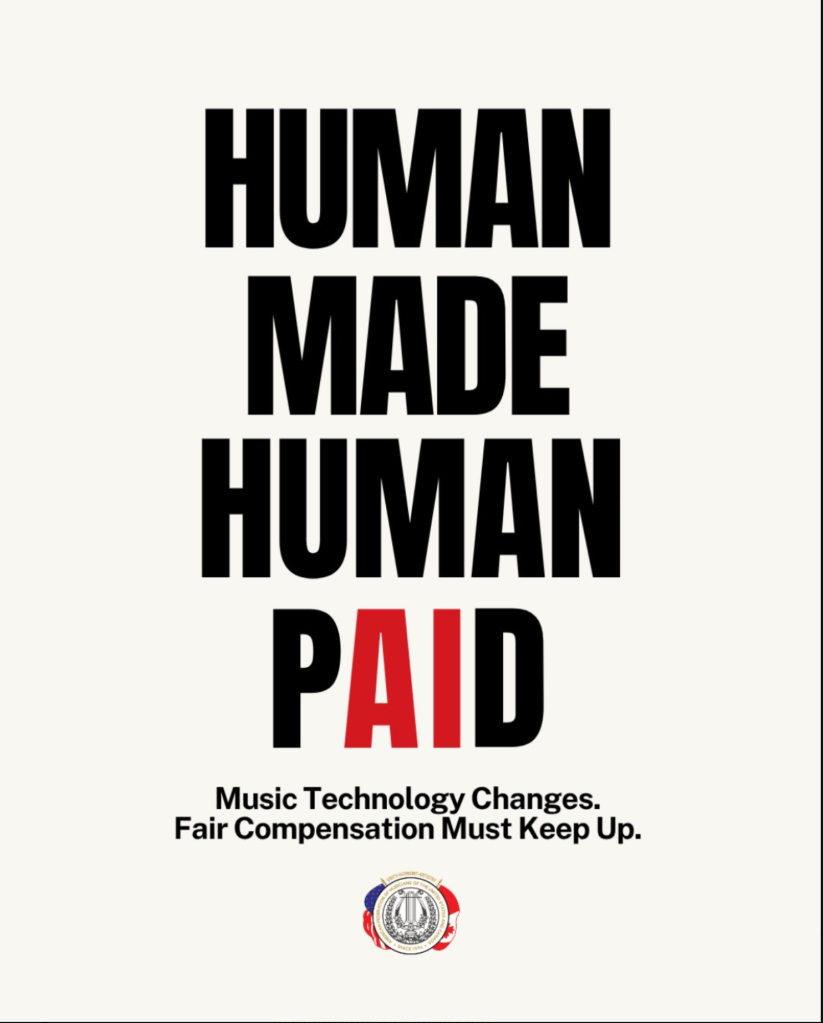


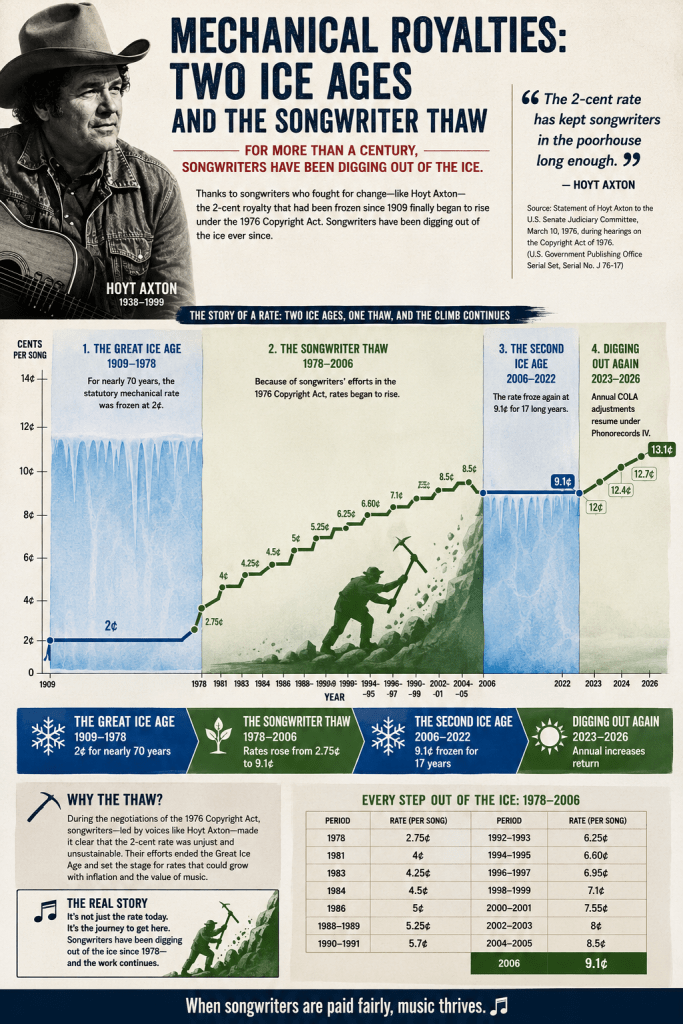
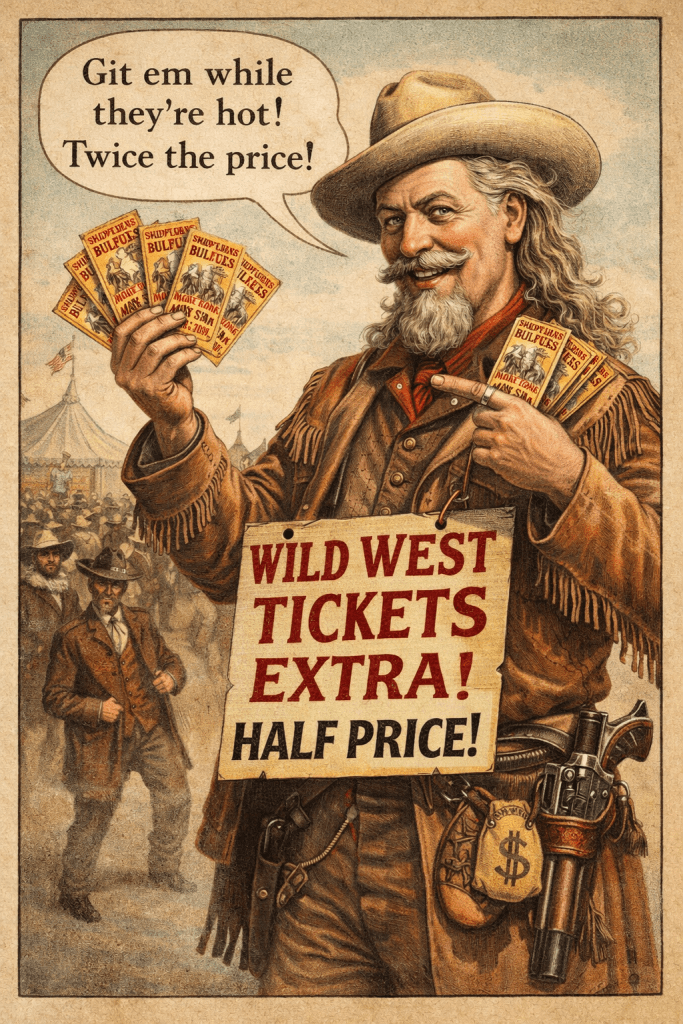
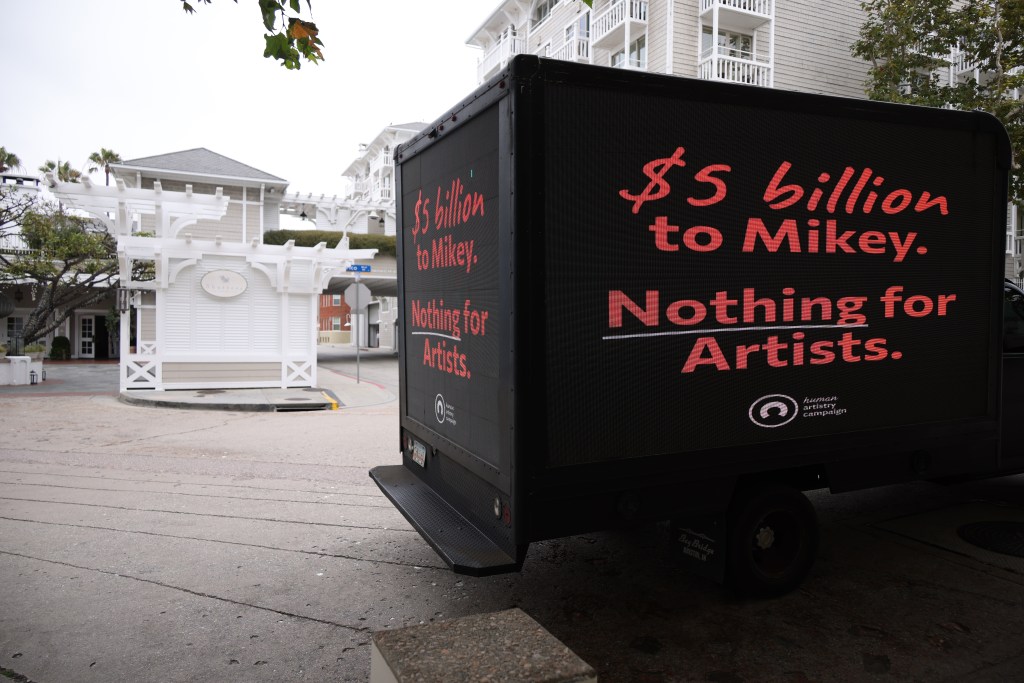
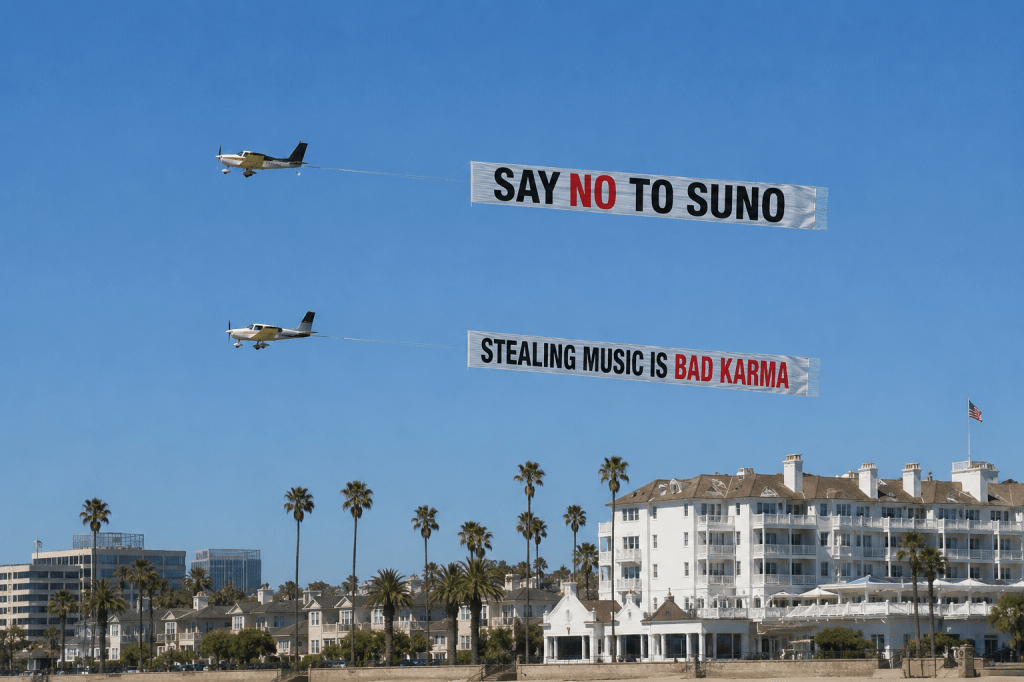

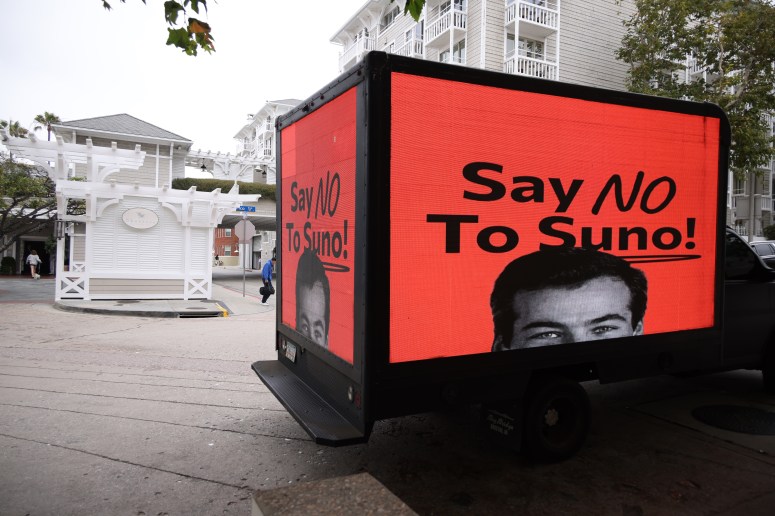



You must be logged in to post a comment.