Only drug dealers and Big Tech refer to their “customers” as “users.”
We really appreciate how Trichordist readers have stuck with the story we have been telling about the treachery afoot at the Copyright Royalty Board in the current review of statutory mechanical royalty rates. This is kind of dry stuff but it sure has resulted in a lot of passion from the songwriting community.
That passion is directed at the frozen mechanical–the collaboration between the big publishers and big record companies to “freeze” the statutory mechanical royalty for physical goods at 2006 levels despite the current inflationary crises and debasement of the value of even the frozen rate itself. We will have more to publish on that subject to call your attention to the voices of songwriters and publishers opposing the freeze.
Ask yourself this question: Is there any reason that a songwriter who opposes a freeze on mechanicals–the only question they were asked to respond to by the Copyright Royalty Board–would ever support a reduction in the streaming mechanical? Would anyone say, oh, well if Spotify is asking for a reduction, then by all means? If you thought the passion against frozen mechanicals ran high, you ain’t seen nothing yet.
But in one of the great acts of self-sabatoge that they are so good at, that passion is currently being hijacked by some of the biggest companies in commercial history to somehow convince us that less is more. Remember–these are the same people who benefit from the sick mass manipulation and addiction practiced and normalized by the Stanford Persuasive Technology Lab.
And now they are trying to use that trickery and psychology on songwriters to gaslight them into ignoring reality and supporting the chaos at the Copyright Royalty Board.
We will be posting a series of excerpts from public filings in coming days. If you want to skip ahead, you can read this letter from Chris Castle to the Copyright Royalty Board roasting the services for twisting the words of Helienne Lindvall, David Lowery and Blake Morgan.
All of the economic indicators are telling us that inflation is going to be around for a while–so songwriters should expect some cost of living adjustment based on the Consumer Price Index when the Copyright Royalty Board sets mechanical royalty rates, especially for the frozen mechanical rate on physical phonorecords. Why do I say that?
The U.S. Consumer Price Index closed 2021 at 7%. That is the highest inflation level since 1982–and remember in 1982 the U.S. had already had a solid two to three years of Federal Reserve Chairman Paul Volker’s anti-inflationary surge after the malaise of the 1970s.
The Producer Price Index for 2021 was measured at 9.7% by the Bureau of Labor Statistics, the largest calendar year increase since 2010. The PPI is a leading indicator of inflation as measured by the CPI because it measures a large basket of raw inputs and future price increases that will affect the CPI in weeks or months.
The University of Michigan survey of consumer sentiment fell to 68.8%, its second lowest level in a decade (the lowest being in November 2021). The survey also measured “confidence in government economic policies is at its lowest level since 2014.” The consumer sentiment survey indicates that consumers expect bad times ahead, or at least expensive times. This can have a pronounced effect on consumer inflation expectations.
Consumer inflation expectations remained unchanged after rising strongly over the last year, particularly the one-year outlook. Inflation expectations can be a self-fulfilling driver of inflation for a number of reasons such as FOMO pricing on homes and cars as well as wages–if you expect inflation to rise x% in the next 12 months, today you will seek wage increases of at least x% (if not more).
All of this tells us that the entire idea of extending the freeze on statutory mechanical royalties gets more absurd by the day. It’s entirely reasonable to “index” statutory mechanical royalties during the current rate setting period of 2023-2027 as we’ll all be very lucky to get through that period without suffering crippling inflation that will further erode the 2006 rates the CRB has used for the past 15 years.
Electronic music producer and artist Skee Mask (full name Bryan Müller) has officially removed “all” his tracks from Spotify over the platform’s perceived lack of respect for creators, in addition to CEO Daniel Ek’s multimillion-dollar investment in AI-powered defense company Helsing. he Germany-based “Rev8617” artist announced his voluntary Spotify exit on social media, and the much-publicized move follows Skee Mask’s May of 2021 decision to release Pool physically and digitally sans a streaming option.
“it’s done, all of my sh-t is gone from Spotify,” Skee Mask said of his music’s just-finalized removal from the Stockholm-headquartered service. “i have nothing against streaming in general, it’s one of many good ways to make music even more accessible!….
“my music will be available there again as soon as this company starts (somehow) becoming honest & respectful towards music makers. if you really don’t have the money to listen to my music in any other way, feel free to digitally steal it anywhere, BUT don’t give you’re [sic] last penny to such a wealthy business that obviously prefers the development of warfare instead of actual progression in the music business. PEACE!” concluded Skee Mask.
Regarding the “100 MILLION €,” “development of warfare,” and “PEACE” components of the statement from Skee Mask, Daniel Ek’s Prima Materia in November provided €100 million (about $113 million at the present exchange rate) in funding to Helsing, “a new type of security and artificial intelligence company.”
We did a casual poll on Twitter to see what our readers thought about streaming as a livable revenue source. Rather surprising unanimity that streaming is not sustainable for artists or songwriters!
Learn about Radio Royalties and the American Music Fairness Act from industry stakeholders and experts during this FREE educational webinarsponsored by: Austin Music Foundation, Austin Texas Musicians, I Respect Music Austin, SoundExchange and Texas Accountants and Lawyers for the Arts.
The American Music Fairness Act is a bipartisan bill which would establish a performance right for sound recordings broadcasted via terrestrial radio. As you may know, the United States is one of the few countries in the world and the only western democracy that does not recognize a performance right for sound recordings on terrestrial radio broadcasts.
Artists and record companies have long advocated for a change to the law to provide a payment when their recordings are broadcast. The U.S. made a step in this direction in 1995 with the Digital Performance Right In Sound Recordings legislation that led to the creation of SoundExchange and the compulsory license for digital performances like webcasting and satellite radio with a royalty rate set by the Copyright Royalty Board.
The legislation has many carve outs and special treatment for small radio stations, college or other non-profits and public radio.
The panelists will provide a background on the history of this issue and discuss how the American Music Fairness Act will ensure artists are compensated fairly for their works when broadcasted on terrestrial radio.
[Tee Double is speaking on the free “Radio Royalties and the American Music Fairness Act” live stream panel hosted by Texas Accountants and Lawyers for the Arts, Austin Texas Musicians, SoundExchange, I Respect Music Austin, Austin Music Foundation and Artist Rights Watch on December 8 at noon CST. Register on Eventbrite. If you’d like to support the American Music Fairness Act, you can sign the petition to Congress here.]
1. Tell us a little about your history as an artist and your work in the Texas music community. Well, I’ve been recording and releasing music since i was 9 years old in Austin, Texas around the same time I sent my first demo I self-produced and performed on to Warner bros. Records. I have been on various boards such as the Texas Chapter of The Grammys, Austin Music foundation, Black Fret a nonprofit which give artist grants yearly to further sustain their craft. I currently am the founder of the urban Artist Alliance which is a leader in education in the music business for underserved creatives who never have access to the tools to succeed in an ever-changing industry. Which recently won the Austin Business Chamber A-List award for Best Bootstrap Company FOR 2021.
2. Can you explain a bit about radio royalties as an artist and then as a songwriter? Sure. Royalties are one of the many ways artists can continue to benefit off their art in new platforms. As an artist, radio royalties are not paid to us even though we are the driving force behind why the song is a hit or synced for commercials and so on. We are as much a contributing factor as the song itself. As a songwriter which I am both an artist and a songwriter of my catalog, I receive those monies which depending on the frequency of the song can generate a nice bit of change. As an indie you don’t go rich but you have some sort of return on your time and effort of creating the song for which someone else ( in my case me) would perform.
3. When SoundExchange opened up a whole new income stream for webcasting and satellite radio, did that have an effect on your revenue as an artist? Any new platform is a good thing if it also includes some positive financial upside for the creatives. But artist must not just limit their potential revenue streams to radio as there are many channels to funnel your art through to add on top of that money. Education is key and adding a unified front to approach unfair practices or outdated laws that truly damage the livelihood of creatives is a step many should be taking moving forward.
4. How will the American Music Fairness Act help working artists, especially those who Blake Morgan calls “middle class artists”? TheAmerican Music Fairness Act will not just help “middle class artists” but also new artists first releasing music to be able to see the economic benefits of that art when it is played on radio now and future technology that will introduce new ways of sharing music. By keeping smaller stations unscathed and making sure larger ones are held accountable to the artist that sustain their ability to remain economically feasible by ads and so forth it is only a good thing.
5. When I speak to artists about copyright policy issues, they often seem overwhelmed by the process and tend to leave it to others. What advice do you have for artists to take direction action to get involved in copyright policy making? My advice would be to join organizations that have your interest at heart. Grammys on the hill is a great one as it also has artist going to their local reps to push their cause. Following blogs and publications that speak to YOU and build up a mental database of ever-changing ideas within the music industry. As I tell artists I mentor, if it makes you one more cent you should be aware of it because music is not a rich person’s game but a long-term journey. Stay the course and stay inspired.
[Trichordist says: The Copyright Royalty Board reopened the comments on frozen mechanical song royalties in Phonorecords IV rate setting and the filings are coming in, especially from songwriters! We will be posting the comments (or excerpts from the long ones. First up is a straight from the heart contribution from Chelsea Crowell, Erin McAnally and Abby North.]
Copyright Royalty Board 37 CFR Part 385 [Docket No. 21–CRB–0001–PR (2023–2027)] Determination of Rates and Terms for Making and Distributing Phonorecords (Phonorecords IV)
Interim Chief Copyright Royalty Judge Suzanne Barnett Copyright Royalty Judge Steven Ruwe Copyright Royalty Judge David R. Strickler US Copyright Royalty Board 101 Independence Ave SE Washington, DC 20024
SECOND REOPENING PERIOD COMMENTS OF ABBY NORTH, ERIN MCANALLY AND CHELSEA CROWELL
To Your Honors:
Thank you for the opportunity to submit additional comments, now that the details of the Memorandum of Understanding (MOU4) apparently related to the Subpart B mechanical rate settlement negotiated by the NMPA, NSAI and three major labels have been made available.
Only the NMPA’s 300 or so publishers are potential parties to the MOU, assuming the opt in terms are the same as those of MOU3 (http://nmpalatefeesettlement.com/mou3/faq.php). The publishers that opt in to the MOU4 settlement will receive money for their participation, and in exchange for this money, the NMPA Board members have agreed to freeze the Subpart B mechanical rate at the $.091 rate that’s been in place since 2006.
In this exchange, NMPA publishers have a stream of revenue (the MOU4 money) that offsets the negative effect of the lack of rate increase in the Subpart B mechanical.
Although foreign CMOs could opt into the current MOU3 settlement, rightsholders that are not NMPA members may not opt in and will not receive the buffer that the MOU4 money provides, yet they are subject to the frozen mechanical rate that is an apparent condition of the negotiation related to the proposed settlement of the Subpart B rates and terms.
Thousands, if not tens of thousands of songwriters in the world have songs published or administered by those NMPA publishers that are party to the rate freeze settlement, but neither these songwriters nor the vast number of songwriters around the globe were given a say in the decision to freeze the mechanical rate.
The concern we have is not that there is a settlement. The concern is that the settlement does not provide for a base rate greater than $.091, plus annual increases to adjust for inflation.
To quote the NMPA’s Supplemental Comments: “…mechanical royalties from Subpart B configurations now constitute only a small part of total mechanical royalty revenue in the U.S., and that share is expected to get smaller during the period covered by this proceeding.”
That concept only resonates with a corporation that aggregates thousands or millions of copyrights.
To an individual songwriter or a small rightsholder, it doesn’t matter if Subpart B mechanicals constitute 1% or 15% or 50% of total royalties. Why? Because every single penny counts.
When an individual is paying a mortgage, tuition or a car payment, every single penny counts. When a health crisis occurs, every penny counts. When existing off the very low streaming royalties generated by even a hit song, every penny counts.
Physical and download mechanicals are still an extremely relevant revenue stream to individual songwriters and small publishers.
At the current retail price of $.99 for a download, the $.091 mechanical is 9.2%.
The streaming royalty pool for songs is roughly 10.5% of the total, possibly as much as 15.1%, per the CRB III hearing results (after all this time, still under appeal). The NMPA has suggested an increase of the streaming royalty rate to 20%. This would be an exceptional improvement.
How is the download royalty not at least the same percentage as the streaming royalty?
Why is the value of a downloaded song less than that of one that is streamed?
We suggest the Subpart B rate and the streaming mechanical rate (based on percentage) should be on no less than a most favored nations basis with one another.
To songwriters and most publishers, every royalty type and every revenue stream matters. The move from physical to digital, the unbundling of albums in favor of singles and the unlivable streaming royalty rates absolutely substantiate the need for an increase in Subpart B mechanicals, at least to reach the percentage paid on the streaming side, and with periodic adjustment for inflation. 3
We appreciate the opportunity to submit these additional comments, and we ask the Judges to recognize that songwriters and small publishers are individuals who do not have the luxury of collecting royalties from the aggregation of hundreds of thousands of works.
It is not fair that songwriters signed to the NMPA publishers have a frozen mechanical rate forced on them, and it is remarkably egregious that non-NMPA publishers and their writers are also forced into this horrible reality.
Respectfully,
Abby North, North Music Group LLC Chelsea Crowell, Songwriter Erin McAnally, Songwriter/Factory of Strange Tones
It is absolutely accurate that the streaming services are pushing for abysmal rates and terms in Phono IV. Some services like Amazon, Pandora and Spotify actually advocate to a return of the rates and terms from prior rate setting “wars” in Phono I (2006) and II (2011). Others, like Apple, suggest applying the rates and terms that are determined by the CRB in Phono III – which, mind you, covers 2018-22, and is being litigated simultaneously despite 2022 commencing in two months – because what an awesome system is this Copyright Royalty Board! Nevertheless, there is something that has been conveniently omitted from each of these media articles: “the why.” Why are the services proposing the “lowest rates in history?” What justification do the services provide for their positions? Unfortunately, the answer is not as simple as the streaming services playing the role of “the villains” in the “war” for songwriters’ livelihoods.
When you download the hundreds of pages of the services’ written direct testimony from the CRB, and wade through the arguments in the mire of heavily redacted passages, there is a surprising common theme used to bolster every last one of their positions: the proposed settlement by the NMPA, NSAI and the three major labels to freeze rates for physical product like vinyl and permanent downloads (the Subpart B configurations) (see here: https://app.crb.gov/document/download/25288).
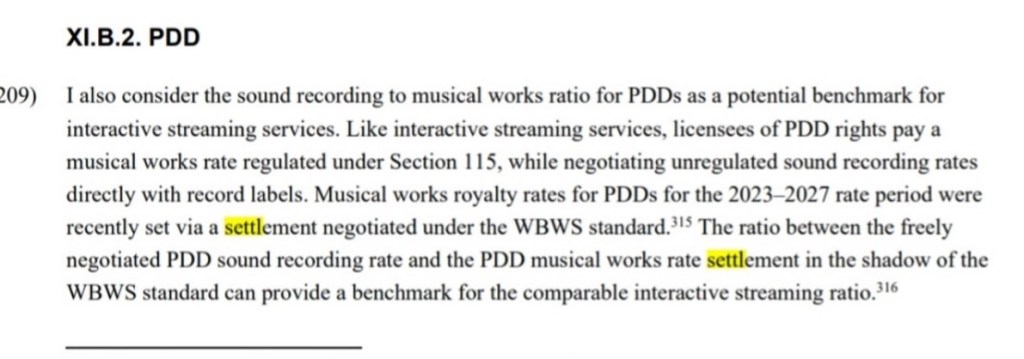
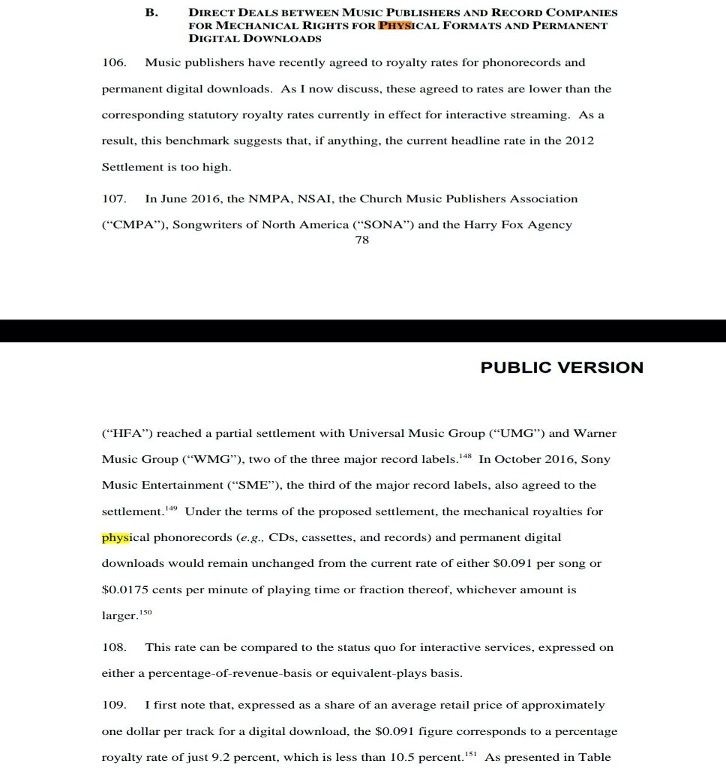
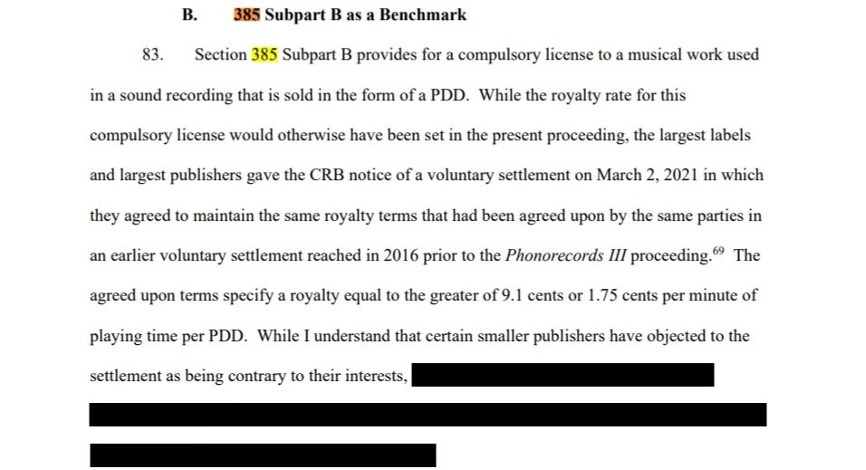
Simply put, every service used the NMPA and NSAI proposed settlement for physical as a benchmark to support their abysmal rates on streaming. Surprised? Me, too. But for reference I’ve included some excerpts from the services’ filings at the end of this post.
For those in need of catching up to this point, TheTrichordist has chronicled this proposed settlement and the reactions thereto (i.e. “the Frozen Mechanicals Crisis” see here: https://thetrichordist.com/category/frozen-mechanicals/ ). Songwriters, music publishers, and songwriter advocates penned articles for The Trichordist and some wrote comments to the CRB objecting strongly to the NMPA and NSAI settlement. Some also wrote their representatives in Congress, expressing their dismay over this important revenue stream being frozen yet again for another five years due to a private settlement between “willing buyers” and “willing sellers” who are one and the same person at the corporate level. What’s more, Texas Congressman Lloyd Doggett submitted a letter to the Librarian of Congress and the Register of Copyrights inquiring about the matter (see here: https://thetrichordist.com/2021/07/18/letter-from-congressman-lloyd-doggett-about-frozen-mechanicals-to-librarian-of-congress-and-register-of-copyrights/).
Now that it is crystal clear the proposed settlement is being seized upon by the services as a way to benchmark and justify their lower-than-ever rate proposals (also called “hoist with your own petard”), it is time for the highly paid representatives of the copyright owners in this proceeding to truly rethink their strategies. This result was predictable – as I mentioned in my last post here: https://thetrichordist.com/2021/06/25/guest-post-by-sealeinthedeal-a-foreseeable-result-of-the-phonorecords-iv-private-settlement-opening-pandoras-box/ , “[i]t did not take a soothsayer to foresee this result; the private settlement opened Pandora’s box – begetting misery for every songwriter.”
More disturbing, they should have seen this coming a long way off because they got called out for doing essentially the same thing in Phonorecords III. For context, when there was a lull in the pace of Phono IV, I began delving through the filings in the Phono III remand. Much to my unsurprise, an expert witness for Pandora in that proceeding, Professor Michael Katz, foreshadowed the current debacle. Not only did he use the physical settlement to make the case that the streaming mechanicals rate in the 2012 settlement was a ’good benchmark,’ but also, even more disastrously, used this argument to rationalize the 2012 rate being too high in testimony filed on April 4, 2021. Chris Castle referred to this issue as the “Streaming Royalty Backfire:
“If you want to argue that there is an inherent value in songs as I do, I don’t think freezing any rates for 20 years gets you there. [Physical mechanical rates were first frozen at 9.1¢ in 2006.] Because there is no logical explanation for why the industry negotiators freeze the rates at 9.1¢ for another five years, the entire process for setting streaming mechanical rates starts to look transactional. In the transactional model, increased streaming mechanicals is ultimately justified by who is paying. When the labels are paying, they want the rate frozen, so why wouldn’t the services use the same argument on the streaming rates, gooses and ganders being what they are? If a song has inherent value—which I firmly believe—it has that value for everyone. Given the billions that are being made from music, songwriters deserve a bigger piece of that cash and an equal say about how it is divided.”
Chris Castle
The proposed settlement did not just open Pandora’s Box, it also opened Spotify’s, Google’s, Amazon’s and Apple’s boxes (don’t mind me, I’m Greek and enjoy every opportunity to make mythology references). So, when posed with the question, “why advocate for this settlement to freeze,” even following the filings of the services, the NMPA’s David Israelite provides the following commentary (heard most recently during last Wednesday’s Town Hall via zoom):
(1) he refers to folks who articulate this concern as professional critics who like to blog from their couches, and that there’s a lot of misinformation going around;
(2) the NMPA has previously (as far back as Phono I) tried to press for an increase to no avail after spending millions of dollars; and
(3) the NMPA wishes to focus efforts on the streaming services as they do not wish to fight multiple fights at once and potentially risk the labels proposing an even lower than 9.1 cent rate.
To respond to this commentary — first, it is difficult to believe the major labels would propose a lower than 9.1¢ rate if the publisher negotiators did not cave if for no other reason that the willing buyer and the willing seller standard ought to work the other way, too. However, if anyone has evidence to support this “labels will screw us” rationale, please reach out to me and I will immediately withdraw that premise. Notwithstanding, even in the hypothetical event that the labels counter with a lower than 9.1 cent rate, is it not the job of the prime representative of the “copyright owners” at the NMPA and NSAI to firmly state that this rate has been frozen for nearly 20 years and no longer will “we” (including their sister publishers) stand by this? In response to the other two points, I understand that I have spent no money in these proceedings and that I do not have the resources to do much more than write about this from the couch in my apartment in Austin, Texas. But, for what it is worth, I believe that an important part of advocacy is being open to critique, listening and learning – even if it is something that you do not wish to hear.
Speaking of, the buried lede is that the CRB has reopened the public comments on the proposed settlement to freeze physical mechanicals – the CRJs are at least willing to listen and learn. Maybe they don’t think we’re couch commenters.
Now, I do not believe in presenting a laundry-list of problems without proffering potential solutions, and luckily, there is a solution that is entirely within the control of the parties that settled: withdraw the proposed settlement to freeze the mechanical rates for Subpart B configurations. Go to the labels and negotiate a voluntary increase. Submit that increase proposal to the CRB. This act will not only bring the entire songwriter and music publisher communities together, but it will also serve to extinguish one of the services’ key benchmarks in their testimony.
While we’re on the topic of strategies, I want to end on one note. Now is not the time to pit what artists are earning from digital radio in relation to what songwriters are earning ( see here: https://variety.com/2021/digital/opinion/digital-radio-guest-column-david-israelite-nmpa-1235092330/ ). One of the great things about working with songwriters in Texas happens to be that many are also recording and performing songwriter/artists. Thus, they value the rates from digital radio that are applied to recording artists, and they welcome the victory achieved by SoundExchange in Web V (which resulted in a rate increase plus index of rates in accordance with inflation — which seems wiser by the day and winter is coming).
Instead, it is time for the focus to be on achieving the best possible results in Phono IV by expanding the revenue stream, not taking money from others which only benefits the services.
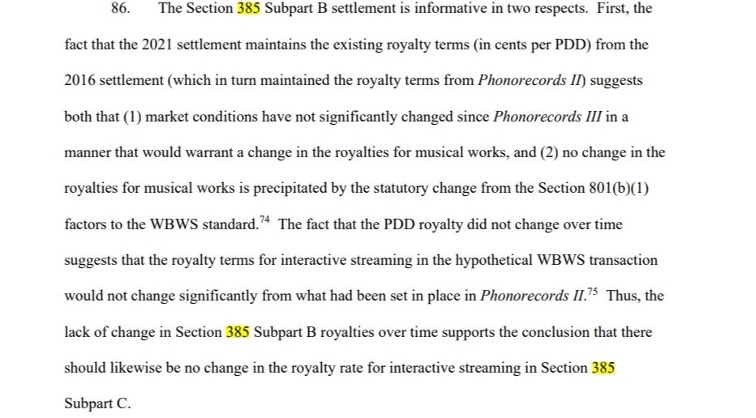
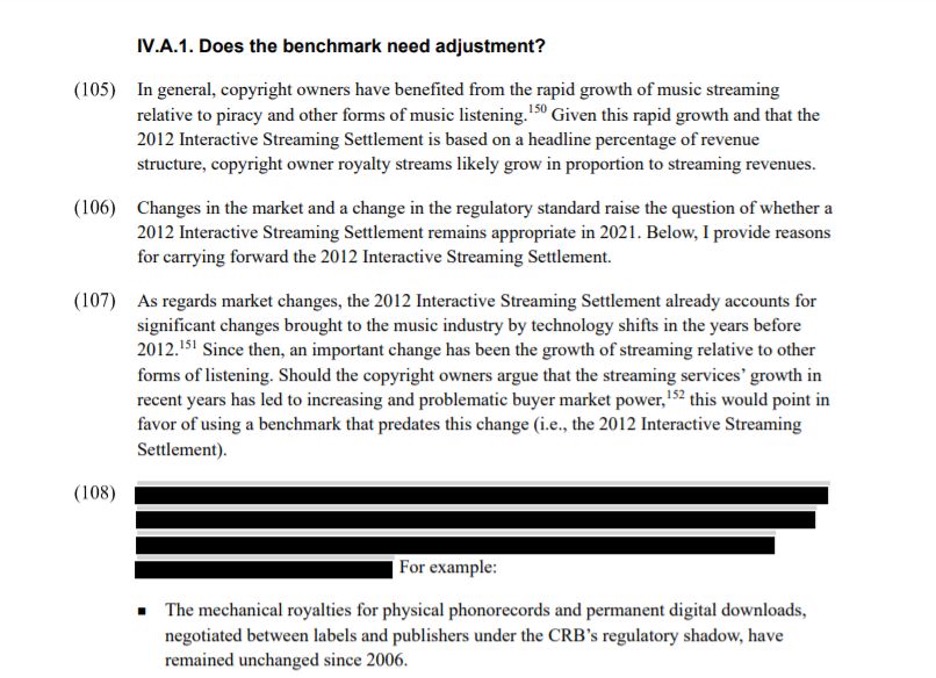
THE RECEIPTS: Petard-Hoisting Excerpts from the Services’ Testimony
(Note: PDD = “permanent digital downloads,” and WBWS = the “willing buyer willing seller” standard which the Copyright Royalty Judges (CRJs) are to use as the basis for determining rates in this proceeding, pursuant to the Music Modernization Act.)
Long story. But a private agreement between major publishers and major labels was part of the Copyright Royalty Board settlement. Seemed sleazy to many songwriters. We protested and the judges did right thing. Reopened comments. https://t.co/IDoV0wuzcR
In an unusual–if not historic–move, the Copyright Royalty Board has decided to re-open public comments in the controversial “frozen mechanicals” rate hearing to set the government rate for mechanical royalties paid on physical records and downloads. It is absolutely crucial that the Judges have reopened the comments because it indicates that they are bending over backwards to demonstrate their interest in being fair and deliberative and not allowing themselves to be used to bootstrap an unfair freeze on mechanical royalties. (If you need to catch up, there are many posts on Trichordist about “frozen mechanicals“.)
The Board gave this reason for reopening the comments:
The Joint Submission [by the NMPA, NSAI and the major labels] included arguments that the MOU is irrelevant to the Judges’ consideration of the proposed partial [frozen mechanicals] settlement and proposed regulations and that the MOU does not call into question the reasonableness of the proposed partial settlement and proposed regulations. Because interested parties other than those who submitted the Joint Submission may have been unable to adequately view or comment upon the MOU prior to the close of the Judges’ extended comment period, the Judges are reopening the comment period. The Judges will allow 30 days for comments [from October 19] regarding the impact, if any, that the MOU should have on the Judges’ consideration of whether the proposed partial settlement and proposed regulations provide a reasonable basis for setting statutory rates and terms.
Quick recap–remember that the NMPA, NSAI and the major record companies decided to keep the freeze on mechanical royalties for physical and downloads that these same groups and companies decided to impose on the world back in 2006. If these people win this argument before the Copyright Royalty Board, the rate will be frozen at 9.1¢ for another five years–until 2027. NMPA and the major labels also made a side deal (called an “MOU”) as a quid pro quo that appeared to be additional incentive to the NMPA to accept the frozen mechanical rate that applied to every songwriter but includes undisclosed payments.
What is particularly offensive about this freeze is that the majors and a lot of indie labels have “controlled compositions” clauses in their recording agreements that give them all kinds of downside protection against rate increases. These include a “rate fixing” clause that freezes the mechanical rate for songs at the rate in effect when the recording is initially released. That’s why there are still many songwriters paid at the 2¢ rate that hasn’t been around since 1977. So giving a rate increase is not anywhere near a 1:1 cost increase for the record companies.
David joined with Helienne Lindvall and Blake Morgan to file a comment asking for the Copyright Royalty Board to give the NMPA and NSAI the deal they made but raise royalty rates for songwriters who don’t get the benefit of the MOU payments (whatever they are). Many other distinguished songwriters, songwriter advocacy groups (12 in total) and publishers filed their own comments opposing the freeze.
[Chris Castle says: Here’s the context of this post. As it turns out, the CRB extended the filing deadline for comments due to what they said was a technical difficulty, although we have yet to meet anyone who couldn’t file their comment on time. This extension seems contrary to the CRB’s February revised rules for filings by participants. The CRB procedures presciently have an email filing procedure in the case of technical problems arising out of their “eCRB” document filing system. It will not surprise you to know that the NMPA, NSAI, and major labels filed what is essentially a reply comment after the close of business on the last day of the extension, after at least our if not all commenter accounts were disabled, the practical effect of which was that no one could respond to their comments through the eCRB, i.e., on the record.
We tried, and drafted a reply to the most important points raised in the majors’ comment. We emailed our comment to the CRB during business hours on the next day in line with the CRB’s own “Procedural Regulations of the Copyright Royalty Board Regarding Electronic Filing System” (see 37 CFR §303.5(m)) or so we thought. But not so fast–we were told by an email from a nameless person at the CRB that we would need to file a motion in order to get approval to file the comment less than 24 hours late for good cause–which of course, we are not able to do since we are not “participants” in the proceeding. See how that works? According to this person’s email, we’d also need to contact CRB technical support to get our accounts reopened which would make the comment later still even if we were able to file a motion. Instead, we decided to just post our reply comment on the Internet. A wider audience. Unfortunately not part of the record, but we’ll see what happens.]
We all have to be grateful to the Copyright Royalty Board for re-opening comments on the frozen mechanicals crisis. That is an indication that the Judges do not intend to be a rubber stamp and let the rich use the CRB to bootstrap their private deal onto every songwriter in the world.
We want to stongly encourage you to file your own comments in the frozen mechanicals hearing, tell your own stories and give your own point of view about how to handle the crisis. If you want to file a comment, you need to register for an account at the Copyright Royalty Board. Chris Castle has a helpful guide to setting up your account.






 The Trichordist
You must be logged in to post a comment.