UPDATE: Panel on The Pledge Music Crowdfunding Debacle

You’ve probably heard the news that PledgeMusic is fast approaching some kind of end.  You may have read Iain Baker of Jesus Jones story of the band’s encounter with Pledge here and hear.

Digital Music News reports giving a chronology of the events leading up to what seemed the inevitable fire sale result of “new boss” syndrome:

Now, a leaked e-mail has revealed how bad things truly are for Rogers’ company, and for artists who depended on the platform.

“Please, please, please buy PledgeMusic!  But, don’t worry.  You don’t have to pay back artists.”

Earlier this morning, Digital Music News received an interesting e-mail from an anonymous source.

FRP Advisory LLP, a UK business advisory firm, has been named the proposed administrator of PledgeMusic.com Limited and its subsidiaries (dubbed ‘The Group’).

With a pre-liquidation fire sale set to take place, FRP Assistant Manager Robbie Wirdnam has now sought “expressions of interest in the business and assets of the Group’ – i.e., PledgeMusic.

By way of introduction, I’m part of the corporate finance team at FRP and assisting my colleagues in the restructuring team, as the proposed administrators of PledgeMusic, in the marketing of the Group’s business and assets.  As you have previously looked at the opportunity on a solvent basis, I’m circling back to determine whether you have an interest in the business and assets for sale, ahead of an administration process.” [“Administration” in the UK is sort of like bankruptcy.“]

Wirdnam explains that the British crowdfunding platform faced two ‘pressures’ which ultimately lead to its demise – working capital pressures and a lack of ongoing funding.

This is serious stuff.  There’s potentially millions at stake and thousands of people worldwide who will be harmed, not only the artists but also fans and vendors, producers and songwriters.

UPDATE: As Jem Aswad in Variety notes in “PledgeMusic Nearing Bankruptcy, Although Sale Talks Continue“:

It should be noted that a buyer of PledgeMusic would be taking on the debts owed creditors, which include artists who launched programs with the company and owed money, which is estimated to be as much as $3 million total (here’s a small list of how much certain artists were owed, as of February). As the company has demonstrated in the past, tends to go to the most prominent, or at least the loudest, artists affected.

Hypebot also has a story on the FRP situation “Pledge enters pre-administration as buyer deliberates”:

UK based corporate advisory FRP has been named to contact potential buyers and value the company’s assets in pre-administration; while in parallel, the interested buyer finishes due diligence.

If no buyer steps forward within the week, PledgeMusic will likely enter Administration with FRP as the proposed administrator.

If you’re in Austin, Chris Castle is moderating a panel about Pledge with Jesse Moore and Peter Ruggero, two bankruptcy law experts.  The panel is co-hosted by the Austin Bar Association Entertainment & Sports Law and Bankruptcy sections  and titled “The Pledge Music Crowdfunding Debacle” on May 22.  Here’s the event description:

The panel will review the reported facts on the decline of PledgeMusic.com, a crowdfunding platform directed at independent artists, established artists with significant fan bases and labels.  PledgeMusic has taken in contributions from fans but has not paid out all or a significant portion of those funds to the artists for over a year. Many Texas consumers, artists and vendors have been affected by the company’s collapse.

The panelists will analyze the effects of this collapse on artists, the rights of consumers and vendors and the potential future outcomes if the company does not solve its financial crisis and seeks protection of the insolvency and bankruptcy laws.

As far as we know, this is the only response from the legal community so far.  Chris tells us that it is directed at artists, fans and vendors as well as lawyers.  $5 covers pizza and parking.

Deets are:

Wed, May 22, 2019
12:00 PM – 1:00 PM CDT

Austin Bar Association
816 Congress Avenue, Room # 700
Austin, TX 78701

Sign up with Eventbrite


Right On Cue, YouTube CEO Unveils Google’s Lobbying Plans Against Copyright Directive Implementation–the fight is just beginning

The European Copyright Directive was a great victory for artists, right?  The Silicon Valley multinationals were sent packing, yes?

True as far as it goes, but it does not go all the way.  Now each of the 28 member states of the European Union are to adopt implementing legislation at the national level to put the Directive into legal effect and they have two years to do it.  Google calls this an opportunity to continue the meddling and interference lobbying campaign.

How do we know?  Because YouTube’s CEO told us so in a fine specimen of oligarchical collectivism.

In a post on the oxymoronic YouTube “creators blog” (aka Pravda Chrome), YouTube CEO Susan Wojcicki tells us about the only thing that she really could say after Google’s massive dezinformatsiya campaign, but yet clearly outlines Google’s next steps during that two year implementation period:

While the Directive has passed, there is still time to affect the final implementation to avoid some of the worst unintended consequences. Each E.U. member state now has two years to introduce national laws that are in line with the new rules, which means that the powerful collective voice of creators can still make a major impact.

Especially the ones Google pays.

Google really only has a limited number of messages when it comes to copyright.  Like George Orwell’s Ministry of Truth, we have Google’s own variation on WAR IS PEACE–that being COPYRIGHT IS CENSORSHIP.  Given that Google doesn’t seem to have a Plan B when it comes to interference lobbying, we can bet that what Ms. Wojcicki means is that Google is going to commence the same kind of fake petitions, bot farming and paid messaging from YouTubers that were the embarrassing (and potentially illegal) hallmarks of Google’s strategy against the Copyright Directive.  The only difference is that this time it will be against the national legislatures (such as the House of Commons in the UK or the National Assembly in France) instead of the European Parliament.

It’s not really the only difference, though.  The other difference is that we are ready for them and we know what to watch for as do the members of the 28 national parliaments.

Americans should also realize that if you thought Google’s disinformation campaign against the Copyright Directive was bad, just wait and see what happens if the Congress should take up the DMCA safe harbor.  That party is just getting started.  And the party–so to speak–is all happening in Room 101–how many fingers, Winston?


SOUTH AFRICA PETITION AGAINST THE SIGNING INTO LAW, THE CURRENT AMENDMENTS TO THE COPYRIGHT ACT No. 98 of 1978 BY HONORABLE PRESIDENT RAMAPHOSA

8561666D-E59E-406C-B71C-109C517A0676

More skullduggery afoot from Google, this time in South Africa–and that’s the fact.  Minister Rob Davies and the Chair of the Portfolio Committee of the National Assembly’s Department of Trade & Industry both need to be called out on exactly how this legislation came to so closely resemble Google’s marching orders on safe harbors and pirate utopias.  As we’ve seen in Europe, Google has no respect for the nation state or local creators.

Sign the petition here and stand shoulder to shoulder with artists in South Africa against Big Tech’s lobbying onslaught.

Save the Date: @miramulholland Speaking at the World Intellectual Property Organization in Geneva April 5

Miranda Mulholland is a wonderfully articulate speaker and advocate for artist rights!  We’re pleased to let readers know that she’ll be on this panel at the World Intellectual Property Organization in Geneva and will be performing with Andrew Penner in their band Harrow Fair.  More info here.

Harrow Fair WIPO

An industry transformed: securing sustainable growth for today’s digital music industry

Friday, 5th April 2019

1pm – 3pm

Geneva, Switzerland

The global music industry has transformed itself through investment and innovation over the past two decades. The recording industry has licensed hundreds of digital music services around the world, driving innovation and providing consumers with access to some 50 million tracks. Meanwhile, artists have gained more choice than ever before in how to reach fans with their music. At the heart of this success are the partnerships between artists and record labels.

Delegates will be presented with key global and regional data from the IFPI Global Music Report (which will be published globally during the week of the SCCR), insights into the partnerships between record companies and artists, and some key challenges to ensuring the sustainable and balanced development of digital music markets around the world.

Next, Graham Henderson will share highlights from Music Canada’s upcoming report on the discrepancy between the value of music accessed by consumers and the revenues returned to the artists and businesses who create it. The report outlines how Canada’s music community has overcome initial skepticism regarding the existence of this discrepancy, known as the Value Gap, and its causes. It examines the key arguments and evidence that have led to widespread acknowledgement of the discrepancy in Canada, and presents a road map to help build a stronger music ecosystem for artists and labels around the world.

The final speaker, Miranda Mulholland, a Canadian musician who runs her own boutique record label, will explain how weak copyright legislation has impaired her career. She will also reflect on the value of record labels in the modern music marketplace, and will demonstrate how artists can help establish a sustainable and functioning marketplace, outlining her own journey as an artist advocate.

Following the discussion, Mulholland will take the stage with Andrew Penner, her musical partner in the band Harrow Fair, to perform their unique blend of folk, country and garage rock music.

Speakers:

Larry S. Miller – Clinical Associate Professor and Director, Music Business Program, NYU Steinhardt School of Culture, Education, and Human Development

Graham Henderson – President and CEO, Music Canada

Miranda Mulholland – Musician, President of Roaring Girl Records, and Music Festival Founder

Performance: Harrow Fair

Grassroots or US Cyberturf? Who Tweets on EU Copyright

Editors Note: In light of the very recent article by Frankfurter Allgemeine Zeitung on efforts by cyberturfers Create.Refresh to pay YouTubers to influence debate on the EU Copyright Directive, this analysis of influencers on Twitter is extraordinarily important.  Please note, this article was reworked from earlier version, omitting location data that proved to be unreliable).

Who tweets on EU copyright?

The debate on the reform of EU copyright law has many facets and a considerable part of the discussion takes place on Twitter.
The power of hashtags

On the one hand, hashtags are used to search for key words in discussions particularly quickly and effectively. On the other hand, it is very easy to find out which topics receive special attention on Twitter by analyzing which terms are often hashed and how often and dynamically they are shared. These terms are then displayed as so-called “trending topics” on the Twitter home page. The so-called “retweeting”, i.e. the unchanged forwarding of a tweet along with hashtags to one’s own followers, is an important factor here.

The frequency of use and distribution of hashtags is therefore often seen as an indicator of the public relevance of certain topics. If, for example, the #saveyourinternet hash tag appears regularly in the trending topics, the impression is created that more and more people are rejecting the copyright reform.

The importance of influencers

Now that the final decision on the reform is about to be taken, it makes sense to take a closer look at the Twitter campaign against the EU copyright reform using aggregated data. The data is based on data from the Talkwalker service, which we have compared with alternative services such as Keyhole. Here we use only the global data without geolocation, i.e. the worldwide number of uses of certain hashtags in a certain period of time, were examined. (the geolocation data proved to be faulty).

Using data from the Hashtagify service, the largest influencers were measured in terms of range.
This makes it easy to see who gave a hash tag the most momentum.The so-called “mentions”, i.e. the mention of a hash tag in a tweet, are decisive for the spread of a hash tag. The more mentions a hashtag experiences, the more it is perceived as relevant for a topic.

The following analysis focuses on the mentions of the hashtags, which play a major role in the campaign against the EU directive from a German perspective, because they are the framing of the anti-reform movement.

#saveyourinternet

#Artikel 13

#upload filter

#linktax

#censorshipmachines

The temporal development of mentions

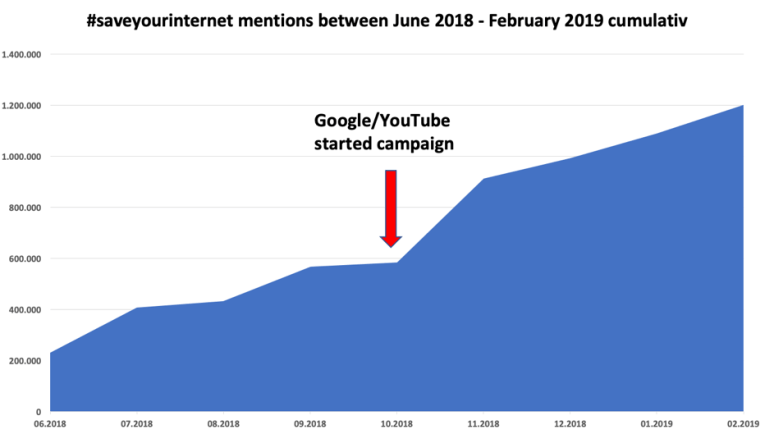
Most noticeable is the increase in mentions of #saveyourinternet after Google/Youtube started its active campaign around this hashtag in autumn 2018.  The numbers doubled.

Picture1.png
Illustration: worldwide cumulative representation of the development of the hashtag #saveyourinternet. Source: Talkwalker

The  graph illustrates very well the influence that Google has on the debate.

The timing  of the votes in the parliament created short peaks peaks in the change (or delta) in number mentions of  #saveyourinternetcampaign.  These boosts helped prolong and expand the reach of the campaign.

Picture2

Illustration: Overall development of the hashtag #saveyourinternet 01.2018- 02.2019 on a weekly basis, source: Talkwalker

One can see very well in this weekly development the impact that Google had through its own Twitter channels Youtube and Youtube Creators.

The campaign with the Hashtag #saveyourinternetwas mainly determined by Google and Youtube from the end of October and was much broader in November/December than in the summer of 2018. There were, however, also peaks that could be explained by the two voting dates.

This is confirmed by the reach measured by the Hashtagify service. It is referred to there as Influence, which we refer to in the following charts and in the text as reach.

In this analysis, the top 10 influencers for different hashtags were examined, but this also means that there were of course far more influencers involved.

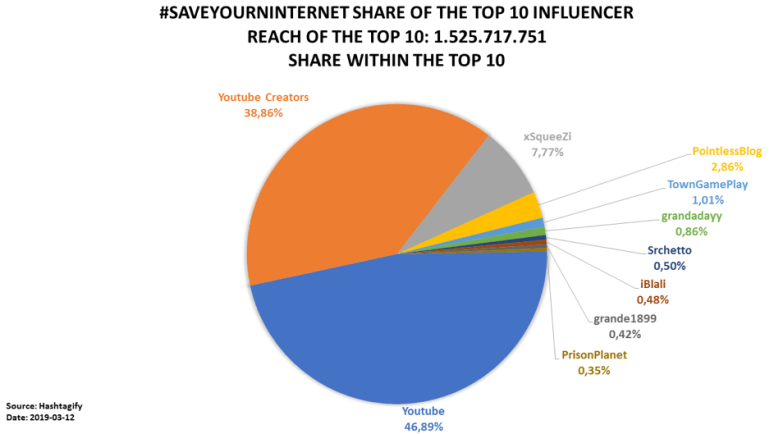
The top 10 influencers at Hashtag #saveyourinternettherefore had a reach of 1.5 billion

However Youtube and YoutubeCreators constitute 1,3 billion at the reach.

That corresponds to 85% of the Top 10 Influencer.

7 further of the Top 10 Influencer are Youtuber. It should be noted that Twitter accounts from Youtubers sometimes have a slightly different name than the Youtube channels. There are also Youtubers who have several Twitter accounts.

The only outlier is the Pirate Party, with a very small percentage.

Picture3.png

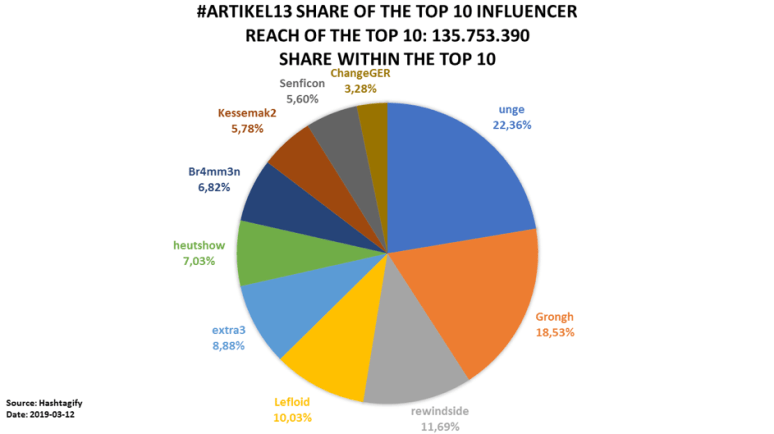
The second largest reach in this study was hashtag #Artikel13.

However, it was only 9% of the range of #saveyourinternetwith 135 million reach (Top 10 Influencer number)

6 of the top 10 influencers are Youtuber. Other media also play a role here, as the shares of the Heuteshow, Extra3 and the SZ illustrate.

Picture4

With a reach of 111 million for the top 10 influencers according to Hashtagify, the hashtag #Uploadfilter comes in 3rd in this review. 5 of the Top 10 are Youtuber.
Other media like Heuteshow, ZDFheute and SZ are also among the Top 10.

Picture5

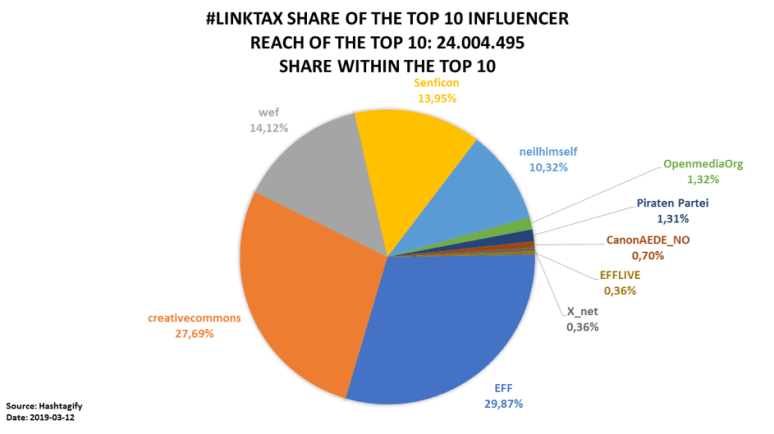
The Hashtag #linktaxcomes to a reach of 24 million.

So it seems to have captured less attention.
There is a somewhat different picture.
The US organizations Creative Commons and EFF apparently managed to best spread this hashtag in the debate about an EU legislation.

Picture6The Hashtag #censorshipmachinesachieved the lowest reach with 8.4 million related to the Top 10. Nevertheless it is remarkable that a US organization (Creative Commons) with almost 70% share within the top 10 dominates the debate in a European legislative process with an anti-reform hashtag.

Picture7

Conclusion:

There are two inescapable lessons:
1.  fear sells
2.  YouTube and Google can effectively use their platforms to capture the attention of their users and to directly affect perceptions on matters relevant to their operations. This capacity can be used to distort debates and create an appearance of movements, or can actually create movements based on the presentation of one-sided information that distorts what is actually a far more nuanced truth.

YouTube intentionally created panic about its future that rather predictably resulted in an outpouring of expression of concern, reflected in the data presented here. A cynical campaign that itself illustrates the dangers to society presented by monopoly/monopsony platforms.


EU and Article 13: The Dystopia That Never Was and Never Will Be

Authors: Stefan Herwig and Lukas Schneider. This  article originally appeared as Upload Filters: The Dystopia Has Been Canceled on the Frankfurter Allgemeine Zeitung here.  German language version here. Translated from German to English by Sarah Swift.
© Frankfurter Allgemeine Zeitung GmbH 2001 – 2019 All Rights Reserved. Reprinted with permission. 

The “Declaration of the Independence of Cyberspace“ published in 1996 by John Perry Barlow begins with the words “Governments of the Industrial World I come from Cyberspace, the new home of Mind. On behalf of the future, I ask you of the past to leave us alone.” One reading of this text entirely rejects the possibility that processes of making and enforcing collectively binding decisions – political processes – apply on the Internet. Another possible reading sees the Internet as a public space governed by rules that must be established through democratic process while also holding that certain sub-spaces belong to the private rather than the public sphere. The distinction between public and private affairs, res publicae und res privata, is essential for the functioning of social spaces. The concept of the “res publicae” as “space concerning us all”  led – and not only etymologically – to the idea of the republic as a form of statehood and, later, as a legitimate space for democratic policymaking.

On the Internet, this essential separation of private and public space has been utterly undermined, and the dividing lines between public and private spaces are becoming ever more blurred. We now have public spaces lacking in enforcement mechanisms and transparency and private spaces inadequately protected from surveillance and the misuse of data. Data protection is one obvious field this conflict is playing out on, and copyright is another.

The new EU Directive on Copyright seeks to establish democratic rules governing the public dissemination of works. Its detractors have not only been vociferous – they have also resorted to misleading forms of framing. The concepts of upload filters, censorship machines and link taxes have been injected into the discussion. They are based on false premises.

Upload filters as cogs in a censorship machine

What campaigners against copyright reform term “upload filters” are not invariably filters with a blocking function; they can be simple identification systems. Content can be scanned at the time of uploading to compare it to patterns from other known content. Such a system could, for example, recognize Aloe Blacc’s retro-soul hit “I need a Dollar.” Such software systems can be compared to dictation software capable of identifying the spoken words in audio files. At this point in time, systems that can identify music tracks on the basis of moderately noisy audio signals can be programed as coursework projects by fourth-semester students drawing on open-source code libraries. Stylizing such systems as prohibitively expensive or as a kind of “alien technology” underestimates both the dystopian potential of advanced pattern recognition systems (in common parlance: artificial intelligence) in surveillance software and similar use cases while also underestimating the feasibility of programming legitimate and helpful systems. The music discovery app “Shazam,” to take a specific example, was created by a startup with only a handful of developers and a modest budget and is now available on millions of smartphones and tablets – for free. The myth that only tech giants can afford such systems is false, as the example of Shazam or of enterprises like Audible Magic shows. Identifying works is a basic prerequisite for a reformed copyright regime, and large platforms will not be able to avoid doing so. Without an identification process in place, the use of licensed works cannot be matched to license holders. Such systems are, however, not filters.

How do upload filters work?

The principal argument of critics intent on frustrating digital copyright reforms that had already appeared to be on the home stretch is their charge that the disproportionate blocking of uploads would represent a wholesale assault on freedom of speech or, indeed, a form of censorship. Here, too, it is necessary to look more closely at the feasibility and potential of available options for monitoring uploads – and especially to consider the degree of efficiency that can be achieved by linking human and automated monitoring. In a first step, identification systems could automatically block secure matches or allow them to pass by comparing them against data supplied by collecting societies. Licensed content could readily be uploaded and its use would be electronically registered. Collecting societies would distribute license revenue raised to originators and artists. Non-licensed uses could automatically be blocked. In a second step, errors could be caught through a complaints handling system making decisions on whether complaints are justified on the basis of human analysis – this would represent a clear improvement on the current procedures used by YouTube and Facebook. What automated pattern recognition systems cannot do is determine the meaning of content items at the semantic level. This means that they cannot identify legitimate uses of protected works – in the context of parodies or mash-ups, say, or when an image is reproduced online in a piece of art criticism. In such cases, the identification system would report a “fuzzy”  match, stating for example that 40% of a given upload corresponded to a copyrighted file known from the database. To achieve a legally watertight result here, human judgment would be required. Humans can recognize parodies or incidental uses such as purely decorative uses of works in ways that that do not constitute breaches of copyright.

The process of analysis could be simplified further by uploaders stating the context of use at the time works are uploaded. Notes such as “This video contains a parody and/or uses a copyrighted work for decorative purposes” could be helpful to analysts. The Network Enforcement Act (NetzDG) in Germany provides a good example of how automatic recognition and human analysis can work in tandem to analyze vast volumes of information. A few hundred people in Germany are currently tasked with deciding whether statements made on Facebook constitute incitement to hatred and violence against certain groups or are otherwise in breach of community rules. These judgments are significantly more complex than detecting impermissible uses of copyrighted works.

Being obliged to implement human monitoring will, of course, impose certain demands on platforms. But those most affected will be the platforms with the largest number of uploads. These major platforms will have the highest personnel requirements because they can host content of almost every kind: music, texts, video etc. Protecting sites like a small photo forum will be much simpler. If only a modest number of uploads is involved, the forum operator can easily check them personally at the end of the working day. In that case, uploaders will simply have to wait for a brief period for their content to appear online. Or operators can opt to engage a service center like Acamar instead of adding these checks to their own workloads. Efficient monitoring is possible.

An additional misinterpretation propagated by campaigners against copyright reform is that platforms will have to take out licenses for all the content in the world from a near-infinite number of licensing partners. This, too, is inaccurate, since the transfer of liability to platforms only arises in cases in which rightsholders have specifically prohibited the unlicensed use of their works and had the works in question added to a database made available to platform operators through collecting societies. Visions of upload filters leading to dystopian censorship are, it follows, unfounded. This should be clear to anybody who has read the text of the directive and has even a basic working knowledge of informatics.

For a free Internet, we need copyright reform

The reform provides a basis for ensuring artists are fairly remunerated for their work and forces rightsholders to assist in the identification of works by registering their content in databases. Both effects are highly advantageous for users. Under the proposed regime, somebody who wants to use the Rage Against The Machines track “Killing In The Name Of”  on the soundtrack of a protest video will no longer have to worry about copyright and can simply upload the video to a platform. Works used will be identified, and the relevant collecting societies will distribute the licensing revenue they receive from the platform. If Rage Against The Machine has objections to the transformative use of their work, they can communicate them to the database. Once the directive has been transposed into national law, this procedure will become standard practice.

It will become possible to publish more content and easier to comply with the law. All of this will contribute to more freedom on the Internet – the kind of freedom that stems from having democratic rules rather than allowing tech giants with their community rules and automated decision-making processes to determine what content is permitted on their platforms and what they are prepared to pay for it.

Barlow overlooked what the author William Gibson had already recognized – that enterprises, when they make the rules, can become more powerful than states. The rejection of state-guaranteed democratic rules creates the power vacuum required for this to happen. This is the wider context that explains why copyright reform is but one battlefield in the struggle for political power on the Internet. YouTube should not be allowed to become the Internet for videos just as Google has practically already become the only filter for web searches. Amazon should not be allowed to evolve from a vendor in the market to the provider of the market and to dictate the earnings of parcel couriers. Rules in digital space must be created and weighed against each other by democratic means and not in an arbitrary fashion dependent solely on who wields the most market power. Artists and net activists should fight this battle together, because the Internet is not some abstract parallel dimension: its data flows determine our creditworthiness just as they supply us with holiday pictures and pervade every aspect of modern life. If we relinquish democratic control over this public space, we will become subject to the despotic rule of neoliberal tech giants, and not merely on the Internet.

Barlow’s manifesto ends with the words: “We will create a civilization of the Mind in Cyberspace. May it be more humane and fair than the world your governments have made before.” Copyright reform will take our society one step closer to this aim. The quasi-governments that must now be opposed are called Google, facebook und Amazon. Those who take the side of these giants in this controversy are opposed to the free Internet in the true meaning of the word.

Translation from German by Sarah Swift.

Authors

Stefan Herwig and Lukas Schneider jointly run a think tank, Mindbase, that tackles questions of Internet policy with academic rigor. Stefan Herwig works in the music industry and advises politicians and enterprises on digital policy issues. Lukas Schneider is an information science expert and a musician and is active in Germany’s Green party (Alliance ’90/The Greens).

Pledge 2019 EU Campaign: Old Wine in New Bottles

In summer 2018 the campaign platform Saveyourinternet.eu set up to fight against the EU copyright reform. The campaign was organized by C4C, which is mainly financed by the American CCIA and the Open Society Foundation. This was criticized at the time. The website Saveyourinternet was later “taken over“ by EDRi; C4C was out.

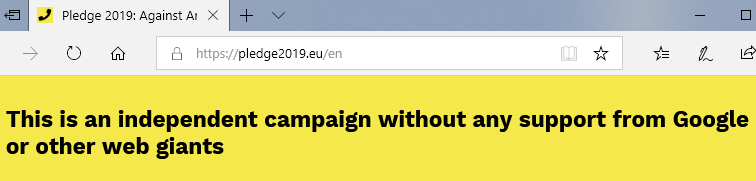
Now there is a new action platform Pledge2019.eu, which claims to be “independent“ and „without any support from Google or other web giants.”

pledge_1_eng

We need to look at this in more detail.

The Saveyourinternet.eu story
In the fight against the EU Copyright Directive, Saveyourinternet.eu’s campaign in summer 2018 was primarily responsible for the bombardment of MEPs with pre-written e-mails, automated tweets and arranged telephone calls, including discussion guidelines.

The campaign was organized by Copyright for Creativity (C4C) and its secretariat N-Square. The C4C has 42 members (EFF, EDRi, BEUC etc.) and, according to its own statements, is mainly financed by the Open Society Foundation (OSF) and the Computer & Communications Industry Association (CCIA). Members of this American industry association include Amazon, Cloudflare, Facebook, Mozilla, Google and Uber.

The page was registered in spring 2018 by the Belgian lobby company N-Square, which also works für Google. And today the registration data and the domain location are concealed by EURID and Cloudflare. The site does not have a legal imprint. There is only the notice that it is “managed” by the EDRi organization.

The new campaign page – Pledge2019.eu
The new campaign page is called “Pledge2019.eu” and is used to organize telephone calls to MEPs. The system connects the user either directly with an opponent suggested by the system or the user can select a time to speak with one of the proponents.

Epicenter.works from Vienna is responsible for the content. Legal notice and data protection declaration are, as very often is the case, borderline. But that is not the point.

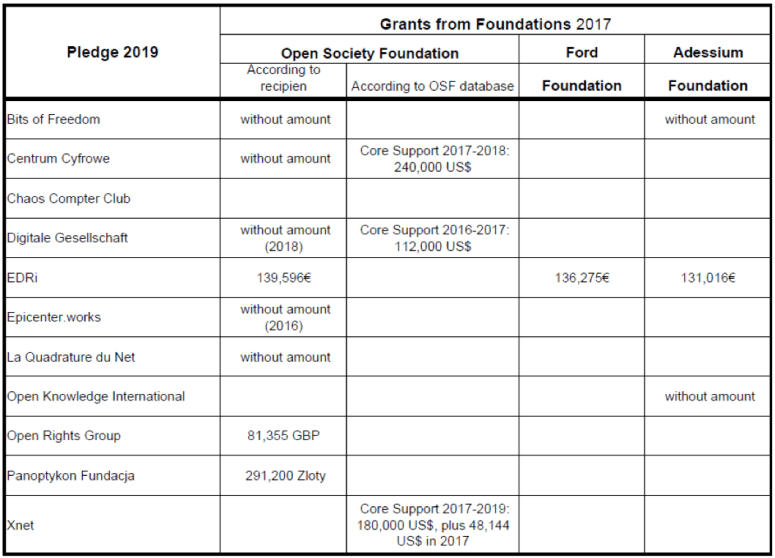
pledge_Tab_1_eng

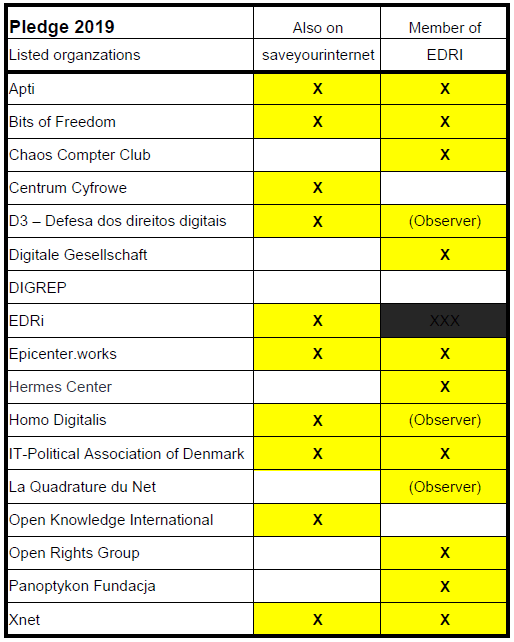
The site refers (as of 8.3.2019) to 17 organizations which are in some way connected to the site.
Besides EDRi, the current “manager” of Saveyourinternet.eu, there are 13 members of EDRi (3 of them “Observer”). Only three organizations do not belong to EDRi.

Ten of these 17 organizations are also listed at Saveyourinternet.eu. Saveyourinternet also links to Pledge2019.eu using the button “ACT NOW – CALL MY MEPs”.

The impression is that the creators of the old campaign (Saveyourinternet.eu) also operate the new action platform (Pledge2019.eu).

The donors
Pledge2019 emphasizes its independence on the homepage: “This is an independent campaign without any support from Google or other web giants”.

Who exactly pays the bills of the campaign cannot be verified by an outsider. A look at the groups involved is very revealing indeed. To what extent do they appear independent? Have they received money from “Google or other web giants” in the past?

Even a first glance at the transparency reports – some of them are good but often completely non-transparent (more on this below) – is significant.
Even those responsible (Epicenter.works) reported in the Transparency Report 2017 that Mozilla is supporting them with €21,630; which is just over 6% of annual revenues. Another big supporter is the Chaos Computer Club with €15,000. Membership fees are not shown, Epicenter is mainly financed by donations.

Mozilla, which receives its income primarily from Google, also supports other stakeholders, including the Dutch Bits of Freedom, EDRi and the Open Rights Group from the UK. At Bits of Freedom, Mozilla is the largest single donor (petabit-donateur) with more than €10,000 per year. How much was actually paid remains open. At the Open Rights Group, the Mozilla Foundation paid £6,900 in 2016.

Other Internet companies are also mentioned in the reports as donors, such as Leaseweb (often named in connection with piracy) with €5,000 for Bits of Freedom or Microsoft (€10,000) and Wikimedia Germany (€5,793) for EDRi in 2017.

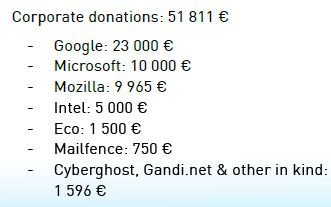
But even Google appears as a direct donor, namely at the Polish Fundacja Panoptykon in 2017 with a four-digit amount and in 2016 with 57,190 Złoty (approx. €13,000) from Google Polska SA and at EDRi in 2016 with €23,000 and in 2015 without stating the amount.

pledge_3_eng
Figure: EDRi – Annual Report 2016, page 40 (in pdf page 43).

EDRi – The finances
Since Pledge2019.eu is mainly backed by EDRi members, it would be a good idea to take a closer look at the finances of EDRi.

In 2017, EDRi generated €728,816. There are hardly any contributions from members. With €39,941 only 5.5% of the revenues are „Members and observers fees“.
2017

EDRi – The finances
Since Pledge2019.eu is mainly backed by EDRi members, it would be a good idea to take a closer look at the finances of EDRi.
In 2017, EDRi generated €728,816. There are hardly any contributions from members. With €39,941 only 5.5% of the revenues are “Members and observers fees”.
2017
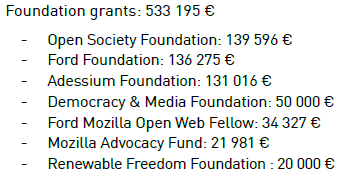
Mozilla appears in various positions with a total of €87,205 (Mozilla Corporation: €26,897, Mozilla Corporation: €4,000, Ford Mozilla Open Web Fellow: €34,327, Mozilla Advocacy Fund: €21,981). In total, this is almost 12% of the budget.
The largest donors of EDRi are three foundations:
– Open Society Foundation: €139,596
– Ford Foundation: €136,275
– Adessium Foundation: €131,016.
Their contribution to the financing of EDRi in 2017 was 55.8%.

pledge_4_eng

Figure: EDRi – Annual Report 2017, page 40 (in pdf page 43).

These three foundations also supported EDRi in 2016 with five- to six-digit amounts. The largest donor with €127,080 in 2016 was again the Open Society Foundation.

The importance of foundations
Among the 17 organizations on Pledge2019.eu are two with a budget of less than €2,500 (IT Politcal Association of Denmark, D3 – Defesa dos direitos digitais). The Bulgarian organization could not be examined due to the Cyrillic character set.
Four organizations (Apti, Hermes Center, Homo Digitalis and Xnet) do not disclose funding either on their website or in the EU Transparency Register. However, at least the Open Society has information on Xnet.

Of the remaining 11 organizations, only the Chaos Computer Club is almost totally funded by membership fees. The other ten all disclose donations from at least one of the three listed foundations. In nine cases the Open Society Foundation finances; in three cases the Adessium Foundation; in one case the Ford Foundation.
The Centrum Cyfrowe claims to receive €281,242 from international organizations in 2018. The Open Society Foundation reports a core support of US$240,000 to this organization for the years 2017 – 2018.

Whether all supporters were found remains to be seen. While the Ford Foundation offers a database with all grants, Adessium provides at least a list of the recipients. The Open Society Foundation, which was classified by Transparify as America’s most non-transparent think tank in 2016, is now presenting a database with data from 2016 onwards. However, not all organizations that claim to be financially supported by the OSF can be found there, possibly due to intermediary organizations.

Picture5.png

The Ford Foundation and the Open Society Foundation do not appear for the first time as lobbyists against Internet regulation. Both intervened on the subject of net neutrality:

„In areas where Google doesn’t spend the cash directly, it can rely on others to help. Foundations including […] Open Society Institute and the Ford Foundation align closely to Silicon Valley’s view on IP policy. The OSI funds a number of groups who style themselves as „civil society“ or „human rights“ (sic) outfits, including EDRI.“[theregister.co.uk]

Limited transparency
Some transparency reports are very detailed, at least in the years 2017 and 2016, such as EDRi or the Fundacja Panoptykon.

In other organizations, only single figures are disclosed, but the essentials are concealed. The epicenter is an example of intransparent transparency. It does show individual sums from donors amounting to €43,130 for2017. Ultimately, however, only 12.6 % of the funds received are declared. The rest is hidden in partly unexplained categories such as donations, sponsoring and grants, foundations.

A similar example of intransparent transparency is the Digitale Gesellschaft from Germany. The income in 2017is explained in only three positions:
– Membership dues, incl. sponsoring membership dues: €51,386.05 €.
– Grants received: €207,941.59
– Donations received: €14,930.26.
The rest you have to find yourself. With donations, which exceed €1,000 in the calendar year, one wants to publish names of the donors and the amount of the donations quarterly on the Website. Where on the extensive side remains unclear.
However, the call for donations in 2018 reports that funds were received from the Open Society Foundation as well as project-related donations from the City of Berlin, the Federal Office for Information Security (BSI) and the Federal Ministry of Justice and Consumer Protection (BMJV). According to the Digital Society, no funds have been received from companies.

But some are even less transparent. In some organizations, for example, only some donors are named, and no amounts are mentioned; e.g. Open Knowledge International.
Four of the 17 participants in Pledge2019.eu, namely Apti, Homo Digitalis, Hermes Center and Xnet, do not disclose any financing at all (or hide it perfectly on their pages).

It remains remarkable to what extent organizations from the USA (associations, foundations and companies) financially support European activists who are actively involved in legislative processes within the EU.

Jörg Weinrich, Volker Rieck


Volker Rieck is managing director of the content protection service provider File Defense Service (FDS), which works for numerous rights owners. The company also conducts studies on piracy and supports law enforcement agencies with its collected data. His articles occasionally appear on the FAZ, Tarnkappe.info, Webschauder and sporadically on the US blogs The Trichordist and Musictecpolicy. This is always about the various aspects of unregulated content distribution.

Jörg Weinrich is managing director of the „Interessenverband des Video- und Medienfachhandels in Deutschland e.V.(IVD)“.


Cloudflare: The Bad, The Worse and The Criminal? @GoldmanSachs @USTreasury #OFAC

Translated from German.  Original here.

Cloudflare: The bad, the worse and the criminal

In the US, a large technology company is about to go public. Cloudflare, a San Francisco-based company, wants to collect nearly $3.5 billion on the stock exchange in the first half of the year with the support of the investment bank Goldman Sachs. But there are dark shadows over Cloudflare. The spectrum of its customers ranges from credit card fraudsters and spammers, to sites that engage in copyright infringement as a business model, to terrorist sites. Even US embargos are undermined.

What is Cloudflare?

Cloudflare offers a content delivery network.

In simple terms, it provides a kind of turbo drive for web pages, allowing them to be delivered world-wide quickly and securely. Cloudflare places itself between, on one hand, the web page and/or servers of its customers and, on the other, the site visitor and/or user of the service. By enabling it to selectively control and distribute site traffic, it can offer increased speed and protection against network overload attacks (DDoS).

However, Cloudflare also offers another feature: anonymizing its customers.

By placing a virtual screen over the original web page and/or their server, Cloudflare makes the operator practically untraceable. Upon inquiry, Cloudflare will only provide its own data, hiding client information such as hosting service and IP address, making it impossible to take legal action against illicit sites and services.

Civil law inquiries are futile, because Cloudflare only provides the naming of the hosting services, which is worthless without the respective IP address. This is roughly equivalent to seeking info on an unmarked apartment with just the address of a high-rise building housing thousands of residents.

The Cloudflare problem is well known

This anonymizing feature from Cloudflare attracts a number of unsavory customers including, again and again, copyright infringers.  But it doesn’t stop there.
Since December 2018, the EU Commission has included Cloudflare on a watch list for counterfeiting and piracy. Most recently, the service received the dubious prize as the worst enemy of the creative community from the US blog TheTrichordist.

The listing of infringing market participants has a long history in the US.
The music association RIAA submits an annual list of the worst offenders to the US Department of Commerce. In 2017, 9 out of 20 violators could not be identified by the RIAA because Cloudflare effectively camouflaged them.
The US film association MPAA is also aware of the problems with Cloudflare obfuscation and names the company in its annual list of interferers.

In the relatively new piracy segment IPTV – the streaming of non-licensed TV signals – the company is also on the move. A study from Fall 2018 shows the role of Cloudflare both in camouflaging the sites that sell IPTV subscriptions and in concealing the origin of the streams.

In a survey of data centers comprising file and streaming hosts in 2016, 40% of the Top 10 and 47% of the Top 30 used Cloudflare.
The ECO, a German association, which obviously doesn’t care about anything


Cloudflare is a member of the German industry association ECO. The purpose of this membership is probably to get a discount for traffic at the Frankfurt (DE-CIX) internet node, which ECO operates through a subsidiary.
ECO has never seemed to care that providers who are very heavily involved in piracy, including Cloudflare, are members of the association. In any case, there was no reaction to corresponding reports that ECO members, including Cloudflare, are responsible for over 50% of piracy traffic in the film sector in 2014, with 45.2% of this activity accounted for by Cloudflare and around 6% by a further five members.

Cloudflare Picture1.png

Screenshot: Extract from the ECO member list, February 2018,

www.eco.de/ueber-eco/mitglieder/#C

Cloudflare in court

The reports of legal proceedings against Cloudflare are long and concern more than just virtual goods. For example, two manufacturers of bridal fashions filed suit for trademark and copyright infringements by plagiarizers who were made anonymous by Cloudflare. And, while a claim brought by adult entertainment provider ALS-Scan ultimately ended in settlement, the judge found that Cloudflare’s activities could significantly support copyright infringement by hosting cached copies of files (though the settlement precluded a final judgment on Cloudflare’s actions and liability).

Supporting Illegal Activity: Calculated or Coincidence?

In Fall 2018, Cloudflare made news by ending its business relationship with pirate hosts like Rapidvideo due to violating its terms of use. Such action begs the question: is the service being cleaned up in anticipation of the IPO or are these just insignificant and cynical platitudes? After all, before this,  Cloudflare had only voluntarily terminated its business relationship with US Nazi site the Daily Stormer in 2017.

Cloudflare picture2.png

Screenshot Youtube Video with Cloudflare CEO Matthew Prince on Fox Business Network

Big Data brings it to light

The current Google Transparency Report offers a look at the actual extent of Cloudflare’s involvement in piracy.
In the report, Google lists all requests from rights holders for deletions from the Google search index that concern rights violations.

In order to understand the importance of Cloudflare to the market, the 5,000 domains that are inactive sites parked with companies such as Team Internet, Sedo or GoDaddy but still protected by Cloudflare have to be subtracted from the 5,000 domains.

This leaves 3,645 domains. Of these 3,645 right-infringing sites, 41.9 % run via Cloudflare. For their part, they are responsible for 44.7 % of the copyright infringements reported to Google.

If one were to extrapolate this proportion to the total number of domains listed in the Google Report for copyright infringements, one would come up with almost 670,000 domains protected by Cloudflare – a significant portion of the 2.2 million domains with requests for delisting from Google’s search engine.


Among Cloudflare’s customers are:

Torrentz.eu, Gosong.net, Share-online.biz, Catshare.net, Bitnoop.com, Deepwarez.org, Turbobit.net, Myfreemp3.eu, and Nitroflare.com.

Each of these websites received at least 3 million deletion requests from the Google search index.

Not only pirates love Cloudflare – also credit card fraudsters, phishing sites, extortionists, and terrorists

The Watchwebsite Crimeflare is a real treasure trove of information about Cloudflare, liisting650 credit card fraud sides alone, to which Cloudflare offers shelter.


Cloudflare also proudly deals in SSL certificates, providing sites like Phishingseiten the manufactured consumer security and confidence-building necessary to be successful. According to the German magazine Heise, hundreds of such certificates for cheats were issued by Cloudflare.

Of course, as Spamhaus reports, the spreading of Malware often takes place over Cloudflare.

With Cloudflare, extortion is also par for the course, which conveniently generates additional services. By providing anonymity and untraceability to sites threatening, for example, to bring a web page to a standstill through DDoS, Cloudflare can then sell the attacked site its protection services.
A truly special form of customer acquisition.

Cloudflare has also found good business in terror.

As far back as 2012, the news agency Reuters confronted Cloudflare with the fact that it maintained the websites of Hamas and Al-Quds, designated by the US as terrorist groups.
In 2015, a petition against Cloudflare in the US highlighted that the service offered shelter to about 50 websites attributed to ISIS.
And in 2018, terrorist organizations were still being supported, with Dutch security researcher Bert Hubert identifying at least 7 different terrorist organization websites that use Cloudflare.

The Huffingtonpost had these findings evaluated by Benjamin Wittes, Senior Fellow of the Brookings Institution:

“This is not a content-based issue. Cloudflare] can be as pure-free-speech people as they want – they have an arguable position that it’s not their job to decide what speech is worthy and what speech is not – but there is a law, a criminal statute, that says that you are not allowed to give services to designated foreign terrorist organizations. Full stop.”

As icing on the cake, the company even has customers who are on the official embargo list of the US (SDN list). For example, CENTRAL REPUBLIC BANK from the Donetsk region uses Cloudflare’s services.

Cloudflare Picture3

Screenshot: Collage of information from theUS Treasury’s Office of Foreign Assets Control
https://www.treasury.gov/resource-center/sanctions/SDN-List/Pages/default.aspx
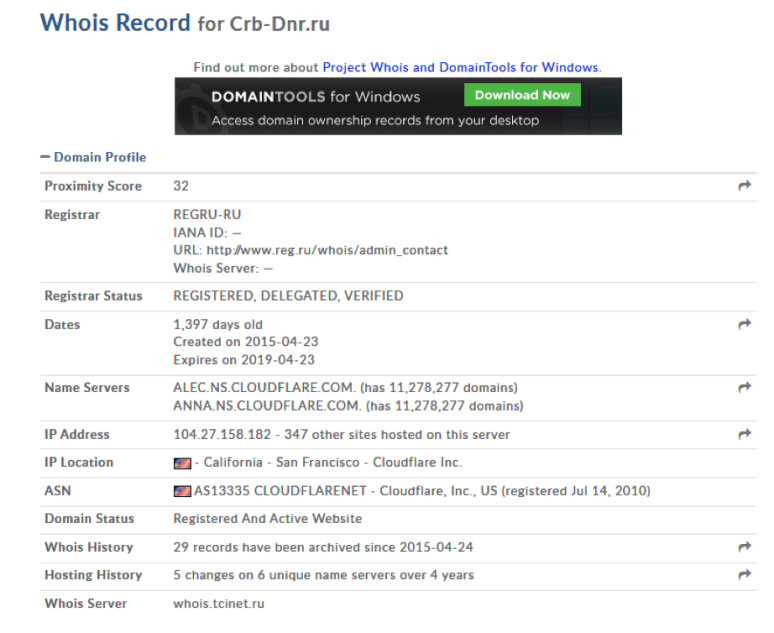
Cloudflare Picture 4

Screenshot: Whois record of crb.dnr.ru at February 18th2019

Do investors actually know what they are investing in?

Against the background of all these facts, two things are worth considering:

1) How has Cloudflare been able to obtain financing rounds from various investment companies in the past, including Google’s parent Alphabet?

2) Does Goldman Sachs actually know anything about the extent of its involvement in rights violations and its support of dubious “ventures,” even to the point of undermining US embargoes?

Risk management is one of the central parameters of investment banks when evaluating investments. Risks must be known and assessable in advance. Cloudflare’s considerable participation in dubious transactions is rare in an IPO and a huge risk. Particularly if, as in the ALS-Scan case, the company is faced with its own liability, or if criminal law is violated through the service’s business with terrorist organizations.

Goldman Sachs and current investors either lack moral standards, are naïve, or consider the risk of failure to be very low, which only shows how urgently we need government regulation of intermediaries on the Internet.