
Social Passivity Resulting in Current Invasive/Spying Technology
Read The Blog Post Here:
https://medium.com/@jonathantaplin/sleeping-through-a-revolution-8c4b147463e5
Watch the Full Lecture Here:
Social Passivity Resulting in Current Invasive/Spying Technology
Read The Blog Post Here:
https://medium.com/@jonathantaplin/sleeping-through-a-revolution-8c4b147463e5
Watch the Full Lecture Here:
We write a lot about the issues facing creators, but we’re only just the first to be effected by the Exploitation Economy.
It’s not only about musicians and creators, we are just the first to be effected. The same Silicon Valley scam is going to exploit more and more people. Read on…
“Nullification is a wilful flouting of regulation, based on some nebulous idea of a higher good only scofflaws can deliver. It can be an invitation to escalate a conflict, of course, as Arkansas governor Orville Faubus did in 1957 when he refused to desegregate public schools and president Eisenhower sent federal troops to enforce the law. But when companies such as Uber, Airbnb, and Google engage in a nullification effort, it’s a libertarian-inspired attempt to establish their services as popular well before regulators can get around to confronting them. Then, when officials push back, they can appeal to their consumer-following to push regulators to surrender.”
READ THE FULL STORY AT THE GUARDIAN:
http://www.theguardian.com/technology/2015/jul/28/uber-lawlessness-sharing-economy-corporates-airbnb-google
What it is, is the Exploitation Economy…
“Disruption rocks though!”
No, it doesn’t. The right kind of disruption rocks. The kind that has value, that solves a problem, that improves an imperfect system. But disruption for the sake of disruption is just noise. It can even be destructive, and that doesn’t rock. It doesn’t rock at all.
Because Apple was “disruptive,” anything deemed disruptive now somehow borrows from Apple’s cachet. “Disruption” has become another meaningless buzzword appropriated by overzealous cheerleaders of the entrepreneurial clique they aspire to someday belong to. And look… every once in a while, someone does come up with a really cool and radical game-changing idea: Vaccines, the motorcar, radio, television, HBO, the internet, laptops, smart phones, Netflix, carbon fiber bicycles, drought-resistant corn, overpriced laptops that don’t burn your thighs in crowded coffee shops… Most of the time though, “disruption” isn’t that. It’s a mirage. It’s a case of The Emperor’s New Clothes, episode twenty-seven thousand, and the same army of early first-adopter fanboys that also claimed that Google Plus and Quora and Jelly were going to revolutionize everything have now jumped on the next desperate bandwagon. What will it be next week? Your guess is as good as mine.”
READ THE FULL POST AT OLIVIER BLANCHARD:
http://olivierblanchard.net/stop-calling-it-the-sharing-economy-that-isnt-what-it-is/
It’s all the same Silicon Valley scam. Whether you are a musician or a cab driver, this about labor, and you could be next…
Silicon Valley calls this arrangement “crowdsourcing,” a label that’s been extended to include contests, online volunteerism, fundraising, and more. Crowdsourced work is supposed to be a new, more casual, and more liberating form of work, but it is anything but. When companies use the word “crowdsourcing”—a coinage that suggests voluntary democratic participation—they are performing a neat ideological inversion.
The kind of tentative employment that we might have scoffed at a decade or two ago, in which individuals provide intellectual labor to a corporation for free or for sub-market wages, has been gussied up with the trappings of technological sophistication, populist appeal, and, in rare cases, the possibility of viral fame.
But in reality, this labor regime is just another variation on the age-old practice of exploiting ordinary workers and restructuring industrial relations to benefit large corporations and owners of the platforms serving them. The lies and rhetorical obfuscations of crowdsourcing have helped tech companies devalue work, and a long-term, reasonably secure, decently paying job has increasingly become a MacGuffin—something we ardently chase after but will likely never capture, since it’s there only to distract us from the main action of the script.
READ THE FULL POST AT THE BAFFLER:
http://thebaffler.com/salvos/crowdsourcing-scam
We don’t need to throw the baby out with the bath water, what we need is fair and ethical businesses.
It’s been a long journey from Google to Snapchat—or to apps that enable drivers to auction off the public street-parking spot they’re about to leave in San Francisco. With a few exceptions, the Valley’s innovations have become smaller, and smaller-minded. Many turn on concepts (network effects, regulatory arbitrage, price discrimination) that economists would say are double-edged, if not pernicious. And while the Web was touted as a great democratizing force, recent tech innovations have created lots of profits at the top of the ladder and lots of job losses lower down. The tech sector itself has proved disappointing as a jobs engine and at times hostile to women.
READ THE FULL POST AT THE ATLANTIC:
http://www.theatlantic.com/magazine/archive/2015/07/silicon-valley-shrinking-vision/395309/
Jaron Lanier was the first to identify and speak about this issue. We’re glad to see others catching up to him. Here’s a refresher…
“Here’s a current example of the challenge we face,” he writes in the book’s prelude: “At the height of its power, the photography company Kodak employed more than 140,000 people and was worth $28 billion. They even invented the first digital camera. But today Kodak is bankrupt, and the new face of digital photography has become Instagram. When Instagram was sold to Facebook for a billion dollars in 2012, it employed only 13 people. Where did all those jobs disappear? And what happened to the wealth that all those middle-class jobs created?”
“Future” also looks at the way the creative class – especially musicians, journalists and photographers — has borne the brunt of disruptive technology.
READ THE FULL STORY AT SALON:
http://www.salon.com/2013/05/12/jaron_lanier_the_internet_destroyed_the_middle_class/
This presentation by Jonathan Taplin at the Annenberg Innovation Lab breaks it all down. Required Viewing.
Google and Pandora’s “MIC Coalition” calls on former Google lawyer in Dept of Justice to go after SESAC and force more songwriters under the government’s boot.
Remember the MIC Coalition? This is the uber lobbying group that Google and Pandora founded along with the National Association of Broadcasters to stop artist pay for radio play.
The MIC Coalition is missing two of its original members–Amazon and NPR both ran for the hills after less than three months being involved. Now we know why.
Not content to stop artist pay for radio play, the MIC Coalition is now complaining to the Department of Justice about SESAC’s recent acquisition of the Harry Fox Agency. Many journalists received this email from the Glen Echo Group, one of the MIC Coalition’s DC shilleries:
From: Aaron Alberico
Date: Mon, Aug 17, 2015 at 9:51 PM
Subject: MIC Coalition Members Urge Attorney General to Reject Calls to Weaken ASCAP and BMI Consent Decrees
I wanted to share with you the attached letter from the association members of the MIC Coalition to U.S…
View original post 509 more words
Yup. Music is the product. Justin Vernon talks about Bon Iver and advertising. The music is the product, not just the business card to book advertising and sponsorship gigs which some would like to suggest – and here’s why…
We did a photo shoot for Bushmills. To be clear: They gave us a bunch of money and we were able to finish without borrowing. It was great for us, and everybody that worked at the company was great, and I love Bushmills and wanted to do the deal because my dad loved Bushmills — we bond over Irish whiskey.
But the problem is that it isn’t just Bushmills. It’s run by a corporation, and you kind of forget that they’re not interested in you or really what you’re doing. They’re interested in your popularity and your reach, and it felt really sickening after a while. Not badmouthing Bushmills the company, but I regret it.
I regret it because it wasn’t us and they put my face on a fucking billboard, even though it was a cool billboard and I was with my brother and my sound engineer and we’re buds and we got drunk while we had the photo shoot. I just missed it. I missed the mark on that one and I let it all kind of get to me. It just doesn’t feel right after the fact, you know?
READ THE FULL STORY AT ADLAND:
http://adland.tv/adnews/music-product/971380697
You’ve no doubt heard that Google has rearranged the deck chairs to reorganize the company. The general idea is that Google is establishing a holding company titled “Alphabet”–please resist the urge to point out that Google now owns the alphabet. What underlies the restructuring is that Google has essentially succeeded in its initial business play to organize the world’s information whether the world likes it or not. Now Google is setting about commoditizing all of it. Not just music, books, movies, television programming.
All of it.
With the European Commission breathing down their necks in what appears to be a vigorous antitrust indictment, one can’t help noticing that breaking up Google will be that much simpler after the Alphabet reorganization than before. So while the spin that Google is putting on the reorganization is that of confidently going a new direction into the future, there may actually be greater uncertainty…
View original post 1,268 more words
The White House is #TeamSpotify.
This is an official US government site. Staffed with employees of the federal government. The writer clearly implies this is an official act of government and an official White House Channel.
Let the White House know what you think about the low rates paid to artists by these highly exploitative services. Doubt we can get through through to the president but we can let the the head of digital strategy know: Kori Schulman. Twitter @KS44. As always be polite. It’s unlikely that The White House or staff has any idea how exploitative these services truly are.
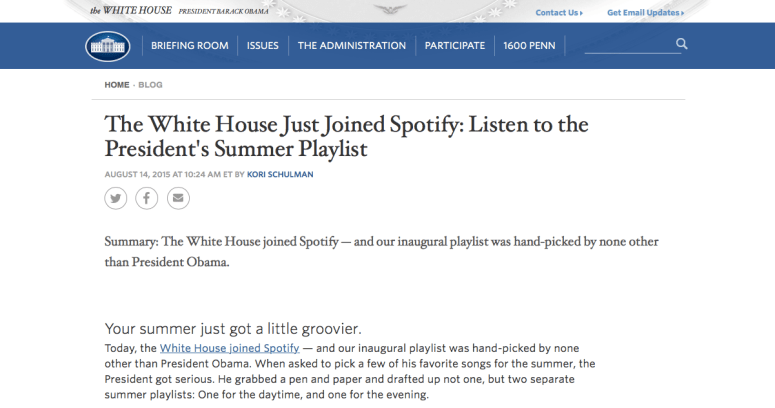
Full PDF here below:
The White House Just Joined Spotify: Listen to the President’s Summer Playlist | whitehouse.gov
Brice S Newman of Memphis details why support for the Fair Play, Fair Pay bill is essential for all musicians and creators to support.
There are four parts to the initiative, which includes a comprehensive bill that gives music creators pay parity. First, legislation would establish a process for setting fair-market royalty rates, not some pathetic low royalty rate that is decades old.
Second, the legislation would create a performance right for artists on terrestrial radio in the U.S., so that artists can get paid when their performances are on the radio. This is how it’s done in much of the rest of the world.
Third, this legislation would close a 1972 loophole and would guarantee that veteran performers receive royalties.
Fourth, the legislation would codify royalty payments to producers — the people behind the songs. If we can make all this happen, I am sure we will be paid back many times over in good music that’s been created by musicians who deserve to make a living.
READ THE FULL STORY AT THE MEMPHIS FLYER:
http://www.memphisflyer.com/memphis/pay-the-band/Content?oid=4073778
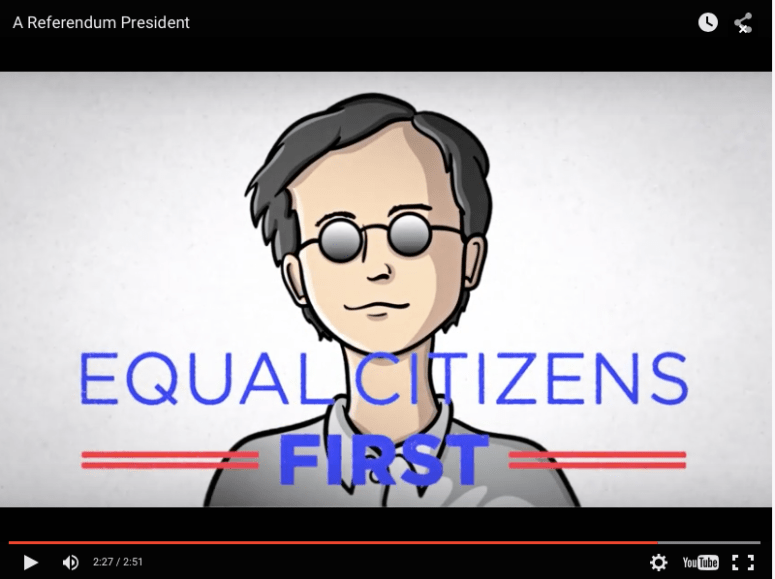
What the fuck does this slogan even mean? Equal citizens go first? Unequal citizens have to wait their turn?
Lawrence Lessig for president. Hahahahahahahahahahahahhahahahahahah. Amazing.
I thought this was a joke. The man who has worked relentlessly to relieve individual creators of their constitutionally protected rights wants to run for president. Let’s elect the man who when faced with the choice of whether to side with an individual’s right to control their artistic work or a tech corporation desire to exploit the work, never seems to take the side of the creator.
Yeah this really seems like a guy who will look out for the little guy.The man who Wired magazine once declared would “smash apart the copyright machine” (to benefit big tech) is running for president.
But forget copyright for moment. The real danger is that this guy is the Manchurian candidate for Silicon Valley billionaires. Sure he seems like a progressive guy, “reforming” copyright, Creative Commons founder, Free Press board member, but when you really dig into everything that he has done and proposed, it becomes clear his efforts have benefited his financial supporters mostly large tech companies and tech investors while hurting individuals who make their living from copyright.
Don’t believe me? Just follow the money. Lessig launched his career at the Google funded Berkman Center at Harvard. Look at all the tech billionaires that supported his Mayday Pac. Check the open secrets website for his PAC . Look at all those Silicon Valley venture capitalists. Among them the arch libertarian Peter Thiel who has declared he no longer believes in democracy nor does he think women voting is the best idea. Yeah we should vote for Thiel’s candidate. Good idea!
Oh and then there is that pesky little matter that he took money from a self-confessed felon to bankroll his causes. And even ickier read this.
Yet Lessig with a complete straight face claims his campaign is built on “equal citizens first.” What does that even mean? Some citizens are equal and they get to go first? Unequal citizens have to wait? Huh?
Well come to think of it, that pretty much describes the political worldview of Silicon Valley. Fake progressive political “talk” while “walking” a crony capitalist walk.
Lessig who admits to alternating between extreme right wing positions and extreme “progressive” positions would like to “hack our democracy” and become president. Do you want some politically unstable ethically challenged Harvard professor “hacking” our democracy? I don’t.
Look clearly we have a problem with our democracy when big money interests can essentially buy our government. We should fix that. But a guy supported mostly by big money interests isn’t gonna fix it by attempting to buy/hack the presidency with the backing of these same moneyed interests.
Watch the video. It’s fucking unbelievable.
Guest post by Alan Graham
This is a long piece. I’m warning you in advance, because these days our short attention spans generally peter out after…well about now. But if you are a professional creator, emerging artist, or rights owner on this planet, you should read this, and the piece that will follow it. It is not simply a call to action, but hopefully an opportunity to open minds to what the creative class is truly facing.
Disrupt: throw into confusion, throw intodisorder, throw into disarray,
cause confusion/turmoil in, play havoc with; disturb, interfere with,upset, unsettle; obstruct, impede, hold up, delay, interrupt, suspend;
informal throw a (monkey) wrench into the works of.
The word disruption is often worn as a merit badge amongst tech circles. The negative connotations have been twisted into a positive. This arose from the obstruction of progress that tech often faced from legacy businesses, who generally held all the keys to all the doors and often refused to share. I have personally experienced this myself, and still see it happening to this day. In the past I use to use “disruptive” quite often in a positive context, up until I began a project in the music industry. Beginning from the ground up, you see the industry for what it actually is, passionate creative people, not just some amorphous entity encapsulated by the words “music industry”.
I realized that any more technological “disruption” will equal death. And not just the death of old inefficient systems, but the actual freedom that this age of technology had promised to deliver the creative class if you just came along for the ride. You believe you have freedom of choice, but as I’ll point out a bit later, it is an illusion. What good are a thousand different choices that are owned by the same handful of people?
We need something better than disruption. We need something that belongs to you.
I don’t need to tell you your very livelihood is at stake, but based on those I meet in the music industry, you are ill equipped and not ready for what is coming. I know you think you know what is happening, but you don’t. These days there is a lot of talk about things like “transparency” which are general abstractions that point towards a lack of clarity and openness between record labels, the deals they make, and royalties. It has become the subject du jour. I cannot speak to those issues. However, what I want to call attention to is that while you and the media are all focusing on those issues, which are of course important, it also serves as a bit of misdirection for issues on the horizon which are much larger problems.
Technology is about to take away your power to enforce your rights. While it joins your chorus and lauds the need for more transparency, it will simultaneously make things more opaque, obfuscating how your creations are used, where they are used, etc. Infringement and piracy is about to get worse than ever before, moral rights will soon disappear, and the DMCA provisions that gave you some semblance of control, will lose all their teeth. While your tech friends get you to focus on the lack of openness from within your own industry and work towards making it more accountable, they are already making that issue moot. You just don’t see it yet. This is exactly what they want. And if you think copyright is going to save you, it already may be too late for that, unless we solve these issues rapidly. The new flag flying in tech is “privacy,” and while it is easy to get everyone on board with that idea, it will render copyright unenforceable.
Privacy always trumps copyright.
I’m going to look into this in detail in the second part of this piece (although I’ll hint at it here), but in order to get there, we need to start by understanding how we got where we are right now.
“Media companies are running scared these days. Their failure to embrace technology has put them in a delicate position. For the first time in history, the bread and butter of the media enterprises like music, film, and television are faced with the fact that they may no longer be in control of their business.”
“Legalize sharing,” urge press releases issued by Peers, another tech astroturfing outfit launched in 2013. Peers is the “grassroots” organization launched by “sharing economy” companies like the transportation app Lyft and the home subletting site Airbnb, the latter of which paid a PR group to create Peers.All of these organizations have one common link: venture capitalist Ron Conway. Conway’s invested in Peers member companies like Airbnb and the online course web site Skillshare, and he’s a founding member of FWD.us and sf.citi, whose Affordable Housing Committee is headed up by none other than SPUR’s Gabriel Metcalf.

“technically we shouldn’t allow it . . . but we’re not going to take it off until the person that holds the copyright. . . is lìke . . . you shouldnt have that. . . then we’ll take it off .”
“…but we can leave this up until someone bitches.”

…while the Electronic Frontier Foundation’s intellectual property director Corynne McSherry confirmed that “it doesn’t appear that Flickr is doing anything wrong”.
Flickr’s latest business model – selling wall-art prints of more than 50m imagesshot by its community of photographers – has sparked a debate around Creative Commons licensing.
The Yahoo-owned site will keep all the revenues from sales of prints based on photos shared to Flickr using a Creative Commons “commercial attribution” licence, which allows commercial use.

“It should be noted that is a simple search engine of videos available at a wide variety of third party websites.
Any videos shown on third party websites are the responsibility of those sites and not . We have no knowledge of whether content shown on third party websites is or is not authorized by the content owner as that is a matter between the host site and the content owner. does not host any content on its servers or network.”
“The worst thing is just the shock of how viral they go on Facebook compared to the ones I post on YouTube,” Thompson said of his videos. “Some of these videos I’ve been working on for years. It makes me wonder why I want to keep doing this.”
“I’m a professional YouTube creator. Some people think that this is some kind of joke but I have 30 employees. All of them work in the online video industry, about half of them work directly on producing videos for our educational YouTube channels. We’re a small, profitable business.”
Re: Facebook “But there are a few things that make me wary, not of their ability to grow my business, but of whether they give a shit about creators, which is actually pretty important to me.“
“What to do? Well, the lack of searchability on Facebook makes it impossible for creators to discover when their content is being freebooted, so if you see suspect content, please reach out to the creator so they can take action. If you have any legal or technical solutions you think might work, please post those as responses to this. And above all, just know that this is an issue and share what you can with who you can. Facebook won’t hold itself accountable, but maybe they will if we make them.“
But most creators have responded, thus far, the same way as me. By shrugging our shoulders and saying “What am I gonna do about it…it’s Facebook, they’re massive.”
But that’s exactly what makes it so awful.

PageFair, a company that works with publishers to measure the cost of ad blocking and to help them display less intrusive advertising that can be whitelisted by the ad blockers, estimates that Google lost out on $6.6 billion in global revenue to ad blockers last year.
To put that into context, that’s 10% of the total revenue Google reported in 2014.
Spending on digital video advertising increased almost 60 percent in 2014 from the previous year. During the same period, the number of Internet users using ad blockers rose from 54 million to 121 million. Today, almost 150 million people have downloaded ad-blocking software
“We’re largely unconscious,” Byrne says. “You know, we operate half awake or on autopilot and end up, whatever, with a house and family and job and everything else, and we haven’t really stopped to ask ourselves, ‘How did I get here?‘ “
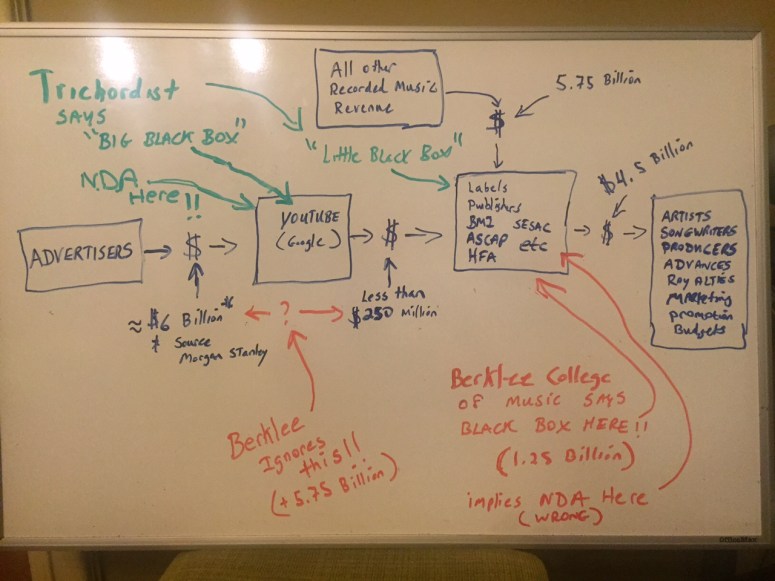
All figures approximate, but based on numbers provided by Morgan Stanley and IFPI.
1. Berklee College of Music/Rethink Music report on fair pay and transparency in music business primarily focuses on “black box” at traditional music industry players like labels, PROs and publishers. Ignores black box at the digital services.
2. The Berklee College of Music/Rethink Music report derides the NDA (non-disclosure agreement) culture that pervades the digital music business, but implies that this is a problem with the labels, publishers and PROs. But it is a well known fact that it is the digital services that demand the non-disclosure agreements.
3. The Berklee College of Music/Rethink Music report was funded by Kobalt Music which is a Google Ventures company. And Google owns YouTube. Rethink Music was started by The Berkman Center. The Berkman Center is an “academic” institution that has close ties to Google. For this reason we believe this report to be a damaging piece of propaganda that distracts artists from the bigger problem: Low pay and no accountability from the digital services like YouTube. At best Berklee College of Music is “fighting the last war” and in effect protecting those who exploit their students.
 The Trichordist
You must be logged in to post a comment.