The Copyright Office has asked for comments from the public on important issues for rulemakings under the Music Modernization Act. This will potentially affect the operations of The MLC and related rights especially because the Copyright Office recently extended the scope of that rulemaking. The proposal drew a mixed response.
We will be posting selected comments that we think might be interesting to Trichordist readers. The project is a bit wonky, but important to stay informed on.
Spirit’s thesis:
We commend the US Copyright Office (USCO) for its highly regarded work in protecting rightsholders and their intellectual property rights. Your efforts have achieved great strides to prevent the misuse and abuse of music copyrights.
Although the [Notice of Proposed Rulemaking]’s original intent was to address the ambiguity in certain aspects of the Termination Right, the USCO’s extension of the scope beyond Termination Rights disrupts standard practices that have been long tested and put into practice by rightsholders. The administrators of copyrighted material are best suited to understand the most current and pragmatic business practices. As such, the administrators should be the ones to establish the day-to-day standards of copyright administration and to make the recommendations pertaining to the administration of copyrights and their respective payments at the MLC.
We believe the administrators’ standard practices and pragmatic solutions must be considered.
We’re about to experience an historical event—the U.S. government’s statutory mechanical rate for physical and permanent downloads will increase twice in 12 months. This is because the record companies agreed in “Phonorecords IV” to raise the statutory mechanical rate from 9.1¢ to 12¢ for physical and permanent downloads (with corresponding long-song royalties) effective January 1, 2023.
This is quite a change from the frozen rate that lasted for 17 years. Not only did the labels agree to increase the rate to 12¢, they agreed to index that increased rate to inflation annually starting in 2024.
Indexing requires increasing the 12¢ rate to current inflation based on a “COLA” or “cost of living adjustment” by applying an uplift formula to the 12¢ rate. That formula itself is a function of the Bureau of Labor Statistics Consumer Price Index which itself comes in a number of varieties. A common version of CPI that the record companies agreed to is the “Consumer Price Index for All Urban Consumers (U.S. City Average, all items),” or “CPI-U.” The CPI-U is weighted toward the cost of living for urban consumers. (Compare CPI-U to the “CPI-W” or Consumer Price Index for Urban Wage Earners and Clerical Workers which is used by Social Security, for example.)
We have experienced a time of high inflation for the last few years and given the indicators, we are likely to continue to suffer with inflation for years to come. So the labels’ agreement to a COLA protects the purchasing power of the hard-won mechanical royalty for physical and downloads and may end up being a critical deal point over the 5 year rate period covered by Phonorecords IV.
Annual rate adjustment. The Copyright Royalty Judges shall adjust the royalty rates in paragraph (a)(1) of this section each year to reflect any changes occurring in the cost of living as determined by the most recent Consumer Price Index for All Urban Consumers (U.S. City Average, all items) (CPI–U) published by the Secretary of Labor before December 1 of the preceding year. The calculation of the rate for each year shall be cumulative based on a calculation of the percentage increase in the CPI–U from the CPI–U published in November, 2022 (the Base Rate) and shall be made according to the following formulas: for the per-work rate, (1 + (Cy−Base Rate)/Base Rate) × 12¢, rounded to the nearest tenth of a cent; for the per-minute rate, (1 + (Cy−Base Rate)/Base Rate) × 2.31¢, rounded to the nearest hundredth of a cent; where Cy is the CPI–U published by the Secretary of Labor before December 1 of the preceding year. The Judges shall publish notice of the adjusted fees in the Federal Register at least 25 days before January 1. The adjusted fees shall be effective on January 1.
One must have the published CPI-U in order to make the COLA calculation. The CPI is published by Bureau of Labor Statistics (technically “by the Secretary of Labor”) on a regularly published schedule. If the regulations require that the relevant CPI-U must be published before December 1, that will be the CPI-U for October to be published next week on November 14 because the CPI-U for November won’t be published until December 12 (which of course is after December 1).
According to the Cleveland Federal Reserve, month over month inflation for November is projected to be pretty much the same as October. So based on the Phonorecords IV Subpart B formula, the minimum statutory rate will likely increase from 12¢ to approximately 12.41¢ starting January 1.
Keep an eye out for the October CPI-U next week when it is announced by BLS at 8:30am ET on November 14. The Copyright Royalty Board is to publish the new COLA-adjusted mechanical rate in the Federal Register, on or about December 8. And remember that the same calculation with then-current CPI-U will apply in December 2024, 2025, 2026 and 2027.
Remember, this COLA rate increase only applies to physical and permanent download configurations, not to streaming. This is because the services refused to engage on the topic. There’s really no good explanation for why the streaming services refused to give a COLA. A COLA really should be mandatory given that the government essentially takes away the songwriters’ ability to bargain for their inflation expectations during a five year rate period.
[This post first appeared on MusicTechPolicy referenced by David in his post below from X]
Remember the millions of flawed “address unknown” NOIs that the Copyright Office allowed to be filed by the largest corporations in commercial history, including Google, because they were unable to locate the copyright owners? Aside from the sheer hilarity of the statement “Google can’t find [X]” it is almost certain that the absence of the line of researchers at the Copyright Office at the time suggests that the big tech companies never really did all the research and were allowed to file false statements with the government. Any guesses as to which Copyright Office lawyer was principally involved in allowing them to get away with that massive charade to the tune of approximately 100,000,000 notices? (See my article from the ABA Entertainment & Sports Lawyer.). That might be the one who left the Copyright Office for the riches of private practice shortly after the incident. Mr. Damle also has pretty consistently represented the Digital Licensee Coordinator. More on that later.
Another fake enterprise seems to have been uncovered by Politico this week, this time apparently in what I think is Mr. Damle’s latest assault on creators, his fascination with Open AI. As Politico reports:
The message in the open letter sent to Congress on Sept. 11 was clear: Don’t put new copyright regulations on artificial intelligence systems.
The letter’s signatories were real players, a broad coalition of think tanks, professors and civil-society groups with a stake in the growing debate about AI and copyright in Washington.
Undisclosed, however, were the fingerprints of Sy Damle, a tech-friendly Washington lawyer and former government official who works for top firms in the industry — including OpenAI, one of the top developers of cutting-edge AI models. Damle is currently representing OpenAI in ongoing copyright lawsuits.
Damle did not sign the letter, and did not reply to multiple attempts to contact him with questions about his involvement. But data contained in a publicly posted PDF of the letter show the document was authored by “SDamle,” and three signatories confirmed to POLITICO that Damle was involved in its drafting and circulation. Two of them said they were first made aware of the letter by Damle, and signed it at his invitation.
The letter’s covert origin offers a window into the deep and often invisible reach of Big Tech influence in the Washington debate over AI — a fast-moving part of the policy landscape where Congress is hungry for outside advice, and which is still new enough to create strange political bedfellows. Signatories included the American Library Association, the progressive nonprofit Public Knowledge and the free-market R Street Institute.
Oh my. This bears all the hallmarks of Google policy washing, while the company is at the same time engaging in a charade with artists through the YouTube AI Music Incubator. And as usual, Mr. Damle is only too happy to accommodate.
Companies using artificial intelligence software are shamelessly ripping off artists from film and music, and it will get worse if not regulated, members of the entertainment industry told U.S. Senators at a hearing Wednesday.
“AI in the service of artists and creativity can be a very, very good thing,” executive vice president of business and legal affairs for Universal Music Group Jeffrey Harleston said. “But AI that uses or worse yet appropriates the work of these artists, their name, their image, their likeness, their voice, without authorization, without consent, simply is not a good thing. Congress needs to establish rules that ensure creators are respected and protected.”
Long before an AI-generated recording imitating Drake and The Weeknd – both Universal Music artists – went viral and captured the attention of press and policymakers, UMG has been thinking about artificial intelligence. One of our companies, Ingrooves, has three patents in AI to assist with marketing independent artists. And AI has long been used as a tool in the studio: For example, Apple Logic Pro X to generate drum tracks, or Captain Plugins to generate chord progressions. We also use AI regularly as a tool to assist in creating Dolby Atmos immersive audio music. It’s a great technology when employed responsibly – and one that we and our artists use.
However, we are before you today because generative AI is raising fundamental issues of responsibility in the creative industries and copyright space. Each day, troubling examples emerge. We know some generative AI engines have been trained on our copyrighted library of recordings and lyrics, image generators have been trained on our copyrighted cover art, and music generators have been trained on our copyrighted music, all without authorization.
We have a robust digital music marketplace, and UMG has hundreds of legitimate partners who’ve worked with us to bring music to fans in a myriad of ways. Those companies and services properly obtained the rights they need to operate from UMG, or from the associated record labels and publishers. So, it’s unfathomable to think AI companies and developers think the rules and laws that apply to other companies and developers don’t apply to them.
U.S. Representative Darrell Issa and the House Judiciary Subcommittee on Courts, Intellectual Property, and the Internet that he chairs will hold a field hearing on Tuesday, June 27, 2023, at 10:00 a.m. CT at Belmont University, Gabhart Student Center, in Nashville, Tennessee. The hearing, entitled “Five Years Later – The Music Modernization Act,” will focus on the entire blanket licensing regime added to the Copyright Act by the MMA to (1) administer blanket mechanical licenses for “covered activities” (largely streaming) and (2) to collect and distribute compulsory mechanical licensing royalties.
Most importantly, the IP Subcommittee website tells us that “[t]he hearing will also explore whether the legislation is operating as intended by Congress and consider reforms.” So why is this happening and why is it happening right now given everything else that Congress is dealing with.
Congress considers whether to renew The MLC, Inc.‘s designation as the mechanical licensing collective. If that sentence seems contradictory, remember those are two different things: the mechanical licensing collective is the statutory body that administers most of the compulsory license under Section 115 of the Copyright Act that was the entirety of Title I of the Music Modernization Act (aka the Harry Fox Preservation Act). The MLC, Inc. is the private company that was “designated” by Congress through its Copyright Office to do the work of the mechanical licensing collective. This is like the form of a body that performs a function (the mechanical licensing collective) and having to animate that form with actual humans (The MLC, Inc.). The MLC, Inc. was designated by the Copyright Office in 2019.
Congress reviews the work product of The MLC, Inc. every five years (17 USC §115(d)(3)(B)(ii)) to decide if Congress should allow The MLC, Inc. to continue another five years. That is, Congress has the right to fire The MLC, Inc. and find someone else if they fail to perform. Hence, “Five Years Later” in the title of the field hearing. This process is called “designation” or “redesignation” and is performed for Congress by the U.S. Copyright Office in their soft oversight role.
That five year period is actually up next year, so Congress may be getting an early start to identify performance benchmarks for The MLC, Inc. so that the Copyright Office doesn’t have to wing it. If you have some thoughts about what The MLC, Inc. could be doing better or is doing well, you have a chance to write to your representative or even members of the subcommittee before (or after) the June 27 hearing and let them know.
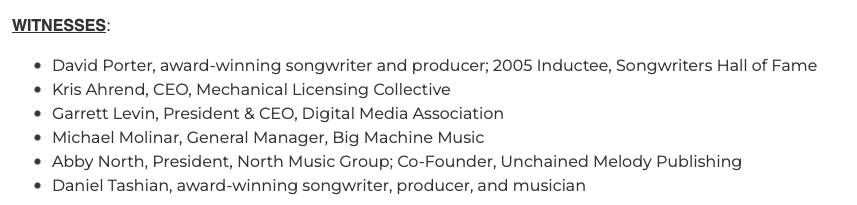
The witness list is well-chosen and seems unlikely to produce the usual propaganda from the controlled opposition that the lobbyists usually try to spoon feed to lawmakers:
I have a few concerns myself.
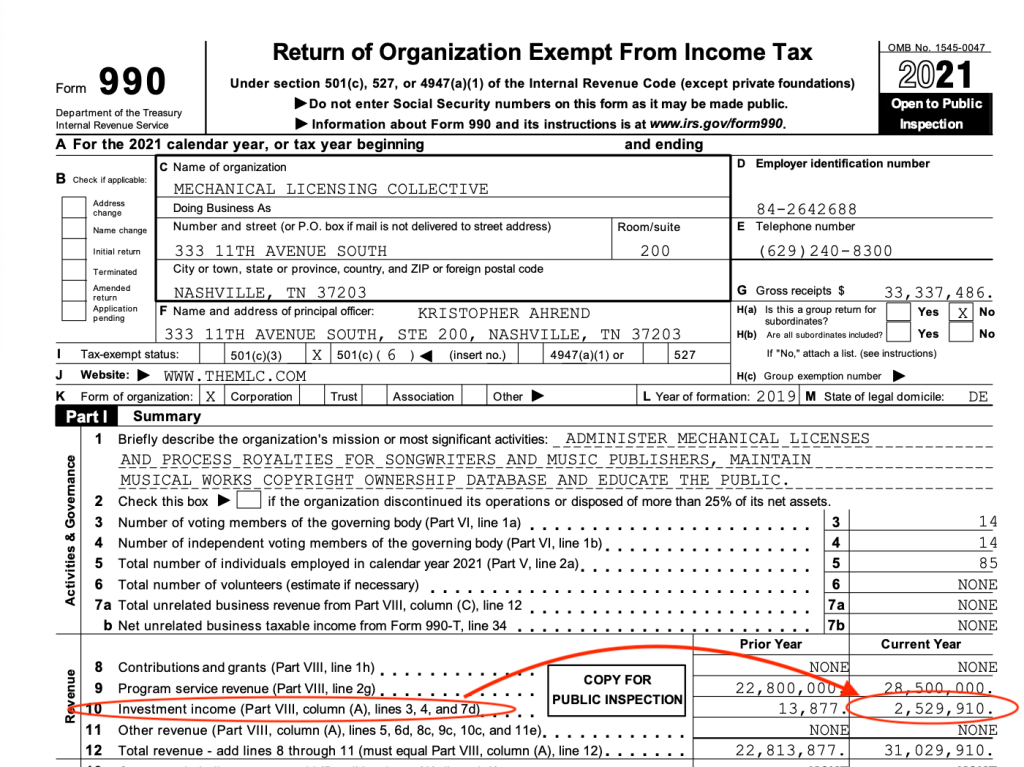
Investment Policy: According to its 2021 tax return, the MLC, Inc. was at that time holding more than $650 million in publicly traded securities. According to the MLC, Inc.’s annual report (at p. 4), this sum seems to include the $424 million of black box monies that the MLC, Inc. received in 2021. Congress is entitled to know exactly how this money is handled, where it resides and who is responsible for making investment decisions.
Congress should consider whether all black box sums and unspent operating costs advanced by blanket licensees should be held in a bank account controlled by the US government so that there is no confusion if Congress fires The MLC, Inc. or any successor.
Congress should also consider whether the same fiduciary duties apply to The MLC, Inc.’s management of the black box as would apply to a pension fund (under ERISA) or comparable duty. (There’s lots of pension funds and even banks with less than $600 million in assets and they are all regulated.) At least with a pension fund the fund trustees know who they owe money to; The MLC, Inc. seems like it should have an even higher responsibility to be good stewards of money it owes to the very unknown songwriters Congress tasked it with finding, thus cementing the moral hazard.
It goes without saying that the infamous “Hoffa Clause” in the MMA should be repealed (17 U.S.C. § 115 (d)(7)(C)). The Hoffa Clause allows the collective to dip into the black box to pay its expenses if the millions of the administrative assessment paid by the blanket licensees just isn’t quite enough.
Succession Plan: What if Congress did fire The MLC, Inc.? Is there a succession plan in place that would allow the seamless transfer to a new collective of databases, operating software, cash on hand, and of course the black box? If there is a succession plan in place, then perhaps Mr. Ahrend should bring it with him to Chairman Issa’s hearing for the records. If not, perhaps he could draft one. In any event, Mr. Ahrend should have ready answers to at least some questions about a succession plan should the Subcommittee ask him. After all, the lobbyists wrote the bill and the five year review language was written into the earliest drafts so he should expect a few questions about what happens. Particularly since the Subcommittee has announced that they want to know “…whether the legislation is operating as intended by Congress and consider reforms.”
Nondisclosure Agreements: I am struck by the fact that there have been no leaks of information about the black box, investment policy, or even life at The MLC, Inc. This usually means that there are nondisclosure agreements in place that scare people into silence–along with a healthy dose of intimidation in a small and incestuous industry when it’s likely that your employer is on the board of directors. Maybe not, but Congress may want to find out what these people are up to so it can decide if it wants to let them keep doing it. This may seem like a small issue, but either people aren’t talking because they have nothing to say or people are talking but nobody will print the story.
Songwriter Directorsand Geographical Diversity: The hearing may provide a good opportunity for the Subcommittee to look into how the collective’s controversial board composition is working out, not to mention the membership levels in the confusing by laws of The MLC, Inc. For example, I for one really see no reason to continue the concept of non-voting directors on the board, and Congress could just eliminate that role. One need only look to other collectives and PROs in the US and around the world for examples. A non-voting board member is a close analog to a “board observer” which is usually someone appointed by an investor to essentially spy on the board.
Similarly, it must be said that all the board members are either from New York, Nashville, Los Angeles or are lobbyists from the Imperial City. There are songwriters all over the country and internationally. Since the collective is really a quasi governmental organization, it is entirely in the remit of Congress to increase transparency and fairness as well as diversity. This could be accomplished by requiring an equal number of songwriter and publisher directors and having them come from states or regions with a big music contribution to America such as one of the reservations ,Atlanta, Chicago, Houston, Miami, New Orleans, Tulsa or Appalachia.
Revisit the Compulsory License: There is, of course, the threshold question of whether the compulsory license should be continued at all. This five year examination really should include this fundamental review rather than just blindly pushing forward with the compulsory license. (I discussed this in some detail in a separate post.) One songwriter has suggested that the Copyright Office reprise another study on the continued viability of the entire compulsory license system and I think he’s got a point there. Perhaps the Subcommittee could task the Copyright Office with conducting such a study as a finding of the field hearing. Those studies allow the public to comment without fear or favor which would be a breath of fresh air. Congress could then hear from more people whose jobs depend on the system working well resulting in the payments to songwriters that Congress wanted rather than the system just stumbling on resulting in high salaries to the operators and little to no transparency.
Let’s see what happens at the field hearing. You can watch it here courtesy of the YouTube monopoly.
Congress is considering whether to renew The MLC, Inc.‘s designation as the mechanical licensing collective. If that sentence seems contradictory, remember those are two different things: the mechanical licensing collective is the statutory body that administers the compulsory license under Section 115. The MLC, Inc. is the private company that was “designated” by Congress through its Copyright Office to do the work of the mechanical licensing collective. This is like the form of a body that performs a function (the mechanical licensing collective) and having to animate that form with actual humans (The MLC, Inc.), kind of like Plato’s allegory of the cave, shadows on the wall being what they are.
Congress reviews the work product of The MLC, Inc. every five years (17 USC §115(d)(3)(B)(ii)) to decide if The MLC, Inc. should be allowed to continue another five years. In its recent guidance to The MLC, Inc. about artificial intelligence, the Copyright Office correctly took pains to make that distinction in a footnote (footnote 2 to be precise. Remember–always read the footnotes, it’s often where the action is.). This is why it is important that we be clear that The MLC, Inc. does not “own” the data it collects (and that HFA as its vendor doesn’t own it either, a point I raised to Spotify’s lobbyist several years ago). Although it may be a blessing if Congress fired The MLC, Inc. and the new collective had to start from scratch.
But Congress likely would only re-up The MLC, Inc. if it had already decided to extend the statutory license and all its cumbersome and byzantine procedures, proceedings and prohibitions on the freedom of songwriters to collectively bargain. Not to mention an extraordinarily huge thumbs down on the scales in favor of the music user and against the interest of the songwriters. The compulsory license is so labyrinthine and Kafka-esque it is actually an insult to Byzantium, but that’s another story.
Rather than just deciding about who is going to get the job of administering the revenues for every songwriter in the world, maybe there should be a vote. Particularly because songwriters cannot be members of the mechanical licensing collective as currently operated. Congress did not ask songwriters what they thought when the whole mechanical licensing scheme was established, so how about now?
Before the Congress decides to continue The MLC, Inc. many believe strongly that the body should reconsider the compulsory license itself. It is the compulsory license that is the real issue that plagues songwriters and blocks a free market. The compulsory license really has passed its sell by date and it’s pretty easy to understand why its gone so sour. Eliminating the Section 115 license will have many implications and we should tread carefully, but purposefully.
Party Like it’s 1909
First of all, consider the actual history of the compulsory license. It’s over 100 years old, and it was established at a time, believe it or not, when the goal of Congress was to even the playing field between, music users and copyright owners. They were worried about music users being hard done by because of the anticompetitive efforts of songwriters and copyright owners. As the late Register Marybeth Peters told Congress, when Congress created the exclusive right to control reproduction and distribution in 1909, “…due to concerns about potential monopolistic behavior [by the copyright owners], Congress also created a compulsory license to allow anyone to make and distribute a mechanical reproduction of a nondramatic musical work without the consent of the copyright owner provided that the person adhered to the provisions of the license, most notably paying a statutorily established royalty to the copyright owner.”
Well, that ship has sailed, don’t you think?
This is kind of incredible when you think about it today because the biggest users of the compulsory license are those who torture the bejesus out of songwriters by conducting lawfare at the Copyright Royalty Board–the richest corporations in commercial history that dominate practically every moment of American life. In fact, the statutory license was hardly used at all before these fictional persons arrived on the scene and have been on a decades-long crusade to hack the Copyright Act through lawfare ever since. This is particularly true since about 2007 when Big Tech discovered Section 115. (And they’re about to do it again with AI–first they send the missionaries.)
If the purpose of the statutory scheme was to create a win-win situation that floats all boats, you would have expected to see songwriters profiting like never before, right? If the compulsory was so great, what we really needed was for everyone to use Section 115, right? Actually, the opposite has happened, even with decades of price fixing at 2¢ by the federal government. When hardly anyone used the compulsory license, songwriters prospered. When its use became widespread, songwriters suffered, and suffered badly.
Songwriters have been relegated to the bottom of the pile in compensation, a sure sign of no leverage because whatever leverage songwriters may have is taken–there’s that word again–by the compulsory license. I don’t think Google, a revanchist Microsoft, Apple, Amazon or Spotify need any protection from the anticompetitive efforts of songwriters. Google, Amazon, Apple, Microsoft, Spotify are only worried about “monopolistic behavior” when one of them does it to one of the others. The Five Families would tell you its nothing personal, it’s just business.
Yet these corporate neo-colonialists would have you believe that the first thing that happens when the writing room door closes is that songwriters collude against them. (Sounding very much like the Radio Music Licensing Committee–so similar it makes you wonder, speaking of collusion.)
The Five Year Plan
Merck Mercuriadis makes the good point that there is no time like the present to evolve: “In the United States, we have a position of stability for the next five years – at the highest rates paid to songwriters to date – in the evolution of the streaming economy. We are now working towards improving the songwriters’ share of the streaming revenue ‘pie’ yet further and, eventually, getting to a free market.” The clock is ticking on the next five years, a reference to the rate period set by the Copyright Royalty Board in the Phonorecords IV proceeding. (And that five years is a different clock than the five years clock on the MLC which is itself an example of the unnecessary confusion in the compulsory license.)
What would happen if the compulsory license vanished? Very likely the industry would continue its easily documented history of voluntary catalog licenses. The evidence is readily apparent for how the industry and music users handled services that did not qualify for a compulsory license like YouTube or TikTok. However stupid the deals were doesn’t change the fact that they happened in the absence of a compulsory license. That Invisible Hand thing, dunno could be good. Seems to work out fine for other people.
Let’s also understand that there is a cottage industry complete with very nice offices, pensions and rich salaries that has grown up around the compulsory license (or consent decrees for that matter). A cottage industry where collecting the songwriters’ money results in dozens of jobs paying more in a year than probably 95% of songwriters will make, maybe ever. (The Trichordist published an excerpt from a recent MLC tax return showing the highest compensated MLC employees.) Generations of lawyers and lobbyists have put generations of children through college and law school from legal fees charged in the pursuit of something that has never existed in the contemporary music business–a willing buyer and a willing seller. Those people will not want to abandon the very government policy that puts food on their tables, but both sides are very, very good at manufacturing excuses why the compulsory license really must be continued to further humanity.
The even sadder reality is that as much as we would like to simply terminate the compulsory license, there is a certain legitimacy to being clear-eyed about a transition. (An example is the proposals for transitioning from PRO consent decrees–ASCAP’s consent decree has been around a long time, too.) There would likely need to be a certain grandfathering in of services that were pre or post the elimination of the compulsory, but that’s easily done, albeit not without a last hurrah of legal fees and lobbyist invoices. Register Pallante noted in the well-received 2015 Copyright Office study (Copyright and the Music Marketplace at 5) “The Office thus believes that, rather than eliminating section 115 altogether, section 115 should instead become the basis of a more flexible collective licensing system that will presumptively cover all mechanical uses except to the extent individual music publishers choose to opt out.” An opt out is another acceptable stop along the way to liberation, or even perhaps a destination itself. David Lowery had a very well thought-out idea along these lines in the pre-MLC era that should be revisited.
X Day
However, while there is a certain attractiveness to having a plan that the dreaded “stakeholders” and their legions of lobbyists and lawyers agree with, it is crucially important for Congress to fix a date certain by which the compulsory license will expire. Rain or shine, plan or no plan, it goes away on the X Day, say five years from now as Merck suggests. So wakey, wakey.
That transparency drives a wedge into the process because otherwise millions will be spent in fees for profiting from moral hazard and surely the praetorians protecting the cottage industry wouldn’t want that. If you doubt that asking for a plan before establishing X Day would fail as a plan, just look at the Copyright Royalty Board and in particular the Phonorecords III remand. Years and years, multiple court rulings, and the rates still are not in effect. Perseveration is not perseverance, it’s compulsive repetition when you know the same unacceptable result will occur.
But don’t let people tell you that the sky will fall if Congress liberates songwriters from the government mandate. The sky will not fall and songwriters will have a generational opportunity to organize a collective bargaining unit with the right to say no to a deal.
Who can forget Sally Fields in Norma Rae?
The closest that Congress has come to a meaningful “vote” in the songwriting world is inviting public comments through interventions, rule makings, roundtables and the like–information gathering that is not controlled by the lobbyists. Indeed, it was this very process at the Copyright Royalty Board that resulted in many articulate comments by songwriters and publishers themselves that were clearly quite at odds with what the CRB was being fed by the lobbyists and lawyers. So much so that the Copyright Royalty Judges rejected not only the “Subpart B” settlement reached by the insiders but the very premise of that settlement. Imagine what might happen if the issue of the compulsory license itself was placed upon the table?
Now that songwriters have had a taste of how The MLC, Inc. has been handling their money, maybe this would be a good time to ask them what they think about how things are going. And whether they want to be liberated from the entire sinking ship that is designed to help Big Tech. And you can start by asking how they feel about the $500 million in black box money that is still sitting in the bank account of The MLC, Inc. and has not been paid–with an infuriating lack of transparency. Yet is being “invested” by The MLC, Inc. with less transparency than many banks with smaller net assets.
This “investment” is another result of the compulsory license which has no transparency requirements for such “investments” of other peoples’ money, perhaps “invested” in the very Big Tech companies that fund the The MLC, Inc. That wasn’t a question that was on the minds of Congress in 1909 but it should be today.
Attention Must Be Paid
Let’s face facts. The compulsory license has coexisted in the decimation of songwriting as a profession. That destruction has increased at an increasing rate roughly coincident with the time the Big Tech discovered Section 115 and sent their legions of lawyers to the Copyright Royalty Board to grind down publishers, and very successfully. That success is in large part due to the very mismatch that the compulsory license was designed to prevent back in 1909 except stood on its head waiting for loophole seekers to notice the potential arbitrage opportunity.
The Phonorecords III and IV proceedings at the Copyright Royalty Board tell Congress all they need to know about how the game is played today and how it has changed since 1909, or the 1976 revision of the Copyright Act for that matter. The compulsory license is no longer fit for purpose and songwriters should have a say in whether it is to be continued or abandoned.
We see the Writers Guild striking and SAG-AFTRA taking a strike authorization vote. When was the last time any songwriters voted on their compensation? Maybe never? Voting, hmm. There’s a concept. Now where have I heard that before?
Suzanne Wilson General Counsel and Associate Register of Copyrights U.S. Copyright Office 101 Independence Avenue S.E. Washington D.C. 20559 Re: Notice of Proposed Rulemaking: Termination Rights and the Music Modernization Act’s Blanket License Docket No. 2022-5 Comment
Dear General Counsel Wilson:
Thank you for the opportunity to make this comment on the docket referenced above.[i]
I am a music lawyer in Austin, Texas and write this comment on my own behalf only and not on behalf of anyone else.
Others will address the substantive termination issues that are well-described and assayed in the Notice, so I will focus on the procedural tension between The Mechanical Licensing Collective, Inc. (“The MLC, Inc.”) currently designated as the mechanical licensing collective (“MLC”), its officers and directors, and the law as described in the Notice.
I argue that the need for this Notice is symptomatic of a larger problem in the relationship between Congress and The MLC, Inc. I hope the Office will consider resolving this tension as it has been authorized to do under the Music Modernization Act[ii] such as through regulations establishing the type of code of conduct that is common for other federal contractors.
This tension is alarming. The Notice states the MLC “does not follow the Office’s rulemaking guidance”[iii] regarding terminations, and that The MLC, Inc. “declin[es] to heed the Office’s warning….”[iv] These disclosures are diametrically at odds with the clear intent of Congress in crafting the MLC’s role.[v]
The disclosures confirm clearly that there are governance and oversight controversies at The MLC, Inc. that in my view need to be conclusively disposed of, and quickly.[vi] These governance issues are symptomatic of what may be much greater problems with the administrative capabilities of The MLC, Inc. that may be metastasizing but have not yet risen to the level of a public inquiry.
The recklessness that gives rise to the Notice also highlights The MLC, Inc.’s general lack of accountability and suggests a conscious disregard for the Copyright Office’s oversight role on a significant matter of law that is not capable of proper resolution through any “business rules.”[vii]
I also note this troubling statement in the Notice:
But, having reviewed the MLC’s policy, the Office is concerned that it conflicts with the MMA, which requires that the MLC’s dispute policies ‘‘shall not affect any legal or equitable rights or remedies available to any copyright owner or songwriter concerning ownership of, and entitlement to royalties for, a musical work.’’[viii]
It seems clear that The MLC, Inc.’s conscious failure to comply with Congressional intent as well as the Office’s guidance is, or ought to be, a decision of some import that surely must have been taken by someone—that is, one or more persons—employed or appointed by the MLC. It seems likely to be a subject that would have been reviewed both by its General Counsel and as part of the millions in outside counsel fees[ix] spent by The MLC, Inc.
The fact that the decision-making process is not readily known is itself of concern and leads one to further consider developing a code of conduct for The MLC, Inc. to assure the Office, the Congress and the public of its administrative capabilities.
Respectfully, I request that you determine how this decision was arrived at and what internal controls The MLC, Inc. has put in place to assure the Congress, the Office and interested parties that these mistakes will not happen again. This should not be an “oh well” moment and should be taken seriously by The MLC, Inc.
If The MLC, Inc. fails to disclose what it is doing by establishing opaque “business rules”, it is essentially creating de facto regulations that have the practical effect of law or regulations made behind closed doors unless the Office or other oversight agency happens to catch them out. The public will never know that the business rule was established, how the “business rule” was arrived at, or have a meaningful opportunity to comment such as in response to this Notice.
For example, do the minutes of The MLC, Inc.’s board of directors or statutory committees reflect a discussion or vote on the adoption of the MLC’s policies on termination treatment? Did such a vote implicate any conflicts of interest? Who determined that there was or was not a conflict of interest in the MLC’s decision to adopt the termination policy, however it was taken? Were there any dissenting votes recorded? Did an officer or director of The MLC, Inc. certify the completeness of the record in these findings in the corporate minute book?
This leads to other concerns under public discussion regarding the hundreds of millions of “black box” monies being held by The MLC, Inc. Given that the public has very little information available to it regarding the results and implications of the MLC’s operational decisions, I respectfully request that you determine what, if any, financial implications have arisen as a result of The MLC, Inc.’s reckless failure to comply with the law and the guidance of the Office in implementing its termination policy. Such determination should likely include any funds[x] that The MLC, Inc. is apparently trading in the market for its own account.[xi] Any curative action required by the Office should, of course, be retroactive in scope which will require considerable before-and-after accounting disclosures.
It must be asked whether the “business rule” established for terminations increases or decreases the enormous black box which was of considerable interest to Chairman Leahy at the recent Copyright Office oversight hearing at which the Register testified.[xii] This is particularly true if the implementation of the business rule results in financial harm to interested parties who rely on The MLC, Inc. to get it right.
The subject of black box came up in the Questions for the Record from Chairman Leahy. The Copyright Office’s response to Chairman Leahy’s inquiry about the hundreds of millions in black box held by the MLC directed the Chairman to the MLC’s annual report for answers.
Respectfully, I find this odd. Chairman Leahy did not ask what the MLC told the world in its annual report; rather he asked, “What can the Copyright Office do to help ensure that the MLC is working to make sure that rightful owners of music works are identified and paid?”[xiii]The question is transitive: We have oversight of you, you have oversight of The MLC, Inc., therefore we have oversight of the MLC.
Surely no one is surprised by this. The question many have is why The MLC, Inc. itself—a quasigovernmental organization operated by inferior officers[xiv] of the United States–is not the subject of an oversight hearing at Senate Judiciary regarding the hundreds of millions it is sitting on. Maybe next time.
It must also be said that the answer to Chairman Leahy goes on:
Notably, the MLC plans to wait to process historical unmatched royalties from the Phonorecords III rate period [2018-2022] until the Copyright Royalty Judges finalize those rates in the ongoing remand proceeding and digital music providers provide adjusted reports of usage and royalty payments. It is the Office’s understanding that the bulk of historical unmatched royalties come from that period.[xv]
Without getting into the timeline of what came when, how is it exactly that The MLC, Inc. took the decision in February 2021—nearly two years ago–to sit on top of hundreds of millions of other peoples’ money that they were somehow investing under their undisclosed “Investment Policy”? Was anyone asked? Who gave the MLC the permission to do this? Do they not hold the black box corpus in trust for songwriters and copyright owners yet to be identified? Does this not compound the already painful series of failures that resulted in the black box in the first place, the delay in accounting to songwriters (or their families) under Phonorecords III remand, and still more delay while legions of lobbyists and lawyers argue over the post-remand true up accountings?
The MLC reported $2,529,910 investment income on its 2021 US Federal tax return 990
Respectfully, there is also, of course, a larger question that the Office may consider answering: If The MLC, Inc. adopts a policy or takes some action outside of the law or its remit, is that policy binding on any future entities designated by the Office as the MLC?
These are all questions that I would expect to have answers that are readily available to the public given that The MLC, Inc. is in a position of public trust administering a compulsory license on behalf of the United States and has been given great privileges under the MMA.[xvi]
Thank you again for the opportunity to comment.
Very truly yours,
Christian L. Castle
CLC/ko
[i] U.S. Copyright Office, Notice of Proposed Rulemaking, Termination Rights and the Music Modernization Act’s Blanket License 87 FR 64405 (Oct. 25, 2022) (Doc. No. 2022-5) (hereafter “Notice”).
[ii]Orrin G. Hatch-Bob Goodlatte Music Modernization Act, Public Law 115–264, 132 Stat. 3676 (2018) (“MMA”) and specifically Title I thereof.
[v]See S. Rep. 115-339 (115th Cong. 2nd Sess. Sept. 17, 2018) at 7 (“Senate Report”). (“The collective is expected to operate in a transparent and accountable manner.”)
[vi] I would hope that this failure will be weighed and measured by the Copyright Office as part of The MLC, Inc.’s quinquennial review as is required under the legislative history. See, e.g., Senate Report at 5 (“[E]vidence of fraud, waste, or abuse, including the failure to follow the relevant regulations adopted by the Copyright Office, over the prior five years should raise serious concerns within the Copyright Office as to whether that same entity has the administrative capabilities necessary to perform the required functions of the collective.”)(emphasis added).
[vii] It must be said that the MLC’s disregard for this particular matter may present a moral hazard (at best) for the publishers represented by at least some of its board members.
[x]See the MLC’s annual report stating that the MLC invests the black box according to its internal “Investment Policy” established by its board of directors but not made public. MLC 2021 Annual Report at p. 4 available at https://www.themlc.com/hubfs/Marketing/23856%20The%20MLC%20AR2021%206-30%20REFRESH%20COMBINED.pdf(“Annual Report”) (“Investment Policy: This policy covers the investment of royalty and assessment funds, respectively, and sets forth The MLC’s goals and objectives in establishing policies to implement The MLC’s investment strategy. The anti-comingling policy required by 17 U.S.C. § 115(d)(3)(D)(ix)(I)(cc) is contained in [The MLC, Inc.’s] Investment Policy. The Investment Policy was approved by the Board in January 2021.”) (emphasis added).
[xi] Realize that every CMO is confronted with the decision about what to do with the royalty float and black box, but not every CMO decides to invest these funds in the market. If they do invest the funds, it is generally the case that any trading profits, dividends or interest goes to offset the CMO’s administrative costs that otherwise would be deducted from collected royalties. However, the MLC, Inc.’s administrative costs are paid by the users of the blanket license (making the United States, I believe, the only country in history or the world that charges for the use of a statutory license). Therefore, the return on the MLC’s investment of the songwriters’ money would not be used for the same purpose as all the world’s CMOs that follow a similar practice. The continuity in ownership for profits derived from The MLC, Inc.’s trading is also unclear; if The MLC, Inc.’s existing designation is not continued but securities are being held or profits generated, what happens?
[xii]Senate Judiciary Committee, Subcommittee on Intellectual Property, Oversight of the U.S. Copyright Office, Responses to Questions for the Record by Shira Perlmutter, Register of Copyrights and Director of the Copyright Office (Sept. 7, 2022), available at https://artistrightswatchdotcom.files.wordpress.com/2022/10/qfr-responses-perlmutter-2022-09-07.pdf. (“Questions for the Record”) (“With respect to the historical, pre-2021, unmatched royalties, which were reported to be about $426 million, the annual report says that the MLC recently started distributing those that it has been able to match. It also says that the MLC has begun making associated usage data for historical unmatched royalties available to copyright owners, which will facilitate further claiming and matching.”)
[xiv] President Donald J. Trump, Statement on Signing the Orrin G. Hatch-Bob Goodlatte Music Modernization Act (October 11, 2018) available athttps://www.govinfo.gov/content/pkg/DCPD-201800692/pdf/DCPD-201800692.pdf (“Because the directors are inferior officers under the Appointments Clause of the Constitution, the Librarian must approve each subsequent selection of a new director.”)
[xvi]See, e.g., Senate Report at 5 (emphasis added). “For the responsibilities described in subparagraphs (J) [distribution of unclaimed royalties] and (K) [dispute resolution] of paragraph (3), the collective is only liable to a party for its actions if the collective is grossly negligent in carrying out the policies and procedures adopted by the Board of Directors pursuant to section 115(d)(11)(D). Since the Register has broad regulatory authority under paragraph (12) of subsection (d), it is expected that such policies and procedures will be thoroughly reviewed by the Register to ensure the fair treatment of interested parties in such proceedings given the high bar in seeking redress.”
In this comment to the Copyright Office, Abby North (independent publisher and Artist Rights Symposium III Moderator) calls on the Copyright Office to stop the MLC quango from unilaterally establishing “business rules” that hurt songwriters and their heirs and protect working families from these arbitrary actions of The MLC. The passing of Jeff Beck reminds us once again that we must take care to protect the heirs of creators.
Re: Termination Rights and the Music Modernization Act’s Blanket License
To the United States Copyright Office:
My name is Abby North. I am a music publishing administrator based in Los Angeles. My views expressed in this letter are solely my own.
With my husband, I am a copyright owner of the classic song “Unchained Melody,” among other copyrights. I also administer musical works and sound recordings on behalf of songwriters, their families and heirs. In many instances, I assist my clients in identifying their termination windows, assist in the research required, and interface with the attorneys who process termination filings.
Abby North, Helienne Lindvall, Erin McAnaly, Melanie Santa Rosa speaking at UGA Artist Rights Symposium III (Nov. 15, 2022 in Athens, GA)
I’m thankful for the opportunity to submit comments in support of the Copyright Office’s proposed rule.
The ability to recapture rights via the United States copyright termination system truly provides composers, songwriters and recording artists and their heirs, a “second bite of the apple.” Many of my clients exercise this right, and in doing so grow their family’s revenue, which, given today’s inflation and very high interest rates, coupled with a depleted stock market, is absolutely necessary.
Allyn Ferguson was a successful composer of film/television scores including “Little Lord Fauntleroy,” “Les Miserables,” “Charlie’s Angels,” and “Barney Miller.” According to Variety in its June 27, 2010 obituary, Ferguson was “among the most prolific composers of TV in the past 40 years.” My company North Music Group administers works controlled by Ferguson’s family.
In addition to his scores, Ferguson wrote songs performed by artists including Johnny Mathis, Count Basie Band and Freddie Hubbard. While the bulk of his film and television scores were created on a work for hire basis, and therefore are not eligible for termination under US copyright law, Ferguson’s commercial compositions and songs were not created as works for hire. Ferguson’s family has been able to exercise its termination rights in various musical works,
thereby increasing its earnings as it now collects the publisher share of United States royalties generated by the terminated works. Individual songwriters and composers and their heirs are not copyright aggregators. Every musical work, and every penny generated is very necessary to these families.
The Music Modernization Act created the blanket digital mechanical license. This move from one-off copyright licenses to a blanket license was a dramatic improvement in US mechanical licensing. However, the suggestion that rights held at the inception of this blanket license might remain, in perpetuity, with the original copyright grantee was frightening. I concur with the Office’s proposed rule and legal analysis of the relevant statutes and authorities.
I appreciate the Office requesting comments on the mechanics of solving the payment issues, because for the independent publishers I speak with and for me personally, many operational questions arise regularly regarding The MLC’s uncharted territories.
As one of The MLC’s statutory goals is to provide transparency to songwriters and copyrightowners, I would ask that the Office require The MLC to notify copyright owners (1) if The MLC’s unilateral termination policy has already been imposed on payments previously paid or that are being held in the historical or current black box, and (2) when the adjusting payment required by the proposed rule had been made.
To be clear, this rule must absolutely be retroactive to inception date of The MLC. Beyond the simple, clarifying amendment to the MMA, I believe there are additional, related issues that must be resolved:
1) What is The MLC’s “business rule” regarding the MLC/HFA Song Code for the terminated work? Prior to the inception of The MLC, the Harry Fox Agency would assign one HFA Song Code fr the work and its pre-termination parties, and a different HFA Song Code for the work with the post-termination parties.
What happens now? Do these multiple HFA Song Codes remain in The MLC’s database? Will there continue to be two separate MLC/HFA Song Codes, particularly given the Harry Fox Agency continues to license physical and download mechanicals on behalf of many publishers? Is it reasonable for the HFA Song Code to be the same as The MLC Song Code, when there is no derivative works exception in Section 115?
2) Which party is entitled to the Unmatched (Black Box) royalties, the related interest fees and to The MLC’s investment proceeds for a terminated work?
Finally, it should be noted that the initial concept proposed by The MLC Board (that the server fixation date should impact termination dates) most likely would have served large publishers, not songwriters.
It is crucial that the Copyright Office exercise vigilant oversight and governance of The MLC’s reporting regarding any payment obligations to copyright owners. Specifically, composers, songwriters and their heirs must have as significant a voice as the largest publishers and copyright aggregators.
Additionally, in the spirit of full transparency, I request full disclosure of board or committee votes, minutes of meetings or other documentation of process. For me and others like me, this would tremendously enhance our understanding of The MLC.
Decisions are being made by The MLC’s board and committee members, while the general MLC member or songwriters have no mechanism to gain information regarding the discussions, the decisions and the implementations thereof. Access to minutes and notes would provide valuable insights to the general membership.
I applaud the Copyright Office for moving swiftly to create this rule and clarify and codify how The MLC must treat copyright terminations. It is important that this rule be dictated by the Office as it is absolutely not The MLC’s job todecide who controls rights and is entitled to collect royalties.
That said, a “business rule” established by The MLC could have the effect of law absent vigilance by the Copyright Office.
On behalf of my family and clients, I wholeheartedly support this proposed regulation, and I truly appreciate the Copyright Office’s consideration of my comments.
Recent data suggests that songwriters and artists are financing the necessities in the face of persistent inflation the same way as everyone else–with their credit cards. This can lead to a very deep hole, particularly if it turns out that this inflation is actually the leading edge of stagflation (that I predicted in October of 2021).
According to the first data release for the US Census Bureau’s recent Household Plus survey, over 1/3 of Americans are using credit cards to finance necessities at an average interest rate of 19%. Credit card balances show an increase that maps the spike in inflation CPI over the same time period. This spike results in a current debt balance of $16.51 trillion (including credit cards). There’s nothing “transitory” about credit card debt no matter the helping of word salad from the Treasury Department. Going into the Christmas season (a bit after this chart) U.S. credit card debt increased to the highest rate in 20 years
These balance increases, being practically across the board, are not surprising given the strong levels of nominal consumption we have seen. With prices more than 8 percent higher than they were a year ago, it is perhaps unsurprising that balances are increasing. Notably, credit card balances have grown at nearly double that rate since last year. The real test, of course, will be to follow whether these borrowers will be able to continue to make the payments on their credit cards. Below, we show the flow into delinquency (30+ days late) grouped by zip code-income. Here, it’s clear—delinquency rates have begun increasing, albeit from the unusually low levels that we saw through the pandemic recession. But they remain low in comparison to the levels we saw through the Great Recession and even through the period of economic growth in the ten years preceding the pandemic. For borrowers in the highest-income areas, delinquency rates remain well below historical trends. It will be important to monitor the path of these delinquency rates going forward: Is this simply a reversion to earlier levels, with forbearances ending and stimulus savings drying up, or is this a sign of trouble ahead?
What does it mean for artists and songwriters? It is more important than ever that creators work is valued and compensated. When it comes to government-mandated royalty rates like webcasting for artists and streaming for songwriters, due to the long-term nature of these government rates, it is crucial that creators be protected by a cost of living adjustment. (Remember, a cost of living adjustment or “COLA” is simply an increase in a government rate based on the rise of the Consumer Price Index, also set by the government.)
Of course, songwriters are in the position that the MLC could issue low to no interest credit cards to help them through hard times at least until the MLC was able to distribute the $500 million in black box they are sitting on.
Thankfully, the webcasting rates (set in “Web V”) are protected by the benchmark cost of living adjustment, as are the mechanical royalty rates paid to songwriters for physical and download.
The odd man out, though, is the streaming mechanical rate which has no cost of living adjustment protection. This is troubling and exposes songwriters to the ravages and rot of inflation in what we continue to be told is the most important income stream for songwriters. If it’s the most important royalty, why shouldn’t it also have the most protection from inflation?
Government intervention into the economy can, and usually does, produce negative externalities (or unanticipated harms). Government interference with price can produce the negative externality of poverty. While we can sue if we are harmed by some negative externalities, we usually can’t sue the government for causing poverty.
Understanding poverty often considers the government’s interaction with citizens. Do the government’s policies increase poverty or reduce poverty?
One of those analytical inquiries is whether the government gives the people too much or too little agency in establishing poverty policy. Does poverty policy remember to allow people the ability to have a meaningful effect on their lives and outcomes based on their own efforts and human agency? Or does poverty policy trap them and limit or even take away their agency?
The Compulsory License as Poverty Program
I can’t think of a better example of the government limiting the outcomes of a class of people than the compulsory mechanical license. Minimum wage tries to influence poverty favorably by establishing a lower bound of fair compensation for employees. Minimum wage policy anticipates that some employers will pay above minimum wage because employees will be able to quit a lower paying job and strive for a higher paying job.
Employees exercise agency because the government policy does not stop them from doing so and gives them a seat at the table in negotiating their own compensation. Money isn’t the only consideration, but it is a core issue. And employees can walk across the street and get a better paying job. Unlike the minimum wage, the compulsory license places a limit on what the biggest corporations in the world are required to pay a specific class of people–songwriters.
Neither can I think of a better example of the government working with Big Tech to destroy human agency than the Copyright Royalty Board–which is strangely consistent with Big Tech’s dehumanizing data trafficking business model.
The New Streaming Mechanical Rates
The Copyright Royalty Judges have issued their final ruling on the rates and terms under the government-mandated compulsory license for streaming mechanicals. That ruling is to be published in the Federal Register in the coming days and is based on a settlement among the National Music Publishers Association, Nashville Songwriters International, Amazon, Apple, Google, Pandora, and Spotify.
The CRJs mostly discuss the 20 comments they received on the proposed version of their rule and don’t really spend much time defending why they are adopting the settlement reached by the richest corporations on Earth (and in Earth’s history) on the one hand and–let’s be honest (and we’ll come back to this)–the major publishers on the other hand. The Judges are adopting the deal these parties made essentially because the CRJs can’t find anything unreasonable or illegal about it.
Said another way, the Judges can’t find a reason to take the heat of rejecting it. That’s unfortunate, because they did reject the “frozen mechanicals” settlement as is their role in the Copyright Royalty Board process required by Congress.
I’m not going to argue about the rates and terms of the settlement itself. I could and I know others will, but I’m going to focus on one economic point today: the absence of a cost of living adjustment (or COLA). There are some other points that should also be addressed that are more nuanced and policy oriented which I’ll come to in another post.
It’s important to understand one aspect of the CRB’s procedural nomenclature: Participants and commenters. There is only one individual songwriter who is a participant in Phonorecords IV–a songwriter named George Johnson who represents himself. Being a “participant” means that you are appearing before the Judges as a legal matter. In the case of settlements that the Judges intend to approve and adopt as law, the Judges are required to make those settlements available for public comment which they did. Those comments are posted in the CRB’s docket for the particular proceeding, styled as “Phonorecords IV” in our case today. Note that if the Judges did not make those settlements available, no one who is answerable to the electorate would be involved in the rate setting.
It is important to understand that the voluntary settlement excludes George Johnson from negotiation and drafting of the settlement even though he is a participant. Commenters are also excluded and only find out the terms of the proposed settlement once the Judges post the settlement as a proposed rule and seek public comments.
Unless commenters persuade the Judges to reject a settlement (which MTP reader will recall happened in the “frozen mechanicals” proceeding), this means that the only people who have a meaningful opportunity to affect the outcome are the important people: The National Music Publishers Association, Nashville Songwriters International, Amazon, Apple, Google, Pandora, and Spotify, that is, “Big Tech.”
Nobody else.
It should be noted that the smart money is betting that the next session of Congress will not be a pleasant experience for any of these DSPs based on public statements of a number of Members, including House Judiciary Chairman-select Jordan. It will be easy for songwriters to point to the latest insult in the form of the streaming mechanical ruling as yet another example of that special combination of Big Tech, the compulsory license and the nine most terrifying words in the English language. One novel issue of law at least at the CRB that the Copyright Office may wish to opine on is what happens if one or more participants in a proceeding negotiate an oppressive voluntary agreement but cease to exist when it is put into effect. Just sayin.
But songwriters will be able to point to the poverty-creating externality of the compulsory rate and the human agency-destroying effect of Congress’s Copyright Royalty Board.
The Failure to COLA
As the Judges confirm in the streaming mechanicals ruling, George Johnson and the commenters who opposed the settlement all support some version of a cost of living adjustment applied to the statutory rate. A COLA is the standard government approach to preserving buying power in a number of areas of the economy driven by government intervention including the physical mechanical royalty for the same songs.
However, since the important people did not agree to a COLA as part of their settlement for the streaming mechanical, the Judges evidently believed they were unable to add a COLA in the final rule because it might disturb the “negotiation” by the biggest corporations in commercial history and God know we wouldn’t want to do that. They might get mad and there’s no poverty at Big Tech.
The Judges authority is an issue that one day may be decided in another forum, perhaps even the Supreme Court. I’m not so sure the role of the Judges was to ignore the utility of a COLA and merely scriven into law the deal the lobbyists and lawyers made while ignoring George and all the public comments in this case supporting a COLA.
This is of particular interest because the Judges had just adopted a COLA in Phonorecords IV for physical records and permanent downloads and have adopted COLAs in other compulsory licenses (and have done so for many years). It must be said that one reason there is a COLA in the “Subpart B” proceeding for physical royalties is becausethe Judges themselves suggested it when they rejected the initial Subpart B settlement. Presumably the Judges could have done the same thing in the streaming mechanicals proceeding despite the tremendous political clout wielded by Big Tech, at least for the moment.
For some reason, the Judges decided not to treat likes alike when it involved the richest corporations on Earth. This means that the exact same writers with the exact same songs will have the value of the government’s compulsory rate protected by a COLA when exploited on vinyl but not when the exact same song and the exact same writers on the exact same recordings are streamed.
If that’s not arbitrary, I’m looking forward to the explanation. I’m all ears.
Bootstrapping for Rich People
One might think that this unequal treatment wasn’t arbitrary because the Judges are directed by Congress to favor adopting as the law applicable to all songwriters voluntary settlements agreements on rates and terms reached among some or all of the participants in a proceeding like Phonorecords IV. Of course Congress made it so expensive to be a participant in a proceeding (and that negotiation) that it’s likely that if you are both a participant and also a party to any voluntary settlement, you must be one of the rich kids.
What is very interesting about Phonorecords IV is that the proceeding was divided between physical and streaming mechanicals. Although the publisher representatives were the same (NMPA and NSAI), the music users were, of course different: The major labels were in the physical negotiation and the DSPs were in the streaming. Faced with strident opposition from commenters and continued opposition from George Johnson, the major labels came up with a solution that included a COLA and got the publishers to agree. That solution increased the minimum penny rate from 9.1¢ to 12¢ as a base rate with an annual COLA.
Why this difference between labels and DSPs? Could it be because the labels understand that they are in the age of the songwriter and they need to be certain that songwriters thrive? You know, no hits, no hit records? Could it be because the DSPs are so blinded by leverage, wealth and political power that they and their THIRTY SIX LAWYERS lack this understanding?
The label deal was acceptable to a lot of people, albeit begrudgingly in some cases, but it closed. And the deal was a step toward what I would call the primary goal of government rate setting–stop bullying songwriters with insulting rates while repeating nonsense talking points that nobody in the trenches believes for a second. It should not be forgotten that the label deal also came with a renewed commitment to finding a way toward a longer table with more people at it to negotiate these deals in the future. We’ll see, but the labels should expect to be reminded about this in the future.
But–nothing like this common sense approach to inclusion happened on the streaming side with DSPs. Why not? Probably because the rich kids were calling the shots and did not give a hoot about what the songwriters thought. They used their situational leverage as participants throughout the Phonorecords IV proceeding to jam through an insulting deal no matter how much they embarrassed themselves in the process. The conduct of the DSPs–and did I mention their THIRTY SIX LAWYERS–was the complete opposite of how the major labels conducted themselves.
You may notice that I refer to the DSPs and the labels as calling the shots in these negotiations. There’s a very simple reason for that–the government has put its thumb on the scale because of the compulsory license. Songwriters can’t say “no” (much less “Hell, no”), so are forced to fight a rear guard action because the outcome is predetermined–unless the settling parties do something to change that outcome. To their great credit, the labels did. But to their great–and highly predictable–shame the DSPs–and did I mention their THIRTY SIX LAWYERS–didn’t. The way the government has constructed the CRB procedures songwriters are thrown into the arena to engage in what amounts to slow motion begging and managed decline.
When the Judges’ ruling is subject to legal review, this arbitrary distinction may be difficult to defend and the Judges certainly don’t put much effort into that defense in their ruling. They say, for example:
[T]he Judges observe the broad increases within the Settlement, including the headline percentage rate applicable to Service Revenue, the percentage of Total Content Costs, and each of the fixed per subscriber elements. The Judges find that the structure and increases are a reasonable approach to providing an organic cost of living adjustment.
In other words, the DSPs and the Judges are pushing a “trickle down” approach that a rising tide lifts all boats. They ignore the underlying algebra that is the flaw at the heart of the “big pool” royalty calculation that’s as true for songwriters as it is for artists. The more DSPs keep prices the same and the more songs are added to the big pool denominator, the lower the per-song royalty trends (particularly for estates because the numerator cannot grow by definition). If the rate of change in the denominator is greater than the rate of change in revenue or the number of songs being paid out in the numerator, the Malthusian algebra demands that the per-writer rate declines over time. It may be less obvious in streaming mechanicals due to the mind bending greater of/lesser than formula, TCC, etc., but gravity always wins.
Why COLA?
There is a common misapprehension of what the COLA is intended to accomplish as well as the government’s compulsory license rate. A COLA is not an increase in value, it is downside protection to preserve value. Stating that the headline rate increases over time so you don’t need a COLA compares apples to oranges and gets a pomegranate. It’s a nonsense statement.
Plus, no element of the Judge’s list of producer supply side inputs have anything to do with cost items relevant to songwriters providing songs to DSPs (or publishers and labels for that matter). The relevant costs for COLA purposes are the components of the Consumer Price Index applicable to songwriters who receive the government’s royalty such as food at home, rent, utilities, gasoline and the like. That’s why you have a COLA–otherwise the real royalty rate declines BOTH because of inflation AND because of the Malthusian algebra. And that creates the negative externality of poverty among songwriters and discourages new people from taking up the craft.
There’s a reason why Big Tech never wants to talk about per-stream rates on either recordings or songs. That’s because if you explained to the average person or Member of Congress what the rates actually were in pennies, the zeros to the right would make it obvious how insulting the entire proposal is to songwriters.
One of the surest ways to cause poverty is for the government to cap income and destroy human agency. But this is what has happened with the streaming mechanicals. Songwriters are crushed again by Big Tech–and did I mention their THIRTY SIX LAWYERS?
And don’t forget–if no one writes hits, no one has hit records. Eventually, this will become a catalog business and American culture will be impoverished right along side the impoverishment of songwriters.







 The Trichordist
You must be logged in to post a comment.