Is @UMG coming to the party on unfrozen mechanicals?

By Chris Castle

[This post first appeared on MusicTechPolicy]

I have it on good authority from someone close to the talks not authorized to speak on the record that Universal is taking the lead on solving the now un-frozen mechanicals crisis. This obviously needs to be confirmed and may not be final, but I think it’s well worth posting about.

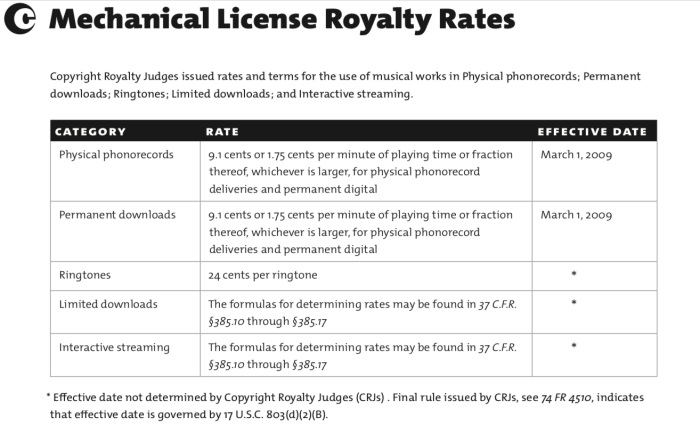
Recall that the crisis pertains to the so-called “Subpart B” mechanical royalties paid by record companies for permanent downloads, vinyl and compact discs. The mechanical rate has been frozen at 9.1¢ since 2008 and the Copyright Royalty Judges recently rejected a settlement among the NMPA, NSAI, Sony, Universal and Warner to extend the freeze in the Phonorecords IV proceeding. Having rejected the proposed settlement, the next step could be knock down, drop dead, drag out litigation that would, in my view, be totally unnecessary. Or the next step could be the labels and publishers submitting a new proposed settlement and asking for the Judges’ approval. 

Also recall that the Judges hinted at a potential deal they would like to see in their rejection of the proposed settlement that would essentially uplift the current 9.1¢ rate by an inflation factor since the rate was set in 2008, bringing the minimum statutory rate for all “Subpart B” configurations to 12¢ that would be further uplifted by an annual cost of living adjustment based on the Consumer Price Index (CPI-U in this case).

We’ve written about this topic so much that you’re probably sick of hearing about it–but if this source turns out to be correct, it’s a real step in the right direction by Universal taking a leadership role that will no doubt be controversial.

As I understand it, Universal may propose a minimum statutory rate of 10¢ for permanent downloads and 12¢ for both vinyl and CD configurations. All three rates would be adjusted annually by the Consumer Price Index (in a similar way that the Judges just indexed the webcasting royalty in Webcasting V applicable to sound recordings). This rate would apply to all songs–not just to George Johnson–as one would expect.

There’s no way to know at this point today whether all the participants in the Phonorecords IV proceeding will accept these terms, including George Johnson who has held out for a much higher minimum statutory rate. Some may scratch their head over why the download rate is less, but my suspicion is that it’s because Apple and Amazon have been inflexible on increasing the wholesale price and I could understand why a label would give themselves some headroom on downloads going into what will surely be highly inflationary times but at the same time agreeing a cost of living adjustment. (When the dust settles, it may be worth a discussion in the artist rights community about whether to campaign against Apple and Amazon.)

I do think it’s commendable if Universal is taking the first step toward bringing fairness to a process that has been unfair for many years. We’ll see what happens, but it looks like it could be light at the end of the tunnel. Watch this space.

The Effect of Unfrozen Mechanicals on Controlled Compositions

[A “controlled compositions clause” explainer for artists and songwriters by Chris Castle on MusicTech.Solutions]

Nice post by Ed Christman in Billboard explaining the continuing crisis on frozen mechanicals. Ed comes up with a rough justice quantification of the impact on songwriter and music publisher revenues in light of controlled compositions clauses in recording contracts that apply to (a) songs written and recorded by artists, or (b) songs by “outside writers” if and only if the artist can get the outside writer to accept the controlled compositions terms and rates.

For those reading along at home, one theory (aside from sheer leverage) that gets used in this context is that the artist/writer can agree on behalf of all co-writers to accept the terms of the license granted by the artist to the label in the controlled compositions clause because they are co-owners of an undivided interest in the song copyright and can grant nonexclusive licenses in the whole subject to a duty to account provided the license is not economic waste or self-dealing. Let’s just leave all that where it lays for now, but that story has never really been properly challenged–particularly the economic waste part given the rate fixing date issue and even the frozen mechanicals crisis itself. We’ll come back to that bit some other time.

The rate fixing date is a key part of the discussion for understanding the impact of unfreezing mechanicals. So what is that rate fixing provision? 

Remember, the controlled compositions clause starts with reducing the minimum statutory mechanical rate in the US (and in theory in Canada subject to MLA) in effect at a point in time. That point in time is either commencement of recording (booo!), delivery, release or sale of a unit embodying the song at issue. Remember that the labels only pay mechanical royalties on physical and downloads (the rates at issue in the frozen mechanicals crisis)–streaming services pay for the interactive streaming mechanicals (and there is no mechanical for webcasting, a whole other beef).

You say, wait–isn’t the mechanical rate 9.1¢? Why does it matter when the record was recorded, delivered, released or sold? Won’t the rates all be the same? And you’d be right if you were asking about a record recorded and released in 2006 or after, or a record recorded and released between 1909 and 1978, like, say some titles by Bob Dylan, The Beatles, Otis Redding or Miles Davis. 

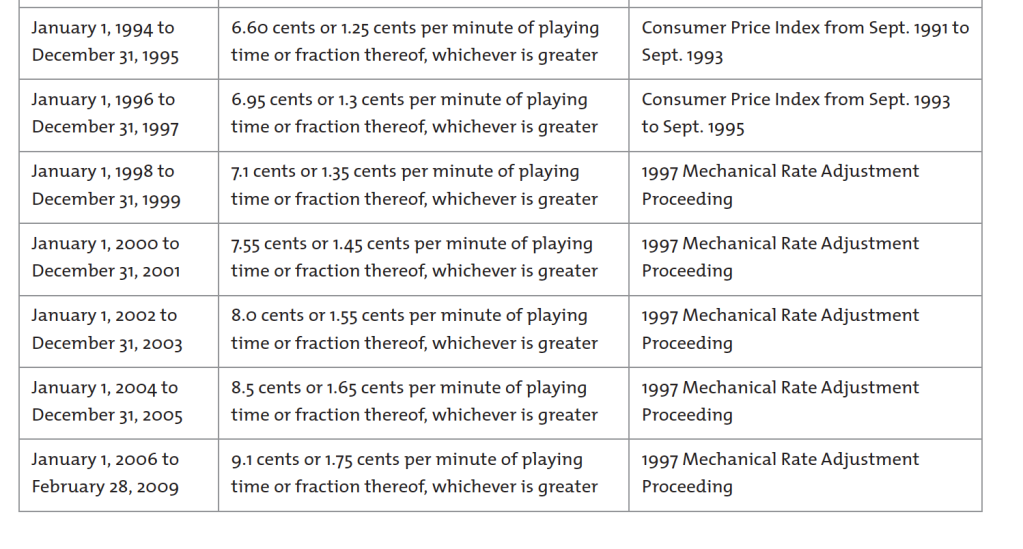
But–it wasn’t always this way. The mechanical royalty rate was set at 2¢ by Congress with the first statutory license, i.e., compulsory license, in 1909 and did not change until the 1976 revision of the US Copyright Act effective 1978. The rate then began to incrementally increase over the years until it reached 9.1¢ in 2006, a phased increase that was to compensate for Congress failing to increase the rate for 70 years, aka “the Ice Age”. The Congress really screwed up songwriters’ lives by freezing the rate at 2¢ during the Ice Age and songwriters and their heirs have been paying for it ever since, right up to the 2006-2022 period, aka “the Second Ice Age” or the Return of the Neanderthals. 

In an effort to help songwriters shovel out from the Ice Age, The Congress also authorized indexing the minimum rate to inflation from 1988 to 1995. Indexing is again on the mind of the Copyright Royalty Board right now–bearing in mind that an increase in rates due to inflation has nothing to do with the intrinsic value of the song copyrights so there’s no confusion. Indexing simply applies any increase in the consumer price index to the statutory rate and preserves buying power. In a way, it is the opposite of a case about value. Indexing assumes that the value issue was already decided (in this case in 2006) and simply preserves buying power so that the “nominal” rate of 9.1¢ in 2006 can still buy the same amount of goods or services in 2022 (or 2023 in the case of the CRB rate period). Otherwise the “real” rate, i.e., the inflation adjusted rate, is not 9.1¢ it is about 6¢.

Remember–the proposed rate increase to 12¢ by the CRB is not about value, it’s about buying power because it’s solely focused on inflation.

So back to controlled compositions. It is no coincidence that at the same time as the 1978 increases were phased in, the labels established controlled compositions clauses that knocked songwriters back down. They would probably not have gotten away with freezing by contract at 2¢ so they let the rate float up but much more slowly and with several caps. The first cap is the maximum number of songs, usually 10 or 11. The next cap is the infamous 3/4 rate, where the label pays based on 75% of the minimum statutory rate. But the third cap is the rate fixing date and that’s the one we want to focus on in the unfrozen mechanicals context.

In simple form, it looks something like this contract language:

If the copyright law of the United States provides for a minimum compulsory rate: The rate equal to seventy-five percent (75%) of the minimum compulsory license rate applicable to the use of musical compositions on audio Records under the United States copyright law (hereinafter referred to as the “U.S. Minimum Statutory Rate”) at the time of the commencement of the recording of the Master concerned but in no event later than the last date for timely Delivery of such Master (the applicable date is hereinafter referred to as the “Copyright Fixing Date”). (The U.S. Minimum Statutory Rate is $.091 per Composition as of January 1, 2006); 

The way that the statutory rate increases come into the controlled compositions clause is because from 1978-2006 the statutory rates increased across albums delivered across album cycles. If you consider that the rates used to increase about every two years and that an album cycle can be two years, it’s likely that LP 1 would have a lower rate than LP2, LP 2 than LP3 and so on right up to 2006.

Also remember that the increases in rates are prospective, meaning that the controlled compositions rate on recordings delivered in the future will, of course, get the higher rate, even if the past rates don’t change which they don’t, at least not yet. Also consider that permanent downloads often are excluded from controlled comp treatment and are paid at full rate, probably on the rate fixing date in the artist’s agreement. Sometimes the download rates “float” or increase in line with increases in the statutory rate, but that’s part of individual negotiations.

If there is an outside songwriter who does not agree to accept the artist’s controlled composition rate (and there are plenty of these) what happens? Typically the label will account to the outside writer at their full minimum statutory rate but will deduct that payment from the maximum aggregate mechanical royalty payable to the artist (i.e., the 10 song cap). There’s some twists and turns to this involving rates on different units “made and distributed”, but for our purposes there is one clear thing to understand:

Because of the rate fixing date which is frozen by contract (the Mini Ice Age) the artist/songwriter will be paying a higher mechanical to the outside writer from a frozen royalty “pool”. 

This is why you should always, always demand “protection” for at least one outside song in your contract and then review each album to determine if that needs to be increased. This is particularly true for records made in places like Nashville where the record company will demand you work with “A” list songwriters (assume none of whom will take 3/4 rate) and then try to deduct the difference between the uncontrolled rate and the controlled rate from you (and if it gets big enough, cross it to your record royalties). (Not only will A list writers not take the 3/4 rate, they’re pissed because they can’t charge you double stat like they do double scale for sessions.)

Example: You have a 10 x 3/4 rate cap on mechanicals, the “cap rate”. That’s the 68.25¢ album rate you hear about (10 x .75 x 9.1¢). Say you have 10 songs on your album and you wrote all of them. You get the entire 68.25¢. If you had two outside songs whose writers get 9.1¢ under current rates, you deduct 18.2¢ from the cap rate, and that leaves 50.05¢ as the “controlled pool” or the total mechanical royalty payable to the artist/songwriter (actually all controlled writers, but leave aside that wrinkle).

So you can see, that’s no longer a 75% rate, it’s actually more like a 55% rate.

Now let’s assume that the new rate is 12¢. Same calculation, two outside songs now get 24¢, but the cap rate stays the same because of the rate fixing date. During the Mini Ice Age, i.e., while that cap rate is fixed at 9.1¢ x 10 x .75, the controlled pool now is expressed as 68.25¢ – 24¢ = 44.25¢, or about 48% (44.25 ÷ 91). The artist’s publisher is not going to be wild about that; the outside writer’s publishers will be thrilled.

This will start to true up on the next LP that takes a rate fixing date after the 12¢ rates go into effect. In that situation you’d be increasing both sides of the equation, so the cap rate would increase to 90¢ (10 x .12 x .75). The outside writers still get 12¢ each for two songs (or 24¢) which is deducted from the cap rate to get a controlled pool of 66¢. The true controlled comp rate is then back to about 55%.

These effects will be less pronounced if you have protection for one or more songs (or fractions of songs) or you have a higher cap, say 11 or 12 instead of 10 (with corresponding increases on other configurations). But you see the trend line.

I think this leads to the conclusion that increasing the statutory rate is a huge step forward and we should all be grateful to the Judges. The rate fixing dates for catalog titles (really the entire rate fixing date concept) must also be considered and any new effort to tweak the controlled compositions clause to effectively nullify the Judges’ rate increase will no doubt cause further conflict.

One day Congress will again act to reduce the effects of the controlled compositions clause and especially the rate fixing date, but in the meantime the Judges may well visit the issue to the extent they are able before we see the Return of the Neanderthals.

Unfrozen: What will the new physical mechanical rates do to or do for valuations? — Music Tech Solutions

There are some decades in which nothing happens and some weeks in which decades happen. This was one of those weeks. You no doubt have seen that the Copyright Royalty Judges offered a breath of fresh air in the contentious and labyrinthine Phonorecords III and IV proceedings by refusing to accept the insider “settlement”…but if mechanical royalties have been understated, what does it mean for catalog valuations in the past and in the future? Looking at you, Bob Dylan!

Unfrozen: What will the new physical mechanical rates do to or do for valuations? — Music Tech Solutions

Frozen Mechanicals Crisis: Twelve Songwriter Groups Reject Majors Position that Copyright Royalty Board MUST Ignore Songwriter Objections

Second Comments Submitted by the Songwriters Guild of America, Inc.,  the Society of Composers & Lyricists, Music Creators North America, and the individual music creators Rick Carnes and Ashley Irwin

These Comments Are Endorsed by the Following Music Creator Organizations:

Alliance for Women Film Composers (AWFC). https://theawfc.com

Alliance of Latin American Composers & Authors (AlcaMusica) https://www.alcamusica.org

Asia-Pacific Music Creators Alliance (APMA), https://musiccreatorsap.org/

European Composers and Songwriters Alliance (ECSA), https://composeralliance.org

The Ivors Academy (IVORS), https://ivorsacademy.com

Music Answers (M.A.), https://www.musicanswers.org

Pan-African Composers and Songwriters Alliance (PACSA), http://www.pacsa.org

Screen Composers Guild of Canada (SCGC), https://screencomposers.ca

Songwriters Association of Canada (SAC), http://www.songwriters.ca


Discussion

  1.  The Statutory Importance of Interested, Non-Participant Comments to CRB Decision Making

While Congress may have expressed enthusiasm for joint rate setting proposals being developed through arms-length, independent negotiations among the parties to a CRB rate-setting proceeding (which clearly may not have been what transpired in the present case among vertically integrated parties),[1] Congress was also crystal clear in another of its related statutory directives.  Namely, that the CRB also has a duty to ensure that interested, non-participating parties who would be bound by the terms of the negotiated agreement are given the full opportunity to comment upon the proposal as part of the record of the proceeding prior to the proposal’s adoption or rejection by the CRB. 

Section 801(b)(7)(a)(i) of the US Copyright Act stipulates that:

[T]he Copyright Royalty Judges shall [1] provide to those that would be bound by the terms, rates, or other determination set by any agreement in a proceeding to determine royalty rates an opportunity to comment on the agreement and shall [2] provide to participants in the proceeding under § 803(b)(2) that would be bound by the terms, rates, or other determination set by the agreement an opportunity to comment on the agreement and object to its adoption as a basis for statutory terms and rates.  (Bracketed numbers added for clarity)

More importantly for the purposes of these Comments, Section 801(b)(7)(a)(ii) explicitly sets forth the authority of the CRB to accept or reject the proposed agreements of parties to a proceeding based upon the combination of comments and objections filed both by participants in the proceeding and outside, interested party commenters:

[T]he Copyright Royalty Judges may decline to adopt the agreement as a basis for statutory terms and rates for participants that are not parties to the agreement, if any participant described in clause (i) objects to the agreement and the Copyright Royalty Judges conclude, based on the record before them if one exists, that the agreement does not provide a reasonable basis for setting statutory terms or rates. (emphasis added)

In the present case, the Major Music Conglomerates (once again counterintuitively joined by NSAI) have chosen to simply ignore the statutory requirements, set forth above, and focus solely on issuing a blanket rejection of the comments of pro se participant George Johnson (who formally objected to the proposed agreement).  In fact, in their submission to the CRB of August 10, 2021,[2] the Major Music Conglomerates did not even bother to mention the detailed comments of those many individuals and groups who, on behalf of their constituents comprising a large percentage of the US’ and the world’s music creators, filed detailed comments with the CRB objecting to the proposed frozen mechanical rate deal as unreasonable.  

Rather, the Conglomerates opted instead to stand solely on the following, naked assertion:

Mr. Johnson provides no basis for the Judges to reject the Settlement. Mr. Johnson makes unfounded accusations of fraud and inaccurate statements concerning the corporate structure of record companies, but provides no economic reason to believe that the rates in the Settlement are outside the “zone of reasonableness.” This is nothing more than a rehash of arguments he made and the Judges rejected when a similar settlement was presented in Phonorecords III….

Objections to a settlement that is substantially the same as the one adopted in Phonorecords III, absent a showing of changed market conditions that would support a change in the rates and terms for Subpart B configurations at this time, do not permit the Judges to “conclude that the agreement reached voluntarily between the Settling Parties does not provide a reasonable basis for setting statutory terms and rates.” (citation omitted). Thus, as in Phonorecords III, “the Judges must adopt the proposed regulations that codify the partial settlement.”[3] (emphasis added).

This evasive and misleading statement is counter-productive to upholding the Congressional mandate that all interested parties be heard –even those unable to afford the hundreds of thousands of dollars required to participate effectively in the formal rate-setting proceedings. 

To repeat the obvious, when they filed the above comments, the Major Music Conglomerates were fully aware that Mr. Johnson was by far not the only person or entity to have filed detailed objections with the CRB to the frozen mechanical proposal, including the extensive comments of the Independent Music Creator groups who are the signatories hereto that had been submitted some two weeks prior to the filing of the Major Music Conglomerates’ comments on August 10, 2021 and reported on and published in the press.[4] 

Specifically, some two dozen other organizations and individuals filed or endorsed comments[5] detailing with great specificity the unreasonable nature of the frozen royalty rate proposal made by the Major Music Conglomerates, owing to drastically changed market conditions that include the damage of long-term and now accelerating inflation, the growing length in time of the current freeze, and the demonstrably re-emerging physical phonorecord, download/Non-Fungible Token (NFT) markets amounting to tens of millions of dollars in annual royalty revenue for music creators.  Those issues were spelled out extensively in our own Comments of July 26, 2021, and later updated in our Letter of October 20, 2021. 

There is little mystery why the Major Music Conglomerates would choose not to acknowledge the existence of these many music creator dissenters, or to comment on what those dissenters had to say.  As the CRB itself noted presciently in its Phonorecords III determination, “NMPA and NSAI represent individual songwriters and publishers.”  For them to “engage in anti-competitive price-fixing at below-market rates,” would be against the interests of their potential constituents, who would likely “seek representation elsewhere” if they were so concerned.[6]  

In the current instance, the Major Music Conglomerates seem to be actively seeking to obfuscate the fact that this result, for whatever reason, is exactly what has transpired.  The multiple sets of comments received by the CRB from US and global music creator advocacy groups bluntly criticizing the frozen royalty rate proposal signify the raising of voices of those representing a vast portion of the world’s music creators against the proposal’s obvious inadvisability and irrationality.  The isolated support for the proposal by NSAI, an organization that represents only a tiny sliver of US songwriters and composers principally from a single genre and local geographic area (and whose underwritten presence in the proceeding raises significant questions about whether it can truly represent any collection of songwriters and composers – let alone the actual, diverse universe whose rights and livelihoods are presently at stake), has been drowned out by hundreds of thousands of other music creators arguing substantively through their organizational representatives against the thoroughly unreasonable nature of extending frozen rates for another five-year period. 

Thus is the specious nature of the Major Music Conglomerates’ central claim –that the CRB has neither the authority nor sufficient reason to reject the proposed mechanical rate freeze as unreasonable– demonstrated.  Fulfilling all statutory requirements, a participant in the proceedings (George Johnson) has objected to the privately negotiated deal concocted by the vertically integrated Conglomerates.  Further, numerous interested commentators who “would be bound by the terms, rates, or other determination set by the agreement” have joined with Johnson in providing to the CRB amply detailed comments demonstrating significant, multiple changes in circumstances that make the proposed agreement unreasonable and irrationally flawed in 2021. 

Under such circumstances, the CRB would be well within the scope of its statutory authority to either “decline to adopt the agreement as a basis for statutory terms and rates for participants that are not parties to the agreement,” or to reject it altogether.  We prefer the latter, but respectfully suggest that it should most certainly do one or the other.

Moreover, the assertion by the Major Music Conglomerates that the CRB lacks sufficient reason or authority to review the Memorandum of Understanding (“MOU”)[7] negotiated and agreed upon concurrently with the Frozen Rate Proposal for its effect on that rate proposal, is equally without merit.  In their submission of August 10, 2021, the Conglomerates go so far as to claim that they “did not present the MOU to the Judges because they viewed it as routine, and irrelevant to the Judges’ decision-making concerning the Settlement.”  To put it mildly, the Songwriter and Composer community views this statement with uneasiness as it pertains to the general issues of fairness and transparency in the Phonorecord IV proceeding, and hopes the CRB shares our concerns.

It suffices to say that two agreements –negotiated side by side with one another at the same time by the same parties regarding details of the same general matter—inarguably stand a substantial chance of being inter-related through both their content and potential quid pro quos.   We therefore believe it obvious that in evaluating the fairness and reasonableness of one, the terms and scope of the other should be considered as a matter of course for reasons of both best practices and common sense. 


[1] As stated in our Comments of July 26, 2021, it is by no means clear that the “negotiations” which took place among the vertically integrated participants in developing the frozen mechanical royalty rate proposal were at arm’s length.  “The circumstances under which the settlement negotiations were conducted that produced the proposed royalty rate freeze set forth in the May 25 Motion to Adopt can be fairly characterized  –under the above standards– as being exactly the opposite of what both Congress and the Executive Branch have in mind in defining “reasonability” under the “willing seller-willing buyer” formula.  Rather than arm’s length negotiations between parties on opposites sides of the table, the referenced discussions that produced the settlement agreement instead seem to have taken place solely among vertically integrated parties and their trade association agents, apparently with little or no input from independent music creators and copyright owners[1] upon whom “those rates and terms [will be] binding.”  See, Comments of July 26, 2021 at 8-9.  

[2]  https://app.crb.gov/document/download/25577

[3] https://app.crb.gov/document/download/25577 at 4-5.

[4] See, e.g., https://thetrichordist.com/2021/07/27/frozen-mechanicals-crisis-davidpoemusics-comment-to-the-copyright-royalty-board/ and https://thetrichordist.com/category/frozen-mechanicals/.

[5] See, https://app.crb.gov/case/detail/21-CRB-0001-PR%20%282023-2027%29 for comments filed between dates July 19 and August 2, 2021.

[6] Phonorecords III at 15298.

[7] According to the Major Music Conglomerates: “Specifically, this memorandum of understanding (“MOU”) provides for (1) participating record companies and music publishers to work collaboratively on licensing processes to improve clearance of new releases, (2) a procedure for bulk distribution of mechanical royalties accrued by participating record companies that are not otherwise payable, and (3) late fee waivers when participating record companies follow specified clearance procedures for new releases.” See, https://app.crb.gov/document/download/25577 at 6.

[Read the entire comment here]

Frozen Mechanicals Crisis: 2nd Comment of @helienne @davidclowery @theblakemorgan Opposing Conflict of Interest in Frozen Mechanicals–‘Let the future have a vote’

SECOND REOPENING PERIOD COMMENTS OF HELIENNE LINDVALL, DAVID LOWERY AND BLAKE MORGAN 

            Helienne Lindvall, David Lowery and Blake Morgan (collectively, the “Writers”) thank the Judges for the opportunity and respectfully submit the following comments responding to the Copyright Royalty Judges’ notice (“Second Notice”) soliciting comments on additional materials (“Reply”) received by the Judges[1] from the National Music Publishers Association, Nashville Songwriters Association International, Sony Music Entertainment, UMG Recordings, Inc. and Warner Music Group Corp. (collectively, the “Majors”)[2] regarding the so-called [frozen] “Subpart B” statutory rates and terms[3] relating to the making and distribution of physical or digital phonorecords of nondramatic musical works in the docket referenced above (“Proceeding”). 

The Writers previously submitted comments[4] (“Prior Comment”) responding to the Judges’ notice[5] (“First Notice”) soliciting comments on the Major’s proposed purported settlement (the “Proposed Settlement”)[6] of the Subpart B rates.  The Writers along with attorney Gwendolyn Seale[7] attempted to submit additional comments in response to the Majors’ filing but were not able to timely file that response.[8]  The Writers appreciate the Judges’ decision to reopen the comment period in order to afford the public, and those that would be bound by the rates and terms set by the Proposed Settlement,[9] an opportunity to comment on those additional materials filed by the Majors and to further participate in the rulemaking.[10]

I.  SUMMARY
            As a general comment on the record to date in Phonorecords IV, the Writers are mystified by the histrionics that have become associated with this Proceeding both on the record and in the press. A voluntary negotiation is just a deal, often made by people who are paid to always be closing. The Writers believe that Congress intended that voluntary negotiation produce a fair result on a reasonable timetable.  

 While not directly at issue in the reopened comment period, what is clearly the case is that the settlement of the Subpart B rates has unnecessarily become a major gating item for the streaming side of this Proceeding, geese and ganders being what they are.  Despite the extensive voluntary negotiation period for the Subpart B rates by the Majors, the Judges—and, frankly, songwriters around the world–are presented instead with a cornucopia of chaos across the board; the cherry on top is the frozen mechanicals crisis.  However, in this season of hope the Writers are confident that the Judges will lead us all out of this daunting situation.

The Writers are not interested in the personalities, the arm-waving or the finger-pointing.  They are interested in the results, particularly because neither they nor anyone they authorized had input into the negotiation that produced either the Proposed Settlement or the impasse.

There is at least one easy way to fix this and recognize the intrinsic value of songs:  Raise the statutory rate proposal for Subpart B configurations in at least some relation to the streaming rate increase.  A song is no less valuable because of the medium in which it is exploited.[11] 

As the Writers will argue, just like the voluntary agreement on Subpart B that led to this impasse was reached by the Majors, those same parties can go back to the drawing board to reach an appropriate conclusion with a higher Subpart B rate.  

Neither the public nor the songwriters are well served (and frankly neither are the Judges) by thrashing about and waiving arms. This may serve well the people who are paid by the hour but it hasn’t served people who are paid by the song.  At all.  “Victory” without winning may pass for success in Washington, but it does not in the writer room or at a songwriter’s kitchen table.

            The Proposed Settlement is a crystallization of everything that is wrong with the licensing and payment practices that have arisen under the compulsory license regime where no is yes, more is less and the Kool-Aid whispers “Drink Me.”  

While the Writers will focus in this comment on the frozen mechanicals issue that has become emblematic of the current crisis, it must be said that the decade-plus MOU [black box] agreements are a backward looking and inequitable insider arrangement that permits a mindset of sloppiness and a “kick the can down the road” mentality that debilitates the entire music publishing business.[12]  It’s no accident that the Mechanical Licensing Collective—run by largely the same cast of characters under a jaw-dropping Congressional governance mandate—has been sitting on $424,000,000 of other peoples’ money for nine months during a pandemic with no visible compliance with another Congressional mandate of paying songwriters correctly in Title I of the Music Modernization Act.[13]  

            The MLC and the sequence of MOUs are both descended from the same ancestors a generation ago.  Each have essentially the same business model and each are somehow inexplicably viewed as a “win” for the songwriters.  The irony of splicing the genetic code of the ancien régime MOU [black box insider settlements] to the future is not lost on anyone.  If the failure to match money and songs in the MOU process is still a problem after fifteen years as well as the much-trumpeted Title I of the Music Modernization Act, it’s not the horse’s fault.  It’s the rider’s.

            It would be a real pity for the CRB to perpetuate this unfairness by adopting the Proposed Settlement.  With respect, it is bad law, bad policy, and a failure to even try to bend the arc of the moral universe.  Conversely, rejecting the Proposed Settlement would provide the kind of steely oversight tragically lacking in the current regime.  Please let the future have a vote, just once.

            The Writers object to the Proposed Settlement for the following reasons and respectfully suggest constructive alternatives.  The gravamen of our objection is that (1) the Subpart B rates have already been frozen since 2006 and extending the freeze another five years is unjust; (2) no evidence has been publicly produced in the Proceeding that justifies or even explains extending the proposed freeze aside from the connection to the memorandum of understanding in the MOU4 late fee waiver (“MOU”), a document that the Majors only recently disclosed in their Reply; (3) very large numbers of songwriters and copyright owners of various domiciles around the world and national origins are unlikely to even know this Proceeding is happening and there still is no evidence that the unrepresented have appointed any of the participants to act on their behalf or were asked to consent to the purported settlement before the fact even if they were members of these organizations aside from the respective board of directors; (4) physical sales are still a vital part of songwriter revenue (which the Writers documented in the Prior Comment[14]); and (5) there are many just alternatives available to the Judges without applying an unjust settlement to the world’s songwriters who are strangers to the Proposed Settlement and in particular the MOU component (as the MOU will likely require membership in the NMPA to benefit consistent with prior MOUs).

[Read the full-length original filing here.]


[1] 86 FR 58626.

            [2] NMPA, NSAI, Sony Music Entertainment, UMG Recordings, Inc. and Warner Music Group Comments in Further Support of the Settlement of Statutory Royalty Rates and Terms for Subpart B Configurations, Determination of Royalty Rates and Terms for Making and Distributing Phonorecords (Phonorecords IV), Copyright Royalty Board (Aug. 10, 2021).

            [3] 37 C.F.R. §385.11(a).

            [4] Comments of Helienne Lindvall, David Lowery and Blake Morgan, Determination of Rates and Terms for Making and Distributing Phonorecords (Phonorecords IV) (July 26, 2021) available at https://app.crb.gov/document/download/25533.

[5] 86 FR 33601.

            [6] Motion To Adopt Settlement of Statutory Royalty Rates and Terms for Subpart B Configurations, Docket No. 21-CRB-0001-PR (2023-2027).

            [7]  Ms. Seale does not otherwise join in this comment.  We understand she is filing a separate comment regarding the additional materials.

            [8] The Writers’ reply was posted on The Trichordist website available at https://thetrichordist.com/2021/08/16/frozenmechanicals-crisis-unfiled-supplemental-comments-of-helienne-lindvall-davidclowery-theblakemorgan-and-sealeinthedeal/.  Parts of that unfiled comment are included in this comment.

[9] See 17 USC 801(b)(7)(a)(i).

                  [10]  As with the Writers prior submission in response to the First Notice, the Writers focus in this comment almost entirely on the Subpart B rates applicable to physical carriers under 37 C.F.R. §385.11(a).  

            [11] The Judges no doubt will be told many stories about how Subpart B configurations are not meaningful sales compared to streaming so rates deserve to be frozen.  This is a novel copyright argument without a statutory basis.  The theory is also not based on accurate facts as the Writers discuss extensively in the Prior Comment at paragraph 5 and will not repeat here.

            [12] There is a growing backlash to decades of delaying definitive action on song metadata and songwriter payments such as Credits Due campaign of the Ivors Academy and Abba’s Björn Ulvaeus.  See generally Chris Cooke, PPL Backs Björn Ulvaeus’s Credits Due Campaign, Complete Music Update (Oct. 4, 2021) available at https://completemusicupdate.com/article/ppl-backs-bjorn-ulvaeuss-credits-due-campaign/

            [13] See, e.g., H. Rep. 115-651 (115th Cong. 2nd Sess. April 25, 2018) at 5; S. Rep. 115-339 (115th Cong. 2nd Sess. Sept. 17, 2018) at 5 (“The Committee welcomes the creation of a new musical works database that is mandated by the legislation….Music metadata has more often been seen as a competitive advantage for the party that controls the database, rather than as a resource for building an industry on.” (emphasis added)).

            [14] See Prior Comment at 16.

Frozen Mechanicals Crisis: Monica Corton Tells Copyright Royalty Board that Without Parity, the Music Ecosystem Will Fail

Honorable Judges:

My name is Monica Corton, and I am the CEO and Founder of Go to ElevenEntertainment, a newly formed independent music publishing company that is funded. I have been in the music publishing business for over thirty years, twenty- seven of which were spent as the Senior Executive Vice President of Creative Affairs & Licensing at Next Decade Entertainment. My experience is in all areas of music licensing, registrations, and royalty payments, and my former clients included the catalogs of the band Boston, Harry Belafonte, Vic Mizzy (the “Addams Family Theme” and “Green Acres Theme”), Sammy Hagar, and many more.

It is my understanding that the CRB judges are being asked to accept a Motion to Adopt a freeze or a non-rate increase for all mechanical licensing uses for physical phonorecords, i.e., CDs and vinyl, permanent digital downloads, ringtones and music bundles (whenmultiple songs are downloaded in groups) for the Rate Period of 2023 to 2027. The rates for these types of uses have been frozen and have not increased for any music publisher or songwriter since 2006. In the past, the National Music Publishers Association (“NMPA”) has explained these freezes as a necessary component to their negotiation for an increase in the digital streaming rates for mechanical licenses. For many years (2006-2021), I have gone along with this explanation, but after fifteen (“15”) years of having noincrease on any physical product or digital downloads, I now believe it is completely unfair and no longer justifiable for music publishers and songwriters, particularly the

independents and DIY creators (do-it-yourself), to have been denied an increase in these rates after fifteen (15) years of allowing record labels to get away without paying any increase whatsoever, and now face being blocked from a raise for another five (“5”) years.

I originally wrote comments to you on July 26, 2021, and I have included thosecomments below. As there was an extension provided, I felt I should augment my former submission to you with a practical reason for why I believe that physical and digital download mechanical royalty rates should increase, at least by a cost of living, forsongwriters and publishers for the Rate Period 2023-2027.

The one format in physical product that seems to be surging now is vinyl. If one visitsthe Amazon.com shop, new releases of vinyl are selling anywhere from

$24.98 to $49.99 at retail. Generally, the wholesale selling price for a label is half of the retail selling price. Therefore, in this scenario, the labels are making anywhere from $12.49 to $24.99 per unit. Under the current physical mechanical rate which would stay the same if you decide not to increase the royalty rate for physical copies and digital downloads, a publisher would be paid $.91 per record with a ten (10) song cap (standard practice) for the right to use all the songs on that release. However, most singer/songwriters have what is called a controlled composition clause in their recording agreement which requires that they agree to a reduced rate of 75% of the statutory rate with a cap of ten (10) songs. This means that the real rate for most singer/songwriters onan album is $.6825 for all the songs on any given album.

Therefore, the label is making anywhere from $11.8075 to $24.3075 of which a small portion will be paid to the artist for artist royalties and some portion will be paid for the expense of making the record and distributing it. The songwriter and the publisher will thereafter, divide the $.6825 in half so that the songwriter will eventually receive $.3412 for the ENTIRE ALBUM of songs, often recording and releasing more than ten songs because creatives tend to release 12-14 songs on any given album which further reducesthe mechanical rate per song.

I ask you, does it seem fare to you that the record label should make $11.875 to

$24.3075 per record and the singer/songwriter who wrote EVERY SONG ON THE ALBUM will make $.3412?

Songwriters rarely get a say in any of these hearings. Digital rates have devastated whole swaths of our creative songwriter community. Please consider that after fifteen (15) years,it’s time to increase the physical mechanical rate and the digital

download rate for songwriters and publishers. We must create some kind of parity for songwriters in the sale of physical product and digital downloads, or our musicecosystem will begin to fail.

Best wishes, 

Monica Corton CEO & Founder

Go to Eleven Entertainment

[Read the original comment here]

Frozen Mechanicals Crisis: Independent Publisher Lynn Robin Green Tells Copyright Royalty Judges how they threaten Survival

President Lynn Robin Green
LANSDOWNE MUSIC-WINSTON MUSIC PUBLISHERS
BLOOR MUSIC-HOFFMAN HOUSE MUSIC

PO BOX 1415 BURBANK, CA 91507

I have been a Music Publisher 45 years and the FREEZING of the statutory mechanical rate which hasn’t been raised in many many years CAUSES us undue continual financial hardship.

The low streaming rates have decimated our earnings for my Writers and Administrated Publisher Clients for the last six years and have have forced us into a corner financially to try to make up for this deep loss of revenue. I administrate also 39 Publishing firms here and these streaming losses are continual.

The Mechanical sales and Sync licensing fees are our only solid source of revenue to try to compensate for these deep losses. Its imperative that THE MECHANICAL RATES BE unfrozen asap and REMADE for REALISTIC FACTUAL inflation considerations of 2021 and for a willing seller/buyer in todays actual market.

We can’t survive if this RATE of 9.1 cts IS NOT raised and adjusted FAIRLY by the CRB for these very urgently important considerations. The Parties who are trying to freeze the rates here are highly conflicted and their sole interests are purely as Parties to Technology deals- and are self projected- and they SIMPLY violate any FAIRNESS OF MECH RATES FOR ALL PUBLISHERS AND SONGWRITERS concerned.

Please listen, please consider the Creators and the Independent Music Publishers who would suffer undue catastrophe level FURTHER financial loss if that RATE is DEEMED frozen for any more additional years whatsoever. WE absolutely URGENTLY need this rate increase NOW, its beyond crucial to our way of business and I implore the CRB to listen to the Independents and Creators and KNOW the truth and hard reality of what THIS important decision represents for our future. 

WE MUST RAISE the mechanical rates, and help save this business of publishing from being plundered for large Corporate interests, WITHOUT FAIR or competitive compensation for small independent businesses.

Sincerely 

LR Green

[Read original comment as filed]

Sneaky Services Use Frozen Mechanicals Public Comments by Songwriters and Independent Publishers–to LOWER Streaming Mechanicals

Only drug dealers and Big Tech refer to their “customers” as “users.”

We really appreciate how Trichordist readers have stuck with the story we have been telling about the treachery afoot at the Copyright Royalty Board in the current review of statutory mechanical royalty rates. This is kind of dry stuff but it sure has resulted in a lot of passion from the songwriting community.

That passion is directed at the frozen mechanical–the collaboration between the big publishers and big record companies to “freeze” the statutory mechanical royalty for physical goods at 2006 levels despite the current inflationary crises and debasement of the value of even the frozen rate itself. We will have more to publish on that subject to call your attention to the voices of songwriters and publishers opposing the freeze.

Ask yourself this question: Is there any reason that a songwriter who opposes a freeze on mechanicals–the only question they were asked to respond to by the Copyright Royalty Board–would ever support a reduction in the streaming mechanical? Would anyone say, oh, well if Spotify is asking for a reduction, then by all means? If you thought the passion against frozen mechanicals ran high, you ain’t seen nothing yet.

But in one of the great acts of self-sabatoge that they are so good at, that passion is currently being hijacked by some of the biggest companies in commercial history to somehow convince us that less is more. Remember–these are the same people who benefit from the sick mass manipulation and addiction practiced and normalized by the Stanford Persuasive Technology Lab.

And now they are trying to use that trickery and psychology on songwriters to gaslight them into ignoring reality and supporting the chaos at the Copyright Royalty Board.

We will be posting a series of excerpts from public filings in coming days. If you want to skip ahead, you can read this letter from Chris Castle to the Copyright Royalty Board roasting the services for twisting the words of Helienne Lindvall, David Lowery and Blake Morgan.

Songwriter Needs Help: GoFundMe Fundraiser for Hugh Prestwood and Judy Ahrens–ArtistRightsWatch

By Chris Castle

[This post first appeared on ArtistRightsWatch.]

If you ever thought we were too aggressive in our campaign to end the 15 year freeze on statutory royalties for physical, consider the situation of songwriter Hugh Prestwood and his wife, photojournalist Judy Ahrens. Songwriters and photographers are two occupations that are devastated by the digital blight that has visited apocalyptic devastation on creators.

As Hugh says in their GoFundMe page, his songwriting income was destroyed by the massive change in the economics of songwriting that split apart the album format with no commensurate increase in songwriter royalties. Songs became a major driver of wealth for hardware manufacturers and Internet providers (remember dancing cows chanting rip, mix, burn?) in the 2000s, and streaming drives wealth for catalogs and platforms. The doubling effect of Moore’s Law imposes a halving effect on creator royalties. Hugh and Judy are living proof of what happens to an aging population of creators who could not have possibly planned around the digital blight–other than learning to code, I guess.

Of course we want to encourage readers to contribute what you can to Hugh and Judy’s GoFundMe, but we also want to make a larger point. 

The Copyright Royalty Judges need to understand that there are real consequences to real people when they freeze mechanical royalties. While the Judges are not responsible for all the harms that accrue to songwriters in the rigged statutory licensing and royalty scheme, they do play a part and they can make a difference. Songwriters may not expect the Judges to fix their problems, but they do expect them not to make it worse. Freezing rates for 15 years makes it worse.

The Judges should also understand that they have an opportunity to do something to add fairness back into the system that the Judges effectively control. Creators like Hugh and Judy will never appear in their courtroom alongside the well-heeled lobbyists and lawyers who make millions off of the rate proceedings and the black box in what has become a laughingstock. 

Congress, too, needs to listen up. It is well past time for a songwriter advocate to be a permanent part of the Copyright Royalty Board proceedings for mechanical royalty rate settings. A songwriter advocate would speak for people like Hugh and Judy. As Linda said of Willie Lohman in Death of a Salesman, “Attention must be paid.” I’m not asking that songwriters should be able to overrule the lobbyists, although that’s not a bad idea.

But at least hear them out before they’re all gone.

All Economic Indicators Are Flashing Red at the Copyright Royalty Board on Frozen Mechanicals–MusicTech.Solutions

by Chris Castle

All of the economic indicators are telling us that inflation is going to be around for a while–so songwriters should expect some cost of living adjustment based on the Consumer Price Index when the Copyright Royalty Board sets mechanical royalty rates, especially for the frozen mechanical rate on physical phonorecords. Why do I say that?

The U.S. Consumer Price Index closed 2021 at 7%. That is the highest inflation level since 1982–and remember in 1982 the U.S. had already had a solid two to three years of Federal Reserve Chairman Paul Volker’s anti-inflationary surge after the malaise of the 1970s.

The Producer Price Index for 2021 was measured at 9.7% by the Bureau of Labor Statistics, the largest calendar year increase since 2010. The PPI is a leading indicator of inflation as measured by the CPI because it measures a large basket of raw inputs and future price increases that will affect the CPI in weeks or months.

The University of Michigan survey of consumer sentiment fell to 68.8%, its second lowest level in a decade (the lowest being in November 2021). The survey also measured “confidence in government economic policies is at its lowest level since 2014.” The consumer sentiment survey indicates that consumers expect bad times ahead, or at least expensive times. This can have a pronounced effect on consumer inflation expectations.

Consumer inflation expectations remained unchanged after rising strongly over the last year, particularly the one-year outlook. Inflation expectations can be a self-fulfilling driver of inflation for a number of reasons such as FOMO pricing on homes and cars as well as wages–if you expect inflation to rise x% in the next 12 months, today you will seek wage increases of at least x% (if not more).

All of this tells us that the entire idea of extending the freeze on statutory mechanical royalties gets more absurd by the day. It’s entirely reasonable to “index” statutory mechanical royalties during the current rate setting period of 2023-2027 as we’ll all be very lucky to get through that period without suffering crippling inflation that will further erode the 2006 rates the CRB has used for the past 15 years.

[Why this wasn’t fixed in Music Modernization Act is anyone’s guess. This post first appeared on MusicTech.Solutions]