Streaming Mechanical Complexity Begets Complexity Begets Legal Fees

Remember how the physical mechanical increased from 9.1¢ to 12¢? And it applies to each record sold? If a songwriter got a cut and the artist sold 100 records, the songwriter got $12. That’s $12 today, next month, six months from now. You could plan. You could complain about a statement to the record company. If the record company wanted you to write more songs for their artists, they’d listen and might even fix an error on your statement. Remember: On records and downloads, the record companies pay.

But what about streaming? The record companies don’t pay on streaming, Big Tech pays. The biggest corporations in the world pay: Spotify, Amazon, Apple, Google, Pandora, and their dozens of lawyers. Artist Rights Watch posted a series of Tweets that shows excerpts from the proposed regulations to calculate streaming royalties–and remember this is the one that we’re told is the important one, the one that dozens of lawyers spend millions in legal fees to come up with. It reads kind of like a drunk you can smell a block away but who sits down next do you and asks how do they look for three days?

The first think you realize is that unlike the 12¢ rate for physical, there’s no way anyone call tell a songwriter how much they’re going to make today or next year on a per play. They can’t even tell you how much you’re going to make today for a burger next Tuesday. Or Wednesday. Or Thursday. But one thing you definitely know is that the lawyers are going to make bank writing this crap, appealing this crap, renegotiating this crap. This section here is a big part of what the fight is all about, can you believe it? This is what the Big Boys and Girls think is important and you can understand why. It puts more legal fees on the table and you know who eventually pays for the legal fees one way or another? Take a look in the mirror.

And understand this: If you get a royalty statement for streaming royalties, take a look at the per-stream rate! It usually starts three or four or even five zeros to the right of the decimal place. It’s even worse than the recording royalty. And DIMA wants us to fight among ourselves against the record companies after all this?

@davidclowery and @musictechpolicy Talk Copyright Royalty Board on Who Knew: The Smartest People in the Room

Big thanks to Tom Truitt and the wonderful audience!

David and Chris discuss improvements in the Copyright Royalty Board rules and procedures including:

–A songwriter advocate as a permanent independent representative of songwriter interests and participant in the Phonorecords proceedings with full rights of a participant. All other participants would bear the cost of the advocate. Other participants would be prohibited from using the advocate as a way to engage in overreaching discovery against individual songwriters or their publishers.

–Each participant would be limited to one lawyer representing their interests in the Phonorecords proceedings. This would counteract the current abuses forced upon the CRB and intimidation tactics of Big Tech.

–Songwriters would be permitted to form a bargaining collective with a general antitrust examption.

–Music users who appeal the Judges’ rulings must pay higher rates pending appeal.

–Discovery would be extremely curtailed to protect songwriters from abuses by Big Tech to punish and intimidate songwriters such as that currently being imposed by Google and other Big Tech companies without songwriter consent or even notification.

–Should songwriters get an across-the-board antitrust exemption under competition law (like the Sherman Act)?

Save the date: A2IM Indie Week Panel with @musictechpolicy on the Impact on Indie Labels of Unfreezing Mechanicals

If you are coming to Indie Week, Trichordist readers might enjoy a panel Chris Castle is on to discuss the impact on indie labels of the Great Unfreeze! 

Entitled How the CRB’s Rejection of Frozen Mechanicals Will Affect Your Label?, the panel goes off at 10:30 am ET on Wednesday, June 15 at the New York Law School.

Speakers are Victor Zaraya: Concord (Moderator), Danielle Aguirre: NMPA (National Music Publishers’ Association), Glen Barros: Exceleration, and Chris.

If you want to read up on the issues that caused the Copyright Royalty Board to reject the failed settlement, here’s some background:

Copyright Royalty Board’s Rejection of NMPA, NSAI, Sony, Warner, Universal settlement

Copyright Royalty Board’s Reaction to Second Settlement Proposal by NMPA, NSAI, Sony, Warner and Universal

Survey Results from Songwriter Survey on Frozen Mechanicals

Comments:

Rosanne Cash

Helienne Lindvall, David Lowery, Blake Morgan

David Poe

Abby North, Erin McAnally, Chelsea Crowell

Kevin Casini

NMPA, NSAI, Sony, Warner, Universal Comment with Copy of MOU4

Chris will post about the panel afterward.

@DavidCLowery to Receive American Eagle Award at NAMM 6/2/22

[Big thank you to the National Music Council for recognizing David with their American Eagle Award.]

Dear Mr. Lowery,

I am writing on behalf of the Board of Directors of the National Music Council, which is well aware of your inspiring and longstanding work in both music education and the championing of music creator rights (especially in regard to ensuring fair remuneration to composers, songwriters and artists). In that regard, I am pleased to inform you that the opportunity arose today (as we sat in our board meeting at the BMI Offices in New York) for NMC to honor with you with its American Eagle Award for 2022.

Unfortunately, due to the exigencies of the pandemic, we are on an incredibly short timeline regarding the presentation of the Award at the NAMM Conference Dinner just two weeks from now (the NAMM Dinner on June 2 at 7pm in the Los Angeles area). It was unclear until today
that the Dinner Event would actually take place. Your transportation and lodging would be paid for by NMC, and the presentation would be made by your colleagues SGA President Rick Carnes and NMC Chair Charlie Sanders.

As you may know, the prestigious American Eagle Award is given each year to individuals who have made a truly significant contribution to the support, development and teaching of music in this country. Past winners have included Kris Kristofferson, Lionel Hampton, Dizzy Gillespie, Van
Cliburn, Benny Goodman, Morton Gould, Dave Brubeck, Marian Anderson, Lena Horne, Roberta Peters, Clive Davis, Hal David, Tom Chapin, Sesame Street Productions, Herbie Hancock, Quincy Jones, Roberta Guaspari and many other musical and educational luminaries.

The awards presentation will be the evening of Thursday, June 2nd. The ceremony will take place in Anaheim, CA. The ceremony will coincide with the NAMM show.

Series 3 of the @ArtistRights Watch Podcast is here! Nik Patel, @DavidCLowery, @MusicTechPolicy and @KCEsq Discuss The Future of Frozen Mechanicals — Artist Rights Watch

Series 3 of The Artist Rights Watch Podcast is here! Nik, David, and Chris are joined by attorney Kevin Casini to talk about the latest with the Copyright Royalty Board and mechanical rates in the Phonorecords IV proceeding and discuss alternatives so songwriters are better represented at the CRB compared to the status quo. 

Check out the podcast here!! Available on all platforms! 

ARW Podcast S3E1: Unfreezing Mechanicals show notes

On the this episode of the Artist Rights Watch, Nik, David, and Chris sit down to talk about the recent developments with the CRB and mechanicals with lawyer and advocate, Kevin Casini. The Copyright Royalty Board who herein will more than likely be referred to as the CRB, ‘is a US system of three copyright reality judges who determines rates and terms for copyright statutory licenses and make determinations on distribution of statutory license royalties collected by the US Copyright Office.’ The US mechanical royalties are determined by the CRB and they meet every 5 years to determine the rate. Songwriter groups argued for a higher rate, and the CRB agreed. On March 29, 2022 the CRB agreed to unfreeze the $0.091 mechanical royalty rate which would commence a fight for a new rate in the 2023-2027 period. Over the past few years, there has been numerous criticisms about the constant rule for freezing the mechanical royalty rate. The royalty rate currently is $0.091 which was set back in 2006, and frankly, songwriters are making less  money due to economic inflation.

Show Notes and Background Materials

Copyright Royalty Board’s Rejection of NMPA, NSAI, Sony, Warner, Universal settlement

Survey Results from Songwriter Survey on Frozen Mechanicals

Selected Frozen Mechanicals Comments:

Rosanne Cash

Helienne Lindvall, David Lowery, Blake Morgan

David Poe

Abby North, Erin McAnally, Chelsea Crowell

Kevin Casini

NMPA, NSAI, Sony, Warner, Universal Comment with Copy of MOU4

Below are some links about Guest Kevin Casini:

Tweets by KCEsq

https://kcesq.medium.com

Below are some links for further reading:

https://completemusicupdate.com/article/us-copyright-royalty-board-rejects-proposal-to-keep-mechanical-royalty-on-discs-and-downloads-unchanged/embed/#?secret=CDnkY1xuT7#?secret=GoUJkY3oLr

https://variety.com/2022/music/news/copyright-royalty-board-crb-rate-1235219872/

https://musictechpolicy.com

https://www.crb.gov

https://variety.com/2022/music/news/songwriters-win-copyright-royalty-board-mechanical-royalties-1235259518/ 

https://www.musicbusinessworldwide.com/record-labels-and-publishers-ink-major-settlement-moving-from-9-1-cents-to-12-cents-per-track-for-us-mechanical-royalties-on-physical-sales1/

Below are our social links and terms of use:

Chris: http://www.christiancastle.com/chris-castle

David: https://twitter.com/davidclowery?s=20

https://www.instagram.com/davidclowery/

Nik: https://www.instagram.com/nikpatelmusic/

www.nikpatelmusic.com

Website: https://artistrightswatch.com

Facebook: https://www.facebook.com/artistrightswatch

Twitter: https://twitter.com/ArtistRights?s=20

Terms of Use: https://artistrightswatchdotcom.files.wordpress.com/2021/01/arw-podcast-terms-of-use-v-1-i-1.pdf

Intro/Outro song: “All My Years” by Nik Patel

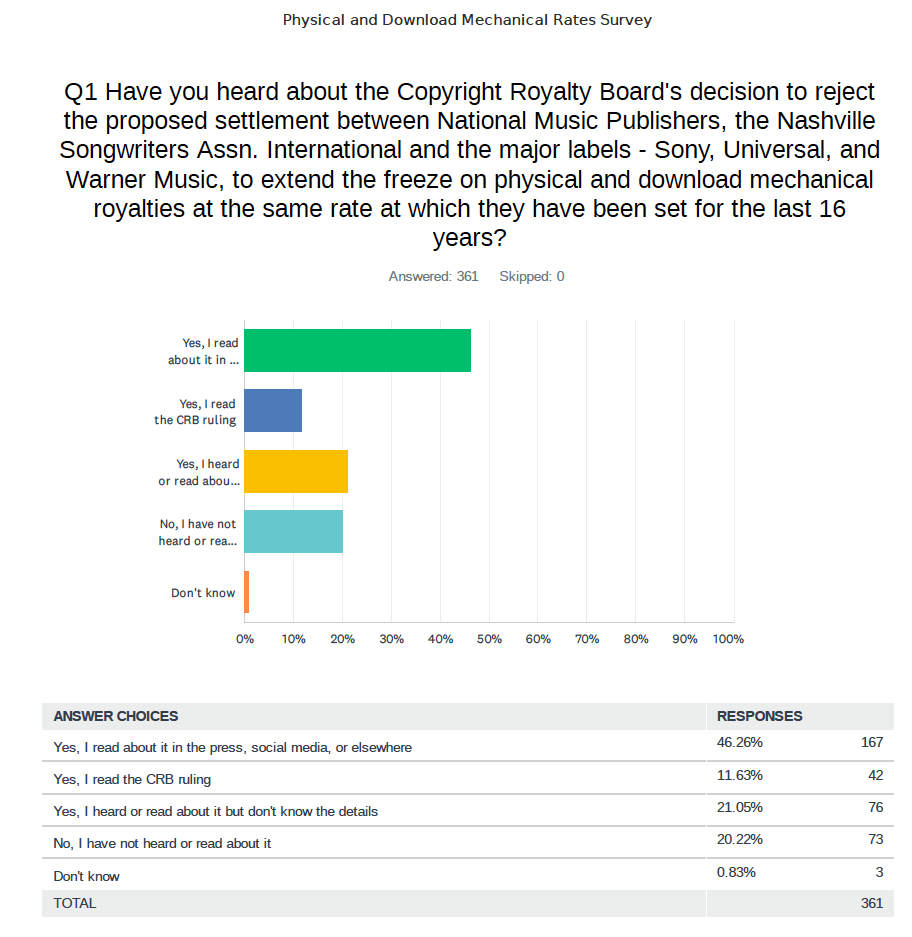
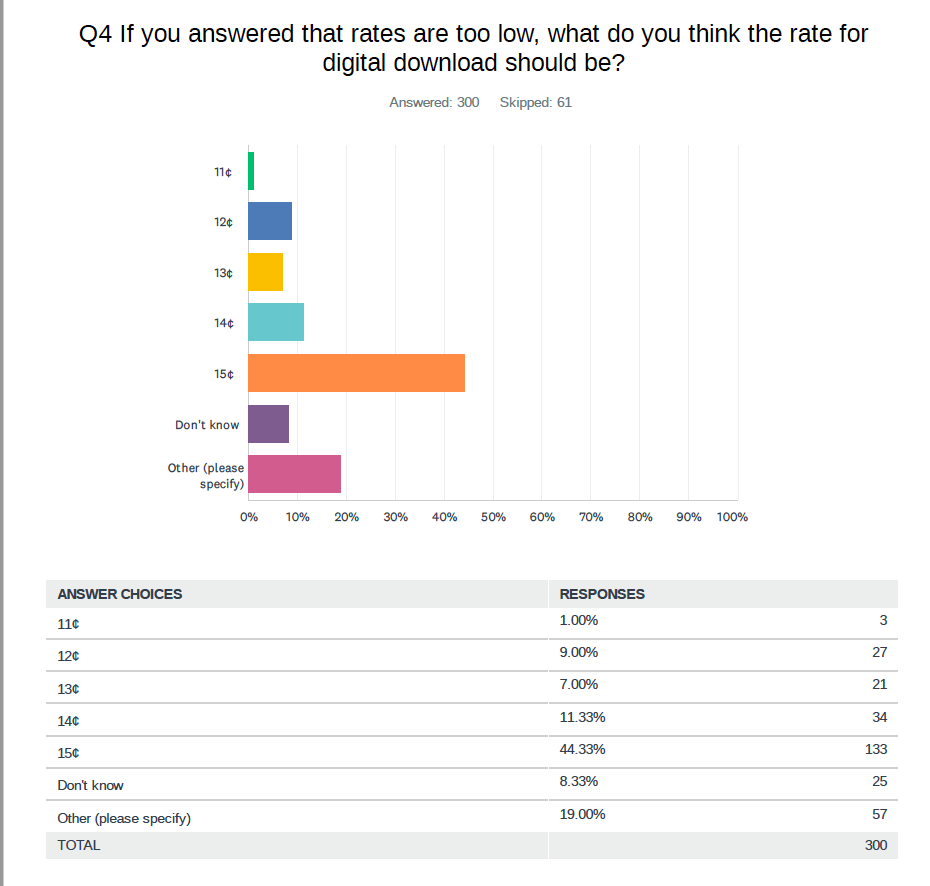
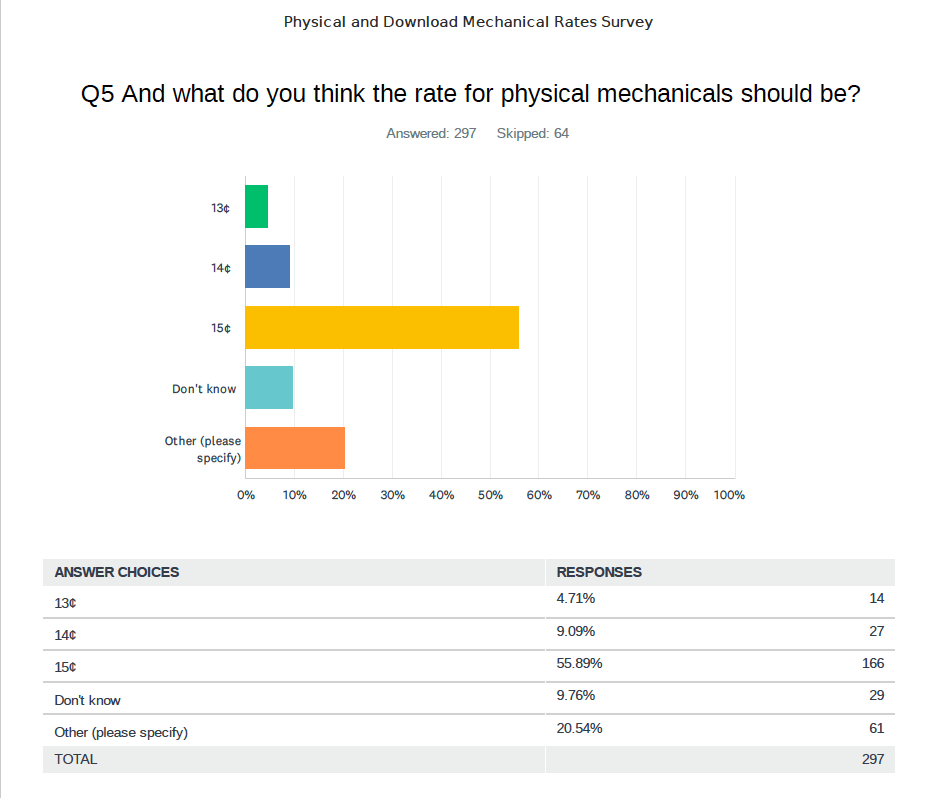
Survey Results: Physical and Download Mechanical Rates Survey–Artist Rights Watch

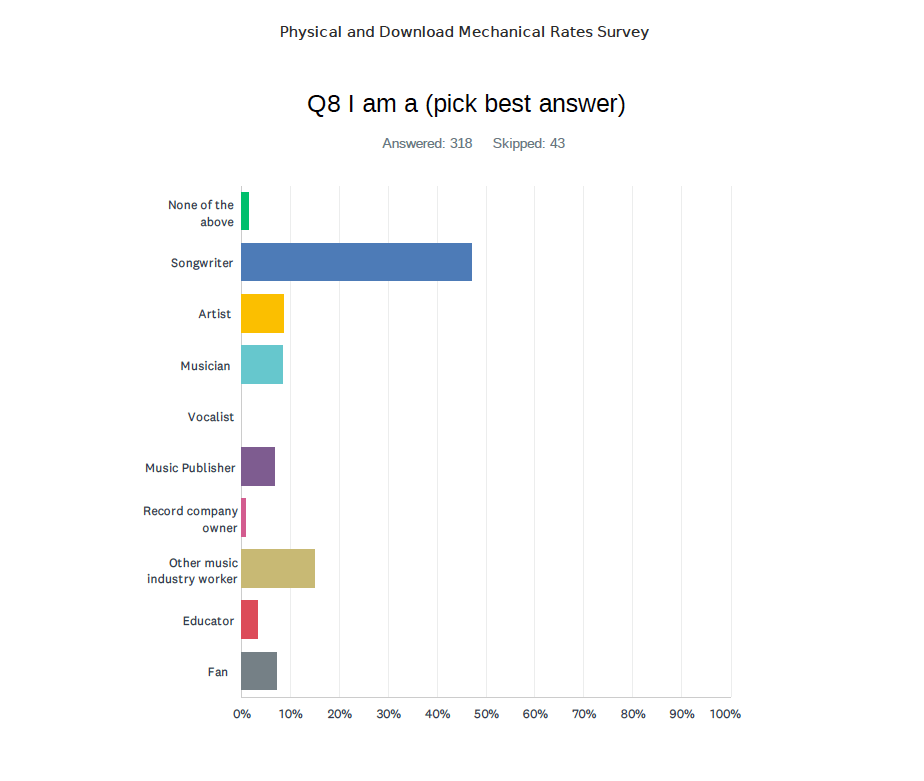
Many readers participated in the Physical and Download Mechanical Rates Survey that various organizations have sent to their members over the last few weeks. Here are the results of the main questions for which we had 361 respondents who self-selected their participation. (Other answers included comments which we chose not to publish for privacy reasons.). 

The results suggest that participants were mostly informed songwriters who had never been asked before what they thought about the issues in the Copyright Royalty Board. We would have to conclude that any of our regular readers would be a bit skewed toward knowledgeable because between the Trichordist, MusicTechPolicy, ARW, Hypebot and Celebrity Access we were probably carrying a very high percentage of the available information on the frozen mechanicals issues.

It also is striking how few respondents said they had ever been asked what they think about any mechanical rates (physical, download, streaming), an important and easily measurable issue. This is something to add to the learning from this episode. It may be that our data is skewed, but even so we didn’t expect that 68% would say they’d never even been asked their opinion. An easy way to find out what people think about something is to ask them. 

A new proposal for songwriters in the Imperial City

[This post first appeared on MusicTechPolicy]

By Chris Castle

As MTP readers will recall, the National Music Publishers Association and the Nashville Songwriters Association International purported to agree on behalf of a “consensus” that never seemed to materialize to extend the long-frozen 9.1¢ mechanical rate for physical and downloads in the form of a settlement agreement in the Copyright Royalty Board’s Phonorecords IV proceeding.  I thought this deal reeked and so did a number of other people, including the Copyright Royalty Board itself which rejected the settlement.

To their great credit, Sony, Universal and Warner stepped up and agreed to offer all the world’s songwriters increased rates of 12¢ plus inflation indexing for the next five years which they didn’t have to do (and was a deal that the CRB hinted that they would find acceptable when they resoundingly rejected the first settlement).  Assuming the Copyright Royalty Board accepts the deal—a step you might miss out from the press coverage–this had the effect of a quick end to a process the labels had every right to litigate at the CRB.

The other benefit to the settlement is that it should—if it doesn’t get screwed up again—it should take away a major argument that the digital retailers are using against songwriters in the streaming part of the Phonorecords IV proceeding.  That argument is the most obvious negotiating tactic in the world:  What’s good for the goose is good for the gander.  The services are essentially saying that if the rates should be frozen when the labels are paying the mechanical (which they are on physical and downloads), then the rates should be frozen when the services are paying the mechanical (which the services are on streaming).  And no inflation adjustment. Well, no kidding.

In one power move, the labels did something fair for songwriters and incidentally also helped publishers in spite of themselves by taking away a major argument from the digital retailers.  Rather than play a schoolyard game of high/low bargaining and stretching out the process for another couple years, the labels cut to the chase and closed. Hopefully the CRB will agree (again, don’t forget that the CRB still has to approve the proposed deal.)

Do we still have bones to pick with the labels?  Absolutely.  Could the rate have been even more fair?  Sure.  Might it have been if the publishers had actually done their job and negotiated in the first place?  Maybe.  Probably.  But they didn’t so we’ll never know.  However, credit where credit’s due, the labels pulled this one out and saved the publishers’ bacon in spite of themselves.

I do have to note in passing that when you read the press coverage on the filing of the settlement, there’s not one US group with a press release today that actually picked up a pen and filed a comment at the CRB when they were needed and duty called.  The awesome UK songwriter group Ivors Academy stepped up and bled with songwriters like Rosanne Cash, George Johnson, Helienne Lindvall, David Lowery and Blake Morgan and all the other commenters who took one for the team when it was unpopular to do so. And as that guy said, he who sheds his blood with me shall be my brother.

You’ll hear a lot of hoorah about how streaming is what’s important from people who are trying to CYA today.  Here’s a hot tip:  IT’S ALL IMPORTANT IF IT’S YOUR MONEY.  Why is that so hard to understand?

Which is why going forward all songwriters and all publishers need to be involved with the rate-setting proceedings at CRB including on streaming.  The CRB knows this and acknowledges.  I think the labels know this on their side.

The question is whether the publishers do.  The announcement of this settlement proposal is both inauspicious and true to form.  Remember—they had practically nothing to do with making the deal they celebrate today.  But don’t let that stop anyone.

We need fairness at the Copyright Royalty Board.  Notice I’m not using the word “transparency” which means whatever the speaker wants it to mean.  I’m very specifically talking about a seat at the table not just for songwriters, but for independent labels and publishers as well as the majors.  As Ann Richards used to say, if you’re not at the table you are on the menu, and this was a very, very close run thing in Phonorecords IV. 

If it weren’t for all the people who commented negatively and resisted the rates that had been bootstrapped in the past and would have been again, I don’t know where songwriters would be today. You gave the Judges the truth, straight from the heart and they responded. So thank you, all of you. And thank you to the readers of MTP and The Trichordist who raised hell right along side. It’s a good day for everyone.

Remember–keep coming back because it works if you work it.

Guest Post by @georgejohnson: The only songwriter in Phonorecords IV speaks his mind

[You may have never heard of George Johnson, but you should have. He’s the only songwriter in the Phonorecords III and IV rate proceedings at the Copyright Royalty Board, representing himself. It’s also important to understand that if George wasn’t carrying the flag as a “participant” in the proceedings, it’s unlikely that the Copyright Royalty Judges would have rejected the bizarre “settlement” proposed by the major labels and publishers paving the way for the second proposed settlement announced today that raises the mechanical rate to 12¢. George asked us to post a short comment on today’s settlement.]

Unfortunately, as glad as I am to see the labels finally offer a slightly better rate of 12 cents, the Judges have not even ruled on the last unreasonable settlement that they rejected, nor had time to hear a back from the Register on the Novel Question of Law proposed by the 3 Major Record Labels. Therefore, it would be premature for me to agree to any rushed deal before first hearing the Register‘s and the Judges’ rulings of law on this issue, and the many other problems the Judges pointed out with these extremely flawed settlements.

Furthermore, the multiple conflicts of interest, self dealing, vertical integration “warning flags”, side deals, and other problems may still need to be resolved by the Judges before any new settlement can be approved.

NMPA CEO David Israelite even stated in 2015 that the rate should be 50 cents, yet he continues to fight me to keep the rate frozen and below market, despite now being forced to offer 12 cents to the Judges which he absolutely did not want to do and fought every step of the way. He is no songwriter advocate whatsoever. He also makes $2 million dollars a year in salary and extra compensation to keep songwriters frozen at 9.1 cents all these years because he really works for the parent record labels, not their vertically integrated publishing division as he claims. It’s a total waste of time for songwriters and I hope Congress puts a stop to this self-dealing and increasing antitrust issues created by these two-timing lobbyists’ behavior.

Btw, when the rate is accurately calculated for inflation since 2006 it’s actually 13 cents, not 12 cents like they offered, but it’s still way below market considering the rate was 2 cents in 1909.  A rate based on today’s marketplace reality would place the rate at a break-even point of 58 cents per song to make up for 89 ignored years of zero inflation adjustments for songwriters, who are entitled to a raise, much less a simple cost of living adjustment for 2022 real world prices. Plus there is no legal difference between adjusting from 2006 or 1909.  NMPA, NSAI, and RIAA just don’t want to increase the profits for their own songwriters, much less all their competitors who have to have their rates frozen by NMPA, NSAI, and the RIAA, which is extraordinary and must end.

There is also the issue of the free unlimited “limited download” loophole which must be paid a mechanical and, of course, the labels completely ignored this core issue which goes hand in hand with a properly adjusted 58 cent inflation royalty rate which all songwriters and publishers deserve now.  Apple and the other Services need to reduce their 30% per dollar fee on downloads to help share in the cost of the Judges’ ruling of no more static rates for songwriters.  If the labels offer a reasonable rate and fix their self dealing conflicts and side deals, along with a paid mechanical for limited downloads, then I would sign a deal like that. Plus, the labels refuse to address the issue of old controlled composition clauses at 75% of the lawful statutory rate or any new controlled composition clauses to reduce any new agreed increases.

Keeping the Songwriter Survey Open!!

Thanks for the HUGE response to the songwriter survey on what you think the new unfrozen mechanical rate should be!! The response has been so strong we’re going to keep the survey open so more of you can participate.

This Survey Monkey questionnaire is anonymous and easy to take–3 minutes to complete–and you could really help a lot by giving your opinions on what you think the rate should be! We will post the results so everyone can see.

You can start the survey at this link. Thank you!