Frozen Mechanicals Crisis: @SealeintheDeal’s Comment to the Copyright Royalty Board

Gwendolyn Seale, Esq.

Chief Copyright Royalty Judge Jesse M. Feder
Copyright Royalty Judge David R. Strickler
Copyright Royalty Judge Steve Ruwe

U.S. Copyright Royalty Board

101 Independence Ave SE / P.O. Box 70977
Washington, DC 20024-0977

July 26, 2021

IN RE DETERMINATION OF ROYALTY RATES AND TERMS FOR MAKING AND DISTRIBUTING PHONORECORDS, DOCKET NUMBER 21-CRB-0001-PR (2023-2027)

(Phonorecords IV)

Honorable Judges,

I am a music lawyer in Austin, Texas, and represent songwriters throughout the state of Texas. Over the last two months, I have spent a considerable amount of time educating songwriters about the proposed settlement (“Proposed Settlement”) presented by the three major labels, the National Music Publishers Association (NMPA) and Nashville Songwriters International (NSAI) (collectively “Settlement Parties”) to freeze the statutory mechanical rate in connection with physical products and digital downloads through 2027.

The feedback I received was straightforward and foreseeable: songwriters do not wish to see this rate frozen for yet another five years. As someone who works with songwriters far removed from the major music industry hubs, like Los Angeles, Nashville and New York, and from the place where the rules are made, Washington, D.C., you quickly recognize that a significant education gap exists, and many songwriters do not comprehend basic copyright and music publishing concepts. Naturally, if songwriters do not grasp music publishing basics, they do not know about this Phonorecords IV proceeding, or government rate-settings in general.

We must remember those songwriters as this rate-setting progresses – as they too are copyright owners who are entitled to due process and transparency. There would be no music publishing business without them.

Thank you for the opportunity to comment in this proceeding and please note that the views I am expressing here are not made on behalf of any client or the State Bar of Texas.

I.              Private Party Settlements Between Willing Buyers and Willing Sellers Representing Different Sides of the Same Corporate Coin Do Not Reflect an Effectively Competitive Market.

With the passage of the Music Modernization Act in 2018, the Copyright Royalty Board (CRB) was instructed in future Section 115 rate-setting proceedings, like this Phonorecords IV proceeding, to “establish rates and terms that most clearly represent the rates and terms that would have been negotiated in the marketplace between a willing buyer and a willing seller.” Pub. L. No. 115-264, § 102(a)(3), 132 Stat. at 3680. In establishing such rates and terms, the Copyright Royalty Judges (“CRJs”) are to base their decision on “economic, competitive and programming information presented by the parties.” 17 U.S.C. § 115(c)(1)(F).

While Phonorecords IV is the first proceeding by which this “willing buyer/willing seller” standard will be applied in the Section 115 context, this standard and the aforementioned language have been the basis for Section 114 rate-settings which provide instructive precedent. Both the CRB and D.C. Circuit in prior Section 114 proceedings understood that proposed rates are to reflect an effectively competitive market. “Legislative history supports the conclusion that

§ 114 directs the Judges to set rates that reflect the workings of a hypothetical effectively competitive market.” 81 FR 26316, 26334. And the CRB “can and should determine whether the proffered rates reflect a sufficiently competitive market, i.e., an ‘effectively competitive’ market.” SoundExchange, Inc. v. Copyright Royalty Bd., 438 U.S. App. D.C. 332, 346, 904 F.3d 41, 55 (2018). Thus, the CRB should examine whether the mechanical rate freeze proffered by the Settlement Parties reflects an effectively competitive market.

While there has been much discourse and disagreement regarding the true meaning of the “willing buyer/willing seller” standard in prior CRB rate proceedings, this Phonorecords IV proceeding has presented a novel conundrum that the CRJs must inspect: what happens when the willing buyer and willing seller are effectively the same parties at the corporate level?

On one side of the Proposed Settlement sits the three major record labels (Sony Music Entertainment, Warner Music Group and Universal Music Group), who are to pay these mechanical royalties to music publishers and songwriters. On the other side of the proposed settlement sits the NMPA and NSAI. The NMPA’s board is comprised of representatives of the publishing company corporate affiliates of the three major labels on the other side of the negotiating table.1 Further, these major publishing company board members appear to have greater voting power than other NMPA board members on account of their gross annual revenue.2 It is also worth noting that the NSAI represents only fragment of the songwriter community, and that two of the three songwriters who penned the “SONGWRITERS REFUTE FALSE CLAIMS REGARDING COPYRIGHT ROYALTY BOARD” letter3

1 https://www.nmpa.org/boardmembers/ .

2 “NMPA shall have two classes of voting members: executive members and general members. A member shall be an executive member if its Gross Revenue is equal to or in excess of One hundred million dollars in the prior calendar year. A member shall be a general member if its Gross Revenue is less than One hundred million dollars in the prior calendar year.” “Each executive and general member shall be entitled to one vote for each one-hundred thousand dollars of gross revenue of such member (including its affiliates) with respect to any matter to be voted on by members; provided that (i) each member shall have at least one vote, and (ii) with respect to a particular calendar year, each executive member shall have no more votes than the number of votes held by the General Member with the greatest number of votes for such year.” NMPA Inc. 2018 IRS 990, Schedule O, at 27.

3 SONGWRITERS REFUTE FALSE CLAIMS REGARDING COPYRIGHT ROYALTY BOARD, available at

https://www.nashvillesongwriters.com/songwriters-refute-false-claims-regarding-copyright-royalty-board .

(presumably published in response to negative press on account of this proposed freeze) sit on NMPA boards, one on the board of NMPA Inc., and the other on the board of the NMPA SONGS Foundation.4

How these organizations wish to conduct their business is wholly up to them, as is how they choose to represent their members. Nonetheless, when I see a phrase in a motion reflecting the intentions of a group of parties riddled with conflicts of interest, “the settlement represents the consensus of buyers and sellers representing the vast majority of the market for `mechanical’ rights for [the 37 CFR 385] Subpart B Configurations”5 – I believe it is important to acknowledge that there are countless millions of copyright owners that these parties do not represent. While the Proposed Settlement may represent the “consensus” of the wealthy major music publishing companies and their record label counterparts, in no manner does this settlement speak for the consensus of songwriters and independent publishers, who lack the overwhelming resources needed to participate in this proceeding and whose views were not solicited.

In sum, none of these factors lead me to believe that this Proposed Settlement reflects an “effectively competitive market.”

II.            The Dire Need for Transparency.

In addition to the proposed settlement, the Settlement Parties (less the NSAI) also referenced a separate Memorandum of Understanding (“MOU”):

“Concurrent with the settlement, the Joint Record Company Participants and NMPA have separately entered into a memorandum of understanding addressing certain negotiated licensing processes and late fee waivers.”6

If this “Memorandum of Understanding” is irrelevant to the proposed settlement, why would it be referenced in the motion to adopt the settlement? Setting aside the broadly drafted “certain negotiated licensing processes,” the phrase “late fee waivers” is exceptionally concerning. I interpret this language to mean that money is changing hands as consideration for this proposed rate freeze – but ultimately, I cannot know this with certainty since neither the Proposed Settlement nor the MOU have been published.

As songwriters worldwide may be bound to the decisions rendered in this Phonorecords IV, it is of the utmost importance for the CRB to work to afford songwriters with complete transparency. In a letter dated July 13, 2021,7 Representative Lloyd Doggett (TX-35) asked,

“May the CRB disclose (or compel the settlement participants to disclose) the unredacted actual settlement agreements referenced in the Motion, including the MOU?”

4 https://www.nmpa.org/boardmembers/ ; https://www.songsfoundation.org/our-board-1 .

5 Motion at 4, available at https://app.crb.gov/document/download/25288.

6 Id. at 3.

7 July 13, 2021 Letter from Representative Lloyd Doggett, available at https://thetrichordist.com/2021/07/18/letter- from-congressman-lloyd-doggett-about-frozen-mechanicals-to-librarian-of-congress-and-register-of-copyrights/.

I would also like to know the answer to this question. Further, in the event the CRB does not reject this Proposed Settlement, it should publish both the actual, unredacted proposed settlement, along with the MOU, not merely the regulations giving effect to the settlement. If songwriters and independent music publishers worldwide are to be bound to these terms, they deserve to have the opportunity to review and to be able to provide meaningful comment on these actual documents at a minimum.

III.          Songwriters and Independent Music Publishers Should Not Face a Rate Freeze In The Midst of a Vinyl Resurgence, During a Worldwide Pandemic.

With the constant consumption of music via the streaming services, many do not realize the degree of revenue generated from the sale of physical products (vinyl, CDs) and digital downloads in the United States. Notwithstanding the devastating pandemic which forced the majority of musicians to pivot, and resulted in at the very least the temporary shutdown of a significant amount of businesses, revenue from the physical music sales amounted to $1.13 billion dollars in 2020.8 Additionally, vinyl record sales increased by more than 28% from 2019 to 2020.9 Further, physical and downloads accounted for 15% of worldwide revenue for U.S. recorded music in 2020.10 Just within the last couple of months, Taylor Swift broke the modern- era weekly vinyl album sales record.11 Record Store Day Drop #1 sparked 1.3 million vinyl album sales during the week ending June 17, 2021, with 942,000 records sold at independent record stores — resulting in the largest weekly vinyl sales at the indie sector in MRC Data history.12 Those Record Store Day figures represent over $1.1 million dollars in mechanical royalties generated within a weekly period (assuming 10 tracks per album at the current statutory rate of 9.1 cents) – which I believe is economically significant for songwriters.

Given the vinyl resurgence, mechanical royalties from physical product sales are a crucial revenue stream for all songwriters, and particularly for independent songwriters who have struggled financially on account of COVID-19 and do not have the resources to compete for the streaming numbers generated by top artists signed with major labels. The effects of COVID-19 are properly taken into account when approximating a free market agreement because of what

U.S. Treasury Secretary Janet Yellen described as “long-term scarring”13 which is projected to exceed the period of the Phonorecords IV rate setting. For context, the mechanical royalty “rate” pertaining to streams on Spotify Premium during April 2020 amounted to $0.00059 per

8 Year-End 2020 RIAA Revenue Statistics, available at https://www.riaa.com/wp-content/uploads/2021/02/2020- Year-End-Music-Industry-Revenue-Report.pdf .

9 Id.

10 Id.

11 Keith Caulfield, Taylor Swift’s ‘Evermore’ Breaks Modern-Era Record for Biggest Vinyl Album Sales Week, BILLBOARD (May 31, 2021), available at https://www.billboard.com/articles/news/9580407/taylor-swift- evermore-record-breaking-vinyl-album-sales-week/ .

12 Keith Caulfield, Record Store Day 2021’s First Drop Sparks 1.3 Million in U.S. Vinyl Album Sales, BILLBOARD (June 22, 2021), available at https://www.billboard.com/articles/business/chart-beat/9590304/record-store-day-2021- first-drop-sets-record.

13 David Lawder, Andrea Shalal, ‘Act Big’ Now To Save Economy, Worry About Debt Later, Yellen Says In Treasury Testimony, Reuters (Jan. 19, 2021), available at https://www.reuters.com/article/us-usa-biden-yellen- idUSKBN29O1WX.

stream (according to the Audiam U.S. Mechanical rate calculator14). The “rate” for the ad- supported tier of Spotify was even lower.

Not only is the music industry experiencing a vinyl resurgence, but also, even CD sales are seeing a boost. According to a July 14, 2021, report from Billboard:

“Vinyl sales, which have grown for the past decade, more than doubled between January and June, up 108.2% to 19.2 million from 9.2 million in the first six months of last year. Even CD sales, which have been steadily and precipitously declining, posted a modest 2.2% gain, to 18.9 million units.”15

IV.            What’s Changed Since 2014? The Willing Buyer/Willing Seller Standard was Supposed to Result in Fairer Rates.

Every person reviewing the comments in this proceeding should go back and review the Copyright Office’s 2015 “Copyright and the Music Marketplace Study.”16 Copyright owners and their representatives within the study shared a common judgement: the then-current 801(b)(1) four-factor test standard resulted in deflated rates — however, this quagmire could be remedied by the adoption of the “willing buyer/willing seller standard.”17 According to the NMPA and Harry Fox Agency’s joint comment in 2014:

“Continued application of the 801(b) standard will ensure that the statutory royalty rate is held artificially low, and that songwriters and music publishers will continue to be treated unfairly in the marketplace.”18

Phonorecords IV is the first proceeding in the Section 115 context by which this “willing buyer/willing seller” standard is to be applied. If the Proposed Settlement is accepted by the CRJs, songwriters and music publishers are no better off than they were under the former 801(b)(1) standard; the statutory rate will continue to be held artificially low through 2027, and songwriters and music publishers will continue to endure unfair treatment in the marketplace.

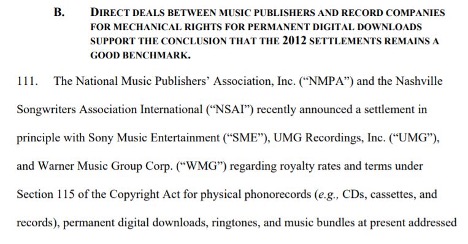
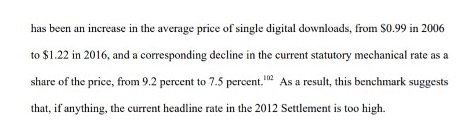
Proposing a freeze for the Subpart B rates during the first Section 115 proceeding applying the “willing buyer/willing seller” standard produces a disastrous ripple-effect with respect to other current and future rate-settings. In the current Phonorecords III remand, Pandora not only has used the Proposed Settlement to make the case that the streaming mechanicals rate in the 2012 settlement was a “good benchmark,” but also used this argument to rationalize the 2012 rate being too high.19

14 Audiam Spotify U.S. Mechanical Rate Calculator, available at https://resources.audiam.com/rates/ .

15 Ed Christman, Audio Streams Up 15%, Vinyl Sales Double in First Half of 2021, BILLBOARD (July 14, 2021), available at https://www.billboard.com/articles/business/9600940/streams-vinyl-cd-sales-genres-midyear-2021- analysis/ .

16 See generally, Copyright and the Music Marketplace (February 2015), available at https://www.copyright.gov/policy/musiclicensingstudy/copyright-and-the-music-marketplace.pdf. 17 Id. at 82-83.

18 NMPA & HFA First Notice Comments at 15-16, available at https://www.copyright.gov/policy/musiclicensingstudy/comments/Docket2014_3/NMPA_HFA_MLS_2014.pdf. 19 Testimony of Michael Katz at 65-66, available at https://app.crb.gov/document/download/23858 .

Equally perplexing upon retrospect is commentary from the NSAI. After stating the organization’s support of eliminating Section 115 entirely (which as an aside, I agree with), the NSAI stated:

“We favor a willing buyer-willing seller free marketplace approach to determining mechanical royalty rates. We believe the underlying work is more valuable that the present 9.1 [sic] rate established by the Copyright Royalty Board.”20

It does not sit well when the organization representing songwriters is party to a settlement proposing extending the freeze at 9.1 cents, seven years after advocating for a “willing buyer/willing seller” rate-setting standard because songs were more valuable than the 9.1 cent rate.

V.            Rates Should not be Frozen Just Because Certain Settlement Parties Deem a Format is Not Worth the Fight.

It is evident that trade organizations representing the publishers and songwriters in this proceeding and prior proceedings have not wished to advocate for an increased mechanical rate for physical products, as they prefer to concentrate on categories that they believe to be economically significant, such as the interactive streaming categories.21 This lack of advocacy was not intended to demonstrate that rate freeze at 9.1 cents reflected the appropriate value of mechanical royalties for physical products, but instead that physical medium revenue was not going to make much of an economic difference within the next five years.22 It is understandable that the NMPA and NSAI have concentrated their efforts on the abysmal streaming services and I applaud the organizations for such efforts. The NSAI also reechoed these sentiments in early June, 2021:

“Based on industry revenue analysis, it is anticipated that physical mechanical royalties will amount to less than 1% of the total mechanical royalty revenue in the United States during 2023-2028, the rate period this CRB proceeding covers. History and experience told us not to create a powerful opponent when there is a strong possibility of losing with little to gain. So, we decided to focus on the digital streaming services and streaming rates during the next trial. While 1% of revenue is meaningful, waging war was not worth the risk, especially since the rate may have been lowered!”23

To date, I have not seen this industry revenue analysis claiming that physical mechanical royalties will amount to less than 1% of the total U.S. mechanical royalty revenue over the next five years. Even if this is the consensus of various industry experts, the figure is simply a prediction. And as the data in Section III shows, the physical format has become increasingly

20 NSAI Reply Comments at 7, available at https://www.copyright.gov/policy/musiclicensingstudy/comments/Docket2014_3/extension_comments/Nashville_S ongwriters_Association_International_NSAI.pdf.

21 See Phonorecords III Open Session, available at https://app.crb.gov/document/download/13897 at 3583-88; https://www.nashvillesongwriters.com/songwriters-refute-false-claims-regarding-copyright-royalty-board .

22 See https://app.crb.gov/document/download/13897 at 3583–88.

23 SONGWRITERS REFUTE FALSE CLAIMS REGARDING COPYRIGHT ROYALTY BOARD, available at

https://www.nashvillesongwriters.com/songwriters-refute-false-claims-regarding-copyright-royalty-board.

popular and provides a meaningful revenue stream for songwriters and publishers — despite prior economic predictions from industry leaders.

In sum, songwriters should not face a continued rate freeze for Subpart B configurations due to trade organizations deeming that these formats are not worth the fight.

VI.            May the CRJs Determine this Proposed Settlement Applies only to the Settlement Participants?

Given the volume of songwriters who are self-published (or self-administered, as the Mechanical Licensing Collective calls it), and the number of independent music publishers who are not NMPA members and have no ties to the major publishers, the question becomes, what recourse do they have when private parties with endless resources decide to convene with their major label counterparts and propose a mechanical rate freeze? May the CRB determine that this frozen rate only applies to the Settlement Parties, but hold that a higher rate will apply to everyone else?

Conclusion

This is the first time I have commented on a CRB rate-proceeding — I was in high school during Phonorecords I and was completing law school when Phonorecords III commenced. This Phonorecords IV proceeding has taught me a lot, and has also raised a lot of questions in my mind about the process of rate-proceedings in general. Ultimately, a settlement to freeze the mechanical rate for the physical format, forged by parties who are one and the same at the corporate level during a vinyl boom in midst of a worldwide pandemic neither reflects an effectively competitive market nor is in the interest of songwriters. Making this situation all the worse is the fact that some of these Settlement Parties advocated for the repeal of the prior rate- setting standard in favor of this “willing buyer/willing seller” standard because they contended the former resulted in deflated rates and the latter would bequeath songwriters with higher rates. If this is truly the end result of CRB rate-proceedings, a process must be established by which copyright owners without the financial resources will have the ability to not only participate in such proceedings, but also have their own independent advocacy arm which can represent their interests. Because as it stands, I do not see the interests of songwriters being adequately represented in Phonorecords IV.

Thank you,  

Gwendolyn Seale

Frozen Mechanicals Crisis: @DavidPoeMusic’s Comment to the Copyright Royalty Board

[The great David Poe was among the first songwriters to post a comment opposing freezing the mechanical royalty rate for physical and downloads promoted by the NMPA and the Nashville Songwriters Association International. We’re going to be posting the comments, but wanted to start with David Poe’s passionate and well-reasoned comment that you can download here.]

July 12, 2021

Via Electronic Delivery

Chief Copyright Royalty Judge Jesse M. Feder

Copyright Royalty Judge David R. Strickler

Copyright Royalty Judge Steve Ruwe

US Copyright Royalty Board

101 Independence Ave SE / P.O. Box 70977 Washington, DC 20024-097

To Your Honors:

Choices you will make regarding mechanical rates will impact the current and future musicmakers’ ability to contribute to our most profound national export: art.

Musicmakers intuitively understand how we stand on the shoulders of giants. Similarly, each aspect of music- adjacent policy sets a precedent for another. And for years, the devaluation of music has been trending: when music piracy made music free, cover charges at local live venues disappeared; when media conglomeration became legal, playlists became homogenous, and far less localized; when algorithms control streaming services, offerings became more generic, by design.

A culture that declares music to be worth less can expect worthless music. It can also expect more musical careers to be sustained only by those who can afford to lose money.

Consider this: our Top Ten is full of artists who are children of the affluent — those who can afford to do this gig. Not children of millionaires: Stevie Wonder, Aretha Franklin, Bob Dylan. The quality of the contributions made by

those who come from privileged upbringings may be a matter of taste, but we can be certain that lessening the ability for musicmakers to make a credible living will beget barriers to entry and a less equitable cohort.

Beyond the cultural impact, common sense arguments against re-freezing mechanical rates that have already in place for two generations include:

  1. Money. The rate that was a little less than a dime in 2009 is functionally worth a little more than a nickel now

— its buying power will only decrease with time.

2. Ethics. Objectively speaking, the proposed freeze represents neither a free nor a fairly-regulated market. It is best characterized as “willing buyer, unwilling seller.”

3. Support from authentic shareholders. Exponentially more musicmakers and music advocacy groups oppose re-freezing mechanical rates. Organizations doing so comprise a distinctly inclusive cohort that looks like America, as well as the diverse, borderless history of music. Among groups opposing frozen mechanicals are the Songwriters Guild of America, the Alliance of Women Film Composers, the Alliance of Latin- American Composers & Authors, the Pan-African Composers and Songwriters Alliance, the Society of Composers and Lyricists, Music Answers, and the Music Creators of North America.

Groups expressing support for freezing mechanicals believe that musicmakers should make less than what we make now. Given this, any claim they make to represent the interests artists is disingenuous. While these groups’ lobbying resources are formidable, both their agenda and actual membership represent a perilously slim minority of musicmakers.

I believe the technological democratization of tools and access for artists of all mediums could enable a new American renaissance. Let us support a regulatory model that fosters that goal, and gives a diverse group of artists the means to do great work that inspires us all.

Sincerely,

David Poe
Songwriter

Frozen Mechanicals CRB Comments: Anthony Garnier

[Anthony Garnier has the honor of being the first commenter in the frozen mechanicals hearing.]

July 18, 2021

Via Electronic Delivery

Copyright Royalty Judge David R. Strickler
Chief Copyright Royalty Judge Jesse M. Feder
Copyright Royalty Judge Steven Ruwe
US Copyright Royalty Board
101 Independence Ave SE
Washington, DC 20024

To Your Honors:

As an artist whose career depends on the sustainability of songwriters, I write with considerable concern for the proposed settlement agreement in Phonorecords IV which will affect ALL songwriters, including independents who are not party to the private, non­ transparent settlement agreement.

As your Honors are aware, the “willing buyer-willing seller” concept was established as a basis for fairness in the regulatory regime of the compulsory license when the Copyright Royalty Board (CRB) was established.  Vertical  integration  (ownership,  interlocking  boards) between the major labels and major publishers poses a serious conflict of interest and engenders self­ dealing among negotiators. Concurrent to the antitrust discussions in Congress concerning vertical integration between corporations, this important “willing  buyer-willing  seller” concept is an issue which songwriters who are not party to the private agreement wish to address as a matter of fairness.

Along with hundreds of thousands of songwriters and composers, I am strongly opposed to the proposed adoption by the CRB of a freeze on mechanical royalty rates for physical phonorecords and downloads, and against other non-transparent elements of the so-called agreement presented to the CRB for adoption by the National Music Publishers Association (NMPA), the Nashville Songwriters Association lnt’I (NSAI), and the major record labels.

NMPA and NSAI have not consulted with any other songwriter organizations despite claiming to represent the interests of songwriters for the entire world. No other songwriter or composer group, neither US or otherwise, joins NSAI in agreeing that adoption of the agreement would serve the interests of music creators rather than cause irreparable harm to their members.

Their secret agreement should be binding only on the parties who opt into the secret agreements, while everyone else should be subject to a different royalty rate determined by equitable and fair marketplace conditions and principles.

Respectfully,

Anthony Garnier

1121 Viewpoint Terrace

Peekskill, NY 10566

Letter from Congressman Lloyd Doggett about Frozen Mechanicals to Librarian of Congress and Register of Copyrights

[This is a letter from Austin Congressman Lloyd Doggett (D-TX) to the Librarian of Congress (who appoints and can sack the Copyright Royalty Judges) and the head of the Copyright Office about procedures in the Copyright Royalty Board’s proceeding on frozen mechanicals. Download the original letter here.]


Dr. Carla Hayden, Librarian of Congress
Shira Perlmutter, Register of Copyrights
The Library of Congress
101 Independence Ave SE Washington, DC 20540

Dear Dr. Hayden and Ms. Perlmutter,

As a Representative covering music communities from San Antonio to Austin, the “Live Music Capitol of the World,” some of my songwriter constituents[1] are concerned about some procedural and substantive issues arising in the ongoing “Determination of Royalty Rates and Terms for Making and Distributing Phonorecords (Phonorecords IV)” currently pending before the Copyright Royalty Board (CRB). I write to seek some clarity for them and for me. The statutory rates set by the CRB are binding on all songs ever written or that may ever be written by anyone in the world who exploits songs in copyright in the United States. While referred to as a “minimum” I am told that statutory rates in practice are a maximum and are, of course, compulsory. Naturally, I am concerned that we not misstep.

While I know the CRB has not rendered a decision in Phonorecords IV, I am trying to understand the process by which the CRB: (1) evaluates settlement agreements proffered by certain parties to a proceeding prior to publishing those settlements for public comment, (2) determines the application of the new “willing buyer/willing seller” standard for rate setting when buyer and seller are related parties, and (3) the degree of transparency that the CRB may require of participants in the proceeding particularly terms of private settlements that the parties voluntarily disclose related to the rates they have negotiated.

In particular, I draw your attention to the Motion To Adopt Settlement Of Statutory Royalty Rates And Terms For Subpart B Configurations, Docket No. 21-CRB-0001-PR (2023-2027) filed by the National Music Publishers Association (NMPA), Nashville Songwriters Association International, Sony Music Entertainment, UMG Recordings, Inc. and Warner Music Group Corp.[2]     This settlement has provoked concern because of its disclosed terms regarding an additional five-year freeze for “mechanical” royalty rates on phonorecords in the physical and permanent download configurations, and undisclosed terms if adopted by the CRB in its determination.

The settling parties apparently refer to both a settlement agreement relating to certain mechanical royalty rates and another agreement that refers to undisclosed “negotiated licensing processes and late fee waivers.” Those settling parties ask the CRB to adopt their settlement on an “industry-wide basis,” and I am trying to better understand what this request means.  I do not wish to interfere in the CRB’s adjudication of the matters before it, but I hope you can help me understand certain procedural matters relating to the CRB itself.

I would appreciate your answering the following questions at your earliest convenience due to the ongoing nature of both Phonorecords IV and other rate setting proceedings before the CRB and thank you in advance for your courtesy.

(1) There appear to be two settlements referenced in the Motion, being the rate setting settlement summarized in draft regulations attached and this other “memorandum of understanding” (“MOU”) between Sony Music Entertainment, UMG Recordings, Inc. and Warner Music Group Corp. (i.e., the same parties to the private rate settlement except the NSAI).

Question: May the CRB disclose (or compel the settlement participants to disclose) the unredacted actual settlement agreements referenced in the Motion, including the MOU?

(2) In the Music Modernization Act,[3]  Congress directed CRB Judges to set the statutory mechanical royalty rate by utilizing a “willing buyer/willing seller” rate standard designed to model the rates that would be reflected in a free market. In the case of the “industry-wide” settlements proposed by the Motion, it appears that there may be joint ownership of some of the members of the NMPA and the record companies proposing the settlement on rates.

Question: Are the Subpart B rates subject to the “willing buyer/willing seller” rate standard?

Question: If so, what is the rule when the “willing buyer” and “willing seller” are under the same corporate umbrella?

(3) It seems that the participants in the proceeding, and certainly the participants in the settlement, are dominated by major publishers and record companies seeking to impose their private settlement on all other songwriters. If other songwriter groups are not participating in the proceeding but object to the settlement (such as songwriters from more diverse communities) I am concerned that those songwriters may have no recourse.

Question: May the CRB limit the scope of a private party settlement to the parties, but determine a higher rate applies to others?

The Motion and the “frozen mechanicals” issue has prompted considerable public debate in the United States and Europe as reported in The Trichordist artist blog[,[4] Billboard, [5]   Complete Music Update[  [6]  and the Creative Industries Newsletter[7].   Three NSAI songwriters have published a defense[8] of their participation in the Motion. The Trichordist notes that the CRB produces considerable frustration and passion on all sides because the process is “inequitable, unwieldy and prohibitively expensive.”[9]

On page 4 of the Motion, the parties advise the CRB that this settlement represents the “consensus of buyers and sellers representing the vast majority of the market for “mechanical ” rights for [physical, permanent downloads]…” Setting aside the issue of the settlement participants representing “buyers” and “sellers” under the same corporate umbrellas, it seems appropriate that every songwriter who will be affected by the outcome of this proceeding, from San Antonio and Austin, Memphis, to Detroit and beyond, should have the opportunity to read and comment meaningfully on the actual settlement agreement posed for adoption, and the related MOU referenced.

I look forward to your response and to continuing to work with you on these matters of such critical importance to our culture and to songwriters everywhere. Please also let me know if you have any other insights to this which may be helpful for my constituents.

Sincerely,

Lloyd Doggett

[1] ATX Musicians Joins Opposition to Frozen Mechanicals, The Trichordist, https://thetrichordist.com/2021/05/28/atx-musicians-joins-opposition-to- frozen-mechanicals/

[2] Available at https://app.crb.gov/docwnent/download/25288

[3] 17 U.S.C. § 115(c)(2)(A).

[4] https://thetrichordist.com/category /frozen-mechanicals/

[5] https://www.billboard.com/articles/business/9577976/songwriters-crb-royalty-rate-comments-letters

[6] https://completemusicupdate.com/article/songwriter-groups- urge-us-copyright-royalty-board-to-open­ submissions-on-proposed-new-mechanical-royalty-rate-on-discs-and-downloads/

[7]  http: //legrandnetwork.blogspot.com/2021/06/songwriters-organisations-object-to.html

[8] https://musicrow.com/2021/06/nsai-son gwriters-respond-to-criticism-of-decision-not-to-challenge-physical­ royalty-rates/

[9] https://thetrichordist.com/2021/06/03/three-nashville-songwriters-respond-on-frozen-mechanicals/

How to Register to Comment at the Copyright Royalty Board on the Frozen Mechanicals Rate Hearing

[This post first appeared on MusicTech.Solutions]

By Chris Castle

If you’ve been following the heated controversy around the frozen mechanicals crisis, you’ll know that the Copyright Royalty Board has received a proposal from the NMPA, NSAI and the major labels to freeze the statutory rate for songwriter mechanical royalties on physical (like CDs and vinyl) and permanent downloads (like iTunes) for another five years. That proposal mentions a settlement to establish the frozen rates (which extends the rates that were first frozen in 2006 for another 5 years) and a memorandum of understanding between the NMPA and the major labels for something, we’re not quite sure what.

There’s quite a bit of material about the problem that was posted on the Trichordist, so you can check there to read up on the background. You can also subscribe to the Artist Rights Watch podcast and listen to our first episode about frozen mechanicals. This post today assumes you already know the background and are ready to file your comment.

Filing comments with the CRB is not quite as simple as filing comments with the Copyright Office and it takes a bit of time–comments close on July 26, so do not leave setting up your account until July 26, or even July 25. I would do it today. You can set up your account before you file your comments so that the account part is all ready to go.

Here are some steps you will probably go through to set up your account:

  1. Go to app.crb.gov. Look for “Register for an account” (the one in small print at the bottom of the list)


2. “Register for an account” will take you to a sign up page. Scroll down to “User Information”. You only need to complete the required fields with a red star (so ignore the bar number, etc.)

There is a pull down menu under “Register as” with a few different roles listed. The one you want is “Commenter”

Then complete the form completing only the required fields.

3. The CRB will then authenticate your account and send you an email confirmation. That part goes pretty quickly. However, once your account is authenticated, make sure you log on. You should be taken to a dashboard, but the question is whether your dashboard looks like this:

Note that the dashboard does not have a button to “File a comment”. If this is what you see when you log into your account, you are not done. Contact the CRB support people ecrbsupport@egov.com and tell them that your account has not been activated to comment.

4. Your account should look like this:

The comment you want to file is for Phonorecords IV. You can ignore the other dockets. It took me several trips to the support desk to get the correct filing tabs on my account, hopefully you won’t have that problem. But–just in case, don’t be running around crazy on July 26 trying to file the comment you slaved over because you left the account to the last minute.

The @ArtistRights Watch Podcast: Episode 1: The Frozen Mechanicals Crisis with Guest @CrispinHunt

Nik Patel, David Lowery, and Chris Castle feature in this podcast where they discuss the current issues of artists’ rights in the music industry. Find the Artist Rights Watch on your favorite podcast platform here https://linktr.ee/artistrightswatchpod Please subscribe, rate and share!

On the first episode of the Artist Rights Watch, Nik Patel, David Lowery, and Chris Castle sit down with Ivors Academy Chair, Crispin Hunt to talk about the frozen mechanical royalties crisis currently playing out in the United States and how it threatens UK songwriters and indeed songwriters around the world.

Crispin gives us his invaluable analysis of how the frozen mechanicals crisis affects songwriters around the world and the highly effective #brokenrecord and #fixstreaming campaigns that Ivors Academy supports in the UK that has lead to a parliamentary inquiry and legislation introduced in the UK Parliament.

The “frozen mechanicals” crisis is rooted in a private deal between big publishers and their big label affiliates to essentially continue the freeze on the already-frozen U.S. mechanical royalty rate paid by the record companies for CDs, vinyl and permanent downloads. The private deal freezes the rate for another five years but does not even account for inflation. Increasing the royalty rate for inflation, does not actually increase songwriter buying power.

The major publishers and labels have asked the Copyright Royalty Board in the US to make their private deal the law and apply that frozen rate to everyone.

In the past, the music industry has experienced a $0.02 mechanical royalty rate that lasted for 70 years, and with the current mechanical royalty rate of $0.091 being set in 2006, advocates hope it’s not a repeat of the past.

In this Artist Rights Watch episode, we cover its numerous implications and consequences such as controlled compositions clauses, the Copyright Royalty Board, CPI and fixed increases, how the UK compares, and potential resolutions.

Below are some links for further reading on frozen mechanicals and Crispin Hunt:

Take the Artist Rights Watch Survey on Mechanical Royalty Rates

How to file your comment with the Copyright Royalty Board on the frozen mechanicals crisis!

Controlled Compositions Clauses and Frozen Mechanicals. Chris Castle

https://musictechpolicy.com/2020/10/10/controlled-compositions-clauses-and-frozen-mechanicals/embed/#?secret=Rftsxg1vsl

What Would @TaylorSwift13 and Eddie @cue Do? One Solution to the Frozen Mechanical Problem. Chris Castle

https://musictech.solutions/2021/05/13/what-would-taylor-and-eddie-do-one-solution-to-the-frozen-mechanical-problem/embed/#?secret=N8n44nO4gn

The Trichordist posts on frozen mechanicals

https://thetrichordist.com/category/frozen-mechanicals/

The Ivors Academy Joins the No Frozen Mechanicals Campaign

Year-End 2020 RIAA Revenue Statistics

Click to access 2020-Year-End-Music-Industry-Revenue-Report.pdf

Below are our social links and terms of use:

Crispin: https://twitter.com/crispinhunt

Chris: http://www.christiancastle.com/chris-castle

David: https://twitter.com/davidclowery?s=20

https://www.instagram.com/davidclowery/

Nik: https://www.instagram.com/nikpatelmusic/

Website: https://artistrightswatch.com
Facebook: https://www.facebook.com/artistrightswatch
Twitter: https://twitter.com/ArtistRights?s=20

Terms of Use: https://artistrightswatchdotcom.files.wordpress.com/2021/01/arw-podcast-terms-of-use-v-1-i-1.pdf

Guest Post by @SealeInTheDeal: A Foreseeable Result of the Phonorecords IV Private Settlement: Opening Pandora’s Box

By Gwendolyn Seale

Over the last six weeks, the Trichordist has chronicled the frozen mechanicals saga occurring at the Copyright Royalty Board in the government’s rate setting for the compulsory mechanical license commonly called “Phonorecords IV.” (Congress mandated that these government rate settings occur every five years and are numbered sequentially.) 

Songwriters, independent music publishers, music lawyers and advocates have penned articles and contacted their representatives in Congress to express their concerns about the private party settlement which would extend the existing freeze on the statutory mechanical rate with respect to physical products and permanent downloads for yet another five years.  That private party settlement among the Big Three record companies, the National Music Publishers Association and the Nashville Songwriters Association International is expected to be opened to public comment later today.  (Friday news dump?)  These entities then submitted that settlement to the Copyright Royalty Board asking the CRB to impose the terms of that private settlement on the rest of the world.  And it now appears that these secret deals may be backfiring.

The frozen rate most prominently applies to permanent downloads and physical sales like vinyl.  Why the Big Three want to freeze mechanical royalty rates on the booming vinyl business is anyone’s guess.

The sticking point for most people commenting in the Trichordist is that the terms of the private settlement are not disclosed to the CRB or to the public, especially a side deal between the Big Three and the NMPA.  Songwriters around the world have no way of knowing the terms of these deals unless the Copyright Royalty Board forces their disclosure.

These entities who are before the CRB in Phonorecords IV, along with those vocal in opposition against their private party settlement have been in this arena for far longer than I. When the Phonorecords I proceeding occurred in 2006, I was merely a freshman in high school — and I was completing my final year of law school as the Phonorecords III proceeding began. Needless to say, there has been a significant amount of information and procedure to digest.

Upon learning of the settlement by the Big Three labels, the NMPA and the NSAI, several thoughts came immediately to mind:

1) The settlement and side agreement referenced must be disclosed immediately.

 2) How can this freeze be rationalized, especially during the midst of a worldwide vinyl resurgence?

3) Why would an organization representing songwriters agree to such a freeze? (As an aside, as I was teaching a course on copyright and songwriter revenue streams to 30 older songwriters two weeks ago, they were shocked and moreover disheartened to learn this — as physical sales, not streaming revenue, pays their bills. One said: ”I can stand out on the street in Smithville, Texas, with my guitar and a tip jar and earn more in a couple hours than I will ever earn from streaming”).

 4) This is perfect ammunition for the streaming services to use to justify their already abysmally-low mechanical “rates.”  

While there is much to say on points 1-3, the focus here is on point 4. Chris Castle echoed the same sentiments on June 1:

“Streaming Royalty Backfire:   If you want to argue that there is an inherent value in songs as I do, I don’t think freezing any rates for 20 years gets you there.  Because there is no logical explanation for why the industry negotiators freeze the rates at 9.1¢ for another five years, the entire process for setting streaming mechanical rates starts to look transactional.  In the transactional model, increased streaming mechanicals is ultimately justified by who is paying.  When the labels are paying, they want the rate frozen, so why wouldn’t the services use the same argument on the streaming rates, gooses and ganders being what they are?  If a song has inherent value—which I firmly believe—it has that value for everyone. Given the billions that are being made from music, songwriters deserve a bigger piece of that cash and an equal say about how it is divided.” (link: https://thetrichordist.com/2021/06/01/healing-with-sunlight-a-rate-based-solution-for-the-frozen-mechanicals-dilemma/)

It did not take a soothsayer to foresee this result; the private settlement opened Pandora’s box – begetting misery for every songwriter. Since the CRB has been quiet for the last month with respect to this proceeding, yesterday, I began delving through some of the more recent Phonorecords III remand filings. And much to my unsurprise, I came across a statement from Pandora Media’s expert witness, Professor Michael Katz, who understandably used the proposed settlement as evidence that the streaming rates were fine as is. Katz’s statement was filed on April 4 – two months before songwriters became aware of the quiet filing of the private settlement and began speaking out.  Here’s the link to Professor Katz’s testimony and you’ll find the text below beginning on page 65:  https://app.crb.gov/document/download/23858 .

Pandora not only used the settlement to make the case that the streaming mechanicals rate in the 2012 settlement was a “good benchmark,” but also, even more disastrously, used this argument to rationalize the 2012 rate being TOO HIGH.

This is what happens when there are only a select few gatekeepers, privileged with endless resources and far removed from the plight of independent songwriters, making decisions that affect literally every songwriter’s future. This is why CRB proceedings must be more easily accessible for independent songwriters and their staunch advocates. This is the consequence of the “willing buyer” and “willing seller” appearing on different sides of the same corporate coin – (and if anyone wishes to challenge me on this point be ready for some “interlocking board” remarks based on extensive research into conflicts of interest).  Songwriters deserve better than to have this crucial revenue stream frozen – especially  immediately following an eighteen-month-long worldwide pandemic.

After the release of misery and misfortune with the private settlement, hope remained at the bottom of pandora’s box—hope that the CRB would allow the songwriters affected by the private settlement to at least have an opportunity to be heard in the exclusive and expensive environment of the Copyright Royalty Board. Once the CRB publishes their request for public comments (on the Friday before the July 4 weekend), songwriters may at last have their chance.

And I firmly believe that by the CRB providing every songwriter the opportunity to express how this settlement and the proposed regulations freezing mechanicals for another five years fails to represent her interest, it will exbibit to all the inherent value of songs and restore hope that every voice matters.

The Copyright Royalty Board Gets It Right: New Increased Inflation-Adjusted Royalty Rates for Webcasting–MusicTechPolicy

[This post first appeared on the MusicTechPolicy blog]

by Chris Castle

The Copyright Royalty Board has announced its decision on webcasting rates under §114 for 2021-25 and it’s good news for non-featured artists, featured artists and sound recording copyright owners. The rates are set for 2021, paid retroactively to January 1. 

ServiceNew Rate Per Performance 2021Old Rate Per Performance 2020Increase
Commercial Nonsubscription$0.0021$0.0018+17%
Commercial Subscription$0.0026$0.0024+8%
Noncommercial Webcaster (Non-educational)$1000 per station or channel up to 159,140 Aggregate Tuning Hours/month Overage at $0.0021 per performance$500 per station or channel up to 159,140 Aggregate Tuning Hours/month. Overage at $0.0018 per performancePer-station: +100%
Overage: +17%

After 2022, these rates are adjusted by the Consumer Price Index (CPI-U for the geeks). 

The Copyright Royalty Judges shall adjust the royalty fees each year to reflect any changes occurring in the cost of living as determined by the most recent Consumer Price Index for All Urban Consumers (U.S. City Average, all items) (CPI-U) published by the Secretary of Labor before December 1 of the preceding year.

So it is clear that the CRB can come up with reasonable rates when they’re asked. It’s also a great example of the power of strong bargaining groups including SoundExchange, the unions, indie and major record companies, and a broad cross-section of music users.

Rates for noncommercial educational webcasters, satellite radio, audio for business establishments and some others — are decided in a different process. Their 2021 rates for these service are on the SoundExchange website.

The @IvorsAcademy Joins the No Frozen Mechanicals Campaign

The Ivors Academy joins the campaign against frozen mechanical royalties for songwriters by the Copyright Royalty Board in the US. Ivors is the UK’s independent professional association for music creators and is a community of diverse, talented songwriters and composers across all styles. Their talent creates the music that the world loves. The organization was formerly known as the British Academy of Songwriters, Composers and Authors, and is home to the Ivors Awards named after Ivor Novello. Ivors Academy are leading advocates for songwriters across Europe and are leading the #BrokenRecord and #PaySongwriters campaigns that have resulted in an inquiry into music streaming by the UK Parliament. Follow them at @IvorsAcademy.

Against Frozen MechanicalsSupporting Frozen Mechanicals
Songwriters Guild of AmericaNational Music Publishers Association
Society of Composers and LyricistsNashville Songwriters Association International
Alliance for Women Film Composers 
Songwriters Association of Canada 
Screen Composers Guild of Canada 
Music Creators North America 
Music Answers 
Alliance of Latin American Composers & Authors 
Asia-Pacific Music Creators Alliance 
European Composers and Songwriters Alliance 
Pan African Composers and Songwriters Alliance 
North Music Group 
Blake Morgan 
David Lowery 
ATX Musicians 
Ivors Academy 

Three Nashville Songwriters Respond on Frozen Mechanicals

You should read this post by three Nashville songwriters published in the Nashville trade website Music Row who evidently are at the center of the negotiations and decisionmaking process on frozen mechanicals at the Copyright Royalty Board and have been for many years.  (One of the signers, Lee Miller, once considered running for Marsha Blackburn’s congressional seat on the Republican ticket in 2017.)  It is a heartfelt effort, although you do have to ask yourself where are the publishers?

The post is a very illuminating look inside the CRB process that many find mysterious, and also is a good demonstration of some of the concerns expressed by writers on The Trichordist on this subject.  The three accomplished Nashville songwriters add some color commentary to the proceedings, particularly for those who may have been in high school or college during the 2006 CRB frozen mechanical rate setting that many think caused the problem. 

The songwriters express a good deal of frustration and passion which is as understandable as the frustration and passion of those who feel that the CRB process is as inequitable, unwieldy and prohibitively expensive as these songwriters seem to be telling us that it is.  Someone may want to do a point by point discussion of the many good issues that the three Nashville songwriters raise, but a couple things jump out.

First, they defend the streaming mechanical rate from the last CRB. No one criticized the streaming mechanical rate in the last CRB proceeding that is currently under appeal.  If the rate survives the appeal and reworking at the CRB, and makes its way through the MLC, every songwriter should expect to see the promised increase in their streaming royalty check.  That would be a great thing and everyone no doubt thanks everyone involved for the effort.  The topic, though, was primarily the frozen mechanical not the streaming mechanical.

Also, who paid the $20 million cost for “our side” to participate in the CRB that the three Nashville songwriters refer to?  Surely the publishers did not ask the songwriters to open up their own pocketbooks, even though each has been extraordinarily successful in their genre. 

We couldn’t find any discussion by the three Nashville songwriters of what terms are in the private settlements referred to in their own filing.  The point that many have made about public commentary about the private settlements is that the Copyright Royalty Judges can decide on who is “bound” by the settlements and that it is the motion at issue as filed that gets commented on unless the Judges ask that it be supplemented.  Commenters said the “who” should be broadly construed.  They also said that the “what” is crucially important. Many have made the point that public commentary about the settlements requires that all the terms of the settlements are made public. Until made public, the terms are private.  The only thing we know about the settlements from the three Nashville songwriters’ own CRB filing is the terms that are disclosed—frozen rates.  Even though their filing refers to settlements, we still don’t know anything further.  Maybe we will in coming days.  Any additional terms that exist may not be remarkable, but they might be.  Presumably this is the kind of thing that important people in the negotiation process would know due to their special position.  We just don’t know.

The three Nashville songwriters apparently believed they had a mandate to make decisions about what was worth pursuing in the CRB.  If they did have that belief, presumably they base that belief on some kind of vote.  Since their CRB settlement impacts every songwriter in the world, that’s the magnitude of decision that some might think is deserving of a vote of their membership, not just a board vote if that’s what happened—we just don’t know.  It’s a real privilege to be in the position to make those kinds of decisions, so you might well think that it’s the kind of thing you wouldn’t want to take on by yourself or with only the approval of a limited number of people.  But maybe not. 

Be sure to read this post and thank these songwriters for their service to the community.  They certainly deserve it.