Who Will Get to the Bottom of The Hundreds of Millions of Black Box Money at MLC?

By Chris Castle

One of the most common questions we get from songwriters about the MLC concerns the gigantic level of “unmatched funds” that have been sitting in the MLC’s accounts since February 2021.  Are they really just waiting until The MLC, Inc. gets redesignated and then distributes hundreds of millions on a market share basis like the lobbyists drafted into the MMA?  

Not My Monkey

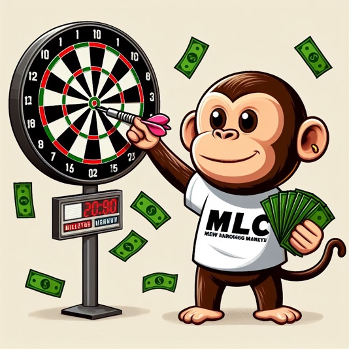
Nobody can believe that the MLC can’t manage to pay out several hundred million dollars of streaming mechanical royalties for over three years so far.  (Resulting in the MLC holding $804,555,579 in stocks as of the end of 2022 on its tax return, Part X, line 11.) The proverbial monkey with a dart board could have paid more songwriters in three years.  Face it—doesn’t it just sound illegal?  In my experience, when something sounds or feels illegal, it probably is.

What’s lacking here is a champion to extract the songwriters’ money.  Clearly the largely unelected smart people in charge could have done something about it by now if they wanted to, but they haven’t.  It’s looking more and more like nobody cares or at least nobody wants to do anything about it.  There is profit in delay.
Or maybe nobody is taking responsibility because there’s nobody to complain to.  Or is there? What if such a champion exists?  What if there were no more waiting?  What if there were someone who could bring the real heat to the situation?

Let’s explore one potentially overlooked angle—a federal agency called the Office of the Inspector General.  Who can bring in the OIG?  Who has jurisdiction?  I think someone does and this is the primary reason why the MLC is different from HFA.

Does The Inspector General Have MLC Jurisdiction?

Who has jurisdiction over the MLC (aside from its severely conflicted board of directors which is not setting the world on fire to pump the hundreds of millions of black box money back into the songwriter economy).  The Music Modernization Act says that the mechanical licensing collective operates at the pleasure of the Congress under the oversight of the U.S. Copyright Office and the OIG has oversight of the Copyright Office through its oversight of the Library of Congress.

But, hold on, you say.  The MLC, Inc. is a private company and the government typically does not have direct oversight over the operations of a private company.

The key concept there is “operates” and that’s the difference between the statutory concept of a mechanical licensing collective and the actual operational collective which is a real company with real employees and real board members.  Kind of like shadows on the wall of a cave for you Plato fans.  Or the magic 8 ball.

The MLC, Inc. is all caught up with the government.  It exists because the government allows it to, it collects money under the government’s blanket mechanical license, its operating costs are set by the government, and its board members are “inferior officers” of the United States.   Even though The MLC, Inc. is technically a private organization, it is at best a quasi-governmental organization, almost like the Tennessee Valley Authority or the Corporation for Public Broadcasting.  So it seems to me that The MLC, Inc. is a stand-in for the federal government.

But The MLC, Inc. is not the federal government.  When Congress passed the MMA and it charged the Copyright Office with oversight of the MLC.  Unfortunately, Congress does not appear to have appropriated funds for the additional oversight work it imposed on the Office.  

Neither did Congress empower the Office to charge the customary reasonable fees to cover the oversight work Congress mandated.  The Copyright Office has an entire fee schedule for its many services, but not MLC oversight.  

Even though the MLC’s operating costs are controlled by the Copyright Royalty Board and paid by the users of the blanket license through an assessment, this assessment money does not cover the transaction cost of having the Copyright Office fulfill an oversight role.

An oversight role may be ill suited to the historical role of the Copyright Office, a pre-New Deal agency with no direct enforcement powers—and no culture of cracking heads about wasteful spending like sending a contingent to Grammy Week.

In fact, there’s an argument that The MLC, Inc. should write a check to the taxpayer to offset the additional costs of MLC oversight.  If that hasn’t happened in five years, it’s probably not going to happen.  

Where Does the Inspector General Fit In?

Fortunately, the Copyright Office has a deep bench to draw on at the Office of the Inspector General for the Library of Congress, currently Dr. Glenda B. Arrington.  That kind of necessary detailed oversight is provided through the OIG’s subpoena power, mutual aid relationships with law enforcement partners as well as its own law enforcement powers as an independent agency of the Department of Homeland Security.  Obviously, all of these functions are desirable but none of them are a cultural fit in the Copyright Office or are a realistic resource allocation.

The OIG is better suited to overseeing waste, fraud and abuse at the MLC given that the traditional role of the Copyright Office does not involve confronting the executives of quasi-governmental organizations like the MLC about their operations, nor does it involve parsing through voluminous accounting statements, tracing financial transactions, demanding answers that the MLC does not want to give, and perhaps even making referrals to the Department of Justice to open investigations into potential malfeasance.  

Or demanding that the MLC set a payment schedule to pry loose the damn black box money.

One of the key roles of the OIG is to conduct audits.  A baseline audit of the MLC, its closely held investment policy and open market trading in hundreds of millions in black box funds might be a good place to start.  

It must be said that the first task of the OIG might be to determine whether Congress ever authorized MLC to “invest” the black box funds in the first place.  Congress is usually very specific about authorizing an agency to “invest” other people’s money, particularly when the people doing the investing are also tasked with finding the proper owners and returning that money to them, with interest. 

None of that customary specificity is present with the MLC.

For example, MLC CEO Kris Ahrens told Congress that the simple requirement that the MLC pay interest on “unmatched” funds in its possession (commonly called “black box”) was the basis on which the MLC was investing hundreds of millions in the open market.  This because he assumed the MLC would have to earn enough from trading securities or other investment income to cover their payment obligations.  That obligation is mostly to cover the federal short term interest rate that the MLC is required to pay on black box.

The Ghost of Grammy Week

The MLC has taken the requirement that the MLC pay interest on black box and bootstrapped that mandate to justify investment of the black box in the open market.  That is quite a bootstrap.

An equally plausible explanation would be that the requirement to pay interest on black box is that the interest is a reasonable cost of the collective to be covered by the administrative assessment.  The plain meaning of the statute reflects the intent of the drafters—the interest payment is a penalty to be paid by the MLC for failing to find the owners of the money in the first place, not an excuse to create a relatively secret $800 million hedge fund for the MLC.  

I say relatively secret because The MLC, Inc. has been given the opportunity to inform Congress of how much money they made or lost in the black box quasi-hedge fund, who bears the risk of loss and who profits from trading.  They have not answered these questions.  Perhaps they could answer them to the OIG getting to the bottom of the coverup.

We do not really know the extent of the MLC’s black box holdings, but it presumably would include the hundreds of millions invested under its stewardship in the $1.9 billion Payton Limited Maturity Fund SI (PYLSX). Based on public SEC filings brought to my attention, The MLC, Inc.’s investment in this fund is sufficient to require disclosure by PYLSX as a “Control Person” that owns 25% or more of PYLSX’s $1.9 billion net asset value. PYLSX is required to disclose the MLC as a Control Person in its fundraising materials to the Securities and Exchange Commission (Form N-1A Registration Statement filed February 28, 2023).  This might be a good place to start.

Otherwise, the MLC’s investment policy makes no sense.  The interest payment is a penalty, and the black box is not a profit center.

But you don’t even have to rely on The MLC, Inc.’s quasi governmental status in order for OIG to exert jurisdiction over the MLC.  It is also good to remember that the Presidential Signing Statement for the Music Modernization Act specifically addresses the role of the MLC’s board of directors as “inferior officers” of the United States:

Because the directors [likely both voting and nonvoting] are inferior officers under the Appointments Clause of the Constitution, the Librarian [of Congress] must approve each subsequent selection of a new director. I expect that the Register of Copyrights will work with the collective, once it has been designated, to ensure that the Librarian retains the ultimate authority, as required by the Constitution, to appoint and remove all directors.

The term “inferior officers” refers to those individuals who occupy positions that wield significant authority, but whose work is directed and supervised at some level by others who were appointed by presidential nomination with the advice and consent of the Senate. Therefore, the OIG could likely review the actions of the MLC’s board (voting and nonvoting members) as they would any other inferior offices of the United States in the normal course of the OIG’s activities.

Next Steps for OIG Investigation

How would the OIG at the Library of Congress actually get involved?  In theory, no additional legislation is necessary and in fact the public might be able to use the OIG whistleblower hotline to persuade the IG to get involved without any other inputs.  The process goes something like this:

  1. Receipt of Allegations: The first step in the OIG investigation process is the receipt of allegations. Allegations of fraud, waste, abuse, and other irregularities concerning LOC  programs and operations like the MLC are received from hotline complaints or other communications. 
  2. Preliminary Review: Once an allegation is received, it undergoes a preliminary review to determine if OIG investigative attention is warranted. This involves determining whether the allegation is credible and reasonably detailed (such as providing a copy of the MLC Congressional testimony including Questions for the Record). If the Office is actually bringing the OIG into the matter, this step would likely be collapsed into investigative action.
  3. Investigative Activity: If the preliminary review warrants further investigation, the OIG conducts the investigation through a variety of activities. These include record reviews and document analysis, witness and subject interviews, IG and grand jury subpoenas, search warrants, special techniques such as consensual monitoring and undercover operations, and coordination with other law enforcement agencies, such as the FBI, as appropriate.  That monitoring might include detailed investigation into the $500,000,000 or more in black box funds, much of which is traded on open market transactions like PYLSX.
  4. Investigative Outputs: Upon completing an investigation, reports and other documents may be written for use by the public, senior decision makers and other stakeholders, including U.S. Attorneys and Copyright Office management. Results of OIG’s administrative investigations, such as employee and program integrity cases, are transmitted to officials for appropriate action. 
  5. Monitoring of Results: The OIG monitors the results of those investigations conducted based on OIG referrals to ensure allegations are sufficiently addressed.

So it seems that the Office of the Inspector General is well suited to assisting the Copyright Office by investigating how the MLC is complying with its statutory financial obligations.  In particular, the OIG is ideally positioned to investigate how the MLC is handling the black box and its open market investments that it so far has refused to disclose to Members of Congress at a Congressional hearing as well as in answers to Questions for the Record from Chairman Issa.

This post previously appeared on MusicTech.Solutions

Guest Post: Attempts to Ban the Song “Glory to Hong Kong” Illustrate Just How Powerful and “Dangerous” Music is Perceived to Be

By Charles J. Sanders

We’ve all seen the headlines from around the world. Musicians, songwriters and composers attacked as rabble-rousers and enemies of the state. Singers arrested, their performances banned as un-patriotic or sacrilegious. We’ve even seen lethal attacks committed against music creators for refusing to perform, or simply for attempting to entertain, not even to proselytize or lampoon.  And just in the past few days, we have seen legal action instituted by a foreign global power against the performance of domestic protest music on a global basis.

No matter our individual political or musical affiliations, the mission of the American music community is clear. We must quickly and effectively formulate ways to help curb this global, governmental trend of singling out artists and music creators for punishment, due in large measure to the perceived, “dangerous” power of music.  Case in point:

In 2019, amid civil unrest in Hong Kong over Chinese Government efforts to crack down on what it deems unacceptable speech, a pro-Hong Kong Independence movement leader known only by the pseudonym “Thomas dgx yhl” penned a song known as “Glory to Hong Kong.”  The composition was immediately embraced by Hong Kong street protesters, translated into various languages on the Internet, and eventually widely recorded and distributed.  In short order, those recordings were being played not only on the Net but in Hong Kong shopping malls and at sporting events and other gatherings, prompting public sing-alongs that have increasingly alarmed Chinese Government officials in Beijing.[1]  

Two weeks ago, on June 5, 2023, the Beijing-aligned Government of Hong Kong announced it had heard enough.  Having previously banned the secessionist anthem “Liberate Hong Kong” after protests began in 2019, it went to court seeking an even broader injunction against “Glory to Hong Kong” that if granted would bar performance, broadcast, and distribution of the song throughout China (and potentially lead to the punishing of Chinese citizens and companies operating in China for violating the ban elsewhere in the world).  According to the Government’s court submissions, the song’s lyrics are meant to provoke secessionist acts in violation of Chinese law, and the court should act to eliminate the dangerous confusion that has been caused by the “mistaken use” of the song in place of the official Chinese national anthem at local and international events in Hong Kong and elsewhere.[2]  Court hearings are scheduled to resume in Hong Kong on July 21, 2023.

As is often the case when governments attempt to ban musical works, the song instantly skyrocketed in popularity.  Within days of the court filing, “Glory to Hong Kong” topped the Apple iTunes charts, which may have resulted in further governmental action behind the scenes. The original version of the song recorded by DGX Music (presumably related to Thomas dgx yhl) has now reportedly been pulled from global music streaming platforms such as Spotify, Apple Music, Facebook and Instagram’s Reels system.  According to DGX, the disappearance of its version from these services is due to the company’s “dealing with some technical issues related to streaming platforms,” and it expressed regret for this “temporary” issue.  The specter of likely governmental coercion against the creator(s), the label and its distributors, however, continues to hang heavily over the entire incident. 

Obviously, what we are witnessing in real time is yet another in a nearly endless series of attempts by governments and powerful interests around the world to forcibly remove politically contentious musical works from the public sphere and punish their creators. 

This past March, the National Music Council of the United States (NMC), in partnership with the International Music Council (IMC) based in Paris, explored the historical roots of this phenomenon in the hopes of helping the world-wide music community to fashion strategies for ensuring more effective, speech-related protections for music creators in the future.  The NMC’s extensive briefing papers for the symposium trace the long litany of repression and coercion against individual creators who used their music to protest social and political injustice, including the murder by the extreme right-wing Pinochet regime in Chile of folksinger Victor Jara, the genocide carried out against Cambodian musicians and composers by the extreme left-wing Khmer Rouge Regime, and the attempted erasure of Native American/First Nation/Aboriginal music and culture by Constitutional democracies including the United States, Canada, the UK and Australia—efforts that often resulted in the brutal deaths of those who resisted.[3]  

Music-based repression and coercion, the NMC concluded, are clearly global problems unlimited by either their political or geographic origins:

Music’s dual, facile ability to serve as both a powerful tool of propaganda and as an existential threat to power structures and political leaders has made it a prime focus of nervous governmental concern over the entire span of history….[M]usic creators and performers have [thus] not only been frequently subject to pressure to conform and participate in governmental propaganda efforts, but also to repressive actions up to and including murder to enforce the silence of those dangerous, high-profile individuals who will not comply. In many cases, this effectively neuters the most persuasive voices of protest, while at the same time setting an example of what happens to those less visible citizens who choose dissent. The repression of music and creators is a government’s way of warning all of its people, “if this is what we’ll do to them, imagine what we’ll do to you.”

For the American music creator community, it’s that last point that should be our initial, paramount concern.  While we may argue over whether certain a musical expression (other than outright hate speech) constitutes patriotism or treason, it is incumbent upon us to champion the position that violence and imprisonment for expressing unpopular views should not be imposed on any person by any government, anywhere.  Though speech freedom advocates may argue for a far broader effort to protect free musical expression –and in the future that may come– job one is to protect the lives and liberties of music creators who have been singled out today for political punishment. 

How?  By not remaining silent. 

At the NMC/IMC symposium, international experts and activists such as Ole Reitof of UNESCO, Julie Trébault of the Artists at Risk Coalition, Mark Ludwig of the Terezin Music Foundation, Dr. Ahmad Sarmast of the Afghanistan National Institute of Music, and Arn Chorn Pond of the Cambodian Living Arts organization, all agreed on the opportunities for the US music community to protect fellow, global music creators and performers from official repression by speaking out in appropriate ways.  Their advice may be distilled to three basic principles:

First, do no harm. This Hippocratic starting point for every effort to assist requires that all international actions must be carefully calibrated to avoid backlash against the endangered individual or group, and should be undertaken only in consultation with those knowledgeable about the local intricacies related to each incident. 

Second, take action by shining a spotlight in the United States on the most egregious cases of music suppression wherever in the world they take place.  Write letters to the White House, to Congress, and to the US State Department and the US Trade Representative concerning individual cases, requesting that the US Government take appropriate steps to save the lives and freedoms of those at risk.  (Other actions may be contemplated, but only after the “no harm” principle has been fully strategized).

Third, for those not willing or unable to take such actions, lend support to organizations engaged directly in protecting the lives and liberties of members of the music community around the world.[4]  

Artistic activism and the defense of it will never be an act of courage devoid of risk.  The ability in the US to speak out on such issues principally without fear of government reprisal, however, places on us a special responsibility to shine that brighter light on these escalating injustices and attacks.  Our community’s responsibilities are to ensure that such anti-democratic activities not remain hidden in the shadows, no matter where in the world they occur—including within our own borders. 

If history has taught us one thing about the persecution of artists and creators, it is that silence is neither an effective nor an acceptable strategy.

Charles J. Sanders

Chair, The National Music Council of the United States


[1] An English language version of the song is accessible at https://www.youtube.com/watch?v=6yjLlYNFKCg.

[2] Hong Kong, a former British protectorate the rule over which was transferred to Beijing in 1997, has continued to maintain its own political and economic systems for the past quarter-century.  Within the past decade, however, the Government of China has concentrated its efforts on bringing Hong Kong more closely in line with Beijing’s governing philosophies—including the stricter control of political speech.  In its submission to the court, the Government pre-emptively sought to quash accusations of censorship by asserting that Beijing “respects and values the rights and freedoms protected by the Basic Law (including freedom of speech), but freedom of speech is not absolute…. The application pursues the legitimate aim of safeguarding national security and is necessary, reasonable, legitimate, and consistent with the Bill of Rights….”

[3] See, https://www.musiccouncil.org/music-politics-history/.  The author of this statement was also the author of the Briefing Papers on behalf of the NMC.

[4] For a list of some non-profit organizations engaged in such activities, see, https://www.musiccouncil.org/protecting-free-speech-in-the-global-music-landscape/

@northmusicgroup Calls Out The MLC’s Ability to Make “Law” Through Business Rules that Hurt Songwriters and Skew the Black Box to Benefit Majors — Artist Rights Watch/Music Technology Policy

In this comment to the Copyright Office, Abby North (independent publisher and Artist Rights Symposium III Moderator) calls on the Copyright Office to stop the MLC quango from unilaterally establishing “business rules” that hurt songwriters and their heirs and protect working families from these arbitrary actions of The MLC. The passing of Jeff Beck reminds us once again that we must take care to protect the heirs of creators.

Read the original comment here on Regulations.gov

January 5, 2023

Via Electronic Delivery

Comments of Abby North

Docket No. 2022-5

Re: Termination Rights and the Music Modernization Act’s Blanket License

To the United States Copyright Office:

My name is Abby North. I am a music publishing administrator based in Los Angeles. My views expressed in this letter are solely my own. 

With my husband, I am a copyright owner of the classic song “Unchained Melody,” among other copyrights. I also administer musical works and sound recordings on behalf of songwriters, their families and heirs. In many instances, I assist my clients in identifying their termination windows, assist in the research required, and interface with the attorneys who process termination filings.

Abby North, Helienne Lindvall, Erin McAnaly, Melanie Santa Rosa speaking at UGA Artist Rights Symposium III (Nov. 15, 2022 in Athens, GA)

I’m thankful for the opportunity to submit comments in support of the Copyright Office’s proposed rule.

The ability to recapture rights via the United States copyright termination system truly provides composers, songwriters and recording artists and their heirs, a “second bite of the apple.” Many of my clients exercise this right, and in doing so grow their family’s revenue, which, given today’s inflation and very high interest rates, coupled with a depleted stock market, is absolutely necessary.

Allyn Ferguson was a successful composer of film/television scores including “Little Lord Fauntleroy,” “Les Miserables,” “Charlie’s Angels,” and “Barney Miller.” According to Variety in its June 27, 2010 obituary, Ferguson was “among the most prolific composers of TV in the past 40 years.” My company North Music Group administers works controlled by Ferguson’s family.

In addition to his scores, Ferguson wrote songs performed by artists including Johnny Mathis, Count Basie Band and Freddie Hubbard. While the bulk of his film and television scores were created on a work for hire basis, and therefore are not eligible for termination under US copyright law, Ferguson’s commercial compositions and songs were not created as works for hire. Ferguson’s family has been able to exercise its termination rights in various musical works,

thereby increasing its earnings as it now collects the publisher share of United States royalties generated by the terminated works. Individual songwriters and composers and their heirs are not copyright aggregators. Every musical work, and every penny generated is very necessary to these families.

The Music Modernization Act created the blanket digital mechanical license. This move from one-off copyright licenses to a blanket license was a dramatic improvement in US mechanical licensing. However, the suggestion that rights held at the inception of this blanket license might remain, in perpetuity, with the original copyright grantee was frightening. I concur with the Office’s proposed rule and legal analysis of the relevant statutes and authorities.

I appreciate the Office requesting comments on the mechanics of solving the payment issues, because for the independent publishers I speak with and for me personally, many operational questions arise regularly regarding The MLC’s uncharted territories.

As one of The MLC’s statutory goals is to provide transparency to songwriters and copyrightowners, I would ask that the Office require The MLC to notify copyright owners (1) if The MLC’s unilateral termination policy has already been imposed on payments previously paid or that are being held in the historical or current black box, and (2) when the adjusting payment required by the proposed rule had been made.

To be clear, this rule must absolutely be retroactive to inception date of The MLC. Beyond the simple, clarifying amendment to the MMA, I believe there are additional, related issues that must be resolved:

1) What is The MLC’s “business rule” regarding the MLC/HFA Song Code for the terminated work? Prior to the inception of The MLC, the Harry Fox Agency would assign one HFA Song Code fr the work and its pre-termination parties, and a different HFA Song Code for the work with the post-termination parties.

What happens now? Do these multiple HFA Song Codes remain in The MLC’s database? Will there continue to be two separate MLC/HFA Song Codes, particularly given the Harry Fox Agency continues to license physical and download mechanicals on behalf of many publishers? Is it reasonable for the HFA Song Code to be the same as The MLC Song Code, when there is no derivative works exception in Section 115?

2) Which party is entitled to the Unmatched (Black Box) royalties, the related interest fees and to The MLC’s investment proceeds for a terminated work?

Finally, it should be noted that the initial concept proposed by The MLC Board (that the server fixation date should impact termination dates) most likely would have served large publishers, not songwriters.

It is crucial that the Copyright Office exercise vigilant oversight and governance of The MLC’s reporting regarding any payment obligations to copyright owners. Specifically, composers, songwriters and their heirs must have as significant a voice as the largest publishers and copyright aggregators.

Additionally, in the spirit of full transparency, I request full disclosure of board or committee votes, minutes of meetings or other documentation of process. For me and others like me, this would tremendously enhance our understanding of The MLC.

Decisions are being made by The MLC’s board and committee members, while the general MLC member or songwriters have no mechanism to gain information regarding the discussions, the decisions and the implementations thereof. Access to minutes and notes would provide valuable insights to the general membership.

I applaud the Copyright Office for moving swiftly to create this rule and clarify and codify how The MLC must treat copyright terminations. It is important that this rule be dictated by the Office as it is absolutely not The MLC’s job todecide who controls rights and is entitled to collect royalties. 

That said, a “business rule” established by The MLC could have the effect of law absent vigilance by the Copyright Office.

On behalf of my family and clients, I wholeheartedly support this proposed regulation, and I truly appreciate the Copyright Office’s consideration of my comments.

Sincerely,

Abby North

North Music Group LLC

@northmusicgroup Calls Out The MLC’s Ability to Make “Law” Through Business Rules that Hurt Songwriters and Skew the Black Box to Benefit Majors — Artist Rights Watch–News for the Artist Rights Advocacy Community — Music Technology Policy

No Hits, No Hit Records: The Streaming Mechanicals Poverty Program at the CRB

by Chris Castle

Government intervention into the economy can, and usually does, produce negative externalities (or unanticipated harms). Government interference with price can produce the negative externality of poverty. While we can sue if we are harmed by some negative externalities, we usually can’t sue the government for causing poverty. 

Understanding poverty often considers the government’s interaction with citizens. Do the government’s policies increase poverty or reduce poverty? 

One of those analytical inquiries is whether the government gives the people too much or too little agency in establishing poverty policy. Does poverty policy remember to allow people the ability to have a meaningful effect on their lives and outcomes based on their own efforts and human agency? Or does poverty policy trap them and limit or even take away their agency? 

The Compulsory License as Poverty Program

I can’t think of a better example of the government limiting the outcomes of a class of people than the compulsory mechanical license. Minimum wage tries to influence poverty favorably by establishing a lower bound of fair compensation for employees. Minimum wage policy anticipates that some employers will pay above minimum wage because employees will be able to quit a lower paying job and strive for a higher paying job. 

Employees exercise agency because the government policy does not stop them from doing so and gives them a seat at the table in negotiating their own compensation. Money isn’t the only consideration, but it is a core issue. And employees can walk across the street and get a better paying job. Unlike the minimum wage, the compulsory license places a limit on what the biggest corporations in the world are required to pay a specific class of people–songwriters. 

Neither can I think of a better example of the government working with Big Tech to destroy human agency than the Copyright Royalty Board–which is strangely consistent with Big Tech’s dehumanizing data trafficking business model.

The New Streaming Mechanical Rates

The Copyright Royalty Judges have issued their final ruling on the rates and terms under the government-mandated compulsory license for streaming mechanicals. That ruling is to be published in the Federal Register in the coming days and is based on a settlement among the National Music Publishers Association, Nashville Songwriters International, Amazon, Apple, Google, Pandora, and Spotify.

The CRJs mostly discuss the 20 comments they received on the proposed version of their rule and don’t really spend much time defending why they are adopting the settlement reached by the richest corporations on Earth (and in Earth’s history) on the one hand and–let’s be honest (and we’ll come back to this)–the major publishers on the other hand. The Judges are adopting the deal these parties made essentially because the CRJs can’t find anything unreasonable or illegal about it.

Said another way, the Judges can’t find a reason to take the heat of rejecting it. That’s unfortunate, because they did reject the “frozen mechanicals” settlement as is their role in the Copyright Royalty Board process required by Congress.

I’m not going to argue about the rates and terms of the settlement itself. I could and I know others will, but I’m going to focus on one economic point today: the absence of a cost of living adjustment (or COLA). There are some other points that should also be addressed that are more nuanced and policy oriented which I’ll come to in another post.

It’s important to understand one aspect of the CRB’s procedural nomenclature: Participants and commenters. There is only one individual songwriter who is a participant in Phonorecords IV–a songwriter named George Johnson who represents himself. Being a “participant” means that you are appearing before the Judges as a legal matter. In the case of settlements that the Judges intend to approve and adopt as law, the Judges are required to make those settlements available for public comment which they did. Those comments are posted in the CRB’s docket for the particular proceeding, styled as “Phonorecords IV” in our case today. Note that if the Judges did not make those settlements available, no one who is answerable to the electorate would be involved in the rate setting.

It is important to understand that the voluntary settlement excludes George Johnson from negotiation and drafting of the settlement even though he is a participant. Commenters are also excluded and only find out the terms of the proposed settlement once the Judges post the settlement as a proposed rule and seek public comments.

Unless commenters persuade the Judges to reject a settlement (which MTP reader will recall happened in the “frozen mechanicals” proceeding), this means that the only people who have a meaningful opportunity to affect the outcome are the important people: The National Music Publishers Association, Nashville Songwriters International, Amazon, Apple, Google, Pandora, and Spotify, that is, “Big Tech.”

Nobody else.

It should be noted that the smart money is betting that the next session of Congress will not be a pleasant experience for any of these DSPs based on public statements of a number of Members, including House Judiciary Chairman-select Jordan. It will be easy for songwriters to point to the latest insult in the form of the streaming mechanical ruling as yet another example of that special combination of Big Tech, the compulsory license and the nine most terrifying words in the English language. One novel issue of law at least at the CRB that the Copyright Office may wish to opine on is what happens if one or more participants in a proceeding negotiate an oppressive voluntary agreement but cease to exist when it is put into effect. Just sayin.

But songwriters will be able to point to the poverty-creating externality of the compulsory rate and the human agency-destroying effect of Congress’s Copyright Royalty Board.

The Failure to COLA

As the Judges confirm in the streaming mechanicals ruling, George Johnson and the commenters who opposed the settlement all support some version of a cost of living adjustment applied to the statutory rate. A COLA is the standard government approach to preserving buying power in a number of areas of the economy driven by government intervention including the physical mechanical royalty for the same songs.

However, since the important people did not agree to a COLA as part of their settlement for the streaming mechanical, the Judges evidently believed they were unable to add a COLA in the final rule because it might disturb the “negotiation” by the biggest corporations in commercial history and God know we wouldn’t want to do that. They might get mad and there’s no poverty at Big Tech.

The Judges authority is an issue that one day may be decided in another forum, perhaps even the Supreme Court. I’m not so sure the role of the Judges was to ignore the utility of a COLA and merely scriven into law the deal the lobbyists and lawyers made while ignoring George and all the public comments in this case supporting a COLA.

This is of particular interest because the Judges had just adopted a COLA in Phonorecords IV for physical records and permanent downloads and have adopted COLAs in other compulsory licenses (and have done so for many years). It must be said that one reason there is a COLA in the “Subpart B” proceeding for physical royalties is because the Judges themselves suggested it when they rejected the initial Subpart B settlement. Presumably the Judges could have done the same thing in the streaming mechanicals proceeding despite the tremendous political clout wielded by Big Tech, at least for the moment.

For some reason, the Judges decided not to treat likes alike when it involved the richest corporations on Earth.  This means that the exact same writers with the exact same songs will have the value of the government’s compulsory rate protected by a COLA when exploited on vinyl but not when the exact same song and the exact same writers on the exact same recordings are streamed.

If that’s not arbitrary, I’m looking forward to the explanation. I’m all ears.

Bootstrapping for Rich People

One might think that this unequal treatment wasn’t arbitrary because the Judges are directed by Congress to favor adopting as the law applicable to all songwriters voluntary settlements agreements on rates and terms reached among some or all of the participants in a proceeding like Phonorecords IV. Of course Congress made it so expensive to be a participant in a proceeding (and that negotiation) that it’s likely that if you are both a participant and also a party to any voluntary settlement, you must be one of the rich kids.

What is very interesting about Phonorecords IV is that the proceeding was divided between physical and streaming mechanicals. Although the publisher representatives were the same (NMPA and NSAI), the music users were, of course different: The major labels were in the physical negotiation and the DSPs were in the streaming. Faced with strident opposition from commenters and continued opposition from George Johnson, the major labels came up with a solution that included a COLA and got the publishers to agree. That solution increased the minimum penny rate from 9.1¢ to 12¢ as a base rate with an annual COLA. 

Why this difference between labels and DSPs? Could it be because the labels understand that they are in the age of the songwriter and they need to be certain that songwriters thrive? You know, no hits, no hit records? Could it be because the DSPs are so blinded by leverage, wealth and political power that they and their THIRTY SIX LAWYERS lack this understanding?

The label deal was acceptable to a lot of people, albeit begrudgingly in some cases, but it closed. And the deal was a step toward what I would call the primary goal of government rate setting–stop bullying songwriters with insulting rates while repeating nonsense talking points that nobody in the trenches believes for a second. It should not be forgotten that the label deal also came with a renewed commitment to finding a way toward a longer table with more people at it to negotiate these deals in the future. We’ll see, but the labels should expect to be reminded about this in the future.

But–nothing like this common sense approach to inclusion happened on the streaming side with DSPs. Why not? Probably because the rich kids were calling the shots and did not give a hoot about what the songwriters thought. They used their situational leverage as participants throughout the Phonorecords IV proceeding to jam through an insulting deal no matter how much they embarrassed themselves in the process. The conduct of the DSPs–and did I mention their THIRTY SIX LAWYERS–was the complete opposite of how the major labels conducted themselves.

You may notice that I refer to the DSPs and the labels as calling the shots in these negotiations. There’s a very simple reason for that–the government has put its thumb on the scale because of the compulsory license. Songwriters can’t say “no” (much less “Hell, no”), so are forced to fight a rear guard action because the outcome is predetermined–unless the settling parties do something to change that outcome. To their great credit, the labels did. But to their great–and highly predictable–shame the DSPs–and did I mention their THIRTY SIX LAWYERS–didn’t. The way the government has constructed the CRB procedures songwriters are thrown into the arena to engage in what amounts to slow motion begging and managed decline.

When the Judges’ ruling is subject to legal review, this arbitrary distinction may be difficult to defend and the Judges certainly don’t put much effort into that defense in their ruling. They say, for example:

[T]he Judges observe the broad increases within the Settlement, including the headline percentage rate applicable to Service Revenue, the percentage of Total Content Costs, and each of the fixed per subscriber elements. The Judges find that the structure and increases are a reasonable approach to providing an organic cost of living adjustment.

In other words, the DSPs and the Judges are pushing a “trickle down” approach that a rising tide lifts all boats. They ignore the underlying algebra that is the flaw at the heart of the “big pool” royalty calculation that’s as true for songwriters as it is for artists. The more DSPs keep prices the same and the more songs are added to the big pool denominator, the lower the per-song royalty trends (particularly for estates because the numerator cannot grow by definition). If the rate of change in the denominator is greater than the rate of change in revenue or the number of songs being paid out in the numerator, the Malthusian algebra demands that the per-writer rate declines over time. It may be less obvious in streaming mechanicals due to the mind bending greater of/lesser than formula, TCC, etc., but gravity always wins. 

Why COLA?

There is a common misapprehension of what the COLA is intended to accomplish as well as the government’s compulsory license rate. A COLA is not an increase in value, it is downside protection to preserve value. Stating that the headline rate increases over time so you don’t need a COLA compares apples to oranges and gets a pomegranate. It’s a nonsense statement.

Plus, no element of the Judge’s list of producer supply side inputs have anything to do with cost items relevant to songwriters providing songs to DSPs (or publishers and labels for that matter). The relevant costs for COLA purposes are the components of the Consumer Price Index applicable to songwriters who receive the government’s royalty such as food at home, rent, utilities, gasoline and the like. That’s why you have a COLA–otherwise the real royalty rate declines BOTH because of inflation AND because of the Malthusian algebra. And that creates the negative externality of poverty among songwriters and discourages new people from taking up the craft.

There’s a reason why Big Tech never wants to talk about per-stream rates on either recordings or songs. That’s because if you explained to the average person or Member of Congress what the rates actually were in pennies, the zeros to the right would make it obvious how insulting the entire proposal is to songwriters. 

One of the surest ways to cause poverty is for the government to cap income and destroy human agency. But this is what has happened with the streaming mechanicals. Songwriters are crushed again by Big Tech–and did I mention their THIRTY SIX LAWYERS?

And don’t forget–if no one writes hits, no one has hit records. Eventually, this will become a catalog business and American culture will be impoverished right along side the impoverishment of songwriters.

Will the Copyright Royalty Board approve Big Tech’s attempted cover-up? 

By Chris Castle

[This MusicTechPolicy post appeared on Hypebot]

There’s an old saying among sailors that water always wins. Sunlight does, too. It may take a while, but time reveals all things in the cold light of dawn. So when you are free riding on huge blocks of aged government cheese like the digital music services do with the compulsory mechanical license, the question you should ask yourself is why hide from the sunlight? It just makes songwriters even more suspicious. 

This melodrama just played out at the Copyright Royalty Board with the frozen mechanicals proceeding. Right on cue, the digital services and their legions of lawyers proved they hadn’t learned a damn thing from that exercise. They turned right around and tried to jam a secret deal through the Copyright Royalty Board on the streaming mechanicals piece of Phonorecords IV. 

To their great credit, the labels handled frozen physical mechanicals quite differently. They voluntarily disclosed the side deal they made with virtually no redactions and certainly didn’t try to file it “under seal” like the services did. Filing “under seal” hides the major moving parts of a voluntary settlement from the world’s songwriters. Songwriters, of course, are the ones most affected by the settlement–which the services want the CRB to approve–some might say “rubber stamp”–and make law.

To fully appreciate the absolute lunacy of the services attempt at filing the purported settlement document under seal, you have to remember that the Copyright Royalty Judges spilled considerable ink in the frozen mechanicals piece of Phonorecords IV telling those participants how important transparency was when they rejected the initial Subpart B settlement.  

This happened mere weeks ago in the SAME PHONORECORDS IV PROCEEDING.

Were the services expecting the Judges to say “Just kidding”? What in the world were they thinking? Realize that filing the settlement–which IF ACCEPTED is then published by the Judges for public comment under the applicable rules established long ago by Congress–is quite different than filing confidential commercial information. You might expect redactions or filings under seal, “attorneys eyes only,” etc., in direct written statements, expert testimony or the other reams of paper all designed to help the Judges guess what rate a willing buyer would pay a willing seller. That rate to be applied to the world under a compulsory license which precludes willing buyers and willing sellers, thank you Franz Kafka. 

When you file the settlement, that document is the end product of all those tens of millions of dollars in legal fees that buy houses in the Hamptons and Martha’s Vinyard as well as send children to prep school, college and graduate school. Not the songwriters’ children, mind you, oh no. 

The final settlement is, in fact, the one document that should NEVER be redacted or secret. How else will the public–who may not get a vote but does get their say–even know what it is the law is based on assuming the Judges approve the otherwise secret deal. It’s asking the Judges to tell the public, the Copyright Office, their colleagues in the appeals courts and ultimately the Congress, sorry, our version of the law is based on secret information.

Does that even scan? I mean, seriously, what kind of buffoons come up with this stuff?  Of course the Judges will question the bona fides and provenance of the settlement. Do you think any other federal agency could get away with actually doing this? The lawlessness of the very idea is breathtaking and demonstrates conclusively in my view that these services like Google are the most dangerous corporations in the world. The one thing that gives solace after this display of arrogance is that some of them may get broken up before they render too many mechanical royalty accounting statements.

To their credit, after receiving the very thin initial filing the Judges instructed the services to do better–to be kind. The Judges issued an order that stated:

The Judges now ORDER the Settling Parties to certify, no later than five days from the date of this order, that the Motion and the Proposed Regulations annexed to the Motion represent the full agreement of the Settling Parties, i.e., that there are no other related agrements and no other clauses. If such other agreements or clauses exist, the Settling Parties shall file them no later than five days from the date of this order.

Just a tip to any younger lawyers reading this post–you really, really, really do not want to be on the receiving end of this kind of order.

Reading between the lines (and not very far) the Judges are telling the parties to come clean. Either “certify” to the Judges “that there are no other related agreements and no other clauses” or produce them. This use of the term “certify” means all the lawyers promise to the Judges as officers of the court that their clients have come clean, or alternatively file the actual documents.

That produced the absurd filing under seal, and that then produced the blowback that led to the filing of the unsealed and unreacted documents. But–wait, there’s more.

Take a close look at what the Judges asked for and what they received. The Judges asked for certification “that there are no other related agrements and no other clauses. If such other agreements or clauses exist, the Settling Parties shall file them no later than five days from the date of this order.”

What the Judges received is described in the purportedly responsive filing by the services:

The Settling Participants [aka the insiders] have provided all of the settlement documentsand, with this public filing, every interested party can fully evaluate and comment upon the settlement. The Settling Participants thus believe that the Judges have everything necessary to “publish the settlement in the Federal Register for notice and comment from those bound by the terms, rates, or other determination set by the” Settlement Agreement, as required under 37 C.F.R. 351.2(b)(2). The Settling Participants respectfully request that the Judges inform them if there is any further information that they require.

Notice that the Judges asked for evidence of the “full agreement of the Settling Parties”, meaning all side deals or other vigorish exchanged between the parties including the DSPs that control vast riches larger than most countries and are super-conflicted with the publishers due to their joint venture investment in the MLC quango.

The response is limited to “the settlement documents” and then cites to what the services no doubt think they can argue limits their disclosure obligations to what is necessary to “publish the settlement”. And then the services have the brass to add “The Settling Participants respectfully request that the Judges inform them if there is any further information that they require.” Just how are the Judges supposed to know if the services complied with the order? Is this candor?

It must also be noted that Google and the NMPA have “lodged” certain documents relating to YouTube’s direct agreements which they claim are not related to the settlement to be published for public comment. These documents are, of course, secret:

[And] are not part of the settlement agreement or understanding of the settling participants concerning the subject matter of the settlement agreement, and do not supersede any part of the settlement agreement with respect to the settling participants’ proposed Phonorecords IV rates and terms. Further, the letter agreements do not change or modify application of the terms to be codified at 37 C.F.R. 385 Subparts C and D, including as they apply to any participant. Rather, the letter agreements simply concern Google’s current allocation practices to avoid the double payment of royalties arising from YouTube’s having entered into direct agreements with certain music publishers while simultaneously operating under the Section 115 statutory license.

You’ll note that there are a number of declarative statements that lets the hoi polloi know that the Data Lords and Kings of the Internet Realms have determined some information involving their royalties is none of their concern. How do you know that you shouldn’t worry your pretty little head about some things? Because the Data Lords tell you so. And now, back to sleep you Epsilons.

So you see that despite the statements in the group filing to the CRB that the “Settling Participants” (i.e., the insiders) claim to have provided all of the settlement documents required by the Judges, Google turns right around and “lodges” this separate filing of still other documents that they think might be related documents with some bearing on the settlement that should be disclosed to the public but they apparently will not be disclosing without a fight. How do we know this? Because they pretty much say so:

Because the letter agreements are subject to confidentiality restrictions and have each only been disclosed to their individual signatories, each such music publisher having an extant direct license agreement with Google, Google and NMPA are lodging the letter agreements directly with the Copyright Royalty Judges, who may then make a determination as to whether the letter agreements are relevant and what, if anything, should be disclosed notwithstanding the confidentiality restrictions in each of the letter agreements.

Ah yes, the old “nondisclosure” clause. You couldn’t ask for a better example of how NDAs are used to hide information from songwriters about their own money.

The Judges noted when rejecting the similar initial frozen mechanical regulations that:

Parties have an undeniable right of contract. The Judges, however, are not required to adopt the terms of any contract, particularly when the contract at issue relates in part, albeit by reference, to additional unknown terms that indicate additional unrevealed consideration passing between the parties, which consideration might have an impact on effective royalty rates. 

So there’s that.

What this all boils down to is that the richest and most dangerous corporations in commercial history are accustomed to algorithmically duping consumers, vendors and even governments in the dark and getting away with it. The question is, if you believe that sunlight always wins, do they still want to hide as long as they can and then look stupid, or do they want to come clean to begin with and be honest brokers.

As Willie Stark famously said in All the King’s Men, “Time reveals all things, I trust it so.”

@sealeinthedeal: Why Did Spotify Reduce Its Black Box Royalty Transfer to the MLC by Nearly $2.3 million?

By Gwendolyn Seale

Remember the $424 million in historical unmatched royalties (also referred to as black box royalties) delivered to the Mechanical Licensing Collective (MLC) by the streaming services last February that songwriters are waiting to receive?

As a refresher, the Music Modernization Act (MMA) required the streaming services to estimate these “historical” black box royalties going back years, and then pay whatever they came up with to the MLC by February 15, 2021.  Why did the services pay this “historical” black box?  Because songwriters gave them a safe harbor in the MMA to enjoy a limitation of liability from statutory damages for the services’ prior acts of copyright infringement—services like Spotify, which was being sued into oblivion.

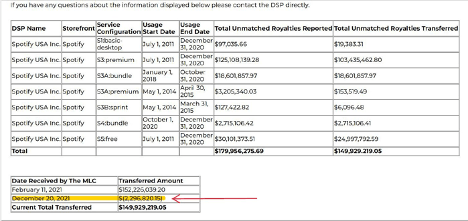
Now here’s the jawdropper. What if I told you that Spotify inexplicably reduced its portion of these historical unmatched royalties by nearly $2.3 million?

According to the MLC, on December 20, 2021 Spotify decreased its transfer of historical unmatched royalties by $2,296,820.15. You can find this information by visiting the MLC’s website here: https://www.themlc.com/spotify-usa-inc-spotify. You may wonder why this occurred. Unfortunately, I cannot provide you with any concrete answers, but I do think it is a more than fair question to raise.

Following the February 2021 data dump and transfer of the historical unmatched royalties to the MLC, the streaming services were given until June (in accordance with the regs) to provide the MLC with their second sets of data. According to the MLC’s Interim Annual Report (https://themlc.com/sites/default/files/2021-12/The%20MLC%20Interim%20AR21%20Hi-res%20FINAL.pdf) “[t]his second set of data contained information regarding works for which DSPs had previously paid some, but not all, of the relevant rightsholders for a given work.” The streaming services then had the right over the summer to amend or adjust the royalties and data provided to the MLC.

It is interesting to compare the historical unmatched royalties transferred by each streaming service in February 2021 with the final transfer amounts reported in summer 2021 — and I invite all of you to do the same (https://www.themlc.com/historical-unmatched-royalties ). What you will quickly realize is that the final transfer amounts for every service—other than Spotify, the Harry Fox Agency’s client, either reflected the same totals from the February dump, or, resulted in a higher amount transferred (like in the cases of Amazon, Apple and Google). At least so far.

You may be thinking, how do we know if this nearly $2.3 million reduction is accurate? Frankly, we do not know, and we forced to trust that Spotify is telling the truth. Regrettably, the MMA negotiators did not get (and may not have asked for) an audit right for songwriters or for the MLC with respect to these historical unmatched royalties. (Although it must be said that publishers with direct deals very likely had the right to audit, and possibly those who licensed to Spotify through Spotify’s licensing agent, the Harry Fox Agency, which was simultaneously acting as a licensors’ publishing administrator may have had an audit right. Have a pretzel and the conflicts make more sense).

I recognize I have the benefit of hindsight here — notwithstanding, I find it unfathomable that the MMA dealmakers did not secure an audit right in connection with what was sure to be hundreds of millions of dollars in unmatched royalties.

It is theoretically possible that Spotify overpaid its amount in historical unmatched royalties back in February 2021. Notwithstanding, and feel free to call me a cynic —  how am I to believe that for once Spotify actually made an overpayment in royalties?

How can I trust a company which amassed its billions in wealth by stealing musicians’ works, and has continued to supplement its wealth by fighting for the lowest mechanical royalty rates for songwriters ever?

How can I trust a company that unveiled a payola-like feature offering further reduced nanopenny rates to artists in exchange for “promotion?” (see “Discovery Mode”: https://www.rollingstone.com/pro/music-biz-commentary/spotify-payola-artist-rights-alliance-1170544/ ).

How can I trust a company that when faced with reasonable requests about paying musicians fairly, responded with a straight up gaslighting campaign?  (see “Loud & Clear” campaign: https://loudandclear.byspotify.com/ )

Remember, this is the company whose executive literally told an independent artist the following in a public forum:

“The problem is this: Spotify was created to solve a problem. The problem was this: piracy and music distribution. The problem was to get artists’ music out there. The problem was not to pay people money.”  (See here: https://www.digitalmusicnews.com/2021/06/29/spotify-executive-entitled-pay-penny-per-stream/)

In sum, how can I trust a company that has proven time and time again from its inception that it has never cared about songwriters and artists? Ultimately, I cannot — which makes it utterly difficult for me to trust that Spotify incorrectly overpaid nearly $2.3 million in historical unmatched royalties to the MLC. Granted, if Spotify made misrepresentations here, it could lose its limitation of liability for those past infringements–after years of litigation. But, without the MLC having the right to audit the historical unmatched amounts, determining whether Spotify’s total transfer is correct is essentially futile.

Awesome.

So, if you happen to contact Spotify this week about removing your catalog or canceling your subscription, consider also asking them to provide evidence that they overpaid the MLC $2,296,820.15 in historical unmatched royalties last February. Maybe if we’re lucky, we’ll get another Loud & Clear gaslighting campaign to post about!

#FrozenMechanicals Take 2: Comment of Professor @KCEsq to the Copyright Royalty Board

[A little context:  As readers will recall, the Copyright Royalty Board is in the middle of two (count ’em, two) simultaneous rate proceedings for the statutory mechanical royalty rates under the reliably absurd Section 115 of the Copyright Act. These two are styled “Phonorecords III” and “Phonorecords IV” respectively. Technically, Phonorecords III was appealed to a higher court (DC Circuit for those reading along at home) and was pretty much rejected and sent back to the Copyright Royalty Board on what’s called “remand” or as it’s know in the vernacular, “nice try.” Phonorecords IV is for the 2023-2027 period and is currently in the discovery phase for streaming mechanicals. MTP readers will also recall that I anticipated an attempt to extend the freeze on physical mechanicals at the 2006 rate of 9.1¢–long since corroded by inflation to a real mechanical rate of about 6¢ given an inflation rate of approximately 33% since 2006. And the majors are vigorously pursuing both a freeze as well as an extension of the pending and unmatched settlements for NMPA members (aka “MOU” for “Memorandum of Understanding” among the insiders) that is tied to the freeze for everyone else. See what they did there? Today we are posting the first of the 2nd round comments on the freeze filed with the Copyright Royalty Board in the Phonorecords IV proceeding. I was kind of hoping that someone would file a comment in support of the freeze but no one did–all comments are opposed. The first up is Professor Kevin Casini’s thoughtful comment. We will be cross posting with the Trichordist.]

November 20, 2021


Hon. C.J. Suzanne Barnett
Hon. J. David R. Strickler 
Hon. J. Steve Ruwe 

US Copyright Royalty Board 
101 Independence Ave SE / P.O. Box 70977 
Washington, DC 20024-0977

Honorable Judges of the Copyright Royalty Board:

I am a Connecticut resident, attorney, and law professor, and the views expressed here are mine, and not necessarily those of any local or state bar association, or any employer. The bulk of this comment appeared in an open letter to this body, and to my senators, dated May 27, 2021. It requested time to comment for those that were not represented by the publishing lobby, the so-called “self-administered” songwriters that were so en vogue during the passing of the Music Modernization Act, and with it, the advent of the Mechanical Licensing Collective. As the preeminent music economist of the day, Will Page, put it in his annual “Global Value of Music Copyright” compendium, “anyone can record a song, but only someone can compose it.”[1] I don’t speak for them, I’ve not been empowered to do so, but because so many of us know “self-administered” means “not administered” I speak to their best interests, even if they don’t know anything about this process. These writers are considered “self-publishing”, but the reality is, they have no publishing. Ironically, it is these independent writers who rely disproportionately on physical sales, direct downloads, and Bandcamp Fridays. In essence, “I speak for the trees.”[2]

On May 18, 2021, a “Notice of Settlement in Principle” was filed by parties to the proceedings before the Copyright Royalty Board about its Determination of Royalty Rates and Terms for Making and Distributing Phonorecords.[3] That Notice was followed on May 25, 2021 by a Motion To Adopt Settlement Of Statutory Royalty Rates And Terms For Subpart B Configurations, filed by the NMPA, Sony, Universal and Warner and NSAI.[4] I write today in reference to that proposed settlement. 

This settlement outlines the terms by which mechanical royalty[5] and download rates will remain locked at the current rate of 9.1¢. The same almost-dime for each copy of a work manufactured and distributed. The same almost-dime that it’s generated since 2006. A paltry sum to be certain but a far cry from the 2¢ royalty rate mechanical royalties imposed for the better part of seventy years.[6] Starting in 1977, Congress mandated that the mechanical royalty be increased incrementally until 2006 when the rate of 9.1¢ was achieved. And there it has remained. 

This proposed private settlement would extend that 2006 freeze until 2027. 

In March 2017, a precursor to Phonorecords IV found the Copyright Royalty Board ruling that interactive streaming services must pay more in mechanical royalties over the course of the next five years.[7] Surely more than a simple inflation adjustment, but nonetheless a sign that the CRB thought costs and values needed to become more aligned for streaming—which is paid by the streaming platforms unlike the physical and download mechanical which is paid by the record companies. Now comes Phonorecords IV, and a proposed settlement from the major publishers and their affiliated major labels. Before this proposal can be accepted by the CRB, I asked for the simple opportunity of public comment. This COurt saw fit to grant that request, and I express my appreciation.

As you well know, in nearly all other administrative proceedings public comment is an integral and indispensable component of the process. To see that the CRB may allow for a public comment period by members of the public beyond the participants in the proceeding or parties to the settlement is a step in the right direction, and my hope is that this development will be broadcast far and wide so that the CRB, and in turn, Congress, may get a full picture of the status of mechanical royalty rates, especially from those that are historically underrepresented. “Public comments” should be comments by the public and made in public; not comments by the participants made publicly.

I have a great deal of respect and admiration for the work put into the landmark copyright legislation that came about at the end of 2018, and for those that made it happen. So too for the members of the CRB, and in this space, I thank those Judges for taking the time to read a letter from an adjunct law professor with no economic stake in the outcome, but rather an interest in, and duty of, candor to the Court. 

In an age of unprecedented political polarization, the consensus built in the passage of the Music Modernization Act showed that politics aside, when it’s time to make new laws that fix old problems, Congress can still get the job done. I know well the sweat-equity poured into its creation by the very same people that propose this settlement. I have found myself on the same side fighting the same fight as them many times. They have proven capable of navigating your halls and taking on those that would seek to devalue (or worse) the work of the songwriter, and musician. In this instance, I would like to see them fight the fight yet again. recognize the reasoning and intention behind the proposed settlement. Commenting by the public is a way for that to happen.[8] I commend this Court for re-opening the comment period to allow for as much dialogue, and information, as possible. 

A year ago, I made the unilateral decision to pivot our consulting company, Ecco Artist Services, to purposefully work with, and advocate for, the traditionally and historically underserved and underrepresented in the music industry. Freezing the growth of rates for physical and digital sales that are already digging out of the residual effects of 70 years at 2¢ strikes at the heart of that community’s ability to generate revenues from their music. 

Now, it’s no secret the trade association for the US music publishing industry is funded by its music publisher members, and of course, as a professional trade organization, the association is bound to represent those members. Publishers have long enjoyed a better reputation amongst industry insiders than “the labels,” and for good reason, but the fact remains that writers signed to publishing deals are in contractual relationships with their publishers, and their interests are not always aligned. Such is the state of play in a consumer-driven marketplace, and especially now that publishers and labels are consolidating their businesses under the same tents. They, it seems, are the forest. An indie songwriter is but a tree. 

Unfortunately, the independent songwriter lacks the resources to participate fully in the process, and although a signed songwriter may believe her interests and those of her publisher are one and the same, they may not always be. It would seem the economic analysis the publishers undertook in deciding the mechanical royalty was not worth the heavy cost and burden of fighting is the same calculus the writers need not do: they couldn’t afford the fight no matter the decision. 

But I ask: if the mechanical royalty covered by the proposed settlement is a dying source of revenue, why would the fight be so onerous? By the RIAA’s 2020 year-end statistics, physical sales and downloads accounted for 15% of the music marketplace.[11] That’s a $12.2 billion marketplace, and that 15% amounts to $1.8 billion. Now, I know attorney’s fees can be exorbitant in regulatory matters, but I would think we could find a firm willing to take the case for less than that. As for sales, in 2020, 27.5 million vinyl LPs were sold in the United States, up 46-percent compared to 2019 and more than 30-fold compared to 2006 when the vinyl comeback began,[12]  while some 31.6 million CD albums were sold.[13]

Median wages in the US, adjusted for inflation, have declined 9% for the American worker. Meanwhile, since the 9.1¢ rate freeze, the cost of living has gone up 31%, according to the American Institute of Economic Research[14]. The 2006 inflation rate was 3.23%. The current year-over-year inflation rate (2020 to 2021) is now 4.16%[15], which is all really to say, simply, an accurate cost-of-living increase would have a mechanical rate of at least 12¢ per sale. Twelve cents! You would think that would be an easy sell, but the streaming rates are fractions of that rate. The reality is a song would need to be streamed 250 times to generate enough money to buy it from iTunes. As my dear friend Abby North put it, the royalty amount for the digital stream of a song is a micro penny.[16]

An adjustment for inflation should require no briefing, let alone argument. If songwriters were employees, this would simply be line-item budgeted as a “cost-of-living adjustment.” If songwriters were unionized it would be a rounding error, but I digress. 

Even if it is true that the mechanical revenue is a lost and dying stream, by the RIAA’s own figures, there stand to be billions of dollars at stake. An opportunity to be heard, without having to sign with a publisher and then hope that publisher takes up the fight you want, maybe that’s all the independent writers of the industry—and, indeed, the world–need to be able to win. 

An inflation-adjusted cost-of-living update to the mechanical statutory royalty rate should be of no issue. Those independent, self-published writers affected by the decision of the CRB have been given the opportunity to voice their concerns through public comments. I hope that the CRB considers the disparities in bargaining power among those on the “writers’ side” of this issue before it makes its final decision. Please note, I pass on judgment on those that serve their constituencies, I just know there is no substitute for direct action, direct aid, or direct advocacy.

I want to close this time by thanking the Board, and Copyright Office, all for their continued attention to the universe of copyright, licensing royalties, and the economy that exists therein, and specifically the recently retired CJ of Copyright Royalty Board Jesse Feder, for allowing this opportunity, and so many other. It is my sincere hope (and effort) that the tone and tenor of these negotiations, deliberations, and litigation proceedings can be focused on the issue at hand, with collaborative results the goal, but when that cannot be, I trust the Copyright Royalty Board will see both forest and trees. 

Kevin M. Casini 
New Haven, CT

Attorney-at-Law, Adj. Professor, Quinnipiac Univ. School of Law

cc: Ms. Carla Hayden, US Librarian of Congress 

Ms. Shira Perlmutter, US Register of Copyrights 


[1] Available at https://tarzaneconomics.com/undercurrents/copyright-2021

[2] SEUSS. (1971). The Lorax. MLA (7th ed.) Seuss, . The Lorax. , 1971. Print.

[3] (Phonorecords IV) (Docket No. 21–CRB–0001–PR (2023–2027)).

[4] Available at https://app.crb.gov/document/download/25288

[5] The term “mechanical royalty” dates back to the 1909 Copyright Law when Congress deemed it necessary to pay a music publishing company for the right to mechanically reproduce a musical composition on a player-piano roll. As a result, music publishers began issuing “mechanical licenses”, and collecting mechanical royalties from piano-roll manufacturers. The times, and the tech, changed, but the name stuck.

[6] A summary of historical mechanical royalty rates is available from the U.S. Copyright Office at https://www.copyright.gov/licensing/m200a.pdf

[7] Docket No. 16-CBR-0003-PR (2018-2022) (Phonorecords III).

[8] The CRB arguably has the statutory obligation to publish the Motion in the Federal Register for public comment, but may have the discretion to construe those commenting to the participants in the proceeding and the parties to the settlement.  17 U.S.C. § 801(b)(7).  

[9] https://www.officialdata.org/Rent-of-primary-residence/price-inflation/2006-to-2021?amount=1000

[10] https://www.in2013dollars.com/Milk/price-inflation/2006-to-2021?amount=4

[11] RIAA year-end revenue statistics. https://www.riaa.com/wp-content/uploads/2021/02/2020-Year-End-Music-Industry-Revenue-Report.pdf

[12] MRC 202 Year End Report. https://static.billboard.com/files/2021/01/MRC_Billboard_YEAR_END_2020_US-Final201.8.21-1610124809.pdf

[13] Id.

[14] American Institute for Economic Research. https://www.aier.org/cost-of-living-calculator/

[15] U.S. Bureau of Labor Statistics Consumer Price Index https://www.officialdata.org/articles/consumer-price-index-since-1913/

[16] Abby North, North Music Group Letter to Congress on Frozen Mechanicals and the Copyright Royalty Board, The Trichordist (May 24, 2021) available at https://thetrichordist.com/2021/05/24/northmusicgroup-letter-to-congress-on-frozen-mechanicals-and-the-copyright-royalty-board/

The DLC Finally Confirms (Sort Of) How Much is in the MMA Black Box–Bigger than a breadbox

By Chris Castle

[This post first appeared on MusicTechPolicy]

We’ve all heard rumors about how much is in the “inception to date” black box at the digital music services. The main reason that nobody knows is another example of the dismal drafting of the Music Modernization Act.

Limitation on Liability

Wouldn’t you think that if the class actions against Spotify gave the insiders the leverage to negotiate the MMA giveaway that they could at least have gotten an immediate accounting from the services for how much of the songwriters’ money they’ve been holding all these years? But no, it’s sleepy time in Washington yet again. From the Land of Frozen Mechanicals they bring you more Brinksmanship 101. The retroactive black box payment is due to be made by the services to the MLC and its data vendor, HFA–remembering that HFA was also the data vendor for at least some of the services that created the black box in the first place.

limitation on liability 2

However, there is some activity at the Copyright Office now about how to get this money paid. It’s at the Copyright Office because while drafting the aircraft carrier revision to the Copyright Act (aka Title I of the Music Modernization Act), the hard parts were never drafted and were left to the Copyright Office to handle through regulations. Musicians–you’ve seen this before. This is the Washington version of “we’ll fix it in the mix.” So you do have feel sympathy for the Copyright Office in the situation when all the smart people leave them twisting in the breeze.

Not that I necessarily believe this number, but for the first time the services have given a bigger than a breadbox idea of how much is in the black box. The DLC’s lawyers filed an “ex parte” letter in which they made that revelation (along with the known universe: Artist Rights Alliance Ex Parte Letter (Nov. 17, 2020)Digital Licensee Coordinator Ex Parte Letter (Nov. 17, 2020)Mechanical Licensing Collective Ex Parte Letter (Nov. 17, 2020)Music Artists Coalition Ex Parte Letter (Nov. 17, 2020)Nashville Songwriters Association International Ex Parte Letter (Nov. 17, 2020)National Music Publishers’ Association Ex Parte Letter (Nov. 17, 2020)Recording Academy & Songwriters of North America Ex Parte Letter (Nov. 17, 2020)Songwriters Guild of America et al. Ex Parte Letter (Nov. 18, 2020).)

The DLC itself is at the mercy of its members in terms of revealing this number but they claim the following in the Digital Licensee Coordinator Ex Parte Letter (Nov. 17, 2020):

DLC also provided a rough estimate of accrued royalties that are available to be transferred to the MLC, based on a limited survey of a subset of DLC members at a particular point in time, and with the crucial caveat that the precise amounts are in flux as digital music providers continue to engage in robust matching efforts. Specifically, DLC estimated that several hundred million dollars were available to be transferred to the MLC as accrued royalties, even after accounting for the derecognition of accruals based on preexisting agreements containing releases to claims for accrued royalties.

DLC also explained that the accruals that were derecognized because copyright owners were paid and provided releases were a fraction of that amount—on the order of tens of millions of dollars.

So now we know at least that much. We know there are “several hundred million” dollars at issue in the black box and we generally know where the money is. We may know that DLC members hold the money. We also know that this money has not been identified, but we at least know enough to get the nose of the camel in the tent.

Crouching Tiger, Hidden Dragon: Broad and Antiquated CDA 230 Immunity for TikTok Could Aid China’s Secret Efforts to Undermine U.S. Cyber-Security: Guest Post by Rick Lane

I believe there are only two public policy issues that President Trump and Vice President Biden agree upon: The status quo of Section 230 of the 1996 Telecommunication Act is no longer acceptable; TikTok is a threat to our cyber and national security.

Interesting enough, these two issues are interlinked. Section 230 of the Communications Decency Act (CDA 230) gives free reign to Internet platforms operating in the United States to act with impunity as it relates to user generated content. Predictably, this has led to unintended and destructive consequences. But, left unsaid is what Big Tech doesn’t want anybody to realize – CDA 230 also unwittingly shields China as America’s top geopolitical adversary challenges U.S. national and economic security right here at home.

According to Bloomberg, Chinese-controlled “ByteDance/TikTok, led by Zhang Yiming, is becoming a viable rival to the dominant American online behemoths, Facebook Inc. and Alphabet Inc..” Last year, TikTok’s net profit was approximately $3 billion and the company estimates that it has about 80 million monthly active users in the United States, 60% of whom are female and 80% fall between the ages of 16 and 34. Of particular concern is that 60% of TikTok users are Gen Z, which is the largest generational cohort in American history and will include 74 million people next year.

As a champion of free markets, I would normally be among the first to applaud an upstart bringing a competitive “A” game to challenge dominant incumbent players no matter where they are based. But we have learned from experience that homegrown social networking companies like Facebook/Instagram, Google, and Twitter exert dominant and controversial influence in U.S. public policy debates – what sort of foreign influence should we expect TikTok to exert on this year’s election.

Lately, I’ve found myself asking should I really be concerned?

A recent article by Larry Magid was the tipping point for me in this debate. The headline of the article was, “How A 51-Year-Old Grandmother and Thousands of Teens Used TikTok to Derail A Trump Rally & Maybe Save Lives.” Magid lays out the series of events illustrating how attendance at a Trump rally was manipulated by a viral video of a grandmother from Iowa. It sounds innocent enough until you realize that the inflated numbers of expected attendees started when fans of K-pop, the popular Korean music genre, ordered free rally tickets from the Trump campaign with no intention of actually attending. Next, according to the article, the “grandmother from Iowa” posted a video on TikTok urging her mostly young viewers to “Google two phrases, ‘Juneteenth’ and ‘Black Wall Street,’” before also suggesting that they register for two free tickets to the Trump rally. Her video post went viral and motivated young TikTok users to request hundreds of thousands of tickets.

After reading this, I was left with a simple question: Whether Trump or Biden, doesn’t it bother anyone else that a Chinese-controlled social network was used to interfere with an American presidential campaign event at the same time that tensions between our two countries are escalating? Even Vice President Biden has banned TikTok from campaign phones and computers. As Mr. Magid’s article acknowledges, “(i)t’s long been known that social media can have a huge impact on politics. That’s why Russia tasked a state-run agency to flood social media with posts and ads to get Donald Trump elected.”

Two additional facts build on the story told by Magid. Another recent article, titled “Anonymous Hackers Target TikTok: ‘Delete This Chinese Spyware Now,” states that TikTok is “a data collection service that is thinly veiled as a social network. If there is an API to get information on you, your contacts, or your device, they’re using it.” The other fact to connect is that the key driver for algorithms and artificial intelligence, especially when dealing with human behavior, is vast data on human interaction. It is one of the main reasons that Microsoft is so interested in buying TikTok.

So now we are confronted with a Chinese based “social networking” site growing more rapidly than any homegrown US competitor and collecting more data on our youngest and most easily influenced demographic at the same time that China, Russia, and Iran are using social networks to undermine our democracy. Let’s not forget that this social networking site has been proven not to be secure and agreed to pay $5.7 million to settle Federal Trade Commission (FTC) allegations that it illegally collected personal information from children, the largest civil penalty ever obtained by the FTC in a children’s privacy case.

But most alarming is that TikTok is protected by CDA 230 and cannot be held accountable for the actions of its “users” even if those “users” happen to be foreign governments. For example, if the Chinese government is leveraging TikTok for its own strategic advantage, the US government has no recourse against TikTok for these activities. The impunity provided by CDA 230 to TikTok, as well as Chinese and other hostile governments, directly threatens our democratic process. Even more troubling is the fact that TikTok, along with Facebook and other social networking sites, cannot be held responsible for illegal conduct occurring on their platforms – even when they know about it.

Besides the potential of interfering with our elections, TikTok also continues to facilitate the sale of illegal drugs. Below are three screenshots of illicit activity being perpetrated on TikTok. The first two images show illegal drug sales of opioids and the other shows illegal drug sales of steroids. Remember, TikTok’s core demographic and the intended audience for these posts consists primarily of members of Gen Z, those born between 1995 and 2012 –our children.  [Similar to Google’s near-indictment and $500,000,000 fine for violating the Controlled Substances Act.]

(Screenshots Provided by Eric Feinberg)

I will leave you with a quote from a recent speech at the Hudson Institute by FBI Director Christopher Wray. He stated:

“The Chinese government is engaged in a broad, diverse campaign of theft and malign influence, and it can execute that campaign with authoritarian efficiency. They’re calculating. They’re persistent. They’re patient. And they’re not subject to the righteous constraints of an open, democratic society or the rule of law… China, as led by the Chinese Communist Party, is going to continue to try to misappropriate our ideas, influence our policymakers, manipulate our public opinion, and steal our data. They will use an all-tools and all-sectors approach—and that demands our own all-tools and all-sectors approach in response.”

For addressing this clear and present danger, the United States must modify CDA 230 and ensure that we have all the tools necessary to hold TikTok accountable for criminal activity that occurs by “others” on their platform. Importantly, this includes illegal actions taken by the Chinese government to misappropriate the site, and the massive amounts of data it collects, in order to inflict harm on the US and its allies. Finally, we must avoid inadvertently making this problem worse by spreading the excessively broad and antiquated immunity of CDA 230 through trade agreements with other countries.

Rick Lane is the founder and CEO of IGGY Ventures. IGGY advises and invests in technology startups and public policy initiatives that can have a positive societal impact. Rick served for 15 years as the Senior Vice President of Government Affairs of 21st Century Fox. Before joining Fox, Rick was the Director of Congressional Affairs focusing on e-Commerce and Internet public policy issues for the United States Chamber of Commerce.

Guest Post: Follow the Money: YouTube’s Failure to Pay Retroactively Gives “Conversion Rate” a Whole New Meaning

[Cross-posted from MusicTechPolicy]

by Chris Castle

Conversion

A performance metric one hears from the digerati is the term “conversion rate.”   “Conversion rate” for a streaming service usually means the rate at which users of an ad-supported free service are “converted” to paying users.  That motivation is usually because they are so fed up with the advertising they are willing to pay.  (This was one of the many failed pitches from Spotify before people stopped trying to justify hanging on until the IPO riches flowed in.)

YouTube, of course, has never been too terribly interested in anything that moves users away from advertising.  That resistance (and potential internal competition between the massive ad sales team and the ever changing YouTube managers), may explain the many failed efforts at launching a YouTube subscription service by a company that knows more about user behavior than anyone in history.  They just couldn’t seem to get it right for the longest time.  You don’t suppose that YouTube’s apparent lack of interest in getting large numbers of users to substitute away from free to subscription was because YouTube made a lot more money from the ads than they ever would from the subscriptions?

One of the ways that YouTube (and Google) makes money from advertising is by taking money that is not theirs to take (sometimes called “monetizing” content).  The civil law calls that act a claim of “conversion” and   the criminal law calls it the crime of “theft”.  Conversion and theft are two sides of the same coin and often one implies the other, albeit with different burdens of proof.

theft

YouTube’s Content ID tool is a way for copyright owners to block or permit advertising on user-generated content that includes their copyrights, often music.  Users of Content ID will tell you that it works just well enough that Google can say it is an effective tool, but even with Content ID music still gets through (and is often monetized by YouTube) for a variety of reasons.  This requires time consuming and costly manual searches.  Companies like AdRev make it a bit easier, but are essentially third party Content ID users.  These companies are compensated with a commission on infringing works they find on YouTube that they convert–there’s that word again–from infringing to monetized, which means that YouTube now splits the advertising revenue with the copyright owners who in turn split their share with an AdRev.

But see what happened there?  If you have Content ID, you can block on the upload some of the time, or you can do a search.  If you don’t have Content ID (see Maria Schneider’s class action) then you can’t block on the upload only chase the infringements manually.  But quite rightly from an economic perspective, companies like AdRev are not that interested in doing that work on a rev share basis if there’s no rev share when you block.

Here’s the point–you have a property right in your copyright.  You have a property right to license that copyright.  Any revenue derived from exploitations of that copyright is your money.  YouTube uses its monopoly power to impose a deal to monetize your copyright (under duress, of course, due to whack a mole DMCA).  That deal involves a revenue share.  (Let’s just assume you decide to take the King’s shilling and accept Google’s deal under duress which you shouldn’t have to do and which may not even be enforceable.)

The question is, when should that revenue share attach–when they start exploiting your copyright in violation of your property rights or when you catch them doing it.  And if (1) you catch them violating your property rights and (2) agree to monetize, when should they pay you your agreed upon share of the revenue from monetizing?  Should they pay retroactively to the first exploitation?  Or only prospectively after you catch them?

The correct answer is they should pay retroactively.  But they don’t.  They just keep the money.  For millions of infringements.  And they get away with it because of their monopoly power, which leaves one choice most artists won’t make, which is to sue them like Maria has.

Remember–Content ID operates largely like any other fingerprinting tool.  (Psychoacoustic fingerprinting is old technology–remember Jonesy in “The Hunt for Red October”?  That’s fingerprinting.  A “fingerprint” is simply a mathematical rendering of the waveform of an audio file.)

There is a reference databases of recordings that are “known knowns” (which is why it is important to be included in the Content ID database as Maria Schneider correctly points out in her class action.)  The fingerprinting tool encounters a new file, takes a fingerprint, then looks for a match in the reference database and reports a result that triggers an action.  Typically, fingerprinting tools are binary:  match or no match.  What happens after the tool finds a match is entirely in the control of the operator.  (So while the tool could have a match rate of 90%, the operator could report a random number of matches or a fixed number of matches, like one every ten, or one every 1000.  That means 90% accuracy could turn into a much lesser percentage of reported matches.  It’s important to know how many matches trigger an action.)

Having had some experience with audio fingerprints, I think you will find that once a fingerprint is in the reference database, the recognition tool (Content ID in this case) will spot the reference fingerprint a very, very high percentage of the time.  The fingerprinting tool I’m most aware of caught matches over 90% of the time.  I can’t imagine that a tool developed by the biggest technology company in commercial history would do less–unless they wanted it to.  Remember, this is not taking into account re-records unless the re-record is itself in the database, or pitch bends.  This is an exact match which is very common use of Content ID.  (See Maria’s class action complaint, and Kerry Muzzey has a great description of this in his recent Senate testimony.)

If Content ID is actually missing matches to known knowns on the upload (assuming exact matching is possible), I find it very odd that Content ID is missing much.  Maybe it’s not, but one way to find out is to force Google to reveal the inner workings through discovery in the class action case.

But if Content ID does miss exact matches, it would be interesting to know what percentage of those misses end up being monetized, and of those, what percentage end up getting caught later by a subsequent use of Content ID or a manual investigative process.  This will give an idea of the scale of the retroactive payment issue.

As Maria rightly points out, it is virtually impossible for an artist or film maker without Content ID to catch YouTube monetizing infringing works.  But I think the analysis has to go a step further–even if you have Content ID, at the moment you catch YouTube monetizing illegal versions, you are in no different position than the artist who lacks access to the Content ID tool.

Both have the same problem–YouTube is profiting from illegal copies.  If when you catch them you then elect to monetize, YouTube will pay you going forward, i.e., prospectively.  But I do not believe they will pay you retroactivelyfor the illegal use.  (There is a rumor that some music publishers do get paid retroactively under some settlement, but that needs to be confirmed.)

That means that YouTube is directly profiting from piracy for the retroactive views which could total into the hundreds of millions per day given the massive number of daily views on YouTube.  If you elect to monetize due to YouTube’s monopoly power, you are essentially releasing them from liability under duress.  If you catch them.

So YouTube takes your property, monetizes it, and refuses to pay you for how much they made before you caught them if you ever do catch them.  They dare you to sue them because you would be taking on the biggest company in commercial history that controls 90% of the access to information in the world and routinely defies governments.  Not everyone has the spine of Maria Schneider.

Failing to license at all or failing to pay retroactively means that YouTube profits from piracy by converting your property to their own.  And as Maria rightly points out, Google scrapes user data through non-display uses in the background even if YouTube is not monetizing overtly which they then use to compile user profiles in “millions of buckets” (which dribbled out before Judge Koh in the Gmail litigation (In Re: Google, Inc. Gmail Litigation,  Case No. 13-MD-02430-LHK, (U.S.D.C. N.D. California, San Jose Division, Sept. 26, 2013)).

In either case, the value of the amount converted or stolen should rightly include the value of these user profiles scraped in the background, as well as the advertising revenue.

And don’t forget that Google is controlled by Larry Page, Sergei Brin, and Eric Schmidt through their “supervoting” shares of stock.  It’s hard to believe that this YouTube policy was created without their blessing.

The simplest move for Google would be to simply pay both retroactively and (if the copyright owner elects to monetize) prospectively.  Otherwise, it seems like a huge number of crimes are going on in a very planned and organized way dreamed up by YouTube and Google employees.  “Dreamed up” is also called a conspiracy, and if there’s an actual conspiracy it’s not a theory (which came up in an interesting trade secret misappropriation RICO case against Google they managed to wriggle out of, at least for the moment).

The law has another word for organized theft at scale–we sometimes call it “racketeering.”

racketeering