The Madness of Amazon’s Song Royalty Refund Demand

You can check out any time you like, but you can never leave.
Hotel California, written by Don Felder, Glenn Frey and Don Henley

There’s no opt-out in either the Hotel California or the compulsory song license. And Amazon’s demand for a royalty refund from songwriters demonstrates once again the madness of the Copyright Royalty Board rate-setting procedures. Whether it creates enough ripples in the booming business around buying out songwriter royalties remains to be seen.

How did we get to this point in the circus act? You may have noticed that sliced bread is in close competition with fire and the wheel for second place behind Greatest Human Accomplishments. Both fire and the wheel are yielding to streaming mechanical royalty rates in the Phonorecords III remand negotiations.  Yes, the so-called “headline rates” in Phonorecords III (or “PR III”) are a Nobel-worthy accomplishment.  At least according to the press agents.

And yet something curious has happened.  I’m told that Amazon, through its agent Music Reports (MRI), has posted what is essentially a demand letter in the MRI user portal.  This demand letter instructs publishers who have directly licensed songs to Amazon to pay up because of an overpayment of streaming mechanicals due to the adjustment required by the new-ish Phonorecords III remand rates that finally set the streaming mechanical rates for the industry.  Something similar may be happening at the MLC; we’ll come to that below in just a bit.

In a testament to just how whack the Copyright Royalty Board system actually is, the PR III remand concerns royalties paid from 2018 through 2022.  That’s right—starting six years ago.  This is largely due to the failure of the publishers to obtain a waiver of the PR III decision as a negotiating chip when they gave away the rest of the farm in Title I of the Music Modernization Act (also hailed as a great gift to songwriters). But I’d say it is primarily due to the desire of digital music services like Amazon—including the largest corporations in commercial history—to crush the kitchen tables of songwriters.  Because judging by the massive overlawyering in the Copyright Royalty Board, that sure looks like the motive.

And when it comes to the services crushing the little people, money is no object, even if they spend more on litigation than the royalty increase cost them.  Evidently the sadistic psychic benefit greatly exceeds the cost.

But Amazon evidently has discovered that even after all the shenanigans with PR III, it appears that they paid too much and now they want it back.  That’s right—Amazon shamelessly wants you to cut them a check.  Because a market value over $2,000,000,000,000 is just not enough. I wonder which buffoon advised Mr. Bezos that was a good idea.

Here’s what it looks like on MRI:

A few questions come to mind.  First, realize what Amazon is saying.  They were evidently accounting to publishers at the rates for Phonorecords II during the several years that the PR III rates were on appeal and then re-litigated before the Copyright Royalty Board.  The final PR III rates (sometimes called “remand rates”) issued in August of last year (2023) were supposed to be an improvement over the PR II rates don’t you know.  At least according to the braying that accompanied the announcement.  In fact, the PR III remand rates where it all ended up were themselves supposed to be an improvement, meaning that publishers were to be paid more under PR III than under PR II. Maybe that’s the difference between an increase in the payable rates compared to an increase in the payable royalties.

So if that’s true, and if Amazon paid PR II rates during the lengthy PR III appeal, why is there now an overpayment by Amazon?  An overpayment that they now want you to pay back? Wouldn’t you expect to see the true-up on new rates result in publishers receiving a credit for increased rates?  Especially if the stream counts and subscriber totals stayed the same on these previously-issued accounting statements? (Not to mention this may be happening at other services, too.)

Some of these PR III statements pre-date and overlap with the MLC’s creation and the “license availability date” for the 2021 blanket license established under Title I of the MMA.  That means that if you or your publisher had a direct deal with Amazon during the PR III rate period, there may be overlapping periods when the MLC took over Amazon’s accountings.

It has long been the standard industry practice that overpayments are just debited to your royalty account.  Nobody asks you to cut a check. Debiting your account is not much better–you still have to pay them back, and the so-called “overpayment” will still potentially zero out your MLC accounts, too. If you did a royalty buyout that included an assumption that these royalties would be paid, your financier may come up short under either direct license or MLC.

This is particularly true for publishing administrators.  If a service were to debit an administrator’s account, that might result in the administrator having to go out of pocket in order to pay some of their publishers for the amount of the demand. If that overpayment is large enough, that administrator may owe royalties to publishers that did not have the benefit of the overpayment. This is pretty elementary math, 2 plus 2 being what it is. You don’t even have to carry the 1.

However, great news!  Amazon will give you an interest-free payday loan so you can pay down your new debt over six months. Or before they send it to collection.

Now the MLC—it’s entirely possible that Amazon is pulling the same stunt under the statutory license. However, it appears that MLC is doing what is normally done in these situations and will be debiting and crediting as necessary.  If you’re concerned, it would be worth checking and asking for an explanation from the MLC.

Even so, it does not change anything about why there is an overpayment in the first place.  If there were ever a situation that cried out for an intensive royalty compliance exam, this is it.  It is hard to believe that all this to-ing and fro-ing with your royalty payments across multiple rates in multiple accounting periods hasn’t resulted in mistakes.  No crime, it’s complex.  That’s why we have audits. At a minimum, Amazon needs to provide publishers with a detailed breakdown of how the repayment was determined along with an explanation of where the rates changed that caused the overpayment.

That’s why Amazon and any other similarly situated service should welcome an extensive audit.  In fact, the MLC should just include the true-up (or true-down in Amazon’s case) in their already-noticed audit of Amazon. This episode also raises the question of who else is going to pull the same stunt.

This slice of life demonstrates once again how unworkable the entire Copyright Royalty Board system is for streaming mechanical royalties. The services get to drag out appeals forever, and songwriters pay the consequences. But like the man said, you can never leave. And the Music Modernization Act just got every one locked in even deeper.

[A version of this post first appeared on MusicTechPolicy]
Must See Testimony by @MMercuriadis at @KevinBrennanMP Hearing on Streaming Economy

Very important testimony by Merck Mercuriadis at the UK House of Commons Culture Media and Sport Committee revisiting the Committee’s inquiry into the economics of streaming.

Read Merck’s fireside chat with Chris at last year’s Artist Rights Symposium at the University of Georgia.

Press Release: @UMG and @TIDAL Partner to Work on Artist-Centric Royalties — Artist Rights Watch

New York, January 31, 2023 – TIDAL, the global music and entertainment platform, and Universal Music Group (UMG), the world leader in music-based entertainment, today announced that the two companies will work together to explore an innovative new economic model for music streaming that might better reward the value provided by artists and more closely reflect the engagement of TIDAL subscribers with those artists and music they love.

Streaming has revolutionized music, catalyzed industry growth, transformed the entertainment experience and provided incredible opportunities for engagement, to the benefit of artists and fans alike. As it has gained mass adoption over the past decade, there is more desire from all parties to look at how to best economically align fans’ interests with those of their favorite artists.

TIDAL and UMG will research how, by harnessing fan engagement, digital music services and platforms can generate greater commercial value for every type of artist. The research will extend to how different economic models could accelerate subscriber growth, deepen retention, and better monetize fandom to the benefit of artists and the broader music community.

“From day one, TIDAL has stood out as artist-first, leading with a premium subscription tier to pay artists more and experimenting with new ideas like fan-centered royalties to see if there are fairer and more equitable ways to get artists paid,” said TIDAL Lead Jesse Dorogusker. “We are setting aside our current fan-centered royalties investigation to focus on this opportunity for more impact. We’re thrilled to partner and learn along the way about the possibilities for more innovative streaming economics. This partnership will enable us to rethink how we can sustainably improve royalties’ distribution for the breadth of artists on our platform.”

“As the digital landscape continues to evolve, it’s become increasingly clear that music streaming’s economic model needs innovation to ensure a vibrant and sustainable future,” said Michael Nash, UMG’s Executive Vice President, Chief Digital Officer. “Tidal’s embrace of this transformational opportunity is especially exciting because the music ecosystem can work better – for every type of artist and fan – but only through dedicated, thoughtful collaboration. Built on deeply held, shared principles about the value of artistry and the importance of the artist-fan relationship, this strategic initiative will explore how to enhance and advance the model in keeping with our collective objectives.”

For more information contact:

TIDAL: Sade Ayodele, Head of Communications – sayodele@tidal.com

Universal Music Group, Global Communications: James Murtagh-Hopkins  james.murtagh-hopkins@umusic.com

Read the press release

h/t Sharkey Laguana and Artist Rights Symposium II panelist Michael Nash.

Will the Copyright Royalty Board approve Big Tech’s attempted cover-up? 

By Chris Castle

[This MusicTechPolicy post appeared on Hypebot]

There’s an old saying among sailors that water always wins. Sunlight does, too. It may take a while, but time reveals all things in the cold light of dawn. So when you are free riding on huge blocks of aged government cheese like the digital music services do with the compulsory mechanical license, the question you should ask yourself is why hide from the sunlight? It just makes songwriters even more suspicious. 

This melodrama just played out at the Copyright Royalty Board with the frozen mechanicals proceeding. Right on cue, the digital services and their legions of lawyers proved they hadn’t learned a damn thing from that exercise. They turned right around and tried to jam a secret deal through the Copyright Royalty Board on the streaming mechanicals piece of Phonorecords IV. 

To their great credit, the labels handled frozen physical mechanicals quite differently. They voluntarily disclosed the side deal they made with virtually no redactions and certainly didn’t try to file it “under seal” like the services did. Filing “under seal” hides the major moving parts of a voluntary settlement from the world’s songwriters. Songwriters, of course, are the ones most affected by the settlement–which the services want the CRB to approve–some might say “rubber stamp”–and make law.

To fully appreciate the absolute lunacy of the services attempt at filing the purported settlement document under seal, you have to remember that the Copyright Royalty Judges spilled considerable ink in the frozen mechanicals piece of Phonorecords IV telling those participants how important transparency was when they rejected the initial Subpart B settlement.  

This happened mere weeks ago in the SAME PHONORECORDS IV PROCEEDING.

Were the services expecting the Judges to say “Just kidding”? What in the world were they thinking? Realize that filing the settlement–which IF ACCEPTED is then published by the Judges for public comment under the applicable rules established long ago by Congress–is quite different than filing confidential commercial information. You might expect redactions or filings under seal, “attorneys eyes only,” etc., in direct written statements, expert testimony or the other reams of paper all designed to help the Judges guess what rate a willing buyer would pay a willing seller. That rate to be applied to the world under a compulsory license which precludes willing buyers and willing sellers, thank you Franz Kafka. 

When you file the settlement, that document is the end product of all those tens of millions of dollars in legal fees that buy houses in the Hamptons and Martha’s Vinyard as well as send children to prep school, college and graduate school. Not the songwriters’ children, mind you, oh no. 

The final settlement is, in fact, the one document that should NEVER be redacted or secret. How else will the public–who may not get a vote but does get their say–even know what it is the law is based on assuming the Judges approve the otherwise secret deal. It’s asking the Judges to tell the public, the Copyright Office, their colleagues in the appeals courts and ultimately the Congress, sorry, our version of the law is based on secret information.

Does that even scan? I mean, seriously, what kind of buffoons come up with this stuff?  Of course the Judges will question the bona fides and provenance of the settlement. Do you think any other federal agency could get away with actually doing this? The lawlessness of the very idea is breathtaking and demonstrates conclusively in my view that these services like Google are the most dangerous corporations in the world. The one thing that gives solace after this display of arrogance is that some of them may get broken up before they render too many mechanical royalty accounting statements.

To their credit, after receiving the very thin initial filing the Judges instructed the services to do better–to be kind. The Judges issued an order that stated:

The Judges now ORDER the Settling Parties to certify, no later than five days from the date of this order, that the Motion and the Proposed Regulations annexed to the Motion represent the full agreement of the Settling Parties, i.e., that there are no other related agrements and no other clauses. If such other agreements or clauses exist, the Settling Parties shall file them no later than five days from the date of this order.

Just a tip to any younger lawyers reading this post–you really, really, really do not want to be on the receiving end of this kind of order.

Reading between the lines (and not very far) the Judges are telling the parties to come clean. Either “certify” to the Judges “that there are no other related agreements and no other clauses” or produce them. This use of the term “certify” means all the lawyers promise to the Judges as officers of the court that their clients have come clean, or alternatively file the actual documents.

That produced the absurd filing under seal, and that then produced the blowback that led to the filing of the unsealed and unreacted documents. But–wait, there’s more.

Take a close look at what the Judges asked for and what they received. The Judges asked for certification “that there are no other related agrements and no other clauses. If such other agreements or clauses exist, the Settling Parties shall file them no later than five days from the date of this order.”

What the Judges received is described in the purportedly responsive filing by the services:

The Settling Participants [aka the insiders] have provided all of the settlement documentsand, with this public filing, every interested party can fully evaluate and comment upon the settlement. The Settling Participants thus believe that the Judges have everything necessary to “publish the settlement in the Federal Register for notice and comment from those bound by the terms, rates, or other determination set by the” Settlement Agreement, as required under 37 C.F.R. 351.2(b)(2). The Settling Participants respectfully request that the Judges inform them if there is any further information that they require.

Notice that the Judges asked for evidence of the “full agreement of the Settling Parties”, meaning all side deals or other vigorish exchanged between the parties including the DSPs that control vast riches larger than most countries and are super-conflicted with the publishers due to their joint venture investment in the MLC quango.

The response is limited to “the settlement documents” and then cites to what the services no doubt think they can argue limits their disclosure obligations to what is necessary to “publish the settlement”. And then the services have the brass to add “The Settling Participants respectfully request that the Judges inform them if there is any further information that they require.” Just how are the Judges supposed to know if the services complied with the order? Is this candor?

It must also be noted that Google and the NMPA have “lodged” certain documents relating to YouTube’s direct agreements which they claim are not related to the settlement to be published for public comment. These documents are, of course, secret:

[And] are not part of the settlement agreement or understanding of the settling participants concerning the subject matter of the settlement agreement, and do not supersede any part of the settlement agreement with respect to the settling participants’ proposed Phonorecords IV rates and terms. Further, the letter agreements do not change or modify application of the terms to be codified at 37 C.F.R. 385 Subparts C and D, including as they apply to any participant. Rather, the letter agreements simply concern Google’s current allocation practices to avoid the double payment of royalties arising from YouTube’s having entered into direct agreements with certain music publishers while simultaneously operating under the Section 115 statutory license.

You’ll note that there are a number of declarative statements that lets the hoi polloi know that the Data Lords and Kings of the Internet Realms have determined some information involving their royalties is none of their concern. How do you know that you shouldn’t worry your pretty little head about some things? Because the Data Lords tell you so. And now, back to sleep you Epsilons.

So you see that despite the statements in the group filing to the CRB that the “Settling Participants” (i.e., the insiders) claim to have provided all of the settlement documents required by the Judges, Google turns right around and “lodges” this separate filing of still other documents that they think might be related documents with some bearing on the settlement that should be disclosed to the public but they apparently will not be disclosing without a fight. How do we know this? Because they pretty much say so:

Because the letter agreements are subject to confidentiality restrictions and have each only been disclosed to their individual signatories, each such music publisher having an extant direct license agreement with Google, Google and NMPA are lodging the letter agreements directly with the Copyright Royalty Judges, who may then make a determination as to whether the letter agreements are relevant and what, if anything, should be disclosed notwithstanding the confidentiality restrictions in each of the letter agreements.

Ah yes, the old “nondisclosure” clause. You couldn’t ask for a better example of how NDAs are used to hide information from songwriters about their own money.

The Judges noted when rejecting the similar initial frozen mechanical regulations that:

Parties have an undeniable right of contract. The Judges, however, are not required to adopt the terms of any contract, particularly when the contract at issue relates in part, albeit by reference, to additional unknown terms that indicate additional unrevealed consideration passing between the parties, which consideration might have an impact on effective royalty rates. 

So there’s that.

What this all boils down to is that the richest and most dangerous corporations in commercial history are accustomed to algorithmically duping consumers, vendors and even governments in the dark and getting away with it. The question is, if you believe that sunlight always wins, do they still want to hide as long as they can and then look stupid, or do they want to come clean to begin with and be honest brokers.

As Willie Stark famously said in All the King’s Men, “Time reveals all things, I trust it so.”

@MMercuriadis on the @CMAgovUK’s Whiff on the Streaming Report

Hipgnosis CEO Merck Mercuriadis had a strong statement in Music Week about the Competition and Markets Authority’s swing and a miss at the obviously absurd music streaming system as it was clearly identified by the groundbreaking report from the Digital Culture Media and Sport Select Committee of the UK Parliament. Given the good work done by the DCMS committee, the CMA report is simply insulting to those Members of Parliament.

Bob Welch and Reggie Jackson, Game 2 1978 World Series

Unfortunately the CMA report reads like a lobbyist’s press release and Mercuriadis lays it down and calls them out. Even though this is a little inside baseball in the UK, Trichordist readers understand that the underlying issues involve every songwriter and involve every artist regardless of where you live and regardless of where you claim as home. Mercuriadis is exactly right, the money is there it’s just not getting to the right people.

The battle continues.

“[Hipgnosis] would like to thank the Competition and Markets Authority for acknowledging in its report today the lack of transparency in the music streaming market, and for highlighting the continued dominance of the market by the major labels and recorded music, along with the severely adverse impact this is having on songwriters’ ability to earn a living,” he said. “However, with 70% of all those responding to the CMA consultation calling for reform, it is regrettable that the CMA is not minded to investigate and address the clear failures its study identified.

“The Digital Culture Media and Sport select committee in its July 2021 report on the economics of music streaming – ‘Music streaming must modernize. Is anybody listening?’ – called for the CMA to address the economic impact of the music majors’ dominance.

“Today the CMA has not acted to address the impact on the creative songwriting community, and this is a missed opportunity to follow up on those concerns raised by Members of Parliament on the Digital Culture Media and Sport select committee. It is a disappointment for songwriters who earn pitiful returns from streaming, not because there is not enough to go round, but simply because it is not being shared fairly and equitably.”

Mercuriadis added: “Hipgnosis will continue to call for fundamental reform of a broken system which does not recognise the paramount role of the songwriter in the music ecosystem. We have always believed that the ultimate solution lies within the music industry itself and we will continue to advocate on behalf of songwriters with the major recorded music companies to push for a fair and equitable split. There would be no recorded music industry without songwriters.

“Legislative and government authorities have the power to redress the economic imbalance where major recorded music companies that own and control the major publishing companies are purposefully undervaluing the songwriter’s contribution. The Intellectual Property Office [UK’s Copyright Office] has a key role to play in redressing the imbalance and we will continue to support its work and efforts.

“Hipgnosis will continue to campaign for change at the highest levels, using our success to advocate and fight on behalf of the songwriting community and to take the songwriter from the bottom of the economic equation to the top.”

The @CMAgovUK UK Competition and Markets Authority’s Missed Opportunity: Reaction from @MrTomGray #BrokenRecord

The literature suggests that in the presence of…positive feedbacks [from the Get Big Fast strategy], firms should pursue an aggressive strategy in which they seek to grow as rapidly as possible and preempt their rivals. Typical tactics include pricing below the short-run profit-maximizing level (or even below the cost of goods sold), rapidly expanding capacity, advertising heavily, and forming alliances to build market clout with suppliers and workers and to deter entry of new players. Intuitively, such aggressive strategies are superior because they increase both industry demand and the aggressive firm’s share of that demand, stimulating the positive feedbacks described above.

Limits to Grown in the NEw Economy: Exploring the Get big Fast strategy in ecommerce https://scripts.mit.edu/~jsterman/docs/Oliva-2003-LimitsToGrowthInTheNewEconomy.pdf

By Chris Castle

You may have seen that the UK Competition and Markets Authority released a report on music streaming in the UK. Of course, because the same players dominate the UK market like they do in France…sorry, I meant Germany…sorry I meant Canada…sorry I meant Sweden…sorry I meant the United States…how different could the competition issues be for US artists and songwriters? You have the biggest corporations in commercial history (Apple, Amazon, Facebook and Google) and the “get big fast” wannabes like Spotify (and Pandora in the US) on one side, the three major labels and the music publishing affiliates on the other side and the artists, songwriters, indie labels, indie publishers and especially the session musicians and vocalists squeezed in the middle.

Plus you have all of the biggest of Big Tech companies as well as wannabe Get-Big-Fast acolytes like Spotify and Pandora setting almost identical price points and freezing them there for a decade while refusing to exercise pricing power and nobody finds that just a trifle odd? Then in the grandest of grand deflections passing this off as the “pie” that everyone should look at instead of acknowledging that it’s the poptart served at the kid’s table in the nursery instead of the feast at the adult’s table in the dining room where the gravy bowls of shares of public stock are handed out dot-bomb style with a side of advertising barter. All while singing an apologia for payola and consumer welfare based on cheapness? You know there’s another way to get really, really cheap goods for consumers that ain’t quite so well received in history.

And yet somehow the Competition and Markets Authority passes this off as good for the consumer? With no meaningful discussion of the Malthusian and anticompetitive effects of the pro-rata model and pretty much summarily ignoring the actual revenue earned by “successful” artists in the beggar-thy-neighbor pricing and revenue charade. Not to mention the complete failure to discuss the supervoting stock at Spotify, Google and Facebook and all the other accoutrements of power that give Daniel Ek, Martin Lorentzen, Tim Cook, Sergey Brin, Larry Page, Mark Zuckerberg and Jeff Bezos control over the global music industry–pale males one and all and also looking pretty stale around the edges the singularity notwithstanding. And then there’s Bytedance and Tencent.

The logic of the CMA in avoiding these issues rivals the Warren Commission’s Single Bullet Theory. But makes total sense as the triumph of the lobbyists for the biggest corporations in commercial history. And sometimes you just might find you get what you need.

We will continue to dig into this latest report and its methodology as will others like Tom Gray, the dynamic founder of the hugely effective #BrokenRecord campaign that led to this investigation which is not over by a long shot. Tom had this reaction to a what’s next question and we take his guidance:

The CMA’s initial findings are:

the music market doesn’t have much competition;

the actions of the Majors and DSPs actively reduce that competition;

artists and songwriters are mostly, if not entirely, doing badly out of it;

but they accept the status quo using the narrowest paradigm of competition and its value to the consumer. It doesn’t go near the fact that the Majors used market power to create the very ‘norms’ the report resigns us to.

A difficult read: one which points to the weakness or indifference of national ‘authorities’ in the face of the gross expansion of multi-nationals unfettered by regulation. Monopolies should be broken to protect citizens and workers, not only to defend consumerism’s need of a saving.

What’s most ironic is you could take the CMA’s findings to a different authority with a more progressive outlook and get a completely different result. They simply don’t seem to have considered it their job to care about the hugely visible negative consequences of concentrated power on musicmakers.

If you would like to tell the Competition and Markets Authority what you think about their statements they want to hear from you.

Must See Documentary: The Way the Music Died: Why You Should #DitchSpotify

Big thanks to Jon at Camden Live for posting about this really important documentary about the deep, down and dirty effects of Spotify on music, musicians and the creative process.

It’s always been a hard road for musicians to make money from their songs. Nonetheless, selling tons of singles and albums was at least a target and something bands could dream about.  Of course, there were many ways the labels could work the sales figures to get their shares out first, and only then the bands might see something. Despite the conflict between the often industrial-strength labels and the upcoming artists, there was at least hope that money was flowing back to the content creators.  Now though in the age of streaming music, the connection between making music and making a living is profoundly broken.

This schism is the subject matter for Lightbringer Production’s documentary film “The Way The Music Died” featuring insights from musicians and industry pros, including Mishkin Fitzgerald from Birdeatsbaby.  The film probes the spirit of artists determined to keep writing songs in the face of the meager payouts from the giant and ever-growing music stream service Spotify. Find out why this is ripping-out the heart and soul of new music.

Spotify’s ESG fail: Governance

This is the third of a three part post on Spotify’s failure to qualify as an “ESG” stock. 

[This is an extension of Spotify’s ESG Fail: Environment and Spotify’s ESG Fail: Social. “ESG” is a Wall Street acronym often attributed to Larry Finkat Blackrock that designates a company as suitable for socially conscious investing based on its “Environmental, Social and Governance” business practices. See the Upright Net Impact data model on Spotify’s sustainability score. As of this writing, the last update of Spotify’s Net Impact score was before the Neil Young scandal.]

Spotify has one big governance problem that permeates its governance like a putrid miasma in the abattoir: “Dual-class stock” sometimes referred to as “supervoting” stock. If you’ve never heard the term, buckle up. I wrote an extensive post on this subject for the New York Daily News that you may find interesting.

Dual class stock allows the holders of those shares–invariably the founders of the public company when it was a private company–to control all votes and control all board seats. Frequently this is accomplished by giving the founders a special class of stock that provides 10 votes for every share or something along those lines. The intention is to give the founders dead hand control over their startup in a kind of corporate reproductive right so that no one can interfere with their vision as envoys of innovation sent by the Gods of the Transhuman Singularity. You know, because technology.

Google was one of the first Silicon Valley startups to adopt this capitalization structure and it is consistent with the Silicon Valley venture capital investor belief in infitilism and the Peter Pan syndrome so that the little children may guide us. The problem is that supervoting stock is forever, well after the founders are bald and porky despite their at-home beach volleyball courts and warmed bidets.

Spotify, Facebook and Google each have a problem with “dual class” stock capitalizations.  Because regulators allow these companies to operate with this structure favoring insiders, the already concentrated streaming music industry is largely controlled by Daniel Ek, Sergey Brin, Larry Page and Mark Zuckerberg.  (While Amazon and Apple lack the dual class stock structure, Jeff Bezos has an outsized influence over both streaming and physical carriers.  Apple’s influence is far more muted given their refusal to implement payola-driven algorithmic enterprise playlist placement for selection and rotation of music and their concentration on music playback hardware.)

The voting power of Ek, Brin, Page and Zuckerberg in their respective companies makes shareholder votes candidates for the least suspenseful events in commercial history.  However, based on market share, Spotify essentially controls the music streaming business.  Let’s consider some of the  implications for competition of this disfavored capitalization technique.

Commissioner Robert Jackson, formerly of the U.S. Securities and Exchange Commission, summed up the problem:

“[D]ual class” voting typically involves capitalization structures that contain two or more classes of shares—one of which has significantly more voting power than the other. That’s distinct from the more common single-class structure, which gives shareholders equal equity and voting power. In a dual-class structure, public shareholders receive shares with one vote per share, while insiders receive shares that empower them with multiple votes. And some firms [Snap, Inc. and Google Class B shares] have recently issued shares that give ordinary public investors no vote at all.

For most of the modern history of American equity markets, the New York Stock Exchange did not list companies with dual-class voting. That’s because the Exchange’s commitment to corporate democracy and accountability dates back to before the Great Depression. But in the midst of the takeover battles of the 1980s, corporate insiders “who saw their firms as being vulnerable to takeovers began lobbying [the exchanges] to liberalize their rules on shareholder voting rights.”  Facing pressure from corporate management and fellow exchanges, the NYSE reversed course, and today permits firms to go public with structures that were once prohibited.

Spotify is the dominant streaming firm and the voting power of Spotify stockholders is concentrated in two men:  Daniel Ek and Martin Lorentzon.  Transitively, those two men literally control the music streaming sector through their voting shares, are extending their horizontal reach into the rapidly consolidating podcasting business and aspire soon to enter the audiobooks vertical.  Where do they get the money is a question on every artists lips after hearing the Spotify poormouthing and seeing their royalty statements.

The effects of that control may be subtle; for example, Spotify engages in multi-billion dollar stock buybacks and debt offerings, but has yet makes ever more spectacular losses while refusing to exercise pricing power.  

So yes, Spotify is starting to look like the kind of Potemkin Village that investment bankers love because they see oodles of the one thing that matters: Fees.

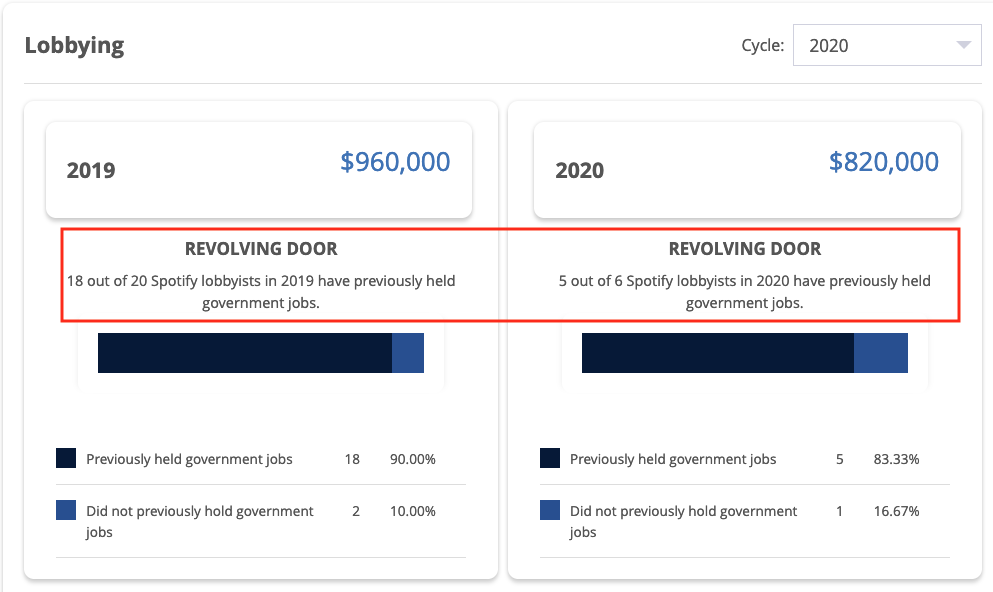
On the political side, let’s see what the company’s campaign contributions tell us:

Spotify has also made a habit out of hiring away government regulators like Regan Smith, the former General Counsel and Associate Register of the US Copyright Office who joined Spotify as head of US public policy (a euphemism for bag person) after drafting all of the regulations for the Mechanical Licensing Collective;

Whether this is enough to trip Spotify up on the abuse of political contributions I don’t know, but the revolving door part certainly does call into question Spotify’s ethics.

It does seem that these are the kinds of facts that should be taken into account when determining Spotify’s ESG score. At this point, it looks like Spotify is an ESG fail–which may require divesting by some of the over 600 mutual funds that hold shares.

Spotify’s ESG Fail: Social

By Chris Castle

[This post first appeared on MusicTechSolutions.]

Investopedia ESG criteria

[This post is Part 2 of a three part post on Spotify’s ESG Fail, and is an extension of Spotify’s ESG Fail: Environment. “ESG” is a Wall Street acronym often attributed to Larry Fink at Blackrock that designates a company as suitable for socially conscious investing based on its “Environmental, Social and Governance” business practices. See the Upright Net Impact data model on Spotify’s sustainability score. As of this writing, the last update of Spotify’s Net Impact score was before the Neil Young scandal.]

I started to write this post in the pre-Neil Young era and I almost feel like I could stop with the title. But there’s a lot more to it, so let’s look at the many ways Spotify is a fail on the Social part of ESG.

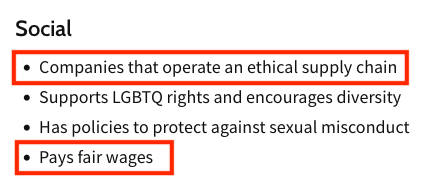
Before Spotify’s Joe Rogan problem, Spotify had both an ethical supply chain problem and a “fair wage” problem on the music side of its business, which for this post we will limit to fair compensation to its ultimate vendors being artists and songwriters. In fact, Spotify is an example to music-tech entrepreneurs of how not to conduct their business.

Treatment of Songwriters

On the songwriter side of the house, let’s not fall into the mudslinging that is going on over the appeal by Spotify (among others) of the Copyright Royalty Board’s ruling in the mechanical royalty rate setting proceeding known as Phonorecords III. Yes, it’s true that streaming screws songwriters even worse that artists, but not only because Spotify exercised its right of appeal of the Phonorecords III case that was pending during the extensive negotiations of Title I of the Music Modernization Act. (Title I is the whole debacle of the Mechanical Licensing Collective scam and the retroactive copyright infringement safe harbor currently being litigated on Constitutional grounds.)

The main reason that Spotify had the right to appeal available to it after passing the MMA was because the negotiators of Title I didn’t get all of the services to give up their appeal right (called a “waiver”) as a condition of getting the substantial giveaways in the MMA. A waiver would have been entirely appropriate given all the goodies that songwriters gave away in the MMA. When did Noah build the Ark?  Before the rain. The negotiators might have gotten that message if they had opened the negotiations to a broader group, but they didn’t so now they’ve got the hot potato no matter how much whinging they do.

Having said that, you will notice that Apple took pity on this egregious oversight and did not appeal the Phonorecords III ruling. You don’t always have to take advantage of your vendor’s negotiating failures, particularly when you are printing money and when being generous would help your vendor keep providing songs. And Mom always told me not to mock the afflicted. Plus it’s good business–take Walmart as an example. Walmart drives a hard bargain, but they leave the vendor enough margin to keep making goods, otherwise the vendor will go under soon or run a business solely to service debt only to go under later. And realize that the decision to be generous is pretty much entirely up to Walmart. Spotify could do the same.

Is being cheap unethical? Is leveraging stupidity unethical? Is trying to recover the costs of the MLC by heavily litigating streaming mechanicals unethical (or unexpected)? Maybe. A great man once said failing to be generous is the most expensive mistake you’ll ever make. So yes, I do think it is unethical although that’s a debatable point. Spotify has not made themselves many friends by taking that course. But what is not debatable is Spotify’s unethical treatment of artists.

Treatment of Artists

The entire streaming royalty model confirms what I call “Ek’s Law” which is related to “Moore’s Law”. Instead of chip speed doubling every 18 months in Moore’s Law, royalties are cut in half every 18 months with Ek’s Law. This reduction over time is an inherent part of the algebra of the streaming business model as I’ve discussed in detail in Arithmetic on the Internet as well as the study I co-authored with Dr. Claudio Feijoo for the World Intellectual Property Organization. These writings have caused a good deal of discussion along with the work of Sharky Laguana about the “Big Pool” or what’s come to be called the “market centric” royalty model.

Dissatisfaction with the market centric model has led to a discussion of the “user-centric” model as an alternative so that fans don’t pay for music they don’t listen to. But it’s also possible that there is no solution to the streaming model because everybody whose getting rich (essentially all Spotify employees and owners of big catalogs) has no intention of changing anything voluntarily. 

It would be easy to say “fair is where we end up” and write off Ek’s Law as just a function of the free market. But the market centric model was designed to reward a small number of artists and big catalog owners without letting consumers know what was happening to the money they thought they spent to support the music they loved. As Glenn Peoples wrote last year (Fare Play: Could SoundCloud’s User-Centric Streaming Payouts Catch On?

When Spotify first negotiated its initial licensing deals with labels in the late 2000s, both sides focused more on how much money the service would take in than the best way to divide it. The idea they settled on, which divides artist payouts based on the overall popularity of recordings, regardless of how they map to individuals’ listening habits, was ‘the simplest system to put together at the time,’ recalls Thomas Hesse, a former Sony Music executive who was involved in those conversations.

In other words, the market centric model was designed behind closed doors and then presented to the world’s artists and musicians as a take it or leave it with an overhyped helping of FOMO.

As we wrote in the WIPO study, the market centric model excludes nonfeatured musicians altogether. These studio musicians and vocalists are cut out of the Spotify streaming riches made off their backs except in two countries and then only because their unions fought like dogs to enforce national laws that require streaming platforms to pay nonfeatured performers.

The other Spotify problem is its global dominance and imposition of largely Anglo-American repertoire in other countries. The company does this for one big reason–they tell a growth story to Wall Street to juice their stock price. In fact, Daniel Ek just did this last week on his Groundhog Day earnings call with stock analysts. For example he said:

The number one thing that we’re stretched for at the moment is more inventory. And that’s why you see us introducing things such as fan and other things. And then long-term with a little bit more horizon, it’s obviously international.

Both user-centric and market-centric are focused on allocating a theoretical revenue “pie” which is so tiny for any one artist (or songwriter) who is not in the top 1 or 5 percent this week that it’s obvious the entire model is bankrupt until it includes the value that makes Daniel Ek into a digital munitions investor–the stock.

Debt and Stock Buybacks

Spotify has taken on substantial levels of debt for a company that makes a profit so infrequently you can say Spotify is unprofitable–which it is on a fully diluted basis in any event. According to its most recent balance sheet, Spotify owes approximately $1.3 billion in long term–secured–debt. 

You might ask how a company that has never made a profit qualifies to borrow $1.3 billion and you’d have a point there. But understand this: If Spotify should ever go bankrupt, which in their case would probably be a reorganization bankruptcy, those lenders are going to stand in the secured creditors line and they will get paid in full or nearly in full well before Spotify meets any of its obligations to artists, songwriters, labels and music publishers, aka unsecured creditors.

Did Title I of the Music Modernization Act take care of this exposure for songwriters who are forced to license but have virtually no recourse if the licensee fails to pay and goes bankrupt? Apparently not–but then the lobbyists would say if they’d insisted on actual protection and reform there would have been no bill (pka no bonus). 

Right. Because “modernization” (whatever that means).

But to our question here–is it ethical for a company that is totally dependent on creator output to be able to take on debt that pushes the royalties owed to those creators to the back of the bankruptcy lines? I think the answer is no.

Spotify has also engaged in a practice that has become increasingly popular in the era of zero interest rates (or lower bound rates anyway) and quantitative easing: stock buy backs.

Stock buy backs were illegal until the Securities and Exchange Commission changed the law in 1982 with the safe harbor Rule 10b-18. (A prime example of unelected bureaucrats creating major changes in the economy, but that’s a story for another day.) 

Stock buy backs are when a company uses the shareholders money to buy outstanding shares of their company and reduce the number of shares trading (aka “the float”). Stock buy backs can be accomplished a few ways such as through a tender offer (a public announcement that the company will buy back x shares at $y for z period of time); open market purchases on the exchange; or buying the shares through direct negotiations, usually with holders of larger blocks of stock. 

Vox’s Matt Yglesias sums it up nicely:

A stock buyback is basically a secondary offering in reverse — instead of selling new shares of stock to the public to put more cash on the corporate balance sheet, a cash-rich company expends some of its own funds on buying shares of stock from the public.

Why do companies buy back their own stock? To juice their financials by artificially increasing earnings per share.

Spotify has announced two different repurchase programs since going public according to their annual report for 12/31/21:

Share Repurchase Program On August 20, 2021, [Spotify] announced that the board of directors [controlled by Daniel Ek] had approved a program to repurchase up to $1.0 billion of the Company’s ordinary shares. Repurchases of up to 10,000,000 of the Company’s ordinary shares were authorized at the Company’s general meeting of shareholders on April 21, 2021. The repurchase program will expire on April 21, 2026. The timing and actual number of shares repurchased depends on a variety of factors, including price, general business and market conditions, and alternative investment opportunities. The repurchase program is executed consistent with the Company’s capital allocation strategy of prioritizing investment to grow the business over the long term. The repurchase program does not obligate the Company to acquire any particular amount of ordinary shares, and the repurchase program may be suspended or discontinued at any time at the Company’s discretion. The Company uses current cash and cash equivalents and the cash flow it generates from operations to fund the share repurchase program.

The authorization of the previous share repurchase program, announced on November 5, 2018, expired on April 21, 2021. The total aggregate amount of repurchased shares under that program was 4,366,427 for a total of approximately $572 million.

Is it ethical to take a billion dollars and buy back shares to juice the stock price while fighting over royalties every chance they get and crying poor? I think not. 

I think there’s clearly a legitimate question of whether Spotify fails on the environmental and social prongs of ESG. In Part 3 we will consider “governance.”