2010 A Brief History Of Spotify, “How Much Do Artists Make?” @SXSW #SXSW (Shill By Shill West)

SXSW Rewind… Back in 2010 during Daniel Ek’s Keynote Speech an audience member who identified themselves as an  independent musician asked how much activity it would take on Spotify to earn just one US Dollar. The 27 year old wunderkind and CEO of the company was stumped for an answer… Five years later we have a pretty good idea why.

2010… #SXSW Rewind…


Live Blog: Spotify CEO Daniel Ek Says Music Service Now Has 320,000 Paid Subscribers | TechCrunch

Q: How many plays equals one dollar?
A: Depends on the type on contract with the publisher/record labels. We share the rev we bring in. You can’t really equate to ‘per play’ we look at all our ad rev. Creates a bucket. For instance how do you account for a purchase of a song. There is no easy answer to your question. Over time our ad revs are growing, number of downloads growing. Amount of rev we bring in is growing.


Will Spotify Be Fair to Artists? | Technology Review

I couldn’t help noticing, however, Ek’s artful dodge to the question of how artists are paid by his service. The subject was broached by an audience member, who identified himself as an independent musician and thanked Ek profusely for the great application. He wanted to know how much he would be paid.

“It’s complicated,” was, in essence, Ek’s reply. But he did reveal that it’s a revenue sharing model; artists get paid a proportion of whatever Spotify gets paid, presumably based on the number of plays on the site they receive.

Ek’s reply was disappointing because this is the million dollar question for many music sites.


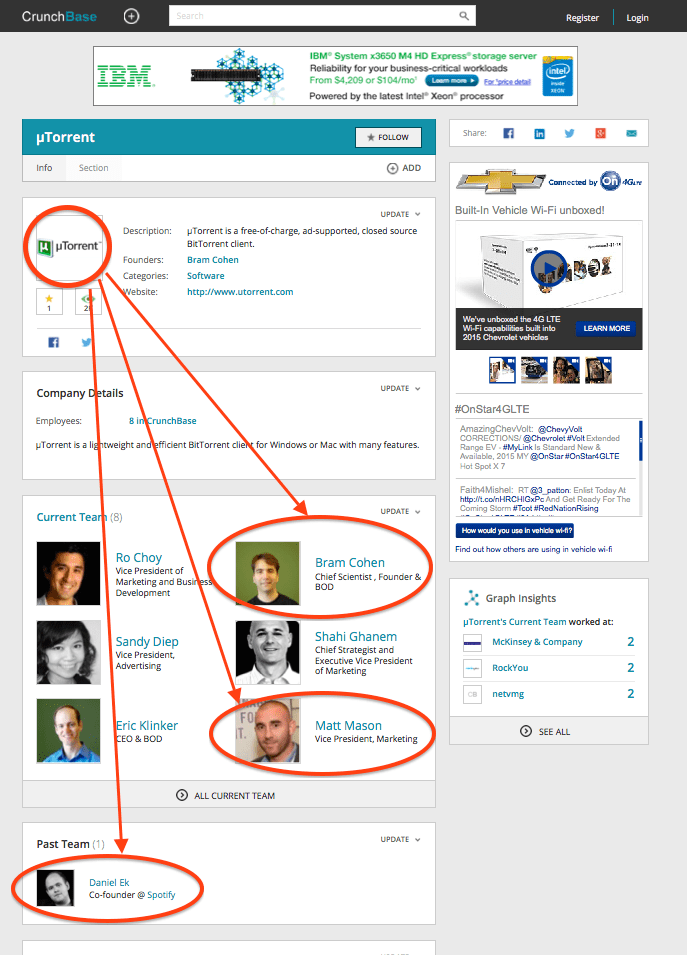
Dodgy from the start. What do you expect from one of the co-founders of U-Torrent… Economics only a pirate could understand?


A Tale of Two Pirates? Daniel Ek (uTorrent) and Kim Dotcom (Megaupload)


USA Spotify Streaming Rates Reveal 58% of Streams Are Free, Pays Only 16% Of Revenue


How to Fix Music Streaming in One Word, “Windows”… two more “Pay Gates”…

YouTube’s Content ID : $375.00 Per Million Views… aka “Block In All Countries”…

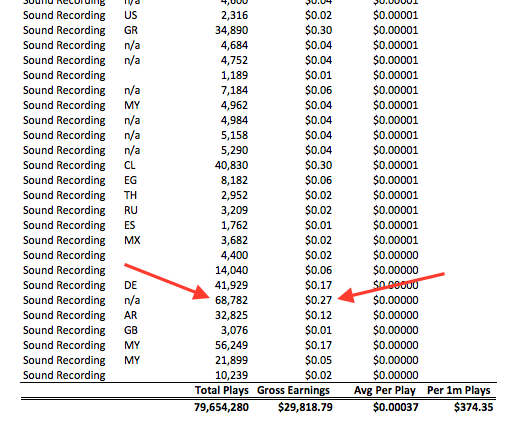
We’ve been supplied nearly a year’s worth of Content ID data from a mid-sized indie label. Over the course of about a year here’s what the data shows:
Content ID

After nearly a year and 80 million plays, the net average per play amounts to less than $375.00 per MILLION Plays on YouTube. Ok, that’s just for the sound recording, there are two other parts to the uploaded copyright, the musical composition and the video content itself. Assuming each of the three parts earns an equal share (why would they not, but how would we know given YouTube’s usual secrecy sauce?), then the full amount payable by YouTube for 1 Million plays via Content ID would be $1,125, or $.001125 per play (on average).

We know that on directly uploaded videos where the creator or rights holder is claiming all three copyrights they are being paid more than $1,125 per million plays on average. So why is the revenue reduced when claimed on Content ID?

The other interesting thing about this data is that there is ZERO consistency on what one play is worth. For example, in what world, and under what circumstances is nearly 70,000 plays worth less than $.30? We’ve heard that the major labels may have a per play floor (or indirectly get the equivalent in off the books “breakage”), but after reviewing this data even that is hard to believe.

The lack of openess, transparency and consistency makes it virtually impossible to determine what the true value of a play is within a single category like a Sound Recording let alone comparing the comparable rates paid for Song Writing and the Video itself. Oh yeah, and there’s no audit clauses either – how convenient.

It is still shocking and amazing to us that after a decade YouTube is still not profitable and is being subsidized by Google’s monopoly money from search and data scraping, and yet digital music executives have been trying to sell us on this as the future of revenue for musicians. How is it that after a decade YouTube can not make a profit? If this is the new financial standard for record labels we can see that it’s starting to work! Is this the genius business model labels are embracing? No profit for a decade? If this is the new standard then we suppose everything is fine…

YouTube’s Content ID presents the same problems and challenges of virtually every other ad-supported streaming platform – it’s just math, and it doesn’t work.

There is an even darker side to YouTube that is exposed in Content ID. Even though the video pictured below was eventually removed from YouTube (via a manual DMCA claim) it illustrates the core problem of YouTube in general.

Here’s the music of Jack White being used to sell Sex Tourism and perhaps even Human Trafficking and Sex Slavery.

Note the Ads by Google with the fine print asking YouTube users to “chat now” or “send gift” for asian girls in Thailand and China as well as filipinocupid.com.

Artists have no consent over where their music is being used, or for what their music is impliedly endorsing or selling. It’s not a big leap from the above to political uses where an artist’s song can be exploited to endorse political candidates, ideologies and issues to which the artist is philosophically opposed.  Like human trafficking.

We have a hard time believing artists would lend their consent to these types of videos (if they knew at all), but then again, you never know when dangling that carrot of thirty cents of revenue in front of them…

So in a world where Spotify is paying about $5,000 per million plays on sound recordings, YouTube by comparison is paying less than $375 for the same million plays. So let’s add this up.

On YouTube artists have no consent and are granted no licenses for the (infringing) distribution for the majority of their work and they’re paid less than 1/10th of what Spotify pays for the same sound recording. Wow, just wow. Ya’ll doing the math on this?

If you thought that Spotify was problematic as an ad-supported streaming platform one has to wonder what could possibly be attractive about YouTube… Oh, you don’t have a choice. You do what YouTube and Google tell you to do as we saw with Google’s “notice and shakedown” practices with Zoë Keating and indie labels. The great decade long experiments of ad-supported streaming are a disaster for artists and rights holders while cannibalizing transactional revenues that once sustained the industry.  Not to mention Google taking down an eye popping 180 million infringing videos from YouTube.

Although streaming is no doubt the future of distrbution, the mismanagement of this transition may well be the worst planned in the history of the industry.

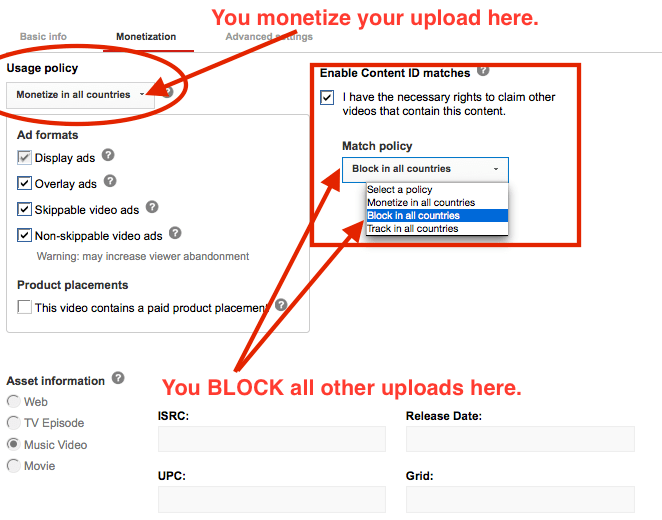
Our advice to artists, particularly artists who own their recordings, is it’s time to take a pass on that $375 per million views and toggle your Content ID setting to “Block In All Countries.” How about adding a little scarcity and reality back into the economics of online music distribution? If YouTube wants to monetize your work maybe they can come up with a fair license.

It’s just math. Just say no…
Block_In_All_Countries

OK, let’s review, you can enable Content ID and make $375 per 1 million views, or you can Block In All Countries. The choice seems pretty obvious, doesn’t it? It’s pretty stunning when Spotify start to look like the good guys.



It’s Just Math : Digital Music Execs Exit, But will the Pivot to Paid Subs Be Enough To Save The Record Biz?

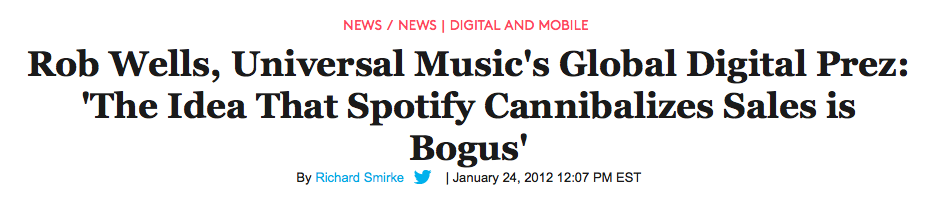
Back in October of 2014 we asked the question “Who will be the First Fired Label Execs over Spotify Fiasco & Cannibalization?“. Now we know. In one week, two senior major label digital music execs have resigned. First Rob Wells on Monday, and on Friday David Ring followed.

Screen Shot 2015-02-24 at 12.18.56 AM

We don’t know if these resignations are related to the realization that Spotify actually is cannibalizing transactional revenues, or that YouTube Music Key will do more and worse, but the timing is suspect given recent statements by label chief Lucian Grange.

“We want to accelerate paid subscriptions… Ad-funded on-demand is not going to sustain the entire ecosystem of the creators as well as the investors” – Lucian Grange

Spotify has been a disaster from bad artist relations to the catalyst for declining transactional revenues. We celebrate the move for more aggressive positioning to paid subscriptions, but even at current rates of $9.99 a month it’s hard to see subs gain the marketshare and revenue needed to compensate for the rapidly declining transactional revenues. In 2014 Itunes revenues dropped by double digits with Apple reporting a decrease of 13%-14% year to year. This following a decrease in overall digital revenues in 2013 (the first decrease ever in digital format sales since their inception).

So that’s two consecutive years of reduced revenue in what should be a growing market segment. So what went wrong? In a word, Spotify. Two more, YouTube.

In other words, Free Doesn’t Pay…

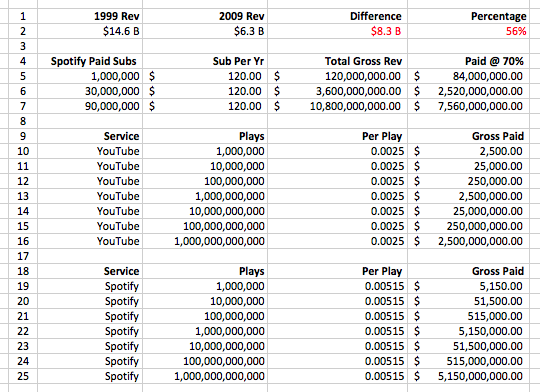
We’ve said it before and we’ll say it again, it’s just math. Below is a table we first published two years ago in February of 2013 when we asked the question, “Music Streaming Math, Can It All Add Up?”.

streamingmath

Although the aggressive move to paid subscriptions is a very positive one, we’re still concerned when looking at the numbers in the tables above when put in the context of the current state of the mature subscription based businesses (see below).

Netflix only has 36m subscribers in the US, no free tier, and massive limitations on available titles of both catalog and new releases. Sirius XM, 26.3m in the US as a non-interactive curated service installed in homes, cars and accessible online. Premium Cable has 56m subscribers in the US paying much more than $10 a month and also with many limitations. Spotify… 3m paid subscribers in the US after four years. Tell us again about this strategy of “waiting for scale.” Three Million Paid… Three…

* 3m Spotify Subs Screen Shot
* 26.3m Sirius XM Subs Screen Shot
* 36m Netflix Subs Screen Shot
* 56m Premium Cable Subs Screen Shot
* $7b Music Business Screen Shot

Of course none of this is to say that streaming can’t work. It can. It’s that Spotify (and YouTube) are just really bad music business models that have unsustainable economics and exploit artists because they are financial instruments and not a music companies.

Let’s be clear about this. We do believe that streaming is the future of music delivery and distribution, but thus far the transition has been horribly mismanaged. What is needed is clear leadership to define the models and value propositions that work for all stakeholders. We’ve made some suggestions in our common sense post “Streaming Is the Future, Spotify Is Not. Let’s talk Solutions.

We’re open minded about new business models, but before people get ahead of themselves with wild claims about a $100 Billion Record Business based on magic unicorn math we need to get back to earth, and get out the calculators.

It’s just math.


Absolute Must Read : How To Make Streaming Royalties Fair(er) | Medium

The record industry has completely disconnected the relationship between artists and their fans whereby the artists catalog is now an aggregated asset to leverage (the label’s) equity in a tech start up that is subsidized by musicians. Not cool.

This is an excellent piece by Sharky Laguna that looks at how all models utilizing divisible revenue pools are fundamentally unfair to the relationship between the artist and the fan. In short, the plays by each consumer should be compensating ONLY the artists that, that person plays (makes sense, right?). Further more 100% of the consumers subscription fee should only pay the artists that individual listens too – no matter how few or how many plays the consumer gives each artist.

Under this proposed revised accounting method, each consumer is once again reconnected directly to the artists they chose to support. This is exactly the kind of thinking that should be happening at the labels and music tech companies.

In a nutshell: Royalties should be paid based on subscriber share, not overall play share.

If I pay $10 and during that month I listen exclusively to Butchers Of The Final Frontier, then that band should get 100% of the royalties. I didn’t listen to anyone else, so no one else should get a share of the $7 that will be paid out as royalties from my subscription fee.

Please read the full post at MEDIUM:
https://medium.com/@sharkyl/how-to-make-streaming-royalties-fair-er-8b38cd862f66

Apple Announces Itunes One Dollar Albums and Ten Cent Song Downloads | Sillycon Daily News

Satire – but not by much.

Apple Computer announced today that for it’s Itunes Music Store to remain competitive in the digital distribution marketplace for music they would be changing their retail pricing of album downloads to one dollar and song downloads to 10 cents each. The pricing change will be effective on black Friday for this holiday season. “Since we purchased Beats music and are competing directly with Spotify we recognized the need for more competitive pricing structures based on what consumers may be willing to pay”, an Apple spokesman said. He continued, “Spotify has proven that as long as we’re paying 70% of gross, the retail pricing is irrelevant, irrelevant! We are even contemplating 10 cent albums and one cent songs to further achieve parity with music streaming services!”

Record label executives rejoiced in the move as one source exclaimed,” I don’t know why we didn’t think of reducing the retail price of downloads by 90% years ago. It’s still money, right? It’s so simple that this is really the only way to grow the business to $100b annually while competing with piracy.”


calculator

Let The Heads Roll…More Genius From The Record Industry Braintrust or Mark Mulligan Gets a Calculator…

Happy Halloween and welcome to the scary stupid post of the day…

We’ve been saying this for a long time, music streaming math just doesn’t add up. Would someone please buy some calculators for the record industry braintrust that keeps making these stupid deals? Seriously, it’s just math and it’s not that hard… even Mark Mulligan is getting it… no kidding…

$2.3 Billion In Net Loss To Artists and Labels Per Year

The report extrapolates that YouTube Music Key will generate $400 million in revenues in its first year. But over the long run it will also be responsible for more than $2.6 billion in lost subscription revenue yearly. That’s a negative net impact of $2.3 billion in lost music revenue every year, according to the study.

Ok, that’s YouTube. Let’s revisit how the Spotify math works…

If you own a calculator, let’s just do the math one more time, real slow and simple like…

1) Spotify and former uTorrent CEO Daniel Ek says Spotify only needs 40m paid subscribers for streaming to be sustainable for artists. But that math just doesn’t work.

2) $10 per month subscription = $120 per year per subscriber

3) $120 per year, per subscriber paying out 70% of gross to rights holders equals $84 per subscriber, per year.

4) $84 per subscriber, per year x’s 40 million subscribers equals $3.4b per year in top line gross revenue to ALL rights holders. That’s $3.4b for labels, artists, publishers and songwriters combined.

5) $3.4b per year is HALF of the current revenue of $7b per year where the domestic business has been flat lined.

6) Assuming you could DOUBLE the subscription base to 80m PAID in the USA within two years by dropping the price in HALF to $5 per subscriber per month you still only gross (wait for it…) $3.4b a year in revenue.

We know this is shocking to the math impaired, but doubling scale (imagined as it is) while cutting the subscription fees in half, actually nets you the same amount of money. Shocking the things one can learn with a calculator or a spreadsheet.

Maybe we’re all screwed, but we will not go quietly and we’re gonna call it how we see it on the race to the bottom. We will document the stupidity undoing the business. Maybe it’s time for Lucian Grange to get out that axe again and let people know what time it is? #stopthemadness

READ THE FULL POST AT HYPEBOT:
http://www.hypebot.com/hypebot/2014/10/youtube-music-service-could-cost-artists-labels-23-billion-in-lost-income.html

RELATED:

Music Streaming Math, Can It All Add Up?

Who will be the First Fired Label Execs over Spotify Fiasco & Cannibalization?

Streaming Is the Future, Spotify Is Not. Let’s talk Solutions.

Streaming Is the Future, Spotify Is Not. Let’s talk Solutions.

It’s not that streaming can’t work. It can. It’s that Spotify is a bad business model that has unsustainable economics and exploits artists because it is a wall street financial instrument and not a music company.

We’ve previously published a couple posts on streaming music where we explore how access models and windowing are working for the film industry and could serve as a guide to the record business. We’ve also shown how transactional music purchases have made legal music consumption the best value in the history of recorded music.

The key to building streaming business models that make sense and are sustainable is to increase the subscription fees, utilize well thought-out windowing models and experiment with new pricing tiers for access based services.

Historically the music business has employed the use of special markets such record clubs  (remember 11 CD’s for one penny). It’s not that record clubs were bad, in fact numerous studies found them to be great source of additional revenue if managed in a way that did not cannibalize front line sales. (Remember 12 month record club holdbacks?) Now we need to strike the same balance with streaming services.

So let’s get real, the Spotify business model and streaming math just does not work and can not work in it’s current form.

Here are five suggestions to get music streaming back on track as a viable business model.

1) Minimum Payment Per Play

You want to give your service away? Fine, but artists and rights holders are not going to subsidize your business by devaluing our work. No plays without a minimum royalty–including the “free service”–and all plays pay at paid subscription rates. If you can’t sustain your business doing this, then you need to rethink how your business works. Your bad business model is not our problem. Maybe an unlimited, non-graduated free tier is a really, really, really bad idea. 30 Day trial offer, ok. Virtually unlimited free access, no.

2) Windowing

The music business must embrace windowing to maximize revenues across all distribution channels and platforms. It’s so basic we can’t believe artists and labels are not utilizing this to greater effect. The first 30 days of a new release could be limited to transactional streaming access by the day, week, or the month at different price points. Likewise, perhaps only two songs from an album are made available on streaming platforms for the first year of release. There are many unexplored variations and options.

3) Transactional Streaming

The music business needs to embrace new models such as “transactional streaming” much like VOD exists for film versus transactional downloads or physical product. There is no reason why streaming distributors should have every title, ever released, for one fixed, flat price. Again, new releases in particular should be priced as transactional streams where the consumer can chose between low cost limited access to a new release, or pay more for a transactional download.

4) Tiered Pricing based on Access and Consumer Value Proposition

Just like cable tv and SiriusXM, one possible solution is to create price tiers based on access. For example, catalogs can be curated into genre and lifestyle packages. Creating bundled packages adds value to both the end user and the streaming service. Individual packages can be as little as $4.99 a month, and complete access could priced at $49.99 a month. Again, there are many unexplored variations and options.

5) Move Beyond Stockholm Syndrome

The answer to every attempt to introduce real world economics to the marketplace can not be met with “or else they’ll steal it.” We already know that. They have been stealing it for over a decade (thank you Mr. Ek for your contributions to uTorrent). The film industry is not approaching streaming with a gun to it’s head offering every title ever made on every platform for one low monthly fee. Itunes is the single most successful dedicated online music business ever, and it doesn’t have a “free-tier”.

Isn’t it odd that companies like Pandora and Spotify that are not profitable and don’t support artists are thought to behold some kind of gnostic wisdom of economics that defies all logic and reason? Last year Twitter lost $645 million dollars. Record labels have been profitable for over half a century with a sustainable ecosystem that invests in artists and new talent, while also creating hits and stars. It’s time to leave the rainbow unicorn school of economics and faith healing behind and develop real business models based on real economics.

Anyone remember the dot com bubble? Where is mp3.com now? Things can and do change fast in web/tech. Any talk of the “record industry” without MySpace in 2004 and you would have been laughed out to the room. Where is MySpace now? Spotify can (and very well may) quickly become MySpace. So let us all focus on how to make streaming actually work for all stakeholders and not only those with equity… it’s just math.

RELATED:

Who will be the First Fired Label Execs over Spotify Fiasco & Cannibalization?

Why Spotify is not Netflix (But Maybe It Should Be)

Mythbusting : Music Is Too Expensive!?

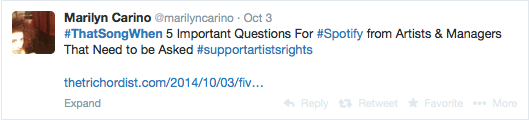
c3 ‪”#thatsongwhen 10k people listened, the artist got paid $60 and the major labels got stock options.”

c3, The Content Creators Coalition is enlisting musicians and songwriters to share their true stories of Spotify plays, payments and thoughts to raise awareness around unsustainable digital service royalty structures. Join in.

If you care about the economic rights of artists in the digital domain, join us in hijacking Spotify’s new twitter hashtag campaign. Got your own numbers to share? Like so: Fun with new Spotify hashtag campaign: “#thatsongwhen 10k people listened, the artist got paid $60 and the major labels got stock options.”

We do believe in digital. But current rates are not sustainable. Spotify is using our music like venture capital and promising better returns later while they pay their employees and hire expensive ad firms to create the above hashtag campaign.

thatsongwhenSarahManningthatsongwhenTessaMakesLove thatsongwhenMarilynCarino

FOLLOW c3 ON FACEBOOK:
https://www.facebook.com/ContentCreatorsCoalition
https://www.facebook.com/pages/ccc-nycorg/

* BREAKING * Spotify Launches Secret ‘Information Tour’ to Convince Top Artists… | DMN

Breaking from Digital Music News:

Currently, we know of three confirmed dates in the US: October 6th (ie, today) at the Soho Club in New York, October 8th at City Winery in Nashville, and October 10th at a private residence in Los Angeles (complete details on these dates below).  The US-based sessions that we know about are being coordinated through the Music Managers’ Forum (MMF), with the Featured Artists’ Coalition (FAC) potentially bringing serious, high-wattage superstars to the table.

TO ATTEND PLEASE RSVP TO: fiona@thefac.org

READ THE FULL POST AT:
http://www.digitalmusicnews.com/permalink/2014/10/06/spotify-launches-information-tour-convince-top-artists

RELATED:

Five Important Questions For Spotify from Artists and Managers

A Tale of Two Pirates? Daniel Ek (uTorrent) and Kim Dotcom (Megaupload)


Music Streaming Math, Can It All Add Up?

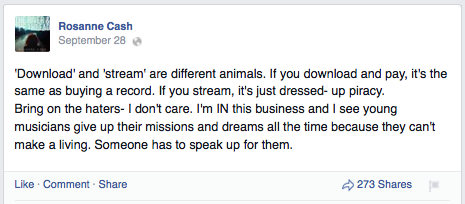
Music Streaming is “just dressed-up piracy” says Rosanne Cash| Hypebot

Hypebot noticed this Facebook post from Rosanne Cash which echoes the sentiments of many artists, that streaming in it’s current form and economics is pretty much legitimized piracy…

RosanneCashStreaming

READ THE FULL POST AT HYPEBOT:
http://www.hypebot.com/hypebot/2014/10/streaming-is-just-dressed-up-piracy-says-rosanne-cash.html

RELATED:

Five Important Questions For Spotify from Artists and Managers

Music Streaming Math, Can It All Add Up?

Streaming Isn’t Saving the Music Industry After All, Data Shows…