The Constitutional and Historical Foundations of Copyright Protection

The Constitutional and Historical Foundations of Copyright Protection
By Paul Clement, Viet Dinh & Jeffrey Harris [1]

Article I, section 8 of the Constitution grants Congress authority “[t]o promote the Progress of Science and the useful Arts, by securing for limited Times to Authors and Inventors the exclusive Right to their respective Writings and Discoveries.”  There was little debate over this provision during the Convention, but James Madison (as Publius) emphasized in Federalist 43 that “[t]he utility of this power will scarcely be questioned,” and “[t]he copyright of authors has been solemnly adjudged, in Great Britain, to be a right of common law.”  With respect to both copyrights and patents, Madison asserted that “[t]he public good fully coincides in both cases with the claims of individuals.”

*     *      *

This history flatly refutes any notion that copyright law is a matter of legislative grace intended solely to serve utilitarian ends. The Copyright Clause of the U.S. Constitution was inspired by a long intellectual tradition—extending back to the very origins of printing and publishing—in which legislators, jurists, scholars, and commentators recognized authors’ inherent property rights in the fruits of their own labor.

Just as the scope of the pre-existing right informs both the contemporary public understanding of, and the Supreme Court’s interpretation of, the right enshrined by the Second Amendment, see Heller, 554 U.S. at 592, 603, this pre-constitutional history is useful both in interpreting the scope of Congress’ copyright power and in informing policy debates about how that power should be exercised. The Supreme Court itself has harkened back to the Statute of Anne in interpreting the copyright laws. See Feltner, 523 U.S. at 349-50. A view of the copyright laws that ignores this history is sorely incomplete.

READ THE FULL REPORT AT:
http://cfif.org/v/index.php/commentary/42-constitution-and-legal/1679-the-constitutional-and-historical-foundations-of-copyright-protection

Universal Declaration of Human Rights – Article 27

Somethings are so simple, fundamental and common sense they cross the boundaries of countries and culture. If only these same principles could penetrate the fortress walls of Silicon Valley which now claims “the internet” as a nation state outside the governance or protection of human rights.

Universal Declaration of Human Rights

The Universal Declaration of Human Rights (UDHR) is a milestone document in the history of human rights. Drafted by representatives with different legal and cultural backgrounds from all regions of the world, the Declaration was proclaimed by the United Nations General Assembly in Paris on 10 December 1948 General Assembly resolution 217 A (III) (French) (Spanish) as a common standard of achievements for all peoples and all nations. It sets out, for the first time, fundamental human rights to be universally protected.

Article 27.

(1) Everyone has the right freely to participate in the cultural life of the community, to enjoy the arts and to share in scientific advancement and its benefits.

(2) Everyone has the right to the protection of the moral and material interests resulting from any scientific, literary or artistic production of which he is the author.

Getting Copyrights, Right. David Lowery at Politico

Our own David Lowery makes a lot of compelling arguments in Politico on Monday morning, but this one in particular regarding a copyright registry and orphan works should be of interests to all consumers and individuals as well as all creators. Copyright effects everyone, not just musicians.

Register Your Family Albums

Both conservatives and liberals should be frightened by the “Principles’” attempt to “reformalize” effective copyright protection by encouraging Goodlatte to take away “rights and remedies” for those who do not register their works. Especially those works that the report deems to have “no commercial value”—as decided by the elites rather than the market, apparently.

So if one of the “users” the principles seem to think they represent — like me — posts a photo of my children on my Facebook page but I don’t register it, and somehow a company or individual then uses this picture commercially, or in some other vile manner, this report explicitly states that I would not have the same “rights and remedies” that I currently enjoy. In fact my reading of this report says I would have no remedies unless I were to win an argument that my family photos have commercial value — full employment for lawyers.

So are we all gonna have to register our family photos with Big Brother in order to keep control of them?

Read the full article here at Politico:
http://www.politico.com/story/2013/05/building-a-real-copyright-consensus-91231.html

Permission, Privacy and Piracy : Where Creators and Consumers Meet

It’s amazing how situationally dependent perspectives about the internet appear to be that something as fundamental as consent (aka permission) would be controversial. Much ink has been spilled over a consumers right to privacy in the digital age and that concern now extends beyond the internet to personal privacy fears over the potential misuse of domestic drones.

The irony of course about all the hysteria being discussed about drones (military, commercial or private) is that the greater threat to personal privacy is much more local than an unmanned aircraft at 14,000 feet, or even a home built quad copter. The real threat that will bring the real world to the same persistent observation (and cataloging) of our daily lives will be Google Glass (where is the EFF when you need them?).

Google Glass is a device that records to the cloud a persistent stream of visual and audio data as the user experiences it. Anything, and everything a person would have experienced as a personal and private experience will be recorded, cataloged, geo-tagged, and stored online. Automated face recognition technology will make it less possible to be anonymous in the real world than it currently is in the online world via the use of avatars.

But what does this have to do with piracy? Specifically what does this have to do with content piracy? How are privacy and piracy related? It’s simple, both privacy and piracy revolve around how we view the importance of the individuals right to grant consent. An individual should have the right to grant the specific permissions to access information about us and how that information can be used. Agreed?

This is the same fundamental individual right that governs the protection of a creators work from illegal exploitation. Permission is the cornerstone to a civilized society. Maybe ask these women in Texas about it?

Below is a recent example of how ordinary people, who are also creators got a first hand lesson in “permissionless innovation” aka, “you will be monetized” or “all ur net proceeds now belong to us.”

When Instagram attempted to change it’s terms of service that would allow the company to monetize the work of the individual without the individuals permission, consumers went ballistic. It seems that permission is not such a difficult concept to grasp when people are personally effected. This is why privacy is a much more universal issue, because everyone is effected by it.

It is strangely ironic (or not really) that the companies who were so quick to threaten an “internet blackout” really have no such motivation in detailing how individual personal data is being collected and monetized. Even when that data is from children. So much for being open and transparent.

What’s worse is that Google has been repeatedly caught red handed violating the privacy of not just it’s users but also unsuspecting consumers. Two cases that immediately come to mind are the Safari privacy scandal and resulting settlement and the much broader real world illegal data collection scheme known as Wi-Spy.

So, just like everyone understands the basic fundamental right to privacy is built on the permissions we grant by consent to other citizens, businesses and institutions, individual creators also have the same right to grant permission to who and how their work can be exploited (yes their work, as in labor) for profit and gain.

This is even more important when those doing the profiting are corporations and businesses like Google, various advertising networks and others.

Trichordist Picks #SXSW Panels Of Interest @ SXSW South by Southwest 2013

Here’s a quick look at what may be panels of interest during music… some because we agree with them, some because we really, really don’t… but we’d like to think we remain open minded, teachable and in search of common solutions and goals to benefit artists rights in the digital age… and, you never know what kind of BS will be peddled and spilled…

### TUESDAY MARCH 12 ###

Tuesday March 12 – 11:00AM -12:00PM

Constructive Disruption for the Music Biz

After the record industry and the live music industry, it’s time for innovation and constructively disrupting how the music industry operates. It’s time to open up the shop and see what outside influences can bring to th…

Brooke Parrott, Finian Murphy, Jim Carroll

###

Tuesday March 12 – 11:00AM -12:00PM

Downloaded: The Digital Revolution

This session presented by SXSW Film and is open to all badge types. Join a round table discussion of the Digital Revolution; how we got here, how the world has changed and what are the best ways forward in these content…

Alex Winter, Chuck D, Eugene Hernandez, John Perry Barlow, Sean Parker, Shawn Fanning

###

Tuesday March 12 -5:00PM – 6:00PM

Fair Play: Music Tech Startups and Artists

It’s a complicated new music world for both tech entrepreneurs and artists, one fraught with anachronistic copyright, byzantine royalty structures, and perhaps most importantly, a cultural divide between the two business…

Doug Freeman (Austin Chronicle), Daniel Senyard (Vivogig), Jean Cook (Musician/Future of Music Coalition) and Brian Zisk (SF MusicTech)

###

### WEDNESDAY MARCH 13 ###

Wednesday March 13 -12:30PM – 1:30PM

The Anatomy of Amanda Fucking Palmer: An Inside Look

Look at the inner workings of a multi-million dollar global recording, touring and merchandise business that is 100% artist controlled. Amanda Palmer raised a record-breaking $1,192,793 on Kickstarter from 24,883 fans —

Kendel Ratley, Kevin Wortis, Martin Goldschmidt, Nicole St Jean, Vickie Starr, Amanda Palmer

###

Wednesday March 13 – 2:00PM – 3:00PM

Artists Staying Afloat in the Digital Revenue Stream

As new business models of digital music consumption grow and new services keep launching where does the artist fit in? The headlines all scream about what the artist makes on this service or that. But does the artist hav…

Eric Garland, Jeff Price, Trevor Skeet, Scott Reilly

###

Wednesday March 13 -2:00PM – 3:00PM

Music Subscription & Artist Revenue

Heated discussions in the music business surround the topic of subscription music, and the effect on the bottom line of the rights holder, artist and songwriter. One side of the aisle claim that on-demand streaming serv…
Adam Rabinovitz, Brian Slagel, Christina Calio, Dan Kruchkow, Steve Savoca, Antony Bruno

###

Wednesday March 13 -5:00PM – 6:00PM

The Fight for Fair Fees in the Music Industry

Once upon a time, terrestrial radio was the only game in town and they do not pay performance royalties. With the advent of online and satellite services, we’ve amassed a patchwork of legacy policies that create a compl…

Chris Harrison, Julia Betley, Patrick Reynolds, Patrick Laird, Erin Griffith

###

### THURSDAY MARCH 14 ###

Thursday March 14 -12:30PM – 1:30PM

Music Curation in 2013

As was predicted from the earliest days of the internet, curation is becoming a bigger factor in the music marketplace both on and off line. Explore the process in which specific associations and gatekeeper on the landsc…

Daniel Seligman, Johanna Rees, Ryan Schreiber, Steve Blatter, Mark Kates

###

Thursday March 14 -12:30PM – 1:30PM

Silicon Valley Isn’t the Enemy Anymore

Beyond Spotify and Pandora, a new group of digital music companies are emerging. These companies are bringing together artists, content carriers and labels to create new user experiences, business models and opportunitie…

Michael Cerda, Paul Resnikoff, Phil Lang, Tyler Lenane, Mike McGuire

###

Thursday March 14 -12:00PM – 3:00PM

Big Data: The New Oil or the New Snake Oil?

Mobile technologies have enabled music executives to understand as never before how people are consuming music. What people are listening to is just the tip of the iceberg – now, labels can see where they are and even wh…

David Lowery, Alex White, Jon Vanhala, Marie-Alicia Chang, Will Mills

###

Thursday March 14 -3:30PM – 4:30PM

Infamous Band Disputes and How To Avoid Them

Hear about the trials, tribulations and aftermath of band warfare from defendants and plaintiffs willing to share behind-the-scenes details of their high profile legal battles with former band mates. Discover the ramific…

Anita Rivas Gisborne, Esq, East Bay Ray, Joe Escalante, Neville Johnson, Matthew Belloni

###

Thursday March 14 -3:30PM – 4:30PM

The Artists’ Copyright Conundrum

Artists make difficult choices in deciding where they fall in the copyright debates. They must strike their own balance between seeing copyright as a way to make money and not wanting to alienate their fans. What measure…

Andrew Bridges, Karen Thorland, Kristelia Garcia, Wendy Seltzer, Margot Kaminski

###

Thursday March 14 -5:00PM – 6:00PM

Downloaded: The Music Industry in the Digital Age

In 1998 Shawn Fanning, a teenage hacker and programmer, created the code that would become the basis for all peer-to-peer file sharing. Shortly after, Fanning and his business partner, fellow teenage hacker Sean Parker, …
Alex Winter, Bill Flanagan, Chuck D, Ian Rogers, J Keyes, Paul D Miller (aka DJ Spooky)

###

Thursday March 14 -5:00PM – 6:00PM

Songs and Recordings: How They Make Money Worldwide

Songwriters, recording artists, publishers, record companies, musicians and performers share in the billions of dollars being generated from music being performed and sold worldwide. Royalty and deal making experts take …

Jeffrey Brabec, John Simson, Todd Brabec

###

### FRIDAY MARCH 15 ###

Friday March 15 -11:00AM -12:00PM

Selling Albums in a Spotify World: Non-Traditional Strategies

Is the subscription music business model ultimately a positive or negative for music industry revenues, compared to the purchase model? Whichever side of the argument you land on, it’s agreed that maintaining a healthy b…
Amanda Palmer, Darius Zelkha, JT Myers, Thaddeus Rudd

###

Friday March 15 – 2:00PM – 3:00PM

Album Release Strategies for the 21st Century

With all of the tools that are available via the web, artists and labels are making more mistakes than ever in the planning of their release strategies. Find out about effective, yet affordable, marketing, sales, and dis…

Adam Pollock, Joe Esposito, Rey Roldan, Sarah Landy, Vinny Rich

###

Friday March 15 – 3:30PM – 4:30PM

CLE 4: Digital Distribution – Where the Future Money Is

The status of the law and business of the non-physical retail, commercial and licensing recording world.……

Bryan Calhoun, Christine Pepe, Cindy Charles, John Simson

###

Friday March 15 – 5:00PM – 6:00PM

Streaming Music: A River of Cash or Up the Creek

Many artists, managers and labels see streaming as stripping away the already beleaguered retail sales and leaving them with only fractions of pennies for their work. Meanwhile streaming services believe holdout artists …

Emily White, Jon Maples, Richard Jones, Simon Wheeler

###

Friday March 15 – 5:00PM – 6:00PM

Who’s Ripping Me Off Now?

In June 2012, a blog post by musician David Lowery set off a firestorm. Written to an intern at NPR who admitted to not having paid for the 11,000 tracks in her collection, the post generated more than a million views in…

David Lowery, East Bay Ray, Daryl Friedman

###

### SATURDAY MARCH 16 ###

Saturday March 16 -11:00AM -12:00PM

CLE 5: The Politics of Music, and Future Copyright Battles

A dissection of the political interests and energy regarding music policies and law.……

Barry Slotnick, Colin Rushing, Lee Knife, Jay Rosenthal

###

Saturday March 16 – 12:30PM – 1:30PM

So We Won SOPA: Turning a Moment into a Movement

The fight over SOPA/PIPA was a Washington watershed: 15 million Americans contacted Congress and stopped laws that would have harmed online culture and innovation. Learn how to transform this victory into a strong, self-…
Jayme White, Julie Samuels, Laurent Crenshaw, Michael Petricone

###

Saturday March 16 – 3:30PM – 4:30PM

CLE 8: The Crystal Ball: Divining The Future of Music Law

Experienced music lawyers ponder, predict and pontificate on the future of music and music law.……

Kenneth Anderson, Tim Mandelbaum, Ken Abdo

###

Music Streaming Math, Can It All Add Up?

Music streaming is clearly a challenge for the recording industry and even more so for the new generation of artists hoping to build professional careers in music like Zoë Keating. This new report from the New York Times, “As Music Streaming Grows, Royalties Slow to a Trickle” is the latest to reignite controversies about music streaming royalties.

We’ve leveled our own criticism of streaming sites in the past perhaps focusing unfairly on Spotify. But as we reported in the, Music Streaming Price Index : Pay Rates as of 12/31/11 our complaint is more with the revenue models and royalty payments than with the services themselves.

To be clear, we like Spotify and the people we’ve met that work there. We’d just like to see better royalty rates and the kind of transparency requested by Zoë Keating, and/or the kind we get from Apple’s Itunes.

We also like that Spotify and other music streaming services are legal and licensed. Spotify (Rhapsody, Zune and Napster) are far more ethical businesses than YouTube and Grooveshark. There are no unauthorized copies of an artists material on Spotify and no massive DMCA issues. We’d love to see more brands spending their money with legitimate services than the shady ad networks that feed advertising to pirate sites.

It’s now clear that the brands themselves are a big part of the problem by supporting piracy when they could be supporting the legally licensed sites. Brands, advertising networks and payment processors are driving the race to the bottom in the “optional payment” and “Illegally free” world of exploiting musicians through online piracy.

In a recent interview for Hypebot, music and technology veteran Ted Cohen sums it up well,

Do you still favor subscription over advertising-based music services?

Yes, I do. I don’t think that the advertising model so far has proved to be sustainable. I think that we have undervalued subscription. I am paying $150 a month for cable. I watch 20 or 30 hours of TV a week. I probably listen to 50 to 60 hours of music a week. I’d argue with you that music is worth more than $10 a month subscription service.

The labels were so concerned about (piracy)—and I was there at the time—that we had to come up with a price that was just a little bit more than free to convince people that they should pay. So far, we have not been able to raise the price. I think that music is worth at least $20 or $25 a month.

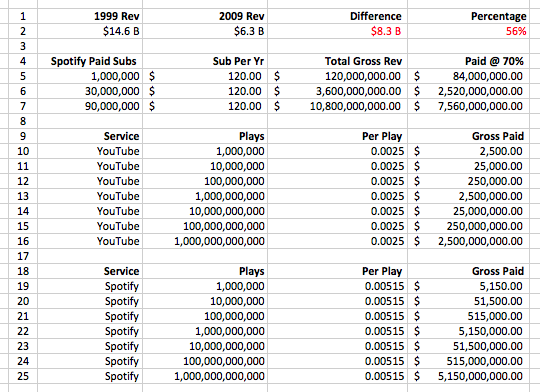
In the chart below calculations are created in tables to illustrate the simple math required to determine the revenue opportunities in different streaming models. For example, lines 5, 6, and 7 detail how much revenue Spotify can generate to artists, songwriters and rights holders paying out 70% of their gross at 1m, 30m and 90m paid subscribers.

If Spotify can capture what most believe is an optimistic amount of paid subscribers in the USA (30m) that would only generate $2.5b in revenue for rights holders. Line 2 represents the revenues of the record industry in the USA between 1999 when it was $14.6b through 2009 when it had plummeted to $6.3b leaving a loss of $8.3b annually since that time.

Maybe we’re missing something. If streaming is the future how does $2.5b in revenue from a massively successful Spotify replace the loss of $8.3b in annual earnings?

streamingmath

So in 2012 when Spotify has claimed 1 million paid subscribers in the US, that’s a payout to artists and rights holders of only about $84m. In simple math, this is about 12m albums at $7 wholesale each (what iTunes pays on a $9.99 album).

Additional food for thought is that Spotify is currently valued at 3 billion dollars. That’s just a little less then half of the entire earnings of the entire US record industry in 2012 at an estimated 7 billion dollars. This means that if the same valuation method is used for both Spotify as a single company, and the domestic record industry as a whole, than either Spotify is overvalued or the record industry is undervalued.

But there are larger problems here than Spotify. As you can see in the chart above YouTube also represents a challenge for artists and rights holders. The site was born of infringement as a business model, and despite policy changes at Google (YouTube’s parent company) the situation is still completely unacceptable for artists as East Bay Ray of The Dead Kennedy’s explains to NPR.

YouTube really deserves it’s own post, and there will be several forthcoming.  In the new “exploitation economy” artists seem to be willing to trip over transactional dollars attempting to pick up streaming pennies. Again, one of the most important distinctions between Spotify and YouTube is that Spotify does not have a massive DMCA and rights management issues that cheats artists of their due. Additionally, YouTube is paying a fraction of what Spotify is, so if this is the future, everyone is really in trouble.

Internet Pay To Play: Payola’s Revenge – Guest Post by Robert Rial of Bakelite78

Guest Post by Robert Rial of the band www.bakelite78.com. (Posted by permission, copyright in the author.)

I just read David Lowery’s Letter to Emily White, got righteously indignant and wanted to rant, so…

My Seattle band Bakelite 78 is not mainstream.  Our genre, which I’ll just call Gothic-Cabaret-Infused-Jazz/Americana, is a bit esoteric, perhaps. We are unsigned, we have no agent or manager, are trying the D.I.Y. thing, have paid for three albums ourselves out of pocket, pooling band income, and I have put in my personal money on occasions.

Our recent album “What The Moon Has Done” had received some good reviews locally, airplay on KCBS, and we were keen on trying to get some exposure with new markets.  So we decided to pay an inordinately large sum (almost enough to record the next album) for an online [REDACTED COMPANY] publicity campaign for the 12 weeks surrounding the release and CD Release Party, to attempt to get the attention of the Inter-Web-Blogosphere.

It was a huge expense and we were hoping for massive exposure and to reap a bunch of downloads/CD Baby sales.  We did get play on some internet radio stations, and interviewed on a couple podcasts.  But the more I understood what was going on, the more pissed off I was getting.  On a lot of the sites, I had to forego my rights as a songwriter, composer, and musician, and allow the internet radio station or podcast in question to play my music and not compensate my BMI blanket publishing entity for each song played.  Apparently the rules have changed and it is supposedly in my best interest to bend over and give my shit away if I ever want anyone to like it enough to buy it.  But the problem is they don’t buy it.  So we were on these blogs/webcasts/internet radio stations.  How many people actually listened?  How effective was an online publicity approach?

After our well attended CD Release Party at Columbia City Theater, and the [REDACTED COMPANY] campaign concluded, we sat back and waited for the online sales.  And after all the time and money we spent on studio time, mixing/mastering, design/layout, replication, and [REDACTED COMPANY] publicity, sales did not allow even a small recoupment of our investment.  I know we don’t suck that bad.

The model is designed to take all the money from musicians while giving them almost nothing back.

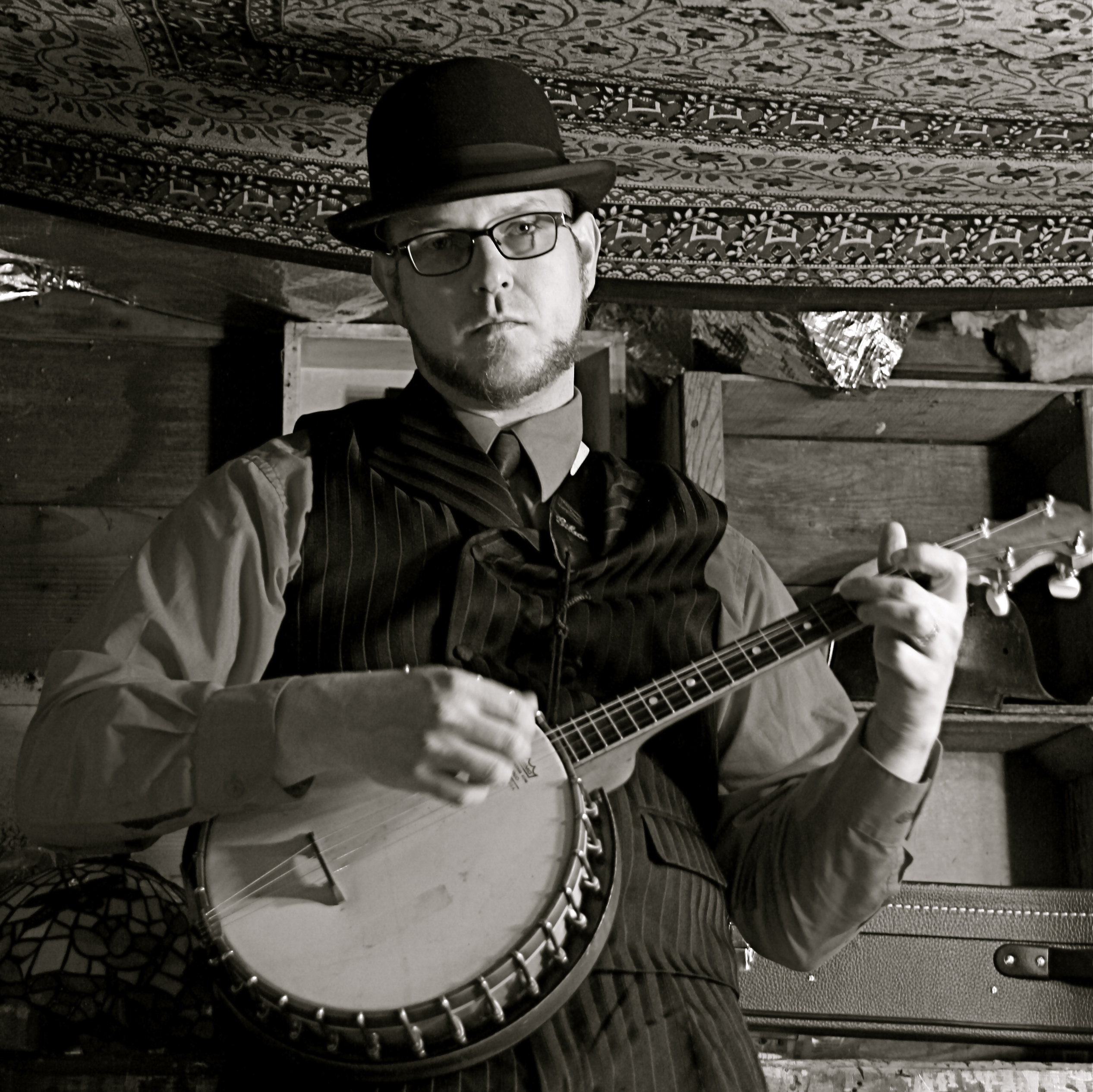
For instance, in addition to the [REDACTED COMPANY] campaign, we had been paying online elsewhere on sites like Sonicbids and Reverb Nation, to submit our electronic press kit to potential venues and festivals (to no avail), and to place Facebook advertisements to get more “Likes”.  None of this crap had enough effect.  And I found myself more broke, not on tour, sitting in front of this macbook more and more, instead of playing my tenor banjo, or listening to some old Emmett Miller 78 r.p.m. record, or going out to a show, or being a member of the real community, the real world, the real scene.  My creativity and focus wasted, burning my retinas, to try to do what?

Blow up the internet.  Let’s go back to the old form of PAYOLA.

[EDITORS NOTE: You can listen 90 seconds of all of the songs, and buy the album here at iTunes.]

robertrial

Over 50 Major Brands Funding Music Piracy, It’s Big Business!

Below is a partial list of over 50 major brands who are advertising on pirate sites and therefore supporting not only music piracy, but also the mainstream piracy of films and every other kind of digitally distributed work. As we’ve stated before the content industries may have the ability to address mass scale, enterprise level, commercial infringement without necessarily requiring any new legislation.

What we find frustrating is that the major content companies and corporations must have existing relationships with these brands as the content and media distribution companies own the television networks (at the very least) that these brands are dependent upon for the mass scale and mainstream promotion of their products and services.

The major content companies as well as their well respected institutions such as The Academy Of Motion Picture Arts and Sciences (The Oscar’s), The National Association Of Recording Arts and Sciences (The Grammy’s) and The Hollywood Foreign Press Association (The Golden Globes) all host annual award shows where many of these brands are also advertising. Why isn’t it possible to use that opportunity to educate these brands about the damage they are doing to the creative community? In other words, where are the adults?

What is disappointing is that the same people pushing for new legislative solutions could also be leveraging their relationships with the brands and advertising agencies directly to educate them about the seriousness of this problem. The same goes for the banks and payment processors such as American Express, Master Card, Visa and others. At least one company, Paypal has been very proactive in severing it’s ties and services with illegal and infringing sites, we wish more would to the same.

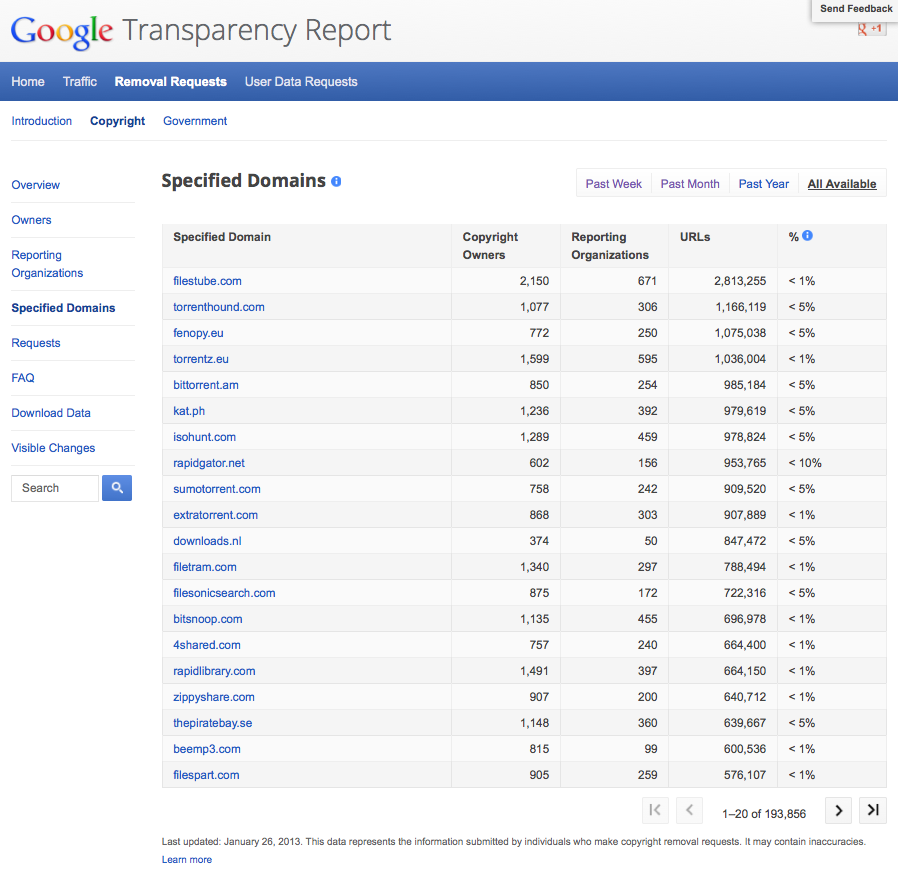
The US Trade Representative’s list of sites in the Notorious Markets List combined with Google’s transparency report for copyright infringement via legitimate DMCA notices to delist links from its search engine provides a very effective list of sites where no advertising should appear as a simple baseline of “best practices”.  (Of course, the Google list does not include YouTube or Blogger.)

http://www.google.com/transparencyreport/removals/copyright/domains/?r=all-time

GoogleTransparencyReport

Keep in mind the screen shot above only lists the Top 20 sites of the almost 200,000 in total that are receiving DMCA notices for copyright infringement.

Clicking on the name of any of the brands below will take you to a post that contains the screen shot of the ad itself. What is also important to note is what brands are NOT on this list.

Brands like Coke and Pepsi do not seem to appear on pirate sites, and that can’t be an accident anymore than it not being an accident that these other brands do appear on pirate sites. So for that, we applaud Coke and Pepsi for their respect to the creative community.

Who knows, perhaps the content industries should use their might, weight and prestige to create an award for brands who respect the creative community in a public forum that enhances value for the brand by the endorsement of artists, musicians, filmmakers and other creators. Just a thought if anyone is reading…

We might also suggest that the brands on this list think about adopting the Bill of Rights for Online Advertisers by Benjamin Edelman of The Harvard Business School.

Five rights to protect advertisers from increasingly powerful ad networks — avoiding fraudulent charges for services not rendered, guaranteeing data portability so advertisers get the best possible value, and assuring price transparency so advertisers know what they’re buying.

Brand  Pirate Site  Artist
Adobe Files Tube Tom Waits
Adobe Files Tube 30 Seconds To Mars / Jared Leto
Adobe Torrent Reactor Neil Young
Adobe Iso Hunt Neil Young
Adobe Kick Ass Torrents Neil Young
ADT Security 4Shared Tom Waits
Alaska Air Iso Hunt Neil Young
Alaska Air Kick Ass Torrents Neil Young
Alaska Airlines Torrent Reactor U2
Amazon 4Shared U2
American Express 4Shared Adele
American Express Delta Airlines Card Mp3 Twister Black Keys
AT&T Mp3 Twister Black Keys
AT&T 4Shared Smashing Pumpkins / Billy Corgan
AT&T Mp3Skull Smashing Pumpkins / Billy Corgan
AT&T 4Shared Adele
AT&T mp3 Skull U2
AT&T mp3 Skull John Mellencamp
AT&T Kick Ass Torrents Neil Young
Audi Mp3Skull Smashing Pumpkins / Billy Corgan
BMW 4Shared Smashing Pumpkins / Billy Corgan
BMW Kick Ass Torrents Tom Waits
Boston Market 4Shared Smashing Pumpkins / Billy Corgan
Boy Scouts of America Torrent Reactor Neil Young
British Airways Kick Ass Torrents Adele
British Airways Mp3 Crow Adele
Century 21 4Shared U2
Charmin Toilet Paper Iso Hunt Neil Young
Charter Cable mp3 Raid U2
Citi Bank 4Shared Smashing Pumpkins / Billy Corgan
Citi Bank 4shared John Mellencamp
Cooper Mini (BMW) Files Tube Neil Young
Cox Cable 4Shared John Mellencamp
Crate & Barrel Files Tube U2
Direct TV Kick Ass Torrents Neil Young
Dish Network Mp3 Twister Black Keys
Ebay Kick Ass Torrents Neil Young
Electronic Arts Need for Speed Mp3 bear Neko Case
Emirates Airlines Files Tube 30 Seconds To Mars / Jared Leto
Ferguson Kick Ass Torrents Talib Kweli
Ford Files Tube 30 Seconds To Mars / Jared Leto
Ford Files Tube Neil Young
Go Pro Files Tube 30 Seconds To Mars / Jared Leto
Google Chrome Mp3 Juices Talib Kweli
Hertz Rent A Car 4Shared Smashing Pumpkins / Billy Corgan
Hewlett Packard Files Tube Neil Young
Hewlett Packard Mp3 Skull U2
Hewlett Packard Files Tube U2
Hewlett Packard Mp3 Skull U2
Hewlett Packard h33t U2
Hilton 4shared Tom Waits
Hyatt 4Shared Tom Waits
Hyundai Mp3Skull Smashing Pumpkins / Billy Corgan
Jet Blue h33t U2
Kayak h33t U2
Kohler Kick Ass Torrents Talib Kweli
Legal Zoom Iso Hunt Neil Young
Levi’s Mp3 Bear Neko Case
LG Files Tube 30 Seconds To Mars / Jared Leto
LG Files Tube Neil Young
LG Files Tube Tom Waits
M&M’s (Mars) Share Beast Black Keys
Macy’s Mp3 bear Neko Case
Marvel Avengers Alliance Mp3 Bear Neko Case
Mazda Mp3Raid Smashing Pumpkins / Billy Corgan
Mini Cooper (BMW) Files Tube Tom Waits
Mitt Romeny 4Shared Tom Waits
Movie 43 (Relativity Media) Mp3 Boo Black Keys
Musicians Friend 4Shared Smashing Pumpkins / Billy Corgan
Nationwide Insurance MediaFire Mp3 Aimee Mann
Neiman Marcus Mp3Skull Smashing Pumpkins / Billy Corgan
Neiman Marcus Mp3 Juices Talib Kweli
Netflix Mp3 Skull John Mellencamp
Nissan Mp3 Boo Black Keys
Nissan Mp3 Take Adele
Nissan MP3 Ape Adele
Priceline 4Shared Tom Waits
Princess Cruises Files Tube Neil Young
Princess Cruises Mp3 Bear Neko Case
Register.Com Kick Ass Torrents Talib Kweli
Rejuvenation Files Tube U2
Sheraton Hotels mp3 Skull U2
Sheraton Hotels 4Shared U2
Skype Mp3 bear Neko Case
Sprint Torrent Reactor U2
State Farm Insurance Mp3 Crank Tom Waits
State Farm Insurance Torrent Reactor U2
State Farm Insurance Kick Ass Torrents Talib Kweli
State Farm Insurance Torrent Reactor Neil Young
State Farm Insurance Iso Hunt Neil Young
State Farm Insurance Kick Ass Torrents Neil Young
State Farm Insurance Mp3 Skull U2
State Farm Insurance 4Shared John Mellencamp
State Farm Insurance Mp3 Skull U2
Sweetwater 4Shared John Mellencamp
Target Mp3Skull Smashing Pumpkins / Billy Corgan
Target MP3 Ape Adele
Target Kick Ass Torrents Neil Young
Target Mp3 Crank Tom Waits
Target Files Tube 30 Seconds To Mars / Jared Leto
Tunecore 4Shared John Mellencamp
United Airlines mp3 Bear U2
United Airlines Files Tube U2
United Airlines h33t U2
Urban Outfitters 4Shared Smashing Pumpkins / Billy Corgan
Urban Outfitters Files Tube Tom Waits
Urban Outfitters mp3 skull U2
Virgin Atlantic IsoHunt Smashing Pumpkins / Billy Corgan
Visa Mp3 Crank Tom Waits
Volkswagen Files Tube 30 Seconds To Mars / Jared Leto
W Hotels 4Shared John Mellencamp
Weight Watchers 4Shared Tom Waits
Wendy’s Kick Ass Torrents Tom Waits
Westen Hotels Kick Ass Torrents Neil Young
Westin Hotels Kick Ass Torrents Tom Waits
Westin Hotels 4Shared U2
Westin Hotels mp3 Raid U2
Westin Hotels 4Shared John Mellencamp
Williams Sonoma IsoHunt Smashing Pumpkins / Billy Corgan
Yahoo Mp3 Bear Neko Case
Yahoo Dilandau Tom Waits

Remember all change is local, and you vote with dollars. If we don’t take action directly ourselves we can’t really blame others. These brands are paying the pirate sites to give away your music (directly or indirectly). One tweet a day to any of these brands is all it takes to start building awareness.

You, yes you, can make a difference. Which of these brands do you support with your money? Let them know you don’t want your money, that you pay to them, being used to promote online music piracy and artist exploitation.

We’re going to be tweeting a brand a day starting tomorrow. Retweet us if you like.

Here’s a directory of the brands on Twitter. Please feel free to copy/paste this simple suggested tweet to them:

@Brand Stop Supporting Online Music Piracy #StopArtistExploitation http://wp.me/p2hvgt-1xH

@Adobe – https://twitter.com/Adobe

@ADTstaysafe – https://twitter.com/ADTstaysafe

@AlaskaAir – https://twitter.com/AlaskaAir

@amazon – https://twitter.com/amazon

@AmericanExpress – https://twitter.com/AmericanExpress

@ATT – https://twitter.com/ATT

@Audi – https://twitter.com/Audi

@BMWUSA  – https://twitter.com/BMWUSA

@bostonmarket – https://twitter.com/bostonmarket

@boyscouts – https://twitter.com/boyscouts

@British_Airways – https://twitter.com/British_Airways

@CENTURY21 – https://twitter.com/CENTURY21

@CharterCom – https://twitter.com/CharterCom

@Citibank – https://twitter.com/Citibank

@MINIUSA – https://twitter.com/MINIUSA

@CoxComm – https://twitter.com/CoxComm

@CrateandBarrel – https://twitter.com/CrateandBarrel

@DirecttTv – https://twitter.com/DirecttTv

@DishSatellite  – https://twitter.com/DishSatellite

@eBay – https://twitter.com/eBay

@EA – https://twitter.com/EA

@Air_Emirates – https://twitter.com/Air_Emirates

@FergusonShowrms – https://twitter.com/FergusonShowrms

@Ford – https://twitter.com/Ford

@GoPro – https://twitter.com/GoPro

@googlechrome – https://twitter.com/googlechrome

@HertzCWB – https://twitter.com/HertzCWB

@HP – https://twitter.com/HP

@HiltonHotels – https://twitter.com/HiltonHotels

@HyattPR – https://twitter.com/HyattPR

@Hyundai – https://twitter.com/Hyundai

@JetBlueAirlines – https://twitter.com/JetBlueAirlines

@KAYAK – https://twitter.com/KAYAK

@Kohler – https://twitter.com/Kohler

@LegalZoom – https://twitter.com/LegalZoom

@LGUS – https://twitter.com/LGUS

@MyMMscom – https://twitter.com/MyMMscom

@Macys – https://twitter.com/Macys

@_MarvelAvengers – https://twitter.com/_MarvelAvengers

@MazdaUSA – https://twitter.com/MazdaUSA

@musiciansfriend – https://twitter.com/musiciansfriend

@Nationwide – https://twitter.com/Nationwide

@neimanmarcus – https://twitter.com/neimanmarcus

@netflix – https://twitter.com/netflix

@NissanUSA – https://twitter.com/NissanUSA

@priceline – https://twitter.com/priceline

@PrincessCruises – https://twitter.com/PrincessCruises

@Register_com – https://twitter.com/Register_com

@RejuvenationInc – https://twitter.com/RejuvenationInc

@Sheraton_Hotels – https://twitter.com/Sheraton_Hotels

@Skype – https://twitter.com/Skype

@sprint – https://twitter.com/sprint

@StateFarm – https://twitter.com/StateFarm

@SweetwaterSound – https://twitter.com/SweetwaterSound

@Target – https://twitter.com/Target

@TuneCore – https://twitter.com/TuneCore

@UNITED_AlRLINES – https://twitter.com/UNITED_AlRLINES

@UrbanOutfitters – https://twitter.com/UrbanOutfitters

@VirginAtlantic – https://twitter.com/VirginAtlantic

@Visa – https://twitter.com/Visa

@VW – https://twitter.com/VW

@WHotels – https://twitter.com/WHotels

@WeightWatchers – https://twitter.com/WeightWatchers

@Wendys- https://twitter.com/Wendys

@Westin – https://twitter.com/Westin

@WilliamsSonoma – https://twitter.com/WilliamsSonoma

@Yahoo – https://twitter.com/Yahoo

Obama Inauguration and White House IP Policy via IPEC, Victoria Espinel

As we’ve written before much of the big internet, anti-copyright blogosphere seems to live in a persistent state of denial regarding The Copyright Policy Reality Gap. We applaud not only President Obama’s support for better protection of Copyright and IP, but also Vice President Biden and we look forward to the next four years of progress for creators rights.

“What’s more, we’re going to aggressively protect our intellectual property.  Our single greatest asset is the innovation and the ingenuity and creativity of the American people.  It is essential to our prosperity and it will only become more so in this century.  But it’s only a competitive advantage if our companies know that someone else can’t just steal that idea and duplicate it with cheaper inputs and labor. ” – President Barack Obama

“…piracy is theft. Clean and simple. It’s smash and grab. It ain’t no different than smashing a window at Tiffany’s and grabbing [merchandise].” – Vice President Joe Biden

In his first term President Obama appointed Victoria Espinel to the position of US Intellectual Property Enforcement Coordinator, which was created during the Bush administration in 2008. Intellectual Property Enforcement is a bi-partisan issue that reaches across all sectors of the United States economic interest.

Intellectual property are the ideas behind inventions, the artistry that goes into books and music, and the logos of companies whose brands we have come to trust.   My job is to help protect the ideas and creativity of the American public.  One of the reasons that I care about this is because I believe it is enormously important that the United States remain a global leader in these forms of innovation – and part of how we do that is by appropriately protecting our intellectual property.  Our intellectual property represents the hard work, creativity, resourcefulness, investment and ingenuity of the American public.  Infringement of intellectual property can hurt our economy and can undermine U.S. jobs.

To learn more about the work being done, you can go here:

http://www.whitehouse.gov/omb/intellectualproperty/spotlight

Artists, photographers, authors, illustrators, filmmakers and creators of all types who rely upon the protection of their copyrights and intellectual property are encouraged to also express their gratitude and appreciation to one of our best and dedicated champions on Capital Hill.

We encourage and suggest that all creators email their support of the great work done by Victoria Espinel and the Office of the U.S. Intellectual Property Enforcement Coordinator at:

intellectualproperty@omb.eop.gov

Free Culture’s Epic Fail – If Free is Working, Why Fight Copyright?

One of the argument’s that is often trotted out by free culture advocates and the copytheft hive mind is to make hay of any artist or creator who gives away their work willingly as an example of how free models can work to benefit creators. Well, the truth is that creators have been employing “Freemium” models long before the birth of the internet. Previously, musicians would for example employ street teams to canvas consumers exiting the concert of a similar type artist and give them free music.

However, it was also the creators choice to determine what would be given away for free, how much of it and for how long. In other words, the creator embracing the power of free, also retained the power of choice. Unfortunately the simple concept of choice and consent has been lost and the faucet free can no longer be turned off.

The power of free, works best with the creators power of choice.

After all, anyone can surrender their Copyright, opt out, or even use Creative Commons. Which also begs the question, if Creative Commons is the solution, shouldn’t there be enough content available after 10 years to show how much better Creative Commons is for artists and creators than traditional copyright protections?

If there are really so many people, creating so much great content, and willing to give it away for free wouldn’t this alone render Copyright a useless and antiquated concept? Why argue so aggressively to take what is not given, when there is so much being given away freely?

It makes no sense to oppose the protections granted in Copyright or to deny these rights to those who wish have them, when there is so much content being made available for free. Why so little faith in free markets? Why not honor the artists and creators who chose not to give their work away by removing their work from the businesses of the exploitation economy? Why not let an honest marketplace chose between the products made available willingly for free, and see how they perform against those who wish to charge?

If we are talking about free markets, wouldn’t there be a great benefit to the artists and creators who embrace “permissionless innovation”? If there are so many benefits to artists and creators in “permissionless innovation” it would attract more than enough creators eager to reap the rewards. We think the answer is pretty obvious as to why so many in the free culture movement insist on wanting to take rights away from artists and creators. Simply put, “permissionless innovation” is nothing more than theft for profit, without consent or compensation.

It appears many of these so called new business models are so deeply flawed as to be incapable of functioning with only willing participants. In other words, they can only function with unwilling participants, who have not granted consent and who are not being compensated.

The epic fail of the free culture and copytheft movement is to have so little faith in their own philosophy so as to not believe that creators and artists would actually, willingly surrender enough content of high enough quality to allow their models to function.