CES Fart Club aka The Slaptastic “Pro-Artist Copyright Policy Panel” features Anti-Copyright Advocates and Google Named Shills #2013CES

Not even kidding, just match the Anti-Copyright Google shills to the panelist list below. Talk about letting the fox guard the hen house. Wow, these are the same people who whine when not invited to trade organization and policy meetings like the TPP, but are so opposed to a balanced conversation they couldn’t actually invite a single artist rights representative! Ok, wow.

This is looking like a Silicon Valley Smug Alert, or otherwise known as Fart Club.

Beyond SOPA: Creating a Pro-innovation, Pro-artist Copyright Policy

Copyright policy – once an esoteric and legal backwater – now has a critical impact on our ability to work, play and communicate. In 2012, millions of Americans contacted their member of Congress to protest restrictive copyright proposals, while intellectual property issues took center stage in Washington and at the Presidential debates.

Join a group of entrepreneurs and DC policymakers as we discuss how to protect IP while maintaining a vibrant internet and creating new opportunities for content creators.

Moderated by:
Declan McCullagh, CNet Reporter

Featuring panelists:

Also on Tuesday January 8th, our own Hank Shocklee will be the DJ at The Innovation Movement party at Surrender at Encore from 7-10 pm.

Hit us up if you’re in town for the show – we’re still taking business meeting requests if you’d like to meet up.
See you in Vegas!

Google names names in amended ‘shills’ list – Employees, consultants, trade groups outed | The Register UK

In addition to the CCIA, Google named the Electronic Frontier Foundation, Public Knowledge, the Center for Democracy and Technology, and the Competitive Enterprise Institute as organizations who have received funds from Google…

Oh, and yeah… Mike Masnick is listed as a Google shill as well in the article at the link above too…

Ending Decade Old Arguments : How the Promise of the Internet has Failed Artists and Musicians…

As Jaron Lanier tells it, Ted Nelson envisioned his version of the internet (Xanadu) as a single walled garden where everyone could be both a consumer and a producer. Ideas and art could be exchanged in a frictionless environment where a truly free market would emerge. People could make their wares available for free, or charge for them. However, once a price was set, the market would then determine the demand for that information be it a song, poem, movie or software. This truly free and open market would have empowered creators of all kinds access to a marketplace the likes of which we’ve never seen. Ted’s vision would have truly empowered creators and democratized distribution. Unfortunately, Ted’s vision has not come to be.

Much has been written about the record industry in particular failing to “adapt and evolve” to the new online digital economy. Whereas this may have been a valid argument in 2002 it holds little water a decade later in 2012. In the past decade we’ve seen many new offerings to consumers for legal and licensed music services tailored to many different consumer lifestyles. The tip of the iceberg includes such well known offerings as Itunes, Spotify, Pandora, Rhapsody and literally hundreds of others. And yet despite there being over 500 legal music services neither sales nor revenue have begun any significant rebound. The one thing these services still require, that piracy does not, is payment.

Let’s take a look back. In 1999 in the USA there were probably ten thousand retail points of sale for physical music, Tower, Sam Goody, Target, Walmart, etc. At the time they were selling $20 dollar physical discs – much of the overhead due to physical packaging, manufacturing, shipping, stocking fees and the overhead of real human beings being employed in record stores who need to eat, have shelter, etc.

These physical retail locations also had all the problems of supply side inventory management – a band would be on tour, and no stock would be in that market, a song would be played on the radio and the album would quickly be out of stock, etc. An artist could get placed on a TV show or featured in a commercial and suddenly there is demand, but no availability. These supply side inventory issues combined with limited points of sale were a massive problem for the artists and the record industry.

Digital distribution has none of these problems. Today someone can walk from their living room to their computer (or it may be on their lap) to purchase the latest hot song, featured in Gossip Girl. Or not even, they can buy the song/album on their iphone while watching the TV show or in a movie theater or at a club or concert.

So today in 2012 there are an estimated 500 million retail points of sale for prerecorded music via itunes alone. Just stop and think about this for a second. We went from ten thousand points of sale to five hundred million points of sale in less than a decade and removed all of the supply side inventory issues… wow. The promise, size and scale of the internet should have seen sales of pre-recorded music increase, massively.

There is frequent argument made that if music cost less, it would sell more… well, we now have 99 cent songs and $9.99 albums and sales have dropped by half in a decade…

So the recording industry adapted by:
1) removing inventory problems
2) making music instantly available
3) allowing for songs to be sold individually at a price never before possible and…
4) dropped the price of the album by half of the retail list price of a decade ago

All of this should be a net positive, not a net negative except for one very big thing, payment is now optional to everyone, and there are no consequences for not paying… So let’s be clear about what the problem is when talking about potential solutions.

The problem is not a lack of viable new business models, the problem is the proliferation of illegally distributed recordings being monetized by advertising on infringing websites. There is money in the distribution of recordings on the internet, the problem is the majority of that money is being made illegally and not paying the artists a penny.

Weekly Recap & News Sunday Dec 2, 2012

Grab the coffee!

Recent Posts:
* Lars Was First And Lars Was Right
* Zoë Keating’s Request for Internet Transparency met w/ usual Hypocrisy
* The Most Important Fact Academics and The Copyleft Neglect to Mention: Copyright is Optional.
* Giving Thanks for Creators Rights and Copyright
* Congressional Research Service Memo on Constitutionality of IRFA Section 5
* Other Than That Mr Westergren, How Was The Play? IRFA Gets An Ass Whupping
* Or Pandora Could Add Another Minute Of Advertising And Raise Their Revenue 50%
* Video of the “Radio Active” panel at The Future of Music Summit 2012.
* The Internet Radio Fairness Act’s Attack on Free Speech
* This photo says it all
* Google’s Serial Obfuscation: Music Canada,BPI, Billboard Question Whether Google Has Really Lowered Pirate Sites Search Rankings
* IRFA is the Broadcast Industry’s SOPA. Censors Free Speech
* IRFA and the Future of Music Policy Summit: Why Would FOMC Miss An Opportunity to Defend Artist Rights?

IRFA-APLOOZA:

Seeking Alpha :
* The Internet Radio Fairness Act Will Fail

Ars Technica :
* Pandora’s Internet radio bill hits a wall of opposition in Congress

CNET :
* Pandora’s Web radio bill is doomed — well, for now

House Judiciary Committee – Video of the Hearing:
* Music Licensing Part One: Legislation in the 112th Congress

WELL, THIS IS EMBARRASSING – OOOPSIES! THE RSC’s FICTIONAL LOOK AT COPYRIGHT IS RECALLED IN LESS THAN 24 HRS:

Techdirt:
* House Republicans: Copyright Law Destroys Markets; It’s Time For Real Reform
* That Was Fast: Hollywood Already Browbeat The Republicans Into Retracting Report On Copyright Reform

Precursor Blog:
* The Copyright Education of Mr. Khanna — Part 2 Defending First Principles Series

Copyhype:
* Republican Study Committee Policy Brief on Copyright: Part 1
* Republican Study Committee Policy Brief on Copyright: Part 2

Music Tech Policy:
* Critiquing The “Free Culture” Book Report or “The Copyright Education of Mr. Khanna”

FROM AROUND THE WEB:

Mercury News:
* German lawmakers call Google campaign ‘cheap propaganda’

“The campaign initiated by Google is cheap propaganda,” said conservative lawmakers Guenter Krings and Ansgar Heveling.

“Under the guise of a supposed project for the freedom of the internet, an attempt is being made to coopt its users for its own lobbying,” the two said in a statement.

Stereogum:
* Deconstructing: Pandora, Spotify, Piracy, And Getting Artists Paid

Pitchfork:
* Making Cents – Damon Krukowski of Galaxie 500 and Damon & Naomi breaks down the meager royalties currently being paid out to bands by streaming services and explains what the music business’ headlong quest for capital means for artists today.

The Cynical Musician:
* Reco’nize: The Original Cynical Musician (Lars Ulrich)

Billboard:
* Songwriters Are Left Out of Pandora’s Royalty Plan: Guest Post by Downtown Music’s Justin Kalifowitz

The National Review Online:
* Myths and Facts about Copyright

VoxIndie:
* How Are Google’s Anti-Piracy Search Policies Working?

Digital Music News:
* We’ve Written Some of the Biggest Songs In History. And This Is What Pandora Pays Us…
* If You Stream a Song Once a Day, When Does It Pay the Same As a Download?
* My Song Was Played 3.1 Million Times on Pandora. My Check Was $39…
* Finally: A Solution for Pandora’s Financial Problems…

Torrent Freak:
* IMAGiNE BitTorrent Piracy Group “Sysop” Jailed 40 months
* BitTorrent Site Owners Fear European Domain Name Seizures
* Canada Set For Mass BitTorrent Lawsuits, Anti-Piracy Company Warns

Music Tech Policy:
* The Artists, United, Can Never Be Defeated
* Too Big to Fix Part 1: YouTube’s Thimblerig, or What’s Inside Your Black Box Today Mr. Schmidt?

Copyhype:
* Friday’s Endnotes – 11/30/12
* A Brief History of Webcaster Royalties
* The Purposes of Copyright Law and “Anti-Copyright” Arguments

Worth an encore, Lars Ulrich predicts the demise of Artists Rights to Internet Robber Barrons in 2000 on The Charlie Rose Show.

Zoë Keating’s Request for Internet Transparency met w/ usual Hypocrisy

We’ve been following Zoë Keating’s blog for a while. Zoë represents (figuratively, not literally) a new generation of musicians whose careers have only really existed in the post-internet, pro-piracy environment. As such, the perspective of these artists who have little experience in the world prior to optional payment and virtually no artist control over the distribution of their work is somewhat different from those who have inhabited both environments.

We celebrate the Zoë Keatings of the world for their undying tenacity in their efforts to navigate the current music industry without having had the benefit of the pre-piracy era. Zoë’s made a few excellent observations and suggestions. One recent post has been to ponder the creation of a new artists rights coalition to represent the needs of contemporary indie and DIY artists. Another post has been soul searching on what might be the fair way to set appropriate royalty rates across the various terrestrial, satellite and internet streaming radio platforms.

But it is one of Zoë’s most recent posts which has really caught our attention, as Zoë has been “slashdotted” just for asking for transparency and data sharing from the internet companies profiting from the artists work.

In the case of a service like Pandora, when someone has taken the time to create a station around my music or given my songs a “thumbs up”… I’d rather know where in the world those particular listeners are than be paid the $0.0011 per play that is currently required by law. That was my point.

Now, we don’t think this should have to be a choice, and we think Zoë has an excellent point, especially given that the Declaration Of Internet Freedom specifically states transparency as one if it’s principles.

Declaration of Internet Freedom

We stand for a free and open Internet.

We support transparent and participatory processes for making Internet policy and the establishment of five basic principles:

Expression: Don’t censor the Internet.

Access: Promote universal access to fast and affordable networks.

Openness: Keep the Internet an open network where everyone is free to connect, communicate, write, read, watch, speak, listen, learn, create and innovate.

Innovation: Protect the freedom to innovate and create without permission. Don’t block new technologies, and don’t punish innovators for their users’ actions.

Privacy: Protect privacy and defend everyone’s ability to control how their data and devices are used.

As with many things we’ve seen from the tech sector, there always seems to be selective reasoning when it comes to them actually adhering to their own principles. This from the same people who want permissionless innovation, up and until, you are not asking them for permission as Google is illustrating with Doogle.

Of course the double standard and irrationality of the freehadist hive mind doesn’t stop there. Among the comments posted, this one is indicative of the faulty logic and thinking expressed by so many of the anti-artist maximalists.

“She got money, I got music. There was no agreement to get my data. 0% is hers.”

The point that should be emphasized is that there was no agreement period. Pandora gets a compulsory license. It gets the benefit of a “one-stop shop” for all sound recordings so long as it pays the rates, no questions asked. Congress took away from Zoe Keating the choice to make that agreement. So it’s also perfectly valid to say that Pandora should also turn over some data to artists in exchange for that – especially if the consumer is (and should be) given the choice to opt-in.

We are pro-choice and respect consent, and we believe that the internet and tech community should also as well.

Giving Thanks for Creators Rights and Copyright

It’s been said that the only thing more sacred than a human being sharing their love, is their labor. We agree. Copyright is the institution to protect the innovative artists, musicians, filmmakers, photographers, writers, illustrators and creators of all types. We are thankful for Copyright.

One of the enduring myths that we constantly hear from those who would deny individuals these fundamental protections of their labor is that copyright is an instrument of corporations to exploit artists and creative innovators. Fortunately this myth is not true. It is in fact very much a lie that copyright is for corporations. Copyright is the instrument that protects the individual from exploitation by and from the tyranny of exploitation by corporations.

Copyright is what grants the individual liberty as expressed in the freedom of choice as to who (if anyone) and how the creator allows their work, labor and love to be exploited. Exploitation in this sense is not a bad word, in so far as the creator has the right to determine who, where and how their work is exploited. Without copyright the individual is powerless from such unwanted exploitation, without consent or compensation. This is why copyright, in it’s essence, very much an issue of human and labor rights.

We are thankful for copyright and to all of our representatives and government officials who do so much good work on our behalf to protect the integrity of the individual spirit as expressed in our art.

Those who are against copyright are also fundamentally against personal liberty and aggressively against the pursuit of the freedom of choice. These are the people who wish to exploit artists for their own personal or corporate gain and like to suggest that artists would be better off without copyright. This is simply not true.

There are those who point to democratized services available to musicians such as TuneCore and CDBaby which allow any musician to access distribution such as Itunes, Spotify and others without the need for a record label. We wholehearted support these services as pro-choice for the power of the individual to make the decisions that are important to them.

These services that provide more choices to artist to determine how they choose to exploit their own work are only viable because the individual artist has the choice to use these services and not sign to a traditional record label. Without copyright, the artists ability to make these choices does not exist. The choices would be made for the artist without any ability determine the uses or the compensation for those uses. This would mean more predatory exploitation of artists, not less.

Copyright is Pro-Choice. Anti-Copyright is Anti-Choice, or Pro-Exploitation.

We think few artists would be in support of losing these rights for all the reasons detailed thus far. Opposition to copyright is opposition to individual rights and supports the unchecked corporate exploitation of artists which we have unfortunately witnessed for the past decade plus online.

We hear from many who are outraged by the wrong doings of record labels, and justifiably so. So let us be clear, any wrong doing should be unacceptable be it by record labels, or those exploiting artists online such as the many illegally operating and infringing business such as the pirate bay and others who literally pay artists nothing, not one penny. The logical disconnect that somehow record labels are bad and the illegally and infringing online businesses are good defies any reasonable justification. Unless of course the motivation is not actually the empowerment of artists, but rather the profits of these tech companies.

So lets get the facts straight. Artists have been given the choice of whom they wish to be in business with. Does anyone really think that artists will be better off with less protection of their work? There is no basis in reality for this assertion and as of this writing, over a decade into the digital economy no new robust middle class of professional musicians has been established in the one place where this theory is being tested. The exploitation economy has failed miserably to create a new sustainable professional middle class of musicians.

For those with an axe to grind with major labels and the RIAA please take note of this, without copyright, the record labels who are more powerful than the individual could just as easily take the artists work without compensation. Surely those who advocate for weaker copyright are not suggesting the records labels should be given more power over the artist? The same would be true of television producers and film studios. If these massive corporations were granted weaker copyright, than artists and creators would be subject to unrelenting exploitation. You can not weaken copyright in one area and not others. The true fallacy of the argument for weaker copyright is that in the areas where copyright is well enforced, creators are compensated greater than where copyright is weaker. This is just common sense.

Weakening copyright would not be isolated to just how rights are granted on the internet, but rather, the individual would be catastrophically disenfranchised. Those with power would exploit those with less power, be it by record labels, film studios, television producers or internet technology companies (as we’ve seen). We need to look no farther to the internet to see this already happening where copyright law is hopelessly out of date for the protection of individual freedom and where artists are so hopelessly disenfranchised and under compensated for their work.

Perhaps it is Metallica’s Lars Ulrich who first (and correctly) noted that “If the record labels are not going to get the money, the internet companies are – and if the internet companies are not going to pay artists that is profiting illegally.”

Copyright provides the foundation for each artist to make individual choices about how to leverage their work. So the truth is that every artists who has signed to a record contract has done so of their own free will, and negotiated contracts which have been reviewed lawyers. As a result of this protection of copyright the record labels must compensate the artists in exchange for a grant of rights. On the much of the internet however, there is no grant of rights, no consent and no compensation. This is categorically unacceptable.

In closing we are thankful for copyright in giving us, the innovative artists, writers, authors, photographers, filmmakers and creators the ability to chose a course of individual freedom and liberty that is fundamental to the ideals of good, fair and honest people everywhere.


Lars Was First And Lars Was Right

Charlie Rose featured guests Lars Ulrich of Metallica and Chuck D from Public Enemy in 2000 to discuss Napster, the internet and the future of the music industry. In stunning clarity, Lars saw the grim future that would disenfranchise millions of artists, musicians, photographers, authors, writers and other creators who would have their living illegally appropriated by internet robber barons.

“if the record labels are not making the money, than the internet companies will be, and if they are not paying the artists, they are profiting illegally.” -Lars Ulrich

Nearly thirteen years later every statement Lars made in this interview has come to pass as truth. The new gatekeepers of the internet profit from the illegal distribution of  artists’ work while paying the artists nothing, nadda, zero, zip.

Meanwhile Chuck D’s prediction definitely did not come true:

“I think there’s going to be more music sold than ever,” – Chuck D May 2000 Washington DC

But Lars is still treated like a pariah.  Especially by those in the tech blogosphere who were wrong then and continue to be wrong now!

CNN: Music’s lost decade: Sales cut in half

And despite the predictions of legions of corporate false prophets there has been no emergence of a new independent professional middle class of musicians. In fact, the complete opposite has happened, there are 45% less professional musicians (according to the Bureau of Labor Statistics) from 20022011.

Lars was right on the money, literally.

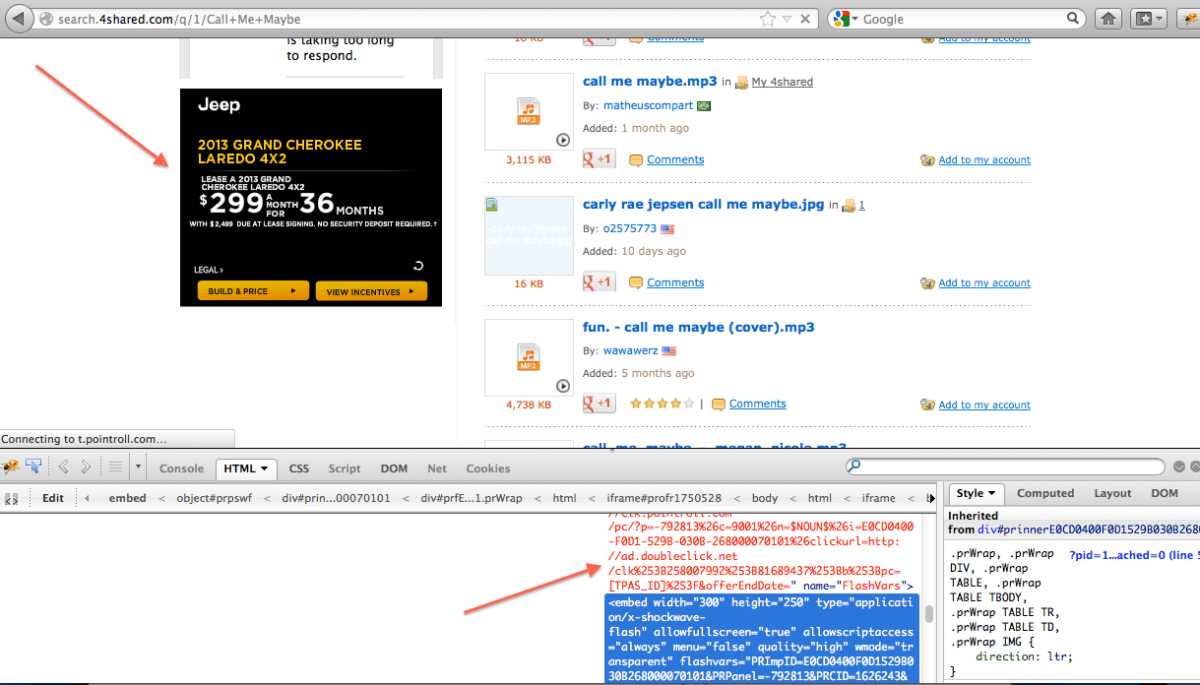
This was never about art, music or freedom.  It is simply a new set of even more ruthless artist-exploiting corporations taking over for the old ones. For example,  in the image below Jeep is advertising on one of the top known pirate sites 4Shared via Google’s Doubleclick ad network. Google alone is estimated to make almost $35 billion dollars annually,  95% of that revenue coming from it’s advertising sales. Google is not sharing ANY of this money with artists that it is exploiting. At least in the 1950’s music business you got a Cadillac every once in a while.

As Lars predicted The New Boss is Worse Than The Old Boss.

Weekly Recap Sunday October 21, 2012 aka Pandorathon, On and On…

Grab the Coffee!

Recent Posts, aka The Pandorathon:
* Sign the @musiciansunion (AFM) Letter: Friends don’t let friends get IRFA’d!
* If Pandora wants Terrestial Radio Royalty Rates, Act Like It – Problem Solved!
* Tim Westergren’s Sophomore Slump. New Bill Sucks, Old Radio Fairness Bill Was Way Better.
* Screw You Too, Pandora. Part I. Pandora The Union Buster! Jail time for Collective Bargaining?
* Four Simple Reasons Why the Pandora Radio Act Screws Musicians (EZ Reader)
* Screw You Too, Pandora. Part II: Did Pandora Lie During Their IPO? Or are they just plain old greedy.
* IRFA Analysis: Section 2
* Screw you too, Pandora™ PT III. Kangaroo Court: Pandora Bill Requires Firing of Copyright Judges and Replacement with Fake Judges.
* Screw You Too Pandora! Pt IV. Why Conservatives and Libertarians Should Be Appalled By The IRFA Bill.
* Radio Fairness? Sirius/XM Paid My Band $2,213 Pandora Paid $91

And, in case you missed it:
* Amex must really like advertising on #1 copyright infringing and illegal porn linking site Filestube
* Mythbusting : Music Is Too Expensive!?
* Remembering Steve Jobs

From Around The Web.

C|NET:
* Breaking Bad’s Bryan Cranston on Piracy and TV’s golden age

SPIN:
* Downloaders Beware: Copyright Alert System Arises as Torrent Sites Enter the Cloud

COPYHYPE:
* Friday’s End Notes Oct 19, 2012

VOXINDIE:
* Blogspot.com, a Bridge to Piracy?
* Why Doesn’t YouTube Address the Real Content ID Fail?

ETHICAL FAN:
* Calling All Lawyers! uTorrent Increases “Privacy” and Counters Mass-Monitoring of Downloads

COPYLIKE via MEMEGENERATOR:
* Scumbag Steve – Downloads Music for free Buys $300 headphones
* Join Copylike on Facebook

THE CYNICAL MUSICIAN:
* If a Tree Falls in the Forest and Nobody Hears It…

TORRENTFREAK:
* Microsoft Will Ban Halo 4 Pirates from XBOX Live
* Maybe he should have thought twice? Pirate Bay Founder in Jail.

DIGITAL MUSIC NEWS:
* Trent Reznor returns to Major Label System

HYPEBOT:
* SXSW announces first 40 Panels for 2013

MUSIC TECH POLICY
* Betting the Company: The Internet Radio Fairness Act has little to do with the Internet, Radio or Fairness
* An Overlooked Brookings Institute Study on Fighting Piracy at the Corporate Level

AFM:
* Check out the American Federation of Musicians on Facebook

CREATIVE AMERICA:
* Petition for an Internet The Works for Everyone

Four Simple Reasons Why the Pandora Radio Act Screws Musicians (EZ Reader)

The intentionally misnamed “Internet Radio Fairness Act” (IFRA) should actually be called the “Pandora Greed Screwing Musicians Bail Out Act” and here’s four simple reasons that everyone can understand why the rate setting in this bill, is in fact UnFair.

1) Pandora negotiated their royalty rate based on functionality.  Other formats of digital radio have different functionality, so they pay different rates.  If Pandora wants to pay a rate like another format of digital radio, then Pandora should function like that format.  They don’t. That’s why Pandora’s rates were fairly negotiated after carefully determining how Pandora actually functions.  As Westergren said in 2009–“The royalty crisis is over!”  Until it’s not, apparently.

2) Other online content services that are dependent upon music for their primary source of revenue such as Spotify and Itunes distribute 70% of their gross keeping a 30% margin for all operating costs. Pandora is complaining about paying only 50% of gross revenues and Tim Westergren wants to pay even less so that he can show Wall Street analysts that Pandora can make more profit.   Not to mention propping up the price of his own Pandora stock for a little bit longer (that he’s selling for about $1 million a month.)

3) It seems strange that Pandora could sell investors on the profitability of its business model during it’s IPO but now seems to think that model doesn’t work. Is this incompetence, or a deliberately dishonest and greedy transfer of wealth in a Wall Street Style bail out by asking Congress to change the law and move the goal posts? A two year old could figure out this is UnFair. Did Pandora think they could make a go of their business at the current rates during the IPO when they cashed out, or have they abandoned that idea now?

4) Pandora uses recordings on a government-mandated compulsory license which means artists have no ability to remove their music from Pandora even if they feel the rates are unfair. (This is like the compulsory license and statutory rate for songs–aka, “prison”.)  Again, both Spotify and Itunes allow artists to remove their music from those services if they so chose. Pandora will force artists into a deal they can not opt out of, this is UnFair.
You May Also Like More Info about PANDORA:

Screw You Too, Pandora. Part I. Pandora The Union Buster! Jail time for Collective Bargaining?

Tim Westergren’s Sophomore Slump. New Bill Sucks, Old Radio Fairness Bill Was Way Better.

If Pandora wants Terrestial Radio Royalty Rates, Act Like It – Problem Solved!

We have no problem with Pandora getting parity with terrestrial radio royalty rates, just disable all of the user interactivity and function exactly like Terrestrial Radio to get exactly the same rates. Isn’t this just obvious?

Simple. Done.

Fair.

In truth, Terrestrial Radio in just about every country outside the USA pays performance royalties to artists and rights holders. So yes, there also should be parity, and Terrestrial Radio in the USA should be paying artists performance royalties as well. The selective reasoning of those who seek to exploit artists seems to know no bounds in it’s lack of consistency or logic.

Stay tuned for more…

Tell Congress: Don’t Slash Music Creators’ Pay

http://musicfirst-coalition.rallycongress.com/7986/tell-congress-dont-slash-music-creators-pay/