Tell Us Again “Streaming Is The Future” As Paid Downloads Are Down 2.3 Percent In the US…

Let’s see… maybe streaming services are cannibalizing transactional sales, maybe? Streaming Royalties are small but they can really grow? Really? Let us guess… the good news is streaming is reducing piracy? In Norway and Sweden

According to half-year stats shared by Nielsen Soundscan with Digital Music News this weekend, paid downloads are slumping 2.3 percent at the half-point, meaning the period from January 1st through June 30th.

All of this points to the same issue of streaming services paying too little, while illegally operating, infringing businesses pay absolutely nothing at all. So much for sustainability…

READ THE FULL POST AT DIGITAL MUSIC NEWS:
http://www.digitalmusicnews.com/permalink/2013/20130721downloads

Pandora Prepares to Attack Artists… Again | DMN

Amazing the lengths Tim Westergren and Pandora are willing to go to, to attack artists…

Accordingly, Pandora is taking steps to have well-written, careful responses ready to go within 24 hours in places like Digital Music News.  Most importantly, the response needs to come from a source not affiliated with Pandora (or, so it seems…)

READ THE FULL STORY (AND EMAILS) AT DIGITAL MUSIC NEWS:
http://www.digitalmusicnews.com/permalink/2013/20130715pandora#QFlbW2t7XHEHic_7jx2vSg

How Pandora Became Music’s Big Villain – The Verge

The Verge reports on the battle over internet royalties…

Pandora struggles to win hearts and minds because its leadership lacks credibility, and has also been utterly inept at pitching the company’s plan to the public, press, and Congress. Pandora failed to generate congressional support to lower royalties last year and unless the company’s leadership dramatically changes its strategy, the popular radio service doesn’t appear to have a prayer of getting help from Washington any time soon.

Michael Pachter, a research analyst with Wedbush Securities, believes Pandora will eventually thrive but that its attempt to legislate lower costs is misguided. “The bill is idiotic,” Pachter said. “It’s insulting to Congress to say you want regulation to lower your costs at the expense of artists. Did you see who was on stage with Obama helping him campaign? Jay-Z and Bruce Springsteen. That’s the Democrats, and how many Republicans are going to want to legislate against capitalism and the free market?”

RED THE FULL STORY AT THE VERGE:
http://www.theverge.com/2013/7/9/4475102/pandroas-pr-problem-why-the-company-cant-win-in-washington

Blake Morgan : Pandora Needs to Do Right By Artists @ Huffington Post

Songwriter, Musician and Label owner Blake Morgan gained national attention through his email correspondence with Tim Westergren regarding Pandora’s attempt to manipulate musicians into signing a letter that would reduce their own royalty payments. Blake returns with a new editorial in the Huffington Post.

Instead of lobbying Congress (as you have) to lower Pandora’s rates, honor the rates Pandora, artists, and labels agreed upon together for Internet radio hand-in-hand with Congress in 2009. It’s an agreement artists went into with you in good faith, that already dramatically lowered the rates Pandora had to pay. It’s an agreement Mr. Westergren himself applauded at the time, famously and happily announcing on his own blog, “the royalty crisis is over!” It was also an agreement we were all supposed to continue honoring together, until 2015.

Instead of taking provocative action and purchasing a tiny radio station in the country’s 255th largest market (as you just did in an attempt to qualify as a terrestrial radio company and not have to pay a performer royalty), take different, provocative action. Stand with music lovers and music makers in reasonably and rationally arguing that terrestrial radio has never paid its fair share, and it’s time it did. And then to show you mean it, sell that station.

READ THE FULL EDITORIAL HERE AT THE HUFFINGTON POST:
http://www.huffingtonpost.com/blake-morgan/pandora-radio_b_3530363.html

Artists Speak Out on Pandora’s Proposed Royalty Rate Cuts

We know that David Lowery’s post here at the Trichordist has re-ignited the debate over Pandora’s latest attempt to reduce royalty rates to songwriters, but David is not alone. During the last attempt by Pandora to screw songwriters and musicians we saw a number of artists speak out, amongst them was respected songwriter, musician and producer Jimmy Jam who testified on Capital Hill.

Here’s a look at some of the other songwriters and artists speaking out from different perspectives.

Songwriter Ellen Shipley in Digitial Music News, “My Song Was Played 3.1 Million Times on Pandora. My Check Was $39…

It is interesting and very disturbing that no one is addressing the SONGWRITER’s situation in this Pandora debacle.

Pandora wishes to REDUCE the amount of royalties that songwriters have already seen CUT in 2005. Let me give you an example of what Pandora is paying in royalties to SONGWRITERS–not the performers, but the people who write the songs–the foundation of the music world—

PANDORA —-“Heaven Is A Place On Earth” (co-written)

accounting period for 3 months—–3,112,300 streams

My Pandora royalty ……………..$39.61

Songwriter, Musician and Indie Label owner Blake Morgan in The Huffington Post, “Tim Westergren Emails Underscore Tension Between Pandora, Artists.

The AFL-CIO, NAACP, Americans for Tax Reform, the American Conservative Union, SoundExchange, and others all oppose this bill, and the supposition that Pandora should pay less to artists and songwriters in order to accomplish higher profitability.

The Songwriters and Musicians of the band Pink Floyd in USA TODAY, “Pink Floyd: Pandora’s Internet radio royalty ripoff.

Of course, this letter doesn’t say anything about an 85% artist pay cut. That would probably turn off most musicians who might consider signing on. All it says about royalties is “We are all fervent advocates for the fair treatment of artists.” And the only hint of Pandora’s real agenda is the innocent sounding line “We are also fervent supporters of internet radio and want more than anything for it to grow.” The petition doesn’t mention that Pandora is pushing the growth of its business directly at the expense of artists’ paychecks.

Even former Pandora employee (and  Camper Van Beethoven band member) Jonathan Segel has written about the situation on his blog, “Pandora Groupthink. (look it up).”

Several of my former workmates at Pandora seem to be drinking the Kool Aid. I’m seeing posts claiming that David Lowery and Pink Floyd are talking ‘trash’. Yes, I worked at Pandora. You can read all about that here. I also play in a band with David Lowery, it’s called Camper Van Beethoven (not the band with the song in question here.) He and I don’t necessarily agree on everything, but I’m totally backing him up on this one.

Let us also not forget that over 125 artists signed a letter to Congress opposing these rate cuts. Here they are again.

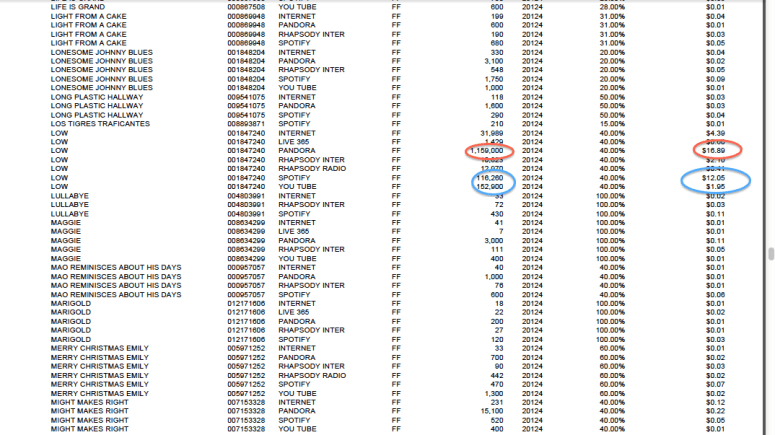
My Song Got Played On Pandora 1 Million Times and All I Got Was $16.89, Less Than What I Make From a Single T-Shirt Sale!

Pandora less than t-shirt sale

As a songwriter Pandora paid me $16.89* for 1,159,000 play of “Low” last quarter.  Less than I make from a single T-shirt sale.  Okay that’s a slight  exaggeration.  That’s only the premium multi-color long sleeve shirts and that’s only at venues that don’t take commission.  But still.

Soon you will be hearing from Pandora how they need Congress to change the way royalties are calculated so that they can pay much much less to songwriters and performers. For you civilians webcasting rates are “compulsory” rates. They are set by the government (crazy, right?). Further since they are compulsory royalties, artists can not “opt out” of a service like Pandora even if they think Pandora doesn’t pay them enough. The majority of songwriters have their rates set by the government, too, in the form of the ASCAP and BMI rate courts–a single judge gets to decide the fate of songwriters (technically not a “compulsory” but may as well be).  This is already a government mandated subsidy from songwriters and artists to Silicon Valley.  Pandora wants to make it even worse.  (Yet another reason the government needs to get out of the business of setting webcasting rates and let the market sort it out.)

Here’s an idea. Why doesn’t Pandora get off the couch and get an actual business model instead of asking for a handout from congress and artists? For instance: Right now Pandora plays one minute of commercials an hour on their free service. Here’s an idea!  Play two minutes of commercials and double your revenue! (Sirius XM often plays 13 minutes and charges a subscription).

I urge all songwriters to post their royalty statements and show the world  just how terrible webcasting rates are for songwriters.

The revolution will not be webcast.

* I only own 40% of the song, the rest of the band owns the other 60% so actually amount paid to songwriters multiply by 2.5 or $42.25)

**  I am also paid a seperate royalty for being the performer of the song.   It’s higher but also what I would regard as unsustainable.   I’ll post that later this week.

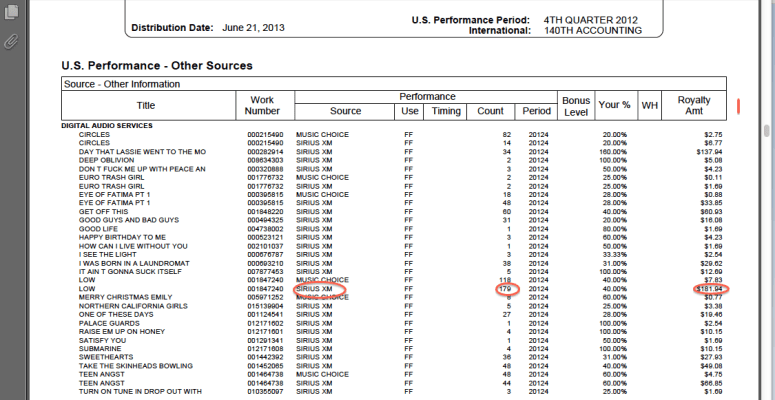
For frame of reference  compare Sirius XM paid me $181.00

sirius royalties

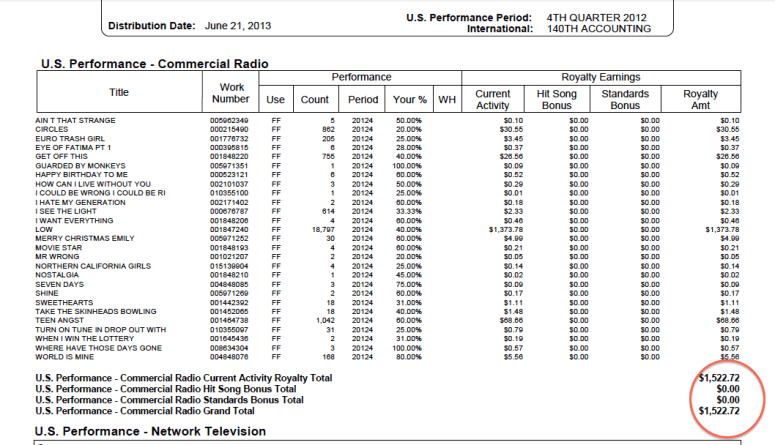
Terrestrial (FM/AM) radio US paid me $1,522.00

Terrestrial Radio royalties Low

Pandora is Stiffing Artists by Josh Kear | The Hill

Josh Kear is a songwriter, ASCAP member and Grammy Award-winning songwriter for such artists as Lady Antebellum, Carrie Underwood, and Darius Rucker to name of few. He’s written an excellent post at The Hill about Pandora’s latest attempt to cheat songwriters and musicians of their rightful royalties.

Pandora is another example that The New Boss, Is Worse Than The Old Boss for musicians, songwriters and creators and elitist technocrats seek to enrich themselves on the labor of others. Kear writes,

Savvy readers will note a mere four percent of Pandora’s total revenue is spent on licensing public performance rights from songwriters and composers. That means we make a fraction of a cent every time one of our songs streams on Pandora’s service

READ THE FULL STORY HERE AT THE HILL:

Streaming Services Ranked By “Artist Friendliness”

There is a lot of debate concerning the amounts paid to artists by streaming services.  It’s often very confusing because what an artist sees in royalties on their statements is highly dependent on a number of factors including whether they have a record deal, publishing deal or whether they are a solo performer or a band.  From an artists perspective royalties may accumulate from multiple sources. The other problem is that in general royalties are based on a percentage of the streaming services revenue.  So the amount may vary month to month and year to year.

Still one good  way to compare services is to look at statements for a moderately sized catalogue and calculate the revenue per stream they pay to “the rightsholders” (label/publisher/performer/songwriter) over a period of months.   This would also be the same amount that a completely independent artist that owns 100% if their own recordings and songwriting receives.

But this is not the only way to look at these streaming services from an “artist friendly” viewpoint.   We also need to look at whether these services respect artists rights. That is, whether these services respect the Artists right to choose how to monetize their music.   When you look at it in those terms the picture is a little different.  Here I’ve ranked the 7 most common services.

1. Rhapsody (Napster/Zune).  These three “on demand” services allow you access to virtually any song at any time. From an artist’s perspective they are identical.   These all work on a paid subscription model.  Like Spotify these services pay a percentage of revenue to rights holders.   But because they do not offer an ad based free service they have more revenue and pay more per stream to each artist than Spotify.  All these services  (like Spotify) operate under a private license.  They do not rely on a government imposed compulsory licenses or rates.  This also means rightsholders can theoretically “opt out” of this service if they think it doesn’t pay well enough. Or better yet negotiate a better deal.

I’m not opposed to compulsory licenses and rates in certain situations. But as  an artist I have to note that these rates are set by political appointees.  Broadcasters generally have a lot more money than artists and are thus better positioned  to influence the political process.  This is not some sort of tin foil hat paranoia.   If you were paying attention this fall you will note  that this is exactly  what happened  with the Orwellian-named Internet Radio Fairness Act.  Pandora fronting for Clear Channel,  Sirius XM and various Silicon Valley firms tried to use their lobbying money and influence to force the government to reduce those compulsory license rates!  Artists could have got an 85% pay cut!  So in general private blanket licensing is better for the artist.  Compulsory federal government imposed rates benefit the politically connected.

As previously noted have access to the streaming royalty payments for a moderately sized catalogue. Here are the average per stream rates paid by these three services Jul-Dec 2011.

Zune 2.8 cents

Napster  1.6 cents

Rhapsody 1.3 cents

These are close to being a sustainable* rate for artists.  (See footnote at end for an explanation.)

As a consumer I enjoy Rhapsody’s  256k mp3s.  As a consumer I prefer Spotify’s interface. I’ve never tried Zune or Napster.

2. Spotify.  #2 ?!! This surprises many of you.  Right? Let me explain.

Currently Spotify appears to be paying rightsholders about .5 -.7  cents a stream.  Considerably lower than the three services above.     While my colleagues here believe this is not a sustainable rate and that it may never become a sustainable rate we can’t know for sure.   It  is unclear how much streaming services  “cannibalize” or displace traditional sales. If streaming services  displace 20% of sales Spotify’s per stream rate could be sustainable.  If they displaces 80% of sales? Probably not.

Spotify  relies heavily on it’s free streaming service that is ad supported.  Spotify pays 70% of revenue to rightsholders.  If Spotify manages to convert more users to it’s premium subscription services revenues will rise.  As a result  rightsholder’s revenues rise.  If the ratio of paying subscribers to free subscribers rises substantially the per stream rate rises to something  sustainable.

What we  like about Spotify:  It operates (mostly?**) under  private licenses which means that rightsholders can withdraw from the service if they wish.  More importantly Spotify  has quietly allowed individual artists to “window” their releases and limit which singles or albums are available in the free service.  This is very important. For instance my band Cracker which has had four top ten rock tracks might find it’s revenues from Spotify acceptable.  But a niche artist like Zoe Keating might find she is losing sales to streaming services. She might chose to have only some or none of her catalogue available.  Choice is the foundation of free markets. Allowing artists to experiment with how to use streaming services, and how to monetize their songs is good for everyone. It will eventually be clear the best way to balance revenue and access.

I also should note that Spotify is being unfairly blamed for the knock on effects of disintermediation.  Disintermediation creates winner-take-all markets, and in an industry that was already winner take almost all, the small and middle class artists have gotten clobbered.  On a positive note, in these kind of markets there are usually countervailing market forces at work that nudge us towards  risk and revenue sharing. Or in Layman’s terms: It usually gets better.    The explanation is kind of complex so I’ll skip it for now.  Suffice it to say that right now it’s not so much Spotify taking artists’ royalties but the superstars taking everyone else’s royalties.

Finally Spotify has gone out of it’s way to engage artists, even critics like myself.  The fact that they were willing to sit down with me and discuss my issues with  their service is encouraging.

#3 Pandora.   Oh how the mighty have fallen.    Once they were our favorite.  Look at early Trichordist blogs and note our enthusiastic tone whenever we speak of Pandora!

For those of you that don’t know Pandora is NOT an on-demand streaming service.  I call it a “virtually on demand streaming service.”  If I type in a song title and artist name, I dont’ get that song.  But I usually get a song by that artist.  Pandora is a music discovery service.  It’s not a replacement for owning an album.  As a result Pandora gets and should get a lower rate than on demand services.

What we don’t like about Pandora:

They operate under a compulsory license so artists can not opt out of the service if they do not like the rates!! But what is worse is they have adopted the tactics of Silicon Valley’s hardball monopolists.  Proudly on display are  lobbyists, fake bloggers, planted stories, paid mouthpieces  and all the usual Kabuki Theatre bullshit we’ve come to expect from the “innovators” of Wall Street- er I mean Silicon Valley.  As I mentioned previously  Pandora fronted for the Internet Radio Fairness Coalition and pushed the Orwellian-named Internet Radio Fairness Act. The bill had nothing to do with Internet radio or fairness and everything to do with screwing artists out of 85% of their royalties.

Curiously the Internet Radio Fairness Coalition which supports the bill  has a lot of traditional broadcasters like Clear Channel and Sirius XM. Kind of odd for an organization with the publicized  purpose of leveling the playing field between Internet broadcasters and traditional broadcasters. The CCIA and CEA are also  inexplicably members of the IRFC.  Well maybe not inexplicably.  Just as the Four Horsemen herald the Apocalypse,   The CCIA  and CEA seem to always herald  La Chingada of someone, somewhere by Google.

So for participating in this rapacious anti-artist skullduggery we move Pandora from the top of the list  to #3.   We would put it at the bottom of the list but the other two lower ranking  services in my humble opinion are not even completely legal.

#4.   YouTube/Google.   YouTube is the biggest on demand streaming service. I know people think of it as a video service but it turns out that it’s the most popular music streaming service.  The main problem is that a lot of the music is uploaded and monetized by people that have no right to the music in the first place.  For example here is one of my recordings:  All Her Favorite Fruit. The problem is I didn’t authorize this person to upload this song, nor did I authorize YouTube to sell advertising or sponsored videos against this song.  It’s possible that the record label did but as I am also the songwriter and legally I should have been consulted.  Worse, the person who uploaded the static image can receive advertising revenues  since they “own” the video.  This is no different than Kim Dotcomm/MegaUpload paying people to upload the most popular movies and songs.  Further I have no idea where the money goes since you can’t audit YouTube without signing an agreement with them that basically says you can’t audit them!  YouTube is like the exploitative 1950’s music business but even worse, as  the artist does not receive the occasional Cadillac in lieu of royalties.

Now consider this:  This track is competing with legitimate authorized  streams of my track on other services.  These services generate some revenue for me.  So say I find it in my financial interests  to take this down?  I have to file what’s called a  DMCA notice.  When I do this Google can place my DMCA notice  on this website to try to publicly shame me into not doing this anymore.  I don’t file DMCA notices with YouTube/Google because I don’t want some deranged Freehadists showing up at my  home or office. This is not a far fetched idea, many of us in the vanguard arguing for artists rights and the preservation of copyright receive constant threats from seriously deranged free culture nutbags.  So the result is I don’t file a notice and I let YouTube/Google get away with this. This website is a tool of intimidation. It is my belief that this is exactly what Google intended when it launched this site.

If Google and UC Berkeley (which hosts the site and lends it intellectual legitimacy) had any common decency they would stop this practice cause someone is gonna get hurt one day. Now while  I don’t hold out hope for Google developing any common sense anytime soon (they are still allowing advertising for no prescription Oxycontin despite a half a billion dollar fine and threat of jail time)  maybe the Chancellor of UC Berkeley will recognize how screwed up this is.  You should ask Chancellor Birgeneau yourself: “Why is UC Berkeley supporting Googles intimidation scheme?”  chancellor AT berkeley.edu.

My friend East Bay Ray of The Dead Kennedys  told me he recently got an “offer” from YouTube/Google to let him claim  his own songs and start receiving royalties.(“Really you’re letting me have control over my own songs? Gee thanks how nice!”).  All he had to do was sign away most of his rights and in return the band would get about .1 cents a view.   Considering your typical banner ad on a shitty pirate website gets 1.5 cents an impression,  this is not even a joke.  It’s an insult.   Honestly I can’t understand how artists can complain about Spotify when YouTube/Google is so much worse and certifiably evil.  As I’ve said before “Don’t be Evil” is not their corporate slogan, It’s their widely ignored corporate reminder. 

#5 Grooveshark.   Many young people I run across seem to think this is a legitimate streaming service. It’s not.  My entire catalogue is on this service. No license, no permission and not a dime ever from these guys.   The sooner these guys go to jail the better.  I’m tempted to have a conversation with Ted Nugent. You think he’s mad about Obama raising his taxes and restricting his gun rights?  Wait till he finds out that Grooveshark is not paying him royalties.

* “Sustainable Rate” is my attempt to figure out a streaming rate that compensates artists well enough to continue to write (and especially) record albums.   I’ve examined a lot of iTunes libraries and “most played” lists.   A typical 20 year old college student seems to play a track they have purchased around 25-30 times before they seem to tire of the track.   So if on demand streaming replaces all album sales a stream should pay about 2.3-2.8 cents to be the equivalent of the 69 cents net received from iTunes on a 99cent download.  But if on-demand streaming only replaces 50% of album sales it could be half that rate.  You see?

But a  word of caution.  First this assumes that 99 cents a track is the right price for all songs.  Not necessarily true.   This is a price that iTunes essentially imposed on the record business, against a backdrop of mass piracy.  You can make an argument that this artificially lowered the price of music.

Second the music business has always worked on a revenue sharing model that assumes the “winners” subsidize the “losers” through record companies, publishing companies and their advances.   If you have total disintermediation in the streaming market even with high per stream rates  niche artists like Zoe Keating and Camper Van Beethoven would never generate enough revenue to record albums.  Music sales exhibit a “wild” variation and with total disintermediation almost all the revenue goes to the winners.   So this “sustainable rate” is not necessarily sustainable at all.  It is only one piece in the puzzle.  Eventually the revenue and risk sharing roles once assumed by record labels will need to be assumed by the record labels again, or other mechanisms need to be developed.

Other’s have suggested non market based  mechanisms which  include “crowd funding” government subsidies and corporate patronage.  I am uncomfortable with all of these.   Government and Corporate funding allow powerful elites to decide what music is made.   Crowd funding works for the most extroverted and popular personalities.   While crowdfunding comes closest to market based incentivizing  I don’t believe crowd funding would have ever given us  important artists  like Jimmy Hendrix, Captain Beefheart, Frank Zappa,  NWA,  Black Flag or Nirvana.   Can you imagine Kurt Cobain or Jimmy Hendrix offering a premium support package that includes the artist coming to your house and cooking dinner for you and 4 of your friends? No crowdfunding works for people like me who already have a career or extremely extroverted self promoting personalities like Amanda Palmer (no offense intended). 

One day I hope that all my musician and digital utopists friends wake up and see that the West’s private market based system for creating culture  has produced some extraordinarily profound and non-mainstream work.   No other system can match it. Why are some so  hell bent on throwing it away?  

** My understanding is that there is a compulsory on demand rate for songwriters (song in abstract) not performers.  It’s not clear to me whether Spotify uses this rate.   And I can’t two experts that agree.  But certainly the bulk (if not all) the revenues Spotify pays our are under the private license not compulsory license.

Weekly Recap and News Sunday Nov 11, 2012

Grab the coffee!

Recent Posts:
* Madison Avenue and Media Piracy, Are Online Ad Networks the Birth of SkyNet?
* Bad News, Good News, Bad News. Internet Radio “Fairness” Act Sponsor and Conservative UT Congressman Chaffetz Taunts Musicians; Admits to Belief in Evolution; Urges Government Interference In Markets.
* Muzzling Free Speech By Artists: IRFA Section 5 Analysis
* Lobbyist For CCIA Makes All Kinds of Wild Claims About Copyright Management Organizations. BMI ASCAP SOCAN SAMI Included in Charges of Corruption.

From Around The Web:

Copyhype:
Friday’s End Notes 11/09/12 (Essential Weekly Reading)

Dan Ariely
How to Stop Illegal Downloads
“Before it was my book being illegally downloaded, I was more on the “Information wants to be free” end of the spectrum. The sudden, though predictable, shift in my feelings when I found my own work being downloaded for free was a jarring experience.”

Digital Music News
Goldman Sachs Is About to Invest $100 Million In Spotify…
Dear Pandora, You Totally Suck. Signed, Songwriters…
Pandora Is Now Suing ASCAP to Lower Songwriter Royalties…

TechCrunch:
Spotify Is Having A Good 2012: Revenues Could Reach $500M As It Expands The Digital Music Market

Billboard:
Songwriters Are Left Out of Pandora’s Royalty Plan: Guest Post by Downtown Music’s Justin Kalifowitz

The Hill:
NAACP blasts Pandora-backed Internet royalty bill

The New York Times:
A Clash Across Europe Over the Value of a Click

The Precursor Blog:
Google’s Top Ten Anti-Privacy Quotes — Part 3 In Google’s Own Words Series
“We know where you are. We know where you’ve been. We can more or less know what you’re thinking about”Google Chairman Eric Schmidt 10-1-10 per the Atlantic

Torrent Freak:
Supreme Court Rejects Hearing For Pirate Bay’s Peter Sunde
RapidShare Limits Public Download Traffic to Drive Away Pirates
“Six-Strikes” BitTorrent Crackdown May Target Private Trackers

Columbia Journalism Review:
Audit Notes: digital ads, margins of error, freehadists – French publishing’s online revenues make the Americans look good

Music Tech Policy:
IRFA and the Future of Music Policy Summit: Why Would FOMC Miss An Opportunity to Defend Artist Rights?
Stretching the Possibilities of Offensiveness, Pandora Demonstrates How to be Ugly at Scale

The Washington Examiner:
Report: Google and Facebook competing for an Obama cabinet slot

Digital Trends:
Sorry, Internet, SOPA had zero effect on election day results
“Of the 24 House Members up for reelection who co-sponsored or otherwise supported the highly contentious anti-piracy legislation, all but three won reelection on Tuesday. This includes Republican Rep. Lamar Smith, of Texas, SOPA’s author and chief co-sponsor who became the Internet’s Enemy No. 1”

ChinaDaily:
Free Online Music in China Coming to An End?

Untruth in Advertising: Pandora’s Misleading Plea To Listeners On Behalf Of The Internet Radio “Fairness” Act.

For those of you that have not been following closely.  The “Internet Fairness Rado Act” is a bill  that is being championed by Pandora Radio.  Pandora radio has been pushing it’s listeners to write their congressmen on behalf of Pandora and in support of this bill.

But Pandora has not honestly explained the bill to their listeners.  They portray the bill as a fix to “discrimination” that internet radio suffers in comparison to traditional broadcasters.  This is simply not true. In addition there are all kinds of nasty things  in this bill that don’t really have anything to do with Pandora.

Here’s how you know you aren’t being told the whole story: The bill is also backed by Clear Channel and other traditional broadcasters.  This is not poor little Pandora vs the other big broadcasters.  They are on the same side. It’s big media vs the artists.   Feel duped?  Write Pandora. Click Here.

So for a little bit of fun we have decided to make an honest and fair version of the Pandora’s plea on behalf of the Orwellian named Internet Radio Fairness Act.

++++++++++++++++++++++++++++++++++++++++++++++++

From the Pandora website

Their text is in black.  Our  more “truthy” text is in red.

INTERNET RADIO FAIRNESS ACT

An important piece of legislation has been introduced in Congress to help end the long-standing discrimination against internet radio fire the copyright royalty board judges.  These judges have made rulings that Pandora did not like in  the past.  This bill also muzzles any group that acts on behalf of  “rightsholders” (artists) by threatening prosecution under The Sherman act for “impeding” any direct licensing between broadcasters and record labels.  Direct licensing deals  often allow record labels to take artists performance royalties and apply it to un-recouped balances. As it stands now these royalties must be  paid directly to artists.  This effectively muzzles artists,songwriters and their unions. This bill infringes free speech!   We’re asking that you contact your representative today to urge them to NOT support the Internet Radio Fairness Act.

This bipartisan bill will  NOT end royalty rate discrimination against internet radio and bring greater fairness to our industry. Because such discrimination does not exist.  It may however keep Pandora’s stock price high while insiders sell  millions of dollars of shares amonth. Today, the discrimination disinformation is extraordinary. In 2011, Pandora paid over 50% of revenues in performance royalties, while SiriusXM paid less than 10%.  But comparing shares of revenue is extremely misleading.

This is because

1) Pandora chooses to play one commercial an hour whereas Sirius plays approximately 13.

 2) Sirius relies on subscription (lots of revenue) while Pandora relies more on advertising (much less revenue)

3) Sirius airs a lot of non music programming.  

Internet radio brings millions of listeners back to music, plays the songs of tens of thousands of promising working artists, enabling them to build their audience while receiving fair compensation. That’s why we want to pay artists 85% less. We would like artists to be unfairly compensated so we can profit more. 

+++++++++++++++++++++++++++++++

If you are a pandora listener,  and you received this very misleading communication from Pandora and you now feel duped?  Write Pandora and ask them some hard questions.  Ask them why they failed to mention the bill fires the copyright  judges.  Ask them why they failed to mention  the Sherman Act is in the bill?  Ask them why they failed to mention they want to muzzle artists groups during direct licensing negotiations? Ask them why they never mentioned that Clear Channel is also behind this bill.  Write them  Click here.

You can also write the congressmen and senators who introduced this bill:

Representatives Jason Chaffetz (R-UT) and Jared Polis (D-CO) along with Senator Ron Wyden (D-OR).