The American Association of Independent Music, the independent label trade association, filed comments with the Copyright Royalty Board opposing increasing the mechanical royalty to songwriters from the “frozen rates” to the 12¢ (plus cost of living adjustment) settlement rate of the participating record companies with the NMPA and NSAI. I wrote a reply to the A2IM comment that was timely filed with the CRB–barely. I will repost that comment in a few parts here on MTP. As I had about 10 minutes to write the comment due to the lateness of the A2IM filing, I will add some bracketed language to make it a bit less inside baseball.
Unfortunately, A2IM chose not to participate in the Phonorecords IV proceeding and came in a bit late to the party complaining of the check. Nobody stopped them from participating; it appears they put it all on red and it came up black. This is important because unlike independent songwriters who cannot afford the cost of participating at the CRB hearings, A2IM could have participated but chose not to.
As I told the Judges in my comment, I will focus on a few issues raised by A2IM regarding the CRB settlement process in general, the penny rate structure of the mechanical royalty system in the United States, and their proposal that mechanical licensing for physical configurations be handed over to the Mechanical Licensing Collective.
The Longer Table
I actually was pleased to join A2IM at their annual Indie Week conference recently in New York on a panel devoted to this very topic. I am well aware that they believe their members will be disproportionately affected by the increase in cost although I have not seen the data. After many years in the music business, I will take on faith for purposes of this letter that they are correct.
I completely concur that the negotiation process for CRB needs a relook if not an overhaul. I made the point on the A2IM panel that David Lowery and I intend to host a conference devoted largely to this subject [on November 15] at the University of Georgia at Athens. Dr. Lowery and I are both of a mind that this issue needs to be vetted by the Copyright Office in their roundtable format.
However, I do not concur that the Subpart B resolution should be derailed at the 11th hour because of these structural issues that lawmakers no doubt will need to resolve. The time for A2IM to have made their views known in Phonorecords IV has long passed. They had the opportunity to participate in the proceeding, which individual songwriters could not afford to do, and they did not. They had the opportunity to comment on the first and second comment periods for what became the rejected settlement and they did not. They had the opportunity to insert themselves in the second settlement and appear not to have done so until filing a comment on the last day at the 11thhour.
Derailing the settlement for this purpose at the 11th hour is inappropriate. Whether the Judges can even accomplish what is asked of them, I respectfully leave to Your Honors to decide, but I do think there’s a question of authority here. I do support including all these topics being on the table for Phonorecords V as do many other commenters.
What is the Actual Cost to Labels of the New Rates?
While I am prepared to take disproportionate impact on faith, I am less prepared to take disproportionate financial impact without more data. There is an assumption that A2IM labels all will have a one-to-one increase in costs because of the new rates, whatever they end up being. I’m not so sure about that and would want to know a few things including the following.
Many indie labels operate on a revenue share basis with their artists (or licensors). In those revenue share deals, the artist or licensor is paid a percentage of revenue that includes all mechanical royalties. In that structure, the new rates have arguably zero impact on the [independent] label.
Because of rate fixing dates in deals [with controlled compositions clauses] where the label does pay the mechanicals, the new rates would only apply to records delivered during the rate period, i.e., after January 1, 2023. Term recording artist agreements would typically include a controlled compositions clause as the Judges have noted in the Withdrawal Notice. In such an arrangement, the label would be paying a modest increase and could easily tell the artist that unless the artist-songwriter agreed to take still lower rates based on the previously frozen rates, the label would be unable to release their records.
A2IM does make a good point about the bull-headedness of the DSPs on permanent download rates. Perhaps the Judges could refer this issue to the Register for subsequent referral to the Department of Justice Antitrust Division to investigate these pricing practices. Congress seems focused on these kinds of issues at the moment.
[It is unfair for A2IM to complain of being excluded from settlement negotiations by the labels who did participate in the proceedings and who did negotiate a settlement with the NMPA publishers who also participated in the proceedings. Participating in the proceedings is a threshold condition for participating in a settlement of the proceedings. It’s hardly the case that the major labels conspired against the indies this time. If A2IM labels were concerned about being included in these negotiations there are a number of steps they could have taken, starting with participating in the bifurcated Subpart B proceeding–a much less expensive proposition than the streaming side.
There is also a threshold question–that A2IM does not really address–as to whether the CRB has the authority to unilaterally change U.S. mechanical licensing structure that Congress initiated in 1909 and has been based on a penny rate ever since, not to mention hundreds of thousands of term recording artist agreements and licenses incorporating those statutory rates. The entire US recording industry is built on statutory rates and controlled compositions clauses, not to mention the valuations of music publishing catalogs.
That change requested by A2IM is a question of such “magnitude and consequence” that it should require Congress to act based on both the CRB’s statutory authority, the U.S. Supreme Court’s recent holding in West Virginia vs. EPA as well as common sense. Not to mention there are other reasons why getting a CRB case before the Supreme Court could backfire and disrupt a process that in other important ways is working quite well.]
A2IM, the independent label trade association, filed comments with the Copyright Royalty Board opposing increasing the mechanical royalty to songwriters from the “frozen rates” to the 12¢ (plus cost of living adjustment) settlement rate of the participating record companies with the NMPA and NSAI. I wrote a reply to the A2IM comment that was timely filed with the CRB–barely. I will repost that comment in a few parts here on MTP. As I had about 10 minutes to write the comment due to the lateness of the A2IM filing, I will add some bracketed language to make it a bit less inside baseball.
Unfortunately, A2IM did not participate in the Phonorecords IV proceeding and came in a bit late to the party complaining of the check. Nobody stopped them from participating; it appears they put it all on red and it came up black.
As I told the Judges, I will focus on a few issues raised by the American Association of Independent Music regarding the CRB settlement process in general, the penny rate structure of the mechanical royalty system in the United States, and their proposal that mechanical licensing for physical configurations be handed over to the Mechanical Licensing Collective.
The Clean Slate
A2IM raises the idea of compensating songwriters on a percentage of wholesale basis which is how mechanicals are paid in many if not most other countries. I understand why labels favor this structure but I also understand why publishers and songwriters do not.
First, I am of the view that a percentage of wholesale royalty is incompatible with a compulsory license. [To my knowledge, the European countries operating on a percentage of wholesale basis do not have a compulsory licensing regime.] Imposing a compulsory obligation to have a third party set the “just compensation” for rights the government takes from the songwriter has that unconstitutional ring to it [see 5th Amendment and Takings by Prof. Richard Epstein, an oldie but goodie].
And that really is the problem with a percentage of wholesale royalty—it allows the conflicted record company to call the tune [for songwriters] which is the very definition of moral hazard. Having said all that, I am happy to have a conversation about a clean slate and reimagining of the entire structure as long as it really is a clean slate. Of course, that will mean throwing away the entire controlled composition structure.
It must be said that in countries with a percentage of dealer price mechanical royalty there [are] no controlled composition terms at all. So if we are to have the discussion, let’s have all the discussion for all the record companies including catalog. If we want to be like Europe, let’s be European.
We cannot overlook that changing that compensation system will throw royalty compliance examinations of every record company onto the table with great force. How can songwriters be asked to give up a system that has been in place since 1909 without knowing whether they have gotten a straight count heretofore?
It must also be said that if A2IM members feel justified in changing the entire U.S. mechanical rate system, there is nothing stopping them from creating such terms in their new signings under controlled compositions clauses. In fact, such arrangements might be a good laboratory to experiment with these alternative structures.
Here it is. The US economic data is undeniably leading to a stagflationary outlook reminiscent of the 1970s. If you don’t have first hand knowledge of the inflation that started under Nixon and Arthur Burns, burned through Ford and Carter and finally came to rest with Federal Reserve Chair Paul Volker and President Ronald Reagan that ultimately resolved in the low inflation that began trending downward in 1983, trust me; it was awful.
This is why it is insane–if not actually cruel–to force songwriters to take a fixed five year mechanical rate with no downside inflation protection in the form of a cost-of-living adjustment. What is bizarre is that this just happened in the streaming mechanical for the Phonorecords IV proceeding, in case you didn’t hear it over the sound of the backslapping.
It appears that songwriters will get the cost of living adjustment (or “COLA”) on the physical mechanical side–you know, the one the smart people told us was unimportant–but failed to get it on the streaming mechanical side which the smart people tell us is critical to the continuation of life as we know it. Even though it certainly looks more likely than not that growth of the money supply and government debt produces the rocket fuel for the inflation that took 1200 points off of the DJIA in one day. 1970s all over again, including James Taylor crooning “Fire and Rain.”
But economists are beginning to remind us that what makes anyone think the 1970s is the worst it can get? There’s a tendency to think of 1970s stagflation as a downside boundary. It’s not. It just happens to be the worst sustained economic times in living memory as the Depression-era Greatest Generation settles into the silence of old age. However, there’s nothing magical about the 1970s.
As it stands today, over 40 countries already have an inflation rate in the double digits, America is a debtor nation, Wall Street has sold a huge number of jobs off shore, productivity growth is lower than the 1970s and we’ve gone along with the central banks’ zero interest rate policies in the years since the 2008 crash. The piper must be paid for the Lehman Bros. of this world leading us all over the cliff in the great recession, even though the central banks’ easy money policy has delayed that payback. All of these are reasons why there must be a cost of living adjustment in any government imposed statutory rate that takes away bargaining rights. But wait, there’s more.
When Federal Reserve Chair Jay Powell changed the Fed’s inflation targeting (remember “transitory inflation”?), he blew an opportunity to start fixing the real problem. But no more. The chickens are coming home to roost with increases in interest rates and yet-to-materialize promise of quantitative tightening. Now that Mr. Powell was reconfirmed for another term.
If there’s even a chance—any chance—that 1970s style stagflation and depression-level demand destruction may be the best we can hope for, anyone setting a wage control like the statutory mechanical royalty rate simply cannot order that rate for five years and fail to take into account the potential for a coming inflation spike even if the smart people sign a suicide pact. Yet this is exactly what just happened with the settlement of the streaming mechanical rates for Phonorecords IV at the Copyright Royalty Board.
Admittedly, the Copyright Royalty Judges are boxed in given the preference for voluntary settlements baked into the Copyright Act. That gives the smart people far too much credit and fails miserably to allow the Judges to do what judges do—bring contemplative thought to the problem. This is what judges do, it is not what lobbyists and their lawyers do. But unless the public raises the failure to include a cost of living adjustment in comments, so far there’s little basis for the Judges to correct the defective settlement.
It is essential that the Judges are allowed to do their job outside the hurley burley of the commercial relationship with the biggest corporations in history whose lawyers are hell-bent on conducting a scorched earth litigation campaign to crush songwriters. This is especially true of Google, Amazon and Spotify who have demonstrated truly vile behavior during the entire proceeding, a bully-fest beyond category.
George Johnson hit upon a potential solution in his recent comment. If one applies the COLA to the royalty pool after the mind-numbing “greater than/lesser of formula” created by those seeking full employment for lobbyists, lawyers and accountants, that’s actually a pretty elegant solution. I would quibble a little bit with the idea and apply the COLA as an uplift to the actual royalty statement so that the royalty recipients could see how that uplift was arrived at (which in theory would make them less likely to audit the MLC). That “show your work” approach would allow the payee to see how the MLC got there and make it easier to audit upstream for obvious mistakes.
It will also make it easier for the Judges to add the COLA because the building blocks of the calculation won’t change from the voluntary settlement (TCC, revenue share, etc.).
If songwriters are forced to stay in the confines of the statutory license trap, at least a COLA keeps the cheese from melting before their eyes. Plus they’re not required to guess today what the cost of food at home, shelter and gasoline will be five or six years from now.
The Judges would also have the opportunity to bring the services into a new era of fairness and wipe out the bullying of process as punishment that we all had to endure through two different proceedings.
Remember, as you have probably read or realized yourselves, all the US needs is one more good exogenous roundhouse shock to the economy (such as the world abandoning petrodollars for a basket of currency such as the ruble, the renminbi and the real to pick a few out of thin air), and we are in serious economic straights with hyperinflation as the real bugaboo.
Remember also that the US bonds pay interest at less than the inflation rate.
The decline of the dollar as the premier world reserve currency will put a stop to that interest/inflation spread practically overnight. The US government will not be able to borrow from a seemingly bottomless pit of lenders paying US dollars for US bonds at any price for the stability and transferability. What happens then? Probably interest rates will increase–a lot–to make it worth the lender’s money. Which means the debt service will take up an even bigger chunk of the US budget which will give us less to spend on the “Cross of Iron” weaponry that got us into the petrodollar business in the first place. And so it goes.
Songwriters may not be able to do anything tangible to stop cataclysmic economic events, but they can demand at least a bare minimum of downside protection through a COLA.
You may say, why so cynical? I’m not altogether cynical, I hope that I’m just cynical enough. The numbers don’t lie. If you know anyone who was a child during the Great Depression, or is the child of that person, ask them what it was like.
The overarching point is why would you want to take a chance and bet it all on the smart people?
One of the main beefs I’ve had with the Copyright Royalty Board is the secrecy in plain sight. Very few people follow what’s going on there, yet every time you move a rock, another toad hops out. Now that we are turning our attention to the streaming mechanical proceeding–which as we were told ad nauseam is the important one, don’t you know–the first thing we find is the shameful antics of Google on full display.
Remember–the Copyright Royalty Board split the rate proceedings in two. One was for the physical and download mechanical (paid by record companies) and one for the streaming mechanical (paid by digital music services), all under the compulsory license which was adopted for the huge benefit of each music user. And of course if it’s compulsory it takes (there’s that word again) away the rights of songwriters to bargain and set their own price without government intervention. (There are alternative ways to do this such as the Nordic model of extended collective licensing that David Lowery discussed in an important blog post a few years ago.)
The Copyright Royalty Judges are given the unenviable task of divining what a willing buyer would pay a willing seller in the open market. Of course that willing/willing rate is a complete legal fiction because in the novella of statutory rates there hasn’t been an open market for over 100 years which for rate setting purposes means there has never been an open market for songwriters. Why? Not sure, really, but there must have been an original sin, the novella tells us so. We can only assume that when that writer room door closes, those pesky songwriters just naturally start colluding, unlike Facebook, Amazon, Apple, Spotify and especially Google. Google who have never been prosecuted for violating the Controlled Substances Act for which they paid a $500,000,000 fine and who we let take over our children like they were a trustworthy television network or something.
So since there’s never been an open market because the government took the songwriters’ rights back in 1909 in this case (and 1941 in the case of the ASCAP consent decree), you can well imagine that a cottage industry of executives, lawyers and lobbyists have grown up to service the bizarre rate setting process that has totally lost their way in my view. It’s hard to believe when we read the shenanigans going on in front of the Judges that this is all designed to determine the value of songs. There are 38 lawyers billing time in the streaming proceeding which will raise the transaction cost of the proceeding to an absurd and Kafka-esque level, but it does help you understand why the lobbyists think that proceeding is so important–it’s definitely more important to them.
Which leads us to the extremely Googley discovery request that Google has filed and the Judges appear to have approved. In a nutshell, Google has said that they only way that the rates can be set is if the Judges force the National Music Publishers Association and the Nashville Songwriters Association International to turn over all to Google of your accounting statements and licenses so Google can determine if the past earnings back up the NMPA and NSAI royalty claims made by their many Lecterian lawyers.
But don’t feel bad–it’s not like they will be turning over the data to the public, just to Google. What a relief, right?
Here’s what the order actually says:
That’s right–Google wants “Music Publishers” to produce all the royalty statements for the most successful songwriters in the world to “test” whether songwriters are struggling financially. Given that this will involve many, many statements which probably have to have personally identifiable information redacted, it’s going to take many hours which is great for those who get paid by the hour but not so great for those who get paid by the song.
Is there no other way to determine whether mechanical royalties have declined to subsistence levels? Surely there must be, and you know what else? There’s also a way to test whether mechanical royalties have declined to below subsistence levels which is really the point here, right?
Yes, I got your test right here, soulless Google lawyers.
But wait, there’s more. Google also wants to raise transaction costs on songwriters by forcing the production of all “free market” licenses. (“Free market” benchmarks are themselves a laughable concept in a hugely distorted market that still suffers from the governments negligent wage and price control of a 2¢ rate from 1909 to 1978).
And given the parameters of the Copyright Royalty Board, the Judges seem to have granted Google’s request in part for the statements and entirely for the licenses.
You do have to ask whether there’s anything songwriters can do to keep their confidential royalty statements and license agreements out of the hands of the Leviathan of Mountain View. It does seem that there could be a process to intervene in the Phonorecords IV case to stop this from happening. Just because Google is trying to prove that songwriter income has not been decimated when we all know it has been does not seem to require the humiliation of having your royalty statements put on display. This is definitely something to speak about to your lawyer and your publisher.
This entire exchange is exceptionally bizarre because the “Copyright Owners” are the NMPA and NSAI, neither of whom own copyrights, send statements or enter licenses. And yet there seems to be an assumption that some group of publishers are bound by the order. I can only assume that the publishers who are on the receiving end of this order are the music publisher affiliates of the CRB participants at the group level of Sony, Universal and Warner, although the order doesn’t really demonstrate that connective tissue because…well, it doesn’t. Publisher affiliates are not participating and if the principle and policy is that every stand alone affiliate of a corporate parent is participating and subject to discovery because the corporate parent is…well, that’s an interesting proposition.
Before you heave a sigh of relieve that only the songwriters signed to a major will have their privacy invaded by the greatest privacy invader of all time, that would be Google hands down, just realize the cost of what can happen if you were to have the temerity to think you could participate in the Copyright Royalty Board.
You can have one of the biggest corporations in commercial history that rips you off every minute of every day and essentially prints money in the public market that they use to destroy your rights and creations sick their army of soul-crushing lawyers on you to prove that songwriters are dying penniless because of Google’s income transfer. And still pay you a number that starts many decimal places to the right and laugh about it over steaks at The Palm with fava beans and a fine Chianti.
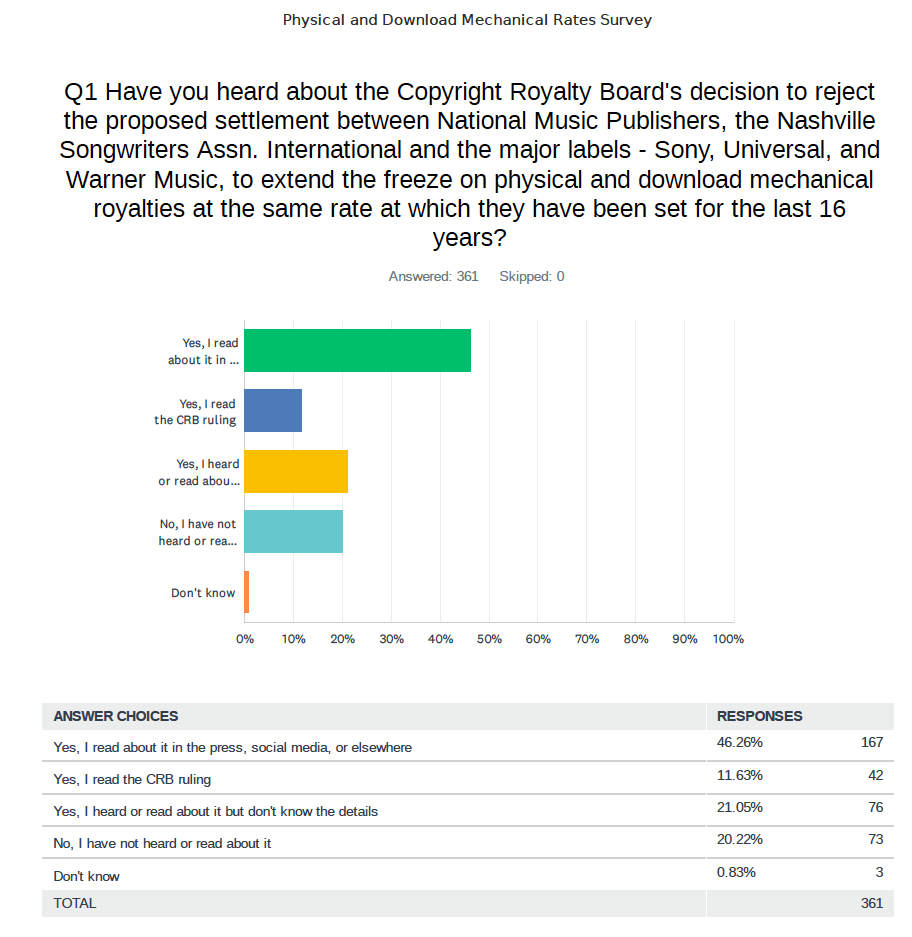
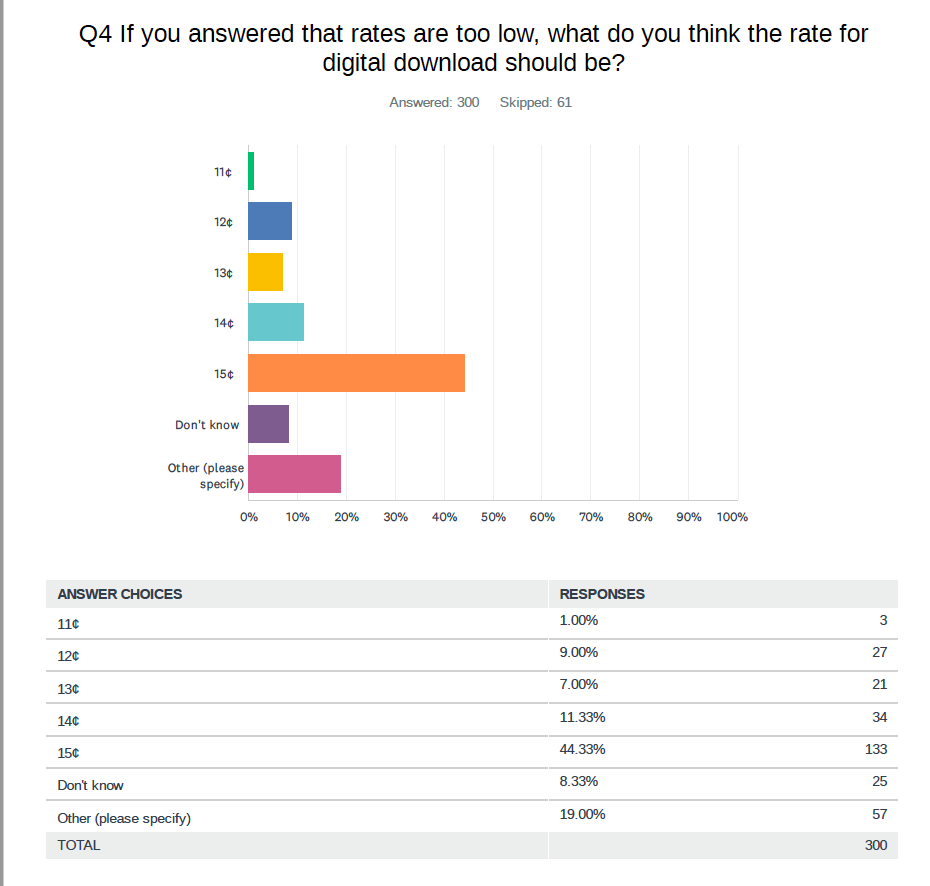
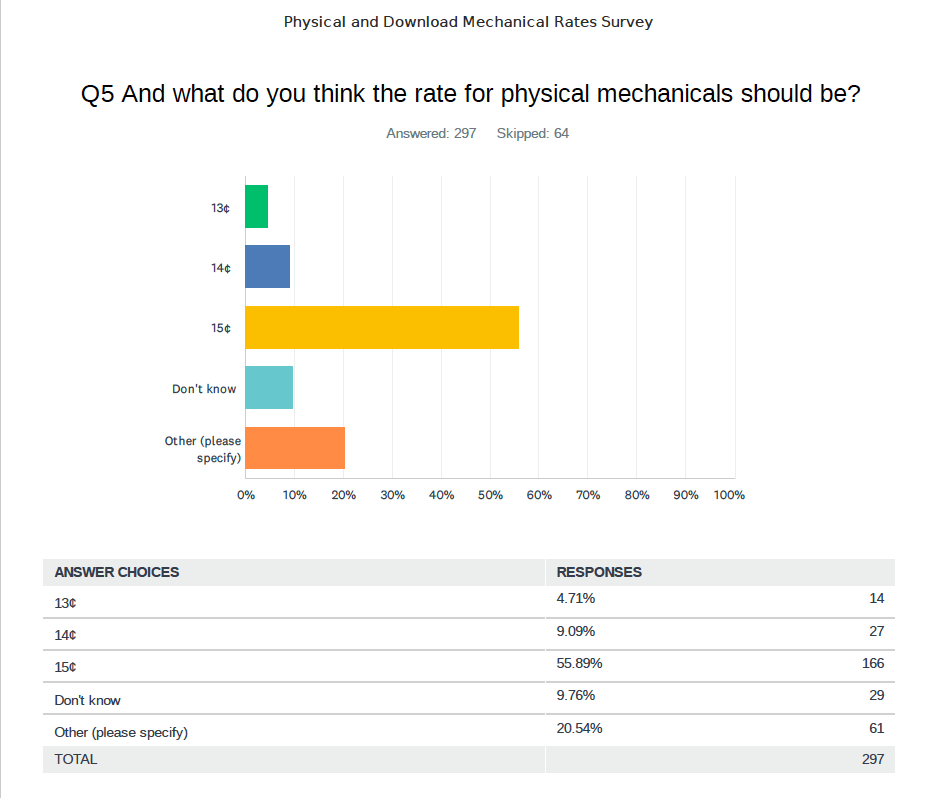
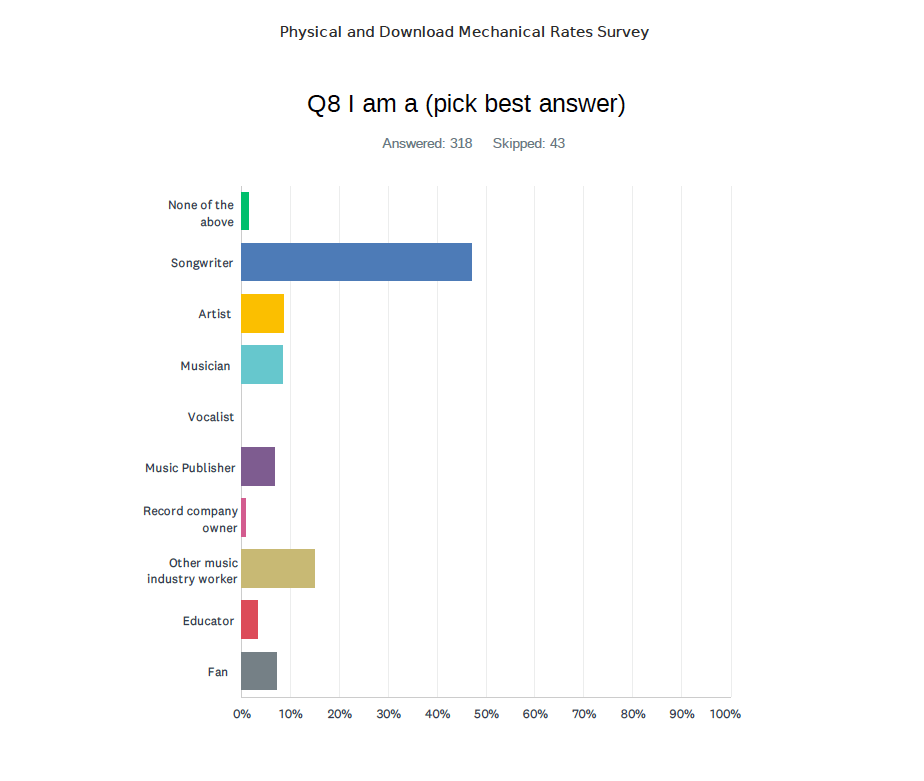
Many readers participated in the Physical and Download Mechanical Rates Survey that various organizations have sent to their members over the last few weeks. Here are the results of the main questions for which we had 361 respondents who self-selected their participation. (Other answers included comments which we chose not to publish for privacy reasons.).
The results suggest that participants were mostly informed songwriters who had never been asked before what they thought about the issues in the Copyright Royalty Board. We would have to conclude that any of our regular readers would be a bit skewed toward knowledgeable because between the Trichordist, MusicTechPolicy, ARW, Hypebot and Celebrity Access we were probably carrying a very high percentage of the available information on the frozen mechanicals issues.
It also is striking how few respondents said they had ever been asked what they think about any mechanical rates (physical, download, streaming), an important and easily measurable issue. This is something to add to the learning from this episode. It may be that our data is skewed, but even so we didn’t expect that 68% would say they’d never even been asked their opinion. An easy way to find out what people think about something is to ask them.
We are participating in a survey being conducted by a number of songwriter groups around the world to ask our readers what you think the new un-frozen mechanical royalty rate should be since the Copyright Royalty Judges rejected the settlement that would have extended the 9.1¢ freeze. Trichordist readers have heard a lot about the frozen mechanicals but after the Judges rejected extending the freeze we have moved on now to a new phase–if the rate isn’t 9.1¢ anymore, what should it be?
This Survey Monkey questionnaire is anonymous and easy to take–3 minutes to complete–and you could really help a lot by giving your opinions on what you think the rate should be! We will post the results so everyone can see.
I have it on good authority from someone close to the talks not authorized to speak on the record that Universal is taking the lead on solving the now un-frozen mechanicals crisis. This obviously needs to be confirmed and may not be final, but I think it’s well worth posting about.
Recall that the crisis pertains to the so-called “Subpart B” mechanical royalties paid by record companies for permanent downloads, vinyl and compact discs. The mechanical rate has been frozen at 9.1¢ since 2008 and the Copyright Royalty Judges recently rejected a settlement among the NMPA, NSAI, Sony, Universal and Warner to extend the freeze in the Phonorecords IV proceeding. Having rejected the proposed settlement, the next step could be knock down, drop dead, drag out litigation that would, in my view, be totally unnecessary. Or the next step could be the labels and publishers submitting a new proposed settlement and asking for the Judges’ approval.
Also recall that the Judges hinted at a potential deal they would like to see in their rejection of the proposed settlement that would essentially uplift the current 9.1¢ rate by an inflation factor since the rate was set in 2008, bringing the minimum statutory rate for all “Subpart B” configurations to 12¢ that would be further uplifted by an annual cost of living adjustment based on the Consumer Price Index (CPI-U in this case).
We’ve written about this topic so much that you’re probably sick of hearing about it–but if this source turns out to be correct, it’s a real step in the right direction by Universal taking a leadership role that will no doubt be controversial.
As I understand it, Universal may propose a minimum statutory rate of 10¢ for permanent downloads and 12¢ for both vinyl and CD configurations. All three rates would be adjusted annually by the Consumer Price Index (in a similar way that the Judges just indexed the webcasting royalty in Webcasting V applicable to sound recordings). This rate would apply to all songs–not just to George Johnson–as one would expect.
There’s no way to know at this point today whether all the participants in the Phonorecords IV proceeding will accept these terms, including George Johnson who has held out for a much higher minimum statutory rate. Some may scratch their head over why the download rate is less, but my suspicion is that it’s because Apple and Amazon have been inflexible on increasing the wholesale price and I could understand why a label would give themselves some headroom on downloads going into what will surely be highly inflationary times but at the same time agreeing a cost of living adjustment. (When the dust settles, it may be worth a discussion in the artist rights community about whether to campaign against Apple and Amazon.)
I do think it’s commendable if Universal is taking the first step toward bringing fairness to a process that has been unfair for many years. We’ll see what happens, but it looks like it could be light at the end of the tunnel. Watch this space.
It was a big week for songwriters last week! The Copyright Royalty Judges rejected the frozen mechanicals settlement put forward by the majors in the current rate-setting proceeding at the Copyright Royalty Board thanks in part to the best audience in the world–that would be you! All that hammering on the issue paid off.
We also acknowledge the hard work of all the commenters who spoke straight from the heart and of course songwriter George Johnson who has been fighting the good fight in the Copyright Royalty Board all by himself for years now. We’re also very grateful to the Judges for a well-thought out ruling and a thorough vetting of the issues, George’s many filings and the songwriter public comments.
The question we’ve heard a lot in recent days is where do we go from here? Clearly the answer is “Up” but how far up is the question. We need to be mindful of the economic impact that increased rates will have on independent labels in particular, but at the same time acknowledge that all record companies have gotten the benefit of frozen rates for 16 years and that songwriters have taken it in the shorts for a long, long time.
The Judges seem to be hinting at a deal in their ruling (remembering this is the rate for physical and downloads only (called “Subpart B rates”) and not for Spotify-type streaming which is not affected by these rate changes). Here’s the relevant quote from the ruling:
Commenters advocated application of an inflation adjustment beginning, at a minimum, in 2006. See, e.g. [Songwriters Guild of America] Comments at 4; [Monica] Corton Comments at 4; [Kevin] Casini Comments at 4. According to the proponents of a cost of living adjustment (COLA) applied to the 2006 rates, that adjustment would yield a 2021 royalty rate of $ 0.12 (an upward 31.9% inflation adjustment over the sixteen-year period). See, e.g., SGA Comments at 4. SGA conceded that the COLA extrapolation cannot be considered dispositive on the issue of new rate-setting, but they contended that it does “starkly demonstrate the outrageous unfairness that has been imposed on the music creator community over a period of more than an entire century.”
Step one, then, could be to increase the minimum statutory rate to 12¢ (or 13¢ depending on how you do the math) with customary adjustments for the “long song” formula for songs over 5 minutes.
That increase in the rate would be significant and probably the biggest rate increase ever on a percentage basis for the statutory rate. Will that satisfy everyone? Probably not, but it’s a step forward.
But–and this is a big but–that’s not the end of the story. We do not want to be right back in the same position in a few years time. One way to avoid this is to increase the new rate for inflation every 12 months (called “indexing”) the same way that the webcasting rates are indexed for sound recordings.
The Judges also hint at indexing as a potential solution to avoid just another rate freeze:
[George Johnson] has long advocated inclusion of an inflation index in royalty rates set by the Judges, including the…rates at issue here. In support of his advocacy, GEO has filed 27 pleadings, including motions seeking imposition of an inflation index on section 115 rates and periodic notices of U.S. inflation rates. His plea is bolstered by the many commenters who, almost unanimously, included this suggestion.
So the way this would work is that starting in 2023, the current 9.1¢ rate would be increased to 12¢. After 12 months, the rate would be increased by the Consumer Price Index (the CPI-U rate) for each 12 month period until 2027 when new rates would get decided by the CRB in the next rate proceeding (Phonorecords V). Example: If the CPI is 10%, then the minimum statutory rate would increase to 13.2¢ for the next 12 months. If the CPI in the second year was also 10%, then the 13.2¢ rate would be increased to 14.52¢ and so on until the last year of the period (2027). (Of course we can’t tell today what the CPI will be in 2023.)
Given the Judge’s rejection of the frozen rates, it is very doubtful that there will ever be another freeze, but we have to stay alert and vocal. When the new rates come up, we all have to pay attention.
It’s important to remember that “indexing” to inflation just preserves buying power. Meaning that 12¢ today is what 9.1¢ was worth in 2006. Would it be the fair thing to index all the way back to 1909? Sure, but while the Judges hint at going back further (the “at a minimum” reference), the Judges may not be inclined to go further back than 2006 when the current freeze started, but we’ll see what happens.
We’d be very interested in hearing from you with any questions you have or other ideas for solutions. Obviously, this post is just sharing ideas with our audience and isn’t a formal statement by any particular person or group. There may be a number of proposals coming out and we’ll of course post them on Trichordist.
It must also be said that George Johnson has yet to weigh in on the situation and may very well have a different idea. There’s also some twists and turns to sort out, such as the black box “MOU” (the fourth of its name) but especially the controlled compositions rates that the Judges discussed in some detail (as Judge Barnett said, “The disparity between the static rate and the dynamic market is even more stark when considering the “controlled composition clause.””).
In any event, feel free to comment and we welcome the discussion.
SECOND REOPENING PERIOD COMMENTS OF HELIENNE LINDVALL, DAVID LOWERY AND BLAKE MORGAN
Helienne Lindvall, David Lowery and Blake Morgan (collectively, the “Writers”) thank the Judges for the opportunity and respectfully submit the following comments responding to the Copyright Royalty Judges’ notice (“Second Notice”) soliciting comments on additional materials (“Reply”) received by the Judges[1] from the National Music Publishers Association, Nashville Songwriters Association International, Sony Music Entertainment, UMG Recordings, Inc. and Warner Music Group Corp. (collectively, the “Majors”)[2] regarding the so-called [frozen] “Subpart B” statutory rates and terms[3] relating to the making and distribution of physical or digital phonorecords of nondramatic musical works in the docket referenced above (“Proceeding”).
The Writers previously submitted comments[4] (“Prior Comment”) responding to the Judges’ notice[5] (“First Notice”) soliciting comments on the Major’s proposed purported settlement (the “Proposed Settlement”)[6] of the Subpart B rates. The Writers along with attorney Gwendolyn Seale[7] attempted to submit additional comments in response to the Majors’ filing but were not able to timely file that response.[8] The Writers appreciate the Judges’ decision to reopen the comment period in order to afford the public, and those that would be bound by the rates and terms set by the Proposed Settlement,[9] an opportunity to comment on those additional materials filed by the Majors and to further participate in the rulemaking.[10]
I. SUMMARY As a general comment on the record to date in Phonorecords IV, the Writers are mystified by the histrionics that have become associated with this Proceeding both on the record and in the press. A voluntary negotiation is just a deal, often made by people who are paid to always be closing. The Writers believe that Congress intended that voluntary negotiation produce a fair result on a reasonable timetable.
While not directly at issue in the reopened comment period, what is clearly the case is that the settlement of the Subpart B rates has unnecessarily become a major gating item for the streaming side of this Proceeding, geese and ganders being what they are. Despite the extensive voluntary negotiation period for the Subpart B rates by the Majors, the Judges—and, frankly, songwriters around the world–are presented instead with a cornucopia of chaos across the board; the cherry on top is the frozen mechanicals crisis. However, in this season of hope the Writers are confident that the Judges will lead us all out of this daunting situation.
The Writers are not interested in the personalities, the arm-waving or the finger-pointing. They are interested in the results, particularly because neither they nor anyone they authorized had input into the negotiation that produced either the Proposed Settlement or the impasse.
There is at least one easy way to fix this and recognize the intrinsic value of songs: Raise the statutory rate proposal for Subpart B configurations in at least some relation to the streaming rate increase. A song is no less valuable because of the medium in which it is exploited.[11]
As the Writers will argue, just like the voluntary agreement on Subpart B that led to this impasse was reached by the Majors, those same parties can go back to the drawing board to reach an appropriate conclusion with a higher Subpart B rate.
Neither the public nor the songwriters are well served (and frankly neither are the Judges) by thrashing about and waiving arms. This may serve well the people who are paid by the hour but it hasn’t served people who are paid by the song. At all. “Victory” without winning may pass for success in Washington, but it does not in the writer room or at a songwriter’s kitchen table.
The Proposed Settlement is a crystallization of everything that is wrong with the licensing and payment practices that have arisen under the compulsory license regime where no is yes, more is less and the Kool-Aid whispers “Drink Me.”
While the Writers will focus in this comment on the frozen mechanicals issue that has become emblematic of the current crisis, it must be said that the decade-plus MOU [black box] agreements are a backward looking and inequitable insider arrangement that permits a mindset of sloppiness and a “kick the can down the road” mentality that debilitates the entire music publishing business.[12] It’s no accident that the Mechanical Licensing Collective—run by largely the same cast of characters under a jaw-dropping Congressional governance mandate—has been sitting on $424,000,000 of other peoples’ money for nine months during a pandemic with no visible compliance with another Congressional mandate of paying songwriters correctly in Title I of the Music Modernization Act.[13]
The MLC and the sequence of MOUs are both descended from the same ancestors a generation ago. Each have essentially the same business model and each are somehow inexplicably viewed as a “win” for the songwriters. The irony of splicing the genetic code of the ancien régime MOU [black box insider settlements] to the future is not lost on anyone. If the failure to match money and songs in the MOU process is still a problem after fifteen years as well as the much-trumpeted Title I of the Music Modernization Act, it’s not the horse’s fault. It’s the rider’s.
It would be a real pity for the CRB to perpetuate this unfairness by adopting the Proposed Settlement. With respect, it is bad law, bad policy, and a failure to even try to bend the arc of the moral universe. Conversely, rejecting the Proposed Settlement would provide the kind of steely oversight tragically lacking in the current regime. Please let the future have a vote, just once.
The Writers object to the Proposed Settlement for the following reasons and respectfully suggest constructive alternatives. The gravamen of our objection is that (1) the Subpart B rates have already been frozen since 2006 and extending the freeze another five years is unjust; (2) no evidence has been publicly produced in the Proceeding that justifies or even explains extending the proposed freeze aside from the connection to the memorandum of understanding in the MOU4 late fee waiver (“MOU”), a document that the Majors only recently disclosed in their Reply; (3) very large numbers of songwriters and copyright owners of various domiciles around the world and national origins are unlikely to even know this Proceeding is happening and there still is no evidence that the unrepresented have appointed any of the participants to act on their behalf or were asked to consent to the purported settlement before the fact even if they were members of these organizations aside from the respective board of directors; (4) physical sales are still a vital part of songwriter revenue (which the Writers documented in the Prior Comment[14]); and (5) there are many just alternatives available to the Judges without applying an unjust settlement to the world’s songwriters who are strangers to the Proposed Settlement and in particular the MOU component (as the MOU will likely require membership in the NMPA to benefit consistent with prior MOUs).
[2] NMPA, NSAI, Sony Music Entertainment, UMG Recordings, Inc. and Warner Music Group Comments in Further Support of the Settlement of Statutory Royalty Rates and Terms for Subpart B Configurations, Determination of Royalty Rates and Terms for Making and Distributing Phonorecords (Phonorecords IV), Copyright Royalty Board (Aug. 10, 2021).
[3] 37 C.F.R. §385.11(a).
[4] Comments of Helienne Lindvall, David Lowery and Blake Morgan, Determination of Rates and Terms for Making and Distributing Phonorecords (Phonorecords IV) (July 26, 2021) available at https://app.crb.gov/document/download/25533.
[10] As with the Writers prior submission in response to the First Notice, the Writers focus in this comment almost entirely on the Subpart B rates applicable to physical carriers under 37 C.F.R. §385.11(a).
[11] The Judges no doubt will be told many stories about how Subpart B configurations are not meaningful sales compared to streaming so rates deserve to be frozen. This is a novel copyright argument without a statutory basis. The theory is also not based on accurate facts as the Writers discuss extensively in the Prior Comment at paragraph 5 and will not repeat here.
[12] There is a growing backlash to decades of delaying definitive action on song metadata and songwriter payments such as Credits Due campaign of the Ivors Academy and Abba’s Björn Ulvaeus. See generally Chris Cooke, PPL Backs Björn Ulvaeus’s Credits Due Campaign, Complete Music Update (Oct. 4, 2021) available at https://completemusicupdate.com/article/ppl-backs-bjorn-ulvaeuss-credits-due-campaign/
[13] See, e.g., H. Rep. 115-651 (115th Cong. 2nd Sess. April 25, 2018) at 5; S. Rep. 115-339 (115th Cong. 2nd Sess. Sept. 17, 2018) at 5 (“The Committee welcomes the creation of a new musical works database that is mandated by the legislation….Music metadata has more often been seen as a competitive advantage for the party that controls the database, rather than as a resource for building an industry on.” (emphasis added)).
[A little context: The public comments on the majors’ proposed settlement at the Copyright Royalty Board that freezes mechanical royalties on vinyl and CDs are again attracting first rate reporting and arguments. Public comments are designed to help the Copyright Royalty Judges focus on important nuances before they tell us all what’s fair.
Enter the connection between extending the fifteen year-old frozen mechanical rate for another five years in return for what may well be hundreds of millions under the unmatched “late fee waiver” settlement (total settlement value still undisclosed). It’s become obvious after the majors’ 11th hour reply comment in “#FrozenMechanicals Take One” that the majors have tied a settlement on what is essentially the late fee on black box mechanicals at the participating labels to getting a freeze on mechanicals. You can ask yourself how much of a risk it is that major publishers will sue their major label affiliates and what kind of a settlement avoiding that risk might drive.
NMPA 2018 Tax ReturnNMPA 2019 Tax Return
Fair enough, right? Well, maybe not. Thanks to excellent open-source research by Austin music lawyer Gwendolyn Seale in her new frozen mechanicals comment, it turns out that there are a couple of loose ends. First, the National Music Publishers Association’s tax returns for 2018 and 2019 suggest that the organization received several million dollars from the late fee waiver program over two years.
Where that money finally came to rest is unclear but something about the size of that sum sounds like “employee year-end performance bonus” to me although that’s just a guess. (Not the first time the unmatched issue has come up–remember the New York Attorney General back in 2004 who dropped the hammer on labels and at least one publisher who had egregious cases of unpaid royalties to people like David Bowie, John Mellencamp, David Matthews, Dolly Parton and Sean Combs.)
Gwen also did a deep dive on past late fee waiver settlements (commonly called “MOUs”) dating back to 2009 or so. These also had similar connective tissue between past mechanical royalty freezes and the late fee settlement dating back many years. (It would not be a shock if some of the more cold-blooded publishers preferred taking the late fee than the black box royalties because a late fee is an interest payment that may not have to be shared with their writers…just sayin’. Let’s not forget who works for whom.)
Not only is the CRB being asked to repeat the sins of the past with the justification that they accepted it before, Gwen discovered yet another wrinkle in the open-source rules of the prior MOUs–you have to join the NMPA and pay dues in order to get paid with what is ostensibly your own money. See what they did there? That’s probably old news to those who also read the establishment press, but worth mentioning in case you missed it.]
Gwendolyn Seale, Esq.
Chief Copyright Royalty Judge Suzanne Barnett
Copyright Royalty Judge David R. Strickler
Copyright Royalty Judge Steve Ruwe
US Copyright Royalty Board
101 Independence Ave SE / P.O. Box 70977
Washington, DC 20024-0977
SENT VIA ELECTRONIC DELIVERY
IN RE DETERMINATION OF ROYALTY RATES AND TERMS FOR MAKING AND DISTRIBUTING PHONORECORDS (Phonorecords IV)
Honorable Judges,
I am a music lawyer in Austin, Texas, and represent songwriters throughout the state of Texas. I appreciate the judges reopening the comment period with respect to the proposed settlement (“Proposed Settlement”) submitted by the three major labels, the National Music Publishers Association (“NMPA”) and the Nashville Songwriters Association International (“NSAI”) which, if adopted by the Judges, would freeze the statutory mechanical royalty rate at 9.1 cents for physical products and permanent digital downloads through 2027. For reference, my prior comment regarding the Proposed Settlement can be found in the footnote below,[1] and the purpose of this supplemental comment is to highlight the relevance of the Memorandum of Understanding 4 (“MOU4”) between the three major labels and the RIAA on the one hand and the NMPA and a select group of music publishers on the other hand (collectively “MOU Parties”) in the Judges’ consideration of the Proposed Settlement. As the Judges will see below, MOU4 appears to be additional consideration for the Proposed Settlement — consideration which is only able to be enjoyed by NMPA members. Binding the world’s songwriters to this Proposed Settlement when the overwhelming majority of songwriters cannot even reap the benefits of the additional consideration demonstrates there is no reasonable basis to adopt the rates and terms of the Proposed Settlement industrywide, and further, doing so would be patently unjust.
Please note that the views I am expressing here are not made on behalf of any client or the State Bar of Texas.
THE PLAIN LANGUAGE OF MOU4 MORE THAN SUGGESTS IT IS ADDITIONAL CONSIDERATION FOR THE PROPOSED SETTLEMENT
When the three major labels, the NMPA and NSAI submitted their motion to adopt the Proposed Settlement to the CRB, included was the following language that raised concerns during the first round of comments:
Concurrent with the settlement, the Joint Record Company Participants and NMPA have
separately entered into a memorandum of understanding addressing certain negotiated
In my prior comment, I posed the question, “[if] this Memorandum of Understanding is irrelevant to the proposed settlement, why would it be referenced in the motion to adopt the settlement?” At the time of drafting the prior comment, I will honestly say I was not too familiar with the previous MOUs and associated NMPA Late Fee Programs (“Late Fee Programs”). Subsequently, I began perusing through the sparse number of media articles concerning the MOU stemming from Phonorecords I (“MOU1”), along with information listed on the Late Fee Program website, and the text of each MOU to date (MOU1, MOU2 and MOU3). Examining the text of the MOUs was eye-opening; it became readily apparent that each, and their associated Late Fee Programs, would never have come into existence if the MOU Parties had not submitted settlement proposals to the Judges in connection with mechanical rates for physical product and permanent downloads (i.e., the mechanical royalties paid by record companies). In other words, there is no Proposed Settlement without MOU4 and there is no MOU4 without the Proposed Settlement – the two are inextricably intertwined. The longstanding history of this practice is first exhibited in the language from Section 1.0 of MOU2:
This MOU 2 shall not go into effect unless a proposed settlement of the 2013-2017 Proceeding is submitted to the Copyright Royalty Judges for approval, which the Parties anticipate happening promptly after this MOU 2 has been entered into by all Parties[3].
The key word to examine here is “unless.” MOU2 would not go into effect unlessa proposed settlement was submitted to the CRB in Phonorecords II (2013-2017). If the MOU Parties had not presented the proposed settlement in Phonorecords II to the CRB, MOU2 would have never gone into effect and thus, no Late Fee Program for that time period. A close review of the plain language of MOU2 is critical as it more than suggests MOU2 served as additional consideration for the proposed settlement in Phonorecords II, which extended the 9.1 cent mechanical rate freeze for physical products and permanent downloads that commenced in 2006.
Fast-forward to the language in Section 2 of MOU3, where the same condition is visible:
This MOU 3 is a separate, conditional agreement that shall not go into effect until NMPA and SME submit a motion to adopt a proposed settlement of the 2018-2022 Proceeding as to rates and terms presently addressed in 37 C.F.R. Part 385 Subpart A to the Copyright Royalty Judges, which the Parties anticipate happening promptly after this MOU 3 has been signed by all of the Parties. It is understood that SME, UMG, WMG, RIAA and NMPA will sign this MOU 3 at the outset, and that NMPA will use its best efforts to obtain the signatures of all the music publishers represented on its Board of Directors as additional Parties to this MOU 3 by October 28, 2016. The term of this MOU 3 shall commence on the date when a motion to adopt such a settlement is submitted to the Copyright Royalty Judges (the “Effective Date”), and continue until the End Date…[4]
Despite the removal of the word, “unless,” exhibited in MOU2, and the replacement with the word, “until,” the analysis remains the same. MOU3 appears to have been additional consideration for the proposed settlement in Phonorecords III, which furthermore extended the 9.1 cent mechanical rate freeze for physical products and permanent downloads.[5]
Finally, the same condition is found in MOU4’s language:
This MOU4 is a separate, conditional agreement that shall not go into effect until NMPA, SME, WMG’s affiliate Warner Music Group Corp., and UMG submit a motion to adopt a proposed settlement of the Phonorecords IV Proceeding as to statutory royalty rates and terms for physical phonorecords, permanent downloads, ringtones and music bundles presently addressed in 37 C.F.R. Part 385 Subpart B (the “Subpart B Configurations”), together with (1) certain definitions applicable to Subpart B Configurations presently addressed in 37 C.F.R. § 385.2 and (2) late payment fees under Section 115 for Subpart B Configurations presently addressed in 37 C.F.R. § 385.3, together with certain definitions applicable to such late payment fees presently addressed in 37 C.F.R. § 385.2, for the rate period covered by the Phonorecords IV Proceeding, which the Parties anticipate happening promptly after this MOU4 has been signed by SME, UMG, WMG, RIAA, NMPA, Sony Music Publishing, Universal Music Publishing Group, and Warner Chappell Music, Inc. (the “Initial Signatories”)…
The plain text of MOU4 and likewise, the plain text of MOU2 and MOU3 demonstrates MOU4 serves as additional consideration for the Proposed Settlement. If this is the case, the Proposed Settlement does not provide a reasonable basis for establishing Subpart B rates and terms because MOU4 is consideration which can only be enjoyed by select participants in Phonorecords IV, while songwriters worldwide are bound to rates and terms they do not approve and for which they receive no benefit of the MOU4 bargain. Further, in a stunning display of pretzel logic, if a self-published songwriter even wants to reap the benefits of MOU4, such songwriter would have to join the NMPA as a publisher to participate in Late Fee Program – which would entail paying to join an organization that has agreed multiple times to freeze the mechanical royalty rate for physical and download formats.[6]
Songwriters, including those who have submitted comments in this proceeding, have made it abundantly clear that they do not support extending a mechanical royalty rate freeze. So, the question becomes whether the Judges believe it is just and reasonable to subject songwriters to a rate freeze that they oppose, understanding that they will either never benefit from the additional consideration for the freeze or will have to pay dues to a party proposing the freeze they oppose to benefit from the additional consideration. Therefore, I ask the Judges to please determine whether MOU4 is additional consideration for the Proposed Settlement.
2. IF ALL SONGWRITERS ARE TO BE BOUND TO THE PROPOSED SETTLEMENT, ADDITIONAL TRANSPARANCY IS WARRANTED
The MOU Parties stated in their “Comments in Further Support of the Settlement of Statutory Royalty Rates and Terms for Subpart B Configurations” (“Reply Comment”) that they did not present MOU4 to the Judges as they regarded it to be routine and irrelevant to the Judges’ determination of the Proposed Settlement.[7] The MOU Parties further stated the payments under the previous MOU processes have resulted in hundreds of millions being properly paid to publishers and songwriters and enabled more successful identifications of musical works.[8] Additionally, the MOU Parties contended the history of the MOUs is no secret, pointing to a couple of articles from 2009-2010 and the NMPA Late Fee Settlement website.[9]
While the MOU Parties can generally state MOU4 and prior MOUs are no secret, the MOU process to date has hardly been transparent. While some media outlets published information about MOU1 in 2009-2010, over the last decade there has been virtually no reporting on the MOU program, encompassing MOU2 and MOU3. With respect to MOU1, outlets reported approximately $275 million was paid out from the labels and distributed to publishers via marketshare methodology.[10] Amounts paid out pursuant to MOU2 and MOU3 have not been publicly disclosed – and should be if MOU2 and MOU3 were additional consideration which continued the mechanical rate freeze to the present day.
The MOU Parties further state, “[c]ontrary to the conspiracy theories of others, there is no secret payoff to major publishers or to any other MOU participant.”[11] It is not conspiratorial to simply point out that the public is unaware of the amounts payable to publishers under these MOUs; it is further obvious the major publishers benefit from a settlement system which distributes funds to publishers in accordance with major label and HFA data via marketshare methodology. Additionally, according to the NMPA’s 2018 and 2019 IRS 990 filings, “Royalty Late Fee Program” was listed as an income line-item, reflecting $2,908,988.00 and $768,368.00, respectively, as revenue for the organization. If in fact this line item pertains to commissions taken by the NMPA on prior Late Fee Programs established by the MOUs, there is absolutely a payoff to a MOU participant, albeit, not secret.
Note that I have no issue with the notion of these MOUs and the Late Fee Programs, or which sums are paid out to whom, provided that the MOUs and associated Late Fee Programs are truly irrelevant deals that do not serve as additional consideration for settlements to freeze the statutory mechanical rate for physical and download configurations industrywide.
3. IF THE PROPOSED SETTLEMENT IS NOT WITHDRAWN, THE JUDGES SHOULD APPLY DIFFERENT RATES AND TERMS TO PUBLISHERS AND SELF-PUBLISHED SONGWRITERS WHO DO NOT OPT INTO MOU4 AND THE LATE FEE PROGRAM
Notwithstanding the repeated practice of the CRB adopting settlements freezing the mechanical rate for physical products and permanent downloads proposed by parties who wield the most power in the music business, the current situation is different and should be treated as such. Many songwriters oppose the Proposed Settlement but cannot afford to participate in this proceeding. Songwriters and other key songwriter advocacy organizations oppose this Proposed Settlement, proffering comments that the Proposed Settlement is unreasonable because songwriters do not wish this revenue stream to be frozen for yet another five years during a vinyl resurgence amid a worldwide pandemic that continues to ravage the world’s economy. While there has been considerably more public outcry with respect to this proceeding than those prior, luckily, there are solutions available which will reverse this course and are entirely within the control of the MOU Parties and the Judges.
First, the MOU Parties can withdraw the Proposed Settlement and voluntarily agree to a rate increase for Subpart B configurations – and continue to proceed with their Late Fee Program. This act will not only bring the entire songwriter and music publisher communities together, but also it will serve to extinguish one of the streaming services’ key benchmarks in their testimony (since every streaming service participant in Phonorecords IV is using this Proposed Settlement to justify their abysmal streaming rate proposals).
Alternatively, if the foregoing is not an option, the terms of the Proposed Settlement should apply only to the MOU Parties and the NMPA publishers that subsequently opt-into the Late Fee Program, while the Judges determine different rates to be applied to everyone else. To be clear, again, I have no issue with the concept of MOU4 or the Late Fee Program, rather it is inequitable for songwriters to be bound to the terms of a settlement which they do not support, particularly when they do not receive any benefit from the consideration attached to the settlement.
CONCLUSION:
Prior to this Phonorecords IV proceeding, it appears the only person who publicly opposed any settlement to freeze the statutory mechanical rate for physical and download configurations was George Johnson, a pro se self-published songwriter participant. While the Judges’ determination of rates and terms for physical and download configurations in Phonorecords III is final, I believe it is worth briefly revisiting an excerpt from the Judges’ determination which addressed Mr. Johnson’s opposition to the Phonorecords III settlement:
But, Mr. Johnson has not even hinted at evidence to support his argument that the representative negotiators are engaged in anti-competitive price-fixing at below-market rates. The very definition of a market value is one that is reached by negotiations between a willing buyer and a willing seller, with neither party being under any compulsion to bargain.[12]
While Mr. Johnson may not have articulated his opposition to the Phonorecords III proposed settlement in a lawyer-like manner, he clearly understood years ago that there was something awry with respect to these proposed settlements. It is evident that the “something awry” happens to be these MOUs, which I never would have realized had the Judges not reopened the comment period to specifically address MOU4. The representative negotiators in these settlements represent “willing buyers” and “willing sellers” who are effectively the same parties at the corporate level. The “willing sellers” (i.e., the major publishers/ NMPA) are under compulsion to bargain so they can enjoy the compensation associated with the Late Fee Program. When such a settlement is adopted and applied industrywide, we are posed with an end result of “unwilling sellers” (i.e., songwriters worldwide) tethered to below-market rates who will not enjoy the benefits of the additional consideration – MOU4 and the associated Late Fee Program.
The Judges have a duty to all songwriters – from the millions who are unaware the CRB exists, to the millions who do not have the financial resources to participate in CRB proceedings, to the millions who do not speak English (in this country and abroad) and cannot follow this proceeding if they wanted to– to determine whether this MOU4, a side agreement which benefits a select few, is in fact additional consideration for the Proposed Settlement which would freeze statutory mechanical royalty rate for physical products and permanent downloads through 2027. And if the Judges determine this is true and the MOU Parties are unable to withdraw the Proposed Settlement, the Judges should establish different rates and terms to be applied to all other songwriters and publishers.
Thank you for re-opening the public comment period and for your consideration.
[2] Motion to Adopt Settlement of Statutory Royalty Rates and Terms for Subpart B Configurations, Docket No. 21–CRB– 0001–PR (2023–2027) (May 25, 2021) (Proposed Settlement).
[7] Comments in Further Support of the Settlement of Statutory Royalty Rates and Terms for Subpart B Configurations, Docket No. 21–CRB– 0001–PR (2023–2027) (August 10, 2021).
[12] 37 CFR Part 385 [Docket No. 16–CRB–0003–PR] Determination of Royalty Rates and Terms for Making and Distributing Phonorecords (Phonorecords III); Subpart A Configurations of the Mechanical License.







You must be logged in to post a comment.