Don’t Freeze Mechanicals Again

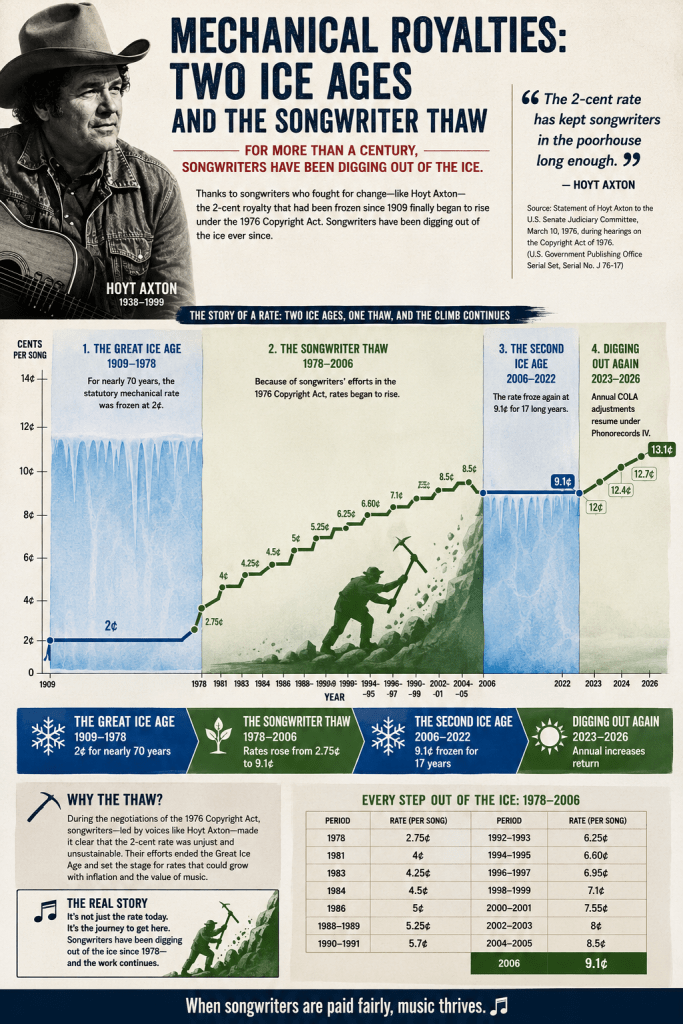
The compulsory mechanical license was created by Congress in the Copyright Act of 1909 as a response to the rise of player pianos and piano rolls, which threatened to place control of a new music reproduction technology in the hands of a few dominant companies. To prevent monopoly control, Congress established a compulsory license allowing anyone to reproduce a musical composition upon payment of a statutory royalty. That royalty was set at 2 cents per song. Remarkably, the 2-cent rate remained unchanged for nearly seven decades, surviving the birth of commercial radio, records, tapes, and the modern recording industry until the Copyright Act of 1976. Given that the dominant music users are either monopolies themselves or effectively monopolies (Google, Amazon, Spotify), the entire purpose of the compulsory license seems laughable today, but oh, well—they’re from Washington and they’re here to help.

The Copyright Act of 1976 did more than end the 2-cent mechanical royalty freeze. It established a framework for periodic review of statutory rates so that songwriters would not again be trapped for generations at a rate set by Congress decades earlier. Over time, Congress refined that system, eventually replacing ad hoc adjustment proceedings with the modern Copyright Royalty Board (CRB). Today, the CRB conducts recurring rate-setting proceedings that evaluate economic conditions and marketplace developments. While the process is often contentious, the result has generally been upward movement in mechanical royalties, reflecting inflation, changing markets, and the enduring value of musical works.

The next mechanical royalty rate-setting hearings before the Copyright Royalty Board are upon us (called “Phonorecords V” follow it here). Like so many other aspects of the CRB, it seems that awareness of the hearing varies inversely to its economic importance for songwriters—meaning that the more it affects your pocketbook, the fewer people appear to know about it. Let’s see if we can change that dynamic.

The CRB will set rates for streaming mechanicals, a whole saga unto itself, but the Board also sets rates for the sale of physical records like vinyl and permanent downloads. It was these rates that created a dust up the last time around in Phonorecords IV, because the first tentative settlement was rejected by the Judges. Had the Judges not rejected the first settlement, the insiders would have frozen the physical/download rates for another five years in addition to the freeze that was already in place since 2006 for a total of 21 years.

The PR V resolution should be simple: whatever inflation-adjusted rate that is in effect at the end of the Phonorecords IV rate period should become the starting point for the next rate period in Phonorecords V. Why? Because the CRJs proposed the 12¢ PR IV base reference rate (plus COLA) as a compromise recognizing that the statutory rate had not been adjusted for inflation from 2006 through 2023. Having adopted an actual inflation-adjusted rate through a revised settlement in PR IV, choosing to revert to 12¢ in 2026 for PR V would effectively disregard the very rationale that justified the compromise in the first place. There’s nothing economically magical about a 12¢ rate in 2022 that should inform a new rate in 2028.

Yet there is a risk that some stakeholders may argue that the 12¢ reference rate established in Phonorecords IV should remain the permanent benchmark and that future proceedings should effectively restart from that 12¢ figure even though they know that the real rate is actually the inflation adjusted rate. This is the kind of thing lawyers come up with and is completely divorced from reality.

We explain the frozen mechanicals crisis from 2022

If the CPI-adjusted rate reaches approximately 13.6¢ by 2027, as current inflation projections suggest, such a 12¢ approach would amount to an immediate reduction in songwriter and publisher compensation. Rough justice, that 12¢ rate would actually be worth around 11¢ today, so asking for a 12¢ reference rate is like saying would you take 11 which would be roughly a 20% reduction. That would make little sense economically, legally, or as a matter of regulatory policy.

The key point is that the annual CPI adjustments adopted in Phonorecords IV are not temporary bonuses. They are part of the rate structure. The Judges did not establish a 12¢ rate and then provide a series of discretionary supplements. Rather, they established a rate that increases annually according to a defined formula. The resulting rate is the actual statutory royalty rate in effect at the time. If the rate reaches 13.6¢ in 2027, then 13.6¢ is the reference rate for PR V.

Resetting the benchmark to 12¢ would create a downward ratchet unlike anything that participants in a functioning market would expect not to mention in the post-1978 history of the Copyright Act. Songwriters and publishers would receive annual increases throughout the rate period only to see those increases erased at the start of the next one. Such a result would be arbitrary and would undermine confidence in the stability of the statutory license.

For years, the mechanical royalty remained frozen at 9.1¢ while inflation steadily eroded its economic value. Phonorecords IV represented an acknowledgment that perpetual freezes are difficult to justify in a modern economy. It would be strange indeed if the solution to one rate freeze were simply to create another.

There is also a practical problem. If the statutory rate can be reset downward whenever a new proceeding begins, then the annual CPI adjustment becomes less meaningful. Parties will spend years litigating a rate structure only to find that the resulting increases can be wiped away at the start of the next cycle. That is not how durable rate regulation is supposed to work.

The cleaner approach is the obvious one. The final rate in effect during one period should become the reference rate for the next period unless the evidentiary record demonstrates that a different rate is warranted. This is how the rate was set from 1978 to 2006 and how most regulated systems operate. The existing rate serves as the baseline, and adjustments are made from there.

The issue is ultimately one of continuity. The statutory mechanical royalty should evolve through evidence-based proceedings, not through accounting tricks that erase previously awarded increases. If the rate reaches 13.6¢ in 2027, then 13.6¢ should become the starting point for the next rate period.

The rate clock should move forward, not backward. A songwriter named Hoyt Axton worked his tail off getting the rate on a track to increase with the passing of the 1976 Copyright Act. And I for one will never forget him.

[A version of this post first appeared on MusicTechPolicy]

Phonorecords V and the “39 Steps” Problem: Time for the CRB to Fix Streaming Mechanicals

Everybody knows that the boat is leaking, everybody knows that the captain lied….
Everybody Knows by Leonard Cohen

We are now well into the next Phonorecords proceeding at the Copyright Royalty Board (CRB) where the government sets mechanical royalty rates for songwriters. Readers may remember that the last rate-setting was Phonorecords IV where Trichordist helped spread the word about the attempted end run around songwriters to freeze physical rates (vinyl & downloads) at 9.1¢ for another five years but instead resulted in an increase to 12¢ plus a cost of living adjustment which has now increased to 13.1¢. (In a demonstration of humility and lack of pomposity, these proceedings are given Roman numerals like the Super Bowl, so the current example of gladiatorial combat is titled Phonorecords V.)

Inside the years-long litigation-like proceeding, there is an issue hiding in plain sight inside the existing and ancient streaming mechanical royalty rate structure that we fondly call “the 39 steps” in honor of John Buchan, Alfred Hitchcock and Richard Hannay. Despite the blood lust for complexity from the ancien régime that clings to its one sided royalty pool, there is one part of this unfair business practice that the CRB can and should address this time around.

Start with the basics. The streaming mechanical formula—the so-called “39 steps”—is built on a simple premise: we are calculating royalties for the use of musical works protected by the Copyright Act. The inputs and deductions in that formula are not abstract accounting categories. They are supposed to reflect real payments for real statutory rights.

That premise is now under pressure because of…wait for it…artificial intelligence and the AI slop that is flooding the market.

The rise of generative AI has introduced a new category of output that does not fit neatly within the Copyright Act. The U.S. Copyright Office has made clear that works generated entirely by AI are not copyrightable, and that protection exists only to the extent of meaningful human authorship in a proportion yet to be determined. (Courts have moved in the same direction, and the Supreme Court’s denial of cert in Thaler v. Perlmutter leaves that framework intact.)

Yet the streaming mechanical formula has no explicit mechanism to deal with AI slop. That creates a risk on two fronts.

We have to consider the royalty pool itself. The compulsory mechanical license applies when the exclusive rights of a copyright owner in a musical work are implicated. If a so-called “AI track” is not a protected musical work, then there is a serious question whether it belongs in the section 115 system at all. Treating non-copyrightable output as if it were a statutory musical work risks diluting the pool for actual rightsholders.

And then, of course, we have the Step 2 deduction for performance royalties. The regulation allows services to subtract payments for the public performance of musical works before calculating the payable pool. But what happens if a service characterizes payments to a platform like AIMPRO as “performance royalties”? If those payments are not, in fact, for the public performance of a copyrightable musical work, they should not reduce the pool. Otherwise, the 39 steps formula starts to leak money, and eventually leak in a big way.

Not only that, but if the U.S. Copyright Office ultimately articulates a workable “human authorship” framework for AI-assisted works during the Phonorecords V rate period, the downstream impact on the Copyright Act section 115 system could be profound: for the first time, the “39 steps” calculation may have to accommodate fractional copyrightability within a single work. Instead of treating a musical work as an either/or, services and the MLC could be forced to parse which portions of a track are attributable to human authorship and therefore eligible for royalties, and which are not. That would introduce a new layer of allocation on top of an already complex formula—effectively embedding micro-level authorship determinations into macro-level royalty calculations—and raising the administrative, evidentiary, and dispute-resolution burdens across the entire system.

The key point is that the CRB does not need to resolve all questions of AI copyrightability to act here for purposes of the 39 Steps. It can simply clarify what is already in the statute and the regulation: The formula applies only to payments that correspond to rights in nondramatic musical works, and deductions are limited to payments that genuinely compensate the public performance of such works. That is not a policy innovation outside the scope of the CRB’s mandate from Congress. It is a classification rule.

If there is doubt about whether a category of material such as purely generative AI output qualifies as a “musical work” for these purposes, that is a question the CRB can refer to the Register of Copyrights in a pinch. But the CRB should not leave the door open for the mechanical royalty pool to be diluted by payments for things that fall outside the Copyright Act altogether. If you get a paycheck every week this may not be that important to you, but if you live off of royalties it damn sure is.

This may also be the moment to ask a more fundamental question: whether the industry should abandon the “39 steps” construct altogether. Whatever its historical justification—particularly in Phonorecords I back in 2009, where publishers were trying to shield early services like MusicNet from crushing retroactive exposure—the current formula has outlived its usefulness. Today, it functions less as a fair pricing mechanism and more as a constraint, allowing services to use their complementary oligopoly market power to effectively cap mechanical royalties by anchoring them to a royalty pool determined in part based on what labels get paid. The result is a structurally odd feedback loop in which sound recording deals influence the value of adjacent musical works. A cleaner alternative would be a flat, escalating penny-rate framework, like what the Judges adopted for both physical and downloads as well as webcasting royalties—simpler, more transparent, and far less susceptible to strategic manipulation.

We have been here before. The history of section 115 is, in many ways, the history of closing gaps between statutory language and market behavior.

Phonorecords V presents another such moment.

The CRB should take it.

Kafka’s Hypothetical Market Strikes Again: The DSPs’ Latest Move to Silence Songwriters by Throwing GMR Out of Phonorecords V

If you want to understand how the streaming services really view songwriters, look no further than their joint motion to exclude Global Music Rights (GMR) from Phonorecords V. It is not subtle. It is not principled. It is an attempt to narrow the field to those voices the services already know how to manage. (All of these services are being investigated by the Texas Attorney General “over alleged payola schemes in which they accept bribes to artificially promote certain songs, artists, or content.”)

The Services—Spotify, Apple, Amazon, Pandora, and Google—argue that GMR lacks a “significant interest” because it licenses performance rights rather than mechanical rights. That argument is technically obvious and substantively hollow, a mile wide and an inch deep, if that. GMR represents songwriters whose mechanical royalties are directly at issue in this proceeding. The idea that those songwriters somehow lose their “significant interest” because their representative also licenses performance rights is not just formalism. It is exclusion by design.

Let’s be clear about what is at stake. GMR affiliates include some of the most commercially significant songwriters in the world—writers like Drake, Bruno Mars, The Weeknd, Pharrell Williams, Nicki Minaj, Post Malone, Pearl Jam, Prince, and Tyler, the Creator. Nobody else in this proceeding speaks for them. Not the NMPA, which represents publishers. Not the services, who are adverse. And certainly not a system that already tilts toward the parties who can afford to litigate at scale.

When songwriters affiliated with Global Music Rights made a choice about how to license their work, they chose a free market model. They chose to be represented by GMR and to negotiate performance royalties directly with users, in arm’s-length, private negotiations reflecting real-world value. That decision matters. It reflects a preference for market pricing over regulatory pricing, and for merit over compulsion.

But the moment you shift from performance rights to mechanical rights, that choice disappears. Why?

Well, that’s a good question, but the answer for now is that under section 115 of the Copyright Act, those same songwriters are forced into a compulsory license regime administered in large part through the CRB which sets the rates. They cannot opt out. They cannot negotiate freely. Instead, their work is swept into a statutory system where rates are set through a complex, expensive, and heavily lawyered process that bears little resemblance to a functioning market. It is a hypothetical market.

So we end up in a strange place, a Kafkaesque place. The same songwriter who can negotiate directly for the public performance of their work is denied that freedom when it comes to the reproduction and distribution of that same work. One side of the market is competitive and arms length. The other is managed and hypothetical.

That is not a neutral design choice. It is a structural constraint—one that continues to shape outcomes in favor of the services.

The Services claim that GMR lacks a “direct financial interest” in the outcome. That is a remarkable position. The entire proceeding is about setting the value of musical works in streaming. If the rate goes down, songwriters get paid less. If the rate goes up, they get paid more. That is the definition of a direct financial interest. The Services’ attempt to redefine “direct” to exclude the very creators whose works are being priced is not statutory interpretation. It is outcome engineering.

The Services also argue that GMR’s interest is merely “indirect” or “attenuated.” This requires ignoring the bargaining power of the songwriters who effectively are GMR. But this is the same playbook the services have used for years: isolate each rights silo, then argue that no one outside the narrowest licensing box is entitled to speak. The result is a fragmented system where the only voices that remain are those structurally aligned with the services’ preferred outcome.

Then there is the efficiency argument—the Services’ claim that allowing GMR to participate would make the proceeding “lengthy, complex, and expensive.” As opposed to what? Nasty, brutish and short?

That would be more persuasive if it were not coming from the very companies that have turned CRB proceedings into multi-year, multi-million-dollar wars of attrition. These are the largest corporations in commercial history (at least one of which is an adjudicated monopoly) arguing that the problem is too many songwriters having a voice.

Let’s call this what it is: a coordinated effort by a handful of dominant platforms to use their collective market power—and their litigation budgets—to shape the CRB process in their favor. The same companies that work relentlessly to drive down the royalties paid to songwriters are now trying to limit who is allowed to advocate for those songwriters to get fair treatment in the first place.

And here is the practical reality the Services are ignoring: even if the Judges exclude GMR, they are not solving the problem. They are postponing it. When the decision is released for public comment, the absence of these voices will not go unnoticed. It will be exposed—and it will undermine the legitimacy of the outcome. Because they’ll be back for comments which will attack the entire proceeding as arbitrary.

The CRB process already leans heavily toward those who can afford to participate. That is a structural fact. But actively excluding a representative of major songwriters—on the theory that those songwriters do not have a “significant interest” in how their own royalties are set—crosses a different line.

The Judges should reject this motion out of hand.

Because if the people who write the songs do not have a seat at the table, then whatever this process is—it is not a willing buyer, willing seller marketplace. Excluding GMR would raise the question of whether it was ever intended to be one.