95 Percent of Streaming Music Catalogs Are ‘Irrelevant’ to Consumers, Study Finds | Digital Music News

So about that long tail and digital empowerment for indie artists, hmmmmmm…

So why aren’t those numbers better?

Mulligan feels that a big part of the problem is that the average consumer simply doesn’t care about enormous selections and vast catalogs, and they’re definitely not willing to pay for it. “Most people aren’t interested in all the music in the world and most people aren’t interested in spending $9.99 (or the local market equivalent) a month for music,” Mulligan continued.

“Indeed, just 5% of streaming catalogues is regularly frequented. Most of the rest is irrelevant for most consumers.”

Surprise! Not all music is equal despite how much of it is being made.

Charge a premium for top shelf professional music and let everyone else give their music away if they want to. Stop exploiting professional artiss into free streaming schemes and scams.

As we reported in our post “Streaming Is The Future, Spotify Is Not Let’s Talk Solutions” we suggested consumer based tiered pricing based on value proposition. Glad to see this is starting to get some notice.

READ THE FULL POST AT DIGITAL MUSIC NEWS:
http://www.digitalmusicnews.com/2015/09/10/95-percent-of-streaming-music-catalogs-are-irrelevant-to-consumers-study-finds/

So Prince released his new album today Exclusively on TIDAL… how long will that last before it’s on YouTube?

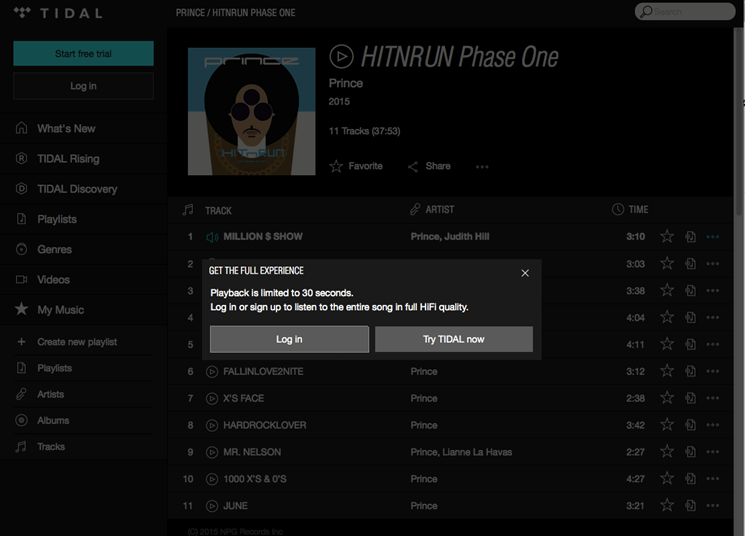
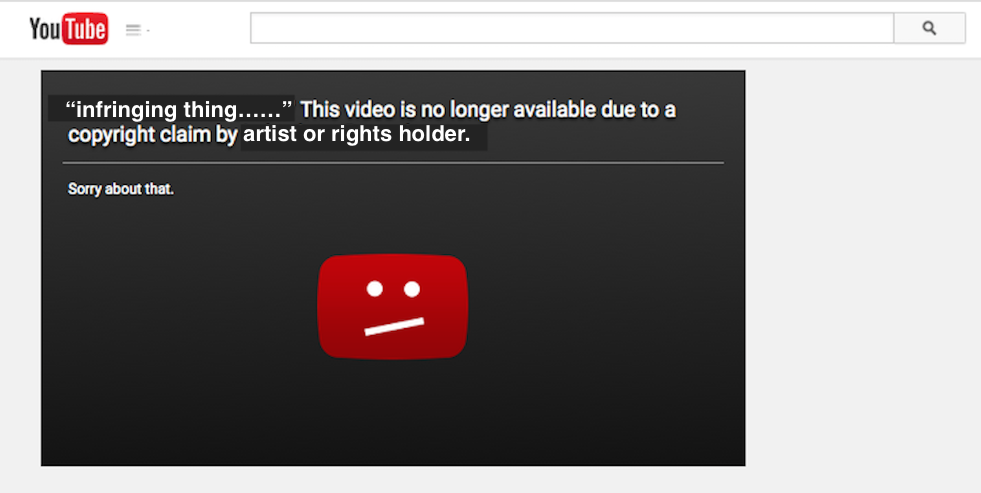
Today Prince released his new album “HITNRUN Phase One” exclusively on TIDAL. The real question is, how long will it be before the album in part or in whole is on YouTube and every other pirate site in the world?

image001

You can listen to :30 of each song at the link below without signing up for the service.
http://listen.tidal.com/album/50767183

Music Tech Policy detailed why we can’t have nice things in the post “The Great Disappointment: Tidal Highlights YouTube’s Moral Hazard for All the World to See”.

Part of Tidal’s business model relies on artists being able to grant exclusives.  The concept of an exclusive requires property rights that are respected by other platforms in the channel.

Imagine if Showtime began showing rips of Game of Thrones day and date with its HBO release.  Forget that HBO would sue them and win.  The actors, screenwriters, producers and the vast below the line personnel would think twice about working for Showtime in the future.

And that’s exactly what should happen to YouTube.

Beyonce released “Die With You” on Tidal as an exclusive.  Everyone at YouTube knows that it was intended to be an exclusive just like everyone at YouTube knows that YouTube could keep the track from being uploaded to YouTube if YouTube wanted to do that.

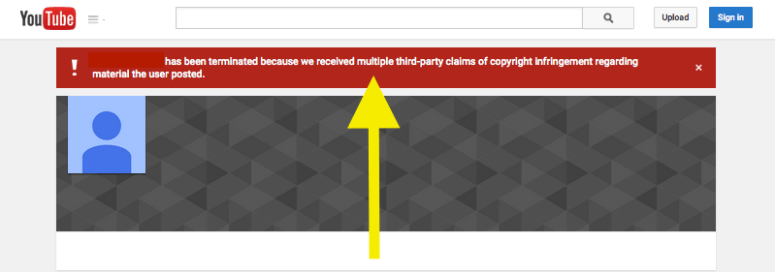
YouTube has worked hard at getting the world to accept the concept of “user generated content” as some kind of great cultural event–even, when like “Die With You”, there isn’t anything particularly “user generated” about it, unless you call a one-to-one rip of Beyonce’s track that was distributed in clear violation of Beyonce’s rights “user generated”.

READ THE FULL POST AT MUSIC TECH POLICY:
https://musictechpolicy.wordpress.com/2015/04/07/tidal-highlights-youtubes-moral-hazard-for-all-the-world-to-see/

Spotify Per Play Rates Continue to Drop (.00408) … More Free Users = Less Money Per Stream #gettherateright

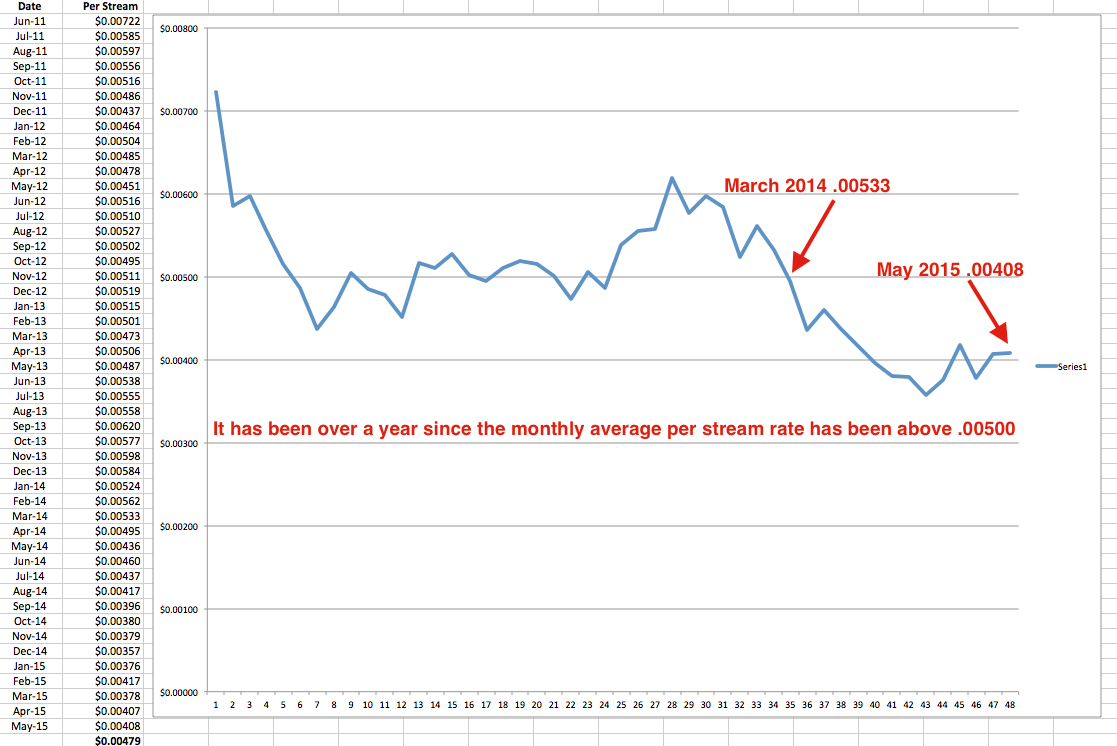
Down, down, down it goes, where it stops nobody knows… The monthly average rate per play on Spotify is currently .00408 for master rights holders.

PerStreamAvg_Jun11_July15

48 Months of Spotify Streaming Rates from Jun 2011 thru May 2015 on an indie label catalog of over 1,500 songs with over 10m plays.

Spotify rates per spin appear to have peaked and are now on a steady decline over time.

Per stream rates are dropping because the amount of revenue is not keeping pace with the  number of streams. There are several possible causes:

1) Advertising rates are falling as more “supply” (the number of streams) come on line and the market saturates.

2) The proportion of  lower paying “free streams”  is growing faster than the proportion of higher paying “paid streams.”

3) All of the above.

This confirms our long held suspicion that as a flat price “freemium” subscription service  scales the price per stream will drop.  As the service reaches “scale” the pool of streaming revenue becomes a fixed amount.  The pie can’t get any larger and adding more streams only cuts the pie into smaller pieces!

The data above is aggregated. In all cases the total amount of revenue is divided by the total number of the streams per service  (ex: $4,080 / 1,000,000 = .00408 per stream). Multiple tiers and pricing structures are all summed together and divided to create an averaged, single rate per play.

Streaming Music is Ripping You Off | Sharky Laguna via Medium

A worthy read from Sharky Laguna on how streaming music has disconnected fans from bands.

You Are Worthless

Imagine a hypothetical artist on a streaming service. Which do you think that artist would rather have: 10,000 fans who stream a song once, or one fan who streams it 10,001 times? Seems obvious, right? 10,000 fans is much better than one fan! But the Big Pool method, which only cares about the number of clicks, says the single person is worth more!
Ass-Backwards

This is bad for the artist, but astoundingly it’s even worse for streaming services: if each subscriber is paying $10 a month then those 10,000 subscribers would generate $1.2M in annual revenue, while the single user only generates a measly $120. Clearly the services benefit from getting more subscribers, not more streams, so why are they incentivizing streams and ignoring subscribers?

READ THE FULL POST AT MEDIUM:
https://medium.com/cuepoint/streaming-music-is-ripping-you-off-61dc501e7f94

Streaming “Transparency” and the 70% Black Box Lie… The Solution Is #gettherateright

The argument goes something like this…

Streaming companies are paying 70% of their revenue but artists are not getting paid enough. This must be the result of record labels and rights holders not passing on the right amount to artists.

The first question is, how do we know that streaming services are actually, really paying 70% of their top line gross revenue to rights holders? We know what the revenue of a transaction is on iTunes, because it is factually transparent – it is the list price being charged. We all know this, and we can all verify this. A $9.99 album on iTunes pays out $7.00, or 70%. Same thing for a $.99 song that pays out $.70, that’s also 70% of revenue.

But when if comes to streaming services however we do not know what the revenue is that should be credited to artists and rights holders. This is what is actually of concern. There is a big black box at the top of the waterfall from which all other money flows downstream.

So if streaming services are paying 70% of revenue, what exactly is that revenue? Let us see it. So here we are with the issue of transparency. If we can’t actually see or know what that number is then yes, the low payouts are very much of concern and have very little to do with intermediaries.

We can disagree about how the 70% of revenue is passed onto artists from iTunes and other transactional sales. But one thing is clear, we all understand the transparent economics of how much money is generated on each transaction. This is not so with streaming. So without transparency at the top of the waterfall, everything that follows is suspect.

More importantly, and more to the point, if there are established retail and wholesale rates for each stream, the calculations become immediately transparent in the same way they are with Itunes. See, the issue here is not what is going on downstream, but rather what is happening at the top of the waterfall.

“WE HAVE A MONETIZATION PROBLEM”

The truth is by now (and everyone should be able to agree on this), we know that streaming creates too little revenue relative to the value of the product. In other words the product is being sold to the consumer for less than the cost that it takes to create and produce it, and still remain sustainable.

In simple terms this is expressed as selling a Porsche for one dollar. It doesn’t matter how many Porsche’s you sell for one dollar while paying out 70% of the revenue, there will never be enough money to actually pay for the cost producing the car. Porsche’s, like professional music are expensive to produce. Despite the advances in recording technology, it is he cost of human labor that is the most important in the value chain.

This is the economics of music streaming in a nutshell, but with one added twist. The Porsche may be sold for one dollar one month, and be sold for only eighty cents the next month, and maybe the month after that sold for a dollar and ten cents. This is because of the fixed (and unsustainable) revenue pool that is divided by the total number of plays.

The common sense solution would be to establish a fixed per stream rate at each platform. This is the most simple way to encourage transparency and fairness as the revenue generated per stream can be transparently and easily calculated from top line data – no more black box at the top of the waterfall. The funny thing is, the people shouting the loudest for transparency also seem to be the most opposed to the easiest solution. Why is that?

So, if we are to have conversations about transparency let’s at least be clear about what it is that we actually need to see.


Music Streaming Now Generates Trillions Of Plays — But Are Royalties Keeping Up? | Billboard

A lot of advertising gets slathered on A Trillion Streams, and served to the most highly prized consumer demographic… no wonder Google/YouTube, Spotify and Pandora are so opposed to non-free, subscription based models that could actually compensate musicians and songwriters fairly.

The headline number in the report is 1,032,225,905,640, or 1.03 trillion, the number of song plays on Pandora, Rdio, Spotify, SoundCloud, Vevo, Vimeo and YouTube that the company tracked in the first six months of this year. It’s a startling number, much larger than anything we’ve seen before it.

It’s safe to say not all 1.03 trillion plays were royalty-bearing streams. Some had a royalty in the 0.05 to 0.1 cents per stream range typical of subscription services. Many of the Pandora streams had a U.S. statutory rate for pure-play webcasters of 0.14 cents plus a smaller amount for publishers (some Pandora streams had a higher royalty applied to streams by subscribers). And SoundCloud, a new entrant to licensed, monetized streaming, most certainly had many non-monetized streams.

Yes, it’s safe to say not all 1.03 trillon plays were royalty-bearing streams. No kidding. For most musicians and songwriters a trillion streams still means the same thing, a couple hundred bucks, if they’re lucky…

READ THE FULL STORY AT BILLBOARD.COM
http://www.billboard.com/biz/articles/6663811/music-streaming-now-generates-trillions-of-plays-but-are-royalties-keeping-up

Pay the Band | Memphis Flyer

Brice S Newman of Memphis details why support for the Fair Play, Fair Pay bill is essential for all musicians and creators to support.

There are four parts to the initiative, which includes a comprehensive bill that gives music creators pay parity. First, legislation would establish a process for setting fair-market royalty rates, not some pathetic low royalty rate that is decades old.

Second, the legislation would create a performance right for artists on terrestrial radio in the U.S., so that artists can get paid when their performances are on the radio. This is how it’s done in much of the rest of the world.

Third, this legislation would close a 1972 loophole and would guarantee that veteran performers receive royalties.

Fourth, the legislation would codify royalty payments to producers — the people behind the songs. If we can make all this happen, I am sure we will be paid back many times over in good music that’s been created by musicians who deserve to make a living.

READ THE FULL STORY AT THE MEMPHIS FLYER:
http://www.memphisflyer.com/memphis/pay-the-band/Content?oid=4073778

Michael Price: Composer for Sherlock blames Google and YouTube for suppressing rewards songwriters receive | Independent UK

More artists, performers, songwriters and composers are getting it.

“YouTube are effectively paying incredibly low rates and are not a willing partner to negotiate licences and that pulls down the rates from someone like Spotify, which has to compete in their free service with YouTube,” he told The Independent on Sunday.

“The value from the music we create is being sucked out into the companies that aggregate it, [but] YouTube … are not happy to set adequate streaming rates. There is a huge shift of value from artists to tech companies.”

READ THE WHOLE STORY AT THE INDEPENDENT UK:
http://www.independent.co.uk/news/media/michael-price-composer-for-sherlock-blames-google-and-youtube-for-suppressing-rewards-songwriters-receive-10447054.html

Fun with Digital Royalties | The Cynical Musician

The excellent blog “The Cynical Musician” has accepted our challenge to debunk the  latest Berklee College of Music/Rethink Music set of flow charts on digital music royalty flow.  Really excellent work by Faza. It’s devastating to Berklee.  Check it out. While this whole exercise has been fun for us,  it has to be embarrassing for a $60k a year academic institution that offers a degree in the “music business” to demonstrate that they fundamentally do not understand how digital royalties work.  

The Trichordist posted a challenge to disassemble Rethink Music’s royalty chart today and I do so love a challenge. I won’t be pasting the whole of it – just the juicy bits – so make sure you read their post.

Let’s start with the breakdown of internet radio royalties:

Read the Full Post :  Fun with Digital Royalties | The Cynical Musician.