Press Release: Indie Songwriter Groups Thank @RepFitzgerald For His Letter to @CopyrightOffice Urging Improvements to the US Mechanical Licensing Collective

The Songwriters Guild of America (SGA), the Society of Composers & Lyricists (SCL) and the Music Creators North America (MCNA) coalition –on behalf of over ten thousand US songwriter and composer members and their heirs and with the support of tens of thousands more represented by our organizations’ affiliated International Council of Music Creators (CIAM)– offer our sincerest thanks and support to US Congressman Scott Fitzgerald (R-WI) for his stalwart efforts in seeking to protect our rights through much needed operational and structural improvements to the US Mechanical Licensing Collective (MLC). The MLC collects and distributes hundreds of millions of dollars in royalties to songwriters and composers through their music publishing administrators each year.

Following the filing by our coalition in May, 2024 of comments expressing conditional support for re-designation by the US Copyright Office of the current MLC if –and only if– certain reforms are instituted to improve its transparency, operational fairness and accuracy in distributions (https://www.songwritersguild.com/site/potential-re-designation-mlc-and-dlc) Representative Fitzgerald came forward with his own letter to the Copyright Office dated August 29, 2024 asserting the need for reforms in full basic harmony with our own positions. His Congressional office is one of many with whom our groups have had impactful and productive discussions concerning the need for closer governmental oversight of the MLC process in order to protect American music creator rights, as clearly intended by Congress in the Music Modernization Act enacted five years ago.

Among the urgently required reforms addressed in Congressman Fitzgerald’s letter are:

–greater MLC budgetary transparency,

–improved outreach and accuracy in identifying and contacting owners of unmatched “black box” royalties (potentially approaching one billion dollars in unmatched and/or undistributed funds by 2025), and

–improved MLC board neutrality, balance and fairness.

As to this latter issue, the Congressman was forthright in acknowledging that the MLC board has conducted itself more as an advocate solely for the corporate music publishing industry rather than, as Congressionally intended, an unbiased body charged principally with protecting creator’ rights and royalties.

There are several problems related to the presence on the MLC board of only four songwriter/composer directors as compared to ten music publisher representatives (a unique imbalance compared to all other music royalty collectives around the world), including the fact that “permanently” unmatched royalties are to be distributed by the MLC on a “market share”
basis.

That construct means that music publisher board members stand to benefit by NOT properly identifying and distributing royalties to their actual creator-owners, the very task legislatively assigned to the MLC at the time of its Congressional creation. Moreover, the alleged songwriter organizations’ representative appointed as the non-voting board overseer for music creator interests has proven to be nothing more than a rubber stamp for corporate interests in direct opposition to the creators’ interests it purports to safeguard. We are aware of no other American music creator group that supports continuation of this facade of creator “representation.”

Our groups appreciate the consistent outreach and earnest work of MLC chief executive officer
Kris Ahrend, but we join Congressman Fitzgerald and his supporting colleagues in the House and Senate in insisting that the enumerated reforms cited in our Copyright Office submissions must be considered essential prerequisites to MLC re-designation (including endorsement by the MLC Board of Congressional action to equalize board representation between music creators on the one hand and their corporate copyright owners and administrators on the other). Our coalition will meanwhile continue its work on Capitol Hill and with the Copyright Office advocating for genuine protections of independent, individual music creator rights by the MLC.

Read Rep. Fitzgerald’s letter here.

@wordsbykristin: Legal Fights, Transparency & Neutrality: DiMA’s CEO On Improvements Streamers Suggest for the MLC

Kristin Robinson makes another important contribution to the artist rights conversation with her interview of Graham Davies, the new head of the Digital Media Association. Graham comes to DiMA from a background in the artist rights movement at our friends the Ivors Academy in the UK. We have high hopes for Graham who brings his intellect to clean up a long, long line of mediocrity at the DiMA leadership who are from Washington and here to help.

Kristin’s interview highlights DiMA’s recent filings in The Reup–the redesignation of the MLC by the Copyright Office that we’ve highlighted on Trichordist. He also has some well thought out analysis on how the MLC is not HFA, however similar the two may seem in practice.

This is an important interview and you can find it on Billboard (subscription required).

Here’s an example of Graham’s insight:

Do you think a re-designation every five years is not enough on its own?

I think it’ll be interesting to see what the re-designation process brings forward from the Copyright Office. Maybe the Copyright Office leans in on governance and says, “We’ve heard enough, and we can come forward with ideas.” But the re-designation process is a different thing than a governance review, which would bring in a special team to actually dig into governance-related issues and bring forward recommendations and proposals that could then be implemented. It would be something more specific and something the MLC could just do. You wouldn’t need the Copyright Office to sponsor it, though they could if they wanted to.

Are You Better Off Today Than You Were Five Years Ago? Selected comments on the MLC Redesignation: John Guertin of ClearRights

The Copyright Office is soliciting public comments about how things are going with the MLC to help the Office decide whether to permit The MLC, Inc. to continue to operate the Collective (see this post for more details on the “redesignation” requirement). We are impressed with the quality of many of the comments filed in the “Initial Comments” at the Copyright Office. As there will be an opportunity to comment again, including to comment on the comments, we will be posting selected Initial Comments to call to your attention. You can read all the comments at this link. If you are hearing about this for the first time, you have until June 28 to file a “reply comment” with the Copyright Office at this link.

You will see that there is a recurring theme with the comments. Many commenters say that they wish for The MLC, Inc. to be redesignated BUT…. They then list a number of items that they object to about the way the Collective has been managed by The MLC, Inc. usually accompanied by a request the The MLC, Inc. change the way it operates.

That structure seems to be inconsistent with a blanket ask for redesignation. Rather, the commenters seem to be making an “if/then” proposal that if The MLC, Inc. improves its operations, including in some cases operating in an opposite manner to its current policies and practices, then The MLC, Inc. should be redesignated. Not wishing to speak for any commenter, let it just be said that this appears to be a conditional proposal for redesignation. Maybe that is not what the commenters were thinking, but it does appear to be what many of them are saying. Perhaps this conditional aspect will be refined in the Reply Comments.

For purposes of these posts, we may quote sections of comments out of sequence but in context. We recommend that you read the comments in their entirety.

Today’s featured comment is from John Guertin, the highly knowledgeable independent publishing administrator who operates ClearRights in Austin, Texas. He works with many Texas artists whose music represents generations of Texas music vital to the Texas economy such as Marcia Ball, Guy Forsyth, Vallejo, Quiet Company and the South Austin Moonlighters.

Like other commenters, Mr. Guertin focuses on The MLC, Inc.’s failures to adopt world-class metadata standards. He offers insight to the Copyright Office similar to information the Office could get if they actually did a proactive deep dive on the MLC standards and practices rather than wait for commenters to get so disillusioned that they will sit down and write up their grievances when their frustration exceeds their fear of retaliation.

If Mr. Guertin is correct about bad old HFA data populating the MLC’s data, one consequence arises when the MLC, Inc. distributes its data feed to dozens of users. Does this mean that anyone who uses the MLC’s mediocre HFA data also has error-ridden data? What is the plan to unwind that one?

Lack of transparency
How does the automated matching process work and what is the logic for a match? We submit quite a bit of data to The MLC, yet titles go unmatched. It is hard to understand how a match does not happen when the system has been provided the song title, writers, isrc and supplementary data such as iswc, recording artist etc. It begs the question, what is the matching logic? If the song title, isrc and songwriter match 100%, how is a match not created? Having worked in the digital music space in the early 2000s at the onset of online digital subscription and download services, there was a fuzzy logic matching employed to help clear thousands of songs at a time. A fuzzy logic matching criteria would have to require a certain percentage of a given data field to match and thus enable matches to be made when there was punctuation or additional wording in the sound recording title such as “Live”. It’s hard to understand how so many line items go unmatched at The MLC when there are small variations in titles etc. Is a fuzzy logic protocol being employed, and if so, is it too tight?

New System , Same Old Player
The forward-facing organization we see is The MLC and its staff, however the vendor(s) used by the MLC is the same player, The Harry Fox Agency. The MLC data is often powered by and supplied by HFA. The HFA system, being a for profit, proprietary system, has been known for years to have old, outdated and/or incorrect data. One can often find the same song registered two, three or more times in the system. In most cases the publisher/owner is different or variant. This “bad data” has been allowed to proliferate the MLC system and has basically resulted in the same issues of old.

Having said vendor(s) also operating as match makers raises several concerns/questions, especially when incorrect matches are made based on this bad or outdated data. When an incorrect match is made (again how does this happen if the titles and songwriters don’t match yet publisher submitted data matches 100% and a match isn’t made?), the publisher is paid royalties.

The burden then falls upon the recipient to find the incorrect match, and then take action to remedy it by either returning monies to the MLC or having it deducted from future payments for other, non-related publishers and songs.

In some cases, the dollar amount of monies is significant and results in the publisher and/or songwriter being debited for the amount all at one time and unable to earn future royalties until the debited amount has been recouped. This can result in financial burden and distress for the publisher/songwriter. The publisher/songwriter may be dependent on these royalties to live on and due to no fault of their own, are subjected to a recoupment process for something they did not initiate. Why is this and why do we think this methodology works? Additionally, we are often told to contact the other party and get the money from them.

Lots of matches, yet even more unclaimed monies
An 80-85% match rate seems impressive until you look at the amount of money that remains unmatched each month. Approx $20 million in monies each month go unmatched and/or unclaimed. That’s over $200 million in a year. How and when is this going to be addressed? Yes, it’s much easier to ignore that and simply distribute that money via market share. But does artist/songwriter X really need more limos and vacation homes when the large majority of these royalties are indie songwriters that either don’t know about this, don’t understand it, or have been frustrated over the years and trained to think that they get micro-pennies for their efforts? We can’t blame this segment for not being totally engaged or not being educated on the complexities of the music industry. If we can put a man on the moon, why can’t we figure this out?

Lack of innovative strategy to clear the back-log of unmatched line items
What exactly is the process used to currently address this [old mediocre HFA data] and how is it being measured? We are told that outside vendors are contracted to perform this function, yet we see approx. $20 million each month in unmatched royalties. Clearly this strategy is not reducing the amount of “black box” monies at a fast enough rate and raises several concerns.

The first is that our senior songwriters and publishers are not getting younger by the day. They do not have time to wait 5 or 10 years for this to be straightened out. Many depend on the fruits of their past labor to live on. They deserve better.

With regard to the apparent inability to make matches and reduce the unmatched royalties, there seems to be other ways to approach this, which may currently be employed but we don’t really know due to the lack of transparency. Many of these unmatched recordings are songs that are registered at PROs. Those PROs have the songwriters and publishers, along with any recording data submitted by the songwriters and publishers. This is a good source of data which also has the contact info for those entities. A strategic partnership with other industry organizations, such as the PROs, should be made to help share and communicate data to bridge the gap with missing data which would allow matches to happen.

Also, where is the data that is being used to match coming from? Most indie artists use aggregators such as CD Baby, TuneCore, Distrokid etc. to distribute to dsps. This is the source of data that feeds to dsps. Such aggregators allow the input of inaccurate data without verification. All one must do is write something in the required data column (i.e. songwriters) and it goes through the system and starts populating everywhere. So bad data in results in bad data going out and reducing the likelihood matches can be made. Industry wide cooperation is required if we are to streamline these processes and make things efficient.

Read the entire comment at this link.

Are You Better Off Today Than You Were Five Years Ago? Selected comments on the MLC Redesignation: Abby North, North Music Group

The Copyright Office is soliciting public comments about how things are going with the MLC to help the Office decide whether to permit The MLC, Inc. to continue to operate the Collective (see this post for more details on the “redesignation” requirement). We are impressed with the quality of many of the comments filed in the “Initial Comments” at the Copyright Office. As there will be an opportunity to comment again, including to comment on the comments, we will be posting selected Initial Comments to call to your attention. You can read all the comments at this link. If you are hearing about this for the first time, you have until June 28 to file a “reply comment” with the Copyright Office at this link.

You will see that there is a recurring theme with the comments. Many commenters say that they wish for The MLC, Inc. to be redesignated BUT…. They then list a number of items that they object to about the way the Collective has been managed by The MLC, Inc. usually accompanied by a request the The MLC, Inc. change the way it operates.

That structure seems to be inconsistent with a blanket ask for redesignation. Rather, the commenters seem to be making an “if/then” proposal that if The MLC, Inc. improves its operations, including in some cases operating in an opposite manner to its current policies and practices, then The MLC, Inc. should be redesignated. Not wishing to speak for any commenter, let it just be said that this appears to be a conditional proposal for redesignation. Maybe that is not what the commenters were thinking, but it does appear to be what many of them are saying. Perhaps this conditional aspect will be refined in the Reply Comments.

For purposes of these posts, we may quote sections of comments out of sequence but in context. We recommend that you read the comments in their entirety. Today’s featured comment is by Abby North, who owns the independent music publisher and administrator North Music Group. Abby was kind enough to participate as a panelist at the 3rd Annual Artist Rights Symposium that David hosts at the University of Georgia Terry College of Business, and also testified at the House Judiciary Committee IP Subcommittee hearing held in Nashville to grade the MLC, Inc. (read Emmanuel Legrand’s reporting on that hearing at this link).

Abby has a number of ideas about meaningful changes that the MLC, Inc. ought to make to its operations and its approach to its fundamental job–timely and accurately accounting for all the money it receives.

Read Abby’s full comment at this link.

MLC BUSINESS RULES THAT CONTRADICT LAW
During the IP Subcommittee hearing held by Chairman Issa,6 the Chairman cautioned MLC, Inc. CEO Kris Ahrend, “…no question at all, what you’ve been making looks a lot like rules.”

The US copyright law permits authors or their heirs, under certain circumstances, to terminate the exclusive or non-exclusive grant of a transfer or license of an author’s copyright in a work. The ability to recapture rights via the United States copyright termination system truly provides
composers, songwriters and recording artists and their heirs, a “second bite of the apple.” Many of my clients exercise this right and subsequently become the original publisher in the United States.

The MLC had made a unilateral determination that rights held at the inception of the new blanket license might remain, in perpetuity, with the original copyright grantee. The MLC initially ignored that the derivative work exception does not apply in the context of the mechanical blanket license.

Fortunately, the US Copyright Office stepped in to clarify that the appropriate payee under the mechanical blanket license to whom the MLC must distribute royalties in connection with a statutory termination is the copyright owner at the time the work is used. When The MLC envisions a new policy, members should be provided a mechanism to provide input related to this policy, prior to it being adopted.

Members must be given a greater voice in business rules and operations of The MLC. Hands-on music publishing administrators have deep insights into workflows, efficiencies and UI/UX. Members need to be consulted with and given opportunities to drive the future of The MLC’s
website and technologies.

The MLC has made unilateral decisions regarding how it treats public domain works. It invoices the DSPs for streams of recordings that embody these public domain works, but no publisher is entitled to these royalties. That means the MLC may collect money it may not pay out. What rule gives The MLC the right to collect but not distribute?

COMMITMENT TO ISWC AS GLOBALLY UNIQUE IDENTIFIER FOR MUSICAL
WORK

Recently, the PRS (the UK-based Performance Rights Organization) completed a proof of concept that allowed record labels to request assignment of an ISWC to identify a musical work embedded in that label’s recording.

This proof of concept provides a necessary step in helping CMOs identify musical works, contributing parties and recordings of these works.

It also firmly demonstrates the global CMO ecosystem’s commitment to the ISWC as the globally unique identifier for the musical work. Every music publisher and every CMO…other than The MLC…relies on the ISWC to identify a musical work.

Instead, The MLC relies on the HFA Song Code, now also known as the MLC Song Code. The only societies in the world that use these codes are HFA and The MLC. Every other society identifies musical works with an ISWC, which unlike the HFA Song Code or MLC Song Code,
functionally acts as a bridge to the International Party Identifier (IPI) and now, the International Standard Recording Code (ISRC).


For The MLC to some day truly be the gold standard in CMOs, it must follow the rest of the world’s lead and require and include the ISWC whenever the ISWC exists. The MLC Song Code may be used as a disambiguator, but it must be used in conjunction with an ISWC. This is how the other societies work: they have their own proprietary identifier, which accompanies the ISWC to allow positive identification of works.

In addition to ISWC as the work identifier shared by the world’s music publishing and rights management community, IPI is the global identifier for the songwriter and publisher. The MLC must commit to including the IPI for any writer or publisher that has been assigned an IPI.

SPEED OF CLAIMING AND MATCHING
According to The MLC in its redesignation comments, “Finally, The MLC has already established itself as a leader in the industry, setting high standards for speed, volume, transparency, efficiency, outreach and member support.”

As of this writing, works I claimed manually in the claiming portal 73 days ago still have not been processed.

Unless I am misunderstanding the process, this means The MLC has already missed two distribution periods.

This is too much time. If there is an issue with the claims, there should be some human communication from The MLC explaining the issues.

If there are no issues, what could possibly be the cause of such a delay?

The oversight body must provide guidelines for The MLC regarding reasonable times from delivery of a match or claim by a member to processing by The MLC.

I also recommend the addition of an interface in the MLC portal for communication between The MLC and the member. For example, if every time I log in, I see a red flag in the interface indicating action is required on my part, I could potentially assist in speeding up the time The MLC takes to process my data. I also would be aware of any potential issues.

SONGWRITER PORTAL
The MLC’s website says it has distributed to “publishers and songwriters.” However, it must be clarified that the only songwriters that directly receive royalties from The MLC are selfpublished, self-administered songwriters that a) are aware of The MLC; b) have become members; and c) have delivered data to The MLC regarding their works and recordings of their works.

Songwriters that are either published or administered by a publisher have no mechanism with which to deliver corrections or missing data regarding their works. Instead, a songwriter that may have had one or many previous deals typically has no relationship with the previous publishers. Even songwriters in current publishing deals may not be able to get their calls returned much less convince their publishers to add or correct data in a timely manner.

Consequently, as many advocates have suggested since the roundtables that occurred prior to the inception of The MLC, The MLC must provide a portal within its website for published and/or administered songwriters to deliver data regarding their works. This data must then be reviewed by The MLC for accuracy, and then The MLC must communicate with the publishers to confirm
accuracy and add the missing or corrected data to the public portal.

It is simply unfair that songwriters have no way to guarantee The MLC has the necessary data to pay these songwriters’ publishers if they are willing to do the matching work at their own expense.

According to the USCO’s website FAQs regarding Title 1 of The Musical Works Modernization Act, “Once established, the MLC will establish and administer a process by which copyright owners can claim ownership of musical works (and shares of such works).” In fact, even though an administered songwriter is the legal copyright owner of his/her musical works, The MLC provides no process by which that songwriter/copyright owner can claim ownership of musical
works.

OVERCLAIMS TOOL
The MLC recently added an Overclaims Tool – only for registrations made within the last 90 days. If you submit a registration and it conflicts with a work that’s older than 90 days, that conflict will not appear in your portal.

According to The MLC:

“Please note: A work can only go into overclaim if shares are added to the
work within 90 days of the work’s registration, based on the “Creation Date”
in the work details.

If you are attempting to claim shares over 100% on a work that was created
more than 90 days prior, you will need to reach out to The MLC Support
team here.”

As a publisher/administrator of works registered decades ago, how would I know if someone has attempted to claim my legacy work and created an overclaim?

I do not recall receiving any announcement seeking publishers to participate in working groups to provide input related to the Overclaims Tool. Experienced hands-on administrators should be given the opportunity to provide insights into functionalities of proposed additions to the MLC portal prior to development of the technology.

The Consensus for Conditional Approval of The MLC, Inc. by the @CopyrightOffice

By Chris Castle

I am pleased to see that there is a consensus against more happy talk among commenters in The MLC, Inc.’s five year review of its operations at the Copyright Office. The consensus is an effort to actually fix the MLC’s data defects, rogue lawmaking and failure to pay “hundreds of millions of dollars” in black box royalties.  But realize this is not just the songwriter groups you would expect to see raising objections (discussed in excellent Complete Music Update post). It’s also coming from some commenters who you would not expect to see criticizing The MLC who may not come right out and say it, but are essentially proposing a conditional redesignation.

When did Noah Build the Ark? The Two Arguments for Conditional Approval

There is a significant group, and sometimes from unexpected corners, who fall into two broad camps: One camp is “approve The MLC, Inc. with post-approval conditions” that may lead to being disapproved if not accomplished until the next five year review rolls around.

The other camp, which is the one I’m in if you’re interested, is to spend some time now getting very specific. The specifics are about crucial improvements The MLC, Inc. needs to put into effect and payments they need to make. This would be accomplished by bringing in advisory groups of publishing experts, especially from the independent community, roundtables, other customary tools for public consultations. But–the redesignation approval would occur only after The MLC, Inc. accomplished these goals. 

Either way, the consensus is for conditions if not the timing. I’m not going to argue for one or the other today, but I have some thoughts about why delayed approval is more likely to accomplish the goals to make things better in the least disruptive way.

Remember, once The MLC, Inc. is approved, or “redsignated,” then all leverage to force change is lost. Why? Because if the last five years is any guide, exactly zero people will enforce the government’s oversight role and everyone knows it.

Putting operations-based obligations on The MLC, Inc. to be responsive to their members before they get the valuable approval preserves leverage and will force change one way or another, The reward for successfully accomplishing these goals is getting approved for another term (or the balance of their five year review). Noah built the Ark before the rain.

What if we fired them?

I’m actually pleased to see the consensus for conditional approval. Simply firing The MLC, Inc. would be disruptive (and they know it), mostly because the Copyright Office hasn’t gotten around to requiring that a succession plan be in place so that firing the MLC would not be disruptive.  That’s a failure of oversight. You can’t expect the MLC to make it easy to fire themselves.

The simple solution to this pickle is for the Copyright Office to make any redesignation conditioned upon certain fixes being accomplished on an aggressive time frame. I say aggressive because they’ve had five years to think about this; it shoudln’t take long to at least implement some fixes. But if we don’t make it conditional the MLC will lack the incentive to actually fix the problems.

A conditional approval would simply say that if the MLC cleans up its act, say in the next 24 months, then they will be officially redesignated. If they don’t, it’s on to the next after that 24 month deadline.

Conditional Approval

I have to say I was encouraged by the number of commenters who said that The MLC, Inc. needs some very definite performance goals. Many commenters said that those goals needed to be met in order for The MLC, Inc. to get approved for another five years until the next review. I’m not quite sure how you approve them for another five years with performance goals unless you are really saying what some commenters came right out and said: Any approval should be conditional. 

I think that means that the Copyright Office needs a plan with two broad elements: One, the plan identifies specific performance goals, and then two, establishes a performance timeline that The MLC, Inc. must meet in order for this current “redesignation” to become final.

That “conditional redesignation” would incentivize The MLC, Inc. to actually accomplish specific tasks like everyone else with a job. The timeline will likely vary based on the particular task concerned, but impliedly would be less than five years. There’s a very good reason to make the approval conditional; there’s just too much money involved. Other people’s money.

The Black Box

Every comment I read brings up the black box. Commenters raised different complaints about how The MLC, Inc. is managing or not managing the matching that is required for the black box distribution contemplated by Congress. They all were pretty freaked out about how big it is, how little we know about it, and the fact that the board of The MLC, Inc. is deeply conflicted because the lobbyists drafted an eventual market share distribution. Strangely enough, there’s every possibility that the market share distribution will happen, or could happen, right after the redesignation. Also known as losing on purpose in a fixed fight.

There’s an easy correction for that one–don’t do the market share distribution, maybe ever. 

The harsh but near certain fact is if there is an announced market share distribution of the black box, the MLC (and everyone involved) will be sued before the actual distribution. It almost doesn’t matter how clean it is. So why do it at all? The MLC is supposed to set an example to the world, right? (And we know how much the world loves it when Americans say that kind of thing.) What if we said that the market share distribution was just bloodlust by the lobbyists salivating over a really big poker pot? On reflection, it should be put aside particularly because Congress may not have been told how big the black box really was if anyone knew at the time. Ahem….what did they know and when did they know it?

The Interest Penalty

This actually goes hand in hand with another interpretation of the black box provisions of Title I of the MMA which requires the payment of compound interest for black box money to be paid by The MLC, Inc. to the true copyright owner. That compound interest accrues at the “federal short term rate” in effect from time to time (that rate is adjusted monthly and is currently 5.01%). MLC’s interest obligation accrues in an account set up for the true copyright owner’s benefit, not for the recipients of the market share distribution. 

Interest runs from the time the unmatched money is received by the MLC until it is matched and paid. There could easily be several different interest rates in effect if the unmatched royalties stay in the black box for months or particularly years. This concept is elaborated in a comment by the Artist Rights Institute. (And of course, why doesn’t the interest run from the time the black box is first held rather than the much later date that the unmatched is paid to the MLC?)

Title I requires this “penalty” the same way that it requires the statutory late fee which itself has been the subject of much negotiation. It is important to note that the word “penalty” does not appear in Section 115, but both the interest rate and the late fee are obviously “penalties” in plain English and in plain site. You don’t have to call it a thing a penalty in order for it to be a penalty. It doesn’t stop being a penalty just because the statute doesn’t define it as one, just like a large furry animal with big teeth, big claws, a loud roar and really bad breath who wants to eat you stops being a bear just because it doesn’t have a sign around its neck saying “BEAR”. Particularly when the furry animal has you by throat.

Align the Incentives

I have to imagine that a penalty of compound interest would incentivize both the MLC and the licensees who pay its bills to match that black box right quick. If a third party is paying the statutory interest penalty which is how it is now according to MLC CEO Kris Ahrend’s testimony to Congress (under oath), then there’s really no incentive for the MLC to pick up the pace on matching and there’s even less incentive for the licensees to make them do it.

It makes sense that the MLC is to maintain an account for each copyright owner (or maybe for each unmatched song since the copyright owner is not matched), so it only makes sense that these accounts and compound interest would be maintained on the ledger of the MLC rather than in a third party bank account, much less a mutual fund. It would be pretty dumb to just lump all the money into one account and run compound interest on the whole thing that would have to be disaggregated and paid out every time a song is matched. Assuming matching was the object of the exercise.

Plus, there’s nothing in Title I that says that black box money has to be put in a bank account that accrues interest so that the MLC doesn’t have to pay this penalty for being slow. Again, the word “bank” does not appear in Section 115. It definitely doesn’t say a federally insured bank account, a bank in the Federal Reserve system, or the like–because the statute does not require a bank.  I would argue that if Congress meant for the money to be kept in a bank they would have said so.

Even so, I have to believe that if you want to an insurance company and said I will bring you the “hundreds of millions of dollars” if you write me a policy that will cover my interest expense and insure the corpus, somebody would take that business. If they can write derivatives contracts for fluctuations in natural gas futures in global energy markets, I bet they could write that policy or my name’s not Jeffrey Skilling.

William of Ockham Gets Into the Act

What makes a lot more sense and is a whole lot simpler is that Congress wanted to incentivize the MLC to match and pay black box royalties quickly. Congress established the compound interest penalty to add jet fuel to that call and response cycle following the jurisprudential theory of subsidiarity. 

That penalty is part of the normal costs of operating the MLC therefore should be paid as part of the administrative assessment, i.e., by the services themselves. If the MLC sits on the money too long, the services can refuse to cover the interest costs beyond that point and the MLC can then pass the hat to the board members who allowed that to happen.  Again, subsidiarity principles suggest that it is good government to create the incentive to fix a problem in the pocketbook of the one who is best positioned to actually get it fixed.

So everyone has a good incentive to clean out the black box. Brilliant lawmaking. I don’t think that’s such a bad deal for the services since they are the ones who sat on the money in the first place that produced the initial hundreds of millions of dollars for the black box. They got everything else they wanted in the MMA, why object to this little detail? Let’s try to hold down the hypocrisy, shall we?

There may be some arguments about that interpretation, but here’s what Congress definitely did not do and about which there should definitely not be an argument. Congress did not authorize the MLC to use the black box money as an investment portfolio. Nowhere in Title I is the MLC authorized to start an investment policy or to become a “control person” of mutual funds. Which they have done.

That investment policy also raises the question of who gets the upside and who bears the downside risk. If there’s a downturn, who makes the corpus whole? And, of course, when the ultimate market share distribution occurs, who gets the trading profits? Who gets the compound interest? Surely the smart people thought of this as part of their investment policy.

The Key Takeaway

You may disagree with the Institute’s analysis about what is and isn’t a penalty, and you may disagree about putting conditions on redesignation, but I think that there is broad agreement that there needs to be a discussion about forcing The MLC, Inc. to do a better job. I bet if you asked, the Congress clearly did not see the Copyright Office’s role as handing out participation trophies or pats on the head. And that should not be the community’s goal, either. This whole thing was cooked up by the lobbyists and they were not interested in any help. That obviously crashed and burned and now we need to help each other to save songwriters today and in future generations. If not us, then who; if not now, then when; if not here, then where?

[A version of this post first appeared on MusicTech.Solutions]

On the Internet, “Partners” Don’t Hear You Scream: Spotify CEO Makes a $350M “Bundle” While Sticking Songwriters with an ESG “Bundle” of Crap

Here’s a quote for the ages:

MICHAEL BURRY

One of the hallmarks of mania is the rapid rise and complexity 
of the rates of fraud. And did you know they’re going up?

The Big Short, screenplay by Charles Randolph and Adam McKay,
based on the book by Michael Lewis

We have often said that if screwups were Easter eggs, Spotify CEO Daniel Ek would be the Easter bunny, hop hop hopping from one to the next. That’s is not consistent with his press agent’s pagan iconography, but it sure seems true to many people.

This week was no different. Mr. Ek cashed out hundreds of millions in Spotify stock while screwing songwriters hard with a lawless interpretation of the songwriter compulsory license. That interpretation is so far off the mark that he surely must know exactly what he is doing. It’s yet another manifestation of Spotify’s sudden obsession with finding profits after a decade of “get big fast.”

The Bunny’s Bundle

Let’s look under the hood at the part they don’t tell you much about. Mr. Ek evidently has what’s called a “10b5-1 agreement” in place with Spotify allowing staggered sales of incremental tranches of the common stock. Those sales have to be announced publicly which Spotify complied with (we think). And we’ll say it again for the hundredth time, stock is where the real money is at this stage of Spotify’s evolution, not revenue.

As a founder of Spotify, Mr. Ek holds founders shares plus whatever stock awards he has been granted by the board he controls through his supervoting stock that we’ve discussed with you many times. These 10b5-1 agreements are a common technique for insiders, especially founders, who hold at least 10% of the company’s shares, to cash out and get the real money through selling their stock.

A 10b5-1 agreement establishes predetermined trading instructions for company stock (usually a sale so not trading the shares) consistent with SEC rules under Section 10b5 of the Securities and Exchange Act of 1934 covering when the insider can sell. Why does this exist? The rule was established in 2000 to protect Silicon Valley insiders from insider trading lawsuits. Yep, you caught it–it’s yet another safe harbor for the special people. Presumably Mr. Ek’s personal agreement is similar if not identical to the safe harbor terms because that’s why the terms are there.

As MusicBusinessWorldWide reported, Mr. Ek recently sold $118.8 million in shares of Spotify at roughly the same time that he likely knew Spotify was planning to change the way his company paid songwriters on streaming mechanicals, or as it’s also known “material nonpublic information”.

As Tim Ingham notes in MusicBusinessWorldwide, Mr. Ek has had a few recent sales under his 10b5-1 agreement: “Across these four transactions (today’s included), Ek has cashed out approximately $340.5 million in Spotify shares since last summer.” Rough justice, but I would place a small wager that Ek has cashed out in personal wealth all or close to all of the money that Spotify has paid to songwriters (through their publishers) for the same period. In this sense, he is no different than the usual disproportionately compensated CEOs at say Google or Raytheon. 

Stock buybacks artificially increase share price. Now why might Spotify want to juice its own stock price?

Spotify Shoves a “Bundled” Rate on Songwriters

Spotify’s argument (that may have caused a jump in share price) claims that its recent audiobook offering made Spotify subscriptions into a “bundle” for purposes of the statutory mechanical rate. (While likely paying an undiscounted royalty to the books.) 

That would be the same bundled rate that was heavily negotiated in the 2021-22 “Phonorecords IV” proceeding at the Copyright Royalty Board at great expense to all concerned, not to mention torturing the Copyright Royalty Judges. These Phonorecords IV rates are in effect for five years, but the next negotiation for new rates is coming soon (called Phonorecords V or PR V for short). We’ll get to the royalty bundle but let’s talk about the cash bundle first.

You Didn’t Build That

Don’t get it wrong, we don’t begrudge Mr. Ek the opportunity to be a billionaire. We don’t at all. But we do begrudge him the opportunity to do it when the government is his “partner” so they can together put a boot on the necks of songwriters. This is how it is with statutory mechanical royalties; he benefits from various other safe harbors, has had his lobbyists rewrite Section 115 to avoid litigation in a potentially unconstitutional reach back safe harbor, and he hired the lawyer at the Copyright Office who largely wrote the rules that he’s currently bending. Yes, we do begrudge him that stuff.

And here’s the other effrontery. When Daniel Ek pulls down $340.5 million as a routine matter, we really don’t want to hear any poor mouthing about how Spotify cannot make a profit because of the royalty payments it makes to artists and songwriters. (Or these days, doesn’t make to some artists.) This is, again, why revenue share calculations are just the wrong way to look at the value conferred by featured and nonfeatured artists and songwriters on the Spotify juggernaut. That’s also the point Chris made in some detail in the paper he co-wrote with Professor Claudio Feijoo for WIPO that came up in Spain, Hungary, France, Uruguay and other countries.

Spotify pays a percentage of revenue on what is essentially a market share basis. Market share royalties allows the population of recordings to increase faster than the artificially suppressed revenue, while excluding songwriters from participating in the increases in market value reflected in the share price. That guarantees royalties will decline over time. Nothing new here, see the economist Thomas Malthus, workhouses and Charles Dickens‘ Oliver Twist.

The market share method forces songwriters to take a share of revenue from someone who purposely suppressed (and effectively subsidized) their subscription pricing for years and years and years. (See Robert Spencer’s Get Big Fast.). It would be a safe bet that the reason they subsidized the subscription price was to boost the share price by telling a growth story to Wall Street bankers (looking at you, Goldman Sachs) and retail traders because the subsidized subscription price increased subscribers.

Just a guess. 

The Royalty Bundle

Now about this bundled subscription issue. One of the fundamental points that gets missed in the statutory mechanical licensing scheme is the compulsory license itself. The fact that songwriters have a compulsory license forced on them for one of their primary sources of income is a HUGE concession. We think the music services like Spotify have lost perspective on just how good they’ve got it and how big a concession it is.

The government has forced songwriters to make this concession since 1909. That’s right–for over 100 years. A century.

A decision that seemed reasonable 100 years ago really doesn’t seem reasonable at all today in a networked world. So start there as opposed to the trope that streaming platforms are doing us a favor by paying us at all, Daniel Ek saved the music business, and all the other iconographic claptrap.

Has anyone seen them in the same room at the same time?

The problem with the Spotify move to bundled subscriptions is that it can happen in the middle of a rate period and at least on the surface has the look of a colorable argument to reduce royalty payments. If you asked songwriters what they thought the rule was, to the extent they had focused on it at all after being bombarded with self-congratulatory hoorah, they probably thought that the deal wasn’t “change rates without renegotiating or at least coming back and asking.”

And they wouldn’t be wrong about that, because it is reasonable to ask that any changes get run by your, you know, “partner.” Maybe that’s where it all goes wrong. Because it is probably a big mistake to think of these people as your “partner” if by “partner” you mean someone who treats you ethically and politely, reasonably and in good faith like a true fiduciary. 

They are not your partner. Don’t normalize that word.

A Compulsory License is a Rent Seeker’s Presidential Suite

But let’s also point out that what is happening with the bundle pricing is a prime example of the brittleness of the compulsory licensing system which is itself like a motel in the desolate and frozen Cyber Pass with a light blinking “Vacancy: Rent Seekers Wanted” surrounded by the bones of empires lost. Unlike the physical mechanical rate which is a fixed penny rate per transaction, the streaming mechanical is a cross between a Rube Goldberg machine and a self-licking ice cream cone. 

The Spotify debacle is just the kind of IED that was bound to explode eventually when you have this level of complexity camouflaging traps for the unwary written into law. And the “written into law” part is what makes the compulsory license process so insidious. When the roadside bomb goes off, it doesn’t just hit the uparmored people before the Copyright Royalty Board–it creams everyone.

David and friends tried to make this point to the Copyright Royalty Judges in Phonorecords IV. They were not confused by the royalty calculations–they understood them all too well. They were worried about fraud hiding in the calculations the same way Michael Burry was worried about fraud in The Big Short. Except there’s no default swaps for songwriters like Burry used to deal with fraud in subprime mortgage bonds. 

Here’s how the Judges responded to David, you decide if they are condescending or if the songwriters were prescient knowing what we know now:

While some songwriters or copyright owners may be confused by the royalties or statements of account, the price discriminatory structure and the associated levels of rates in settlement do not appear gratuitous, but rather designed, after negotiations, to establish a structure that may expand the revenues and royalties to the benefit of copyright owners and music services alikewhile also protecting copyright owners from potential revenue diminution. This approach and the resulting rate setting formula is not unreasonable. Indeed, when the market itself is complex, it is unsurprising that the regulatory provisions would resemble the complex terms in a commercial agreement negotiated in such a setting.

PR IV Final Rule at 80452 https://app.crb.gov/document/download/27410

It must be said that there never has been a “commercial agreement negotiated in such a setting” that wasn’t constrained by the compulsory license. It’s unclear what the Judges even mean. But if what the Judges mean is that the compulsory license approximates what would happen in a free market where the songwriters ran free and good men didn’t die like dogs, the compulsory license is nothing like a free market deal.

If the Judges are going to allow services to change their business model in midstream but essentially keep their music offering the same while offloading the cost of their audiobook royalties onto songwriters through a discount in the statutory rate, then there should be some downside protection. Better yet, they should have to come back and renegotiate or songwriters should get another bite at the apple.

Unfortunately, there are neither, which almost guarantees another acrimonious, scorched earth lawyer fest in PR V coming soon to a charnel house near you.

Eject, Eject!

This is really disappointing because it was so avoidable if for no other reason. It’s a great time for someone…ahem…to step forward and head off the foreseeable collision on the billable time highway. The Judges surely know that the rate calculation is a farce

But the Judges are dealing with people negotiating the statutory license who have made too much money negotiating it to ever give it up willingly although a donnybrook is brewing. This inevitable dust up means other work will suffer at the CRB. It must be said in fairness that the Judges seem to find it hard enough to get to the work they’ve committed to according to a recent SoundExchange filing in a different case (SDARS III remand from 2020).  

That’s not uncharitable–I’m merely noting that when dozens of lawyers in the mechanical royalty proceedings engage in what many of us feel are absurd discovery excesses. When there are stupid lawyer tricks at the CRB, they are–frankly–distracting the Judges from doing their job by making them focus on, well, bollocks. We’ll come back to this issue in future. The dozens and hundreds of lawyers putting children through college at the CRB–need to take a breath and realize that judicial resources at the CRB are a zero sum game. This behavior isn’t fair to the Judges and it’s definitely not fair to the real parties in interest–the songwriters.

Tell the Horse to Open Wider

A compulsory license in stagflationary times is an incredibly valuable gift, and when you not only look the gift horse in the mouth but ask that it open wide so you can check the molars, don’t be surprised if one day it kicks you.

A version of this post first appeared on MusicTech.Solutions

The First Shot Across the Bow at the MLC’s “Redesignation” Proceeding #TheReup

We must always tell what we see. Above all, and this is more difficult, we must always see what we see.
Charles Peguy

By Chris Castle

The Reup is on! MTP readers will remember that The MLC, Inc. is in the beginning of its “redesignation” proceeding before the U.S. Copyright Office that we call “the rep,” because…because….well, you have to laugh at some point. Having appointed (or “designated”) The MLC, Inc. as the statutory mechanical licensing collective in 2019, the Copyright Office is required by statute to review The MLC, Inc. to see how they are doing with their exclusive monopoly over songwriter streaming mechanical collections.

It’s important to remember that the mechanical licensing collective (lower case) is a statutory body. Congress tasked the head of the Copyright Office with selecting an entity to actually do the work. In a shocker that rocked the industry, the Copyright Office selected (or “designated”) the favorite corporation of the National Music Publishers Association and the Nashville Songwriters Association International that styled itself “The MLC, Inc.” 

The MLC, Inc. then turned right around and selected the Harry Fox Agency as its data vendor to actually run the accounting part of the collective–another shocker. If you thought you were going to escape the hubris and incompetence of HFA under the glorious revolution of the Music Modernization Act, tough break. So it is now the Copyright Office’s decision to either redesignate The MLC, Inc. (and by default, HFA) for another five years of holding onto your money in their vast black box, or find someone else.

And just to be clear, these exclusive appointments or “designations” last for five years. Every five years, Congress required the Copyright Office to take a critical look at the wisdom of their prior decision and determine after soul-searching and self-criticism whether they should ratify their previous genius by extending the monopoly another five years. As Congress said in the legislative history narrative:

The Register [the head of the Copyright Office] is allowed to re-designate an entity to serve as the collective every 5 years after the initial designation. Although there is no guarantee of a continued designation by the collective, continuity in the collective would be beneficial to copyright owners so long as the entity previously chosen to be the collective has regularly demonstrated its efficient and fair administration of the collective in a manner that respects varying interests and concernsIn contrast, evidence of fraud, waste, or abuse, including the failure to follow the relevant regulations adopted by the Copyright Office, over the prior five years should raise serious concerns within the Copyright Office as to whether that same entity has the administrative capabilities necessary to perform the required functions of the collective. In such cases, where the record of fraud, waste, or abuse is clear, the Register should give serious consideration to the selection of a new entity even if not all criteria are met pursuant to section 115(d)(3)(B)(iii).

So the way this is going to go down according to the Copyright Office is that they will seek a kind of thesis defense from each of The MLC, Inc. and the MLC’s counterpart for the digital services called the Digital Licensee Coordinator or “the DLC” which we often forget is there. Then the public gets to comment on how things are going.

Let’s understand how this game is played. Nobody likes to open the kimono and have their operations examined. But opening the kimono is actually a much bigger deal for the MLC than for the DLC. The MLC has a lot of functionality that perpetuates the same old spaghetti code from HFA and the need to hide it from sunlight. In my view the sense of entitlement and hubris is overwhelmingly stronger at The MLC, Inc. than at the DLC. Remember, the DLC pretty much just writes the overpriced checks to keep MLC executives in the style to which they have become accustomed (see Trichordist “Know Your MLC 2022“).

We are starting to get a sense of how the DLC is going to approach the reup proceeding given a recent blog post by Graham Davies, the new head of the Digital Media Association. DiMA essentially is the DLC. Technically, the DLC’s mission is to represent all users of the blanket mechanical license, and I think perhaps for the first time, the DLC will represent all the users both large and small, not just DiMA members. Let’s take a look at some of the points Graham raised.

The Insult of Governance

But first, remember that the MMA created the first US mechanical licensing CMO. This was an event that had been coming for oh, say 100 years round numbers. The first difference between the US and most other countries is that in the US there is not equal board representation between publishers and songwriters. This is an insult to songwriters. 

That’s right–in the rest of the world, songwriters have at least equal representation. Just call it what it is, it’s an insult. And not a casual insult or the insult of low expectations. This insult is right in your face.

There will be a lot of rending of garments about the unfairness of the MLC’s board composition and that’s all fine, but know this: You will not change the board composition until you change the mindset that produced the board composition.

What is astonishing about how this happened is that before they get to Washington, all these publishers with board seats have good relations with songwriters and value their writers. Do we have arguments inside the family? Sure. But something happens to these publishers when they get to Washington, DC and they go rogue or they are encouraged to go rogue. 

So I would encourage these board members to come back to your values and what you hold dear and don’t listen to the bad advice. The bad advice didn’t build your companies; your relations with your songwriters did. Yet there is such hostility toward this board composition that it will take you years to overcome the insult and the distrust it produced. It didn’t have to happen that way and it should not be allowed to continue.

No Free Lunch

The next big difference is that the cost of standing up and operating the MLC is born by the licensees. There is a reason that this doesn’t happen in any other country–it is a bullshit idea. It OBVIOUSLY produced an inherent conflict of interest at the outset. Does it shovel money onto the kitchen tables of the insiders? Of course. Does it feed into salaries, bonuses and T&E of the MLC? Oh, yes. So let’s see what Graham Davies has to say about this one.

For starters, here’s a headline: THE MONEY IS NOT HAPPY. Get it? What do you think happens when the money is not happy? Maybe, just maybe, you think they might not want to keep paying? Maybe just maybe they gave you your lead for five years and let you get good and hooked before they started reeling you in?

As Graham says:

All around the world, it is the rightsholders who bear the cost of the collectives licensing their rights, and copyright offices or similar government bodies often have oversight powers over the collectives to ensure that royalties are distributed fairly and the collectives operate efficiently.  

In the US, unlike anywhere else in the world, legislators placed the burden of funding the collective’s operations on the licensees as opposed to the rightsholders. This particular arrangement was a feature of the statute, but means a collective’s traditional incentives for optimum performance are not inherently built in and may become skewed. [Now there’s a shocker.]

This structure makes it even more important that the Copyright Office ensures fair and efficient operation of the collective, including for those who fund it.

How can you read that and not realize that THE MONEY IS NOT HAPPY. See what you see. Anyone who believed that the licensees large and small would just go on writing the checks for absurd salaries and ridiculous travel and entertainment expenses must be from Washington.

Oversight Culture Clash

This goes hand-in-hand with the true problem with the entire megillah which is where Graham starts: Lack of oversight. Don’t blow past this. 

Remember, DiMA represents the biggest corporations in commercial history and make no mistake–they own Washington, DC. So when the DiMA members look at this oversight issue, from their point of view the government works for them and the government is falling down on the job. The money is not happy. See what you see.

Oversight is a key part of Graham’s complaint.

As we embark on the redesignation process, oversight of the mechanical licensing collective is a key issue. Collective licensing is common for many rights in the music sector, because it is a sensible solution for reducing transaction costs and improving efficiencies between rightsholders and licensees….

The MMA mandated that the MLC be run by a Board made up largely of music publishers and some songwriters. While it makes sense for rights holders to have oversight over a collective of their rights, it has become apparent in the five years since the MMA was passed, that this structure, without guardrails and robust oversight, provides little incentive for the collective to carefully weigh risks and conduct rigorous cost-benefit analysis of decisions before action. [Like any CMO conducts a “rigorous cost-benefit analysis”–try not to laugh, but you get the idea.] This is of great importance because without a clearly circumscribed remit for The MLC, the positions the collective takes can have significant consequences for the functioning of the US music market.

The record shows that in passing the MMA, Congress chose to establish a collective that would serve as the administrator of  the mechanical blanket license….Congress [did not] intend to write the collective a blank check.  Indeed, Congress was astute in requiring that streaming services be responsible only for the reasonable costs of the collective. Such reasonable costs relate to the collective’s core functions – such as work registration and matching. Where The MLC has focused on these core functions, there is good work [no there isn’t], particularly in the context of the relatively short window from designation to operation [already making excuses]. However, where The MLC has gone beyond its remit, there has been, and continues to be cause for concern. Reasonable costs of the collective cannot include everything from traveling to distant countries to conduct outreach to songwriters far beyond the U.S. licensing system, to suing one of the licensees that pays its costs — using licensee money to pursue its allegations against a licensee on a novel legal theory. [This is the Pandora lawsuit filed by The MLC, Inc. I was wondering how long that would take to get under the skin.]

I take Graham’s point and understand his frustration (and discretion in not calling out the ridiculous salaries). But it must also be said that only lobbyists in the Imperial City would have drafted Title I of the MMA to provide for oversight of a private company by a government agency. That’s just idiotic. First of all, it’s really unfair to expect the Copyright Office to supervise the MLC’s travel and entertainment expenses. They barely have the resources to manage their own operations much less have oversight on Kris Ahrend’s tips in transit. It’s also just not in the cerebral culture of the Copyright Office to have the kind of dressing down relationship with the MLC that would be necessary for financial oversight. 

I also have to call bullshit on this complaint about costs being framed as an oversight issue. Yeah, sure, I guess on some level everything is an oversight issue. But if anything, this is an issue for the board of directors at the MLC which includes the DLC. But in most companies it’s a management issue for the CEO and the CFO. So if Graham has a beef about T&E (which sounds like a legitimate beef and is not the first I’ve heard of it), he needs to take it up with the management. You know, the management that reports to the board the DLC sits on (nonvoting or not).

Alternatively, the operating budget of the MLC comes through the Copyright Royalty Board which approves the budget in the form of the “Administrative Assessment.” The DLC can raise these complaints about spending in that forum as well and really should.

So Graham raises some important points that we should be aware of as the MLC enters its all-important reup proceeding. Stay tuned for responses.

MLC “ReUp” Proceeding Highlights Ownership Issues for Your Musical Works Database When You Correct To Collect?

Guest post By Chris Castle

Ever wonder who owns the registration data you have slaved to correct and recorrect at your own cost when you “Play Your Part” to “Correct to Collect” at the MLC?

Remember the sainted Music Modernization Act allowed the lobbyists a vehicle to create their mechanical licensing collective in the US that was going to solve all of Big Tech’s problems. The MMA, unsurprisingly, also gave Big Tech a brand new copyright infringement safe harbor arising out of the Spotify class actions. Generations of the children of lawyers and lobbyists will be put through college–thank you songwriters!

One of the few things Congress got right in Title I of the Music Modernization Act is the five-year review of the mechanical licensing collective. Or more precisely, whether the private company previously designated by the Copyright Office to conduct the functions of the Mechanical Licensing Collective (The MLC, Inc.) should have another five years to continue doing whatever it is they do.

Impliedly, and I think a bit unfairly, Congress told the Copyright Office to approve its own decision to appoint the current MLC or admit they made a mistake. This is yet another one of the growing list of oversights in the oversight. Wouldn’t it make more sense for someone not involved in the initial decision to be evaluating the performance of the MLC? Particularly when there are at least tens of millions of dollars changing hands as well as some highly compensated MLC employees, any one of whom makes more than the Copyright Royalty Judges. The MLC’s budget (paid by the services they oversee) was $32,900,000 in 2023 and will be $39,050,000 this year because, you know, the budget is indexed to inflation, just like streaming mechanicals…oh sorry. Not like streaming mechanicals.

Who Owns the Database?

What happens if the Register of Copyright actually fires The MLC, Inc. and designates a new MLC operator? The first question probably should be what is The MLC, Inc.’s plan for a hand off to a successor. But since that doesn’t exist, it instead should be what happens to the vaunted MLC musical works database and the attendant software and accounting systems which seem to be maintained out of the UK for some reason.

I actually raised this ownership question in a comment to the Copyright Office back in 2020. In short, my question was probably more of a statement: ‘‘The musical works database does not belong to the MLC or The MLC and if there is any confusion about that, it should be cleared up right away.” 

The Copyright Office had a very clear response:

While the mechanical licensing collective must ‘‘establish and maintain a database containing information relating to musical works,’’ the statute and legislative history emphasize that the database is meant to benefit the music industry overall and is not ‘‘owned’’ by the collective itself….Any use by the Office referring to the public database as ‘‘the MLC’s database’’ or ‘‘its database’’ was meant to refer to the creation and maintenance of the database, not ownership. [85 FR at 58172, text accompanying notes 30 and 31.]

So if the current operator of the MLC is fired, we know from the MMA and the Copyright Office guidance that one thing The MLC, Inc. cannot do is hold the database and its attendant systems hostage, or demand payment, or any other shadiness. These items do not belong to them so they must not assert control over that which they do not own. Neither does the database belong to any contractor if for no other reason than the MLC, Inc. cannot transfer to a contractor something that the MLC, Inc. doesn’t own in the first place.

Another thing that doesn’t belong to The MLC, Inc. is the hundreds of millions of black box money that the MLC, Inc. has failed to distribute in going on four years. I’ve even heard cynics suggest that the market share distribution of black box will occur immediately following The MLC, Inc.’s redesignation and the corresponding renewal of HFA’s back office contract which seems to be worth about $10 million a year all by itself.

What would also have been helpful would be for Congress to have required the Copyright Office to publish evaluation criteria for what they expected the MLC’s operator to actually do as well as performance benchmarks. Like I said, it’s a bit unfair of Congress to put the Copyright Office in the unprecedented position of evaluating such an important role with no usable guidance whatsoever. Surely Congress did not intend for the Copyright Office to have unfettered autonomy in deciding what standards to apply to their review of a quasi-governmental agency like the MLC? Yet Congress seems to have defaulted to the guardrail of the Administrative Procedures Act or some other backstop to sustain checks and balances on the situation.

But at least the ownership question is settled.

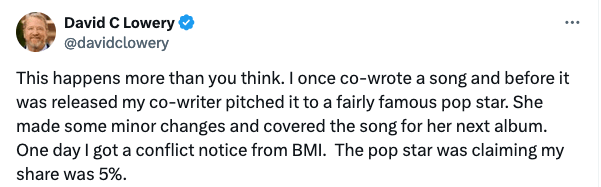
Show Me the Splits: Tiffany Red Illuminates Stealing Publishing

By Chris Castle
(A version of this post appeared on MusicTechPolicy and on Hypebot)

It’s unfortunately an old story, but that doesn’t make it right.

One of the most underpaid creatives in our business are songwriters who “just” write songs. “Just” is an odd word to use but it’s a common way to refer to those who give artists a voice because it really does all start with the song. And as Tiffany Red says in her video, the system is simply unjust.

“The system” is what has always been called “stealing publishing”. This is when an artist or a producer (and it happens with producers but for different reasons) threatens songwriters who created a song the artist may record with not covering that song unless the artist gets a chunk of the publishing. The amount can range all over the place, but often is at least 25% of the copyright. So not only are they not entitled to song’s earnings as a financial interest, they are definitely not entitled to the copyright because they created nothing.

On top of it, songwriters often have to eat many costs in order to get the song written, demoed and pitched. (I can’t tell you the number of times the songwriter demo essentially becomes the arrangement of the final recording, so “demo” is relative.). There’s a bunch of opportunities along the way for people to write themselves into the song when all they did was a job that they were probably being paid to do anyway. I have even encountered producers whose managers demanded a piece of publishing for the producer to even listen to an artist’s demos. 

On the producer side, some producers want a piece of all publishing on the record and if they actually write they want their contributor share as a writer ON TOP of the publishing they are already stealing. Why? What possesses anyone to think they are entitled to do this? And “entitled” is exactly the right word. 

One reason they steal publishing is because the producer royalty is unlikely to even recoup the producer advance in a streaming reality unless the track is a huge hit. (Remember that a producer gets a percentage of what the artist gets, say 30%ish, and the artist gets somewhere around 50% of the fraction of a penny per stream.) This is especially true of producers who enjoyed a lifestyle in the pre-streaming era and are trying to keep it going. It’s understandable, but that doesn’t make it right. 

And remember, the songwriter isn’t getting an advance. On top of the insult of stealing publishing, the artist has no intention of paying for it because the songwriter should consider themselves lucky to get the cover–which often is a career making record for the artist opening up income streams the songwriter never participates in.

When faced with these overreaching demands, songwriters have to make some hard choices. Occasionally I get to tell the artist’s team to fuck off. More often though–as Tiffany says–songwriters acquiesce.

I think Tiffany is also hitting at a point that Merck Mercuriadis made at the last Artist Rights Symposium that David hosts at the University of Georgia:

Let’s face it—this is insulting.  If I sat down and explained to my decent Greek working class parents that this is how songwriters get paid, they’d be shocked.  If you went to your bank manager and explained how songwriters get paid, they’d be shocked.  Doctors, lawyers, everyone who has some understanding of the economics of the world or what drives an industry and what creates value for an industry would be shocked by how songwriters are paid. 

But nobody can bring the frustration home like a songwriter on the receiving end of this injustice. Watch Tiffany’s video. Take 15 minutes out of your life and watch it from beginning to end with no distractions. She’s absolutely correct that until the artists stop, until they let their team know that stealing publishing is not acceptable and if they do it they are not only not helping the artist, but they’ll be fired–then it will start to change. 

She’s right about something else, too. A songwriter shouldn’t need a gatekeeper to protect them in a situation that should not be happening in the first place. There’s a line that we all learn from parents, teachers, coaches, mentors, the line between acceptable and unacceptable treatment of other humans, right and wrong if you like although that’s a bit simplistic. Stealing publishing is wrong, stealing publishing is on the wrong side of that line. This is what I think whenever I have to deal with the situation–how do you sleep at night?

Watch the video. it’s not a rant, it’s the truth.

Selected Comments on the Copyright Office Proposed Rule on Termination Rights and MLC Operations: Digital Licensee Coordinator

The Copyright Office has asked for comments from the public on important issues for rulemakings under the Music Modernization Act. This will potentially affect the operations of The MLC and related rights especially because the Copyright Office recently extended the scope of that rulemaking. The proposal drew a mixed response.

We will be posting selected comments that we think might be interesting to Trichordist readers. The project is a bit wonky, but important to stay informed on. This comment by attorney Allison Stillman representing the Digital Licensee Coordinator (who controls the purse strings for The MLC) has some interesting complaints about The MLC that are food for thought in light of the MLC’s potential redesignation coming next year.

The DLC’s firm view is that any additional costs associated with a proposed rule that upends the practices of the entire industry, without actually facilitating the payment of royalties to songwriters or music publishers, as a matter of law would not be “reasonable collective total costs” that could be imposed on the DMPs, through the administrative assessment or otherwise….

As noted in the DLC’s Initial Comments…the [Copyright Office] raises important issues regarding the need for the MLC to have a fair, efficient and transparent methodology for administering corrections and adjustments to payments. These are issues that apply…more broadly to any form of payment adjustment that may be necessary….

While some other commenters echoed similar concerns, the MLC suggests that error corrections, adjustments, disputes and payee changes outside of the specific and purportedly unique termination context “do not represent a controversial topic that would require regulation of operational details” and merely constitute part of “the normal course of business, which The MLC can administer without additional regulation.”

But the DLC members’ experiences in waiting for corrections and adjustments from the MLC where the issue has arisen so far indicate otherwise, and that is before the MLC has had to operationalize the anticipated regular practice of DMPs’ over-estimating monthly royalties [or Phonorecords III retroactive adjustments]…. The same principles underlying any regulatory approach to ensuring the prompt and transparent correction of erroneous payments to one rightsholder vs another as a result of copyright termination apply equally to require the prompt and transparent correction of [other payments to DMPs or rights holders].