Our Songs = Your Photos & Privacy : After a Week of “Whack-a-Mole” Reddit Bans Celebrity Photo Forums

So how’s that DMCA working now?

We’ve written about this before in our posts “My Songs = Your Instagram Photos” and “Two Simple Facts about Technology and Piracy : iTunes Vs. YouTube.” Now Reddit experiences what musicians have been dealing with directly for over a decade, the flawed arguments of ignoring consent online.

Reddit community manager Lisa Liebig, explains:

“We understand that the moderators did the best they could with the situation at hand, but having users purposefully try and circumvent the takedowns was starting to become a whack-a-mole game,” Liebig said, adding, “These factors led us to decide that the subreddit and many of its sister-subreddits were in violation of rule five of the site, ‘don’t…do anything that interferes with normal use of the site.’”

Make no mistake about it, this is about intent. Either we allow lawlessness as the norm, or we enforce the same rule of online as we do in the physical world. Consent is cornerstone of civilized society and mob rule should not be tolerated (not even for free music or celeb nudes).

The same mentality and arguments that make it acceptable to hack and post personal photos have been used as an excuse to ignore the massive, for profit, theft of personal copyrighted works for more than a decade. Neither is acceptable. As the future of music is tied to ad funded piracy, so is privacy tied to internet profits by the same lack of personal consent.

We applaud Reddit for not standing on a soapbox conflating personal rights, privacy and consent with some twisted notion of censorship and some nonsense about “breaking the internet.” Indeed, as we noted in our post “Principles for an Ethical and Sustainable Internet” technology may change but principles do not. It would seem that at least just for today, maybe the internet is growing up, just a little bit…

Read the Full Story at ReCode:
Reddit Bans Celebrity Photo Forums After a Week of “Whack-a-Mole”

Spotify’s Daniel Ek is Really Bad At Simple Math, “Artists Will Make a Decent Living Off Streaming In Just a Few Years”

The future of music for artist revenue streams seems more uncertain than ever. Digital Music News is reporting a quote from Spotify’s Daniel Ek on CNN Money which appears to show the failure of the companies CEO to perform simple math.

It should be noted that Daniel Ek was also the CEO of uTorrent, “the world’s most popular Bit-Torrent client” which is advertising funded.

Spotify CEO: “Artists Will Make a Decent Living Off Streaming In Just a Few Years” | Digital Music News

CNN: At what point can an artist survive on a Spotify income?

Ek: Well, I mean, the interesting thing here is that we’re just in its infancy when it comes to streaming. And we just last week had an artist announcement where we basically said if there would be 40 million subscribers paying for a service like Spotify, it would be more than anything else in the entire music industry, including iTunes.

We don’t want to say Mr.Ek is lying, but he does appear to be very bad at simple math and to be misinformed about the actual size of the record business and the revenue being generated by Apple’s Itunes.

Is anyone actually capable of doing simple math in a spreadsheet? Here goes. 40m Spotify Subs at $10 a month is only $3.3b in annual revenue to artists and rights holders at paying out 70% of gross. How is $3.3b “more than” the current $15b total annual global revenue or the $7b in domestic revenue in the US?

Here’s the simple math…

40,000,000 * $84 = $3,360,000,000

$84 dollars per subscriber annually is calculated at $10 per month per subscriber paying out 70% to Artists & Rights Holders or, $7 per month. $7 per month, multiplied by 12 months equals $84 per year, per subscriber payable to Artists and Rights Holders.

40m Subscribers x’s $84 per year = $3.3b in annual global revenue to artists and rights holders (assuming they really are paying out 70% of gross).

Simple math.

If you are an artist you might also read these links below:

Music Streaming Math, Can It All Add Up?

Venture Capitalist Admits Artists Can Not Make A Living On Streaming Royalties…

The Internet Empowered Artist? What 1 Million Streams Means To You!

Streaming Price Index : Now with YouTube pay rates!

It appears to us that music streaming can only truly be profitable to those with participating equity in the streaming company itself. Those with equity are leveraging their catalogs of assets against the potential revenue of an IPO (in which the catalog of assets is being leveraged for that equity). Thus far however, it appears that the artists and songwriters who have created those assets as the basis for that equity leverage do not participate in any profit sharing that the equity shares may earn.

So it’s not that music streaming can not be profitable, it’s just that it can not be profitable (or equitable) to artists.

Please tell us which artists are being compensated from the $3b sale of Beats music to Apple? Let’s see a show of hands… Bueller… Bueller… Bueller…

Remember when we were told that in countries where music streaming was the most successful that transactional sales also increased? We’ve got a bridge in Brooklyn to sell you too, and cheap. More food for thought below.

Streaming Isn’t Saving the Music Industry After All, Data Shows… | Digital Music News

Album Sales Hit A New Low | Billboard

No Surprise Here: Spotify Streams Soar While Track Sales Fall | Billboard


Copyright Stifles Innovation And Creativity! (Says The Internet): It Doesn’t; And Here’s Why | Nova.Edu

By Stephen Carlisle, Nova Southeastern University

If you read the internet, copyright, and especially long copyright terms are an unfathomable evil. In their eyes copyright “hinders learning, destroys our cultural legacy, hurts innovation and the general public, but most importantly it impedes filmmakers, artists, DJ’s and other content creators that need to be able to build upon the work of others to create new content”. 1 There are lots of dire pronouncements, with lots of invective and insults hurled, particularly at the Walt Disney Company (quote “responsible for one of the greatest thefts in world history”) 2. Yet as typical with such cyberspace broadsides, there is very little explanation of precisely how this suppression of innovation occurs.

That’s because copyright doesn’t suppress either creativity or innovation. And here’s why:

READ THE FULL POST AT NOVA SOUTHEASTERN UNIVERSITY:
http://copyright.nova.edu/copyright-does-not-stifle-innovation-creativity/

Pandora: money trumps morality, ran ads for anti-gay group.

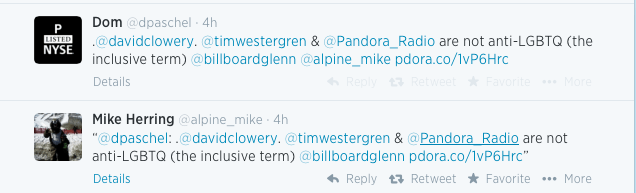
Screen Shot 2014-08-15 at 1.12.23 AM


Above Pandora CFO Mike Herring shows how down with the gays Pandora really is!  The link goes to a custom Pandora radio station for “Oakland Pride Radio.”   Wow that’s really going out on a limb there Pandora! I bet some of your best friends are gay! I wonder what Oakland Pride thinks of Pandora using them as a prop to excuse their donations to an anti-gay demagogue?  And what will they say when they find out Pandora ran ads for “Speak Up University?”   


When I worked for Pandora, I took my job seriously. My title was “Listener Advocate”, and, as a listener myself, I tried to bring the opinions of the listeners to the company. Of course, most of our job was helping people to be able to simply listen to the online station, sort of minimal tech support. However, there were several legitimate things that we initiated meetings with management about, and many times these were met with new ways to word our responses to ameliorate listener concerns.

After I had been there for about a year, and had responded to many complaints about specific ads, we started hosting tons of ads for Meg Whitman, who was running as the republican candidate in the California gubernatorial race, 2010. She came from being CEO of Ebay, (then to Hewlett-Packard afterwards) and was rich as hell, and apparently spent more of her own money on the race than any other political candidate in history ($144 million, $178 million including donations). The company was thrilled to take her money and run her ads all the time, which of course generated complaints, which I thought a lot about, and then brought them to the company.

I advocated on behalf of establishing a rule that we take ads only selling goods and services, and nothing dogmatic (i.e. politics or religion.) The company’s party line was that we would accept any advertising that ran on “major mass media”, ignoring the fact that the term “major mass media” is essentially so vague as to be meaningless. For example, we explicitly stated that we would not accept advertising about pornography or gambling, while Clear Channel, which is obviously mass media, ran billboards advertising gambling casinos all up and down the state.

I had several conversations with Joe Kennedy and Tim Westergren about this. Joe basically heard me out and then dismissed me. With Tim it was more difficult. One thing that I pointed out to him was that when we played political or dogmatic ads, it reflected on the company’s political stance. He absolutely did not believe that, he said “TV stations always run advertising for all political parties”. I said, “yes, but we see television companies as being driven only by money, so we distrust them implicitly.” Tim, as well, refused to believe that his public political action had any bearing on how the company was seen by the public-at-large. I thought that this was very short-sighted of him, and said to him that simply because he was very visibly active in politics, for example asking our listeners to advocate on the company’s behalf vis-a-vis royalty rates or other congressional mandates, that anything political that the listener hears on Pandora would be viewed with the inherent politics of the company in mind.

I brought up the hypothetical situation of running ads promoting Proposition 8, which was on the California ballot at that time, which was opposing same-sex marriage.

Tim blew me off on this, adding cryptically “I’d love to argue about this, I’m a student of Chomsky!” If he actually were, I would think he would currently be living in some sort of nightmare of cognitive dissonance. Anyway, I still advocated the idea of only advertising goods and services, and questioned the whole idea of trying to be parochial to “major mass media”. If we wanted to be a shining light in the field of “radio”, we should make our own rules, we absolutely did not have to be mini-Clear Channels. I tend to think that making our own rules about such things would work out better in the end, both internally and externally.

I didn’t realize at the time how the lip service we gave to being “pro-music” and being “about music” was covering that fact that it was, indeed, in the end, all about money, and only about money. Being moral has nothing to do with business, especially if you are in the United States, and, it seems, especially if you in the tech world. One of the engineers came by my desk and mentioned that the Meg Whitman ads were paying dollars where other paid nickels, so she was gonna get those ads placed in any case. (She lost that election, regardless.)

It was the following year that the company held its IPO and became a publicly traded entity. Then it got really bad. While Joe Kennedy claimed “an IPO is just another round of funding”, being even more beholden to the investors started to become evident. The advertising and programming choices became even more suspect, listeners began wondering what was happening. And along with the political things, came advertising that was even weirder. We got many complaints about “Speak Up University”, who appear to be a support group for “straight Christians”, but a little more research into the Speak Up organization proves it to be essentially and anti-gay hate group, among other things.

(It’s a fallacy to think that any dominant culture would need support in the face of abused minorities, the same way that there is no such thing as “masculinism” battling the tenets of feminism: feminism strives for equality; being against it is being for the current inequality of all people, regardless of gender. Nonetheless, there is so much misunderstanding of it that people are duped into thinking that they should be against it because somehow it promotes more power to one side (women in this example,) instead of simply promoting equality. One would think that the anti-gay marriage proponents believed that allowing it would make it mandatory—or Worse!)

I brought this up to the management, again. This, surely, was a moral line we should not cross in our blind acceptance of money for political or dogmatic advertising. This slightly stirred things up, partially because my team had several gay members, to say nothing of those who were simply trying to advocate morality and refused to accept that there was any difference between people regardless, and hence advertising that is divisive or hateful in any way should be avoided. We never really got closure on this, as the advertising sales people were the cream of the business crop, in their own little money-driven world, and couldn’t be bothered so much with whom they sold to, so long as they sold time or web space.

I realized at this point that the entire area of “customer service” within Pandora was backwards. The listeners were not the customers, the advertisers were. The listeners got music in exchange for listening to ads. That was the deal. Again, music was irrelevant, we could have been pumping sausage through a pipe into their mouths all day long, in exchange for watching ads. But the public perception of the company was still that it was somehow “pro-music and musicians.”

I tried to accept this all, but still had to speak out when we ran ads for “Minnesotans for Marriage”, another anti-gay hate group opposing gay marriage in Minnesota. And, looking around, our very team was segregated: the gay contingent was off to one end by themselves…This time was the last straw for management, I was brought into a meeting and told to “stop questioning decisions that had been made by the company”, that is, get with the program or get out. They said “you have some tough decisions to make”. The next day I was told to clean out my desk. Many people asked me about whether I wrote this article after I was fired (I didn’t, but it is all true.) Take a look.

http://www.buzzfeed.com/reyhan/tech-confessional-how-pandoras-ipo-changed-every

Losing my job was bad, of course, that always is, and it makes one a pariah in the tech world to simply care about the morality of what is done. I wrote this a year later: http://jsegel.wordpress.com/2013/03/21/pandora-now-a-year-down-the-road-from-me/

(To repeat some of that blog entry, when I was told by the new over-manager  “you can’t keep questioning things that the company has already made decisions on”, I replied that of course I have to keep questioning! What if people hadn’t kept questioning during the civil rights protests in the 1960s? He became really angry and reared up and said, you can’t compare these things to racial issues! I said, “uh, yes you can, I’m talking about civil rights, this ad is for an anti-homosexual group…?” When I left that day and went to a yoga class, I spoke with an expert: none other than Angela Davis was a student in the same yoga class that I went to in Oakland. She was fairly adamant that I was on the right track!)

In the past two years, Tim Westergren has proven that all he really cared about all along was the money, he and many of the other upper management and investors have been cashing out millions of dollars in stocks all the while lobbying against royalty rates to pay for the music that supposedly the whole Pandora concept is based on. And as he, and the company, become more and more politically involved, it reflects more and more on the company as a whole.

Now it has come out that Tim and Joe and others even donated to the radical right wing anti-gay congressman Jason Chaffetz. Presumably, they simply did this to throw money at him to sponsor IRFA, the “Internet Radio Fairness Act” (a very Orwellian name!) Of course doing so supports him in his entire agenda. So, they really don’t care? Or is the company based in such a sense of pseudo-morality that these people like Tim are actually supporting Chaffetz’ anti-gay agenda? How could we know?

If it is that, then this company is sick at its core. If it is only about money, then the company is amoral. That same sort of amorality and hypocrisy permeates the rich industrialists of the world, see here for example regarding the Koch family.

In any event, the Pandora bosses have made out like bandits already, so I doubt they care what happens. Maybe the company will wither, and in its withering prevent similar IPO-based “funding”.

We can only hope that they are replaced by music streaming companies that really care about music.


-post by Jonathan Segel

“Fifteen years of utter bollocks”: how a generation’s freeloading has starved creativity | New Statesman

Arguments for digital piracy are drivel – it’s high time we steered away from this cultural cliff, argues author Chris Ruen.

Piracy may feel like victimless “free culture” to the user, but they are in fact participating in a digital black market. It’s not about information wanting to be free, but rather it’s about exploitative black marketeers and willfully blind tech companies wanting to get rich. They are simply capitalising on loopholes in the regulatory framework. In this sense, mass digital piracy is a symptom of underdevelopment. It’s the Internet Third World, with outdoor markets hawking counterfeit goods and purveyors bribing the local cops to look the other way.

Tech companies will go on skimming profits off the top of this black market until enlightened governments cooperate to squeeze out these illicit profiteers in an effective and transparent manner. As Google’s own Chief Economist Hal Varian has written, “all that is required is the political will to enforce intellectual property rights”.

READ THE FULL STORY AT THE NEW STATESMAN:
http://www.newstatesman.com/culture/2014/07/fifteen-years-utter-bollocks-how-generation-s-freeloading-has-starved-creativity

Some cold analysis of the YouTube-Indie labels story, and some long term reflections | Wildcat Blog

So what’s going on with Google, YouTube and Indie labels?

There’s been so much fuss, indies tearing their hair, lawyers trying to tone it down: I try to sum up the whole thing here for your delight and delectation.

Alright, this is not a music law blog. It is, however, a blog where law and music meet. So, here we go. If you don’t know the ante-fact, have a read here or here.

And there’s also this update that Google may be revising its position now.

Why is the contract so bad? Wait, is it really bad?

READ THE FULL POST AT WILDCAT BLOG:
http://blog.thewildcat.co.uk/post/91151130569/some-cold-analysis-of-the-youtube-indie-labels-story

Pan Handling For A Career in Music | Guest Post By Dustin Mitchell of Katagory V

Recently, my band Katagory V created a crowdsourcing campaign to finance the release of our latest album, which had been completed (recorded, mixed, and mastered) over three years ago.  As much as Silicon Valley seems to laud this as “the way” to finance a musician’s work, I personally was very resistant to it for a long time.  This was more of a moral issue for myself than one of not wanting to “get with the times”, as we artists are so often accused of.  Recently, however, it became far more than a moral problem; it became a political one, too.

Don’t get me wrong.  I think the whole crowdsourcing concept is brilliant.  It’s a fantastic way to kick-start your craft if you have no capital to work with and arejust getting started as a band, filmmaker, writer, etc.  It is something I wish had existed when I started my musical endeavor years ago.  However, the more I look at it concerning my own band which has existed for 15 years, I feel like we are essentially panhandling. It is one thing, in my opinion, to use this to “kickstart” your dream career, it is another creature all together when you rely on it as your sole source of income to maintain it.

With that said, let’s not mince words here and just call it what it really is — crowdsourcing is panhandling on the internet.  I can’t be the only person that sees it this way…or am I?  I was raised to believe that hard work and perseverance gets rewarded, and when you reap these rewards, you do so with absolute humility.  Panhandling completely negates what I was taught. Granted, people who contribute get “perks” or a finished product IF…if it succeeds.  However, it is still asking for money for something that doesn’t actually exist yet.  Money for a promise: this is where my moral compass just spins out of control. Are we asking consumers, our fans, to become investors now?

The part that goes beyond my moral problems with this is that we are not crowdsourcing our unreleased album to get our career started, rebooted, as a noble cause, or even to try and break away from the whole record label cycle.  We are doing it because after three years, we have no other choice.  Labels are reluctant to take risks or give advances, consumers are using streaming or free options, both of which obviously pay us nothing, and we don’t have any more capital ourselves to fund it.  Nothing is more frustrating or humiliating than doing something that you find absolutely immoral AND politically backwards, yet knowing that you HAVE to do it as a means to an end.  There is no Plan B or C; this is the ONLY plan left.  It’s very ironic, but one of the songs we had written for this unreleased album, “I Am Change,” lyrically and inadvertently prophesied this very situation.

When I told the members of my band that I was going forward with this panhandling scheme, I insisted that our campaign bio had to explain to our fans WHY we were doing it.  Unlike most artists doing these funding projects, I wanted it spelled out in big bold letterson the front page of the campaign, that thanks to the “new boss,” we had no choice but to have our fans directly fund our work.  Otherwise, this album would never be released.

There are several paragraphs in our campaign explaining what has happened in the music business in the last decade, why our “middle-class” band had been forced at gunpoint to climb aboard the express train to “poverty,” and why we are now holding out our hands, begging for spare change.  By laying out the truth and thus risking the possibility of being viewed as sniveling and whiny, we may be pushing our potential contributors away.

Why would these potential contributors be turned off?  Because NO ONE likes cry-baby musicians.  They literally tune them right out.  Music consumers don’t want to hear our problems.  They just stuff cotton in their ears and mouse click over to the next free meal.  And you know what?  I don’t care…it’s already been three years.  I can wait another three, ten, or even twenty years if it means standing my ground on how I feel about the digital age and how we as artists are being bent over the proverbial barrel more than ever in the history of the music business.

The band was surprisingly supportive of this idea to add this segment to the campaign.  I had been preaching this possible doomsday scenario to them (and anyone else who would listen) as far back as 2007.  I always knew it was going to get worse before it got better when we started recording this album back in 2010; I just never imagined it would get THIS bad with no real resolution in sight.  I can’t help but wonder if this is the end of days for music.

Our fans (and others looking to contribute) need to know the truth.  Of course we want people to contribute; we want this album out there just as much as our fans do, or else we wouldn’t have resorted to creating a panhandling campaign!  If it doesn’t work, this album is going to go back on the shelf indefinitely.  Even if people don’t contribute and they walk away from it with a little education and a better understanding of how things work (or don’t work) in the world of music today, I will personally feel a little better about having to resort to this fundraising tactic.  I can only hope we don’t ever have to take this route again.

The financial ecosystem in which our band had worked under for over a decade has been eradicated.  It’s as if we are living out that John Carpenter movie, “They Live.”  The music industry isn’t even an industry anymore; they/we are the puppets of this new boss.  We put in thousands of dollars of our own money into this album thinking that things would get better, that someone would find this miracle “new business model” that would restore the balance to the force, and that we would at least see a return that would pay back our expenses.  This has yet to happen and, sadly, probably never will.  So now, after three years of waiting for the other shoe to drop, we decided to stop bruising our backsides from sitting on the fence, swallow our pride, and fund our music by turning our band into a PBS pledge drive.  I never in my wildest dreams thought I would be panhandling for my career in music.

Never.

Dustin Mitchell
Bassist/songwriter – Katagory V
website: http://www.katagory5.com

Weatherley: ‘Cutting off ad revenue to illegal sites is key to piracy battle’ | Music Week

“Following the money is the key to shutting down the vast majority of websites that host illegal material,” said Weatherley. “This report explores a number of issues surrounding the piracy debate and I hope that it will spur further discussion both in the UK and, given the international nature of this problem, in other countries across the world.

“As the Intellectual Property Adviser to the Prime Minister, I feel that it is my role to highlight just how damaging piracy is to the UK economy. It is paramount that we curb advertising revenue that is going to pirates who are, in turn, seriously damaging our creative industries.”

Commander Steve Head, head of economic crime at City of London Police, said: “Disrupting revenue to pirate websites is vital to combating online intellectual property piracy and I therefore welcome the recommendations in Mike Weatherley’s report. We must take the profit out of this type of criminality and where legitimate companies, such as payment providers, are facilitating that profit they must be held to account if they fail to act.

READ THE FULL STORY AT MUSIC WEEK:
http://www.musicweek.com/news/read/weatherley-cutting-off-ad-revenue-to-illegal-sites-is-key-to-piracy-battle/058830

The Pirate Bay must be fought for the sake of exploited musicians | The Sydney Morning Herald

In Australia, there is very little that a musician can do to stop illegal streaming and downloading sites from using their work. These illegal sites make massive amounts of money from ads and nothing goes back to the artists who provide the content. Not one cent.

Sites such as the Pirate Bay and Kickass Torrents exploit artists in the worst sense of the word. These illegal sites do not support musicians’ careers. They deprive musicians of the right to have their work valued in a free and open market.

The success of these sites is predicated on taking without paying on a massive scale. In fact, that is their business model. They don’t create anything. I feel infuriated when I see my work and my friends’ work being used in this way by people who don’t give a damn.

READ THE FULL STORY AT THE SYDNEY MORNING HERALD:
http://www.smh.com.au/comment/the-pirate-bay-must-be-fought-for-the-sake-of-exploited-musicians-20140623-zsiqo.html

2.5 Million P2P Users Worldwide Illegally Shared The Top 60 Video Game Titles | Digital Journal

It’s not just music…

“With most of these games being $20 and $50 or more to download, the loss of revenue from this amount of piracy is huge,” said Kyle Reed, Co-Founder and COO, CEG TEK. “There’s been a lot of debate about whether or not piracy is really an issue for the massively successful video game business, but if publishers like Electronic Arts are losing nearly $30M a day in potential revenue on 13 of their hottest titles, that’s something to be concerned about.”

READ THE FULL STORY AT DIGITAL JOURNAL:
http://www.digitaljournal.com/pr/1983503