How to ignore YouTube completely: One Direction’s radical gamble | Music Business Worldwide

Good luck Sony, let’s see how this goes with the “User Pirated Content” at YouTube…

Search YouTube for 1D’s new comeback single Drag Me Down, and you’ll discover Harry, Niall, Louis and Liam are nowhere to be found.

Sony won’t confirm it, but the major appears to have a taskforce stamping out any attempt to upload the track onto the platform.

Why? Because One Direction are using their colossal social media presence (Twitter: 24.5m; Facebook 37m; Instagram: 9.7m) to actively push fans towards iTunes and Spotify instead.

READ THE FULL STORY AT MUSIC BUSINESS WORLDWIDE:
http://www.musicbusinessworldwide.com/how-to-ignore-youtube-completely-one-directions-radical-gamble/


YouTube’s Content ID : $375.00 Per Million Views… aka “Block In All Countries”…


What YouTube Really Pays… Makes Spotify Look Good! #sxsw


@BerkleeCollege Shows They Aren’t Serious, Responds to Our Criticism with Straw Man Argument

Professor Whiteboard Trichordist vs Berklee item 1

Berklee College of Music has still not addressed our fundamental criticism of their report. 

A few days ago I had an email conversation with Panos Panay who may or may not have authored the flawed Berklee College of Music report on transparency and fair pay in the music business.   In our conversation he indicated that he thought our list of omissions were valid criticisms of their report.  I encouraged him to issue a follow-up report or letter.

Yesterday Berklee did indeed issue a follow-up.  But it was less of an actual correction or update and more of a defensive “fuck you.”  Yes, they squandered their opportunity to have a real discussion, by following up with a bullshit straw man argument, that completely misrepresents our criticism of the report.  These guys are not interested in a real and honest discussion.  Therefore don’t expect an honest discussion at their conference either. In other words don’t waste your money.

Here’s what they say about our criticism in their follow up:
“Some have questioned the role of digital services in this debate. It is important to remember that most online music services pay 70% of their revenue to rights holders (except YouTube, who should be encouraged to pay more than their current 50%), and we believe that this technology for distribution is a good thing. It is impossible to put the “Internet genie back in the bottle” — let’s not forget that the main source of industry woes 5 years ago was piracy — and at least a business model has evolved that has people paying for music again” 

Classic straw man argument.

We don’t think “the technology” is a bad thing, and we are not trying to put the “internet genie back in the bottle.”  If you want to put it in terms of “internet genies” we are asking the internet genies to drop their NDAs and to exhibit more transparency on advertising revenues and expenses.   This is clearly illustrated in the whiteboard photo above.  Further the email record clearly  indicates that Panay understands our criticisms.  The only conclusion is that Berklee knowingly misrepresented our criticisms of their report.

This is classic demagoguing.  Trying to neutralize your critics by dishonestly claiming they are saying something they are not.  Berklee implies we are “trying to put the internet genie back in the bottle”  or somehow we are against streaming technology because they wish to portray us as hopeless luddites that are completely out of touch with the modern world. Yet facts are facts, our criticism illustrates a deeper understanding of the revenue flow in the digital world than their sloppy and biased report.

I don’t understand how someone at an academic institution can engage in this sort of demagoguing and still have a job.   My academic institution would really have a problem with me issuing an official statement in the name of the institution that engaged in this level of dishonesty.

At the very least from a public relations stand point Berklee needs to learn to stop “poking the bear.”  Especially this bear.  They just gave us at least five new posts on why rights holders and artists should NOT go to their “Rethink”  conference.


BUT SPOTIFY IS PAYING 70% OF GROSS TO ARTISTS, ISN’T THAT FAIR? NO, AND HERE’S WHY…


Why Digital Exec’s ARPU is Bad Math and also Bad Philosophy for Artists.


Music Artists Take On the Business, Calling for Change | New York Times

The New York Times quotes representatives of the artists rights movement including Blake Morgan of the #irespectmusic campaign, Melvin Gibbs of C3Action.Org (Content Creators Coalition), David Lowery of the Trichordist as well as musicians Zoe Keating, David Byrne and others.

“None of these companies that are supposedly in the music business are actually in the music business,” Mr. Gibbs said. “They are in the data-aggregation business. They’re in the ad-selling business. The value of music means nothing to them.”

READ MORE AT THE NEW YORK TIMES:
http://www.nytimes.com/2015/08/01/business/media/music-artists-take-on-the-business-calling-for-change.html

“User Pirated Content” Is Core Internet Advertising Model (Which is Why Streaming Rates Can’t Increase Until Piracy is Decreased)

Google’s YouTube is a business built on infringement as a model. So called “User Generated Content” is really just code for what the majority of the high value media on YouTube really is, “User PIRATED Content“.

In other words there’s nothing internet advertising loves more than illegally monetizing the work of professional creators, and thus driving down the true fair market rates for those works (keep this in mind when thinking about Spotify and streaming services!).

Below are excerpts from emails discovered during the Viacom Vs. YouTube lawsuit and published  by DailyFinance:

• A July 29 email conversation about competing video sites laid out the importance to YouTube of continuing to use the copyrighted material. “Steal it!” Chen said , and got a reply from Hurley, “hmmm, steal the movies?” Chen’s answer: “we have to keep in mind that we need to attract traffic. how much traffic will we get from personal videos? remember, the only reason our traffic surged was due to a video of this type.”

And this is not the only smoking gun, here’s a quote from DailyTech regarding Google’s Ad Sales and the site EasyDownloadCenter: 

In fact, Google’s ad teams even made suggestions designed to optimize conversion rates by using keywords targeted to pirated content – such as suggesting downloading films still in theatrical release, that obviously were not available yet in any authorized format for home viewing.

According to PCWorld this added up to some decent money…

EasyDownloadCenter.com and TheDownloadPlace.com generated US$1.1 million in revenue between 2003 and 2005, and Google received $809,000 for advertising, the Journal reported.

Both YouTube and Google Search function similarly by monetizing infringing “User Pirated Content” with advertising. On YouTube users upload infringing music and videos of all varieties which attract the consumers to the globally dominant and monopolistic video streaming site.

Remember the email above where the YouTube founders admit “how much traffic will we get from personal videos? remember, the only reason our traffic surged was due to a video of this type”. And by “this type” they mean professionally produced and created media by artists, musicians, filmmakers and other creative professionals that are of high value in attracting an audience – an audience that can then be monetized with advertising.

Google Search operates in very similar way (no coincidence) by monetizing (mostly with advertising) millions infringing URLs on sites primarily dedicated to distribution of copyrighted works via p2p networks and bittorrent.

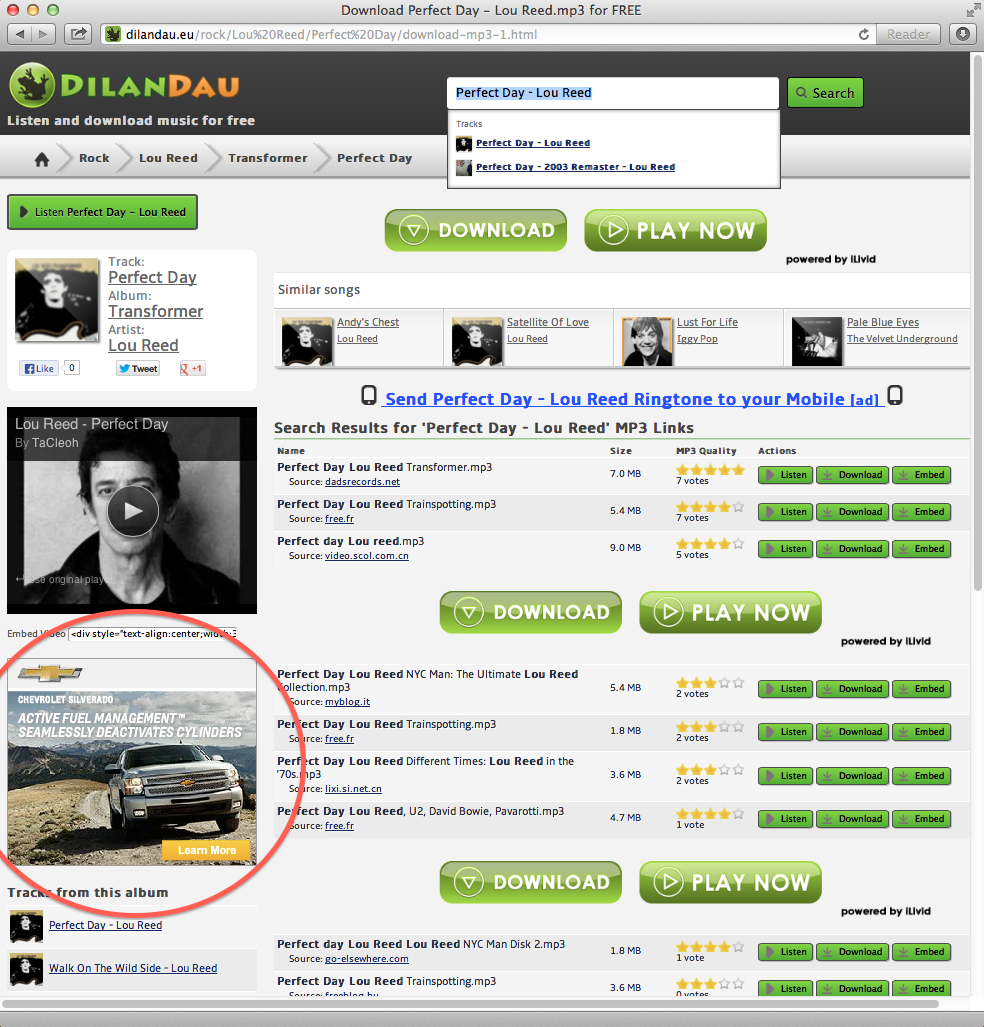
Over 50 Major Brands Funding Music Piracy, It’s Big Business!

LouReedCHEVY

But don’t take our word for it, here’s a report from DigiDay (owned by The Economist):

According to AppNexus CEO Brian O’Kelley, it’s an easy problem to fix, but ad companies are attracted by the revenue torrent sites can generate for them. Kelley said his company refuses to serve ads to torrent sites and other sites facilitating the distribution of pirated content. It’s easy to do technically, he said, but others refuse to do it.

“We want everyone to technically stop their customers from advertising on these sites, but there’s a financial incentive to keep doing so,” he said. “Companies that aren’t taking a stand against this are making a lot of money.”

What about the removing infringing material with a DMCA notice you ask? Well, we’re glad you did… here’s how it “works”…

https://vimeo.com/94514834


DMCA “Takedown” Notices: Why “Takedown” Should Become “Take Down and Stay Down” and Why It’s Good for Everyone | Nova Edu


Safe Harbor Not Loophole: Five Things We Could Do Right Now to Make the DMCA Notice and Takedown Work Better


A Declaration of Principles for an Ethical and Sustainable Internet

Originally written and posted in 2012, here again for your July 4th weekend…


Technology may change but principles do not. A society that encourages the creative spirit is rare in history and worth defending. The internet and digital technology have opened up many new opportunities for artists, but it has also opened up new opportunities for those who wish to exploit those artists.

We offer for discussion a set of principles as a guide for companies and policy makers to keep in mind. It is our hope that these principles will help build a sustainable online creative ecosystem, one that benefits creators, innovators, and the general public alike.

1. FAIR AND ETHICAL LABOR PRACTICES: RESPECT WORKERS’ RIGHTS
A fair and ethical internet is built on the respect and protection of the rights of individuals to determine who benefits from their labor and creations.

Since the rise of digital utopians in the 1990s, we’ve unfortunately seen many very old arguments surface as to why the economic benefits of a few big companies should be valued over the labor rights of many. This problem is what drives workers to organize to protect their labor and demand fair compensation. Not only are artist rights protected by the US Constitution, artist rights are also internationally recognized as human rights protected by many international treaties, including the Universal Declaration of Human Rights. Unfortunately, however, there are those who seek to capture the value of artist rights profit only for themselves by systematically violating these rights for commercial gain.

A free and open internet works best without overbearing regulation, but it will not work at all without protection for fundamental rights of working people.

2. CONSENT IS THE FOUNDATION OF CIVILIZATION: RESPECT ARTISTS’ INTEGRITY
Your right to swing your fist stops at the end of my nose. Your rights end where mine begin.

Rights secured by the Constitution are intended to protect the individual from hostile majority forces and the tyranny of the mob, particularly the corporate mob. This is especially true regarding copyright, which is itself a vehicle of the right of free expression for individuals, and protected by the Constitution.

Everyone understands the value of individual privacy in the digital age. The essence of the artist’s control over the integrity of their work is not that different. Individual consent should be required for a corporation to profit from taking any creative work (just like individual consent is required for taking personal information) because the creative work goes to the artist’s personhood. Protecting an individual’s right to their personhood and the protection of their free expression are building blocks in the foundation of civilization.

3. PROTECT INDIVIDUAL FREEDOM OF EXPRESSION: DON’T TRIVIALIZE CENSORSHIP
Freedom of speech requires freedom of expression. Copyright protects free expression. Together, they ensure a robust marketplace of ideas that advances truth, knowledge, and culture.

Let’s get this straight. Censorship is intolerable. You don’t have to look very far to see artists being censored by governments — there are many historical examples . No one understands this more than the scores of individual artists, musicians, painters, writers, poets, filmmakers and creators of all disciplines who have actually (and literally) have been persecuted, disappeared or assassinated for their views all over the world. Sadly, many confuse the actual freedom of expression with the mistaken idea that preventing the illegal exploitation of that very expression is the same thing. It’s not.

The copying and distribution of those expressions without the creators permission is simply exploitation without consent or compensation. Would you think that a car thief is being censored when they are prosecuted for stealing your car or a bank robber is being censored when they are prosecuted for stealing your money? Don’t trivialize “censorship”.

4. FAIR COMPENSATION: IF YOU DON’T LIKE IT, DON’T BUY IT
In any value chain where the individual creator’s work is exploited, the creator must be compensated.

Most fair and reasonable people embrace “Fair Trade” products to support and encourage fair compensation of labor. Unions have fought long hard-won battles for the protection of labor rights. As a society we recognize the individual’s right to fair compensation of labor as a fundamental cornerstone to an ethical and healthy society. The internet is inhabited by as many different varied participants as the physical world, and the respect for human labor should not be devalued simply because technology makes it possible to be unethical.

It’s very simple–the answer if you don’t like an artist’s work is not to steal it–just don’t buy it. They’ll get the message.

5. MUTUAL RESPECT: IT’S ABOUT GETTING IT RIGHT, NOT GETTING AWAY WITH IT
Mutual respect for the diversity of all online citizens is the cornerstone of a healthy and robust community.

The mutual respect granted by intellectual property rights allows individual creators the freedom to determine what permissions they wish to grant and at what price. No one has to pay that price, but the creator is entitled to set it. Denying these freedoms to creators because the mob or a public company wants to overrun a musician, author, illustrator or photographer violates the very protections against mob rule that the Constitution is intended to secure. Sadly, this is largely how individual rights are viewed today by some online corporate interests.

6. PARASITIC EXPLOITATION IS NOT INNOVATION: FREE AND OPEN SHOULD BE FAIR AND HONEST
The illegal exploitation of individuals for commercial gain is not innovation, it is techno-thuggery and cyberbullying.

We see many companies on the internet illegally exploiting the work, labor, innovation and creations of others simply because they can get away with it. We’re often told that innovation requires the unauthorized exploitation of creators in some kind of technological determinism that rejects the innovation of creators because it“scales”. That is just another way of using “convenience” as an excuse for theft. Any business that requires the illegal exploitation of individuals to be profitable is not a business but rather is a parasitic engine of oppression.

7. SUSTAINABLE INNOVATION SOLVES PROBLEMS: FAIR NOT FAKE
Sustainable innovation is best represented by solving problems, not creating them by adding intentional opaque layers of obfuscation.

The organized and deliberate complexity of some online ad networks, pirate site operations, and other businesses creates an impenetrable black box to protect illicit money flows and give the participants plausible deniability. Then we are told to “follow the money” through advertising networks, down a rabbit hole to a maze followed by another rabbit hole. That’s not innovation. It is old school wire fraud. This should not be a badge of honor for the online community but rather a point of embarrassment that the Internet—one of the greatest technological achievements of all time–is trivialized by making it nothing more than a safe house for many illegitimate businesses profiting at the expense of honest citizens.

8. COMMON GOALS, BEST PRACTICES AND SOLUTIONS:
There are centuries of mutual ground between creators, commerce and rights holders. Let’s not throw this away.

Let’s not set a goal of building a large database for clearances of all copyrights and do nothing until it is operational. That solution almost guarantees that there won’t be many new works to put in that database. Such a database has never existed and is incredibly complex. A transparent rights clearinghouse is a possible solution, but the lack of one it is definitely not an excuse for bad behavior.


Why .002 is Greater than .001 and Why 90 Days is Better than Forever…

There’s been a lot of talk and understandable dissent surrounding Apple’s free tier payment of the reported .002 per play during each consumers 90 day free trial period. We now live in a world of lessor evils.

Here are three things that we may want to keep in mind…

One:

Eliminating the Unlimited Free, Ad-Supported, On-Demand Access to Music is Job #1. Apple Music and Tidal are both positive steps in that direction.

Two:

.002 is DOUBLE .001 which is what Spotify is paying on it’s ad-supported free tier (see chart below). Yes, we’d love Apple to pay the full ride. Yes, Apple can afford to pay the full ride. Yes, we support any action that influences Apple to pay the full ride – but as a compromise we could be doing worse, and in fact we have been for over five years since the Spotify launch.

Three:

90 Days is Limited. Ad-Supported is forever. This is the big problem. Even if  Spotify was limiting their ad-supported free tier to 90 Days, Apple is still paying DOUBLE. But the real problem is that Spotify is FREE FOREVER. It’s time to keep the eye on the prize here.

Three Steps to a Sustainable Digital Music Ecosystem:

1) Eliminate the Unlimited Free, Ad-Supported, On-Demand Access to Music

2) Windowing

3) Tiered Pricing, based on Access and Consumer Value Proposition

That’s really it. It’s not really any harder than this and we can already see these models working for the Film and TV businesses.


Streaming Is the Future, Spotify Is Not. Let’s talk Solutions.


Why Spotify is not Netflix (But Maybe It Should Be)


Why Digital Exec’s ARPU is Bad Math and also Bad Philosophy for Artists.

Why Apple Music and Tidal are the right business models with the wrong optics.

Since Spotify launched in 2010 the music business has been in an existential crisis. Convinced that ad-supported unlimited free access to on-demand music would ultimately grow recorded music revenues the major labels opted into what may be their worst decision ever. This decision aided by an estimated 18% (or more) equity position in Spotify has not grown overall music revenues over the past five years. In fact, for the year ending 2014 global revenues reported by the IFPI stated that revenues were at the lowest point in decades. So what to do?

For starters the first and most obvious solution would be to eliminate the unlimited ad-supported free access to on-demand music. This is the model that made ad funded, for profit piracy so popular on over half a million infringing links from unlicensed businesses served by Google search and delivered to your inbox by Google Alerts complete with social media sharing buttons. These unlicensed businesses are receiving hundreds of millions of DMCA notices annually from artists and rights holders. Let us not forget that this is also the same model that Daniel Ek helped to perfect as the CEO of u-torrent the worlds most installed bit-torrent client. Ek has said he’d rather shut down Spotify than give up his failed ad supported business model.  We thought Spotify was built on converting ad supported (where Spotify board member Google makes money serving ads) to subscription (where artists make money).  So much for that.

And this is who the record business is taking notes from? Perhaps that’s why Universal is restructuring.  This may have seemed like a good idea to some senior executives but it turned out to be a complete disaster.  Time to change.

Despite moves in the right direction by Tidal and Apple Music the optics for both of these companies at launch of their respective streaming models have been somewhere between missteps and an absolute disaster. Dismissing for a second that both Apple and Tidal could be the targets of public relations campaigns by competing corporations such as Spotify, Pandora and Google (YouTube) let’s look at what each is offering. Tidal and Apple Music offer no unlimited ad-supported free access to on-demand music. That means no business to those selling advertising… like, Google.

There is nothing more important to the future of the recorded music ecosystem than removing the unlimited ad-supported free access to on-demand music.

For all intents and purposes even free streaming is ownership and here’s how you can tell. If you can chose it, and access it, you essentially own it whether you pay for it or not. Streaming replaces ownership at the consumer level but does not compare to ownership on price. At some point there needs to be a market correction to properly value music consumption.

The launch of Tidal should have been a rallying cry for all artists to support a business model that limited free streaming, incentivized paid subscriptions through exclusive offerings and diversified consumer experiences with higher quality streaming formats. This is the model we should be focused on. As the Buddhist saying goes, “trust the teaching, if not the teacher.” In other words it doesn’t matter if you don’t like Jay-Z and Madonna.  And securities laws makes the whole stock issue so difficult that Tidal would have been far better off saying they’d pay all participating artists a bonus in the cash from the company’s own stock sales rather than get down the rabbit hole of who gets stock and who doesn’t.

Unfortunately the celebrity that could have united a community, instead divided it through messaging that most would acknowledge appeared to be less than inclusive. Worse, the optics appeared to be elitist whereby those already rich and famous seemed to be more focused on their own fortunes as opposed to a sustainable ecosystem for the next generation of musicians.

Perhaps if each of the artists at the Tidal launch would have appeared with a developing artist they were supporting the messaging and optics would have been more inclusive and more about community than celebrity.

We have to acknowledge what kind of business we want going forward. Clearly, unlimited ad-supported free access to on-demand music is not working. Both Tidal and Apple Music do NOT have unlimited ad-supported free access to on-demand music. So what’s the problem?

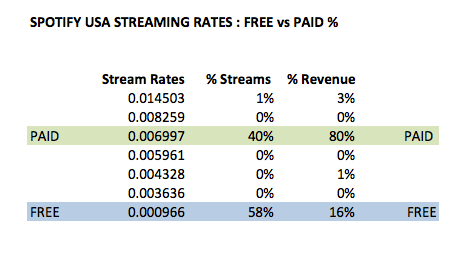
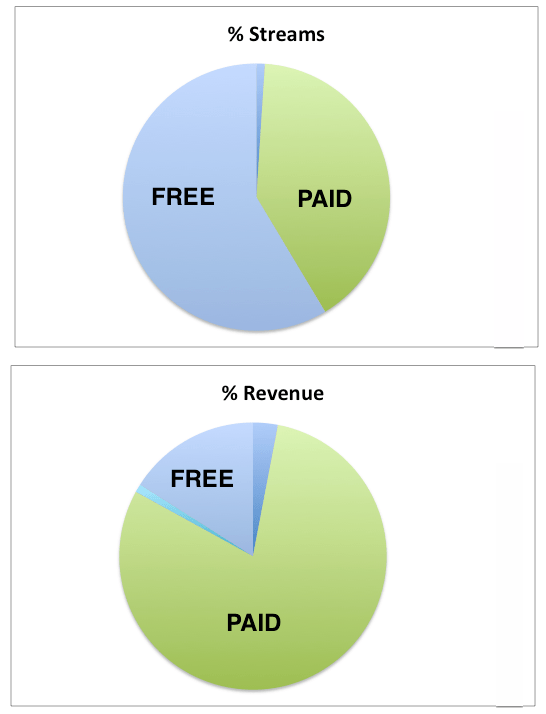
Following the Apple Music launch Spotify announced it had achieved 75m global users (we love that, “users” no kidding) and 20m paid subscribers. So let’s look at the numbers in relationship to what Apple Music could bring to the market place. Keep in mind that 55m of Spotify’s user base are NOT paying for the service. Based on reporting we’ve been provided the free tier accounts for 58% of plays which is only 16% of the total revenue.

With all the back and forth between Apple and labels and the announcement last week by NMPA of the publisher’s deal—freely negotiated without government “help” by the way–it’s pretty clear that Apple announced Apple Music without all their ducks in a row contractually.  This opened up an opportunity for haters who are just gonna hate.  Now that the picture is becoming a bit clearer, we feel more confident than ever that most of the noise is coming from competitors who would like to create yet another consent decree situation but this time for artists and record companies.

So there are a few questions we need to ask about the launch of Apple Music to evaluate the trade-off for eliminating the unlimited ad-supported free access to on-demand music. But before we ask those questions, we need to understand the mechanics of the Apple Music ecosystem.

First, the 90 days free without payment at launch requires the understanding that all consumers will get 90 days free at Apple Music whether they sign up at launch or at any other point later. This means that some people will opt in at launch, some will opt in at some later time. Based on what we have seen of how these streaming subscription services scale we have to ask a few questions.

How many people will have access to opt into Apple Music Streaming on launch? We’ll assume it’s the entire installed user base who upgrade into iOS 8.4. Here’s some back of the napkin math from the iPhone 6 launch when Apple dropped that U2 album into everyone’s Itunes.

According to CBS News 33 Million people of the 500 Million Global Itunes users “experienced” the U2 album. That’s just 6.7 percent of Apple’s reported consumer base.

So what kind of adoption and conversion rate could one expect from the launch of Apple Music? 10 million paid subscribers? 20 million paid subscribers? 50 million paid subscribers? It’s hard to know, but anything north of 20 million pretty much beats Spotify on paid subscribers.  And if you are looking for the company that has defined a paid music service, who you gonna call?  Apple or Spotify?  Who do you trust going forward?

What if Apple is able to convert 30 million or more consumers to paid streaming in only four months when it has taken Spotify five years to acquire 20 million paid?


BREAKING NEWS AT PRESS TIME. APPLE WILL PAY ARTISTS DURING THE FREE TRIAL PERIOD!
Apple Reverses Course, Will Pay Artists During Apple Music Free Trial | Mac Rumors


Of course, Apple should use a couple of bucks from it’s 178 billion dollars in cash reserves to compensate musicians for the consumption of their music during the initial 90 day launch of Apple Music. This would  incentivized artists to promote the service as being both fair and artist friendly and give Apple the thumbs up from the people that matter the most, the artists themselves. Apple’s purchase of Beats was a three billion dollar acquisition, so surely there’s enough money in those coffers to pay artists something.

To put these numbers into perspective Spotify claimed to have paid artists and rights holders two billion dollars globally from it’s initial launch in 2008 through October of 2014.

Here’s some more perspective from asymco.com: In 2012, global music revenues were reported at $16.5 billion, with $5.6 billion coming from digital music. Of that $5.6 billion in music downloads, Apple paid labels $3.4 billion for iTunes sales, which is about 60% of the total digital revenues industry wide—IN LESS THAN ONE YEAR.

In 2012, Apple’s transactional digital model created more revenue for artists and rights holders in less than a year in then it took for Spotify to earn almost 6 years.

If we want to break the death spiral of unlimited ad-supported free access to on-demand music we have to embrace the trade-off of offering limited free trial periods as an incentive for consumers to make the switch.

And by the way—compare the classy way that Eddie Cue of Apple handled Taylor Swift compared to Daniel Ek who comes off like a semi-stalker.  Who understands artist relations the best?

The problem with ad-supported unlimited free access to on-demand music is illustrated below showing Spotify domestic streams and revenues. It’s just math and it’s time to move on. Apple Music and Tidal are showing us the way.

 

DMN Says It’s Unlikely Spotify Pays More to Rights Holders Than Apple Does

In the dust up surrounding the Apple Music Launch and the leaked agreement that lead to speculation that Apple was paying indies less than the often heard 70% to rights holders an interesting thing happened.

Industry executives and commenters at Digital Music News reported that Spotify was also paying indies less than 70% and closer to the 58%, or less than Apple.

Update to June 15th, and Apple is not only stating that they are paying 70%, but a more aggressive 71.5% to 73% of revenues depending on territory.

But what makes this that much more interesting is that Spotify has now been outed as NOT paying the commonly accepted 70% of revenues and also has NOT responded to the claims being made at Digital Music News…

So how much is Spotify actually paying? So much for openness and transparency…

RutOh...