Remarks at the California Copyright Conference #irespectmusic Grassroots Advocacy Panel with Adam Dorn, Karoline Kramer Gould, David Lowery and Blake Morgan

Music Technology Policy

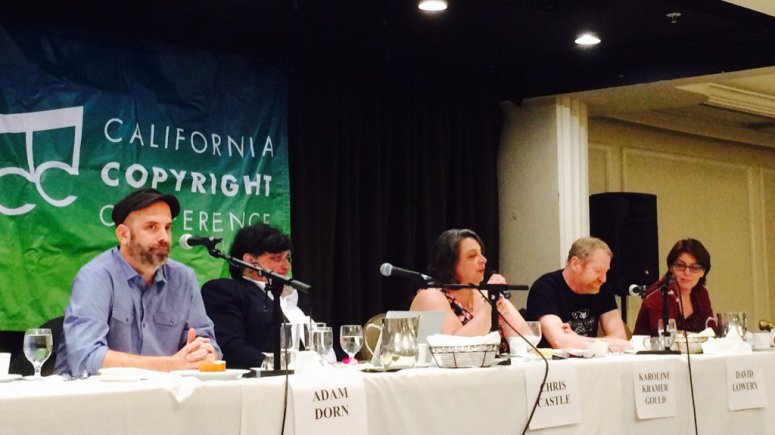
Ca5c9v2VIAE3V5f.jpg-large Photo courtesy @amyraasch

What a great way to start Grammy Week!  Last night Adam Dorn, Karoline Kramer Gould, David Lowery and Blake Morgan came together to tell their personal stories and they let me moderate.  Each of them has an inspiring story of how they came to their personal epiphany, their inspiration to turn to advocacy as part of their lives.

And in case it wasn’t clear–we were recruiting!  Follow them on Twitter through the ‪#‎irespectmusic‬ and @theblakemorgan, @radioclevekkg @davidclowery @moceanworker and @musictechpolicy.

The following are my introductory remarks to the panel:

Successful advocacy sits on a three legged stool whether we like it or not—lobbyists, campaign contributions and individual action.  The music industry and the larger entertainment industry has largely failed to achieve successful advocacy.  We still have essentially the same problems today that we had 15 years ago and the industry is at least half its former…

View original post 543 more words

#irespectmusic: Tish Hinojosa Speaks Out on Fair Pay for Musicians at Live Music Venues

The great artist Tish Hinojosa wrote a must-read opinion piece for her home town paper, the Austin American-Statesman, about the realities of gigging in a “no cover”/”tip jar” reality that is all too common at live music venues across the country.

In her post “Austin venues, patrons can do more to pay musicians fairly,” Tish lays bare the ugly truth that we experience every day–wage stagnation for musicians produces the “you’re lucky to have a job” mentality with many venues:

I am finding that even Austin’s best-known and talented support — aka “side” — musicians and singer-songwriters are playing for peanuts, meaning, for the same or less than we were earning in the 1980s. In the meantime, the cost of living in this city has grown tremendously — and so has the city’s pocketbook. That Austin’s reliable, hard-working, talented and diligent musicians can’t even afford to live in the city is a shame, especially considering that they are the backbone of the “Live Music Capitol Of The World.”

Too many Austin venues are taking advantage of good musicians who just need to work and are offering those artists “this or nothing deals” like: “Do you know how many of you would be happy just to say they play here?”

Tish’s post links to another Statesman story about the findings of the 2015 Austin Music Census which confirmed Tish’s concerns about the music community.  The City of Austin commissioned the Austin Music Census, the only study of its kind, that surveyed 4,000 members of the Austin music community and identified the “no cover” issue as a major problem that needs to be addressed.

In her must-read post, Tish gives the human side from an artist’s perspective on the ground.  Wherever you live, we believe that you’ve probably experienced the exact same take-it-or-leave-it deals that amount to “pay to play” enforced the old fashioned way–by intimidation.

Thanks to Tish for speaking out.

@theblakemorgan Looking For #irespectmusic Results from Government

Music Technology Policy

Blake Shumer

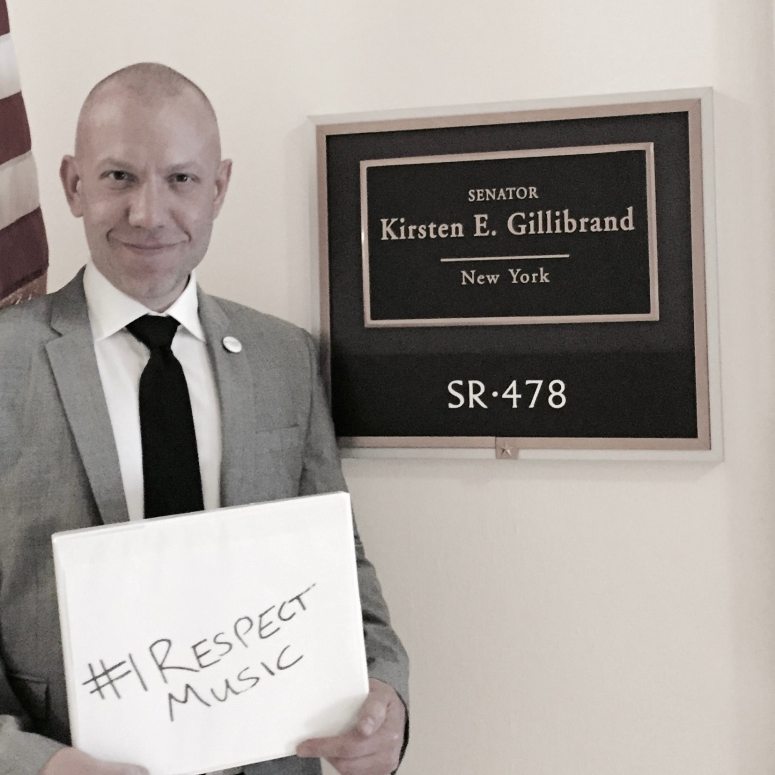
Blake Morgan took the #irespectmusic campaign to Capitol Hill again last week, this time in support of the Songwriter Equity Act (bill numbers HR 1283 and S662) with staff in the U.S. Senate.  His meetings included his own New York Senators Chuck Schumer and Kirstin Gellibrand.

Blake Gillibrand

One of the cornerstone principles of the #irespectmusic campaign is to support the ideal of fair treatment for all creators and is not limited to specific legislation.  Here’s an example.  Principle: Artist pay for radio play.  Bill: Fair Play, Fair Pay.  Principle:  Songwriters should be fairly compensated.  Bill: Songwriter Equity Act.

Blake Leahy

Blake’s trip to Washington coincided with the second anniversary of the #irespectmusic petition.  The movement is now in its second session of Congress–it started in the second year of the last session (the 113th) and is now working on the current session of Congress (the 114th).

mikulski blake

Blake wrote this insightful post that…

View original post 185 more words

A Burger Today: Spotify’s Bridge Loan to Nowhere is All the Rage

If Spotify runs out of money and files for bankruptcy, what happens to the money they have supposedly “set aside” for songwriter payments?

Music Technology Policy

“D” is for “desperate.”  And “debt.”  According to the Wall Street Journal:

Swedish music-streaming company Spotify AB has scheduled a series of investor meetings in an effort to raise about half a billion dollars through a convertible bond issue, a person familiar with the matter said Wednesday.

Spotify is eager to have financial firepower at hand should consolidation opportunities arise in the industry, according to the person. The issue won’t necessarily be a prelude to a stock-market listing of the privately held company, the person said.

The Financial Times tell us:

Swedish newspaper Svenska Dagbladet, which first reported the planned funding round, said that the loans would pay an annual interest rate of 4 per cent. In addition, they would convert into equity at a 17.5 per cent discount to Spotify’s share price if the company goes public in the next year.

This financial structure would guarantee lenders hefty…

View original post 1,421 more words

Blake Morgan Takes #irespectmusic Campaign to U.S. Senate Supporting Songwriters Equity Act

Music Technology Policy

Blake Morgan posted this on his Facebook page today:

blake senate 1

So…today is the day. For the first time, I’ll be bringing the #IRespectMusic campaign to the United States Senate. Over the next two days, I’ll be in Senate offices for discussions on fair market value specifically for American songwriters. The Songwriter Equity Act, like the Fair Play Fair Pay Act, is a crucial piece of legislation supported by both parties that American music makers want, need, and deserve. #IRespectMusic began as a spontaneous online grassroots uprising, and now look at where we’ve brought it, together. I’m saddled up. Game on.

Once again, Blake demonstrates the power of grassroots!  We’ll keep you posted on his journey.

If you’re going to be in Los Angeles for Grammy Week, don’t forget that the California Copyright Conference is hosting a panel on #irespectmusic on February 9, click here for details.

View original post

Save the Date: Feb. 9 California Copyright Conference Panel on #irespectmusic

If you’re going to Los Angeles for Grammy Week, check out this awesome artist rights panel!

Music Technology Policy

The California Copyright Conference will be hosting a panel entitled “The I Respect Music Campaign and the New Grassroots Artist Rights Advocacy” on February 9 from 6-9:30ish at the Sportsman’s Lodge in Los Angeles.  We will be having a wonderful group of panelists in Adam Dorn pka Mocean Worker, Karoline Kramer-Gould, David Lowery and Blake Morgan.

CCC Members and College Students $45 per person | Non-members $55 per person
Students must show College ID at the door, if paying at the member rate

Click here for details and reservations!

The I Respect Music Campaign and the New Grassroots Artist Rights Advocacy

Blake Morgan founded the #irespectmusic campaign to support fair treatment for creators, starting with over 13,000 signers of a petition calling on Congress to support artist pay for radio play.   After Reps. Jerry Nadler and Marsha Blackburn introduced the Fair Play, Fair Pay Act, #irespectmusic supporter and…

View original post 219 more words

If Streaming Is The Solution To Piracy, Why Is Piracy Still Increasing?

Music Business Worldwide is reporting that “GLOBAL MUSIC PIRACY DOWNLOADS GREW BY ALMOST A FIFTH IN 2015″.

The amount of music downloaded on illegal piracy sites grew by 16.5% in the second half of 2015 compared to the year’s opening six months.

That’s according to leading content protection and market analytics company MUSO, which tracked web activity on 576 sites which were ‘wholly dedicated to music piracy or contained significant music content’.

Across these sites, MUSO analysed over 2 billion visitor traffic hits globally.

READ THE FULL STORY AT MUSIC BUSINESS WORLDWIDE:
http://www.musicbusinessworldwide.com/global-music-piracy-downloads-grew-by-almost-a-fifth-in-2015/

Netflix Is The Model for Spotify, Watch And Learn…

Ahem… we were making these observations in 2013 when we wrote, “Why Spotify is not Netflix (But Maybe It Should Be)“. In that piece we detailed the practical and philosophical divide between the record business and the film/TV businesses online.

Nowhere is that divide in logic, reason, investment and profit more profound than the differences between Spotify and Netflix. It’s time for the record business to recognize and understand there is a mature digital business model that exists in digital distrbution, and it includes both streaming and capital investment for the development of new works.

Music Business Worldwide Reports:

Netflix is doing a lot of things that Spotify isn’t.

This year, across licensed content and its own original shows, the company will spend $5bn on programming.

It’s just launched in 109 countries, including India, where Daniel Ek is yet to tread.

It boasts around 75m paying subscribers – three times that of  Spotify.

Oh, and it’s turning a profit.

And you know what else, Netflix has NO FREE TIER and rotates inventory MONTHLY.

Watch and learn people. Seriously, it’s not that hard.

READ THE FULL STORY AT MUSIC BUSINESS WORLDWIDE:
http://www.musicbusinessworldwide.com/netflix-is-putting-all-sides-of-the-music-business-to-shame/


Why Spotify is not Netflix (But Maybe It Should Be)

What Did Spotify Know and When Did They Know It?

Music Technology Policy

Kiss me once, then once more.
What a dunce I was before.
How long has this been going on?

From How Long Has This Been Going On?
Music by George Gershwin, Lyric by Ira Gershwin from Funny Face

If you have been following the separate class actions for songwriter royalties brought against Spotify by David Lowery and Melissa Ferrick, a question might have occurred to you as it has to me:  How long has Spotify known about its songwriter royalty problem?

Given reports that as much 25% of Spotify’s music offering is unlicensed, surely this didn’t happen the week before the first class action was filed.  That’s millions of songs and that kind of mistake takes some time to get to scale.

Thinking back, I remembered the meetings that Spotify hosted in October 2014 as part of its artist outreach campaign.  Those meetings were held in New York, Nashville and…

View original post 751 more words