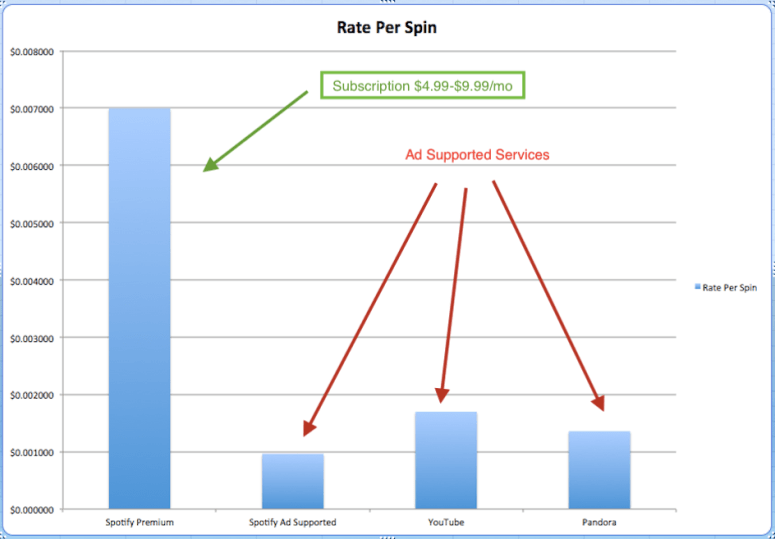
Rates are “all in” at source. Calculations based on royalty statements from a catalogue of 1500 titles 2014. Exception is Pandora which was calculated from 2nd quarter 2015 statements (higher than 2014).
In the fight for fair pay artists are not at war with the Internet or really even the streaming services, we are at war with the online advertising industry. As we have demonstrated time and time again, subscription (paid) music streaming services pay at least 7 times the rate that the free services pay. When you see artists (like myself) post absurdly low royalty payments it’s usually from one of the services that is predominately ad supported. Above is a chart that illustrates this nicely.
So for artists the solution seems easy: get rid of ad-supported free tiers. The problem is that in order to do away with these ad-supported tiers we have to fight not just the music streaming services but we have to fight the real power behind the throne: the online advertising industry which is dominated by Google. Indeed all three ad supported services above rely on Google to serve their ads.
So basically we have to fight Google?
Good luck with that, right? This is a company with so much lobbying power in Washington D.C. they can make an FTC investigation go away and turn a federal criminal drug charge (aiding “Canadian” pharmacies) into a civil penalty. Artists don’t have the money to fight Google largely cause Google has decimated our income streams over the years by allowing “users” to give our stuff away for free on YouTube and feeding massively infringing sites with ad dollars.
+++++++++++++++++++++++++++++++
So what would happen if most consumers decided to block ads?
First of all it’s not a question of if consumers will block ads but when. Consumers have grown increasingly suspicious of the entire ad tech industry. It’s not just the annoying banners, pop-ups and pre-rolls that slow down our browsing experience, consumers have finally become aware of the industrial scale data mining and spying operations used by the online advertising industry. These companies are tracking virtually every web page you visit and often know your physical location to within a few meters. (Don’t believe it? Don’t take it from me, ask your tech savvy friends who use browser plug-ins like Ghostery.)
While it’s relatively easy now to block pop-ups and banner ads it’s more difficult to block ads on Spotify and YouTube. But it is doable (if a little clunky) and it is only a matter of time before ad blocking technology catches up with the streaming services. Apple has announced its intention to allow ad blocking in the newest IOS. It’s unclear if this will eventually block ads in Spotify and YouTube but most users would welcome it.
So what happens to artists if this happens? If it becomes suddenly possible to block all ads?
In the short term artists would lose revenue. But it is not as bad as you think. If ALL the free streams on Spotify went away IMMEDIATELY artists would see their Spotify payments drop only 16%. See here: USA Spotify Streaming Rates Reveal 58% of Streams Are Free, Pays Only 16% Of Revenue. But lets not get too distracted by that because the real crime is that YouTube pays so little it’s a joke.
YouTube is the biggest digital platform of all. Yet as a songwriter I received $12.87 from YouTube last quarter. By my calculations YouTube paid all rights holders (label/publisher/songwriter) less than $340 for access to my catalogue. YouTube revenue is not gonna save artists and or the industry at large. I will barely miss it. And YouTube is clearly inhibiting the growth of subscription services that pay higher revenues.
++++++++++++++++++++++++++++++++++++
What happens in the long term?
This is where it gets interesting and also very difficult to forecast. Admittedly I’m not an expert (and my terminology may not be perfect) but in the long term ad-blocking forces all ad supported services to move towards other sources of revenue or cross subsidies. Subscription? Bundle with another service or services? Become a loss leading “add on” to a company selling other goods? Or much more lucrative advertising schemes like embedded ads or sponsorship.
All of these are more likely than not to boost revenue to artists on a per stream basis. We already know subscription boosts revenue per stream; Cable (I know, not a great example) has figured out how to get people who don’t watch sports to pay $6 a month for ESPN; and iTunes was clearly a loss leader built to sell hardware. Regardless the point is there are very common cross subsidy schemes already out there that could increase revenue to artists.
The downside is that there is a very real potential we end up with something like an Apple/Amazon/Altice (don’t laugh) streaming tri-opoly if streaming services aren’t standalone. (Why no Google? Ad-blocking may put Google into a revenue crisis with unpredictable consequences.) But I would argue that consumers will adopt ad-blocking anyway, with or without artists encouraging it. IMHO it is better for this to happen sooner than later because the longer these services limp along with no hope of profitability, the greater the damage to perceived value of music.
+++++++++++++++++++++++++++++++++++++++++++++++
The Difference Between Free and Ad-supported
I want to make an important distinction here. Not all free and ad-supported services are the same. In reality there is a continuum but I’m gonna simplify into three groups from good to bad:
- Services that offer free trials which convert to paid subscriptions after 30-90 days.
- Services that offer free ad supported tiers but provide effective incentives for users to upgrade to subscription tiers.
- Services that offer free tiers with no intention or incentives to upgrade to subscription tiers or lack subscription tiers entirely or fake subscription tiers that never materialize. (like YouTube’s Music Key?)
We can argue all day over which services go into category 2. Lets skip that for now or reserve it for a future post. The question is whether ad-blocking eliminates category 2 and whether the users then move into subscription tiers or down into category 3?
Reasonable people can disagree, but I think that a degradation or elimination of ad revenue for category 2 is a net positive for artists as it forces these services to hone their incentives and move users from free tier to subscription tiers faster. It’s also possible that if this is not managed correctly users will move backwards to category 3. Admittedly there are risks.
+++++++++++++++++++++++++++++++++++++++
What about YouTube/Google?
If consumers get really serious about blocking ads and refusing to be tracked? There is no Google/YouTube. Not in its current incarnation, not at its current size. Google must invade your privacy for its cash machine to continue working.
Google could work around ad-blocking and anti-tracking software, but my bet (60%/40%) is they are not nimble enough to do so without a serious hit to their revenue.
Despite all the claims to the contrary Google is a one trick pony: advertising. More than 90% of Google’s revenue comes from advertising. And a lot of that is the nastiest form of advertising, the tracking spying kind. I believe Google is what Nassim Taleb would term “fragile.” An institution too brittle to adjust to unpredictable external shock. A shock like the “viral” adoption of technology that allows consumers to NOT be tracked or subjected to their obnoxious advertising. The ad supported web is not and never was a given. The internet doesn’t care about Google’s stock price, currently stable business model or how many lobbyists they have in DC. Just ask the music business.
The wildcard here is that an unintended consequences of net-neutrality. As written net-neutrality gives Google – oops, I mean the FCC a backdoor into consumers smartphones, tablets and PCs. Absurd as it sounds the FCC could declare ad blocking in violation of net-neutrality, because it discriminates against certain packets and sources of traffic. Hopefully I’m wrong on this.
+++++++++++++++++++++++++++++++++++++++
What about piracy?
Ha. Piracy is completely supported by ad revenue. Just ask Kim Dotcom. And Google has always been there to lend a hand, with obfuscating ad exchanges, astroturf organizations, bloggers with financial ties to Google, shared law firms and amicus briefs. Also does anyone else find it odd that that Dotcom was arrested only after he proposed a plan to hijack the entire online ad network (link above)?
I think it is fair to say that Google has served as the deep pockets to aid many massively infringing businesses in their legal battles against rights holders. This has the benefit of prolonging a market failure that keeps supplier prices low for its “other” business YouTube .
+++++++++++++++++++++++++++++++++++++++
What happens to the Internet?
Nothing.
The internet and the online advertising industry are not the same thing, although there are companies that spend a lot of money trying to make you think they are the same thing. To counter this I ask you to read this imaginary conversation between The Verge’s Nillay Patel and The Berkman Center’s Doc Searls (author of the conversation), starting with this paragraph:
(NP) Unfortunately, the ads pay for all that content…
(DS) A lot, but not all. There are plenty of publishers and broadcasters that get along fine without advertising. HBO, Netflix, Consumer Reports and this blog, for example.
(NP) …an uneasy compromise between the real cost of media production and the prices consumers are willing to pay…
(DS) Stop. The commercial Internet is just 20 years old (dating from the end of NSFNet, the last holdout against commercial traffic within the Internet). We’ve hardly begun to experiment with all the different ways things can be funded, and ways people can signal their willingness to pay…
Actually read all five of his pieces on the online advertising industry.
http://blogs.law.harvard.edu/doc/2015/09/18/debugging-adtech-assumptions/
++++++++++++++++++++++++++++++++++++++++
To Block or Not to Block?
So should artists encourage their fans to block ads? It’s not certain that things will get better for artists in the short term or long term. On the other hand the professional working class musician is about to be snuffed out of existence. Can it really get that much worse?
An options trader would see this as a great opportunity: our losses are small and capped but the upside is potentially unlimited.
If you haven’t noticed I’m a bit of a bomb thrower. I enjoy provoking what I see as necessary conversations. I also enjoy figuring out how to break things. Encouraging fans to ad-block is a bit of both. It provokes a necessary conversation about the exploitative logic of the ad supported web and breaks stuff at the same time. Naturally I’m drawn to it.
But what is not so easy to see is that there is a careful calculation here. The idea is to disrupt the disruptors. Musicians, performers, producers and songwriters have this in our DNA. Each successive musical style or innovation disrupts the last one which was not so long ago the disruptor. Usually after the disruptor has grown soft, complacent or even arrogant. When the disruptor begins to proclaim they are here to stay or changing the world? In the music business everyone knows what happens next. Remember just ten short years ago we were proclaiming MySpace the future of the music business.
As a musician I’ve prospered (to varying degrees) through five dominant format shifts: Vinyl, Cassettes, CDs, MP3s and Streaming. The last two were the most challenging. Still you think musicians will be sweating another transition as we go from ad-supported streaming to a fairer model? No. By paying so little the ad-supported streaming services have made themselves economically irrelevant to most of us. The way most musicians look at it: Who cares if they fail? They need us more than we need them.
You know what to do right?

 The Trichordist
You must be logged in to post a comment.