Is NPR Violating the Plugola Laws by Failing to Disclose Membership in MIC Coalition?

mccoaltion - Amazon

Remember the “MIC Coalition” or as we prefer to call them the McCoalition?   This is an astroturf trade group organized by Pandora, National Public Radio, the National Association of Broadcasters, Google/YouTube, DiMA, CCIA, CES and others to oppose paying artists and songwriters for radio airplay.  In particular, the McCoalition intends to fight the Fair Play, Fair Pay Act introduced by Representatives Jerry Nadler and Marsha Blackburn.  Based on the McCoalition mission statement, songwriters are next.

According to the always reliable Ed Christman writing in Billboard, Amazon has left the McCoalition, the first member to exit.  In his post, originally titled “Amazon Pulls Out of Anti-Fair Play Fair-Pay Coalition” before the editors got their hands on it,  Amazon’s representative states that Amazon’s motives for joining the McCoalition was “transparency” in ownership of music rights.  A little odd because the McCoalition’s public messaging only tangentially mentions “transparency” but it does say this under “Mission“:

We join together with a collective voice because all stakeholders in the music marketplace – artists, content owners, users and distributors – benefit when current and accurate information about copyright ownership and payment to artists is easily accessible. In order for the music marketplace to grow and thrive, we need balance in copyright and competition policies that will benefit all participants rather than the few – the major record labels and publishers.

Kind of gibberish straight out of 1999, right?  Sounds like these companies with multi-trillion dollar market caps and their trade associations are going after the major record labels and publishers.  And trying to intimidate their artists and songwriters.

Whatever Amazon’s reason for leaving, that’s a good thing.  They don’t need the headache of being associated with the pariahs of the online music business like Pandora, Google and YouTube.

Which leaves National Public Radio.  As an NPR whistleblower told us, NPR’s decision to join the McCoalition was all about the lobbying staff at NPR trying to feather their collective nest by making common cause with these pariahs–albeit rich pariahs–and the move evidently was made without the knowledge of NPR’s music and news divisions according to an internal email we leaked:

We have joined the MIC Coalition through NPR’s Policy and Representation division, which is charged with representing the needs and interests of NPR Member Stations before federal legislative and regulatory bodies. This role is stipulated in NPR’s charter which provides that it is part of NPR’s mission to represent our members in matters of mutual interest.

Our participation in the coalition is completely separate from NPR’s newsroom. NPR journalists and music curators have absolutely no role or involvement in the coalition,

We’re prepared to believe that the NPR newsroom wasn’t involved at the outset, but what is becoming increasingly apparent is that NPR is there to provide cover for the pariahs and their anti-artist trade associations like DiMA, CCIA and CES, not to mention the restauranteurs who play music that is subsidized by the US taxpayers paying foreign songwriters (under the Fairness In Music Licensing Act arbitration award).

The rumor is that NPR did not pay a membership fee to join the McCoalition.  If true, why was that?  Maybe NPR is paying for its membership “in kind”?  NPR is after all a major influencer of public opinion and the music division brings years of tastemaking credibility to the bargaining table.  Any evidence of that motivation?

Yes, there is.  NPR’s music news group (“The Record: music news from NPR“) has started a series called “Streaming at the Tipping Point” that in our view is simply boosting the goals of the McCoalition–without ever disclosing to listeners the fact of NPR’s membership in the organization much less the purposes of the organization or identifying the financial benefit to NPR of boosting streaming to the great benefit of MIC Coalition members.  For example, in “How Streaming Services Are Remaking The Pop Charts,” NPR fails to even mention that the Billboard “consumption chart” penalizes soundtracks and branded compilation companies like Ministry of Sound in NPRs rush to boost streaming services:

The prominence of streaming on the Billboard charts — comparable if not quite equal footing with radio and sales — is appropriate, given how important streaming is for the recording industry, and how (relatively) novel it is as a form of music consumption. Unlike radio, with streaming the consumer gets to choose what she hears. And unlike music retail, after she plays the song, she doesn’t keep a copy.

NPR fails to mention that Billboard itself is in the streaming business in China (“Billboard Radio China”) and so may have a conflict of interest in how it weights the “consumption charts”.  NPR also fails to mention the Turtles litigation against Pandora and SiriusXM that are both screwing pre-72 artists.  Strangely, NPR’s music news division has failed to cover the class certification for the Turtles in their lawsuit against SiriusXM–a win for artists that is not in the interests of the MIC Coalition.  Even though The Street reported that the ruling took 1.54% off the Sirius market cap.  Maybe that wasn’t news.

But more importantly, NPR is not disclosing the fact that it is a member of the MIC Coalition and that the spin in its reporting on streaming benefits the McCoalition’s goals of screwing artists through sheer multinational corporate market domination.

As we feared, NPR has compromised its journalistic integrity by joining this McCoalition–aside from NPR’s membership being a slap in the face to artists who go out of their way to help NPR Music be relevant and tastemaking.

Plus, there actually are laws about this kind of thing that NPR may be violating.

It’s called “plugola,” the cousin to payola.  Plugola usually involves on-air talent taking payments to plug products or services, or plug products or services they have an undisclosed interest in.  You know, like a free membership in the McCoalition.  As one expert summed it up succinctly, plugola is “promoting the non-broadcast activities of the station licensee or an on-air personality on the air. Plugola occurs only when the financial interests are those of persons ‘responsible for including promotional material in a broadcast.'”  (Read David’s FCC comments on the NAB’s application for a waiver of the payola rules “The Return of the $50 Handshake.”)

Granted, the recipient of the under the table benefit for NPR’s streaming coverage is NPR itself and its fellow MIC Coalition members, but do they really want to raise that as a plugola defense?

Regardless of whether NPR is violating the law, it certainly appears that they are violating every standard of objective reporting in NPR’s “Streaming at the Tipping Point” series.

It’s just more sleaze from people we thought better of.  We really hope that NPR sees the corner they’ve painted themselves into and follows Amazon in exiting from the McCoalition.
Must Read: Austin Music Census

The Austin Music Office and Economic Development Department of the City of Austin commissioned the Austin Music Census that was released this week to a standing ovation at a standing room only meeting of the Austin Music Commission:

Coverage of the Census in Texas Monthly suggests that the “middle class musician” is mostly a myth:

“Musicians often get paid less—or, at best, the same—as they’d make ten years ago. In the tech industry, if wages in 2015 were the same as wages in 2005, it’d be awfully hard to keep coders.”

The Census garnered a supportive post from the editorial board of the Austin-American Statesman (“Austin Music Census finds city at tipping point as Live Music Capital”):

Less talked about are the struggles local musicians, venues and other industry professionals endure in a city with an ever-growing affordability problem. The Austin Music Census released this week is the first comprehensive attempt to quantify what the industry is up against.

The city-commissioned report, presented during the Austin Music Commission meeting, shows what many have long suspected: Local musicians and music venue owners are finding it more difficult to live and do business in a city that is increasingly becoming unaffordable for middle- and lower-income workers [like San Francisco].

You can read the study at the ATX Music site.

@zoecello’s Royalties Give the Lie to Daniel Ek’s “Greedy Middlemen” Rant

Music Technology Policy

Sony Contract Leak: The Bright and Shiny Object

Regardless of who you believe actually leaked Spotify’s contract with Sony Music, Spotify’s CEO Daniel Ek certainly is trying to capitalize on the leak.  (“Spotify CEO says middlemen gobble cash“)  It sounds like this is just another indication of how badly a defiant Spotify has broken trust with its label “partners” and their artists.

The spin from Mr. Ek is that he wants you to believe that the reason that artists think Spotify’s royalties are low is not because of Spotify, it’s because of the greedy major labels.  More accurately–with the benefit of the contract leak–any label that has MFN treatment with Sony Music.  (Because if you’re leaking contracts, you can’t really leak all the contracts, but you don’t need to if you can leak a single MFN contract from which terms can be extrapolated due to the MFN treatment.)  …

View original post 1,383 more words

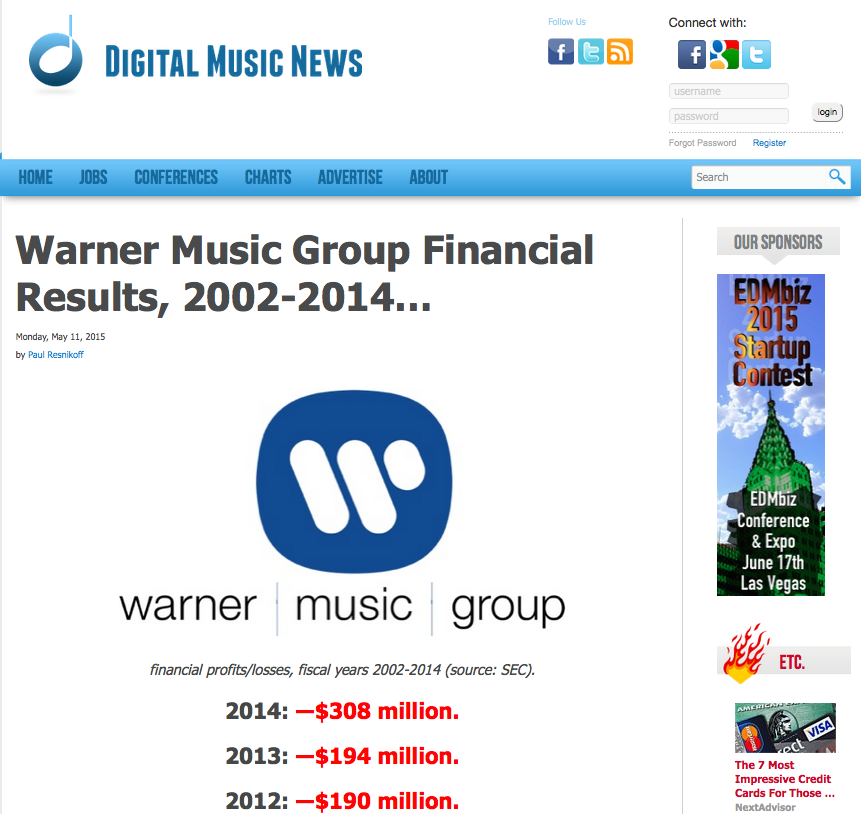
Warner Music Group Free Streaming Advocates Lose Another $100m in 2014… Can’t Make This Up…

We can’t help but think these two things are related. Read the full stories at DMN… Here and Here

WarnerMusicGroupLosses


WarnerMusicFreeStreaming

So how’s that $3.00 per “user” annual ARPU working out from free streaming?

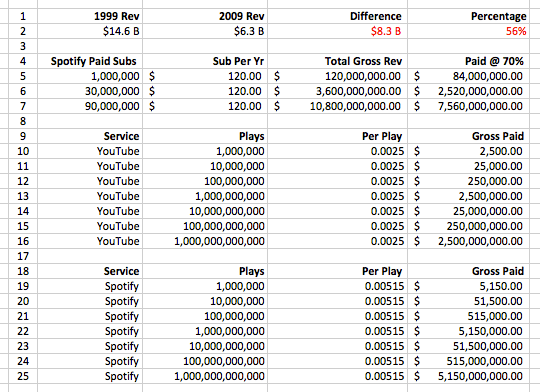
It’s amazing to us that the current conversation and controversy is still focused on the free tier. We’re not entirely certain that Spotify can even work at $10 a month / $120 per yer, per subscriber. The number of subscribers needed to replace the revenue from transactional sales exceeds those of any current mature subscription business.

It will take  60 Million PAID subscribers at $10 a month to generate about $7.2b in gross revenues annually. It takes another 30 Million (or 90 Million PAID Total) to come up with $7.5b payable to rights holders. Ninety Million. Paid…

Here’s some context for the chart above. Netflix only has 36m subscribers in the US, no free tier, and massive limitations on available titles of both catalog and new releases. Sirius XM, 26.3m in the US as a non-interactive curated service installed in homes, cars and accessible online. Premium Cable has 56m subscribers in the US paying much more than $10 a month and also with many limitations. Spotify… 3m paid subscribers in the US after four years. Tell us again about this strategy of “waiting for scale.” Three Million Paid… Three…

* 3m Spotify Subs Screen Shot
* 26.3m Sirius XM Subs Screen Shot
* 36m Netflix Subs Screen Shot
* 56m Premium Cable Subs Screen Shot
* $7b Music Business Screen Shot

It’s just math.


Streaming Is the Future, Spotify Is Not. Let’s talk Solutions.

Music Streaming Math, Can It All Add Up?

Spotify is the Problem, Not Labels. (Well, Mostly…)


5 Reasons The Major Labels Didn’t Really Blow It With Napster | Hypebot

Whatever the reason, it’s bullshit. The major labels were right not to compromise with Napster. I was VP of Electronic Music Distribution at Sony Music at the time, dealing with these issues day to day. Understandably, some people may think, what does it matter if the majors were right or not? They lost. But I think its important to understand the various facets and history of these events, if only to provide perspective for issues the industry is still dealing with today.  So, at the risk of being unhip, here are Five Reasons Why The Major Labels Didn’t Blow It With Napster.

READ THE FULL POST AT HYPEBOT:
http://www.hypebot.com/hypebot/2015/05/five-reasons-the-major-labels-didnt-blow-it-with-napster.html

@zoecello, @theblakemorgan, @themisreadcity, @thatkatetaylor at Global Forum on #irespectmusic, artist rights

Music Technology Policy

Once again, MusicCanada’s Global Forum at Canadian Music Week in Toronto gives a major platform to creators to discuss the human rights of artists and how to deal with the Silicon Valley onslaught.  This year featured a great interview by Kate Taylor of the Globe and Mail with Zoë Keating, Blake Morgan and Scott Timberg.  Watch the full video for the most insightful commentary on our struggle you’ll hear for a long, long time.  And consider this an invitation to sign the #irespectmusic petition and support artist pay for radio play!

image

Also big thanks to Toronto Mayor John Tory for showing his support for artists in Toronto and beyond!

And an especially warm homecoming show by Canadian born Zoë Keating, achingly cool memories for all who heard her.

View original post

Another Artist Rights Victory: Turtles Win Class Certification in Class Action Against SiriusXM #irespectmusic

Let’s see how long it takes for NPR to cover this story given its news blackout on any stories that challenge the values of its political allies in the Mic Coalition….

Music Technology Policy

Ruling on Turtles’ Class Certification

More on this later, but great news from the Turtles class action against SiriusXM.  The Turtles struck another blow for artist rights when the Court approved the band as representatives of the class of pre-72 artists similarly ripped off by Sirius.  The Turtles lawyers Gradstein & Marzano were also appointed class attorneys.

A good day for those who respect music.

View original post

Digital Media Association (DiMA) Always Against Musicians

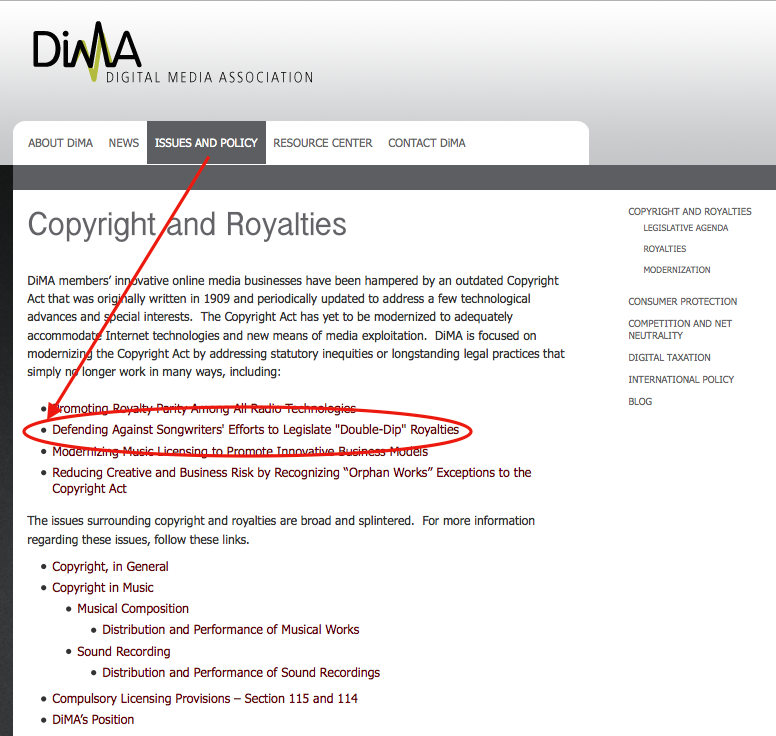
Who is DiMA? Glad you asked, the Digital Media Association. Why do we care? Well, because they are actively working against artists rights. How do we know? Three words… “Defending Against Songwriters”. Yes, DiMA is dedicated to “Defending Against Songwriters” because, you know songwriters are a force that businesses need to defend themselves against.

Wow, really? Seriously? Ok, check it out…

DimaDoubleDipSongwriters

But lets take a look below where current DiMA policy positions are directly in opposition to artists and songwriters rights.

DiMA supports Pandora buying a terrestrial radio station in an effort to lower the royalties Pandora will pay to songwriters.

DiMA is opposed to the Fair Play, Fair Pay Act that would pay performers a terrestrial radio broadcast royalty.

DiMA is opposed to The Songwriter Equity act that would allow songwriters the ability to negotiate fair market rates for their work.

DimaPOlicyAgainstArtists

Who would work with DiMA that wasn’t forced to via statutory rates and rate courts?


Daniel Ek Brings Another Whopper and Claire Atkinson Let’s Him Get Away With It

It’s not every day that we can get two “Big Lies” out of one Daniel Ek interview, but the Claire Atkinson reporting in the New York Post shows a distinct lack of fact checking that let him get away with another whopper.  (“Spotify CEO says middlemen gobble cash“)

Ek suggests there are perhaps too many middlemen, coupled with the problem of antiquated collection systems. “Some systems and processes use physical pieces of paper. How do you do that when every unit would be in the billions? That’s a lot of paper,” says the tech-focused Swede.

Antiquated?  You know who uses “physical pieces of paper”?  Google.  Anyone knows this who gets a Google royalty statement which is pretty much everyone.  You can elect to get accounted to electronically (which usually signs you up for a bunch of other sneaky stuff), but the default is a paper statement.

But–but–if you read the Spotify agreement with Sony that was posted on The Verge (and has now been taken down), specifically Paragraph 2 “Reporting and Payment,” you would know that all of the statements from Spotify to Sony are required to be in “machine readable” form.  You can safely assume that all the major labels are accounted to the same way–in fact, everyone we know who gets a statement from Spotify gets a digital statement  We can also tell you that we have never heard of anyone who got a paper Spotify artist statement.  (Which, by the way, doesn’t mean that the statement is correct, paper or digital.)

They may send paper statements to publishers, but as far as we know, all of the major publishers and administrators require digital statements, particularly for streaming services.  This would include companies like Kobalt, Ole, Songs, Peer and many others, including ASCAP, BMI and SESAC.  There’s really no believable way that anyone with a catalog of any size could get a paper statement from Spotify because there would be hundreds if not thousands of pages even for a relatively small catalog.  And a check for $9.  The paper for the statements would cost more than the earned royalties.

We are just mystified as to why an outstanding reporter like Claire Atkinson would allow Ek to get away with what is clearly a questionable statement.  Unless Ek never read his contracts and never talked to his royalty department, he knew the statement was false when he made it.  Claire Atkinson should have asked him for names or picked up the phone and asked any CFO or accounting manager in any of the labels or digital aggregators that do business with Spotify and they could have told her off the top of the head that Ek was making a false statement.

We don’t see how it could have been anything other than a knowingly false statement, also called a lie.

Why didn’t anyone fact check it?  Because just like the “greedy middlemen” headline, it fits the 1999 narrative that Ek and the McCoalition are still trying to peddle.  The music business is so antiquated that they’ll never been as hip as “the tech-focused Swede” with his monopoly music service.  Just like nobody questions how Spotify gets a valuation that’s higher than any record company.  Ek is sooo 1999 from biting the hand that feeds to the Dot Bomb valuations.

Hey, Mr. Bit Torrent–1999 called and wants its bullshit back.  And shame on the New York Post for publishing these rants without checking the facts.