@zoecello’s Royalties Give the Lie to Daniel Ek’s “Greedy Middlemen” Rant

Music Technology Policy

Sony Contract Leak: The Bright and Shiny Object

Regardless of who you believe actually leaked Spotify’s contract with Sony Music, Spotify’s CEO Daniel Ek certainly is trying to capitalize on the leak.  (“Spotify CEO says middlemen gobble cash“)  It sounds like this is just another indication of how badly a defiant Spotify has broken trust with its label “partners” and their artists.

The spin from Mr. Ek is that he wants you to believe that the reason that artists think Spotify’s royalties are low is not because of Spotify, it’s because of the greedy major labels.  More accurately–with the benefit of the contract leak–any label that has MFN treatment with Sony Music.  (Because if you’re leaking contracts, you can’t really leak all the contracts, but you don’t need to if you can leak a single MFN contract from which terms can be extrapolated due to the MFN treatment.)  …

View original post 1,383 more words

Warner Music Group Free Streaming Advocates Lose Another $100m in 2014… Can’t Make This Up…

We can’t help but think these two things are related. Read the full stories at DMN… Here and Here

WarnerMusicGroupLosses


WarnerMusicFreeStreaming

So how’s that $3.00 per “user” annual ARPU working out from free streaming?

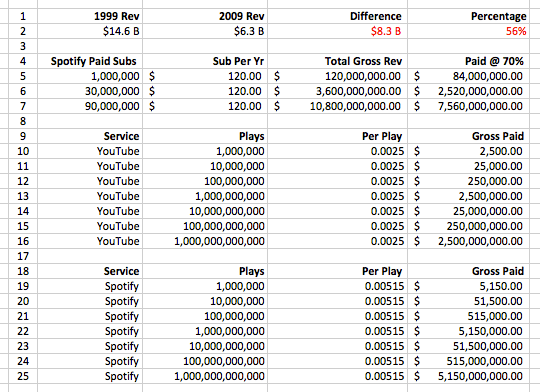
It’s amazing to us that the current conversation and controversy is still focused on the free tier. We’re not entirely certain that Spotify can even work at $10 a month / $120 per yer, per subscriber. The number of subscribers needed to replace the revenue from transactional sales exceeds those of any current mature subscription business.

It will take  60 Million PAID subscribers at $10 a month to generate about $7.2b in gross revenues annually. It takes another 30 Million (or 90 Million PAID Total) to come up with $7.5b payable to rights holders. Ninety Million. Paid…

Here’s some context for the chart above. Netflix only has 36m subscribers in the US, no free tier, and massive limitations on available titles of both catalog and new releases. Sirius XM, 26.3m in the US as a non-interactive curated service installed in homes, cars and accessible online. Premium Cable has 56m subscribers in the US paying much more than $10 a month and also with many limitations. Spotify… 3m paid subscribers in the US after four years. Tell us again about this strategy of “waiting for scale.” Three Million Paid… Three…

* 3m Spotify Subs Screen Shot
* 26.3m Sirius XM Subs Screen Shot
* 36m Netflix Subs Screen Shot
* 56m Premium Cable Subs Screen Shot
* $7b Music Business Screen Shot

It’s just math.


Streaming Is the Future, Spotify Is Not. Let’s talk Solutions.

Music Streaming Math, Can It All Add Up?

Spotify is the Problem, Not Labels. (Well, Mostly…)


5 Reasons The Major Labels Didn’t Really Blow It With Napster | Hypebot

Whatever the reason, it’s bullshit. The major labels were right not to compromise with Napster. I was VP of Electronic Music Distribution at Sony Music at the time, dealing with these issues day to day. Understandably, some people may think, what does it matter if the majors were right or not? They lost. But I think its important to understand the various facets and history of these events, if only to provide perspective for issues the industry is still dealing with today.  So, at the risk of being unhip, here are Five Reasons Why The Major Labels Didn’t Blow It With Napster.

READ THE FULL POST AT HYPEBOT:
http://www.hypebot.com/hypebot/2015/05/five-reasons-the-major-labels-didnt-blow-it-with-napster.html

@zoecello, @theblakemorgan, @themisreadcity, @thatkatetaylor at Global Forum on #irespectmusic, artist rights

Music Technology Policy

Once again, MusicCanada’s Global Forum at Canadian Music Week in Toronto gives a major platform to creators to discuss the human rights of artists and how to deal with the Silicon Valley onslaught.  This year featured a great interview by Kate Taylor of the Globe and Mail with Zoë Keating, Blake Morgan and Scott Timberg.  Watch the full video for the most insightful commentary on our struggle you’ll hear for a long, long time.  And consider this an invitation to sign the #irespectmusic petition and support artist pay for radio play!

image

Also big thanks to Toronto Mayor John Tory for showing his support for artists in Toronto and beyond!

And an especially warm homecoming show by Canadian born Zoë Keating, achingly cool memories for all who heard her.

View original post

Another Artist Rights Victory: Turtles Win Class Certification in Class Action Against SiriusXM #irespectmusic

Let’s see how long it takes for NPR to cover this story given its news blackout on any stories that challenge the values of its political allies in the Mic Coalition….

Music Technology Policy

Ruling on Turtles’ Class Certification

More on this later, but great news from the Turtles class action against SiriusXM.  The Turtles struck another blow for artist rights when the Court approved the band as representatives of the class of pre-72 artists similarly ripped off by Sirius.  The Turtles lawyers Gradstein & Marzano were also appointed class attorneys.

A good day for those who respect music.

View original post

Digital Media Association (DiMA) Always Against Musicians

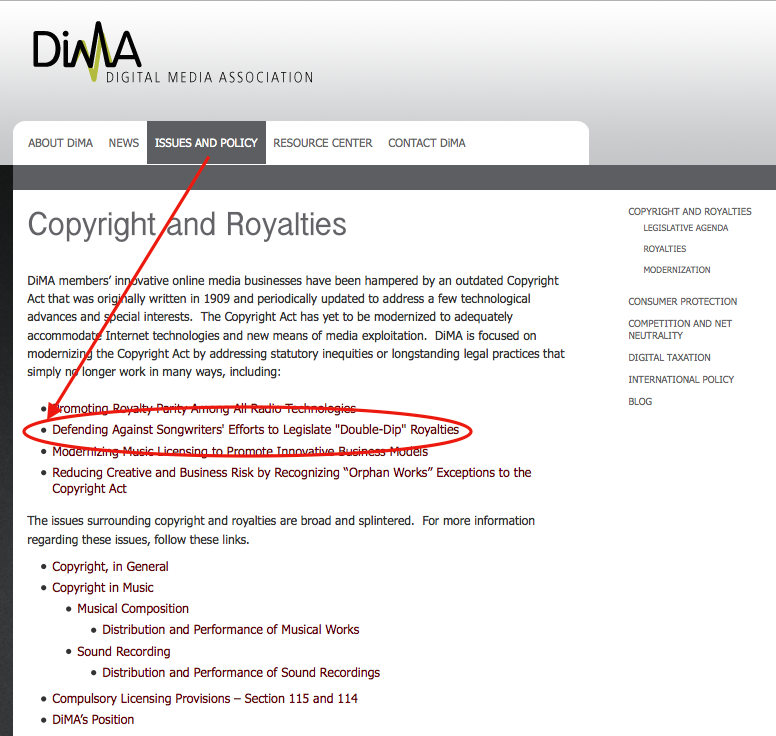
Who is DiMA? Glad you asked, the Digital Media Association. Why do we care? Well, because they are actively working against artists rights. How do we know? Three words… “Defending Against Songwriters”. Yes, DiMA is dedicated to “Defending Against Songwriters” because, you know songwriters are a force that businesses need to defend themselves against.

Wow, really? Seriously? Ok, check it out…

DimaDoubleDipSongwriters

But lets take a look below where current DiMA policy positions are directly in opposition to artists and songwriters rights.

DiMA supports Pandora buying a terrestrial radio station in an effort to lower the royalties Pandora will pay to songwriters.

DiMA is opposed to the Fair Play, Fair Pay Act that would pay performers a terrestrial radio broadcast royalty.

DiMA is opposed to The Songwriter Equity act that would allow songwriters the ability to negotiate fair market rates for their work.

DimaPOlicyAgainstArtists

Who would work with DiMA that wasn’t forced to via statutory rates and rate courts?


Daniel Ek Brings Another Whopper and Claire Atkinson Let’s Him Get Away With It

It’s not every day that we can get two “Big Lies” out of one Daniel Ek interview, but the Claire Atkinson reporting in the New York Post shows a distinct lack of fact checking that let him get away with another whopper.  (“Spotify CEO says middlemen gobble cash“)

Ek suggests there are perhaps too many middlemen, coupled with the problem of antiquated collection systems. “Some systems and processes use physical pieces of paper. How do you do that when every unit would be in the billions? That’s a lot of paper,” says the tech-focused Swede.

Antiquated?  You know who uses “physical pieces of paper”?  Google.  Anyone knows this who gets a Google royalty statement which is pretty much everyone.  You can elect to get accounted to electronically (which usually signs you up for a bunch of other sneaky stuff), but the default is a paper statement.

But–but–if you read the Spotify agreement with Sony that was posted on The Verge (and has now been taken down), specifically Paragraph 2 “Reporting and Payment,” you would know that all of the statements from Spotify to Sony are required to be in “machine readable” form.  You can safely assume that all the major labels are accounted to the same way–in fact, everyone we know who gets a statement from Spotify gets a digital statement  We can also tell you that we have never heard of anyone who got a paper Spotify artist statement.  (Which, by the way, doesn’t mean that the statement is correct, paper or digital.)

They may send paper statements to publishers, but as far as we know, all of the major publishers and administrators require digital statements, particularly for streaming services.  This would include companies like Kobalt, Ole, Songs, Peer and many others, including ASCAP, BMI and SESAC.  There’s really no believable way that anyone with a catalog of any size could get a paper statement from Spotify because there would be hundreds if not thousands of pages even for a relatively small catalog.  And a check for $9.  The paper for the statements would cost more than the earned royalties.

We are just mystified as to why an outstanding reporter like Claire Atkinson would allow Ek to get away with what is clearly a questionable statement.  Unless Ek never read his contracts and never talked to his royalty department, he knew the statement was false when he made it.  Claire Atkinson should have asked him for names or picked up the phone and asked any CFO or accounting manager in any of the labels or digital aggregators that do business with Spotify and they could have told her off the top of the head that Ek was making a false statement.

We don’t see how it could have been anything other than a knowingly false statement, also called a lie.

Why didn’t anyone fact check it?  Because just like the “greedy middlemen” headline, it fits the 1999 narrative that Ek and the McCoalition are still trying to peddle.  The music business is so antiquated that they’ll never been as hip as “the tech-focused Swede” with his monopoly music service.  Just like nobody questions how Spotify gets a valuation that’s higher than any record company.  Ek is sooo 1999 from biting the hand that feeds to the Dot Bomb valuations.

Hey, Mr. Bit Torrent–1999 called and wants its bullshit back.  And shame on the New York Post for publishing these rants without checking the facts.

It’s the Data, Stupid: Here’s How Google Gets the Data About You They Don’t Already Have

And then there’s YouTube….

Music Technology Policy

The Wall Street Journal reports that Google intends to compete with Amazon, eBay and every other online retailer:

Google Inc. will launch buy buttons on its search-result pages in coming weeks, a controversial step by the company toward becoming an online marketplace rivaling those run by Amazon.com Inc. and eBay Inc.

The search giant will start showing the buttons when people search for products on mobile devices, according to people familiar with the launch.

The buttons will accompany sponsored—or paid—search results, often displayed under a “Shop on Google” heading at the top of the page. Buttons won’t appear with the nonsponsored results that are driven by Google’s basic search algorithm.

Given Google’s search monopoly, this move accomplishes at least two predatory moves:  First, Google will get personally identifiable data from you about your purchasing habits as well as your name, address, credit card number, phone number and whatever else they can extract…

View original post 357 more words

The Serial Dissembling of Daniel Ek and Spotify on Artist Pay (and Just About Everything Else)

Screen Shot 2015-05-24 at 11.34.57 PM

 Dissemble

Verb, dissembled, dissembling.

to give a false or misleading appearance to; conceal the truth or real nature of

For the past three years I’ve been advocating for better pay for artists from digital services.  However when I started on this quest Spotify was not at the top of my list.  While I have never been enthusiastic about having all my catalogue on the free tier of streaming services (there is a substantial difference in pay per spin on free and premium platforms)  I was willing to put this issue on the back burner while we focused on much bigger  problems like ad-funded piracy and much much lower rates from services like YouTube and Pandora.

But over the last three years I’ve come to believe that Spotify is a much bigger problem.  Not only because of their low rates  but because they deliberately use highly manipulative tactics, paid flacks, proxy organizations, leaked documents, and even paid bloggers to intimidate critics and counter criticism of their service.   As a former State Department employee remarked  “their public relations strategy resembles the playbook of an authoritarian regime.”  The real problem with Spotify is that you cannot trust them.

The latest object-lesson is the still-unfolding kabuki surrounding the leak of the Spotify-Sony Music contract  to the  technology website The Verge.   The Verge is the same site that leaked the  Sony pictures hack.  The Verge apparently has a hard-on for Sony.

Now I have to admit to some schadenfreude when I heard about the Spotify contract leak.  For the last three years we’ve taken significant pushback from the recording industry over our criticism of Spotify.   Major labels have strongly defended Spotify against criticism from artists like myself.  Meanwhile Sony went so far as to replace its own streaming service on the playstation with Spotify.  So yes,  I have to admit it was kind of awesome to see Sony get stabbed in the back by their “partner” Spotify with the contract leak.  On behalf of artists everywhere I must issue a pro forma “We told you so!”

And yes it’s abundantly clear  that it was Spotify that leaked the contract.  Who else beside Sony and Spotify had paper copies of this contract?  The leak helped Spotify and clearly hurt Sony.  Spotify had motive, Sony did not.

Plus it was excellent timing for Spotify.   Let’s review timeline of the kabuki so far:

1. Tuesday Spotify-Sony contract leaks to Sony hater The Verge.  The Verge doesn’t really understand the contract but eviscerates Sony anyway.   Internets go crazy.

2) Wednesday Spotify has press conference (live streamed by The Verge ) announcing new Spotify features. Internets go “meh.”

3) Thursday Daniel Ek does interview with NY Post which results in a convenient headline that reads: “Spotify CEO Says Middlemen Gobble Cash”

So what Spotify and their publicity flacks would have you believe is that this whole problem with artists being fairly compensated has nothing to do with them. It is all the fault of the record labels.   In the NY Post Ek goes pseudo diplomatic and says “I don’t want to point fingers, it’s a systemic thing.”  Meanwhile the  little green men over at The Verge do all his finger pointing for him.

And this is why I say Ek and Spotify are dissembling on artist compensation.  While the major labels like Sony or WMG are contributing to the problem of low compensation by treating revenue as sales (10-20%)  not licensing (50%), the problem still starts with Spotify.  And specifically it starts with the free tier.  Spotify and Ek know this.

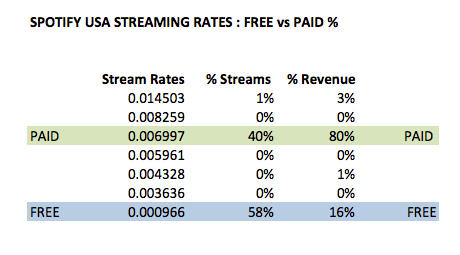
We didn’t need a leaked Sony contract to know this.   We have access to digital revenue reports for a moderately sized indie label catalogue and we have diligently reported on the payouts for the last 18 months.  These are the rates paid FROM Spotify TO the labels.  No middlemen involved.  The rate on the free tier in the US is abysmal.

 It takes 7,000 spins (not 1,500 as Billboard magazine would have you believe) to generate the same revenue as a digital album download.
StreamingRatesandPercentagesUSA

Spotify pays out at seven different rates with the free tier being the majority of spins. 

 Artists would make SEVEN times as much if consumers could be converted from the free streaming tier to the paid tiers.   One way to do this would be to have exclusive content on the paid tier right?  An incentive to subscribe to the service.  But Spotify refuses to do this.   Spotify insists there be no exclusives and all music on the service is also available for free.  This specifically led  to Taylor Swift’s album not being available on the service.

Ek does not get it. Why would anybody in their right mind switch to the paid service if they can get the same service for free?

Ek and Spotify need to come clean.  They need to stop playing games and admit they have as much to do with bad pay to artists as the major labels.

Questions for the International Music Managers Forum

Billboard reports that the International Music Managers Forum has more than the usual helping of sanctimony about the terms of Spotify’s deal with Sony (and by inference all other major labels).  Curiously, Billboard doesn’t seem to question the credentials of managers to speak on behalf of all artists.  We do.

Ask yourself this–how many managers have screwed artists to the wall?  Want to talk about sunset clauses?  Commissioning income the manager had nothing to do with producing?  Expense charges for first class tickets to MIDEM and $1000 dinners that suddenly appear when the artist wants to leave the manager?  Charging cars for the manager’s mistress to the artist’s credit card so the wife doesn’t catch him?  Sure, there are plenty of great managers who would take a bullet for their artists or dangle an offending promoter out of a window, but let’s not pretend that managers as a class are without sin.

Let’s also not pretend that artists feel like they can question their manager’s transparency or conflicts of interest.

Speaking of sin and the sanctimony of transparency–here’s a few questions for those in the glass house of the IMMF.

1.  How much money do you get from Google, directly or indirectly?  There have been rumors for years that IMMF is in Google’s pocket, so how about publishing your books online?  Anything to hide?

2.  Did any of your members get stock from Spotify, Bit Torrent or any tech company your organization promotes?  Were you given the opportunity to invest or did you get the stock for service rendered?

3.  Any IMMF members been hired as consultants by Google?  Spotify? Bit Torrent?

4.  Do your members have an obligation in their management contracts to disclose all sources of their income to their artists (like Spotify stock)?

5.  Who gets to decide whether the manager has a conflict of interest?  The manager?  Or the artist?

6.  How many of your members knew about the Spotify major label terms before the Verge leak?

7.  If your member got stock from a tech company what was it for?  Their wisdom or their access?

We’re reminded of a story about a manager who made a fortune managing a particular superstar and then wanted to sell his management company (and the superstar’s contract) for a bundle.  The artist wished him well and had just one question:

Where’s my 80%?