Apparently Billboard Doesn’t Want Jay Z at Billboard Music Awards, Pimps for Spotify! @S_C_

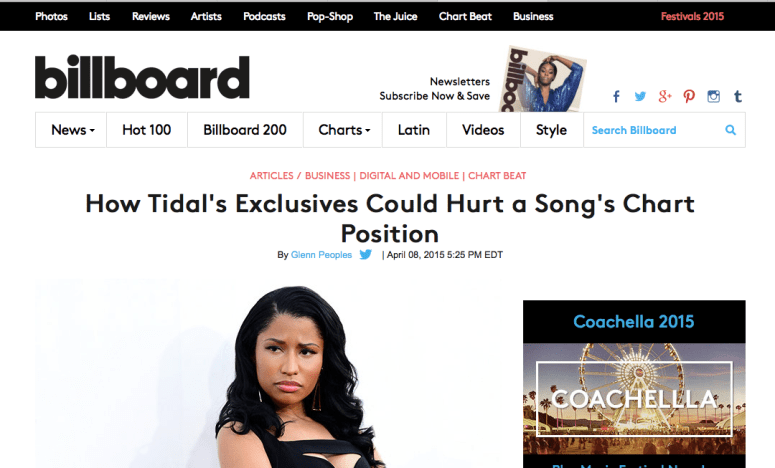
Why on earth is Glenn Peoples and Billboard warning artists not to go exclusive with Jay Z’s Tidal?   Is Billboard pimping for Spotify?    We’ve long suspected this. Glad it’s almost out in the open.

Screen Shot 2015-04-09 at 2.45.06 PM


The ‘Zero Effect’: Do New Consumption Charts Penalize Compilation Records and Artists Who Window?


New Math $.00666 : Billboard’s New “Consumption” Chart, Free Streams and the End Of Meaningful Metrics?


Copyright Royalty Board Filing Suggests that Pandora/Chris Harrison “Created Evidence” for Rate Court Proceedings

Sadly no one in the music business press seems to be paying attention to the Copyright Royalty Board filings. But we all should be watching this closely.   A couple days ago SoundExchange filed a letter with this bombshell in it:

“SoundExchange requested a specific email sent by Pandora executive Chris Harrison in December of 2013 in which Mr. Harrison highlighted the success of a strategy he implemented for DMX that involved entering into direct licenses in order to create evidence for a rate court proceeding. Evidence of a strategic motive underlying Pandora’s direct licensing would undermine the direct licenses Pandora has proffered as benchmarks. But Pandora has refused to produce the requested email and any other documents except for two. In light of their clear probative value to the key benchmarks Pandora has put at issue here, Pandora should produce all documents that constitute, comprise, memorialize, or analyze Mr. Harrison’s efforts on DMX’s behalf.”

full document here:

2015-04-07 Reply re Pandora [PUBLIC]

Created evidence?   That sounds a lot like “manufacturing evidence” to me.   If this is true,  Pandora at the behest of counsel Chris Harrison specifically cut this direct deal with MERLIN (the independent label consortium)  to “create evidence” for the rate court then this should be seriously investigated.  I’m not an expert but when I say investigate I mean law enforcement, The Judiciary Committee or at very least some bar association ethics panel.   If Harrison and Pandora are allowed to get away with this, it doesn’t just harm songwriters and artists, it harms the entire legal process.

(Also some of the labels represented by MERLIN need to start asking:  what it is that MERLIN/MERLIN executives got out of the Pandora deal? Who was banging on MERLIN’s door asking for a direct deal with Pandora?)

Meanwhile the DOJ (despite reports to the contrary) still have the anti-trust consent decrees pointed at songwriters rather than Pandora and Broadcasters.    What a world we live in.

The Great Disappointment: Tidal Highlights YouTube’s Moral Hazard for All the World to See

Escape from the Great Streaming Cult….

Music Technology Policy

Part of Tidal’s business model relies on artists being able to grant exclusives.  The concept of an exclusive requires property rights that are respected by other platforms in the channel.

Imagine if Showtime began showing rips of Game of Thrones day and date with its HBO release.  Forget that HBO would sue them and win.  The actors, screenwriters, producers and the vast below the line personnel would think twice about working for Showtime in the future.

And that’s exactly what should happen to YouTube.

Beyonce released “Die With You” on Tidal as an exclusive.  Everyone at YouTube knows that it was intended to be an exclusive just like everyone at YouTube knows that YouTube could keep the track from being uploaded to YouTube if YouTube wanted to do that.

YouTube has worked hard at getting the world to accept the concept of “user generated content” as some kind of great…

View original post 590 more words

#howgooglegateworks: Will @senmikelee Investigate Washington Insider Beth Wilkinson for Her Role in the FTC’s Noninvestigation of Google?

The FTC can regulate songwriters but not Google?

Music Technology Policy

The Googlegate Mascot

One of the historical facts that may (or ought to) come up in Senator Mike Lee’s corruption investigation of Google and the Federal Trade Commission is the FTC’s hiring of Washington insider Beth Wilkinson.  Ms. Wilkinson was hired to oversee the FTC’s Google investigation on April 26, 2012, four months before the internal FTC report recommending prosecution as reported by Brody Mullins at the Wall Street Journal.  Beth Wilkinson has several dots that connect her to various players in the Googlegate corruption probe.

Why Was Ms. Wilkinson Hired?  The threshold question is why did the FTC need to bring in an outside lawyer to manage the Google investigation?  Has the FTC done this before?  (Not that I can find.)  Why did they do it this time?  Why did they hire Ms. Wilkinson and who else did they consider for the post (if anyone)?  How…

View original post 1,460 more words

@senmikelee Investigating White House Influence in FTC Decision Not to Prosecute Google

Maybe Senator Lee could look at Google’s scorched earth attack on Zoë Keating?

Music Technology Policy

According to the National Journal (“Senate to Investigate White House Role in Google’s Antitrust Victory“):

A Senate panel plans to investigate whether the White House inappropriately derailed a federal investigation into accusations that Google was stifling online competition.

Sen. Mike Lee, the chairman of the Senate Judiciary’s Antitrust Subcommittee, plans to contact the Federal Trade Commission, Google, and other online companies to discuss the issue, Emily Long, a spokeswoman for the Utah Republican, said Monday. The subcommittee has no plans yet to hold a hearing on the issue, she said….

“In short, we are interested in how the FTC allowed a confidential report to be disclosed, and second, what conversations, if any, the FTC or Google had with the White House about the pending investigation,” Long said in an emailed statement. “We are not likely at this time to re-examine the underlying merits of the investigation, which was…

View original post 874 more words

The Queen of Denial: Be Careful or Rachel Whetstone Will Clap You in Irons

Music Technology Policy

The demagogue is one who preaches doctrines he knows to be untrue to men he knows to be idiots.

H.L. Mencken

You may have read one of many, many recent news articles about an internal Federal Trade Commission report about the Google antitrust investigation released by the FTC under a Freedom of Information Act request by the Wall Street Journal.   That report conclusively demonstrates that at least some of the lawyers at the Federal Trade Commission wanted to bring an action against Google for a variety of violations of the U.S. antitrust laws.

That report was overruled by the political appointees who run the FTC.

The Journal followed up their reporting with an analysis of how many times Google met with Obama Administration officials at the White House both before and after the FTC voted not to pursue an action against Google.  When coupled with the number of Google executives…

View original post 1,222 more words

Spotify is the Problem, Not Labels. (Well, Mostly…)

There is a narrative that keeps getting repeated by Spotify apologists and propagandists. It goes something like this, “The problem is not that Spotify pays too little to artists it’s that record labels are not paying the artists their fair share of royalties from Spotify.” Ha! When the gross payable is half a cent or less we think this has a lot more to do with Spotify than labels.

But this idea that labels are the problem pretty much means that Spotify ignores or otherwise feels that any artist not signed to a major label is unimportant in this conversation and that’s too bad.

We don’t know how many artists and small DIY indie labels aggregate to Spotify via Tunecore and CDBaby for example but we suspect it’s literally THOUSANDS of artists that are not signed to major labels (or ANY label). These are artists who are collecting either 100% of their Spotify royalties directly (Tunecore) or collecting those royalties after a 9% dist fee (CDBaby).

When Spotify shifts the blame for low royalties they are ignoring and invalidating all of the artists not signed to major labels, or any label. There are no industry middlemen taking Zoe Keating’s royalties from Spotify. The per stream rate is just incredibly, horribly bad. 

There are high profile artists such as Zoe Keating and others who echo the sentiments of artists across all strata’s of the business. The economics of Spotify are just unsustainable from the top down at present rates.

Everyone knows that record labels advance massive amounts of money to develop the careers of those artists signed. These advances are recouped from monies earned in royalties. One can argue about the recoupment mechanics but it doesn’t change the fact that with so little money being generated by Spotify the problem is much greater then the labels.

It’s also interesting that in all the talk of democratization and empowering musicians how little of it appears to be actually happening.

99.9% of Tunecore Artists Make Less Than Minimum Wage…

If the Internet is working for Musicians, Why aren’t more Musicians Working Professionally?

We’ve detailed numerous times how at the top end of the food chain, the Spotify math just doesn’t work and would require more subscribers paying $9.99 a month then any other mature premium subscriber business has achieved to date.

Here’s some context for the chart above. Netflix only has 36m subscribers in the US, no free tier, and massive limitations on available titles of both catalog and new releases. Sirius XM, 26.3m in the US as a non-interactive curated service installed in homes, cars and accessible online. Premium Cable has 56m subscribers in the US paying much more than $10 a month and also with many limitations. Spotify… 3m paid subscribers in the US after four years. Tell us again about this strategy of “waiting for scale.” Three Million Paid… Three…

* 3m Spotify Subs Screen Shot
* 26.3m Sirius XM Subs Screen Shot
* 36m Netflix Subs Screen Shot
* 56m Premium Cable Subs Screen Shot
* $7b Music Business Screen Shot

And, just so everyone is clear, we’re not giving the labels a free pass either. But Spotify’s divisive punt to blame the labels for their own bad business model isn’t fair. We’ve reported on the 18% equity stake the labels took as part of their licensing agreements. That’s an 18% equity stake that we’re pretty sure the artists won’t participate in at the time of an IPO or sale (should there be one).

The larger issue in this conversation however is that if Spotify and on demand streaming services can not generate the same or more revenue then transactional sales, then the model is a net negative for artists.  This has nothing to do with labels and everything to do with a flawed business model. Removing the free Ad-Supported tier after a limited time is probably the first, best and most obvious immediate solution but not the only one that should be addressed.

Spotify can not hide behind their bad math by shifting blame to labels when so many artists are getting their royalties from Spotify directly without labels.



Spotify Must “Adapt Or Die” : Pricing For Sustainability


Five Important Questions For Spotify from Artists and Managers


Streaming Is the Future, Spotify Is Not. Let’s talk Solutions.


Another Indie Label Sells Out Artists: This Time It’s My Own Euro Label Cooking Vinyl

It is with great sadness that I see Martin Goldschmidt of Cooking Vinyl resort to demagoguery in the debate about Spotify. Defending Spotify n the Wall Street Journal he says

““A lot of artists think the world owes them a living,” says Mr. Goldschmidt. “And it doesn’t.”

Sometimes all caps is necessary.

NO ARTIST IS DEMANDING A LIVING. THEY JUST WANT A FAIR DEAL FROM SPOTIFY AND STREAMING SERVICES. OR THE RIGHT TO OPT OUT. UNLIKE THE MEMBERS OF THE MERLIN INDIE LABEL ALLIANCE WE DIDN”T GET EQUITY IN SPOTIFY.

FURTHER SPOTIFY ISN”T ENTITLED TO A PROFIT. ESPECIALLY WHEN IT REQUIRES THE INVOLUNTARY EXPLOITATION OF ARTISTS SONGS.

http://www.wsj.com/articles/selling-songs-for-a-song-scrutinizing-the-streaming-model-1427468267?mod=WSJ_hp_RightTopStories

Must Read Op-Ed by AFM President Ray Hair Lays it Down on the Shadowy Naxos Deal with Pandora

As we posted, there are very few details about the recent direct deal between Naxos Records and Pandora.  The two big points that aren’t getting discussed is the Pandora special “steering payola” that Naxos and Pandora refused to discuss with the RAIN Newsletter.

The big issue that Naxos and Pandora also refused to discuss is direct payment to artists, musicians and vocalists through SoundExchange which was a big part of the Merlin direct deal with Pandora.

The musicians union president Ray Hair (American Federation of Musicians) stepped up and called out Naxos and Pandora on this issue in Billboard in a must-read op-ed:

We are alarmed by the agreement recently reached between Pandora and Naxos, the world’s leading classical music label, on a multi-year US license for the entire Naxos catalog. We were concerned when their joint announcement was notably silent on any mention of fair and direct payment of royalties to artists. As AFM members who record classical music are keenly aware, professional musicians receive royalties directly and immediately when Pandora uses the statutory license. Pandora has repeatedly and publicly boasted about the supposed benefit it provides to artists, including in their sworn testimony to the House Judiciary Subcommittee, just a few months ago. They praised the statutory licensing process as an efficient, transparent solution that “must be preserved,” and specifically applauded the fact that the statutory license ensures that artists and musicians “actually receive their fair share of the hundreds of millions of dollars in royalties that services like Pandora pay each year.”

Indeed, direct pay to artists and musicians was supposedly a significant part of Pandora’s agreement with Merlin, an independent consortium of record labels — there was an entire paragraph in the Billboard article on the agreement about the fact that artists would still be paid directly, even if they were on a label subject to that agreement. But nothing in the Naxos announcement mentions anything about SoundExchange administering payment to the artists.

Read the whole thing here in Billboard.

We are 100% in Ray’s corner on this and commend him for taking a leadership role in calling out both Naxos and Pandora to disclose the terms of the deal and pay creators fairly.

We also are 100% in sync with the AFM members calling for the AFL-CIO union pension funds to divest of any shares of Pandora or Google stock they hold, and of course any shares of the members of the “Free Radio Alliance” who oppose artist pay for radio play.  It’s time to get serious.

Big thanks to Ray for all he does for musicians.