
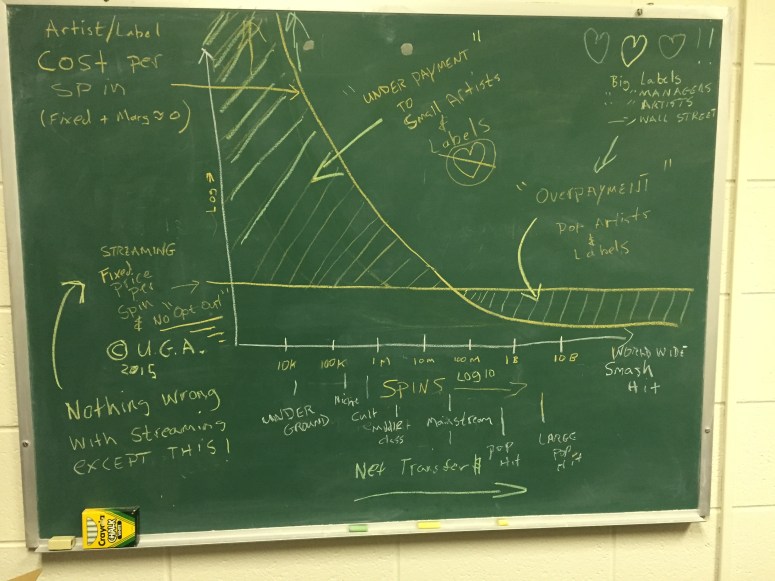
(Sharky Laguna’s recent post on the problem with streaming got me thinking about the issue again. I decided to probe a little deeper into the matter at UGA this week. This is still a work in progress but I think this goes a long way to explaining the internal conflict within the music business over streaming.)
Apologies in advance to “generation tl;dr” there is not a simple explanation here. This is the best I can do: In a free market specialty or niche products generally cost more than mass market products. So for instance a semi-ironic american flag tank top from walmart can be sold for $9 and the manufacturer still makes money. This is in part because the fixed costs can be spread over a large number of buyers. Compare that to a Rockmount Ranch Wear hand stitched western shirt. It’s impossible for this maker to sell this shirt at $9 and stay in business. Now if through a combination of government mandates and cartel price fixing all shirt makers were required to sell each of their shirts for $9 the Walmart american flag tank top would stay in business. Rockmount Ranch Wear would go out of business.
I’m simplifying here but, on-demand streaming pays a more or less fixed rate to rightsholders per spin. For Spotify it’s around $0.0049. For YouTube (Content ID) it’s on average less than $0.001 ( YouTube is a much bigger problem for artists than Spotify!!). This fixed price per spin was the result of a combination of government mandates and cartel price fixing.
So what has happened? I’m generalizing here, but niche market artists (and their labels), even middle class artists have a difficult time recouping fixed costs of recording and are generally unhappy with this sort of deal (not all). Meanwhile pop stars, their labels and managers are generally happy with this deal because it’s easier for them to recoup their fixed costs (but again not all). Both groups of artists/labels and managers are acting rationally from their own perspectives.
But if you really look at my chart you see that something much more troubling is going on. Niche products should be more expensive, while mass produced products should be less expensive. But here the reverse is true. Because of the fixed price per spin, the most popular artists look like they are being overpaid. While the the niche and middle class artists look like they are being underpaid. So in effect this is a transfer of wealth from the niche and middle class artists/labels to the biggest pop stars and their labels.
++++++ tl;dr stop reading here+++++++++++++++
Assumptions:
My curve is Y= Average Fixed Cost Per Song ÷X
Y = fixed cost per spin.
How do I know what the average fixed cost per song is? I don’t. I was trained in abstract mathematics -and I realize this is gonna drive the applied math and engineers folks crazy- but you don’t really need to know that.
It doesn’t matter whether the average fixed cost per song is $500 or $50,000 dollars you are still gonna get the same shape in the curve. You will still have the biggest artists being overpaid and the niche artists being underpaid.
Further because spins of songs appear to exhibit non-guassian variation the “break even” point is still gonna be up towards the top tier of artists whether fixed costs are $500 or $50,000. My “break even” point for this version of the chart was just subjectively chosen. Its where I thought the “pain” seemed to be kicking in. Artists in the below 10 million spins seem to be complaining. Artists above 100 million spins, not so much.
UPDATE 1
One side of the scale (X axis) is log scale compressed, because spins/sales exhibit wild variation and I couldn’t properly draw the curve on the chalkboard. Unless the chalk board was several miles (?) long. This misrepresents the size of “overpayment” region. But the “underpayment” region isn’t really represented properly either. My intent is not to have you compare the “area” of these regions. Just that there is an aggregate underpayment to smaller artists and an aggregate overpayment to very popular artists. If you look very very closely it says “log?” on the Y axis. The Y axis is not supposed to be Log compressed, though i did make that note. I’m not really sure it would make much difference either way since I’m asking the reader to NOT compare size of regions. Not compressing the Y axis helps make the curve more “readable” but distorts the size of regions. But I am open to suggestion on this.
UPDATE 2
Finally remember I am talking about the hypothetical average song and the average artist. There clearly will be individual exceptions. Of particular importance is that many small artists some new, some semi-professional, others hobbyists (no negative connotation implied) will happily offer their music for free, and the low per spin rate is not a problem. New artists especially, have always given away their music for free. It’s a competitive advantage and a key part of any new artist marketing strategy. I’m sure you can find any number of small artists that don’t feel underpaid and instead feel that streaming services offer them an opportunity to reach a mass market. The odds are long for these artists as the consumer is faced with a tyranny of choice, but it is still a rational choice for many artists. And I am all for artists choice. What concerns me the most is that this streaming model seems to underpay the vast middle class of working artists that are really the backbone of the music industry.
Is the video below a glimpse of what the future looks like without this middle class of artists 🙂 ?
I welcome sensible and polite comments. I hope this provokes a conversation that leads to a better and more accurate model of this phenomenon and eventually that leads to sensible solutions.

 The Trichordist
You must be logged in to post a comment.