Trichordist Bookshelf – Essential Reading for Artists Rights

Holiday Reading List? Enjoy!

The Trichordist

“WHO OWNS THE FUTURE” by JARON LANIER – BUY AT AMAZON:
http://www.amazon.com/Who-Owns-Future-Jaron-Lanier/dp/1451654960/

The Dazzling New Masterwork from the Prophet of Silicon Valley

Jaron Lanier is the bestselling author of You Are Not a Gadget, the father of virtual reality, and one of the most influential thinkers of our time. For decades, Lanier has drawn on his expertise and experience as a computer scientist, musician, and digital media pioneer to predict the revolutionary ways in which technology is transforming our culture.

Who Owns the Future? is a visionary reckoning with the effects network technologies have had on our economy. Lanier asserts that the rise of digital networks led our economy into recession and decimated the middle class. Now, as technology flattens more and more industries—from media to medicine to manufacturing—we are facing even greater challenges to employment and personal wealth.

But there is an alternative to allowing technology to own our…

View original post 1,036 more words

Horrible: Caitlin Dewey, Washington Post Praises Site That Refused Request By Parents to Remove Pictures of Murdered Children.

I’m sorry to do this to you.  But with all the fawning press by technology journalists on the Pirate Bay, someone has to remind the world how horrible the Pirate Bay really was.  The technology press has given them a free pass for years.  The misery they created for thousands of creators is nothing compared to the misery they created for the father of two murdered children after their autopsy photos were distributed on The Pirate Bay.  When the father asked TPB moderators to remove  the photos be removed this was the response: he was  to stop whining and fuck off.

This is the “courage of conviction” you are praising Caitlin Dewey.  How the fuck do you sleep at night?

http://www.washingtonpost.com/news/the-intersect/wp/2014/12/10/you-can-take-down-pirate-bay-but-you-cant-kill-the-internet-it-created/

Oh and why didn’t you mention that the Pirate Bay was originally funded by Neo-Nazi?

That apparently was their  “courage of conviction” as well.   Is this also a conviction you admire?

Do you and  the Washington post normally go around praising organizations funded by Neo-Nazis?

Here is Caitlin Dewey’s twitter handle

@caitlindewey


LA Times Editor Jon Healey’s Ode to Bittorrent: Did he Coordinate Earlier Editorial with Bittorrent?

We’re just asking questions here.  Questions that should be answered. Were these two pieces coordinated with Bittorrent?

Today Jon Healey published this ode to P2P filesharing company Bittorrent.

http://www.latimes.com/business/technology/la-fi-tn-bittorrent-browser-project-maelstrom-20141211-story.html#page=1

Healy a serial piracy apologist,  makes the following highly misleading statement about BitTorrent use in Hollywood’s hometown paper:

“It’s true that BitTorrent is favored by the illegal-downloading crowd; what’s less well known is how widely the protocol is used for legitimate purposes.”

Sure if by “widely used for legitimate purposes” he means “less than 1%” of bittorrent traffic. Well then yes Bittorrent is then “widely used” for legitimate purposes.  Never mind that Bittorrent has a history of monetizing all this illegal traffic with advertising in it’s client software.  That is, directly profiting from from the misery of artists. Healey seems to think this ethically and morally challenged Belorussian/San Francisco company  deserves an advertorial in one of the nation’s largest papers.

But it goes beyond that.  Healey is not a serious and responsible journalist and probably should not be in a position that relies on objectivity and facts. Further there appears to be some sort of coziness between the editor and Bittorrent.   Why do I say this?  Two reasons:  Cox Media (the cable company) and North Korea.

1) Healey as the LA Times editorial board pushed out a very misleading piece about the BMG vs Cox suit, alleging in a mind-bending logical contortion that the suit was trying to create “new law.”  Whereas any impartial reading of the facts would conclude that  BMG is pursuing it’s remedies as proscribed by US law, and Cox has possibly failed to follow the law.  How on earth an attempt to get a large cable company to follow US law could be characterized as creating new law is positively Orwellian. Further the fact that  Healy as the LA Times Editorial board immediately pushed out an editorial on a relatively obscure lawsuit in Maryland brought by a German company is eyebrow-raising to say the least.  I won’t speculate on the appearance of coordination with p2p file-sharing interests, but the follow up puff piece on Bittorrent (the company)  should prompt an internal review by the LA Times.  At least to assure no co-ordination took place.  BTW the Op Ed board at the LA Times rejected my proposal to write an piece corrected their previous misstatements.  So much for objective journalism right?

2) Healey has been quick to spread the laughable and unsubstantiated rumor that North Korea is behind the Sony Hack.  Is this the type of thing the an editor of the LA Times should be doing?  It seems completely irresponsible to me to publicly state that North Korea is behind the hack when there is no evidence (see my twitter conversation with Healey) My suspicion is that his clear sympathies for those who profit from piracy at the expense of creators (Bittorrent and Google) makes him hope that this act of economic sabotage has not been committed by one of his fellow travelers.

Below are my conversations with Healey as well as my letter to the LA times.

+++++++++++++++++++++++


davidclowery ‏@davidclowery  Dec 8
@jcahealey how but a different viewpoint on the BMG vs Cox from me?

Jon Healey ‏@jcahealey  Dec 8
@davidclowery You mean a letter to the editor, or do you want more space? We have Blowbacks, but those are online only.
davidcloweryVerified account‏@davidclowery
@jcahealey more space. I think that the LA times Hollywoods hometown paper comes out against Legal action on P2P infringers deserves print.

11:39 AM – 8 Dec 2014

Tweet text
Reply to @jcahealey 

davidclowery ‏@davidclowery  Dec 8
@jcahealey especially after the Sony hack

0 replies0 retweets0 favorites
Reply
Retweet
Favorite
More
Jon Healey ‏@jcahealey  Dec 8
@davidclowery You’ll have to make that case with the op-ed folks, then. But op-ed doesn’t exist to rebut editorials. Separate mission.

0 replies0 retweets0 favorites
Reply
Retweet
Favorite
More
Jon Healey ‏@jcahealey  Dec 8
@davidclowery Because the North Korean regime and Cox have something in common?

0 replies0 retweets0 favorites
Reply
Retweet
Favorite
More
davidclowery ‏@davidclowery  Dec 8
@jcahealey nice snark. How do you think the real economic damage occurs?

0 replies0 retweets0 favorites
Reply
Retweet
Favorite
More
davidclowery ‏@davidclowery  Dec 8
@jcahealey lets not play semantics. you’re smarter than that. You know what I mean. and you know it’s right that you print different view.

0 replies0 retweets0 favorites
Reply
Retweet
Favorite
More
davidclowery ‏@davidclowery  Dec 8
Breaking news LA TIMES editor claims to have established that NORTH KOREA behind Sony Hack. @jcahealey

0 replies0 retweets1 favorite
Reply
Retweet
Favorite1
More
davidclowery ‏@davidclowery  Dec 8
@jcahealey I’ve got a bridge to sell you.

0 replies0 retweets0 favorites
Reply
Retweet
Favorite
More
Jon Healey ‏@jcahealey  Dec 8
@davidclowery Send your pitch to oped@latimes.com. The op-ed folks are wholly separate from us, and I’ll keep my nose out of this one.

0 replies0 retweets0 favorites
Reply
Retweet
Favorite
More
Jon Healey ‏@jcahealey  Dec 8
@davidclowery The standard length is 800 words, but they’ve published longer and shorter pieces.

0 replies0 retweets0 favorites
Reply
Retweet
Favorite
More
davidclowery ‏@davidclowery  Dec 8
@jcahealey much appreciated. thanks


to oped
I would like to propose an op-ed.  My view on Cox and it’s obligations under the DMCA act.

I am a musician, academic, researcher, entrepreneur and artists rights advocate.

I noticed that LA Times ran this editorial piece.  Aside from the fact that it’s shocking to see Hollywoods hometown paper  implicitly defend p2p file sharing, the opinion piece really mischaracterizes what rights holders like myself  are trying to do when they send notices to ISPs like Cox communications.
The mischaracterization is that  this a as “attempt to turn ISPs into bare-knuckled enforcers.”
Fact: the notices are part of a process proscribed by US LAW!  Read the DMCA act if you think otherwise.  BMG, Digital Rightscorp and individual artists like myself are following the letter of the law.
It is my experience (objectively demonstrable), Cox does not fulfill it’s obligations under the law.  They do not cut off repeat infringers as the DMCA act requires and thus this BMG  lawsuit is necessary.
Further the Copyright Alert System that the LA Times endorses is not a law passed by our democratically elected representatives.  It is an extra-legal agreement between a few corporations. Aside from it being a failure,   it has no legal standing, it doesn’t cut off repeat infringers as required by law.  Yet ISPs (and now LA Times) wants to force rights holders (like music publishers and myself) to treat this extra-legal agreement as a sort of law.
Isn’t this creating new law?  Something to which the LA times is opposed?
Finally it’s amusing to see your paper trot out the old Google generated slogan “Don’t Break the Internet”
 How bout we don’t break the democratic legislative process by allowing corporations to ignore the law and substitute an extra-legal private agreement in it’s place.

The Real Issue Of Online Piracy and Illegal File-Sharing: Assholes (guest post)

Just thinking about The Pirate Bay and those who have supported it…

The Trichordist

By Zach Hemsey
(Copyright in the author, used by permission)

Debates about illegal file-sharing have been going on for quite some time now, and while there are many interesting perspectives on the issue, the one thing that continues to surprise me is that very few people seem to actually understand what the central matter being debated is. Time and again, arguments are made that miss the point, facts or statistics are presented that have no relevance, and ultimately discussions digress into personal opinions about artists, major labels, the industry, etc. I’d like to clear up much of this foolishness, so that moving forward we can all focus on the relevant issue at hand. Note that for the sake of simplicity, the following will focus on music piracy and artists, but obviously the points raised are equally applicable to movies, authors, etc.

Lets begin with the myth that piracy was born…

View original post 2,503 more words

Spotify Must “Adapt Or Die” : Pricing For Sustainability

The single biggest problem with Spotify (and other services like it) is that they have completely removed the relationship between the artists and the fan. The labels have leveraged their catalogs as an asset in exchange for equity shares in a tech start up that is subsidized by the artists. And to be clear, that is equity that the labels are not “sharing” with the artists who are making the equity possible. We’re not even sure how this could be legal, but we’ll leave that to the lawyers to figure out.

The second problem is that the money the consumer pays, does not pay the artists the consumer is supporting. The model for Spotify and others is to divide the total pool of revenue by the total number of streams and pay out the revenue on a per stream basis. But that is not the same as a directing each consumers payments only to the artists that consumer is streaming.

So in two very important ways the relationship between the fan and the artist has been broken by completely disconnecting compensation from consumption.

There’s a very simple fix, per stream retail pricing. We are NOT supporting the notion that 150 streams should equal one song download. However for the purposes of this writing that’s where we’re going to start. We feel that Billboard has grossly undervalued the cost of a stream, but we’ll get to that later.

We’re starting with this metric specifically in the context of the new Billboard “consumption” chart whereby every 150 streams = 1 song. At retail, that means each stream is worth $.00666 (we still love the irony there).

$.00666 x 150 = $.99

Here’s what the breakdown looks like PER STREAM:

$.00666 Gross Retail (Paid by Consumer to Spotify)

$.00666 x .70 = $.00467 Paid to Artist/Rights Holder (70% of Gross)

$.00666 x .10 = $.000666 Paid to Songwriters / Publishers from 70% Above

So let’s recap… in context of 150 streams to ONE SONG:

$.00666 x 150 = $.99 (One Song)

$.00467  x 150 = $.70 (70% of Gross) To Artist/Label

$.000666 x 150 = $.09 (Full Stat Mechanical, One Song) To Songwriter/Publisher

$.70 – $.09 = $.61 Net to Artist/Label

These are the exact same mechanics paid on a single song download.

Another way to express this would be to say that the consumer spending $10 a month on Spotify can play 1,500 streams. Every stream the consumer plays then pays out 70% of gross, just like iTunes. In other words, every 150 streams equals the same economics as ONE Itunes Song Download in the distribution of revenue.

A consumer pays $10 for every 1,500 streams they consume at $.00666 retail pricing. If they consume more, they pay more. If they consume, less they pay less.  Compensation is now directly reconnected to consumption!

Simple. Easy. Fair.

We can argue about what the price of a stream should be, but reconnecting the artist fan relationship through compensation for consumption is essential.

Steve Jobs was a genius. He reversed engineered the margins and mechanics of physical retail distribution for Itunes. Jobs made it easy for labels to make sense of digital revenues, accounting, operations and royalties reporting. There is no logical reason why streaming services can not operate the same way.

There is also no logical reason why per stream retail pricing can not exist. That is unless of course the goal is to NOT have a simple, easy and fair ecosystem that is sustainable and supports artists.

We tend to think that the retail price per stream should probably more like two to five cents per stream (maybe more), as we’ve heard Beats may be paying. Whatever the retail price per stream to consumers there should be flexibility in the model for variable pricing bu artists and labels.  Variable pricing exists in digital stores such as iTunes as it also does in physical distribution.

Retail per stream pricing restores the relationship between the fan and the artist whereby compensation is directly connected to consumption. This model works and does not change the margins paid by Spotify (and others). The streaming service still retain 30% of the gross revenue, except now we have the opportunity of moving closer to a fair cost of goods.

No Music = No Business.

Add to the above experiments with new release windowing, value propositions based on bundled tiers, etc, and we can start to see a smart and sustainable streaming business emerging for all stakeholders.

Spotify can chose to “adapt or die.” It’s just math.


A Royale With Cheese: How Google Taught the U.S. Congress to Lead With Their Chins

More Google lobbyist shenanigans!

Music Technology Policy

l’Arc de Triomphe de l’Étoile

VINCENT

But you know what the funniest thing about Europe is?

JULES

What?

VINCENT

It’s the little differences.  A lotta the same shit we got here, they got there, but there they’re a little different.

JULES

Examples?

VINCENT

In Paris, you can buy a beer at McDonald’s.  Also, you know what they call a Quarter Pounder with Cheese in Paris?

JULES
They don’t call it a Quarter Pounder with Cheese?

VINCENT

No, they got the metric system there, they wouldn’t know what the fuck a Quarter Pounder is.

Pulp Fiction, by Quentin Tarantino & Roger Avary

Google is in the middle of a knock-down drag out fight with the European Commission’s antitrust authority over a very simple issue:  Google has nearly 100% market share in Europe over search (including video search through its YouTube platform), much, much higher than Google’s US market share.  Google…

View original post 2,744 more words

MegaUpload (MegaVideo) Smoking Gun? Did the site illegally charge for Streaming Movies?

As the SONY HACK unravels, keep this in mind. It’s about the money.

The Trichordist

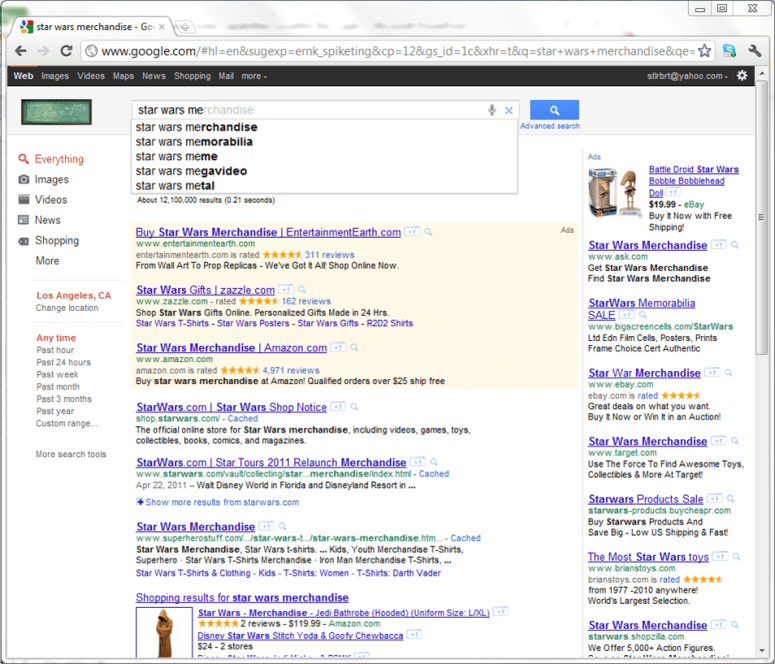
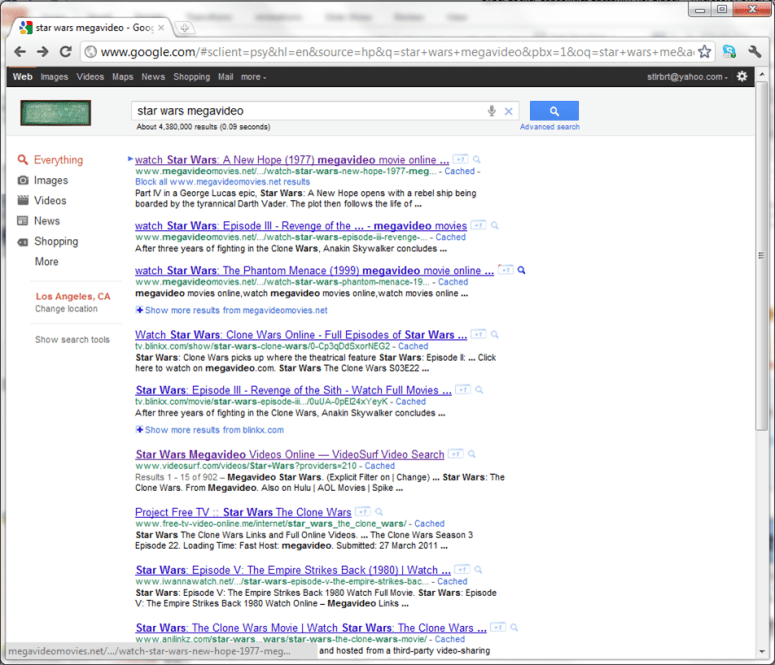
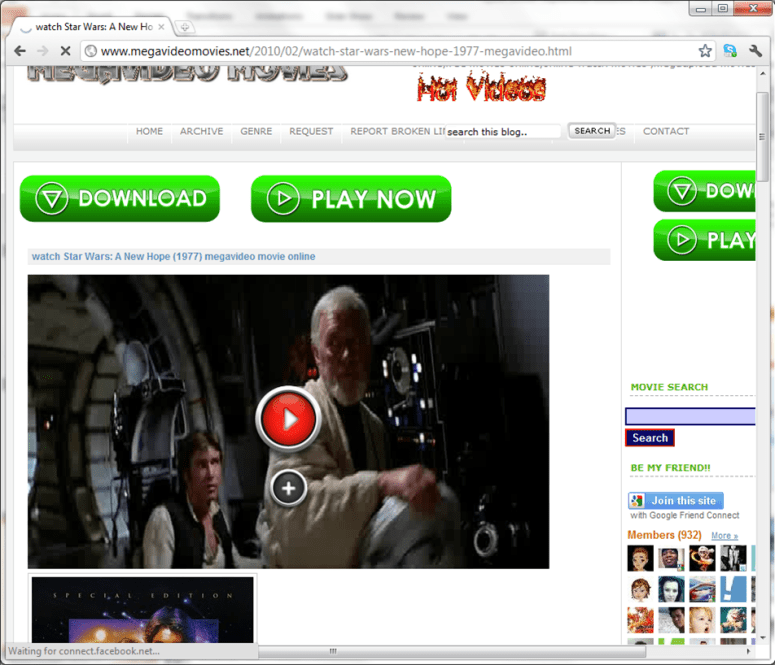
These screen shots appear to show that Kim Dotcom’s Megaupload was selling streaming movies that it did not have the rights to sell.

Megaupload was allegedly paid uploaders per stream from files they uploaded to Megaupload. That is why there were so many links that Google autopopulated Megavideo after you entered Star Wars in the search field.

Then Google estimated that there were 4.3 million web pages that had the words “star wars megavideo” on them.  Legitimate file locker sites like Dropbox, don’t allow any public links to copyrighted content.  In fact Dropbox just banned Boxopus, a torrent tool from using its API.

Megavideo let you play the first 45 minutes of Star Wars and thousands of other movies for free (after they had served you and profited from dozens ads) . . .

But then, to watch past 45 minutes, you had to enter your credit card and pay…

View original post 83 more words

Zero Dark Thirty, Best Picture Academy Award Nominee, Exploited by AT&T, Verizon, MetroPCS, Nissan, H&R Block, British Airways, Progresso, and more…

Zero Dark Thirty was also a SONY PICTURES release – this is how piracy is a FOR PROFIT business. The latest hack is intended to create financial harm…

The Trichordist

We spend most of our time here focused on artists rights as it applies to music and musicians. But we wanted to see if the film industry was having the same challenges as music. We believe in the rights of all creators to consent and compensation for their work (ethical internet principles numbers two and four, respectively).

With the upcoming Academy Awards we wondered if it would be possible to find pirated versions of Zero Dark Thirty. It is  the most talked about film of the year which is nominated for five Academy Awards including Best Picture. But it could easily be any of the other nominated films, in any of the categories as well. We just picked Zero Dark Thirty. It’s also been widely reported that most of the nominated films have already been pirated and are online.

We were also curious what major brands might…

View original post 695 more words

@sydell Raises the Issue of Pandora and Payola Platform Parity

“Do not turn to mediums or necromancers; do not seek them out, and so make yourselves unclean by them.”

Leviticus 19:31

National Public Radio reporter Laura Sydell has raised a very interesting question about the “new boss” direct license agreements that Pandora is making with record companies: the return of payola (“Pandora’s New Deal: Different Pay, Different Play“).  She notes correctly that at least one direct license contains a “steering” clause that promotes airplay in consideration of a lower royalty payment.

It’s not too much of a stretch to think that the timing of Pandora’s desire to make these deals did not just happen by accident or through market forces.  Our bet is that Pandora makes these direct deals to manufacture evidence of “willing buyer willing seller” royalty rates for the rate setting proceeding currently underway before the Copyright Royalty Board in Washington, DC (“CRB”).

Ms. Sydell calls out a serious question that goes to the heart of the very direct licenses that Pandora is trying to use as evidence to lower webcasting rates for everyone.  We have to ask if these licenses ought to be considered for rate setting before they are determined to be lawful in the first place.  As Ms. Sydell reports, there’s every possibility that “steering” clauses are illegal.

Here’s the point:  If anyone says they know whether steering clauses are legal, they have as much claim on predicting the future as a medium has of talking to souls in the afterlife.  And you know why they say about that.

Steering or Payola?

Under its steering clause, at least as far as we can tell, Pandora promises to play more of the artists licensed to a label if the label does the direct deal.  And that’s where the payola issue comes up.  (An interesting question is whether the artists who are not featured take a royalty cut regardless, subsidizing those who are featured.)

As Ms. Sydell reports:

An Uneven Playing Field

Pandora recently signed a deal with a company called Merlin, a consortium of independent record labels that’s adding another factor to the algorithm: money.

Performers get paid a small royalty each time one of their songs is played on Internet radio, at a rate set by a Royalty Court at the Library of Congress. But Internet radio and labels can strike individual deals, as Pandora did with Merlin. The Internet service will recommend Merlin artists over those not affiliated with the consortium in exchange for paying Merlin’s musicians a lower royalty rate.

Merlin artists get more spins, and Pandora winds up paying less in royalties than it would if were giving those same spins to non-Merlin artists. Plus, consortium labels will get to suggest favorite tracks.

This particular deal happens to be with Merlin, the indie label licensing organization (although Pandora refuses to say how many of the Merlin labels have opted in to the deal).  Merlin has a long history of being committed to maintaining the value of music, so this payola issue should not blow back on Merlin no matter how hard Pandora tries.  (Note that Pandora refuses to clearly state how many of the “thousands” of Merlin labels have opted in to Pandora’s agreement.  On a November 28, 2014 conference call, Pandora’s CFO dodged the question by saying that Pandora had opt-in from over 90% of Merlin members who were part of the original pool that Pandora targeted with the agreement–whatever that means.  This has been misreported as 90% of all Merlin labels, which is not at all what he said.)

But Pandora is in the middle of a rate hearing before the CRB that will set the rates for all webcasters and simulcasters–and all featured artists, session players and singers and recording owners.  Pandora is using the Merlin agreement as evidence of a market rate deal–presumably to reduce the rates that Pandora pays everyone else.  Because the “steering” component is consideration that only applies to Merlin labels at the moment, Pandora will have to get the CRB to ignore what may be the payola component and only focus on the lower rates.  (This is also known as a “Chris Harrison Special” and is very similar to the screwing that Pandora lawyer Harrison did to songwriters when he worked at DMX–and he did such a good job of sticking it to songwriters, that may have commended him for the Pandora job.)

While Pandora filed a copy of their Merlin contract with the CRB, it’s so heavily blacked out FBI-style that no artist can find out what the terms are.

Is it Payola?

Here’s what the FCC says about its payola rules:

What the Rules Say 

The Communications Act and the FCC’s rules require that:

When a broadcast licensee has received or been promised payment for the airing of program material, then, at the time of the airing, the station must disclose that fact and identify who paid for or promised to pay for the material. All sponsored material must be explicitly identified at the time of broadcast as paid for and by whom, except when it is clear that the mention of a product or service constitutes sponsorship identification;

Any broadcast station employee who has accepted or agreed to accept payment for the airing of program material, and the person making or promising to make the payment, must disclose this information to the station prior to the airing of the program;

Any person involved in the supply, production or preparation of a program who receives or agrees to receive, or makes or promises to make payment for the airing of program material, or knows of such arrangements, must disclose this information prior to the airing of the program. Broadcast licensees must make reasonable efforts to obtain from their employees and others they deal with for program material the information necessary to make the required sponsorship identification announcements;

The information must be provided up the chain of production and distribution before the time of broadcast, so the station can air the required disclosure; and

These rules apply to all kinds of program material aired over broadcast radio and television stations. Some of the rules also may apply to cablecasts.

Does the payola law apply to Internet radio?  Here’s a helpful 2008 article from a very important Internet radio lawyer, David Oxenford of Washington, DC who has represented Pandora.  Mr. Oxenford is a powerful lawyer and has been a major player who influenced the current artist royalty rates in and out of the back rooms of Washington, so we should pay close attention to what he has to say on the subject:

[A] pay for play scheme would limit royalties that a digital music service would pay – as it is likely that any service that is getting paid to play songs would also get a waiver of the royalties for those songs (see our post on waivers here).  When confronted with a proposal where artist would waive royalties in exchange for airplay [including a label waiving part of their artist’s royalties?], artist groups [including the Recording Artist Coalition] complained that the waiver of royalties without disclosure, in and of itself, constituted consideration for airplay and would be “payola” if not disclosed.  We’ll save discussion of that issue for another day, but disclosure solves any issue that may exist.

Remember, the “disclosure” that Mr. Oxenford describes must occur at the time the song is played on Pandora.  This could get tricky given Pandora’s business model.  It’s hard to imagine how they would comply, but surely the Silicon Valley can produce a transparent solution to that disruption to offer a lawful consumer experience to users.

If “Pandora Is Radio,” Is “Steering” Payola?

Is the “steering” clause unlawful payola?  Until the FCC rules on the issue, we won’t know.  But until we know, how can the CRB take notice of a potentially illegal contract as evidence of anything?

As Ms. Sydell reports:

Jim Burger, a copyright lawyer and adjunct professor at Georgetown University, says [steering clauses] would receive legal scrutiny if it were taking place on old-fashioned radio.

“If they were a terrestrial radio station and they were getting a discount on certain music as long as they played it more than other music, that would be considered illegal,” Burger says, adding that stations would have to announce such an arrangement upfront….

Pandora CEO Brian McAndrews says there’s no comparison between that and what his company is doing.

“Payola is where record labels pay radio stations to get airplay,” McAndrews says, “and the opposite is what happens today. As Pandora, we pay the record labels and the artist to allow airplay. So it’s completely different.”

Wrong again, Brian.  The payola laws put the disclosure responsibility on the FCC licensed broadcasters.  Not the labels.  In fact, we have to believe that Merlin got promises from Pandora that the contract is in fact legal.  So if there’s a payola problem with the Merlin deal, it’s not Merlin’s fault or Merlin’s problem.  It’s Pandora’s problem.

Does McAndrews really want to stand in the witness box with right hand to God and try to convince a judge that Pandora didn’t get paid to play, they just paid less to play more of certain artists?  You know, less is more your honor.

You may be thinking that Internet radio doesn’t require an FCC license so how can the payola rules apply to webcasters?  A good point.  We’re not saying that the payola rules apply to all webcasters (although Mr. Oxenford mused that payola might apply to Internet radio, and we agree with Mr. Oxenford.  Given the current power of Internet radio and Pandora’s  near-obssessive desire for a level playing field, it probably should).

But–Pandora is desperately trying to acquire an FCC licensed radio station in South Dakota in an attempt to make an end run around songwriters and characterize themselves as radio station.  And as Pandora will tell you, “Pandora Is Radio”.   So if Pandora is radio, and if Pandora acquires an FCC broadcast license, why shouldn’t Pandora be subject to the same payola rules as any other radio station and on all their platforms?

As Pandora lawyer Mr. Oxenford tells us:

The payola statute, 47 USC Section 508, applies to radio stations and their employees, so by its terms it does not apply to Internet radio (at least to the extent that Internet Radio is not transmitted by radio waves – we’ll ignore questions of whether Internet radio transmitted by wi-fi, WiMax or cellular technology might be considered a “radio” service for purposes of this statute).  But that does not end the inquiry.  Note that neither the prosecutions brought by Eliot Spitzer in New York state a few years ago nor the prosecution of legendary disc jockey Alan Fried in the 1950s were brought under the payola statute.  Instead, both were based on state law commercial bribery statutes on the theory that improper payments were being received for a commercial advantage.  Such statutes are in no way limited to radio, but can apply to any business.  Thus, Internet radio stations would need to be concerned.

So as Pandora’s lawyer tells us, if the FCC can’t get  jurisdiction over pureplay webcasters, state attorneys general may be able to under applicable state law commercial bribery statutes.  That’s potentially what’s called a 51 jurisdiction issue (50 states plus federal law).

Presciently, Mr. Oxenford also warned of potential jurisdiction of the Federal Trade Commission:

[T]he FTC has in the last few years expressed concerns about viral marketing and other advertising schemes where the consumer is not aware that he or she is being subjected to advertising.  Whether it be the stranger in the bar who is paid to brag about the taste of some brand of beer or the chain email that endorses some product without revealing that the testimonial was bought and paid for, the FTC has been concerned that these techniques are false and deceptive trade practices.  Again, an all-payola channel would seem to trigger these concerns.

But of course the real question is whether an FCC licensee like Pandora wants to be would have to comply with the payola statutes on its Pureplay webcasting affiliate.  We agree with Mr. Oxenford that there definitely seems to be an issue.

It’s such a big issue that it’s hard to understand how the CRB should accept a “steering” deal as evidence of anything for Pandora’s rates.  It seems that the CRB would be well-advised to at least delay consideration of the agreement until the FCC rules on the sale of KXMZ to Pandora and if the license is granted, also wait until the FCC further rules on whether Pandora is subject to the payola statutes as an FCC licensed broadcaster.  Not even a necromancer can predict how that ruling would turn out.

That ruling would answer the question of whether and why an Internet radio company like Pandora should be treated differently than a broadcaster, especially if Pandora turns out to be both.

You know–platform parity and all.

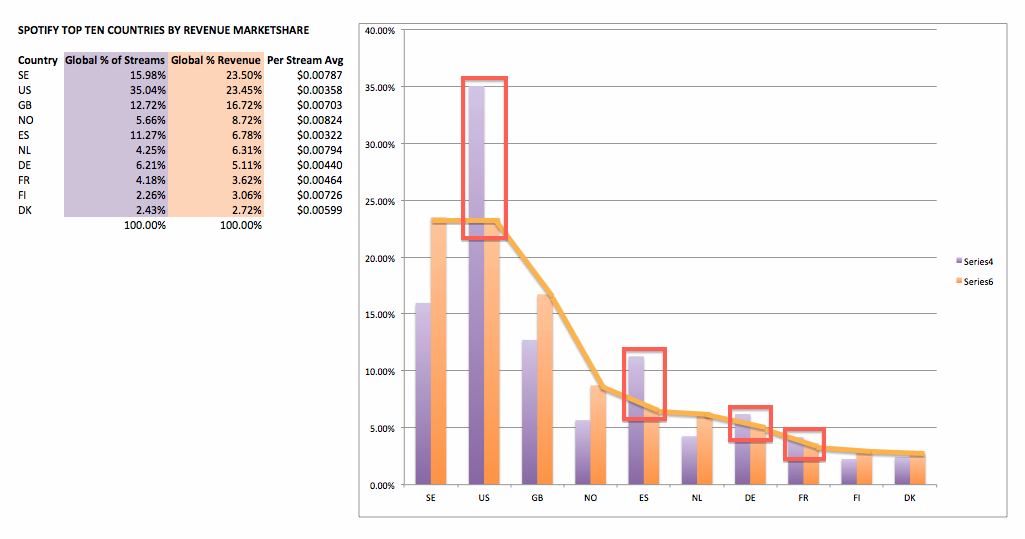
Spotify Top 10 Territories : Global Revenue Marketshare & Streaming Percentages

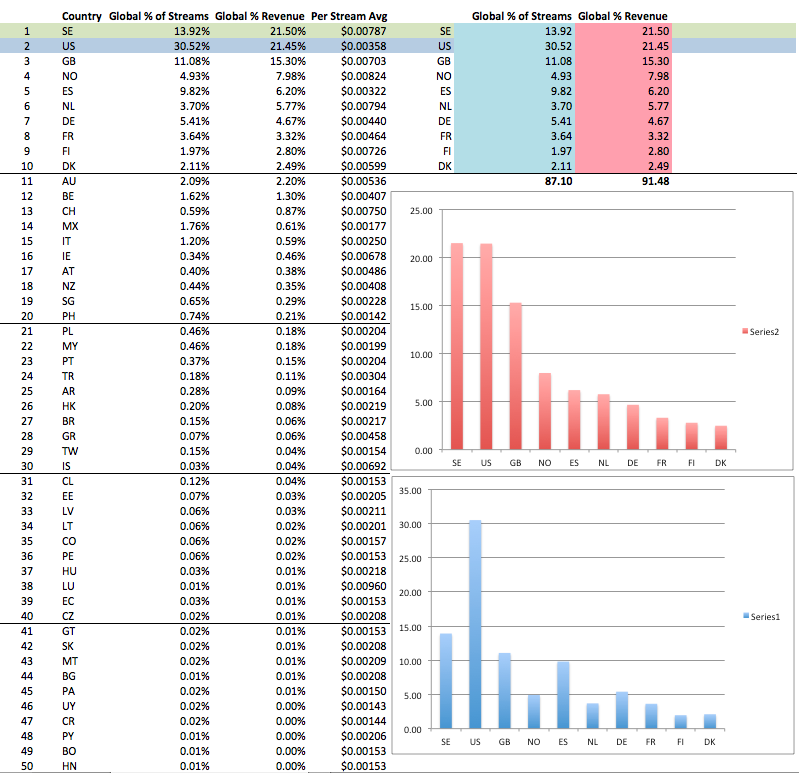
The Top 10 territories account for 87.10% of all streams and 91.48% of all revenue. So all revenue outside of the Top 10 is less than 9% of global revenues. So if you’re streaming your music outside of the Top 10 territories, you are more or less giving your music away.

SpotifyGLOBALMarketshareRevStreams

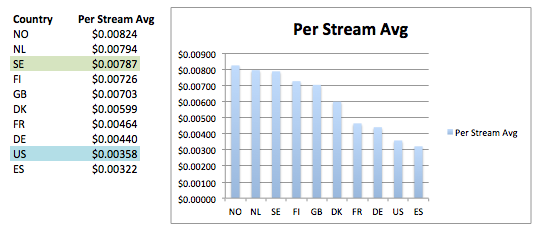
Here’s the summed, net averaged per play rate for the top ten territories.

SpotifyT10CountriesStreamingRates

Below the top ten territories are isolated (and the market share recalculated).

The data would seem to suggest that savvy artists and labels avoid the territories where the number of streams far exceeds the percentage of revenue (the red boxes).

SpotifyNOFLYTerritories

Data set provided by US based indie label with 800 songs. Data is summed from sales and reports dated Sept 2011 – Aug 2014. This is what Spotify really looks like to most artists and indie labels.