New Report Says How Much Advertising Is Going to Piracy Sites | ADWEEK

Piracy is not only a threat to the content creators whose material is being stolen but the reputations of the advertisers whose brands appear on the sites and the credibility of the digital advertising ecosystem, says the report, titled “Good Money Gone Bad: Digital Thieves and the Hijacking of the Online Ad Business.

The report lists the sites it studied as well as the dozens of blue-chip advertisers whose ads were seen on the offending sites, including AT&T, Lego and Toyota.

“The reality of it is, this is a big business,” said Wenda Harris Millard, president and COO of MediaLink. “I think people thought it was a cottage industry.

READ THE FULL STORY AT ADWEEK:
http://www.adweek.com/news/advertising-branding/new-report-says-how-much-advertising-going-piracy-sites-155770

RELATED:

Google, Advertising, Money and Piracy. A History of Wrongdoing Exposed.

Over 50 Major Brands Supporting Music Piracy, It’s Big Business!

Report links Google, Yahoo to Internet piracy sites | LA Times

Spotify seeks to hire U.S. filings expert as bankers eye IPO | Reuters

* Move adds to speculation about IPO

* Senior banker says firm to be valued at $7-8 bln

* Spotify doubled revenue but registered loss in 2012

STOCKHOLM, Feb 17 (Reuters) – Online music streaming service Spotify is recruiting a U.S. financial reporting specialist, adding to speculation that the Swedish start-up is preparing for a share listing, which one banker said could value the firm at as much as $8 billion.

Meeting U.S. Securities and Exchange Commission (SEC) standards for filing financial disclosures is essential for any firm planning to go public and bankers and lawyers said they inferred from the job ad that the company is getting ready for an initial public share offering (IPO), possibly next year.)

READ THE FULL STORY AT REUTERS:
http://www.reuters.com/article/2014/02/17/spotify-idUSL6N0LM2E520140217

RELATED:

If Spotify is saving Swedish music sales, why aren’t indies celebrating?

While Artists are Bitching About Spotify Royalties… Google, YouTube and Grooveshark are in the Getaway Car…

Get Ready For The Streaming-Music Die-Off

Streaming Services Will Never Become Profitable, Study Finds… | Digital Music News

“The streaming business has to slowly move from a free economy to a paid economy as the sustainability of ad-supported revenue model is a big question mark.”

The grim financial outlook comes as rumors intensify over plans by Spotify to go public.  But just like Pandora, Spotify’s financials remain ugly and are unlikely to improve. “Pandora has never made a profit and we think that the company will never make a profit, unless there is a major change in strategy,” Generator concluded.

READ THE FULL STORY AT DIGITAL MUSIC NEWS:
http://www.digitalmusicnews.com/permalink/2014/02/18/profitless

RELATED:

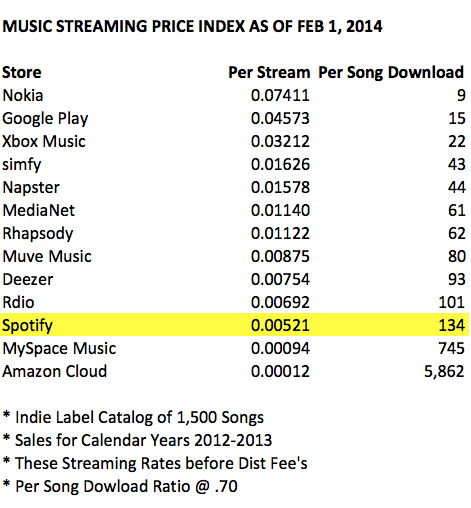
Music Streaming Math, Can It All Add Up?

No, Streaming is not more profitable than Transactional Sales… Not Today, Maybe Not Ever…

Beck on Spotify: “The Model Doesn’t Work. And the Quality Sucks.” | DMN

Gloria Steinem: Artists Rights Are Human Rights #IRESPECTMUSIC

Electronic Frontier Fondation disagrees.  “*&#$&^@!!!!”

So let’s see…. Human Rights are interfering with our freedoms?  Help me out here.  I guess you have to be a lawyer to understand this logic.

RELATED:

Universal Declaration of Human Rights – Article 27

The Human Rights of Artists

Google pretends to care about human rights | Vox Indie

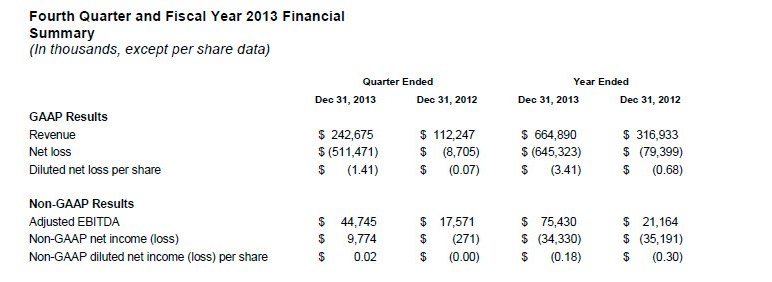
Camper Van Beethoven’s 2013 Net Profit Was $645 Million Dollars Higher Than Twitter.

Technologists in Silicon Valley love to tell artists we need to update our business model.

This is hilarious since each of my businesses have been profitable for decades. Stunning when you look at just how unprofitable these Silicon Valley Companies actually are.  Twitter for instance lost $645 million dollars last year.   Jaw dropping when you consider that their total revenues were $646 million dollars.   They spent 2 dollars for every 1 dollar of revenue.  And if you look at their losses they are accelerating.

Screen shot 2014-02-19 at 10.59.36 AM

Source: https://investor.twitterinc.com/releasedetail.cfm?ReleaseID=823321

Now consider the fact that the City of San Francisco also gave them approximately $56 million in tax beaks.  This is while the city has been pushing to slash benefits to city workers. 

Yes maybe Camper Van Beethoven needs to update our business model to include tax breaks and political cronyism.

RELATED:

http://irespectmusic.org

Internet Consultants Are Wrong : Confused About Musicians, The Internet and Piracy

My Song Got Played On Pandora 1 Million Times and All I Got Was $16.89

Pandora Suit May Upend Century-Old Royalty Plan | NY Times

After federal antitrust investigations, both groups agreed to government supervision in 1941.

This system has hummed along for decades. But with the rise of Internet radio, publishers have complained that the rules are antiquated and unfair. They point to the disparity in the way Pandora compensates the two sides of the music business: Last year, Pandora paid 49 percent of its revenue, or about $313 million, to record companies, but only 4 percent, or about $26 million, to publishers.

“It’s a godawful system that just doesn’t work,” said Martin N. Bandier, the chairman of Sony/ATV, the world’s largest music publisher.

The wider music world has been galvanized by the issue of low royalties from fast-growing streaming companies.

For songwriters, Ascap and BMI have also been among the most reliable institutions in the music industry, and few want to see them go. But Rick Carnes, a Nashville songwriter and president of the Songwriters Guild of America, said that while these organizations had served him and his colleagues well, the Justice Department agreements that govern them were outdated and must be changed.

“This is a horse-and-buggy consent decree in a digital environment,” Mr. Carnes said. “There’s no way that works now.”

READ THE FULL STORY AT THE NEW YORK TIMES:
http://www.nytimes.com/2014/02/14/business/media/pandora-suit-may-upend-century-old-royalty-plan.html?

CCC-NYC.ORG | RALLY & CONCERT FEB 25 2014 feats David Byrne, Marc Ribot, Mike Mills, John McCrea, More!

About CCC-NYC

The New York City Chapter of the Content Creators Coalition is a new group united with the national CCC behind the idea that creators of cultural content need to join forces in order to ensure fairness and dignity for artists in the digital age. If the past fifteen years has taught us anything, it’s that artists cannot depend on industry professionals or journalists or fans to advocate for them—we must speak up for ourselves.

The group is enacting bylaws and seeking nonprofit status so we can operate and address these issues over the long-term.

Statement of Principles:

1) We believe in an Artist’s Control Of Their Work; that it’s the right of any creator of cultural content to choose when, how, and whether their work is distributed for commercial gain, monetized with advertising, or otherwise exploited.

2) We believe in the Ability to Opt-Out of services; the right of artists, writers, and other creators of cultural content to refuse, individually and collectively, to participate in business models that threaten our livelihoods.

3) We believe in Fair Pay; the right of content creators to a fair share of the wealth our work generates.

4) We believe in Collective Representation; the right of all creators of cultural content to aggregate our power to protect our livelihoods and our art forms.

Join Us!

If you are a NYC area creator of cultural content and would like to get involved, please contact us at cccnewyorkcity@gmail.com (or the form below). We want you at our meetings and events. You can also follow us on Facebook or Twitter.

If you are outside the New York area, please visit the national CCC website: www.contentcreatorscoalition.org.

7 royalty cheques that’ll make you lose your faith in the music industry | AUX

How little does the music industry pay artists? Shockingly little. Spotify, the dominant streaming music source in the U.S., is leaking money. They reportedly dole out 70 per cent of their revenue to royalties, and while that number seems high, consider this: each song stream pays an artist between one-sixth and one-eight of a cent. One source claimed that, on streaming music services, an artist requires nearly 50,000 plays to receive the revenue earned from one album sale. Ouch.

Indeed, things are getting dire. And here are seven examples of how bad things can get.

READ THE FULL STORY AT AUX:
http://m.aux.tv/news/100455-7-royalty-cheques-that-ll-make-you-lose-your-faith-in-the-music-industry

Is The Piracy Threat Really Decreasing?

Flat or declining revenues at major media companies like Sony and Viacom is contrary to recent reports that digital piracy is declining.

Guest post by Robert Steele

Recently, there has been a lot of discussion surrounding a few articles suggesting that online piracy is decreasing.  From where I sit that is not the case.  I am the Chief Technology Officer and Chief Operating Officer of a company that helps monetize copyrighted intellectual property (IP) for the artists and holders of copyrights.

A brief overview of the public filings of Viacom and Sony, two major players in the production and distribution of copyrighted intellectual property shows that one has no growth over 3 years and the other has declining revenues. In fact, Moody’s recently expressed concern that Sony will be unable to maintain future profitability and has downgraded the Company’s debt rating to “junk” status. Due to various external circumstances including “rapid changes in technology”, Moody’s announced that it would be difficult for Sony to improve their financial position in the near-term

Much of the claims that piracy is declining are based on a new report published by Sandvine,  To get our levels set correctly here, Sandvine is a Canadian company, which as it ends up, makes software to assist ISPs to “shape” i.e. control, BitTorrent traffic.  BitTorrent is the primary tool for file sharing and pirating content online.  This report declares that “Filesharing now accounts for less than 10% of total daily traffic in North America”  This has been widely touted in various blogs as a decrease in piracy.  Specifically, the report states that during the second half of 2013, filesharing’s share of aggregate peak-period traffic in North America (not worldwide) fell to 8.93% from 10.5%. This data is being shown as proof that the proliferation of legal services that distribute copyrighted content such as Spotify, Netflix, YouTube, are helping to combat the fight against piracy.

If we had written a narrative regarding the same data, we would have stated that BitTorrent piracy grew by data volume during the period.  Since Sandvine’s clients are ISPs, they don’t want to highlight this embarrassing fact about how their clients are harming companies like Sony and Viacom, so they feature the statistics that paint their client’s in the best light. 

In regards to their narrative on their findings we see problems with the report–all of which should cause companies, investors and owners of copyrighted IP to be skeptical of any optimism about the decline of online piracy. Among them:

1) The report estimates that total traffic from the first half of 2013 to the second half of 2013 increased 20-30%.  This means that the total amount of data used for filesharing increased.  The 8.93% of internet traffic in the second half of 2013 is more movies, music and video games consumed illegally than the 10.5% indicated in the first half of 2013 because the overall “pie” grew by 20% to 30%.

2) The report shows BitTorrent’s share of total Internet traffic increased, as did total volume of BitTorrent traffic, everywhere else they measure–Europe, Asia-Pacific, and Latin America (as it has in every report published).

3) The narrative does not take into account the increase use of VPNs (Virtual Private Networks) or proxies increasingly used by BitTorrent users to “mask” where their traffic is coming from. SSL (Secure Sockets Layer) traffic, used by VPN services, more than doubled in the past year (as reported by Sandvine).  They include data on VPN usage but leave that out of their analysis on filesharing.

4) We believe that the report is misleading when it states “Long are the days when filesharing accounted for over 31% total daily traffic, as we had revealed in our 2008 report.”  The total amount of fixed data transferred on the internet grew by more than 310% between 2008 and 2012 from 9,927 Petabytes per month to 31,388 Petabytles per month.  We are still waiting for total 2013 internet traffic totals.  So 8.93% of internet traffic in 2012 used for filesharing is a lot more music and movies files than 31% of internet traffic in 2008.

4) The report hinges its filesharing debate solely on public BitTorrent, ignoring the rise in popularity of “dark nets” including Tor and other encrypted digital lockers used for online piracy.

5) Despite the increase in total traffic, U.S. digital track sales decreased for the first time ever in 2013, dropping from 1.34 billion to 1.26 billion, according to Nielsen SoundScan. CD sales also declined, dropping 14% to 165 million.

The data provided by Sandvine says nothing about the number of files share, or the number of files shared per person. That is the information that matters, and what we attempt to solve everyday at Rightscorp.

Ignoring all the other factors, this is reason alone to question the claim that “piracy is decreasing”.

VPNs and Proxies

US BitTorrent users are becoming more savvy and turning to VPNs to mask their traffic from their ISP. It has been shown that this method is effective in avoiding piracy lawsuits and strikes. TorrentFreak, a popular piracy blog, reports “a majority” of BitTorrent users are turning to VPNs.

The results in the Sandvine report show that SSL (Secure Sockets Layer) traffic, used by VPN services, has increased significantly over the last report, more than doubling from 2.5% to 5.4% of total traffic. Since actual traffic has increased even more, the true usage of VPNs could be significantly more.

As TorrentFreak pointed out

“This increase in VPN use also means that the actual percentage of BitTorrent traffic is even higher, since the Sandvine report puts the traffic generated by these users in the SSL category.”

Other Piracy Channels

The metric Sandvine uses for all “piracy” is BitTorrent. This is flawed, as recently many pirates have been abandoning torrent-based peer-to-peer file sharing, partially because there are many other ways available to share material.

Dark nets” such as Tor and other encrypted digital lockers have experienced an exponential growth in number of users in recent months. Particularly following the attention drawn to them by the Edward Snowden case. Other popular anonymous networks including I2P, and Freenet have combined to more than double in size in the past year.

The limitations in Sandvine’s tracking data for anonymous networks such as Tor suggest that the report is missing one of the fast growing segments of the piracy market.

What Does This Mean?

Well, to be frank, piracy is not decreasing, and investors should be skeptical about reports stating that it is. On the contrary, there are many reasons to believe that it is in fact on the rise. Artists are still unable to properly monetize their copyrights.

Hopefully, with services, including our own at Rightscorp (RIHT), artists will be able to protect what is theirs. Additionally, Rightscorp has been successful at getting VPN companies to adopt its copyright monetization services to discourage misuse of VPN services.

The cultural acceptance of piracy–particularly with young people–creates a lot of media incentives to mask the consequences of this system. It also leads to optimistic reports like the one above.