Shut Up And Sing: EFF Tones Down Personal Attacks on Artist for Libertarian Propaganda

I’d just like to point you at this article because it illustrates just how juvenile and ridiculous many of the “Deep Thinkers” on the Copyleft truly are. For instance this is what passes for “dialogue” with the EFF. Or consider the following series of Tweets from members of the CCIA and EFF.

Music Technology Policy

If you were following the Twitterverse during last weeks IP Subcommittee hearing on fair use, you got an idea of where the EFF activists were really at.  After the hearing, two EFF tweeters posted this piece on the “Personal Liberty Digest” a blog hosted by the “Personal Liberty Media Group” run by Bob Livingston:

Bob is an ultra-conservative American who has been writing a newsletter since 1969. Bob has devoted much of his life to research and the quest for truth on a variety of subjects. Bob specializes in health issues such as nutritional supplements and alternatives to drugs as well as issues of privacy (both personal & financial), asset protection and the preservation of freedom.

I wonder if Bob Livingston knows this about the EFF (from Roger Parloff writing in Fortune):

If the Electronic Frontier Foundation, the nation’s preeminent digital rights nonprofit, had disclosed last year that it…

View original post 1,174 more words

Jean Michel Jarre: ‘Don’t forget that us creators are the smart part in a smart phone | MTP

by Helienne Lindvall

At this week’s Midem music conference in Cannes, France, I sat down with electronic music pioneer Jean Michel Jarre, whose career as an artist and composer is now in its fifth decade, having broken through internationally with his groundbreaking Oxygene album in 1976. Last year, he took over the presidency of CISAC, the global body for authors’ societies, after the previous president, Robin Gibb, passed away – and so his Midem “visionary talk” went under the headline Fair Share for Creators.

Jarre:

“We should never forget that in the smartphone, the smart part is us creators. If you get rid of music, images, videos, words and literature from the smartphone, you just have a simple phone that would be worth about $50. Let’s accept that there’s a lot of innovation in the smartphone, so let’s add $100 for this innovation – the remaining $300-$400 of the price should go to us.

So we should sit down and talk to all the telephone companies and computer companies selling hardware, the companies carrying the content on the internet, such as Facebook and Google. We need each other, so at the end of the day we have to find the right partnership. We are talking about a business partnership, not a tax, and this shouldn’t affect the consumer.”

READ THE FULL INTERVIEW AT MUSIC TECHNOLOGY POLICY:
http://musictechpolicy.wordpress.com/2014/02/05/jean-michel-jarre-dont-forget-that-us-creators-are-the-smart-part-in-a-smartphone-by-helienne-lindvall/

David Byrne Wants Performance Royalties On Commercial Radio | Stereogum #irespectmusic

Byrne points out a bill in the House Of Representatives, sponsored by Jerry Nadler of New York, that would bring artist royalties into federal law. He further clarifies that digital and streaming radio services such as Pandora already pay artist royalties. Independent and college radio stations would not be affected either — just the stations that make money playing music. He also links to a petition about the issue. And at the outset of his piece, Byrne says he’s been meeting with a small group of musicians and writers about forming a creatives union. Read the full essay here.

READ THE FULL STORY AT STEREO GUM:
http://www.stereogum.com/1648771/david-byrne-wants-performance-royalties-on-commercial-radio/news/

RELATED:

http://irespectmusic.org

Please sign the petition at Irespectmusic.org to support artist pay for radio play

U2 Manager Paul McGuinness on Artists Rights and Piracy

What needs to be done is simple, take the sites down and keep them down. If the pirates can manage to replace their sites instantly with legions of bots, Google, with their brilliant algorithm engineers can counter it.

We need the technology giants like Google to do the things that labels, the publishers, the artists, the writers repeatedly ask them to do. They need to show corporate and social responsibility. Take down the illegal sites, keep them down and clear the way for the legal digital distributers like iTunes, Spotify, Deezer, the new Jimmy Iovine Beats service, which promises to be a very serious competitor. Those services now exist, it is no longer acceptable to say that the music industry is not available, not making its wares available online.

We’re all aware in this room that subscription is now replacing downloading — legal or illegal — but we do need those mega corporations to make a genuine effort to cooperate and feed the industry that has been so good to them.

READ THE FULL STORY AT BILLBOARD:
http://www.billboard.com/biz/articles/news/global/5893877/u2-manager-paul-mcguinness-receives-billboards-industry-icon-award

RELATED:

U2 Exploited by United Airlines, Jet Blue, HP, State Farm, Westin, Urban Outfitters, Sprint, AT&T, Amazon, Disney Resorts, Crate and Barrel


Bring Out Your Dead: Goldieblox Gets Superbowl After Ripping Off Dead Guys and Marketing by Lawsuit

Remember this as you watch the GoldieBlox’s Superbowl Ad.

The lesson our daughters will learn from GoldieBlox’s permissionless use of the Beastie Boys’ song and their publicity generating preemptive lawsuit:

Daughters, don’t be engineers. If you want to be to be rich and famous follow me.  If you want to get a whole Superbowl of publicity do what I do.  Rip off dead guys. File lawsuits. Ignore the spirit of the law. Always try to find a loophole.  Never ask permission.  If told “no” do it anyway.  Claim your personal greed is for the greater good. Do whatever it takes to get attention.   For if you have expensive lawyers on your side you can do anything.

Music Technology Policy

UPDATE: Goldieblox was given permission to delay their filing responding to the Beastie Boys claims until…wait for it…after the Superbowl.  I know–what a coincidence.  A filing that was made on January 27–a couple days before the “announcement” that Goldieblox would win the Intuit “contest”.  Thanks to Adland, there seems to be a few Twitter bots at work in the Intuit Small Botnet Contest….

I know that MTP readers will find it about as shocking as gambling at Rick’s, but in the Great Circularity, tech company Intuit had the extraordinary bad taste to reward serial dead guy-infringer Goldieblox with a Superbowl ad.  This was, of course, the object of the exercise when they ripped off the Beastie Boys and then sued the band.  (After they also ripped off Freddie Mercury and Queen in a different ad).

This is reported in the tech press with the usual bias such as this…

View original post 307 more words

Old Wine in a New Bottle: “Annotated” Lyric Sites Are Not “Fair Users” of Others’ Music. Guest Post By Thomas D. Sydnor II

Old Wine in a New Bottle: “Annotated” Lyric Sites Are Not “Fair Users” of Others’ Music

By Thomas D. Sydnor II*

On January 28, 2014, the Subcommittee on of the House Committee on the Judiciary held a hearing on the fair-use limitation on copyright protection. During the hearing, recording artist, songwriter, and University of Georgia professor, David Lowery, (best known as the vocalist and guitarist for the bands Cracker and Camper Van Beethoven), offered—as an example of what is NOT “fair-use”—the case of unlicensed “lyric sites” that reproduce and “annotate” the lyrics of his songs. Lowery cited the example of Rap Genius, the now-reforming site that topped his last list of 50 Undesirable Lyric Websites.

The usual defenders of most all forms of Internet piracy may claim that this proves that Lowery doesn’t really “get” the affirmative defense of fair use. After all, if an unlicensed lyric site “annotates” complete copies of Lowery’s, some might argue that annotations that add new context could somehow “transform” rote copying of lyrics into a “fair use.” Indeed, this was defense of the unlicensed-version of Rap Genius offered by both its operators and by Techdirt ‘s Mike Masnick, who also made the even-less-credible claim that “the most obviously single-purpose lyric site that does nothing but post song lyrics is likely innocuous at worst and beneficial to all involved at best.”

Meanwhile, back on Earth, Lowery’s testimony re-proves that artists and those businesses that fund their work—because they are constantly on both sides of the “fair-use” equation—tend to instinctively understand fair use as well or better than the most learned scholars of copyright law or practicing copyright lawyers. The case of unlicensed “annotated” lyric sites proves this point. The lawyer or law professor who carefully researches the question of whether the appending of original “annotations” should rationalize otherwise unauthorized mass copying and distribution of complete copies of song lyrics should conclude that Lowery is right: this is copyright infringement, not “fair use.” Indeed, it is “old wine in a new bottle”—a 21st-Century echo of a 19th-Century trick that U.S. law has condemned as infringement for at least 100 years.

Long before we had the Internet—or even computers—would-be copyright pirates concocted the idea of adding original “annotations” to the works of others and claiming the reproduction and distribution of the resulting “annotated” work was lawful and “fair.” As a result—no later than 1914—the United States ratified, (and still adheres to), The Buenos Aries Convention (1910) (the “BAC”). Article 13 of the BAC thus condemned the by-then-familiar trick of appending annotations to rationalize the mass copying and distribution of someone else’s copyrighted work:

13th.–The indirect appropriation of unauthorized parts of a literary or artistic work, having no original character, shall be deemed an illicit reproduction, in so far as affects civil liability.

The reproduction in any form of an entire work, or of the greater part thereof, accompanied by notes or commentaries under the pretext of literary criticism or amplification, or supplement to the original work, shall also be considered illicit.

The BAC is still the law of the United States. The U.S. and many other Members of the BAC re-affirmed their intent to abide by it in the 1952 and 1971 versions of the Universal Copyright Convention. Today, the teaching of BAC Article 13 could be subsumed by the general “three-step test” for judging the validity of copyright limitations exceptions. See Berne Convention on the Protection of Literary and Artistic Works, art. 9(2). (1979) (the “Berne Convention”). If not, then BAC Article 13 would be a “special agreement” under Article 20 of the Berne Convention. In either case, it would be part of the legal obligations arising under the WTO’s Agreement on the Trade-Related Aspects of Intellectual Property Rights, art. 9(1) (1994) (the “TRIPS Agreement”).

This also means that U.S. courts interpreting the meaning of the fair-use defense under U.S. law would interpret the defense to respect BAC commitments were it reasonable to do so. As a result of what U.S. courts sometimes call “Charming-Betsy deference,” federal judges interpret existing U.S. copyright laws to conform to the international obligations of the United States whenever any reasonable interpretation of them would do so. See, e.g., Murray v. Charming Betsy, 6 U.S. 64, 118 (1804) (Marshall, J.).

To be clear, this does not mean that someone creating and distributing an unauthorized “annotated” version of a complete or mostly complete copy of someone else’s copyrighted work can never establish the affirmative defense of fair use under U.S. law. But the fact that the use of annotations to justify rote copying turns out to be “old wine in a new bottle,” does mean that unauthorized lyric sites are highly unlikely to be able to prove that the addition of “notes or commentary” can somehow transform the unauthorized, commercial rote copying and distribution of the lyrics of thousands of copyrighted songs into fair use. Both Mr. Lowery and Members of Congress were thus well-served by his research on lyric sites and his songwriter’s instincts.

*Mr. Sydnor serves as a Consulting IP Fellow to the Innovators Network, a 501(c)(3) organization that studies the relationships between innovation and intellectual property rights. The views expressed here are solely his own.

GoldieBlox And Intuit Appear to Have Violated Rules in SuperBowl Ad Contest. Did They Also Break State and Federal Law?

As reported by www.adland.tv  GoldieBlox was not disqualified despite their “permissionless” commercial use of The Beastie Boys song “Girls”.   This appears to be against the rules of the contest.  If true, they should have been disqualified in round 3 according to the rules as they were violating the content restrictions at that point.

https://www.smallbusinessbiggame.com/rules/

Content Restrictions:

  • The Submission must not contain material that violates or infringes another’s rights, including but not limited to privacy, publicity or intellectual property rights, or that constitutes copyright infringement;
  • Entrant must have permission from all individuals mentioned or displayed in the Submission (if any) to use their name and likeness in the Submission and to grant the rights set forth herein and if requested, entrant must be able to provide such permissions in a form acceptable to Sponsor;

Read Adland.tv’s excellent coverage here.

So big deal. Two Silicon Valley firms, Intuit and GoldieBlox, breaking the rules? Yawn. As we’ve seen with the “Google Bus” corruption scandal  this has become an everyday occurrence in the valley of permissionless innovation.

Well here’s the kicker. Public contests, lotteries and sweepstakes are strictly regulated by state and federal laws.  Some of which have criminal penalties.   If I had a small business in this contest I would look at those state and federal laws very carefully!  Who knows DairyPoop may already be a winner!

We all know that Goldieblox appears willing to do anything to garner publicity including what some commentators have suggested was  marketing by lawsuit. Why a generally sensible company like Intuit would put themselves in a position where they may be liable is a mystery to me.

If Spotify is saving Swedish music sales, why aren’t indies celebrating? | The Guardian UK

It’s often hailed as a model for the future of digital music, but the reality is that many smaller labels can’t survive on streaming

When Swedish independent artist/producer/songwriter and label owner David Elfström Lilja checked his admin page on Phonofile, his distributor, the other day to find out how much he had made from his latest single Worlds Collide in its first few weeks of release, his heart sank. For 18,035 streams he had received 8.70 SEK (£0.80). Meanwhile it had sold two copies on iTunes, for which he received 36.37 SEK (£3).

“No one can say that streams don’t cannibalise sales, cause I can’t imagine those streams wouldn’t have generated at least a few sales [if people couldn’t stream it unlimited times],” he reflects.

It’s worth noting that 2013’s 5% rise of music sales in Sweden represents a slowdown, as sales rose by 13.8% in 2012. You’d be hard pressed to find anyone in Sweden that doesn’t know about Spotify by now, so perhaps we’re getting closer to the point where the market is saturated, when all those willing to pay for it are already paying (the company recently dropping listening limits for free users is not exactly helping to push people towards paid subscriptions). And yet revenue levels are nowhere close to where they were in the early noughties.

READ THE FULL STORY AT THE GUARDIAN:
http://www.theguardian.com/media/media-blog/2014/jan/30/spotify-swedish-music-deles-streaming?

Please sign the petition at Irespectmusic.org to support artist pay for radio play

Music Technology Policy

As you may know, the US is one of the few countries in the world that doesn’t respect artists, musicians and vocalists enough to pay them when their songs are played on the radio.  That’s right, when you hear “Gimmie Shelter” on the radio, Jagger and Richards get paid for the song but Merry Clayton does not.  Even on her own version of the song.

And when you hear “R-E-S-P-E-C-T” performed by Aretha Franklin, the songwriter Otis Redding gets paid a royalty, but Aretha does not.  (And neither do the players or background singers).

This sucks.

If you haven’t heard about it, there is a spontaneous petition that Blake Morgan put up at irespectmusic.org that Blake discusses in his MTP interview to tell the U.S. Congress that you respect music (#irespectmusic) and want our artists to be paid for radio airplay.

View original post

Oral Testimony of David Lowery to House Subcommittee On Courts Intellectual Property and the Internet Jan 28 2014

House of Representatives

Subcommittee on Courts, Intellectual Property, and the Internet

“The Scope of Fair Use”

David Lowery Oral Testimony and Notes

January 28th 2014

Chairman Goodlatte, Chairman Coble, Ranking Member, and Members of the Subcommittee:

My name is David Lowery and I am a mathematician, writer, musician, producer and entrepreneur based in Richmond, VA and Athens, GA. I also teach music business finance at the University of Georgia.

Thank you for this opportunity to speak with you today about the scope of fair use. The rise of the Internet corresponds with recent attention devoted to fair use as an excuse for trumping the rights of authors established both in the U.S. and other countries. This attention comes from technology companies, commentators, lobbyists and some parts of the academy.

I am not concerned with parody, commentary, criticism, documentary filmmakers or research. These are legitimate fair use categories. I am concerned with an illegal copy that masquerades as a “fair use”, but is really just a copy. This masquerade trivializes legitimate fair use categories and creates conflict where there need be none.

These interpretations of “fair use” have become important to my daily life as a singer songwriter. There are attempts by certain websites and commercial services to pass off as fair use versions of my work that are indistinguishable from licensed copies of my work. As I will demonstrate, these unlicensed copies compete directly with licensed instances of my work. Yet, as a professional singer songwriter, I believe the “fair use” doctrine as intended by Congress is working in the music industry and should not be expanded.

Sampling and remixing is one arena where there has been a push for expanded fair use because of some urgent need. This defies logic as there is no emergency. For example, Hip Hop relies on samples of other artists works. There exists robust market based mechanism for licensing these samples and Hip Hop has become the most popular form of music on the planet without expanded fair use. Don’t fix it if it ain’t broke. I go into this in great detail in my written testimony.

Another arena is song lyrics. Some commentators have suggested that sites that reprint song lyrics with annotations or “meanings” may be covered by the “fair use” doctrine. I have personally experienced the unauthorized use of my lyrics in one of the most famous lyrics “annotation sites, RapGenius. Exhibit 1 shows an example from this lyric annotations site.

I research lyric sites as part of my academic work at the University of Georgia and produce the “UGA top 50 Undesirable Lyric Website List.” After I published my most recent update to the list which placed RapGenius at number 1, I observed that the account of “editor in chief” of RapGenius transcribed the lyrics of my song “Low” and began annotation of the lyrics. The annotations are invisible in the exhibit; they appear only as hyperlinks to pop up windows. Note these links could refer to anything.

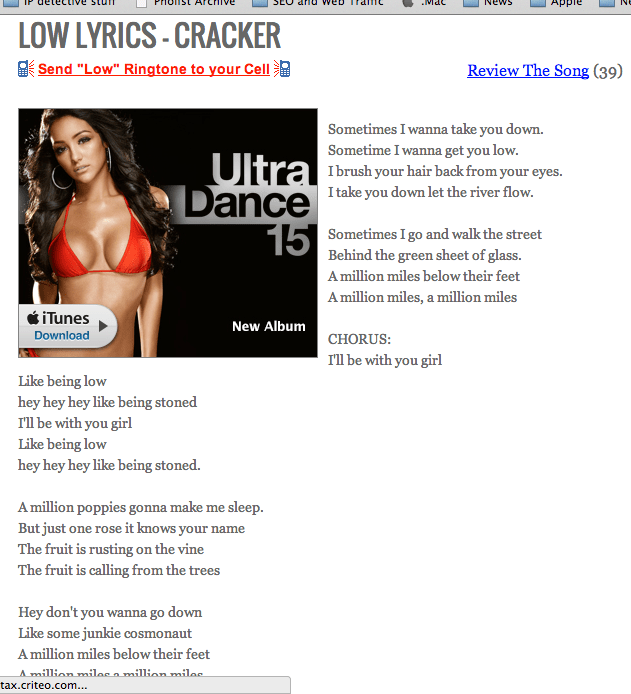
How is this use any different from the use of my lyrics on a non-annotated and licensed site (Exhibit 2)? The RapGenius instance of my lyrics is nearly identical. How is it “Fair Use?” It competes directly with the revenue I receive from the licensed site. Following this logic I could reprint an entire book and occasionally provide a hyperlink to the definition of a word and that would be “Fair Use”.

Indeed the owners of RapGenius seem to agree that their use is not “fair use” as evidenced by their recently completed licensing deals with Sony/ATV Music and Universal.

My final point before thanking the Subcommittee for this opportunity to speak today, is, what’s so hard about asking permission? As an artist I only expect to be treated as I would treat other artists. I believe that permission, or the legitimacy of consent, and doing unto others are the foundations of civilization. The rights holders have never been easier to find. Millions of recordings can be identified with a smartphone app or looked up in a public database all at no charge. It just takes a little effort.

In conclusion, I respectfully request that the Members of the Subcommittee review the practical history of the application of the fair use defense to see that it is

working as intended. I hope you will agree with me that no legislative expansion or government intervention is needed at this time.

Thank you very much.

David Lowery.

Exhibit 1 and 2
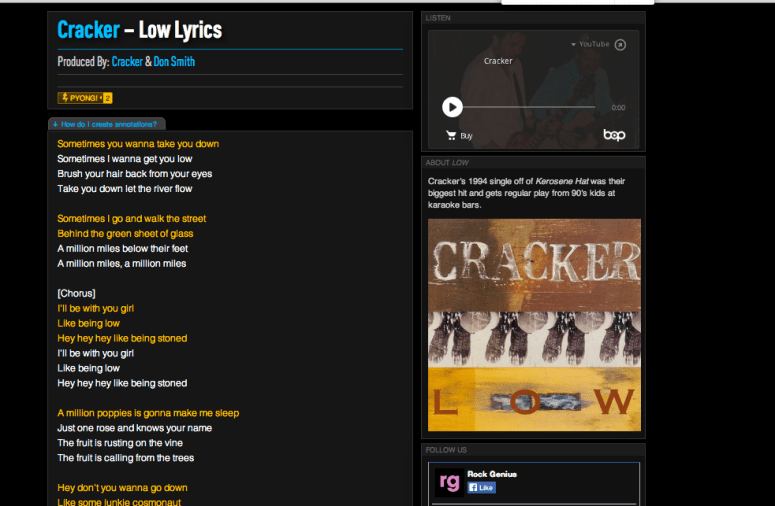
Exhibit 1 Cracker unlicensed annotated lyric site

Exhibit 2 Cracker licensed lyric site