The New Yorker : If You Care About Music, Should You Ditch Spotify?

The New Yorker weighs in on the controversy surrounding music streaming royalty rates…

The issue beneath all the complaints about micropayments is fundamental: What are recordings now? Are they an artistic expression that musicians cannot be compensated for but will create simply out of need? Are they promotional tools? What seems clear is that streaming arrangements, like those made with Spotify, are institutionalizing a marginal role for the recordings that were once major income streams for working musicians—which may explain the artist Damon Krukowski’s opinion that music should simply be given away, circumventing this entire system. But first, some words from Godrich, condensed and edited for clarity.

READ THE FULL STORY AT THE NEW YORKER:
http://www.newyorker.com/online/blogs/sashafrerejones/2013/07/spotify-boycott-new-artists-music-business-model.html

The Digital Royalty Fight: A Primer for Business Journalists. Pt 2 Thom Yorke and Spotify

The Digital Royalty Fight: A Primer for Business Journalists Part Two

How Thom Yorke And Nigel Godrich Pulled Their Solo Recordings From Spotify.

Thom Yorke and Nigel Godrich blew up the Internets last week when they abruptly pulled some of their catalogue from Spotify.  I’ve been getting many inquiries as to how they managed to do this, when other artists and songwriters can’t.  Short answer: they were able to do this because they controlled all or most of the rights to their recordings.  They actually pulled their recordings but not their songs.   Confused?  Let’s dive in.

#1.  I covered this in part 1 but let’s reiterate.  The copyrights for songs and recordings are two separate copyrights.  Sometimes they are owned by the same individuals or companies.  But most of the time they are not.  However the songwriting copyright is contained within every recording of the song.   For this reason any service using a recording needs TWO licenses.  One from the songwriter and another from the owner of the recording.  This is also why as explained in part 1 there are two kinds of royalties.  Songwriter royalties and Performer royalties.

#2.  Copyrights for songs and copyrights for recordings are treated differently under the law.   Different rules, rates and uses are mandated (or not mandated) by the government for songs and recordings.  (Again why in 2013 the government is involved in setting prices for different uses of songs and recordings makes no sense to me either.)

#3 Different rules and rates are mandated (or not mandated) for different kinds of digital services. Webcasting has different rules and rates than streaming.

#4 Webcasting and Streaming are two totally different kinds of digital services.  Pandora is webcasting.  Among other things you can’t play a song on demand. Spotify is Streaming. You can play a song on demand.   Spotify is like virtually owning a song and is purely “consumption” not promotion.  Pandora allows you to play a particular artist on demand but not the exact song.   Pandora is a combination of promotion and consumption (See part 1 #4 and #5 for explanation.)

#5. A compulsory license is a use that is essentially mandated by the government. It is a use for which a songwriter or performer cannot “opt out”.   It also generally mandates a price that the songwriter and performer must sell the right to use that song or recording. However companies and individuals may privately negotiate that rate lower.

#6.  A consent decree is similar to a compulsory license but it’s even weirder.  It essentially allows a service to use a song while negotiating prices and use of song. Again it’s virtually impossible for an individual songwriter to “opt out”.   The consent decree only covers songs not recordings.

Still with me?  Cause here comes the interesting part.

#7  A streaming services like Spotify uses a compulsory license and the consent decree to allow it access to songs.  But there is no compulsory license for the recordings.  Therefore Spotify had to go around and cut private deals with all the major record labels and a large alliance of independent labels.   Independent artists often get their recordings on Spotify through services called aggregators.  These aggregators also cut deals with Spotify.  So for recordings these are all private agreements.  No one is compelled by the government to let the Spotify play their recordings.

#8  Since Yorke and Godrich likely control all or most of their rights to their solo recordings they could pull their recordings from Spotify.  Remember there is no compulsory license for recordings when it comes to Streaming services.  Yorke and Godrich are not mandated to let Spotify use their recordings.

#9.  But Radiohead is still on Spotify?   Yes. Yorke and Godrich are unlikely to control these recordings.  These recordings are likely controlled by their record label or perhaps Yorke simply decided to leave his “back catalogue” on Spotify.

#10. On the other hand Spotify has a government mandated compulsory license to use any songs. (Also the Consent Decree comes into play, but it’s too complicated to explain here).  No songwriter can prevent the use of their songs on a commercial service like Spotify as long as they pay the government mandated royalty.   This is true for any streaming service. So strangely Someone could record covers of Yorke and Godrich’s songs and put them back on Spotify.

11.  Pandora and webcasters are in an even stronger position.  They enjoy government mandated access and rates for both the song copyrights and the recording copyrights.    Technically there is a consent decree for the songs and then a compulsory license for the recordings. Songwriters nor performers can “opt out” of webcasting no matter how terrible the rates.  Hence Yorke and Goodrich are still on Pandora.

12.  I sort of lied about #11.   You can opt out but it’s a sort of a “Nuclear Option”. I don’t quite understand how this works yet but it goes something like this:  If you as a songwriter also happen to be what is known as a publisher. AND you are represented by the Non-profit-member-owned American Society of Composers Authors and Publishers apparently you can withdraw your digital rights from ASCAP and cut or rather choose NOT to cut a direct deal with Pandora and other webcasters.  It appears the band Tool somehow managed to do this.  The downside is, if you want to be on some digital services but not others, you have to go around and individually negotiate deals and collect monies. Essentially you throw away your right to be part of any collective-like bargaining.  Also good luck getting paid.  Not a very good position to be in.   It’s still unclear to me if you can do this if you are a member of BMI instead of ASCAP.

***************************************

Now allow me to editorialize for a moment.   The United States Congress has started a periodic review of the copyright laws.  IMHO I think that congress should consider doing less,  when it amends the copyright act. In particular it should rethink the compulsory licenses for webcasting and streaming. In particular it should get rid of them.   There may have once been a rationale for compulsory licenses and rates  when these industries were in their infancy. But now these compulsory licenses have essentially become subsidies to some of the richest companies on earth (Google and Apple are now in the streaming game!)

These one price fits all compulsory licenses commoditize music and limit the kind of monetization models available to musicians. They limit innovation on the artists side.  They are anti market and prevent the market from discovering the true prices of songs and recordings.

Further I believe these licenses limit innovation on the tech side by specifying the exact model for streaming and webcasting businesses.  Finally they are just plain unnecessary.  Terrestrial radio does not have the luxury of a compulsory license for songs yet BMI/ASCAP/SESAC and the broadcast industry seem to manage to come to agreement on prices and uses without government interference.   Webcasters and Streaming services should be expected to do the same.

Why are you still fighting for Torrents, If Piracy is Collapsing Due to Legal Alternatives?

Oh, like the drunk who insists they don’t have a drinking problem, perhaps “the lady doth protest too much.”

In the latest offer of highly selective reasoning of what may be a dubious study (er uhm, sorry, make that survey) our favorite (ok, maybe second favorite) site for tech lobby disinformation lets loose with another gem, “Piracy Collapses As Legal Alternatives Do Their Job.” Which, you know, may or may not be true, based on the methodology of the “survey” and the bias of the subjects questioned.

It seems once a year we get one of these “no really, piracy isn’t really happening” survey’s passed off as science. First it was pirates buy 10xs more music than non-pirates, despite there being no factual sales data to support that claim. This is categorically different than say the actual traffic studies that show how BitTorrent is 99% infringing.

And why is it that “illegal” is positioned as a necessary alternative to “legal” in the first place? Why the false binary? There should be no excuse for allowing illegally operating businesses making billions of dollars a year in advertising revenue from the illegal exploitation of artists work to even exist. This has nothing to do with copyright but everything to do with common sense.

Also Norway may not exactly be the best model for the rest of the world. The same people that like to tell us that when they ask college students about piracy, we’re told that “Norwegian students think piracy is OK.” So the outcome of this latest survey should not come as a surprise and it’s always the spin that is most amusing,

So what is responsible for these significant drops in piracy? First of all this effect cannot be put down to anti-piracy campaigns. Only a tiny number of Norwegian file-sharers have been prosecuted in the past five years and only since July 1st has the law been loosened to allow that position to change.

Really now? Not to put to fine a point on it but this is the same tech lobby and freehadi talking points we’ve been hearing for over a decade and not much unlike Kim Dotcom’s “End Of Piracy” hubub. Over and over for more than a decade the same tech lobby and anti-artist talking points are repeated, “piracy isn’t hurting you, it’s helping, get over it.” Not so fast…

All of this despite what the source article states here:

In a report by IFPI, an organization for the international record companies, it also appears that in countries where it is introduced legislation that will block sites like Pirate Bay, the number of users of Pirate Bay has more than halved in 2012. This includes countries such as Denmark, Finland, the Netherlands and the United Kingdom.

Perhaps it’s just common sense that a “study of studies” not surprisingly reported that “Yes, Piracy Does Cause Economic Harm.

if dozens of researchers have tried, all using different methodologies, then their conclusions in the aggregate are the best we’re going to do. Put another way, it will henceforth be very difficult to dislodge Smith and Telang’s conclusion that piracy does economic harm to content creators.

But the proof is really that despite all of these claims, there are 45% fewer professional musicians since 2002. Even the best spin to put on the numbers (by the IFPI no less) at the end of 2012 was a net gain of three tenths of one percent… Even being an optimist and giving the benefit of the doubt that sales may have actually increased by less than a third of one percent is that really any evidence that ad sponsored piracy isn’t continuing to destroy the careers of artists?

And there’s this, courtesy of the New York Times (hint, graph going wrong direction despite decade plus of dubious “survey’s”)…

So the question remains if piracy is collapsing due to legal alternatives why is there such a need to keep defending the ripping off musicians and creators without their consent, and without paying them?

If piracy is irrelevant, it makes little sense to keep fighting for something that has outlived it’s usefulness now that “legal alternatives” are providing the better user experience. Except for just one thing… that little bit about money… who makes it, how, who actually get’s paid (the illegally operating businesses) and of course, who doesn’t get paid (the creators).

Could it be this is the last stand of Free Culture’s Epic Fail? We think so.

[UPDATE] The “collapse” of piracy seems to have been short lived…

Half of surveyed Britons listened to pirated music last month says Bloom.fm

Almost half of a sample of Britons listened to illegally downloaded music last month, according to new survey by music streaming service Bloom.fm.

When asked whether they had listened to music acquired from an illegal online service, from the 976 respondents, 49 per cent admitted that they had, reports Music Ally.

The Spotify Shakedown: “That’s a Real Nice Album You Got There I’d Hate For It To Be Torrented”

We’ve been hinting at this for a while.  That essentially the streaming services implicitly  use the threat of piracy to negotiate lower rates with artists.    We suspect that is why a service like Spotify that claims to be “Pro-Artist”  refuses to speak out against Ad Supported Piracy despite our previous request for them to do so and despite the fact the “legal” services and pirate sites compete for exactly the same ad revenue.

We no longer have to hint at this.  It appears Spotify has crossed the rubicon.  In this corporate “study” they explicitly link non-availability on Spotify to increased piracy.  In other words:

“Thats a real nice album you got there. I’d hate to see it torrented”

To me this reads like a admission that the threat of piracy is fundamental to their business model.

(Ed note: Is this legal? A question for National Association of Attorneys General?)

But I could be wrong.  Spotify could easily clear this up. We ask once again for Artist-in-Residence at Spotify D.A Wallach to take action against Ad Supported Piracy.  Will Spotify join us in the fight against Ad Supported Piracy?

When will the streaming and webcasting  services understand that their low payments (to songwriters especially) make them qualitatively no different than a pirate site.  In fact I’d rather have an honest conversation with a pirate party advocate than to listen to lies from some Silicon Valley billionaire.

“Oh please! Tell me again how your 5th amendment violating, government mandated and  artists subsidized streaming service is gonna be good for me  ‘when it scales?‘”

Poll: Should Songwriters Have The Right To Opt Out Of Individual Digital Music Services?

Many of my non-music business friends ask “If streaming services and webcasters pay so little to songwriters  why don’t you pull your songs off the services?”

To further confuse things you probably know by now Thom Yorke pulled his recordings from Spotify.   But oddly any “covers” of his songs will remain on Spotify.   Why is it that?  Why don’t songwriters pull their songs from digital services like Pandora and Spotify if the rates are so bad?

The short answer is:  By government mandate we are not allowed.

And here’s the short explanation: There are two similar government mandates that prevent us from doing this. Something called a “consent decree” and another called “compulsory licensing”.  Yes believe it or not in 2013 The Government of The United States mandates terms and prices  for certain digital uses of songs!

The long explanation:  We can sort of opt out but we have to exercise the “Nuclear Option” and pull our digital rights from ASCAP/BMI/SESAC.   We would then have to negotiate and collect directly from each and every single digital service on the planet.  This is feasible for someone with a lot of catalogue and market power (like Sony ATV)   but not for individual songwriters.  In other words the only way to “opt out” is to essentially abandon our ability to bargain in a collective manner.

Maybe the solution is to allow songwriters to  “opt out” of specific services, or to pick and choose which songs are available on which types of services.  This would be a small step towards free markets and  aid in “price discovery.”   If we have true price discovery for songs we could eliminate the need for governments to set prices and mandate licenses in the first place.  I realize this could create new challenges for Songwriters and publisher but can the situation really get any worse?

But heck what do we know?   We’d  genuinely like to hear what you think.

Pandora Prepares to Attack Artists… Again | DMN

Amazing the lengths Tim Westergren and Pandora are willing to go to, to attack artists…

Accordingly, Pandora is taking steps to have well-written, careful responses ready to go within 24 hours in places like Digital Music News.  Most importantly, the response needs to come from a source not affiliated with Pandora (or, so it seems…)

READ THE FULL STORY (AND EMAILS) AT DIGITAL MUSIC NEWS:
http://www.digitalmusicnews.com/permalink/2013/20130715pandora#QFlbW2t7XHEHic_7jx2vSg

Did Google Finally Admit They Pay Criminals? Will Big Evil Show Us What’s Behind the Curtain?

If you want to solve a problem, you have to acknowledge a problem actually exists… Read On…

Music Technology Policy

According to Searchengineland and Variety, Google Chairman Eric Schmidt tells us that he’s had enough of the DMCA notices, but with that extra special “Big Evil” spin:

Google’s Eric Schmidt says that the entertainment industry should focus on taking content pirates to court, rather than just trying to get Google (and other search engines) to remove pirate sites from search results.  [Schmidt says] “Our position is that somebody’s making money on this pirated content and it should be possible to identify those people and bring them to justice.

This latest dodge from Google’s Dodger in Chief is exceptionally absurd for a few reasons.  First,Schmidt is clearly trying to deflect, deflect, and then be sure you deflect attention away from Google and on to that bad guy behind the tree.  In Bulgaria.  Or China.  Or a Schmidt fav, North Korea.  Somewhere far away and difficult to prosecute.  And if someone…

View original post 1,017 more words

Thom Yorke Vs Spotify : Why Doesn’t Spotify Speak Out Against Ad Funded Piracy?

Thom Yorke’s announcement to boycott Spotify is just the latest public acknowledgement that the pay rates and business models of streaming services need to adapt and evolve to pay sustainable rates to artists and rights holders. We’ve previously offered our own point of view on Spotify whereby we believe that current streaming based models are fundamentally flawed at the level of their pay rates and are especially devastating to developing artists.

Both Thom Yorke of Radiohead and Trent Rezenor of Nine Inch Nails were two of the first artists to explore and experiment with potentially new music business models on the internet. However, the realities of those experiments have become apparent this year as Thom Yorke spoke out about Google and Trent Reznor against music streaming services being unfair to artists.

But it’s also important to remember that despite our disagreements over the revenue distribution models of Spotify and Pandora these are legal and licensed services. The primary reason that these streaming businesses even exist is in response to a decade plus of infringing and illegally operating business who pay nothing at all, zero, zilch, nada.

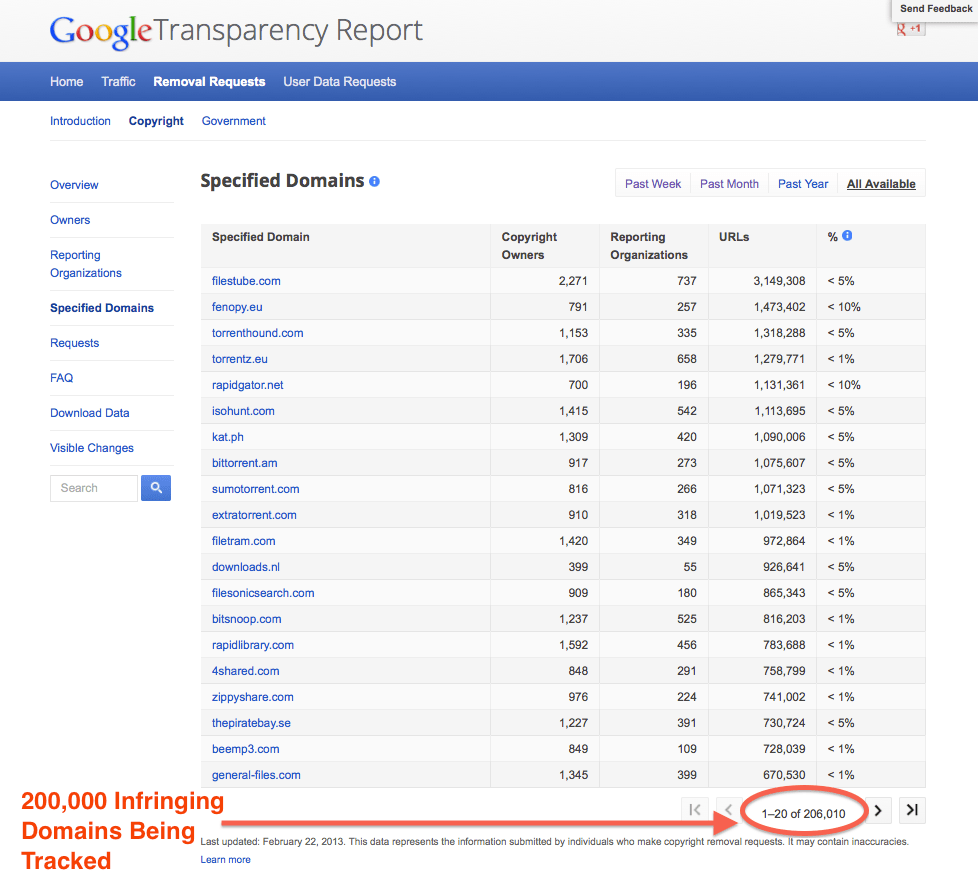
Let’s get really real for one second… One of the primary reasons Spotify pays so little is because so many more pay nothing at all. Google alone is tracking millions and millions of infringement notices to over 200,000 known illegally operating businesses.

For those who unaware, Ad Sponsored Piracy is the mechanism by which illegal and infringing online businesses get paid to display advertising on their sites. These sites do not license any of the music they distribute nor do they share any of this revenue with artists or rights holders. In other words Silicon Valley corporate interests pocket 100% of the money and pay artists nothing.

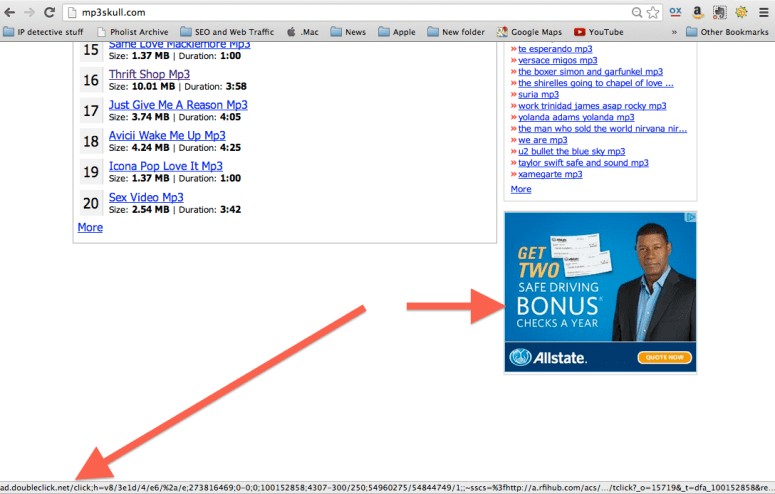
Simply put, ad supported piracy is the practice whereby ad networks like Google’s Adsense profit by placing ads on pirate sites like www mp3skull com.

Brand $$$-> Ad Agency $$$-> On Line Ad Services $$$-> Ad Exchanges $$$-> Illegal and Infringing Sites Profit from Ad Placements.

Any legally licensed, legitimate internet music business has to acknowledge that mass scale, enterprise level, commercial infringement of music only harms their business. The devaluation of advertising inventory on infringing sites harms both the legitimate businesses ability to grow, and the ability to pay sustainable rates to musicians.

So why doesn’t Spotify join with artists by insisting on better controls and regulation of online advertising? Spotify’s existence alone is not the solution as the payments to artists and rights holders simply do not scale as we have previously pointed out (also note how much less YouTube pays than Spotify – more on this later).

Music Streaming Math, Can It All Add Up?

Maybe we’re missing something. If streaming is the future how does $2.5b in revenue from a massively successful Spotify replace the loss of $8.3b in annual earnings?

Solutions for Artist Rights must include the acknowledgement that the mathematical facts of streaming services is that they are unsustainable at current rates (see chart above). Therefore, there must be regulatory enforcement to protect artists and other creators (authors, filmmakers, etc) from Ad Sponsored Piracy.

We have previous identified over 50 Major Brands Supporting Illegal and Infringing online businesses here:

Over 50 Major Brands Supporting Music Piracy, It’s Big Business!

See more Corporate Advertising Funded Exploitation of Artists:
Tom Waits * Neil Young * Aimee Mann * Neko Case * U2 * Ben Gibbard/Death Cab For Cutie * East Bay Ray / Dead Kennedy’s * Billy Corgan/Smashing Pumpkins

Despite Mississippi Attorney General’s Action, Is Google Still Advertising On Specific Pirate Site In Complaint?

I just spent a week with my kids doing some coding,  so I’m thinking in a binary fashion.   Let’s look at this Google, Mississippi Attorney General Hood and “Ad Supported Piracy” situation in an IF/THEN/ELSE kind  of way.

If you are not aware the Federal Government has basically decided to let Google get away with anything. And just like the Tobacco Settlement it’s been left up to the states to try to reign in the Mountain View Drug Advertising and Spying Cartel. Mississippi Attorney General Hood is leading State attorneys general in an investigation into current Google advertising practices.  And in particular whether they violate Google’s criminal Non Prosecution Agreement with the US Government for knowingly enabling sales of controlled substances online. 

Google claims to AG Hood  that they are trying not to serve advertising onto pirate sites like Mp3skull.com.  But as evidenced from the screenshots below, clearly DoubleClick (Google) is somehow involved in serving these Allstate Insurance ads on this massively infringing site. Further this is the very website that the General Hood used as an example of Google’s behavior.

(BTW according to my preliminary UGA study  Allstate Insurance is  one of the biggest repeat enablers of Ad Supported Piracy and I feel artists should organize a boycott until they change their ways.)

So this is the way I see it:

IF >

You take Google at their word

Then>

Google genuinely has no idea where they are serving ads nor do they have any control over where the ads end up.  So Google advertising products are the mother of all  products liability design defect cases. 

ELSE>

Google is not being forthright with the Attorney General Hood.

What happens when you aren’t forthright with the kind of people with subpoena power?  Just curious.

Below is excerpt of statement April 19th 2013 from John Burchett Google Director of Public Policy for United States, Latin America and Canada. This was in response to the State Attorney Generals Action.

google to hood

Here is exhibit from Attorney General Hood  singling out the site http://www.mp3skull.com.  Further the AG has taken this from Google’s own Transparency Report to show they are keenly aware of the mass infringement on this website. They acknowledge that they have been notified of over 800,000 infringing links!

AG hood g trans mp3 skull

Here are a few Screenshots I took July 12th 2013 .  These show Google’s DoubleClick helping serve Allstate advertising onto the http://www.mp3skull.com website.

doubleclick allstate mp3skull1

And again a short time later.

doubleclick allstate mp3skull2

And for the coders, again using firebug/firefox.

allstate double click firebug skull