Madison Avenue Firm TWBA Chiat Day Runs Pro-Piracy Billboards In Times Square. Is this Payback For Calling Them Out on Ad Supported Piracy?

As we have detailed here many many times on The Trichordist,  the advertising industry profits by selling advertising to pirate sites like www.webgalu.com.   But we were  mightily surprised to see advertising firm  TBWA Chiat Day,  apparently doubling down and actually running billboards in Times Square that say things like “Piracy is Progress”.   I can see why they think it’s “progress” if they profit from this exploitative practice.  Here at The Trichordist we have repeatedly called out companies that TBWA Chiat Day lists as their clients for advertising on these sites–and we know in some cases the complaints went up the flagpole.

That is why we ask:

 Is this some sort of Ad-Agency-Gone-Cowboy payback scheme?  We’re open to other explanations, but the “PIRACY IS PROGRESS” campaign seems to us to be both straight out of Orwell’s 1984 and retaliatory against the many brand sponsored piracy efforts.

Especially since another aspect of this campaign is a highly manipulative and cynical attempt to pit artists against artists.  

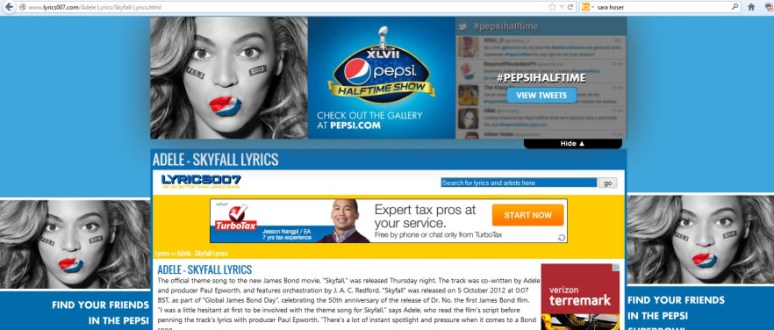
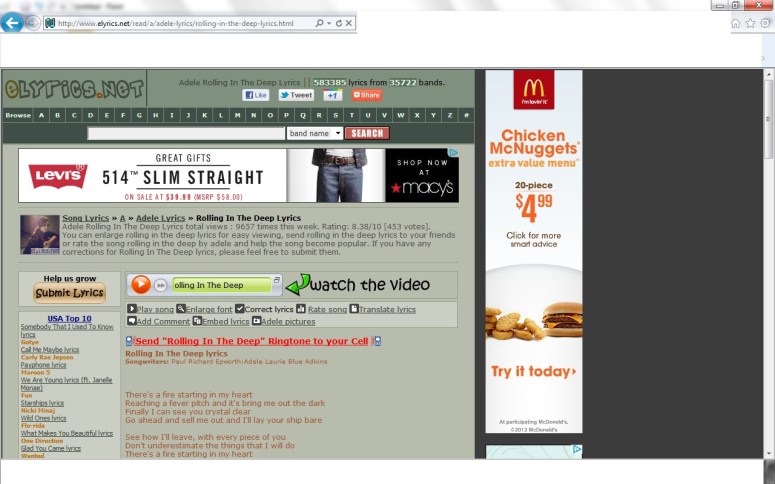
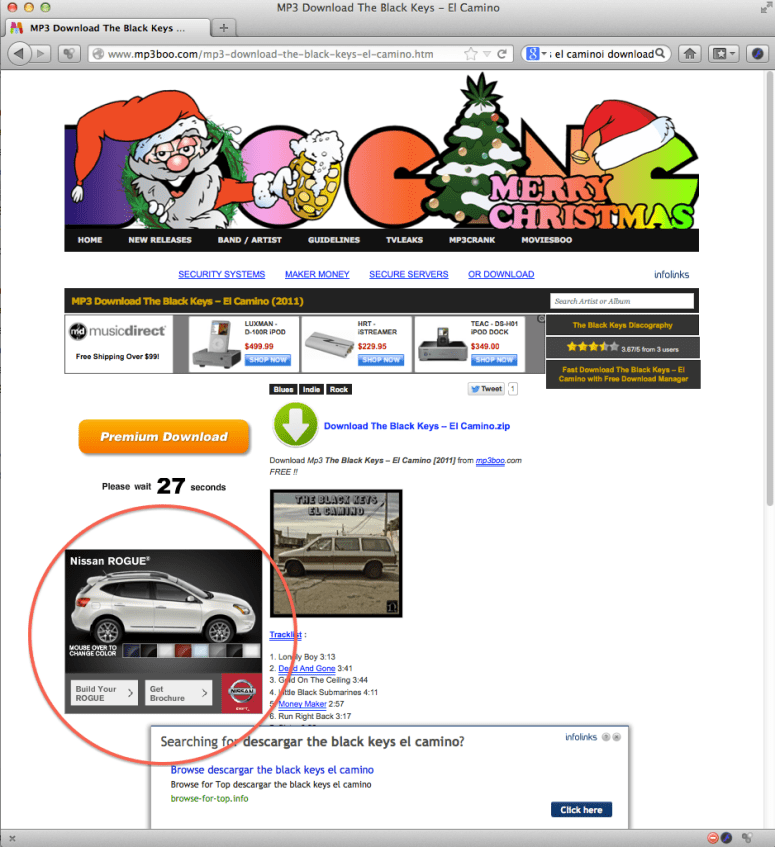
Examples of companies that TBWA Chiat Day claims as clients that we spotted also advertising on pirate sites:

bk_mp3boonissan

lyrics007-adele-pepsi

adele-rolling-in-the-deep1

Artist Rights Watch – Monday March 25, 2013

THE HILL:
* Protect rights of artists in new copyright law

Should Congress take on the challenge of updating the Copyright Act, it must do so guided by sound principles, and its deliberations must be based in reality rather than rhetoric.

Chief among these principles is that protecting authors is in the public interest. Ensuring that all creators retain the freedom of choice in determining how their creative work is used, disseminated and monetized is vital to protecting freedom of expression. Consent is at the heart of freedom, thus we must judge any proposed update by whether it prioritizes artists’ rights to have meaningful control over their creative work and livelihood.

ZIMEYE:
* Mukanya’s Concern on Music Piracy: The New Zimbabwean Epidemic

Personally, I take unbridled umbrage at such individuals who are tired of working real jobs and are now trying to snatch easier ways to cut corners and make survival here in the Diaspora. By committing such nasty internet acts of pirating on our Zimbabwe musicians products they are feeding on other people’s blood.

This is in cases where most of our entertainers throw in their blood, sweat and tears to emerge with such scintillating music hoping to make headlines, best sellers and earn decent income. I would then wonder why someone would, from the blues, make such an evil act of trying to benefit from someone’s work using the internet, hoping not to be caught.

BUSINESS WEEK:
* Congress Reviews the Copyright Act in the Digital Age

BILLBOARD:
* Business Matters: Digital Piracy Study Conflicts with Two Papers it Cites

There have been numerous studies that have concluded file sharing hurts recorded music sales. The JRC study is different because it focuses only on file-sharing’s effect on digital purchases.

* SXSW: David Lowery and Co. Lash out Against Industry ‘Pimps’

Lowery said it was incumbent on artists to speak out about the importance of paying for music. Many artists who defer to corporate interests suffer from a kind of “Stockholm Syndrome,” he said.

“Lars Ulrich was the first to speak out and they put his head on a stake,” Lowery said, referring to the backlash against the Metallica singer after he took Napster to court in 2000. “But Ulrich was right. If you go back and watch his interview with Charlie Rose, everything he said came true. The technologists were wrong.”

COPYRIGHT ALLIANCE:
* Worth the Wait: 9th Circuit Delivers Big Win for Creators in Isohunt Case

the court pointed to numerous instances in which Fung was instrumental in assisting users in finding, acquiring, and burning infringing content. The court also explained how Fung profited off this infringement:

“Fung promoted advertising by pointing to infringing activity; obtained advertising revenue that depended on the number of visitors to his sites; attracted primarily visitors who were seeking to engage in infringing activity, as that is mostly what occurred on his sites; and encouraged that infringing activity. Given this confluence of circumstances, Fung’s revenue stream was tied directly to the infringing activity involving his websites, both as to his ability to attract advertisers and as to the amount of revenue he received.”

THE MUSIC VOID:
* EU Piracy Report – Ramifications For The Music Business

More importantly, there can be no argument that Google has played a massive unarguable part in helping piracy to thrive. Whether that was intentional or not is a moot point. The fact is you can type in any artist name and you links will have links to pirate site’s outnumbering those to legal sites.

The recent campaign to shame brands who’s advertising supports illegal file sharing sites is a worthy cause which TMV supports.

It would be helpful if Google gave all of the revenue it earns from SEM directly related to pirate sites back to the industry so rights holders and ultimately artists actually got paid from pirate sources. Hitting the pirates in the money pocket is exactly the right way to bring them to the negotiating table. Why do we want to negotiate with such people – because the user data is of immense value to brands and music rights holders themselves.

BRAND-E.BIZ:
* Ads fund illegal music, says IFPI

“Brand owners typically want to avoid the reputational damage that can be caused when their advertisements are placed on websites that engage in or facilitate unlawful activity,” says the IFPI. “They also want to be sure their advertising budget is not providing financial support to unlicensed websites.”

VOX INDIE:
* A Good Week for Copyright
* Mirror, Mirror…Why Does the Anti-Copyright Lobby Live in Opposite World?

The talking points echoed by the panel at SXSW reflected the anti-copyright lobby’s disingenuous mantra that content creators seeking to protect their work from theft should be viewed as criminals, while those who brazenly steal (and monetize) the work of others are somehow the “innovators.” Are you serious? I hate to break it to these folks, but the tech industry does not have first dibs on the adjective “innovative.”

Creative artists have always thrived on the cutting edge–and while the modern-day tech industry has developed new means of delivery and consumption–their innovations would be useless were it not for the content their products deliver. In many ways, creative content is the fuel has fed the tech revolution. Why can’t we have a discussion that acknowledges this symbiosis, rather than diminishes it?

THE ILLUSION OF MORE:
* More Than 3Dimensions
* Copyright, copyright everywhere…

So, for anyone who reads this blog and is not knee-deep in the gore of the copyright battle, the big picture as I see it this: I believe the copyright system will change over the next decade or so, but if that change is predicated too much on the self-serving premises of its tech-industry antagonists, the results for artists in particular, and for society in general, will be regressive rather than progressive. It would be like allowing the oil industry to overly influence emissions policy.

MUSIC WEEK:
* IFPI slams EU piracy study as ‘flawed and misleading’

The findings seem disconnected from commercial reality, are based on a limited view of the market and are contradicted by a large volume of alternative third party research that confirms the negative impact of piracy on the legitimate music business.

CENSORSHIP IN AMERICA:
* Music Censorship – A Timeline

SPITFIRE HIPHOP:
* What You Can Do Today – To Stop Brand Sponsored Piracy Through Touring Contracts or Sponsor Deals: Artists Helping Artists

If you are like most artists, you feel overwhelmed by the alliance of Big Tech and Fortune 500 companies allied against us in the intricate network of brand sponsored piracy.

ABC ONLINE:
* Internet Piracy – is it a right to not pay artists you like?

The self-righteous anger of free downloaders reveals much about the weakness of human nature and the often heartless and faceless nature of what constitutes debate on the internet.

This is one of the most revealing books about how technology shapes us I have ever read. It goes far beyond the normal platitiudes and in forensic detail explains the connections between human endeavour, morals, consumption and commerce.

DIGITAL MUSIC NEWS:
* Streaming Accounts for Just 4 Percent of Global Recording Revenues, Study Finds…
* For the First Time Ever, Song Downloads Are Declining In the US…
* Chevrolet Is Now Financing Grooveshark’s Mobile Expansion…
* Why Non-Disclosure Agreements Are Making It Impossible to Watch a Video In Germany…

A source close to one of the other negotiations with YouTube said that the rights holders had proposed that they’d base the deal on a revenue share – a proposal that seems more than fair. Only problem, the source said, is that Google/YouTube won’t tell anyone what its revenue and profits are.

For a corporation that has based its entire business on the sharing of information, it’s somewhat ironic how reluctant it is to share its own.

THE VERGE:
* Google accidentally blocks entire Digg domain from search, is working on a fix

MASHABLE:
* Supreme Court Refuses to Hear $220k Music Piracy Case

This is the third time the court has refused to hear a peer-to-peer piracy case. One of the other cases was that of Joel Tenenbaum, the other person who refused to settle with the RIAA, and was sentenced to pay $675,000 for downloading 30 songs. The Supreme Court declined to hear his case in May.

TORRENT FREAK:
* Spain to Crackdown on Pirate Sites and Outlaw File-Sharing
* isoHunt Loses Appeal Against the MPAA, Keyword Filter Remains
* Fresh Calls to Congress to Make Movie and Music Streaming a Felony
* MPAA: Pirates Can’t Hijack Freedom of Expression

THE SUN DAILY:
* Putting a stop to digital piracy

Internet companies all work together to block IP addresses that broadcast spam (www.spamhaus.org/). This doesn’t “break the internet” or “violate free speech”. The notion that brilliant technologists in the US$400 billion telecom business that is growing at 10% a year and the US$28 billion internet advertising business that is growing 10% a year can’t help make the internet a just and ethical marketplace for musicians is false.

DIGITAL TRENDS:
* Set-top showdown: Apple TV vs. Roku 3 vs. Boxee Box vs. WD TV Play vs. Google TV

TORONTO STAR:
* Government urged to invest in music industry to drive economic activity

Music Canada has come up with 17 recommendations in a report, “The Next Big Bang: A New Direction for Music in Canada,” released at Canadian Music Week this week.

SPYGHANA:
* Dying Musicians cry out over 1M CD sales drop to 50K

The National Chairman of Ghana Musicians Rights Organisation (GHAMRO,) Mr. Carlos Sakyi, has lamented the increasing rate of piracy in the industry saying it is collapsing Ghana’s music industry.

THE INDIAN EXPRESS:
* Piracy Equals Drunken Driving

Flipkart made a clear distinction about guilt-free downloads, paid or otherwise. It was an affirmation that downloading music (or movies) off torrents has now become a sort of uncool behaviour…much like drunken driving.

THE FUTURE OF COPYRIGHT:
* Controversial copyright bill passes German Upper House

On 1 March 2013, the Bundestag, the Lower House of the German Parliament, approved a new legislative proposal that aims to protect the copyright of publishers on the Internet. The new bill would require search engines and news aggregators like Google News to pay a fee for displaying content longer than “individual words or short excerpts” (snippets). Read more in our previous article on this topic.

THE DEANS LIST:
* Music, Copyright and New Technology in the News From a Creator’s Perspective

THE LEFT ROOM:
* Piracy, free books, etc

5. What I think

I have endless and fantastically violent contempt for the sites making money off the back of work they didn’t help create, and for the people behind them. I have nothing, really, against the ordinary people who illegally download my books – I can’t stop you, most of you wouldn’t have bought them anyway, and I just hope that, if you enjoy them, you consider buying some of them at some point, to support not just me, but also the other people, less visible, whose work made my books possible in the first place.

WIRSINDLEGION:
* The Pirate Bay and human rights

STOP THE CYBORGS:
* Google Glass ban signs

For a complete listing of every weekly update of the Artists Rights Watch, CLICK HERE!

Like A Rock. Digital Music News Reports that Chevrolet Is Sponsoring Grooveshark’s Mobile App.

Paul Resnikoff at Digital Music News is reporting that Chevrolet is sponsoring the new Grooveshark App. We verified this.  For those that don’t know, Grooveshark is NOT a legitimate streaming service.  Like most artists, Grooveshark has my entire catalogue available for streaming despite the fact they do not have permission to use my songs  nor have they ever paid me the proper royalties.

But what is amusing about all of this is that Chevrolet more than any other truck brand has relied on performers to build their brand and their image.  In particular they have relied on Bob Seger.   “Like A Rock”  the Bob Seger track was the Chevy truck theme song for years.

Here is Chevrolet exploiting Bob Seger via Grooveshark.  This was at 12:35 pm EDT  March 21 2013.

chevy grooveshark

like a rock and grooveshark

My Cracker catalogue on Groove shark.  (Oh yeah screw you WestJet).

cracker on grooveshark

My CVB Catalogue on Grooveshark (again screw you WestJet).

cvb on grooveshark

IsoHunt Court Ruling Notes “Ad Sponsored Piracy”: Exploitation is not Innovation

The 9th Circuit delivers a substantial win for creators in its IsoHunt ruling, as The Copyright Alliance notes in it’s summary which quotes this from the court directly,

“Fung promoted advertising by pointing to infringing activity; obtained advertising revenue that depended on the number of visitors to his sites; attracted primarily visitors who were seeking to engage in infringing activity, as that is mostly what occurred on his sites; and encouraged that infringing activity. Given this confluence of circumstances, Fung’s revenue stream was tied directly to the infringing activity involving his websites, both as to his ability to attract advertisers and as to the amount of revenue he received.”

It would appear that the motives of these for profit businesses are being seen for what they are, nothing more than than the blatant exploitation of artists and creators. It should be recognized that this practice is not unknown within the online advertising/tech business either, as reported by Jack Marshall’s post titled “Why is Ad Tech Still Funding Piracy?” in DigiDay,

Visit the top torrent search engines, and you’ll find ad calls from Yahoo, Google, Turn, Zedo, RocketFuel, AdRoll, CPX Interactive and others. These sites exist to connect people with illegal downloads of intellectual property, a practice that’s estimated to cost the U.S. economy $20 billion in the movie industry alone. No matter your feelings about U.S. copyright laws, they are laws, and there’s no doubt these sites facilitate illegal behavior, even if they don’t house the content themselves. The oxygen that sustains many of these sites is advertising, delivered by the vast archipelago of the ad tech industry.

According to AppNexus CEO Brian O’Kelley, it’s an easy problem to fix, but ad companies are attracted by the revenue torrent sites can generate for them. Kelley said his company refuses to serve ads to torrent sites and other sites facilitating the distribution of pirated content. It’s easy to do technically, he said, but others refuse to do it.

“We want everyone to technically stop their customers from advertising on these sites, but there’s a financial incentive to keep doing so,” he said. “Companies that aren’t taking a stand against this are making a lot of money.”

If you want to see more examples of Ad Sponsored Piracy in action, see our post, “Over 50 Major Brands Supporting Music Piracy, It’s Big Business!” Mainstream awareness of the subject has been growing due in part  by the work being done by the Annenberg Innovation Lab which has been reported in the Los Angeles Times and The New York Times earlier this year. And The Wall Street Journal also reported on the role of advertising in its reporting of wider ranging issues facing creators battling online piracy,

Another focus is online-ad networks, which media companies say help finance piracy by placing ads on sites that traffic in unauthorized content. A study last summer, commissioned in part by Google, found that 86% of peer-to-peer sharing sites are dependent on advertising for income.

As more awareness builds, the truth becomes plain to see and painfully obvious. Unfortunately there are still those in the tech blogosphere who like to defend businesses exploiting artists and claiming that this is a non-issue making statements like, “internet display ads pay next to nothing.” This remark seems to be a direct contradiction with the statement by the very knowledgeable AppNexus CEO Brian O’Kelley, who above stated, “Companies that aren’t taking a stand against this are making a lot of money.”

Bottom Line: Exploitation is not Innovation.

Ad Sponsored Piracy is a land grab by internet BUSINESSES to steal money from musicians, artists, photographers, authors and other creators. It’s about money.

Music Technology Policy

I’ve had enough questions lately about why I started focusing on brand sponsored piracy that I thought it important enough to give credit where it’s due.  It all started with this quotation from Professor Eric Goldman, commenting on the dip in Google’s stock price after the announcement that it had dodged a career-ending indictment for promoting the sale of illegal drugs when the Department of Justice allowed the company’s executives to pay a fine with $500,000,000 of the stockholders money.

The Google drug dealing case was followed by a still-ongoing shareholder lawsuit that named, among others, the entire Google board of directors and certain executives including Larry Page and Sheryl Sandberg.  Yes, that Sheryl Sandberg.

Shareholder Suite

Here’s Professor Goldman’s money quote, so to speak from the New York Times:

“Web companies can be held liable for advertising on their sites that breaks federal criminal law, and Google and…

View original post 344 more words

Band Quiet Company says Internet Has Made Things Worse for Artists “New Boss is Worse Than Old Boss”

A decade into the snake oil and lies of the empowered internet musician the truth bares itself out over and over again. In a recent case study the band Quiet Company said of their promotional experiment with Grooveshark in an interview with Digital Trends,

“I think for years now, as far as back as [Quiet Company] has been together, people have been talking about how different the music industry is and how the Internet has changed everything and how we’re all looking for a new model.”

“After everything, I’m not sure there is a new model. The old model is still the model, it’s just that the Internet made it way worse.”

We’re not surprised in the least as we’ve previously noted how Grooveshark’s infringement based business model could easily be described as “Notice and Shakedown.” Even tech progressive artists such as Zoë Keating have struggled with the service. Zoë could not get her music removed from the site after issuing at least six DMCA notices to Grooveshark.

So it’s strange to us despite there being near universal agreement on just how bad this service is for artists that some people still don’t get it. Of course these always seem to be the same people that defend every other service that rips off musicians and pays them nothing like The Pirate Bay.

One tech blog actually said after the Pirate Bay verdict, “The folks this will hurt the most are those content creators who actually do value The Pirate Bay.” But we doubt that as it’s not like there aren’t tons opportunities for artists to give away their work willing, with consent, should they so chose. What we find most disturbing is why the choice of consent to give away one’s work should be forcefully take from them by companies who are profiting from advertising revenue?

It’s all pretty simple. Artists need to get paid and so many of these so called “new models” seem to be built on the “new model” of not paying artists anything at all, or next to nothing at all. Again, from Digital Trends,

But now the contract is up and not being renewed, because – you guessed it – a monetization strategy couldn’t be found for Grooveshark. “We were the test monkeys,” says Osbon.

Once again we see that The New Boss is Worse Than The Old Boss, indeed. We’re not surprised, we know there’s a lot of money being made on the internet in music distribution, it’s just not being “shared” with musicians. So once again we ask where are all of these self empowered, independent new middle class musicians? The answer is, like most things where the truth is self evident, they just don’t exist.

So Much For Innovation, YouTuber’s Meet The New Boss…

The persistent myth that artists and creators neither want or need partners in the self empowered digital age seems to have hit a wall. The LA Weekly recently reported on a number of high profile YouTube Artists who have found themselves on the bad end of bad deals with YouTube Producers. Get that. Artists have found themselves on the bad end of deals with business people exploiting them.

Ben Vacas, the creator of Braindeadly posted a video on his YouTube channel explaining the situation to his fans and audience,

“I woke up today hoping to make a video, but I went into a call with Machinima this evening and they said that my contract is completely enforceable. I can’t get out of it,” Vacas tells the camera. “They said I am with them for the rest of my life — that I am with them forever.

How could this happen in this digital age when no one should ever need any help or support from anyone else? So many in the tech blogosphere are constantly on the bullhorn bemouning the evils of record labels and movie studios, so the hypocrisy and irony of this new generation of creators falling prey to the same old types of exploitation is telling.

What’s worse is these artists appear to have entered into the types of agreements that the traditional record and film businesses have long since left behind as those industries matured and the rights of artists have been won in long hard fought battles.

As Chris Castle of Music Tech Policy commented in his post, It’s Called A Union, Numbnuts he sadly points out the obvious that the more things change the more they stay the same. Artists and creators are still prey for those seeking opportunistic exploitation of the creative class.

Well kids, welcome to the new boss. There is a reason why talent and craft unions exist and it’s not to “stifle innovation” of filmmakers any more than copyright exists to “stifle innovation” of musicians, artists, photographers, writers, authors, filmmakers and other creators.

But perhaps it is this more recent story that is more revealing. All Things D wrote this in “YouTube’s Show-Me-The-Money Problem“,

“It’s hard, given YouTube’s low [revenue-sharing] numbers and lack of marketing infrastructure to make the unit economics for premium programming work,” says Steve Raymond, who runs Big Frame, a YouTube network/programmer that says it has generated 3.2 billion views.

So let’s do the math on this. YouTube, which is the great white hope of, and often cited embodiment of the independent new digital culture for creators has bred an environment of draconian contracts for individual creators and at the same time it can not generate enough revenue for it’s most successful producers to maintain a sustainable business model.

How is this “innovation and progress”? Answer, it’s not. Of course readers of this blog will be familiar with David Lowery’s insightful and accurate analysis of the music business “Meet The New Boss, Worse Than The Old Boss” and now we can see that the same forces are also shaping the new reality for more artists and creators than just musicians.

For all of the hype, it’s really funny what happens when you actually just look at the math. What’s more funny is when some tech blogs make statements like, “First of all, YouTube revenue is incremental revenue on top of other revenue.” Well apparently they haven’t spoken to Big Frame about that, unless of course they are suggesting that Big Frame’s primary business (and the creators that work for them) should have day jobs to supplement their revenue from YouTube. You know, jobs like selling t-shirts and touring…

Artists Rights Watch – Monday March 18, 2013

DIGI DAY:
* Why is Ad Tech Still Funding Piracy?

Visit the top torrent search engines, and you’ll find ad calls from Yahoo, Google, Turn, Zedo, RocketFuel, AdRoll, CPX Interactive and others. These sites exist to connect people with illegal downloads of intellectual property, a practice that’s estimated to cost the U.S. economy $20 billion in the movie industry alone. No matter your feelings about U.S. copyright laws, they are laws, and there’s no doubt these sites facilitate illegal behavior, even if they don’t house the content themselves. The oxygen that sustains many of these sites is advertising, delivered by the vast archipelago of the ad tech industry.

According to AppNexus CEO Brian O’Kelley, it’s an easy problem to fix, but ad companies are attracted by the revenue torrent sites can generate for them. Kelley said his company refuses to serve ads to torrent sites and other sites facilitating the distribution of pirated content. It’s easy to do technically, he said, but others refuse to do it.

“We want everyone to technically stop their customers from advertising on these sites, but there’s a financial incentive to keep doing so,” he said. “Companies that aren’t taking a stand against this are making a lot of money.”

JUNKEE:
* The Case Against Free

What is the difference between the writer who can’t sustain a career because of publishers who are unwilling to pay them because the next person will do it for free, and the musician who can’t afford to play in their band because taking time off work to play some shows makes their vocation unsustainable?

THE ONION (Thanks CopyHype!):
* Word ‘Innovate’ Said 650,000 Times At SXSW So Far

Bryant additionally confirmed the absence of the less common phrases “investment model,” “practical business strategy,” and “economic realities,” which together have been mentioned a total of zero times.

LIFE HACKER:
* Why I Stopped Pirating and Started Paying for Media

For a period I pirated everything I could. As technology pushed forward, it became less necessary, and now I don’t even bother. Here’s why.

Piracy affects pretty much every part of the entertainment industry from big corporations to independent creators. While pirating isn’t always immoral (say you already own the movie), it is illegal, and while many pirates buy more, that doesn’t mean they buy everything they pirate—and that hurts the industry in question, particularly when you’re talking about independent creators.

THE CHICAGO TRIBUNE:
* For Amanda Palmer, it takes a village

she also fretted that not every artist — PJ Harvey, Jeff Mangum, Elliot Smith, to name just a few — can be or wants to be as “hyper-social” as she is. “It’s our collective responsibility to help them because they’re not as loud,” she said.

THE WASHINGTON POST:
* Hey Internet, where’s the outrage?

Given CISPA’s legal benefits to private companies such as Google and Facebook, it’s easier to see why the corporate pillars of the Internet haven’t jumped on the outrage bandwagon.

However, it’s not as clear why other major Internet players, such as Craigslist or Wikipedia, who participated in SOPA protests aren’t being as vocal now.

COPYHYPE:
* “Manifestly ill-founded”: Pirate Bay Free Speech Argument Tossed

a unanimous chamber at the European Court of Human Rights held that the massive infringement the site enabled justified any interference with the site founders’ free expression rights. The Court, in fact, said that the founders’ appeal on free speech grounds was “manifestly ill-founded.”

MUSIC WEEK:
* More music pirated than TV, film and games combined – new Ofcom report

Ofcom has published a new report tracking online copyright infringement during Q3 2012, with music seeing far higher volumes of piracy than TV, film, video games, software and e-books combined.

PRECURSOR:
* Cellphone Unlocking Effort a Trojan Horse to Gut DMCA Digital-Locks Copyright Enforcement

Remember, this new Fix-the-DMCA coalition is just a new PR face for the old Free Culture/Free Software movement that does not believe software and digital information should be copyrightable, patentable or proprietary. It can’t be said enough that their definition of a “free and open Internet” is where “free” means no payment or permission required and “open” means no property respected.

Amazingly this movement opposes the principle of digital “locks.” In our society most people lock their house, yard, room, car, bike, money, etc. Locks are our friend and our protector. Locks are only the enemy to those who seek to take something from someone without their permission. We lock what has value and what we want to protect or control.

TECH LIBERATION:
* Who Really Believes in “Permissionless Innovation”?

That’s a great question, but let’s ponder an even more fundamental one: Does anyone really believe in the ideal of “permissionless innovation”? Is there anyone out there who makes a consistent case for permissionless innovation across the technological landscape, or is it the case that a fair degree of selective morality is at work here? That is, people love the idea of “permissionless innovation” until they find reasons to hate it — namely, when it somehow conflicts with certain values they hold dear.

NEW YORK TIMES:
* Google Concedes That Drive-By Prying Violated Privacy

Google on Tuesday acknowledged to state officials that it had violated people’s privacy during its Street View mapping project when it casually scooped up passwords, e-mail and other personal information from unsuspecting computer users.

LA TIMES:
* SXSW 2013: Spotify predicts a ‘decent living’ for artists

“My goal is to not just convert the 24 million into buying [a subscription],” Ek said. “My goal is to get  1 billion using streaming services rather than a piracy service.”

DIGITAL MUSIC NEWS:
* Because as Long as Fans Aren’t Stealing, It Must Be Okay…
* The European Court of Human Rights Rejects an Appeal of The Pirate Bay Verdict…
* Why Those Who Claim Copyright Enforcement Stifles Innovation Are Wrong.

If, as anti-copyright campaigners claim, copyright stifles innovation, then how come the interfaces of pirate websites are so unimaginative and, let’s face it, crap?

DIGITAL TRENDS:
* Indie band Quiet Company and the terrifying, murky waters of streaming sites and social networks

“After everything, I’m not sure there is a new model. The old model is still the model, it’s just that the Internet made it way worse.”

HYPEBOT:
* On Gaining Visibility Through Grooveshark: Mike Masnick vs. Bruce Houghton

But there has to be a line that we don’t cross. If I told Quiet Company that they could build their fanbase by working with a company that stole musical instruments from working musicians, would that be an acceptable path to success?

TORRENT FREAK:
* Kim Dotcom: “I Will Never be in a U.S. Prison”

BRETT DANAHER:
* Explanation of Megaupload Study (or: Econometrics 101)

Perhaps lots of invisible fairies *just happened to appear in January 2012* in countries with high Megaupload use and told consumers to start buying more movies.  And some fairies appeared in medium Megaupload countries and told consumers to start buying a few more movies.  And no such fairies appeared in low Megaupload countries.  But how likely is this counter-explanation?

ARL POLICY NOTES:
* Notes from Register Pallante’s “The Next Great Copyright Act”

Stronger Enforcement

—The new law must respect the integrity of the internet, including free speech

—There needs to be, however, a mix of legislative and voluntary efforts to combat infringement online

—On solution may be to increase criminal penalties for streaming, or at least bring them in line with the penalties for distribution through downloads

DOTTED MUSIC:
* Music Industry Plagued By Retitling Of Songs #Infographic

A new infographic report “State of the Music Licensing Industry: 2013” just published by The Music Licensing Directory provides alarming new data that shows an increasingly problematic music licensing landscape for recording artists, labels and publishers.

MUSIC TECH POLICY:
* Best SXSW Panel: Recording Academy’s Artist Rights Panel Includes…Artists! @nakia, @davidclowery and @eastbayray1
* Pandora Promo Campaigns: Disinformation by Internet Radio Fairness Coalition?
* SXSW: The Governor’s Salute to Texas Music (Don’t Tell the Broadcasters)

For a Complete Archive of all Weekly News and Updates [CLICK HERE].

It’s about money. It’s about education of musicians and creators that the money is out there, it’s just not being “shared” with musicians.

Music Technology Policy

It’s been a pretty surprising SXSW so far–on the conference side it has become very similar to the Consumer Electronics Show.  Lots of panels about copyright and artist rights, but no artists.  Lots of suits–consultants, lawyers, some consultants who are lawyers, lawyers who are consultants and even journalists who are lawyers.  Lots of organizations on the Google Shill List–but no artists.  And don’t forget–every consultant has a client.  As one of these wanna-be shill listers said, “Sorry for the tirade, but my boss was in the audience.”

To the very great credit of the Recording Academy, today marked the first panel in a week that actually included artists.  Three of them, in fact: Nakia, David Lowery and East Bay Ray along with Daryl Friedman of the Academy.

A few observations–Nakia is of the generation of artists that came up in a post-Napster world.  He mentioned several times that he gave…

View original post 184 more words

The Beautiful People are so misunderstood….!

Music Technology Policy

It’s really important that we protect the rights of really good looking people in this society,”

Attorney Andrew Bridges of Fenwick & West quoted at Beautiful Person Derek Khanna’s SXSW “Fashion Week” Panel

In today’s News of the Beautiful, we find that the  founders of the very beautiful Pirate Bay–who are both beautiful and innovative–have discovered yet another law that must be reformed and “updated”.  Yes, we are of course speaking of the unspeakably out of date European Convention of Human Rights.  We, of course, commend the beauties to take their appeal to only the highest level of appeal for they are obviously Too Beautiful to be judged merely by their peers.  Yes, the Beautiful may only be judged by the European Court of Human Rights–but they unfortunately found that the reach of the running dogs of the MPAA penetrate even unto that august body.

The section…

View original post 764 more words