Back in 2010, the Government Accountability Office (GAO) published a meta-study of the economic effects of intellectual property infringement (including counterfeit goods as well as copyrighted works). The GAO concluded that IP infringement is a problem for the economy, but it’s not possible to quantify the extent of the damage — and may never be. It looked at many existing studies and found bias or methodological problems in every one.
More recently, Michael Smith and Rahul Telang, two professors at Carnegie-Mellon University, published another meta-study that serves as a sort of rejoinder to the GAO study. This was the subject of Prof. Smith’s talk at the recent Digital Book World (DBW) conference in NYC.
If you are like most artists, you feel overwhelmed by the alliance of Big Tech and Fortune 500 companies allied against us in the intricate network of brand sponsored piracy. (If you need more background on what “brand sponsored piracy” means, just look around on the Trichordist or on MusicTechPolicy and you’ll get the idea.) From Google search to Chilling Effects, some artists would like to know what they can do to fight back. Of course, if artists wanted to fight piracy full-time, they would be cops not artists. So we need to find ways to leverage your time more effectively and try to find everyday ways that artists can help themselves and each other to fight back.
You may not be aware of it, but clubs, tours and especially festivals or event programming take ads online. Sometimes these ads appear on pirate sites. Here’s an extreme example from the illegal lyric site, Lyrics007.com that rips off songwriters, in this case Adele:
Beyonce, Adele and the Super Bowl Exploited by Pepsi
Do I think that Beyonce knew that her name and likeness would be plastered all over illegal music sites? Of course not. Did the NFL know? Unlikely. Did Pepsi know?
Now that is a more difficult question. The problem that these big brands have is that someone always knows. Someone at their ad agency also definitely knows. They’ll give you a big song and dance about it’s a big system, millions of transactions, but it is simply not possible that no one knows, yet a brand the size of Pepsi–a company that has been a very good friend to the music business, by the way–spends millions on an advertising campaign without knowing where its ads are going?
Put Them On Notice
Thanks to David Lowery, Camper Van Beethoven and Cracker, artists have come up with an easy way to create some incentives for their touring partners to take responsibility for where the promoters advertise their shows. And this concept could fit in every artist agreement from an one-nighter agreement, to a recording agreement, to Beyonce’s Super Bowl promotion with Pepsi or any other event-driven advertising campaign.
The artist can tell them no.
With a simple contract clause that could go in the artist’s agreement (including in the tour rider), an artist can prohibit the artist’s work from being advertised on pirate sites. Violating this clause could put the promoter in breach–but the point isn’t to sue people. The point is to have a dialog, raise awareness and get people to be more careful. Offer promoters a competitive advantage to get the deals in the first place. If you want repeat business with an artist, don’t let the artist see ads show up on pirate sites.
So what’s a pirate site? Big Tech would like you to believe that it is only sites that have been adjudicated an infringer in a final, nonappealable judgement before the highest court in every country of the world.
That’s obviously bunk and designed to make you feel helpless because only Big Tech can afford that kind of litigation, so naturally that’s the bright and shiny object they want you to focus on.
Remember–you are talking about a private contract. Your private contract. How and where your show is marketed is a function of how much you trust your promoter to market your name…your brand…so it is absolutely reasonable for you to want to control how you are presented to your fans and to the general public when you permit someone else to make decisions about that marketing, just like you would decide that the headliner’s name came first in billing.
Meaning that if you are making a private contract, you are in control of your marketing (at least generally) and you can negotiate those terms. The list of sites you want to exclude–if any–is up to you, a subjective decision.
You could also decide that you want the promoter to be able to refer to an objective list, that is, a list determined by a third party who you both agree will reasonably set the standard. The USC-Annenberg Innovation Lab’s Transparency Report uses the Google Transparency List. This is a good list, but Google has some pretty large exclusions from that report. So the language that Camper and Cracker like also includes the US Trade Representatives Notorious Markets List, which is much shorter than the Google list, but uses US Government resources in its determination.
Suggested Contract Language
If you decide you want to go this route, the Camper/Cracker antipiracy clause covers three bases, which I think are probably good enough: The USTR List, the Google List, and whatever list the artist may come up with that isn’t on either of those lists. (The artist doesn’t have to give a list, but reserves the right to do so–the artist may also add back sites that USTR or Google would exclude.)
Here’s the language (“BUYER” usually refers to the talent buyer or promoter):
Obviously, this is not meant as legal advice and you should confirm with your own lawyers how this language might affect your rights under the particular agreement, but it should be a good starting place for any show agreement that is based on the American Federation of Musicians “One Nighter” agreement or the equivalent.This language could be included in a watermark on any pdf version of a show agreement, or placed in the artist’s rider.
Flow Down Language
In more complex situations, you may wish to consider adding it as a flow down provision in a promoter agreement that requires the promoter to include the language in any show agreements. A flow down provision is a clause that anticipates the other side will be empowered to make many contracts with third parties that give effect to the principal two-party agreement, and one side wants to control certain aspects of those third party contracts without negotiating or signing them.
For example, a US promoter might buy a 50 city tour and have an overall deal with the band. The US promoter then goes out and contracts with local promoters for each of the 50 shows. The artist may want to get the US promoter to promise the each of these 50 contracts will have certain clauses to protect the artist often relating to staging, insurance, venue sales and advertising. That’s a good place to put the antipiracy clause, but the artist is not necessarily a party to those agreements.
Artists Helping Artists
It is easy to see how this language could be adopted in sponsorship or event agreements, and i t would go a long way to raising awareness of the situation and incentivizing all concerned in the right way.
“I woke up today hoping to make a video, but I went into a call with Machinima this evening and they said that my contract is completely enforceable. I can’t get out of it,” Vacas tells the camera. “They said I am with them for the rest of my life — that I am with them forever.
“If I’m locked down to Machinima for the rest of my life and I’ve got no freedom, then I don’t want to make videos anymore,” he says quietly.
Spotify, Pandora and others like them pay fractions of a cent to record companies and publishers each time a song is played, some portion of which goes to performers and songwriters as royalties. Unlike the royalties from a sale, these payments accrue every time a listener clicks on a song, year after year.
The question dogging the music industry is whether these micropayments can add up to anything substantial.
“No artist will be able to survive to be professionals except those who have a significant live business, and that’s very few,” said Hartwig Masuch, chief executive of BMG Rights Management.
“There’s a disconnect between people not buying music and not understanding why [bands] go away. There are people who are like monkeys in a cage just hitting the coke button. They don’t really get that for [musicians and artists] to do these things, they have to fund them. They have to have something to pay the rent.”
Decisions about business and policy have to be made based on the best information we have available. After a certain point, simply poking holes in studies — particularly those whose results you don’t happen to like — isn’t sufficient.
It may indeed, as the GAO suggested, be impossible to measure the economic effects of piracy with a large amount of accuracy. But if dozens of researchers have tried, all using different methodologies, then their conclusions in the aggregate are the best we’re going to do. Put another way, it will henceforth be very difficult to dislodge Smith and Telang’s conclusion that piracy does economic harm to content creators.
“I believe that artists should be paid for their creativity. There’s no other industry where people can come in and take what you create for free and give it away for free and that’s acceptable.”
“We are the last fortress against this YouTube situation, and we are fighting hard on that,” he said. “The problem is the fair price, getting statements and getting all the business plans… The biggest problem to solve the YouTube deal is they want a non-disclosure deal, and we are not allowed by Germany law to do with any partners a non-disclosure [deal]. We have to do it open.”
“YouTube seemed like a really incredible opportunity, but it’s not repeatable. I don’t know how to make it in the music industry. I don’t think anybody really knows how, and I’m unable to repeat what happened to Pomplamoose.”
Hook expressed astonishment that in the internet economy, consumers act aggrieved if musicians ask to be compensated for their music or if reporters object to having their stories re-purposed by other news organizations without getting credit or cash.
“If you love and respect music, you should pay for it,” Hook said.
There’s enormous potential in this ‘Your Content, Their Profit’ crowd-sourcing business model, and it’s turned companies like YouTube, Google and Twitter into multi-billion-dollar corporations.
Whether you realize it not, what you post online (your words, your pictures, your pictures of other people, you name it) becomes someone else’s revenue generating opportunity as soon as you post it.
Top social networking sites build into their user agreements and conditions of use the automatic rights to profit from the content that’s posted (or stored or indexed).
The graphs show “the average musician”, the one guy that doesn’t exist.
The survey includes a lot of different musicians, many of which don’t have any recordings (41.5% answered N/A on the “sound recordings” question and 56.2% answered N/A on the “money from songwriting/composition question”).
It’s heavily skewed towards classical and jazz musicians (50.9%) and those two genres together make up about 4% of the record business. It’s also made in 2011, after music sales have dropped by 50%. It would be interesting to compare it to some kind of similar survey from pre-Napster times, but there probably hasn’t been any made using the same criteria.
That said, it seemed pretty balanced to me and worth a read if someone is interested.
I’ll point out that for those calling themselves “composers” copyright-related income on average was around 45%.
For those musicians who made the most money, copyright-related income was a larger part of the pie than for the average musician. Just goes to show that it’s as everybody has always said, the real money in the music business is in writing songs.
( As long as people buy the records 🙂 )
I’ll copy-paste some bits for those who don’t want to read the whole paper:
34/77
“There are subgroups of musicians who make a much more substantial portion of their revenue from compositions, especially, and also recordings. These relatively copyright‐reliant subgroups include composers and musicians in the highest brackets for music‐related income, as described below.”
35/77
“This suggests that sound recordings have greater relative importance for lower-income, part-time, and younger musicians. Selling recordings might be a way to get started in the industry. But for higher-income musicians accumulating revenue streams, composition royalties have a much larger role in earning revenue..”
41/77
“Figure 8 also shows how some of the negative trends in the industry are affecting musicians’ revenue. Twice as many respondents who compose reported a decrease in mechanical royalties as reported an increase: 50 percent to 24 percent. Unsurprisingly, sales of recordings in traditional retail stores showed a distinctly negative trend, with 50 percent of respondents who record music reporting a decrease. Financial support from record labels is also in decline; 41 percent of those recording artists with record‐label contracts reported a decrease in financial support against only 9 percent who reported an increase. This accords with my colleagues’ findings in the separate, qualitative‐interview phase of the larger project.”
46/77
“But merchandising, branding, and licensing of one’s persona make up only a tiny fraction of musicians’ revenue, despite the increased prevalence of social networking. Merchandising revenue is a tiny sliver of musicians’ revenue “pie.””
48/77
“In sum, some musicians are more dependent on revenue streams that are directly related to copyright than others. The variation in musicians’ sources of revenue is important; it shows that musicians have a wider range of roles and revenue sources that go beyond composing and recording. Musical creativity takes a number of forms, not just the kinds that copyright law protects. This broader perspective should not, however, obscure the reliance on copyright for many musicians in particular subgroups. To return to a key example, those who focus their activity on composing rely on composition revenue and are much more vulnerable to harm from copyright infringement. The same goes for recording artists who rely on sales of sound recordings.”
Pretty much, yeah.
[EDITORS NOTE: It is the Dicola study that had made headlines declaring only 6% of musicians benefit from Copyright]
Guest Post by Robert Rial of the band www.bakelite78.com. (Posted by permission, copyright in the author.)
I just read David Lowery’s Letter to Emily White, got righteously indignant and wanted to rant, so…
My Seattle band Bakelite 78 is not mainstream. Our genre, which I’ll just call Gothic-Cabaret-Infused-Jazz/Americana, is a bit esoteric, perhaps. We are unsigned, we have no agent or manager, are trying the D.I.Y. thing, have paid for three albums ourselves out of pocket, pooling band income, and I have put in my personal money on occasions.
Our recent album “What The Moon Has Done” had received some good reviews locally, airplay on KCBS, and we were keen on trying to get some exposure with new markets. So we decided to pay an inordinately large sum (almost enough to record the next album) for an online [REDACTED COMPANY] publicity campaign for the 12 weeks surrounding the release and CD Release Party, to attempt to get the attention of the Inter-Web-Blogosphere.
It was a huge expense and we were hoping for massive exposure and to reap a bunch of downloads/CD Baby sales. We did get play on some internet radio stations, and interviewed on a couple podcasts. But the more I understood what was going on, the more pissed off I was getting. On a lot of the sites, I had to forego my rights as a songwriter, composer, and musician, and allow the internet radio station or podcast in question to play my music and not compensate my BMI blanket publishing entity for each song played. Apparently the rules have changed and it is supposedly in my best interest to bend over and give my shit away if I ever want anyone to like it enough to buy it. But the problem is they don’t buy it. So we were on these blogs/webcasts/internet radio stations. How many people actually listened? How effective was an online publicity approach?
After our well attended CD Release Party at Columbia City Theater, and the [REDACTED COMPANY] campaign concluded, we sat back and waited for the online sales. And after all the time and money we spent on studio time, mixing/mastering, design/layout, replication, and [REDACTED COMPANY] publicity, sales did not allow even a small recoupment of our investment. I know we don’t suck that bad.
The model is designed to take all the money from musicians while giving them almost nothing back.
For instance, in addition to the [REDACTED COMPANY] campaign, we had been paying online elsewhere on sites like Sonicbids and Reverb Nation, to submit our electronic press kit to potential venues and festivals (to no avail), and to place Facebook advertisements to get more “Likes”. None of this crap had enough effect. And I found myself more broke, not on tour, sitting in front of this macbook more and more, instead of playing my tenor banjo, or listening to some old Emmett Miller 78 r.p.m. record, or going out to a show, or being a member of the real community, the real world, the real scene. My creativity and focus wasted, burning my retinas, to try to do what?
Blow up the internet. Let’s go back to the old form of PAYOLA.
Remember when we asked you to comment on the Copyright Office rulemaking for compulsory (or “statutory”) mechanical licenses? We’ll be posting some of the comments that did go up on the Copyright Office site starting with this one from Chris Castle at MusicTechPolicy
Alice’s Adventures in Wonderland, by Lewis Carroll
The following are my initial comments to the current proposed rulemaking at the Copyright Office that would, in my view, give digital streaming services a pass on transparency and accountability for their extraordinarily low royalty payments. The reporting on the ridiculously low royalty payments from services like Spotify assume one key fact that is not in evidence–that the royalty, however low, is calculated correctly.
Given the extraordinary sloppiness in the compulsory licensing system and the prohibition in the Copyright Act against songwriters and artists being able to audit statutory mechanical royalty payments, I have to agree with National Music Publishers Association President and CEO David Israelite (quoted again below): “It’s almost as if you had a tax system where there were no penalties if you didn’t file your taxes.” First they take away the songwriter’s right to…
As we suggested on our post, Over 50 Major Brands Supporting Music Piracy, It’s Big Business! the best way to start to effect positive change is to simply encourage like minded people to send a daily tweet to one of the brands on the list. A tweet a day to just one of these brands will create enough awareness to bring this issue to the attention of the brands themselves. There are over 50 brands, so that’s nearly two months of tweets just by doing one simple tweet a day.
By using the hashtag #StopArtistExploitation we can also easily help others find out about this problem and build support for artists rights online.
Thanks to everyone who participates, you really can make a difference. We’re also tweeting a brand a day, so feel free to retweet us if you like – which is even easier.
Here’s a directory of the brands on Twitter. Please feel free to copy/paste this simple suggested tweet to them:
We spend most of our time here focused on artists rights as it applies to music and musicians. But we wanted to see if the film industry was having the same challenges as music. We believe in the rights of all creators to consent and compensation for their work (ethical internet principles numbers two and four, respectively).
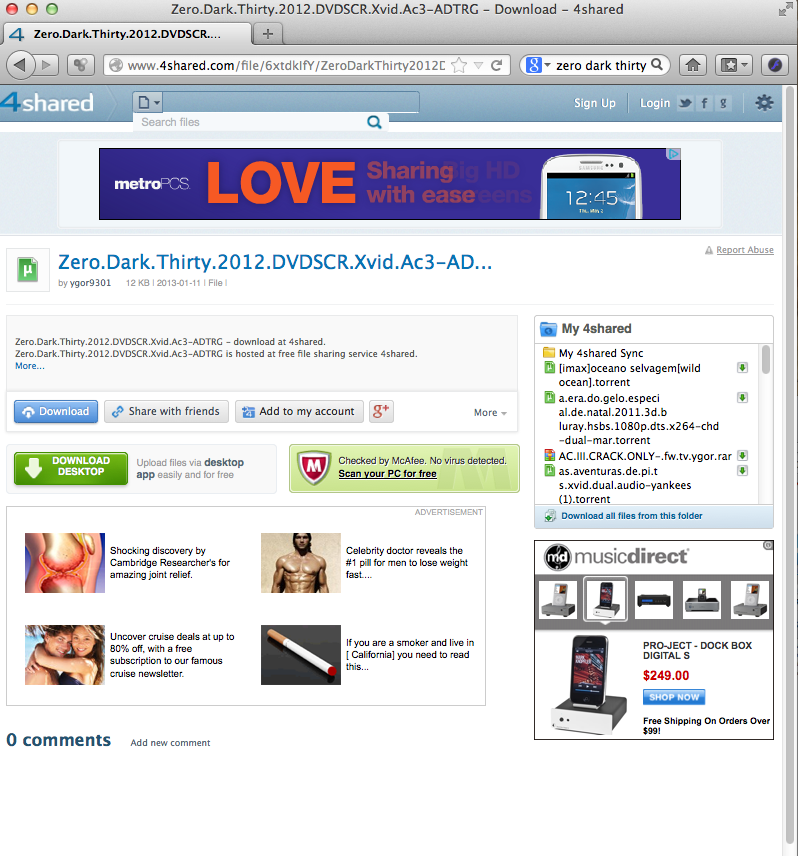
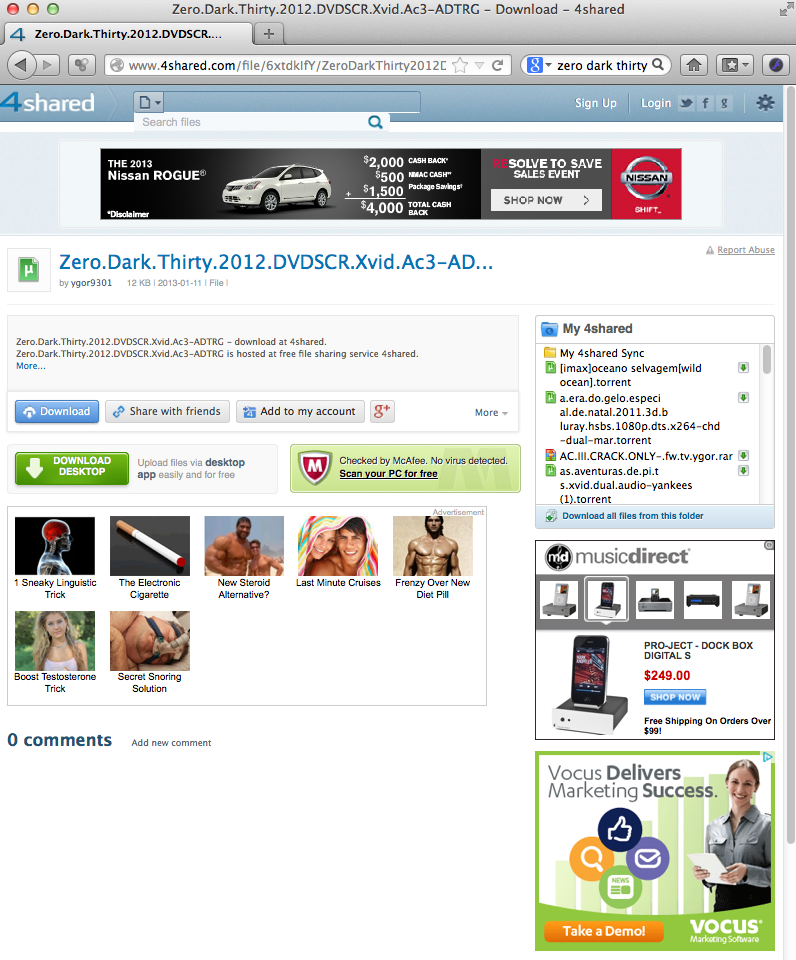
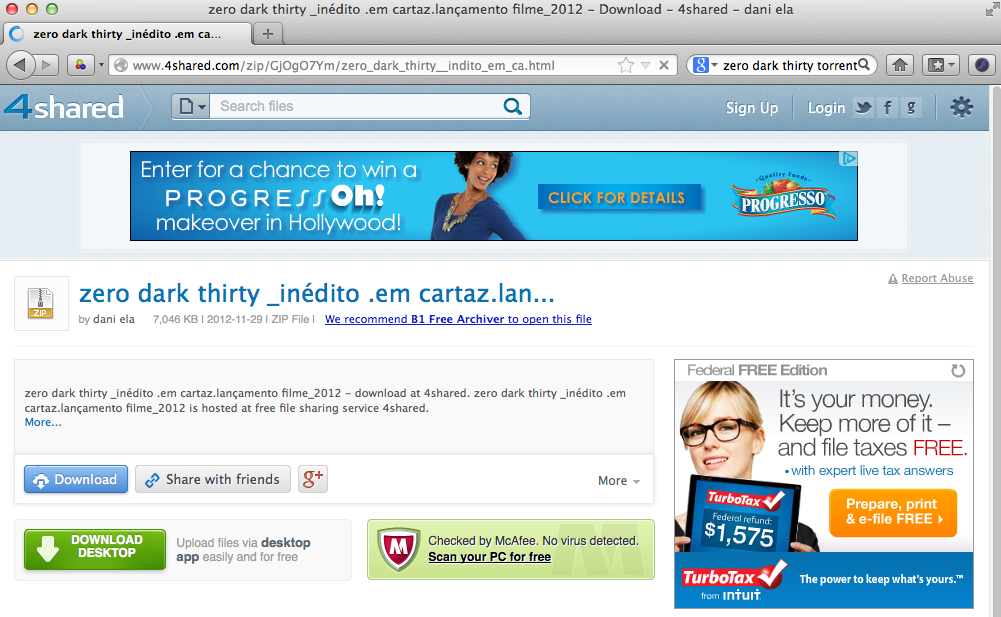
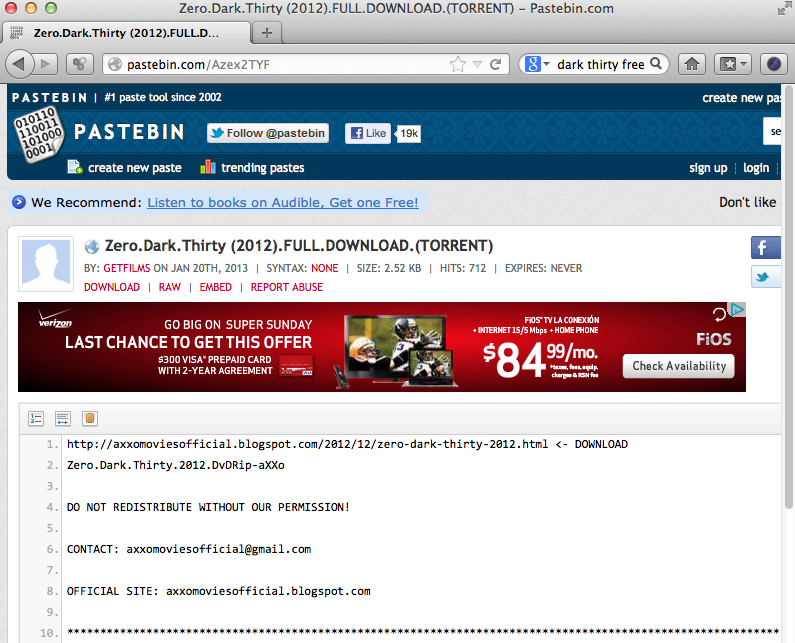
With the upcoming Academy Awards we wondered if it would be possible to find pirated versions of Zero Dark Thirty. It is the most talked about film of the year which is nominated for five Academy Awards including Best Picture. But it could easily be any of the other nominated films, in any of the categories as well. We just picked Zero Dark Thirty. It’s also been widely reported that most of the nominated films have already been pirated and are online.
We were also curious what major brands might be supporting that piracy, and if any of those same brands might have advertising that appears on the broadcast of The Academy Awards show itself. We would hope the Academy Of Motion Picture Arts and Sciences would be able to educate the various brands, advertising agencies and online ad networks about the damage they are doing to the creative community.
What makes this even more frustrating in the case of Zero Dark Thirty is that the film is not even out of theaters yet. At least with music, it is usually (usually…) commercially available before it is pirated.
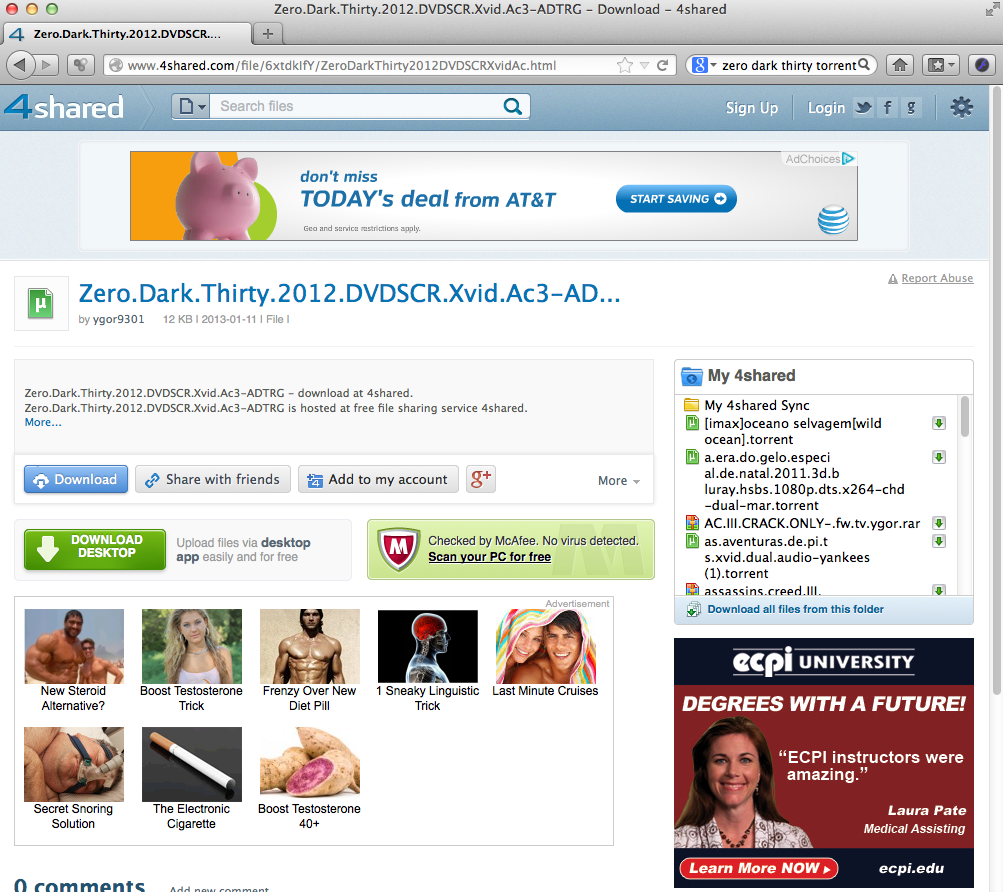
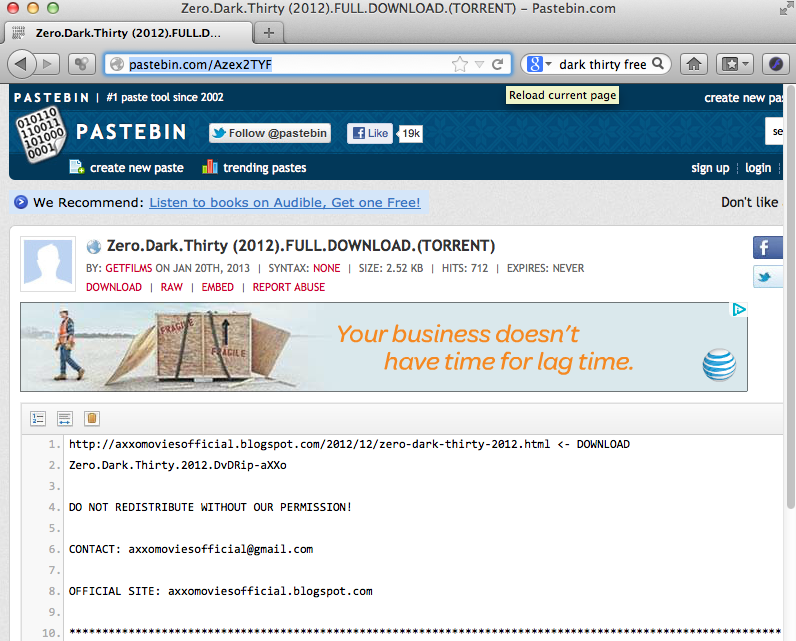
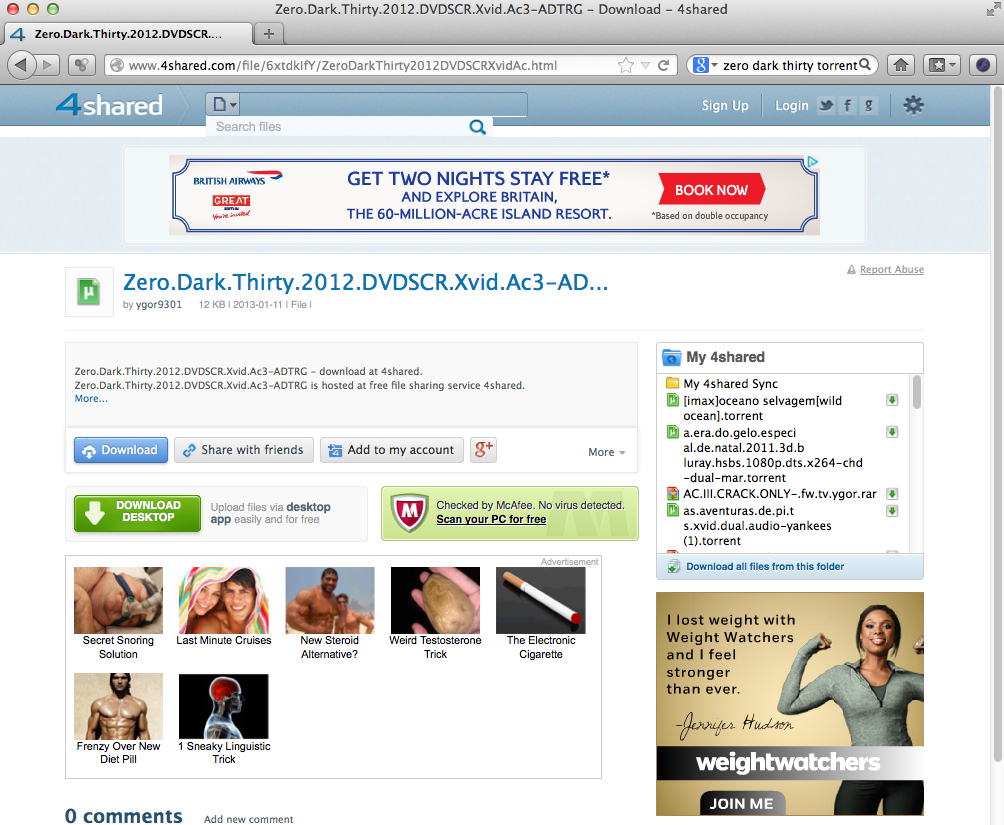
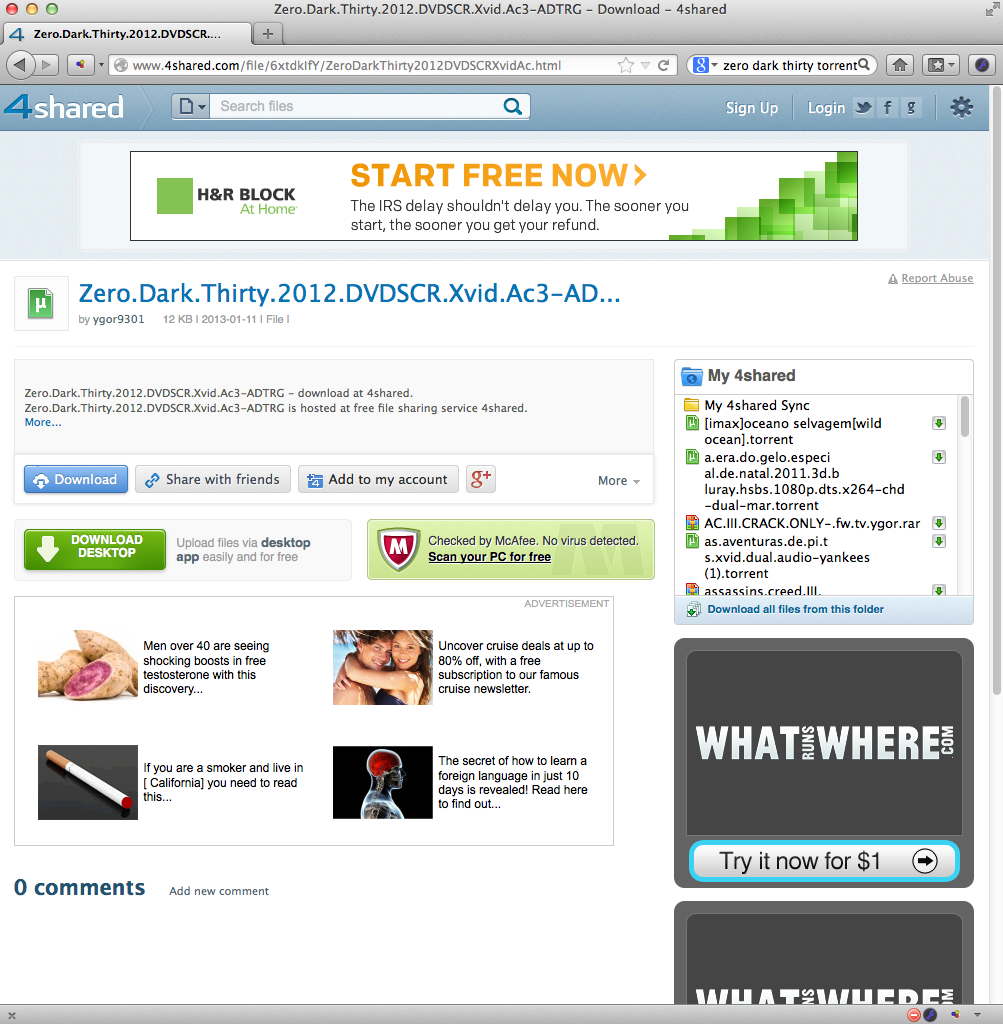
Here’s what we found within a few minutes, on just two sites…
* AT&T on 4Shared
* AT&T on Pastebin
* British Airways on 4Shared
* H&R Block on 4Shared
* MetroPCS on 4Shared
* Nissan on 4Shared
* Progresso on 4Shared
* Turbo Tax on 4Shared
* Verizon on Pastebin
That’s just a couple sites to download the movie for free. What’s more common amongst film piracy are the faux subscription services that charge annual membership fee’s to stream all of their pirated movies (so much for information wants to be free, but movie want to be paid for…).
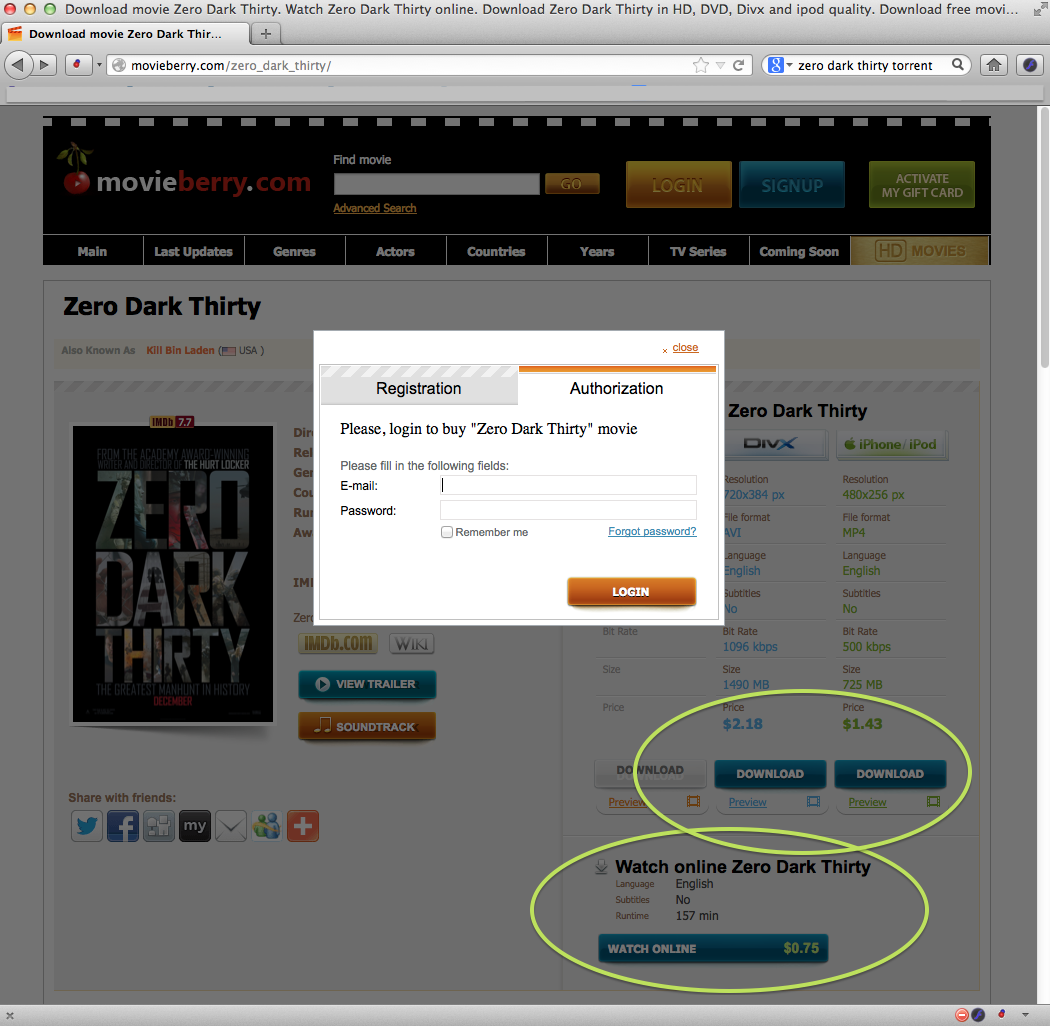
Here’s just one example where you can pay on a transactional basis of $.75 to stream the film or between $1.43 or $2.18 to download the film of varying quality.
So much for “Free Culture.” As it turns out there’s probably very little online piracy happening without money changing hands somewhere in the value chain. The money may be in advertising, or it may be in transactional or subscription fees, but one thing is for sure, people are getting paid and not paying the creators.
In the case of the above, and as we also asked did MegaVideo Charge for Streaming Movies the problem here is to address those processing payments such as American Express, Visa, Master Card and the various other banks such as Citi Bank and Wells Fargo (whom have also been seen advertising on pirate sites). At least PayPal is taking responsibility and denying service to pirate sites. That thanks largely to the good work being done by StopFileLockers.
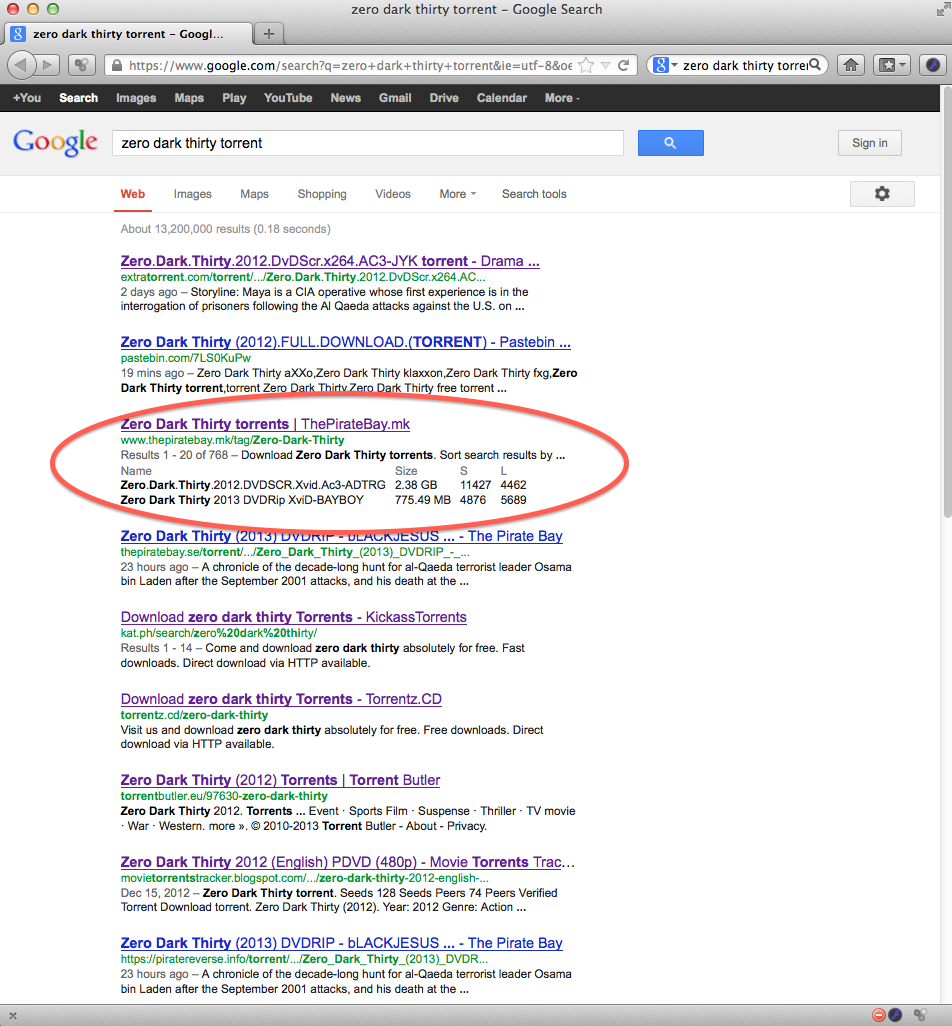
We found a couple of things of interest as well regarding Google’s search. Despite there being (we’re guessing conservatively) literally thousands of DMCA notices to remove the film from search, The Pirate Bay still ranks #3 on the first page of search results! Surely Google as well as everyone else in the world knows the site was found guilty and it’s founders sent to jail. Yet Google has not delisted the site from search in it’s entirety which would be the right thing to do, knowing that the judgement against The Pirate Bay was upheld even by the Supreme Court of Sweden.
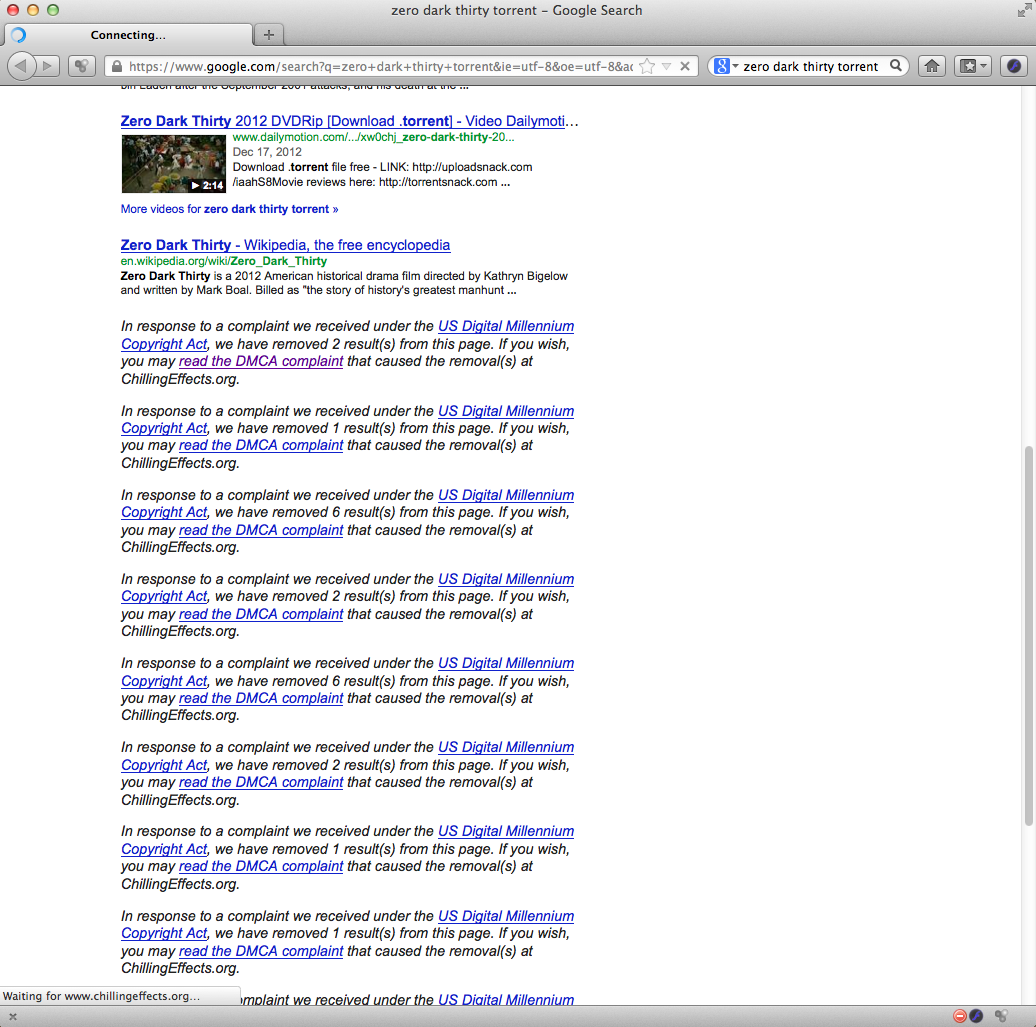
Of course a quick scroll down the page and the delisted link removal notices start to appear as follows:
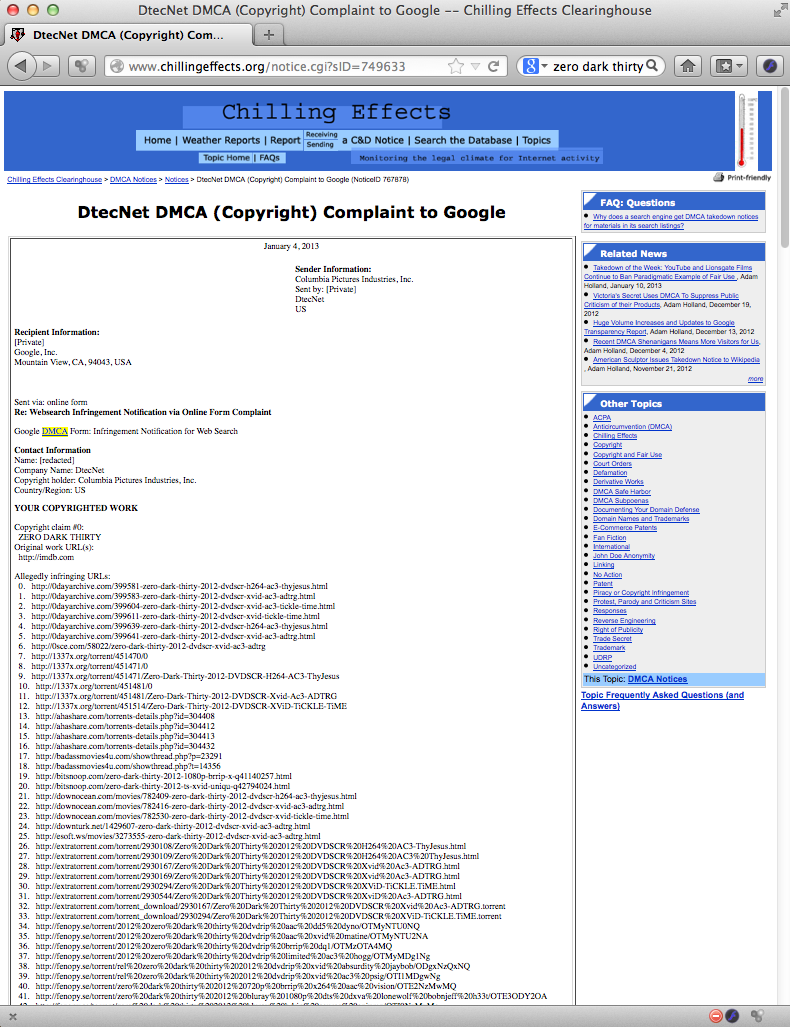
Now why exactly is there a need, once a link has been delisted to post a notice to a site that then shows that very same link that had been lawfully delisted from Google search by the DMCA? In the screen shot below are shown just the first forty delisted links, but on that one notice alone there are over three hundred delisted links to pirated copies of Zero Dark Thirty in one way or another.
Make no mistake about it, every one of those previously delisted links is still active on the servers where it originated and it can simply be copied and pasted back into any web browser.
Further more, these links have been delisted due to the fact that most if not all of these infringing sites are not based in the United States and do not conform to United States law and therefore do not comply with the DMCA itself.
Is this all just a cat and mouse game for Google to profit from piracy? Draw your own conclusions.
As some of you may know, I again will be moderating the Global Forum at Canadian Music Week this year. They keynote speakers I will introduce will be Chris Ruen, author of Freeloading: How our insatiable hunger for free content starves creativity, and David Lowery, the founder of Cracker and Camper Van Beethovan and editor of The Trichordist. The topic of the keynotes as well as the famous structured table discussions among the 200+ worldwide industry leaders will be brand sponsored piracy.
The New York Times coverage today of how brands sponsor piracy is timely, largely on target and will provide us with further supporting documentation for answering what I perceive to be one of the central questions in the corrupt “unholy alliance” among brands, ad agencies, ad networks, search engines and thieves:
If the brands don’t stop funneling money to sites they know are unauthorized, should artists…
There has been a lot of ink spilled on the retracted and disowned “memo” titled Three Myths of Copyright that was posted on the Republican Study Committee (RSC) website. Notwithstanding the fictional revisionist history of the op-ed the usual suspects are insisting on grand conspiracy theories worthy of a tin foil hat.
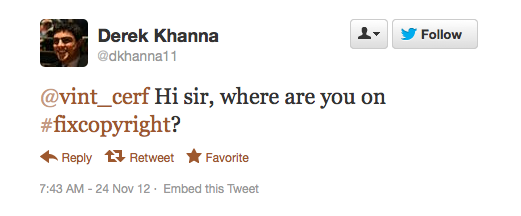
For those who are unaware the RSC “memo” was authored by one Hill staffer working at RSC named Derek Khanna. Shortly after the memo was posted on the RSC website, it appeared nearly simultaneously on several locations in the anti-copyright echo chamber (e.g., Ars Technica’s Tim Lee, Techdirt, etc.). Within hours of its posting, the “memo” was not only removed by the RSC, but also disavowed by the organization itself.
It’s important to note that Mr. Khanna acknowledged (on Reddit) that he was freelancing–no one asked Mr. Khanna to write the memo. How he was able to post the memo on the RSC’s website–which would tend to give the memo the imprimatur of the RSC to the casual reader–is anyone’s guess (although someone surely must know).
So if the RSC didn’t request it, we wonder where the inspiration came from as the memo appears to repeat many of the same old tired talking points we see repeatedly in the anti-copyright and tech blogosphere echo chamber. Some may suspect that Khanna could be hoping to earn favor in the corporate sector who have the same goals in seeing artists rights in copyright diminished, but who knows. Perhaps a staffer at the end of his run with the committee tried to shoot a three pointer as the clock was running out?
William Patry currently serves as senior copyright counsel to Google Inc. Vint Cerf has worked for Google as a Vice President and Chief Internet Evangelist since September 2005.
“Three Myths claimed that US copyright laws violate “nearly every tenet of laissez fair capitalism” and constitute “corporate welfare” that thwart capitalism, hamper science, stifle libraries, penalize journalism, hurt innovation and consumers, and even conceal Nazis.
The next day, the RSC Executive Director firmly disowned Three Myths. He explained that it had been “published without adequate review within the RSC” and that it violated RSC publication standards because it failed “to provide informative analysis of major policy issues… that accounts for the range of perspectives held by RSC Members and among conservatives….” The stated reasons for the RSC disavowal seemed valid, especially since many Republicans consider copyrights to be one of the many private property rights that encourage private production of valuable goods, services, and books.
But Khanna then undermined the RSC by publicly embracing the just-disowned paper and associating himself with the “tech community” at TechDirt: “I am the author of this memo, and I hope the tech community continues to add to these ideas….” Khanna then appended a link to… TechDirt.
Predictably, “copyright skeptics” erupted in outrage. Skeptics then accused the RSC of disowning the typo-ridden Three Myths—not because it actually was uninformative and biased—but because bad copyright-industry lobbyists must have strong-armed the stronger-armed RSC into suppressing Three Myths because it had spoken truth to power. To assess the validity of such accusations, the quality of the analyses in Three Myths can be tested against the RSC’s standards for publication and external realities—a test that Three Myths fails miserably.
But that’s not the end of it. Slate reported later on that Derek Khanna was separated from the RSC. Of course this wouldn’t be the least bit surprising given the information above (but this also doesn’t appear to be verified either). Don’t shed a tear for Derek, we’re sure he’ll land with some good opportunities, perhaps even at Google?
The fairy tales spun by the young Republican are easily debunked as the facts about Copyright haven’t changed so much as he would like to think otherwise. Scott Cleland makes quick work of refuting the so called myths in his post, “The Copyright Education of Mr. Khanna.” Cleland states,
“Mr. Khanna has obviously and grossly mischaracterized Constitutional first principles, property rights, and free markets beyond recognition.”
“…any debate or dialogue should begin with sound premises. This policy brief doesn’t. Instead, like an unfortunate strand of copyright skepticism, it runs from reality, rewrites history, and hides from logic.”
What the irrational anti-copyright movement had hoped would give them legitimacy in the form of an endorsement from a major political party has instead had the opposite effect of highlighting the desperate attempts to rewrite history in such a shallow and over reaching way as to invalidate an honest debate or dialog based in facts. No doubt, somewhere out there is basis of Khanna’s “memo” and it’s unlikely that he did little more than parrot the existing talking points of those who rallied around him in the wake of the memo’s demise.
Derek Khanna, a junior and executive political director of the Massachusetts Alliance of College Republicans, and his friend Trevor Lair, the organization’s chairman, have launched a Web site to gather signatures to petition Samuel J. Werzulbacher to challenge Rep. Marcy Kaptur, D-Ohio, in 2010.






 The Trichordist
You must be logged in to post a comment.