Streaming Services Ranked By “Artist Friendliness”

There is a lot of debate concerning the amounts paid to artists by streaming services.  It’s often very confusing because what an artist sees in royalties on their statements is highly dependent on a number of factors including whether they have a record deal, publishing deal or whether they are a solo performer or a band.  From an artists perspective royalties may accumulate from multiple sources. The other problem is that in general royalties are based on a percentage of the streaming services revenue.  So the amount may vary month to month and year to year.

Still one good  way to compare services is to look at statements for a moderately sized catalogue and calculate the revenue per stream they pay to “the rightsholders” (label/publisher/performer/songwriter) over a period of months.   This would also be the same amount that a completely independent artist that owns 100% if their own recordings and songwriting receives.

But this is not the only way to look at these streaming services from an “artist friendly” viewpoint.   We also need to look at whether these services respect artists rights. That is, whether these services respect the Artists right to choose how to monetize their music.   When you look at it in those terms the picture is a little different.  Here I’ve ranked the 7 most common services.

1. Rhapsody (Napster/Zune).  These three “on demand” services allow you access to virtually any song at any time. From an artist’s perspective they are identical.   These all work on a paid subscription model.  Like Spotify these services pay a percentage of revenue to rights holders.   But because they do not offer an ad based free service they have more revenue and pay more per stream to each artist than Spotify.  All these services  (like Spotify) operate under a private license.  They do not rely on a government imposed compulsory licenses or rates.  This also means rightsholders can theoretically “opt out” of this service if they think it doesn’t pay well enough. Or better yet negotiate a better deal.

I’m not opposed to compulsory licenses and rates in certain situations. But as  an artist I have to note that these rates are set by political appointees.  Broadcasters generally have a lot more money than artists and are thus better positioned  to influence the political process.  This is not some sort of tin foil hat paranoia.   If you were paying attention this fall you will note  that this is exactly  what happened  with the Orwellian-named Internet Radio Fairness Act.  Pandora fronting for Clear Channel,  Sirius XM and various Silicon Valley firms tried to use their lobbying money and influence to force the government to reduce those compulsory license rates!  Artists could have got an 85% pay cut!  So in general private blanket licensing is better for the artist.  Compulsory federal government imposed rates benefit the politically connected.

As previously noted have access to the streaming royalty payments for a moderately sized catalogue. Here are the average per stream rates paid by these three services Jul-Dec 2011.

Zune 2.8 cents

Napster  1.6 cents

Rhapsody 1.3 cents

These are close to being a sustainable* rate for artists.  (See footnote at end for an explanation.)

As a consumer I enjoy Rhapsody’s  256k mp3s.  As a consumer I prefer Spotify’s interface. I’ve never tried Zune or Napster.

2. Spotify.  #2 ?!! This surprises many of you.  Right? Let me explain.

Currently Spotify appears to be paying rightsholders about .5 -.7  cents a stream.  Considerably lower than the three services above.     While my colleagues here believe this is not a sustainable rate and that it may never become a sustainable rate we can’t know for sure.   It  is unclear how much streaming services  “cannibalize” or displace traditional sales. If streaming services  displace 20% of sales Spotify’s per stream rate could be sustainable.  If they displaces 80% of sales? Probably not.

Spotify  relies heavily on it’s free streaming service that is ad supported.  Spotify pays 70% of revenue to rightsholders.  If Spotify manages to convert more users to it’s premium subscription services revenues will rise.  As a result  rightsholder’s revenues rise.  If the ratio of paying subscribers to free subscribers rises substantially the per stream rate rises to something  sustainable.

What we  like about Spotify:  It operates (mostly?**) under  private licenses which means that rightsholders can withdraw from the service if they wish.  More importantly Spotify  has quietly allowed individual artists to “window” their releases and limit which singles or albums are available in the free service.  This is very important. For instance my band Cracker which has had four top ten rock tracks might find it’s revenues from Spotify acceptable.  But a niche artist like Zoe Keating might find she is losing sales to streaming services. She might chose to have only some or none of her catalogue available.  Choice is the foundation of free markets. Allowing artists to experiment with how to use streaming services, and how to monetize their songs is good for everyone. It will eventually be clear the best way to balance revenue and access.

I also should note that Spotify is being unfairly blamed for the knock on effects of disintermediation.  Disintermediation creates winner-take-all markets, and in an industry that was already winner take almost all, the small and middle class artists have gotten clobbered.  On a positive note, in these kind of markets there are usually countervailing market forces at work that nudge us towards  risk and revenue sharing. Or in Layman’s terms: It usually gets better.    The explanation is kind of complex so I’ll skip it for now.  Suffice it to say that right now it’s not so much Spotify taking artists’ royalties but the superstars taking everyone else’s royalties.

Finally Spotify has gone out of it’s way to engage artists, even critics like myself.  The fact that they were willing to sit down with me and discuss my issues with  their service is encouraging.

#3 Pandora.   Oh how the mighty have fallen.    Once they were our favorite.  Look at early Trichordist blogs and note our enthusiastic tone whenever we speak of Pandora!

For those of you that don’t know Pandora is NOT an on-demand streaming service.  I call it a “virtually on demand streaming service.”  If I type in a song title and artist name, I dont’ get that song.  But I usually get a song by that artist.  Pandora is a music discovery service.  It’s not a replacement for owning an album.  As a result Pandora gets and should get a lower rate than on demand services.

What we don’t like about Pandora:

They operate under a compulsory license so artists can not opt out of the service if they do not like the rates!! But what is worse is they have adopted the tactics of Silicon Valley’s hardball monopolists.  Proudly on display are  lobbyists, fake bloggers, planted stories, paid mouthpieces  and all the usual Kabuki Theatre bullshit we’ve come to expect from the “innovators” of Wall Street- er I mean Silicon Valley.  As I mentioned previously  Pandora fronted for the Internet Radio Fairness Coalition and pushed the Orwellian-named Internet Radio Fairness Act. The bill had nothing to do with Internet radio or fairness and everything to do with screwing artists out of 85% of their royalties.

Curiously the Internet Radio Fairness Coalition which supports the bill  has a lot of traditional broadcasters like Clear Channel and Sirius XM. Kind of odd for an organization with the publicized  purpose of leveling the playing field between Internet broadcasters and traditional broadcasters. The CCIA and CEA are also  inexplicably members of the IRFC.  Well maybe not inexplicably.  Just as the Four Horsemen herald the Apocalypse,   The CCIA  and CEA seem to always herald  La Chingada of someone, somewhere by Google.

So for participating in this rapacious anti-artist skullduggery we move Pandora from the top of the list  to #3.   We would put it at the bottom of the list but the other two lower ranking  services in my humble opinion are not even completely legal.

#4.   YouTube/Google.   YouTube is the biggest on demand streaming service. I know people think of it as a video service but it turns out that it’s the most popular music streaming service.  The main problem is that a lot of the music is uploaded and monetized by people that have no right to the music in the first place.  For example here is one of my recordings:  All Her Favorite Fruit. The problem is I didn’t authorize this person to upload this song, nor did I authorize YouTube to sell advertising or sponsored videos against this song.  It’s possible that the record label did but as I am also the songwriter and legally I should have been consulted.  Worse, the person who uploaded the static image can receive advertising revenues  since they “own” the video.  This is no different than Kim Dotcomm/MegaUpload paying people to upload the most popular movies and songs.  Further I have no idea where the money goes since you can’t audit YouTube without signing an agreement with them that basically says you can’t audit them!  YouTube is like the exploitative 1950’s music business but even worse, as  the artist does not receive the occasional Cadillac in lieu of royalties.

Now consider this:  This track is competing with legitimate authorized  streams of my track on other services.  These services generate some revenue for me.  So say I find it in my financial interests  to take this down?  I have to file what’s called a  DMCA notice.  When I do this Google can place my DMCA notice  on this website to try to publicly shame me into not doing this anymore.  I don’t file DMCA notices with YouTube/Google because I don’t want some deranged Freehadists showing up at my  home or office. This is not a far fetched idea, many of us in the vanguard arguing for artists rights and the preservation of copyright receive constant threats from seriously deranged free culture nutbags.  So the result is I don’t file a notice and I let YouTube/Google get away with this. This website is a tool of intimidation. It is my belief that this is exactly what Google intended when it launched this site.

If Google and UC Berkeley (which hosts the site and lends it intellectual legitimacy) had any common decency they would stop this practice cause someone is gonna get hurt one day. Now while  I don’t hold out hope for Google developing any common sense anytime soon (they are still allowing advertising for no prescription Oxycontin despite a half a billion dollar fine and threat of jail time)  maybe the Chancellor of UC Berkeley will recognize how screwed up this is.  You should ask Chancellor Birgeneau yourself: “Why is UC Berkeley supporting Googles intimidation scheme?”  chancellor AT berkeley.edu.

My friend East Bay Ray of The Dead Kennedys  told me he recently got an “offer” from YouTube/Google to let him claim  his own songs and start receiving royalties.(“Really you’re letting me have control over my own songs? Gee thanks how nice!”).  All he had to do was sign away most of his rights and in return the band would get about .1 cents a view.   Considering your typical banner ad on a shitty pirate website gets 1.5 cents an impression,  this is not even a joke.  It’s an insult.   Honestly I can’t understand how artists can complain about Spotify when YouTube/Google is so much worse and certifiably evil.  As I’ve said before “Don’t be Evil” is not their corporate slogan, It’s their widely ignored corporate reminder. 

#5 Grooveshark.   Many young people I run across seem to think this is a legitimate streaming service. It’s not.  My entire catalogue is on this service. No license, no permission and not a dime ever from these guys.   The sooner these guys go to jail the better.  I’m tempted to have a conversation with Ted Nugent. You think he’s mad about Obama raising his taxes and restricting his gun rights?  Wait till he finds out that Grooveshark is not paying him royalties.

* “Sustainable Rate” is my attempt to figure out a streaming rate that compensates artists well enough to continue to write (and especially) record albums.   I’ve examined a lot of iTunes libraries and “most played” lists.   A typical 20 year old college student seems to play a track they have purchased around 25-30 times before they seem to tire of the track.   So if on demand streaming replaces all album sales a stream should pay about 2.3-2.8 cents to be the equivalent of the 69 cents net received from iTunes on a 99cent download.  But if on-demand streaming only replaces 50% of album sales it could be half that rate.  You see?

But a  word of caution.  First this assumes that 99 cents a track is the right price for all songs.  Not necessarily true.   This is a price that iTunes essentially imposed on the record business, against a backdrop of mass piracy.  You can make an argument that this artificially lowered the price of music.

Second the music business has always worked on a revenue sharing model that assumes the “winners” subsidize the “losers” through record companies, publishing companies and their advances.   If you have total disintermediation in the streaming market even with high per stream rates  niche artists like Zoe Keating and Camper Van Beethoven would never generate enough revenue to record albums.  Music sales exhibit a “wild” variation and with total disintermediation almost all the revenue goes to the winners.   So this “sustainable rate” is not necessarily sustainable at all.  It is only one piece in the puzzle.  Eventually the revenue and risk sharing roles once assumed by record labels will need to be assumed by the record labels again, or other mechanisms need to be developed.

Other’s have suggested non market based  mechanisms which  include “crowd funding” government subsidies and corporate patronage.  I am uncomfortable with all of these.   Government and Corporate funding allow powerful elites to decide what music is made.   Crowd funding works for the most extroverted and popular personalities.   While crowdfunding comes closest to market based incentivizing  I don’t believe crowd funding would have ever given us  important artists  like Jimmy Hendrix, Captain Beefheart, Frank Zappa,  NWA,  Black Flag or Nirvana.   Can you imagine Kurt Cobain or Jimmy Hendrix offering a premium support package that includes the artist coming to your house and cooking dinner for you and 4 of your friends? No crowdfunding works for people like me who already have a career or extremely extroverted self promoting personalities like Amanda Palmer (no offense intended). 

One day I hope that all my musician and digital utopists friends wake up and see that the West’s private market based system for creating culture  has produced some extraordinarily profound and non-mainstream work.   No other system can match it. Why are some so  hell bent on throwing it away?  

** My understanding is that there is a compulsory on demand rate for songwriters (song in abstract) not performers.  It’s not clear to me whether Spotify uses this rate.   And I can’t two experts that agree.  But certainly the bulk (if not all) the revenues Spotify pays our are under the private license not compulsory license.

…it will henceforth be very difficult to dislodge Smith and Telang’s conclusion that piracy does economic harm to content creators…

Copyright and Technology

Back in 2010, the Government Accountability Office (GAO) published a meta-study of the economic effects of intellectual property infringement (including counterfeit goods as well as copyrighted works).  The GAO concluded that IP infringement is a problem for the economy, but it’s not possible to quantify the extent of the damage — and may never be.  It looked at many existing studies and found bias or methodological problems in every one.

More recently, Michael Smith and Rahul Telang, two professors at Carnegie-Mellon University, published another meta-study that serves as a sort of rejoinder to the GAO study.  This was the subject of Prof. Smith’s talk at the recent Digital Book World (DBW) conference in NYC.

Assessing the Academic Literature Regarding the Impact of Media Piracy on Sales summarizes what has been a growing body of studies on the economic effects of so-called media piracy.  Their conclusion is that piracy does have…

View original post 391 more words

What You Can Do Today to Stop Brand Sponsored Piracy Through Touring Contracts or Sponsor Deals: Artists Helping Artists

by Chris Castle

If you are like most artists, you feel overwhelmed by the alliance of Big Tech and Fortune 500 companies allied against us in the intricate network of brand sponsored piracy.  (If you need more background on what “brand sponsored piracy” means, just look around on the Trichordist or on MusicTechPolicy and you’ll get the idea.)  From Google search to Chilling Effects, some artists would like to know what they can do to fight back.  Of course, if artists wanted to fight piracy full-time, they would be cops not artists.  So we need to find ways to leverage your time more effectively and try to find everyday ways that artists can help themselves and each other to fight back.

You may not be aware of it, but clubs, tours and especially festivals or event programming take ads online.  Sometimes these ads appear on pirate sites.  Here’s an extreme example from the illegal lyric site, Lyrics007.com that rips off songwriters, in this case Adele:

Beyonce, Adele and the Super Bowl Exploited by Pepsi

Do I think that Beyonce knew that her name and likeness would be plastered all over illegal music sites?  Of course not.  Did the NFL know?  Unlikely.  Did Pepsi know?

Now that is a more difficult question.  The problem that these big brands have is that someone always knows.  Someone at their ad agency also definitely knows.  They’ll give you a big song and dance about it’s a big system, millions of transactions, but it is simply not possible that no one knows, yet a brand the size of Pepsi–a company that has been a very good friend to the music business, by the way–spends millions on an advertising campaign without knowing where its ads are going?

Put Them On Notice

Thanks to David Lowery, Camper Van Beethoven and Cracker, artists have come up with an easy way to create some incentives for their touring partners to take responsibility for where the promoters advertise their shows.  And this concept could fit in every artist agreement from an one-nighter agreement, to a recording agreement, to Beyonce’s Super Bowl promotion with Pepsi or any other event-driven advertising campaign.

The artist can tell them no.

With a simple contract clause that could go in the artist’s agreement (including in the tour rider), an artist can prohibit the artist’s work from being advertised on pirate sites.  Violating this clause could put the promoter in breach–but the point isn’t to sue people.  The point is to have a dialog, raise awareness and get people to be more careful.  Offer promoters a competitive advantage to get the deals in the first place.  If you want repeat business with an artist, don’t let the artist see ads show up on pirate sites.

So what’s a pirate site?  Big Tech would like you to believe that it is only sites that have been adjudicated an infringer in a final, nonappealable judgement before the highest court in every country of the world.

That’s obviously bunk and designed to make  you feel helpless because only Big Tech can afford that kind of litigation, so naturally that’s the bright and shiny object they want you to focus on.

Remember–you are talking about a private contract.  Your private contract.  How and where your show is marketed is a function of how much you trust your promoter to market your name…your brand…so it is absolutely reasonable for you to want to control how you are presented to your fans and to the general public when you permit someone else to make decisions about that marketing, just like you would decide that the headliner’s name came first in billing.

Meaning that if you are making a private contract, you are in control of your marketing (at least generally) and you can negotiate those terms.  The list of sites you want to exclude–if any–is up to you, a subjective decision.

You could also decide that you want the promoter to be able to refer to an objective list, that is, a list determined by a third party who you both agree will reasonably set the standard.  The USC-Annenberg Innovation Lab’s Transparency Report uses the Google Transparency List.  This is a good list, but Google has some pretty large exclusions from that report.  So the language that Camper and Cracker like also includes the US Trade Representatives Notorious Markets List, which is much shorter than the Google list, but uses US Government resources in its determination.

Suggested Contract Language

If you decide you want to go this route, the Camper/Cracker antipiracy clause covers three bases, which I think are probably good enough:  The USTR List, the Google List, and whatever list the artist may come up with that isn’t on either of those lists.  (The artist doesn’t have to give a list, but reserves the right to do so–the artist may also add back sites that USTR or Google would exclude.)

Here’s the language (“BUYER” usually refers to the talent buyer or promoter):

“THE BUYER WILL NOT, AND WILL NOT AUTHORIZE THIRD PARTIES TO, ADVERTISE THE SHOW ON ANY WEBSITE THAT IS LISTED ON THE CURRENT US TRADE REPRESENTATIVE’S NOTORIOUS MARKETS LIST (currently http://www.ustr.gov/sites/default/files/121312%20Notorious%20Markets%20List.pdf), OR THAT IS LISTED IN THE CURRENT GOOGLE TRANSPARENCY REPORT (currently http://www.google.com/transparencyreport/removals/copyright/domains/?r=last-month), OR THAT THE ARTIST HAS INFORMED THE BUYER IS A SITE ON WHICH THE ARTIST DOES NOT WISH THE BUYER TO ADVERTISE THE SHOW.”

Obviously, this is not meant as legal advice and you should confirm with your own lawyers how this language might affect your rights under the particular agreement, but it should be a good starting place for any show agreement that is based on the American Federation of Musicians “One Nighter” agreement or the equivalent.This language could be included in a watermark on any pdf version of a show agreement, or placed in the artist’s rider.

Flow Down Language

In more complex situations, you may wish to consider adding it as a flow down provision in a promoter agreement that requires the promoter to include the language in any show agreements.  A flow down provision is a clause that anticipates the other side will be empowered to make many contracts with third parties that give effect to the principal two-party agreement, and one side wants to control certain aspects of those third party contracts without negotiating or signing them.

For example, a US promoter might buy a 50 city tour and have an overall deal with the band.  The US promoter then goes out and contracts with local promoters for each of the 50 shows.  The artist may want to get the US promoter to promise the each of these 50 contracts will have certain clauses to protect the artist often relating to staging, insurance, venue sales and advertising.  That’s a good place to put the antipiracy clause, but the artist is not necessarily a party to those agreements.

Artists Helping Artists

It is easy to see how this language could be adopted in sponsorship or event agreements, and i  t would go a long way to raising awareness of the situation and incentivizing all concerned in the right way.

It’s nothing personal, it’s just business.

Artists Rights Watch – Sunday Feb 3, 2013

Grab the coffee!

Recent Posts:
* Over 50 Major Brands Supporting Music Piracy, It’s Big Business!
* @pepsi and @beyonce @superbowl Ads Supporting Pirate Lyrics Site That Exploits Adele and Skyfall
* Derek Khanna is Wrong: Copyleft Mystery Man’s Misleading Memo Creates its Own Myths…
* It’s Not Whack A Mole if You Own the Mole: New York Times Coverage of Brand Sponsored Piracy
* Zero Dark Thirty, Best Picture Academy Award Nominee, Exploited by AT&T, Verizon, MetroPCS, Nissan, H&R Block, British Airways, Progresso, and more…
* #StopArtistExploitation – Tweet Daily for Artists Rights!
* Underreporting and No Accountability: Another Reason Streaming Royalties are So Small
* Internet Pay To Play: Payola’s Revenge – Guest Post by Robert Rial of Bakelite78

From Around The Web

LA WEEKLY:
* YouTube Stars Fight Back

“I woke up today hoping to make a video, but I went into a call with Machinima this evening and they said that my contract is completely enforceable. I can’t get out of it,” Vacas tells the camera. “They said I am with them for the rest of my life — that I am with them forever.

“If I’m locked down to Machinima for the rest of my life and I’ve got no freedom, then I don’t want to make videos anymore,” he says quietly.

The screen fades to black.

NEW YORK TIMES:
* Playing Whac-a-Mole With Piracy Sites
* As Music Streaming Grows, Royalties Slow to a Trickle

Spotify, Pandora and others like them pay fractions of a cent to record companies and publishers each time a song is played, some portion of which goes to performers and songwriters as royalties. Unlike the royalties from a sale, these payments accrue every time a listener clicks on a song, year after year.

The question dogging the music industry is whether these micropayments can add up to anything substantial.

“No artist will be able to survive to be professionals except those who have a significant live business, and that’s very few,” said Hartwig Masuch, chief executive of BMG Rights Management.

ADLAND:
* Online pirating: sponsored by many brands, and now, one government.

BUSINESS INSIDER:
* How Jobs In The Media Industry Got Demolished In The Last 10 Years [Charts]

The Bureau of Labor Statistics has put together a presentation on the recent history and direction of media jobs. It’s not pretty.

THE LEFT ROOM:
* Piracy, Free Books, etc

DIGITAL BOOK WORLD:
* Does Piracy Hurt Digital Content Sales? Yes

BRITISH JOURNAL OF PHOTOGRAPHY:
* Photographers find support in House of Lords in copyright fight

THE HOLLYWOOD REPORTER:
* Ray Charles’ Children Win Lawsuit Over Song Rights Termination

BLABBERMOUTH:
* TOOL Frontman Sounds Off On Illegal Downloading, Music Industry And Digital Distribution

“There’s a disconnect between people not buying music and not understanding why [bands] go away. There are people who are like monkeys in a cage just hitting the coke button. They don’t really get that for [musicians and artists] to do these things, they have to fund them. They have to have something to pay the rent.”

VOX INDIE:
* New Spotlight on Piracy Profitmongers

THE ILLUSION OF MORE:
* Think File Sharing is Sticking it to The Man? Really?
* On Being a Luddite

COPYRIGHT AND TECHNOLOGY:
* Yes, Piracy Does Cause Economic Harm

Decisions about business and policy have to be made based on the best information we have available. After a certain point, simply poking holes in studies — particularly those whose results you don’t happen to like — isn’t sufficient.

It may indeed, as the GAO suggested, be impossible to measure the economic effects of piracy with a large amount of accuracy. But if dozens of researchers have tried, all using different methodologies, then their conclusions in the aggregate are the best we’re going to do. Put another way, it will henceforth be very difficult to dislodge Smith and Telang’s conclusion that piracy does economic harm to content creators.

RAPIDTV NEWS:
* LATAM pay-TV operators unite against piracy

CIOL:
* Kamal Haasan fans help curb Vishwaroopam online piracy

BILLBOARD:
* Worldwide Independent Network Announces ‘Independent Manifesto’
* Blink-182’s Mark Hoppus Talks Piracy, Pros and Cons of Digital at MIDEM

“I believe that artists should be paid for their creativity. There’s no other industry where people can come in and take what you create for free and give it away for free and that’s acceptable.”

MUSIC ALLEY:
* U2 manager Paul McGuinness: ‘I don’t want to engage in Google-bashing, but…’
* Irving Azoff sticks it to Pandora and StubHub
* Midem 2013: How the Music Industry Manages Innovation

“We are the last fortress against this YouTube situation, and we are fighting hard on that,” he said. “The problem is the fair price, getting statements and getting all the business plans… The biggest problem to solve the YouTube deal is they want a non-disclosure deal, and we are not allowed by Germany law to do with any partners a non-disclosure [deal]. We have to do it open.”

DIGITAL MUSIC NEWS:
* Pandora Executives Cash Another $3 Million In January…
* Hey Advertisers: You Might Want to Ask VEVO for a Refund…

HYPEBOT:
* Myspace Allegedly Hosting Unlicensed Indie Music, Merlin Prepares Legal Response
* The Most Honest Interview About the Music Industry Ever, Featuring Jacke Conte of Pomplamoose

“YouTube seemed like a really incredible opportunity, but it’s not repeatable. I don’t know how to make it in the music industry. I don’t think anybody really knows how, and I’m unable to repeat what happened to Pomplamoose.”

PLAGIARISM TODAY:
* 4 New-ish Pro-Copyright Sites To Read

THE FEDERALIST SOCIETY:
* Laws of Creation: An Examination of Intellectual Property Rights

INSTITUTE FOR POLICY INNOVATION:
* Copyright and Innovation? No. Copyright IS innovation.

YAHOO:
* New Order’s Peter Hook: Musicians, Journalists Only People Who Don’t Get Paid for Work

Hook expressed astonishment that in the internet economy, consumers act aggrieved if musicians ask to be compensated for their music or if reporters object to having their stories re-purposed by other news organizations without getting credit or cash.

“If you love and respect music, you should pay for it,” Hook said.

COPYRIGHT ALLIANCE:
* Creators and Consumers Should Cut the Strings

TORRENT FREAK:
* Russia Wants To Fine Websites For Poor Copyright Takedowns
* University of Illinois Disconnects Pirating Students, Staffer Asked To Leave
* Pirate Bay Founder Could Be Prosecuted For Hacking “Within a Month”

VARIETY:
* Music retail giant puts tunes online (Amoeba Archives Project)

THE SCOTSMAN:
* New look at copyright key to digital boom

THE CALGARY HERALD:
* Your content is Freely Shared; their Profit is Closely Held

There’s enormous potential in this ‘Your Content, Their Profit’ crowd-sourcing business model, and it’s turned companies like YouTube, Google and Twitter into multi-billion-dollar corporations.

Whether you realize it not, what you post online (your words, your pictures, your pictures of other people, you name it) becomes someone else’s revenue generating opportunity as soon as you post it.

Top social networking sites build into their user agreements and conditions of use the automatic rights to profit from the content that’s posted (or stored or indexed).

JOHN BOSTOCK @ TED CONVERSATIONS:
* Meet the new Boss, Worse than the Old Boss

THE MAUI NEWS:
* Creators v. Consumers : Restating the Obvious

SAD RED EARTH:
* Aaron Swartz and “Hactivision”

DiCola Study : Read the paper before getting caught up with the pretty pictures, people.

Guest Post by Sebastian Förström, you can check out his website [here]. Copyright in the Author.

Please read the 77 page paper before getting caught up with the pretty pictures, people.

The graphs show “the average musician”, the one guy that doesn’t exist.

The survey includes a lot of different musicians, many of which don’t have any recordings (41.5% answered N/A on the “sound recordings” question and 56.2% answered N/A on the “money from songwriting/composition question”).

It’s heavily skewed towards classical and jazz musicians (50.9%) and those two genres together make up about 4% of the record business. It’s also made in 2011, after music sales have dropped by 50%. It would be interesting to compare it to some kind of similar survey from pre-Napster times, but there probably hasn’t been any made using the same criteria.

That said, it seemed pretty balanced to me and worth a read if someone is interested.

I’ll point out that for those calling themselves “composers” copyright-related income on average was around 45%.

For those musicians who made the most money, copyright-related income was a larger part of the pie than for the average musician. Just goes to show that it’s as everybody has always said, the real money in the music business is in writing songs.
( As long as people buy the records 🙂 )

I’ll copy-paste some bits for those who don’t want to read the whole paper:

34/77
“There are subgroups of musicians who make a much more substantial portion of their revenue from compositions, especially, and also recordings. These relatively copyright­‐reliant subgroups include composers and musicians in the highest brackets for music­‐related income, as described below.”

35/77
“This suggests that sound recordings have greater relative importance for lower-income, part-time, and younger musicians. Selling recordings might be a way to get started in the industry. But for higher-income musicians accumulating revenue streams, composition royalties have a much larger role in earning revenue..”

41/77
“Figure 8 also shows how some of the negative trends in the industry are affecting musicians’ revenue. Twice as many respondents who compose reported a decrease in mechanical royalties as reported an increase: 50 percent to 24 percent. Unsurprisingly, sales of recordings in traditional retail stores showed a distinctly negative trend, with 50 percent of respondents who record music reporting a decrease. Financial support from record labels is also in decline; 41 percent of those recording artists with record­‐label contracts reported a decrease in financial support against only 9 percent who reported an increase. This accords with my colleagues’ findings in the separate, qualitative­‐interview phase of the larger project.”

46/77
“But merchandising, branding, and licensing of one’s persona make up only a tiny fraction of musicians’ revenue, despite the increased prevalence of social networking. Merchandising revenue is a tiny sliver of musicians’ revenue “pie.””

48/77
“In sum, some musicians are more dependent on revenue streams that are directly related to copyright than others. The variation in musicians’ sources of revenue is important; it shows that musicians have a wider range of roles and revenue sources that go beyond composing and recording. Musical creativity takes a number of forms, not just the kinds that copyright law protects. This broader perspective should not, however, obscure the reliance on copyright for many musicians in particular subgroups. To return to a key example, those who focus their activity on composing rely on composition revenue and are much more vulnerable to harm from copyright infringement. The same goes for recording artists who rely on sales of sound recordings.”

Pretty much, yeah.

[EDITORS NOTE: It is the Dicola study that had made headlines declaring only 6% of musicians benefit from Copyright]

Internet Pay To Play: Payola’s Revenge – Guest Post by Robert Rial of Bakelite78

Guest Post by Robert Rial of the band www.bakelite78.com. (Posted by permission, copyright in the author.)

I just read David Lowery’s Letter to Emily White, got righteously indignant and wanted to rant, so…

My Seattle band Bakelite 78 is not mainstream.  Our genre, which I’ll just call Gothic-Cabaret-Infused-Jazz/Americana, is a bit esoteric, perhaps. We are unsigned, we have no agent or manager, are trying the D.I.Y. thing, have paid for three albums ourselves out of pocket, pooling band income, and I have put in my personal money on occasions.

Our recent album “What The Moon Has Done” had received some good reviews locally, airplay on KCBS, and we were keen on trying to get some exposure with new markets.  So we decided to pay an inordinately large sum (almost enough to record the next album) for an online [REDACTED COMPANY] publicity campaign for the 12 weeks surrounding the release and CD Release Party, to attempt to get the attention of the Inter-Web-Blogosphere.

It was a huge expense and we were hoping for massive exposure and to reap a bunch of downloads/CD Baby sales.  We did get play on some internet radio stations, and interviewed on a couple podcasts.  But the more I understood what was going on, the more pissed off I was getting.  On a lot of the sites, I had to forego my rights as a songwriter, composer, and musician, and allow the internet radio station or podcast in question to play my music and not compensate my BMI blanket publishing entity for each song played.  Apparently the rules have changed and it is supposedly in my best interest to bend over and give my shit away if I ever want anyone to like it enough to buy it.  But the problem is they don’t buy it.  So we were on these blogs/webcasts/internet radio stations.  How many people actually listened?  How effective was an online publicity approach?

After our well attended CD Release Party at Columbia City Theater, and the [REDACTED COMPANY] campaign concluded, we sat back and waited for the online sales.  And after all the time and money we spent on studio time, mixing/mastering, design/layout, replication, and [REDACTED COMPANY] publicity, sales did not allow even a small recoupment of our investment.  I know we don’t suck that bad.

The model is designed to take all the money from musicians while giving them almost nothing back.

For instance, in addition to the [REDACTED COMPANY] campaign, we had been paying online elsewhere on sites like Sonicbids and Reverb Nation, to submit our electronic press kit to potential venues and festivals (to no avail), and to place Facebook advertisements to get more “Likes”.  None of this crap had enough effect.  And I found myself more broke, not on tour, sitting in front of this macbook more and more, instead of playing my tenor banjo, or listening to some old Emmett Miller 78 r.p.m. record, or going out to a show, or being a member of the real community, the real world, the real scene.  My creativity and focus wasted, burning my retinas, to try to do what?

Blow up the internet.  Let’s go back to the old form of PAYOLA.

[EDITORS NOTE: You can listen 90 seconds of all of the songs, and buy the album here at iTunes.]

robertrial

Remember when we asked you to comment on the Copyright Office rulemaking for compulsory (or “statutory”) mechanical licenses? We’ll be posting some of the comments that did go up on the Copyright Office site starting with this one from Chris Castle at MusicTechPolicy

Music Technology Policy

We’re all mad here…

Alice’s Adventures in Wonderland, by Lewis Carroll

The following are my initial comments to the current proposed rulemaking at the Copyright Office that would, in my view, give digital streaming services a pass on transparency and accountability for their extraordinarily low royalty payments.  The reporting on the ridiculously low royalty payments from services like Spotify assume one key fact that is not in evidence–that the royalty, however low, is calculated correctly.

Given the extraordinary sloppiness in the compulsory licensing system and the prohibition in the Copyright Act against songwriters and artists being able to audit statutory mechanical royalty payments, I have to agree with National Music Publishers Association President and CEO David Israelite (quoted again below): “It’s almost as if you had a tax system where there were no penalties if you didn’t file your taxes.”  First they take away the songwriter’s right to…

View original post 5,149 more words

#StopArtistExploitation – Tweet Daily for Artists Rights!

As we suggested on our post, Over 50 Major Brands Supporting Music Piracy, It’s Big Business! the best way to start to effect positive change is to simply encourage like minded people to send a daily tweet to one of the brands on the list. A tweet a day to just one of these brands will create enough awareness to bring this issue to the attention of the brands themselves. There are over 50 brands, so that’s nearly two months of tweets just by doing one simple tweet a day.

By using the hashtag #StopArtistExploitation we can also easily help others find out about this problem and build support for artists rights online.

Thanks to everyone who participates, you really can make a difference. We’re also tweeting a brand a day, so feel free to retweet us if you like – which is even easier.

Here’s a directory of the brands on Twitter. Please feel free to copy/paste this simple suggested tweet to them:

@Brand Stop Supporting Online Music Piracy #StopArtistExploitation http://wp.me/p2hvgt-1xH

@Adobe – https://twitter.com/Adobe

@ADTstaysafe – https://twitter.com/ADTstaysafe

@AlaskaAir – https://twitter.com/AlaskaAir

@amazon – https://twitter.com/amazon

@AmericanExpress – https://twitter.com/AmericanExpress

@ATT – https://twitter.com/ATT

@Audi – https://twitter.com/Audi

@BMWUSA  – https://twitter.com/BMWUSA

@bostonmarket – https://twitter.com/bostonmarket

@boyscouts – https://twitter.com/boyscouts

@British_Airways – https://twitter.com/British_Airways

@CENTURY21 – https://twitter.com/CENTURY21

@CharterCom – https://twitter.com/CharterCom

@Citibank – https://twitter.com/Citibank

@MINIUSA – https://twitter.com/MINIUSA

@CoxComm – https://twitter.com/CoxComm

@CrateandBarrel – https://twitter.com/CrateandBarrel

@DirecttTv – https://twitter.com/DirecttTv

@DishSatellite  – https://twitter.com/DishSatellite

@eBay – https://twitter.com/eBay

@EA – https://twitter.com/EA

@Air_Emirates – https://twitter.com/Air_Emirates

@FergusonShowrms – https://twitter.com/FergusonShowrms

@Ford – https://twitter.com/Ford

@GoPro – https://twitter.com/GoPro

@googlechrome – https://twitter.com/googlechrome

@HertzCWB – https://twitter.com/HertzCWB

@HP – https://twitter.com/HP

@HiltonHotels – https://twitter.com/HiltonHotels

@HyattPR – https://twitter.com/HyattPR

@Hyundai – https://twitter.com/Hyundai

@JetBlueAirlines – https://twitter.com/JetBlueAirlines

@KAYAK – https://twitter.com/KAYAK

@Kohler – https://twitter.com/Kohler

@LegalZoom – https://twitter.com/LegalZoom

@LGUS – https://twitter.com/LGUS

@MyMMscom – https://twitter.com/MyMMscom

@Macys – https://twitter.com/Macys

@_MarvelAvengers – https://twitter.com/_MarvelAvengers

@MazdaUSA – https://twitter.com/MazdaUSA

@musiciansfriend – https://twitter.com/musiciansfriend

@Nationwide – https://twitter.com/Nationwide

@neimanmarcus – https://twitter.com/neimanmarcus

@netflix – https://twitter.com/netflix

@NissanUSA – https://twitter.com/NissanUSA

@priceline – https://twitter.com/priceline

@PrincessCruises – https://twitter.com/PrincessCruises

@Register_com – https://twitter.com/Register_com

@RejuvenationInc – https://twitter.com/RejuvenationInc

@Sheraton_Hotels – https://twitter.com/Sheraton_Hotels

@Skype – https://twitter.com/Skype

@sprint – https://twitter.com/sprint

@StateFarm – https://twitter.com/StateFarm

@SweetwaterSound – https://twitter.com/SweetwaterSound

@Target – https://twitter.com/Target

@TuneCore – https://twitter.com/TuneCore

@UNITED_AlRLINES – https://twitter.com/UNITED_AlRLINES

@UrbanOutfitters – https://twitter.com/UrbanOutfitters

@VirginAtlantic – https://twitter.com/VirginAtlantic

@Visa – https://twitter.com/Visa

@VW – https://twitter.com/VW

@WHotels – https://twitter.com/WHotels

@WeightWatchers – https://twitter.com/WeightWatchers

@Wendys- https://twitter.com/Wendys

@Westin – https://twitter.com/Westin

@WilliamsSonoma – https://twitter.com/WilliamsSonoma

@Yahoo – https://twitter.com/Yahoo

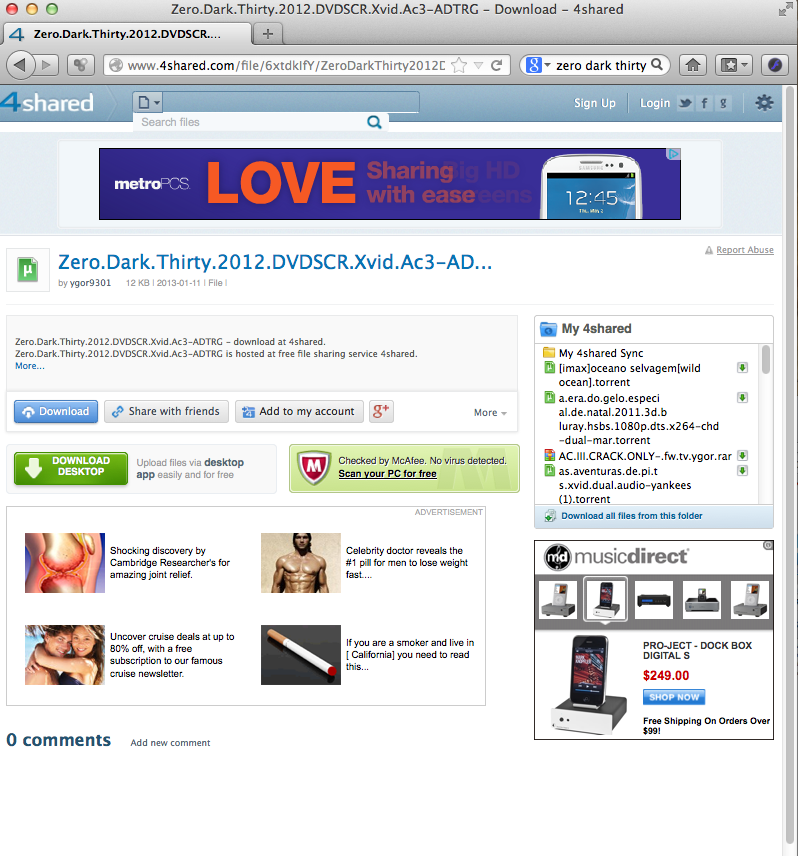
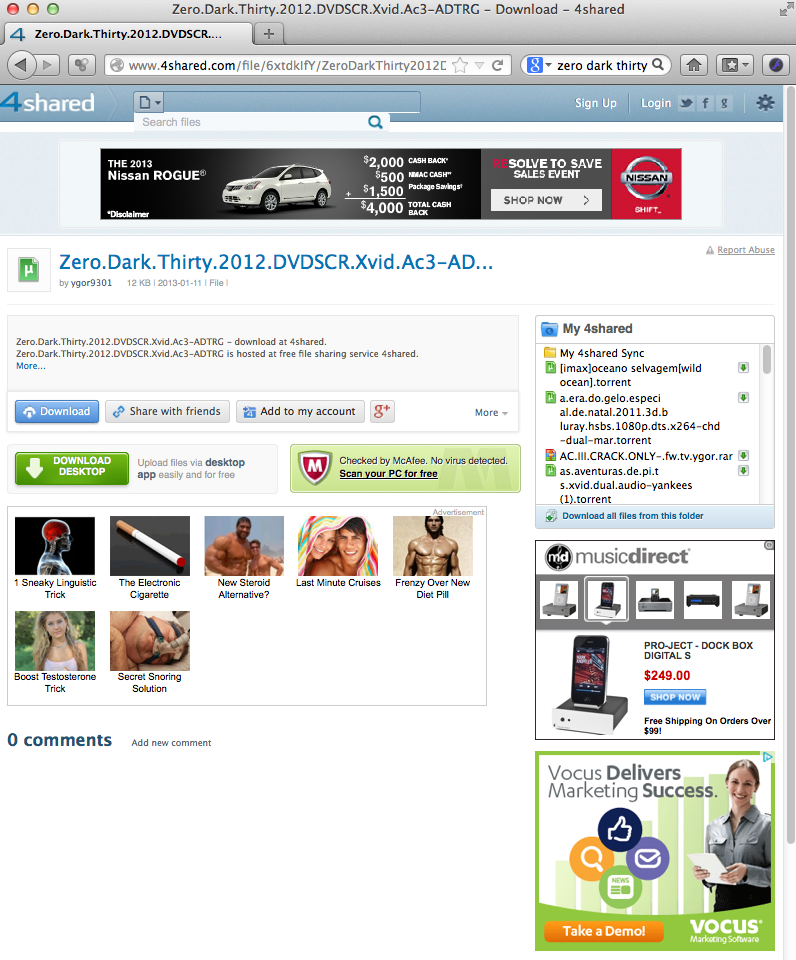
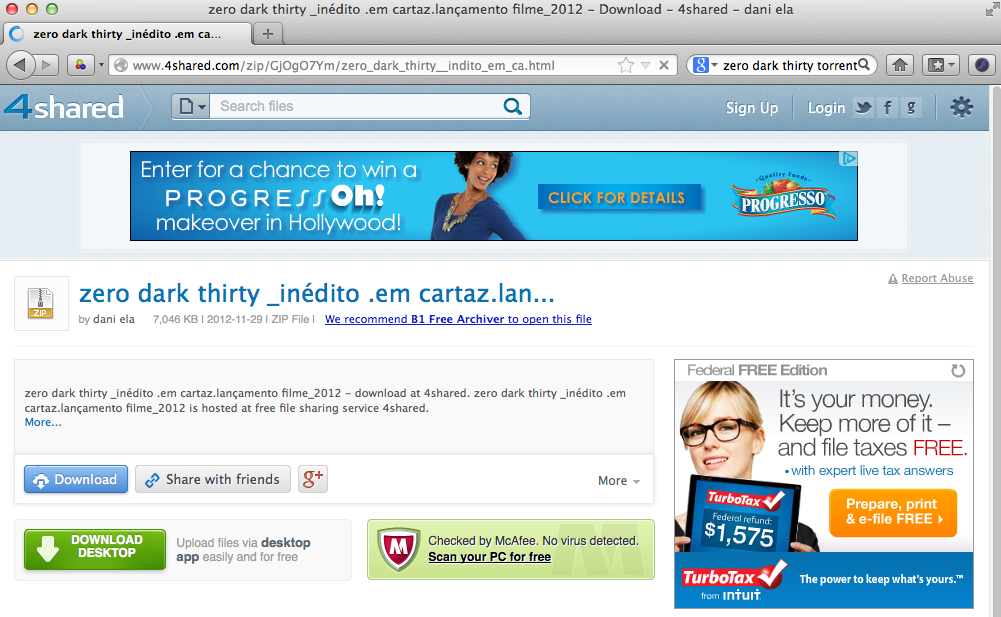
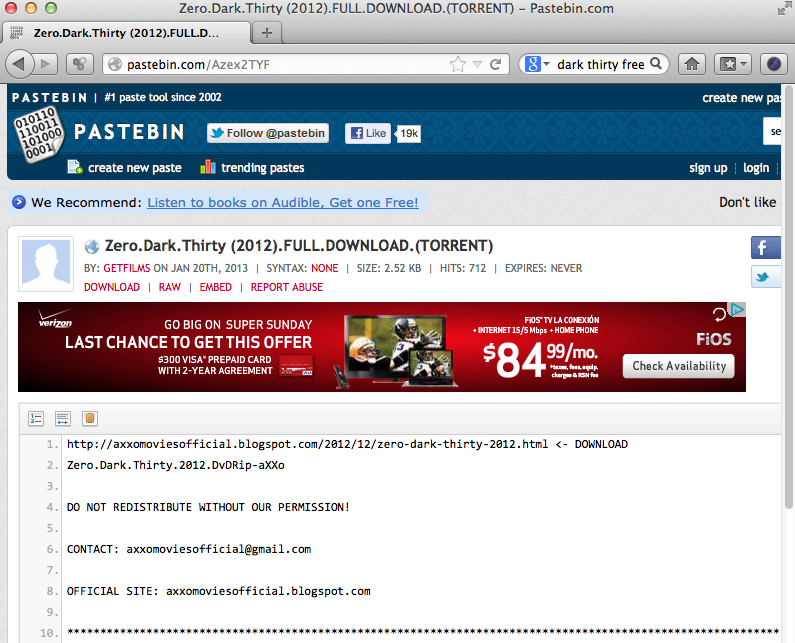
Zero Dark Thirty, Best Picture Academy Award Nominee, Exploited by AT&T, Verizon, MetroPCS, Nissan, H&R Block, British Airways, Progresso, and more…

We spend most of our time here focused on artists rights as it applies to music and musicians. But we wanted to see if the film industry was having the same challenges as music. We believe in the rights of all creators to consent and compensation for their work (ethical internet principles numbers two and four, respectively).

With the upcoming Academy Awards we wondered if it would be possible to find pirated versions of Zero Dark Thirty. It is  the most talked about film of the year which is nominated for five Academy Awards including Best Picture. But it could easily be any of the other nominated films, in any of the categories as well. We just picked Zero Dark Thirty. It’s also been widely reported that most of the nominated films have already been pirated and are online.

We were also curious what major brands might be supporting that piracy, and if any of those same brands might have advertising that appears on the broadcast of  The Academy Awards show itself. We would hope the Academy Of Motion Picture Arts and Sciences would be able to educate the various brands, advertising agencies and online ad networks about the damage they are doing to the creative community.

What makes this even more frustrating in the case of Zero Dark Thirty is that the film is not even out of theaters yet. At least with music, it is usually (usually…) commercially available before it is pirated.

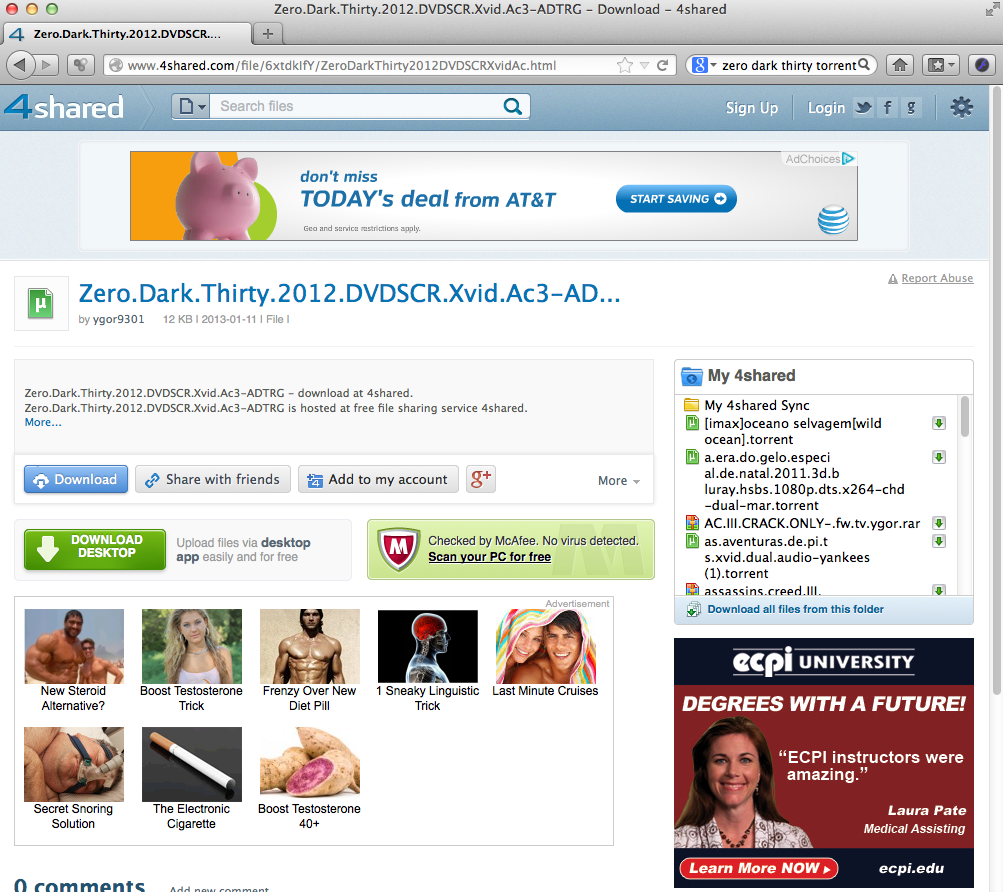
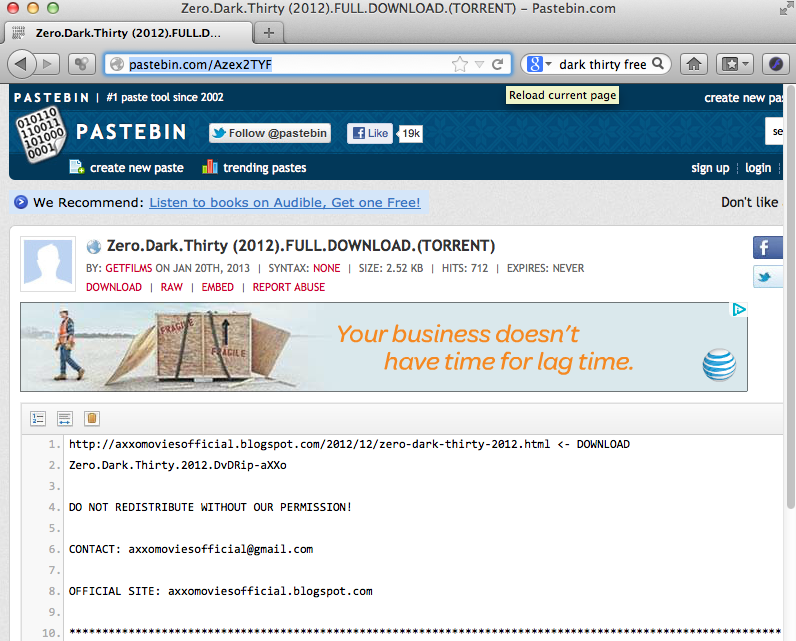
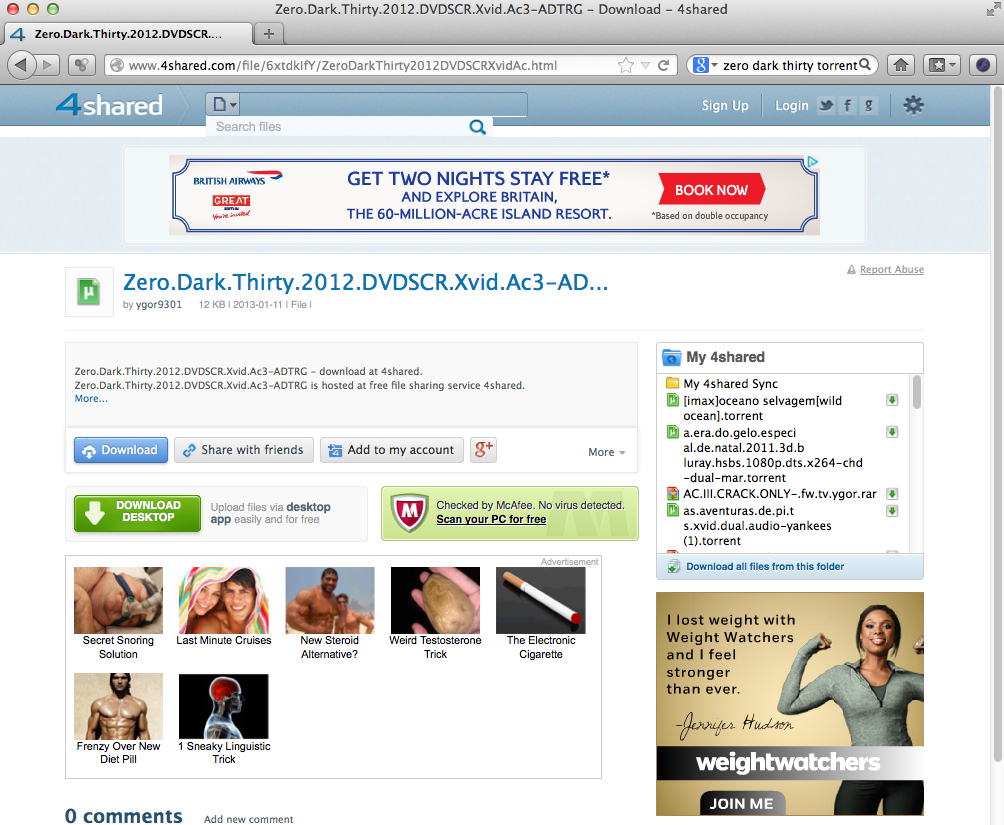
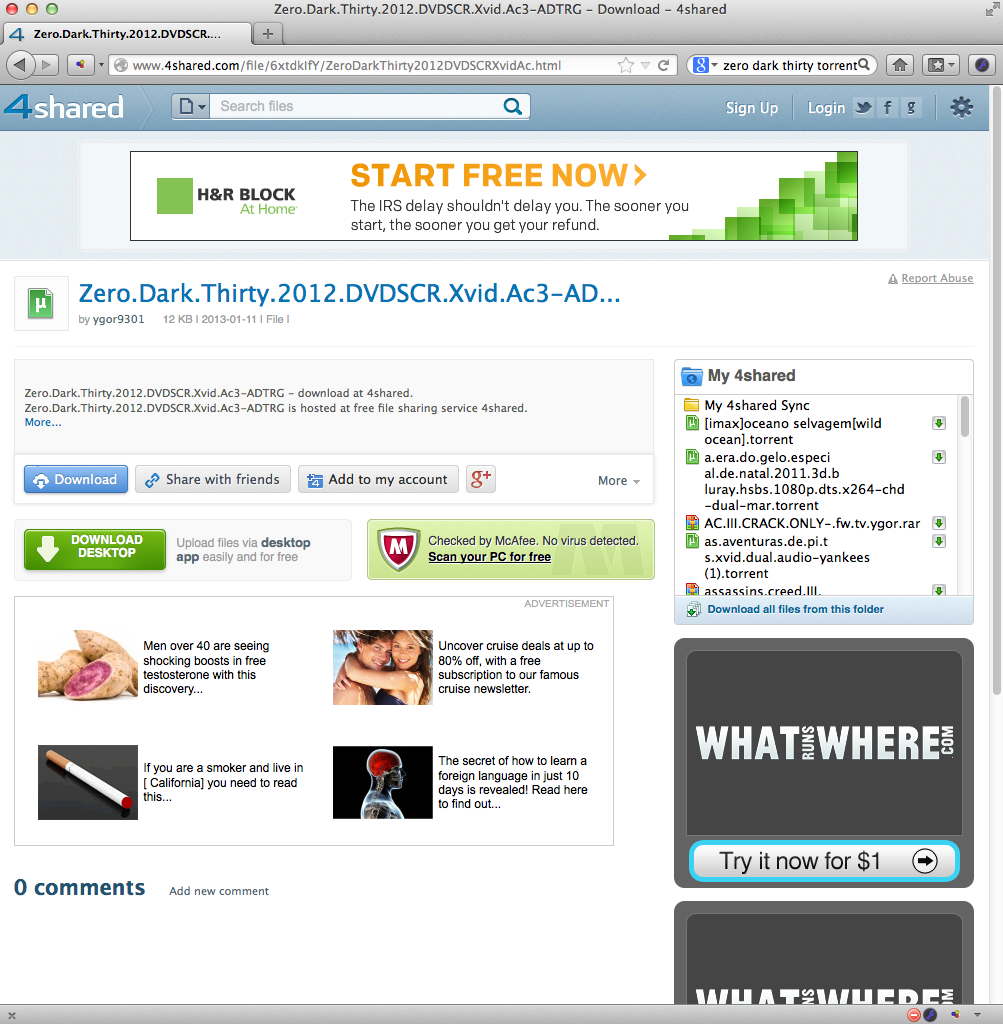
Here’s what we found within a few minutes, on just two sites…

* AT&T on 4Shared
* AT&T on Pastebin
* British Airways on 4Shared
* H&R Block on 4Shared
* MetroPCS on 4Shared
* Nissan on 4Shared
* Progresso on 4Shared
* Turbo Tax on 4Shared
* Verizon on Pastebin

ZDT_ATTT

ZDT_Pastebin

ZDT_BAZDT_H&RBlockZDT_metroPCSZDT_NIssanZDT_ProgressoTTZDT_Verizon

That’s just a couple sites to download the movie for free. What’s more common amongst film piracy are the faux subscription services that charge annual membership fee’s to stream all of their pirated movies (so much for information wants to be free, but movie want to be paid for…).

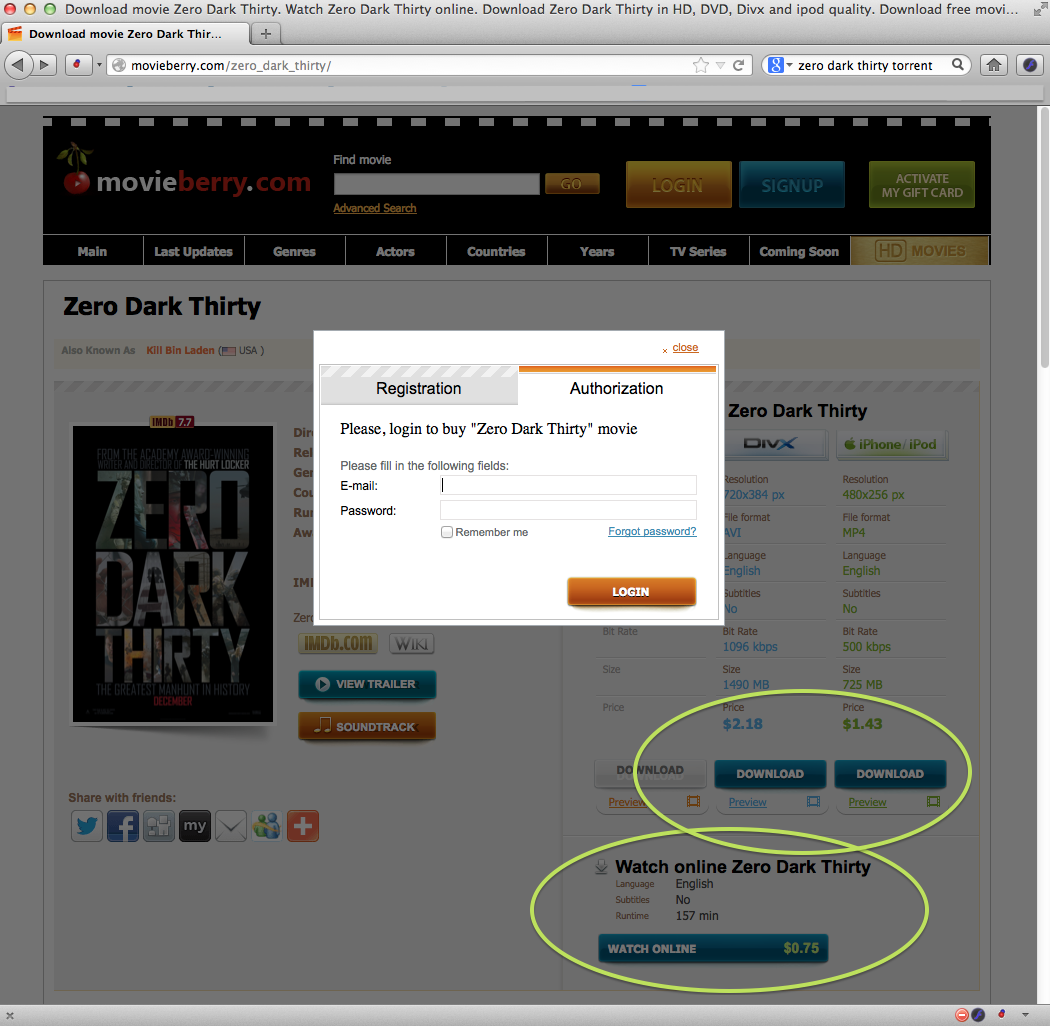
Here’s just one example where you can pay on a transactional basis of $.75 to stream the film or between $1.43 or $2.18 to download the film of varying quality.

ZDT_movieberry

So much for “Free Culture.” As it turns out there’s probably very little online piracy happening without money changing hands somewhere in the value chain. The money may be in advertising, or it may be in transactional or subscription fees, but one thing is for sure, people are getting paid and not paying the creators.

In the case of the above, and as we also asked did MegaVideo Charge for Streaming Movies the problem here is to address those processing payments such as American Express, Visa, Master Card and the various other banks such as Citi Bank and Wells Fargo (whom have also been seen advertising on pirate sites). At least PayPal is taking responsibility and denying service to pirate sites. That thanks largely to the good work being done by StopFileLockers.

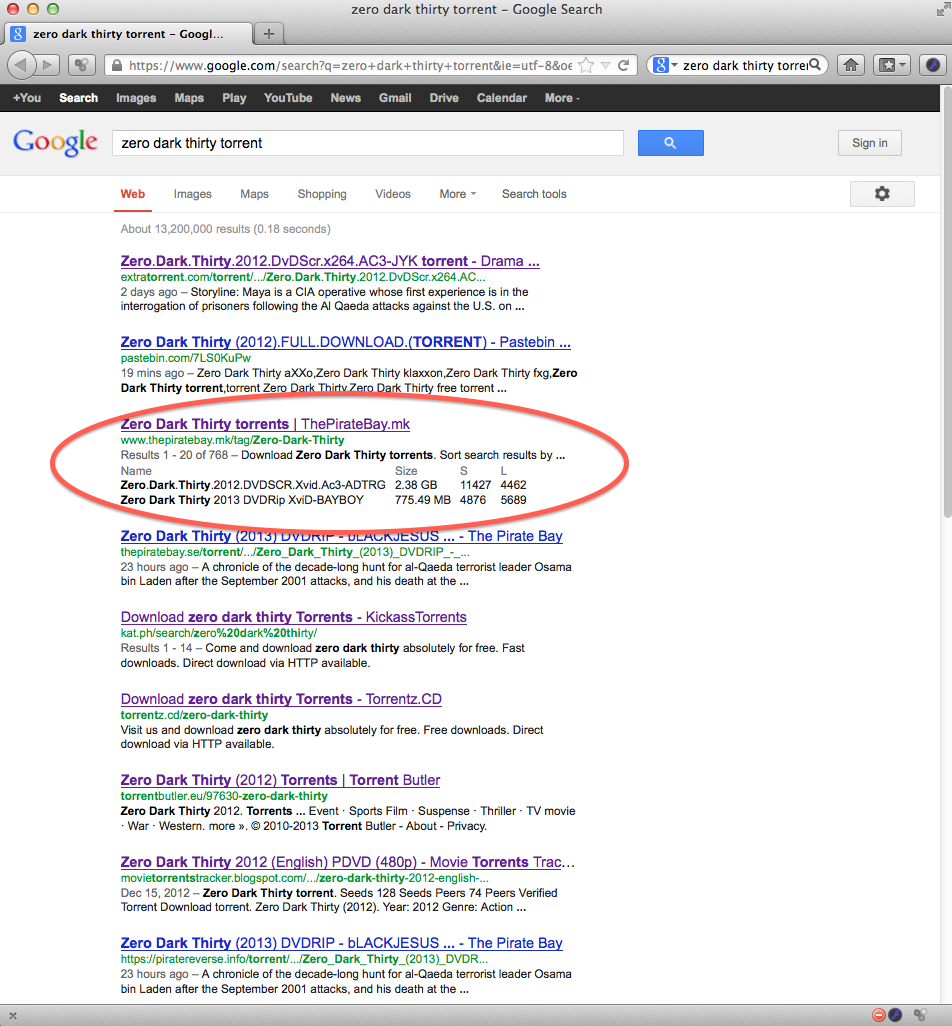
We found a couple of things of interest as well regarding Google’s search. Despite there being (we’re guessing conservatively) literally thousands of DMCA notices to remove the film from search, The Pirate Bay still ranks #3 on the first page of search results! Surely Google as well as everyone else in the world knows the site was found guilty and it’s founders sent to jail. Yet Google has not delisted the site from search in it’s entirety which would be the right thing to do, knowing that the judgement against The Pirate Bay was upheld even by the Supreme Court of Sweden.

ZDT_GoogleSearch

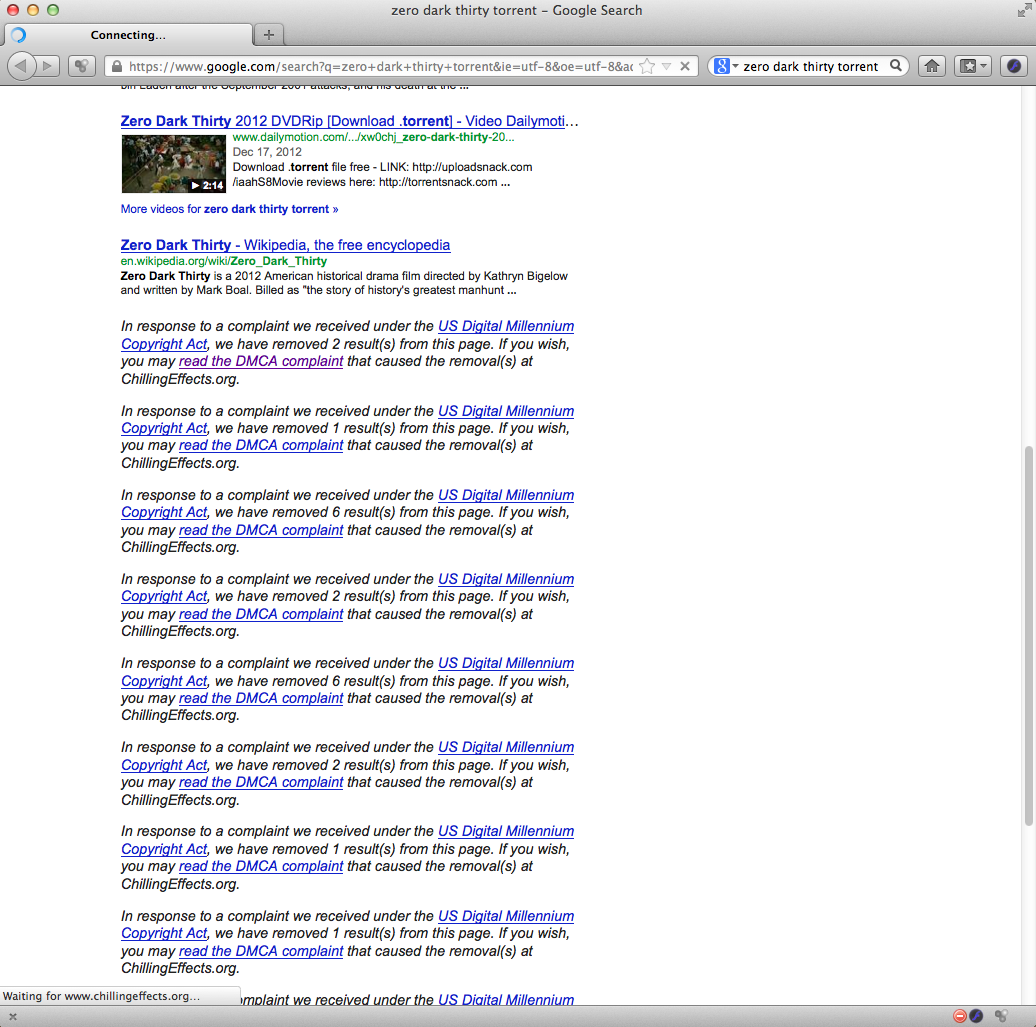
Of course a quick scroll down the page and the delisted link removal notices start to appear as follows:

In response to a complaint we received under the US Digital Millennium Copyright Act, we have removed 1 result(s) from this page. If you wish, you may read the DMCA complaint that caused the removal(s) at ChillingEffects.org.

ZDT_DMCA_GoogleCjill

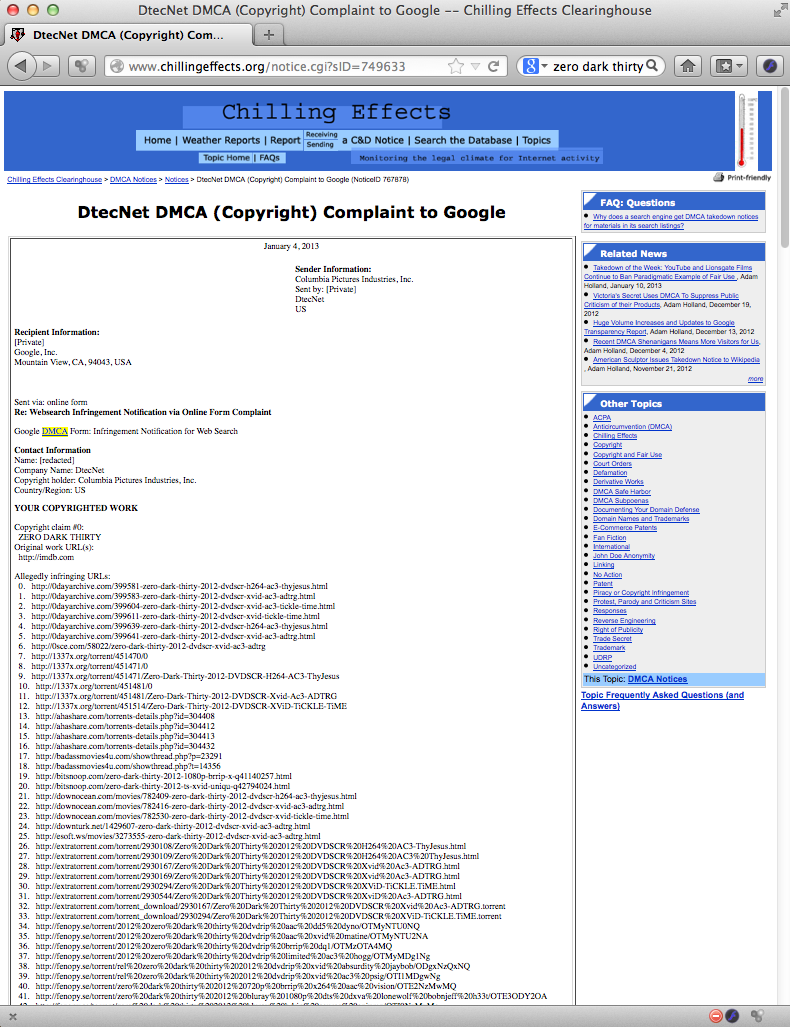
Now why exactly is there a need, once a link has been delisted to post a notice to a site that then shows that very same link that had been lawfully delisted from Google search by the DMCA? In the screen shot below are shown just the first forty delisted links, but on that one notice alone there are over three hundred delisted links to pirated copies of Zero Dark Thirty in one way or another.

ZDT_CEpg1

Make no mistake about it, every one of those previously delisted links is still active on the servers where it originated and it can simply be copied and pasted back into any web browser.

Further more, these links have been delisted due to the fact that most if not all of these infringing sites are not based in the United States and do not conform to United States law and therefore do not comply with the DMCA itself.

Is this all just a cat and mouse game for Google to profit from piracy? Draw your own conclusions.

Insightful analysis from Music Tech Policy on today’s New York Times Story “Playing Whac-a-Mole With Piracy Sites

Music Technology Policy

As some of you may know, I again will be moderating the Global Forum at Canadian Music Week this year.  They keynote speakers I will introduce will be Chris Ruen, author of Freeloading: How our insatiable hunger for free content starves creativity, and David Lowery, the founder of Cracker and Camper Van Beethovan and editor of The Trichordist.  The topic of the keynotes as well as the famous structured table discussions among the 200+ worldwide industry leaders will be brand sponsored piracy.

The New York Times coverage today of how brands sponsor piracy is timely, largely on target and will provide us with further supporting documentation for answering what I perceive to be one of the central questions in the corrupt “unholy alliance” among brands, ad agencies, ad networks, search engines and thieves:

If the brands don’t stop funneling money to sites they know are unauthorized, should artists…

View original post 1,443 more words