20 Questions: An artist’s checklist for an NFT pitch

By Chris Castle

[This post first appeared on MusicTechPolicy.]

If you’ve been pitched to lend your name to an NFT platform or promotion, or if you are an NFT promoter who wants to attract artists to your program, there are some issues that should get addressed. Obviously, discuss all this with your lawyers since this isn’t legal advice, but the following are some issues that you may want to consider before you commit to anything.

As NFTs are priced in cryptocurrencies, a word about that. You should understand that cryptocurrencies use a huge amount of energy due to “mining” (See the Cambridge University bitcoin energy consumption index) and the current spike in the cost of energy is going to have an effect. Also realize that when someone tells you that an crypto enterprise is “green” you have to ask them what they mean exactly–for example, Google tells you that their data centers are “green” because they buy carbon offsets or use hydroelectric power from Oregon or wind farms in Nebraska (just ask Senators Ron Wyden and Ben Sasse), but that doesn’t mean that it doesn’t still take enough electricity to power Cincinnati in order to operate YouTube. There are no magic elves on golden flywheels producing electricity as if by magic. They still plug into the wall like everyone else.

1.  What artist rights are being granted and to whom?

2.  Does grant of rights match the project summary and are license agreement, smart contract, marketplace/auction TOS and cryptocurrency rules all consistent?  Has a subject matter expert been engaged to produce a report stating and certifying that the smart contract code implements the actual deal or needs to be revised?

3.  What royalty is paid and to whom and when?  Does artist, previous owner or charity participate in resale revenue after initial sale? Are any state or federal relevant tax rules implicated? What have you done to keep NFT revenue as far away from MLC as possible? (Remember that Etherium vehicle Consensys is somehow involved with the MLC.)

4.  Are there exploitation or marketing restrictions on the NFT that would prevent the NFT and artist name being used in ways that are offensive to the artist, at least during the artist’s lifetime? Could heirs enforce these rights?

5. Are there any third party payments involved like producer payments, production company overrides, or any third party rights involved, re-recording restrictions. Will any letter of direction be required, e.g., for producers?

6. Are you being asked to clear publishing? If someone is telling you that they have cleared publishing, has the publisher confirmed the license and are individual songwriters actually receiving a share of revenue? The tendency is that the major publishers “settle” these kinds of cases for a lump sum and prospective royalty, which may or may not be received by individual songwriters after multiple commissions being siphoned off the top.

7.  When does NFT terminate?  (On resale, transfer by owner, term of years)

8.  What is the governing law and venue?  (And how to enforce)

9.  Who maintains the blockchain and who is responsible for policing it? What happens if they fail to do so? (See my post with Alan Graham on this subject.)

10.  Is artist asked to make representations, warranties and indemnity?  Can the artist make such reps and warranties?

11.  Is indemnity capped?  

12.  Are there any active disputes among anyone in the chain on the NFT promoters’ side? (“Disputes” is any disagreements, including, but not limited to, litigation or threatened litigation.) Who will cover artist’s costs of defense?

13.  Is there insurance on chain of title, failure to enforce the smart contract, nonpayment, business risk?

14.  Can license agreement or smart contract be revised unilaterally?

15.  Is the NFT or NFT collection comprised of “generative art” or artwork created by machines, algorithms, artificial intelligence, and related technologies (i.e., potentially not capable of copyright protection)? What are implications for name and likeness rights.

16.  What assurances have been given to identify purchasers of NFTs to enforce terms or prosecute breaches for first or subsequent sales?

17.  Are any union rules implicated (e.g., SAG-AFTRA Basic Agreement Par. 22A)?  See my post on NFT union payments.

18. Is NFT or any NFT cash flows implicated in any sanctions placed on persons related to the Russian Federation? Given the strong reaction to Russia’s invasion of Ukraine, consider any implications if China were to invade Taiwan and similar actions were taken against China or China-based companies.

19.  Has NFT seller or marketplace obtained legal opinion regarding whether the NFT constitutes a “security” that would require sale by a registered securities broker-dealer or other regulatory oversight?

20. Are any state securities laws, tax laws or regulations, or “doing business” laws implicated or reporting obligations triggered?

Each NFT raises its own questions, so this checklist is just a starting point.  

@MartinChilton: ‘He made sure that she got nothing’: The sad story of Astrud Gilberto, the face of bossa nova — Artist Rights Watch

[Editor Charlie sez: When you read this cautionary tale for artists, remember that like so many other artists we look up to, Astrud never got a penny from radio performances of her records in the US which would have given her a direct payment outside of her recording agreement through SoundExchange.]

“The Girl from Ipanema” was one of the seminal songs of the 1960s. It sold more than five million copies worldwide, popularised bossa nova music around the world and made a superstar of the Brazilian singer Astrud Gilberto, who was only 22 when she recorded the track on 18 March 1963.

Yet what should be an uplifting story – celebrating a singer making an extraordinary mark in her first professional engagement – became a sorry tale of how a shy young woman was exploited, manipulated and left broken by a male-dominated music industry full, as she put it, of “wolves posing as sheep”.

Read the post on The Independent

Daniel Ek’s Edifice Complex: Millions for tribute, but not one red cent for royalties as Spotify buys naming rights to biggest football stadium in Europe — Artist Rights Watch

By Chris Castle

If screwups were Easter eggs, Daniel Ek would be the Easter bunny. Right in the middle of Spotify’s crashing stock price, billion-dollar stock buy backs, shenanigans at the Copyright Royalty Board (which grows more chaotic by the day), the Joe Rogan controversy, and an investigation by the UK competition authorities after an investigation by the Digital Culture Media and Sport Committee of the UK House of Commons, here’s another Easter egg that Little Danny missed.

According to Marca, the sport site based in Spain, Ek is soothing his (so far) failed bid to buy the UK football club Arsenal by acquiring the naming rights to Barcelona FC’s super-stadium, Camp Nou, the largest football stadium in Europe.  According to Marca:

Sponsorship seems to be the way in which Laporta hopes to get the Blaugrana out of the red and into the black.

An agreement with music streaming platform Spotify, which is expected to be confirmed imminently, will see the club receive 225 million euros.

In turn, Spotify will sponsor the men and women’s shirts as well as their training wear. Furthermore, Spotify will have the rights to the stadium for the next three seasons- which has received mixed reviews from fans of the club.

Barcelona expect annual income of 20 million euros from Spotify to sponsor the Camp Nou, which is estimated to be more than Manchester City‘s deal with Etihad – who sponsor their stadium for 15 million euros per season.

That’s right–not one red cent for artists (or songwriters) but millions for tribute. And how did this deal come about do you think? Well, realize that Barcelona is also shopping for a rather large loan to renovate the Camp Nou stadium and they turned to…Goldman Sachs, which happens to be one of Spotify’s investment bankers. So which came first? 

Does Goldman think there’s anything unethical about a company that screws creators all the livelong day but spends hundreds of millions on naming a soccer stadium after itself? (OK, I got that out with a straight face, but you can laugh now.) Evidently not, because in the catechism of Goldman, you stop at the fees novena.

And speaking of fees, what is the source of funds for Daniel Ek’s latest self-aggrandizement or whatever you call it? Perhaps a loan from Goldman before interest rates spike this year if the Federal Reserve really does say goodbye to the easy money era that has bubbled up assets around the world?

@sealeinthedeal: Why Did Spotify Reduce Its Black Box Royalty Transfer to the MLC by Nearly $2.3 million?

By Gwendolyn Seale

Remember the $424 million in historical unmatched royalties (also referred to as black box royalties) delivered to the Mechanical Licensing Collective (MLC) by the streaming services last February that songwriters are waiting to receive?

As a refresher, the Music Modernization Act (MMA) required the streaming services to estimate these “historical” black box royalties going back years, and then pay whatever they came up with to the MLC by February 15, 2021.  Why did the services pay this “historical” black box?  Because songwriters gave them a safe harbor in the MMA to enjoy a limitation of liability from statutory damages for the services’ prior acts of copyright infringement—services like Spotify, which was being sued into oblivion.

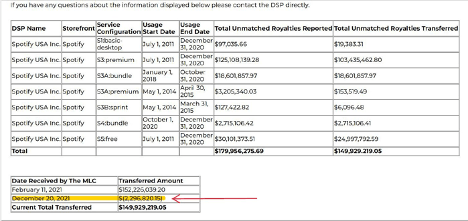
Now here’s the jawdropper. What if I told you that Spotify inexplicably reduced its portion of these historical unmatched royalties by nearly $2.3 million?

According to the MLC, on December 20, 2021 Spotify decreased its transfer of historical unmatched royalties by $2,296,820.15. You can find this information by visiting the MLC’s website here: https://www.themlc.com/spotify-usa-inc-spotify. You may wonder why this occurred. Unfortunately, I cannot provide you with any concrete answers, but I do think it is a more than fair question to raise.

Following the February 2021 data dump and transfer of the historical unmatched royalties to the MLC, the streaming services were given until June (in accordance with the regs) to provide the MLC with their second sets of data. According to the MLC’s Interim Annual Report (https://themlc.com/sites/default/files/2021-12/The%20MLC%20Interim%20AR21%20Hi-res%20FINAL.pdf) “[t]his second set of data contained information regarding works for which DSPs had previously paid some, but not all, of the relevant rightsholders for a given work.” The streaming services then had the right over the summer to amend or adjust the royalties and data provided to the MLC.

It is interesting to compare the historical unmatched royalties transferred by each streaming service in February 2021 with the final transfer amounts reported in summer 2021 — and I invite all of you to do the same (https://www.themlc.com/historical-unmatched-royalties ). What you will quickly realize is that the final transfer amounts for every service—other than Spotify, the Harry Fox Agency’s client, either reflected the same totals from the February dump, or, resulted in a higher amount transferred (like in the cases of Amazon, Apple and Google). At least so far.

You may be thinking, how do we know if this nearly $2.3 million reduction is accurate? Frankly, we do not know, and we forced to trust that Spotify is telling the truth. Regrettably, the MMA negotiators did not get (and may not have asked for) an audit right for songwriters or for the MLC with respect to these historical unmatched royalties. (Although it must be said that publishers with direct deals very likely had the right to audit, and possibly those who licensed to Spotify through Spotify’s licensing agent, the Harry Fox Agency, which was simultaneously acting as a licensors’ publishing administrator may have had an audit right. Have a pretzel and the conflicts make more sense).

I recognize I have the benefit of hindsight here — notwithstanding, I find it unfathomable that the MMA dealmakers did not secure an audit right in connection with what was sure to be hundreds of millions of dollars in unmatched royalties.

It is theoretically possible that Spotify overpaid its amount in historical unmatched royalties back in February 2021. Notwithstanding, and feel free to call me a cynic —  how am I to believe that for once Spotify actually made an overpayment in royalties?

How can I trust a company which amassed its billions in wealth by stealing musicians’ works, and has continued to supplement its wealth by fighting for the lowest mechanical royalty rates for songwriters ever?

How can I trust a company that unveiled a payola-like feature offering further reduced nanopenny rates to artists in exchange for “promotion?” (see “Discovery Mode”: https://www.rollingstone.com/pro/music-biz-commentary/spotify-payola-artist-rights-alliance-1170544/ ).

How can I trust a company that when faced with reasonable requests about paying musicians fairly, responded with a straight up gaslighting campaign?  (see “Loud & Clear” campaign: https://loudandclear.byspotify.com/ )

Remember, this is the company whose executive literally told an independent artist the following in a public forum:

“The problem is this: Spotify was created to solve a problem. The problem was this: piracy and music distribution. The problem was to get artists’ music out there. The problem was not to pay people money.”  (See here: https://www.digitalmusicnews.com/2021/06/29/spotify-executive-entitled-pay-penny-per-stream/)

In sum, how can I trust a company that has proven time and time again from its inception that it has never cared about songwriters and artists? Ultimately, I cannot — which makes it utterly difficult for me to trust that Spotify incorrectly overpaid nearly $2.3 million in historical unmatched royalties to the MLC. Granted, if Spotify made misrepresentations here, it could lose its limitation of liability for those past infringements–after years of litigation. But, without the MLC having the right to audit the historical unmatched amounts, determining whether Spotify’s total transfer is correct is essentially futile.

Awesome.

So, if you happen to contact Spotify this week about removing your catalog or canceling your subscription, consider also asking them to provide evidence that they overpaid the MLC $2,296,820.15 in historical unmatched royalties last February. Maybe if we’re lucky, we’ll get another Loud & Clear gaslighting campaign to post about!

@agraham999 and @musictechpolicy: Forever is a Long Time–thoughts on the state of NFTs

By Alan Graham and Chris Castle

If you’ve followed any of the drama surrounding the NFT music infringement marketplace Hitpiece, you know it has deservedly received a lot of grief—and at least one pretty potent cease and desist letter–for its blatant attempt at profiting from allegedly scraped IP it didn’t own. But the interesting thing is that it actually gives us an opportunity to discuss some of the greater potential challenges surrounding NFTs, and how it may in fact be impossible to live up to their promise. Let’s start by picking apart Hitpiece, and see where we get with this teachable moment.

Blockchains or databases that represent ownership, must have one trait in common to provide value, and that is a consensus mechanic whereby each party that is allowed to write data is known to the system, therefore the data that is written is trusted, and then all copies (or nodes) can commit these changes. Ta-da.  There is an inherent logic to the consenus mechanic.  It’s what Shawn Fanning’s SNOCAP accomplished with its registry in sharp contrast to the Wild West of p2p and essentially lies at the heart of Hernando de Soto’s extensive work in macroeconomics.  Good things can happen when people trust the system.

It’s also the starting point of what went wrong at Hitpiece.  Instead of using a blockchain solution like Ethereum, we’re told Hitpiece operates some kind of a “private blockchain.”

So what does that actually mean? It should suggest a distributed ledger, hosted by multiple separate parties to keep everyone honest, with a method of cryptographic consensus (who can write data, how are they known to the system, how is it trusted).  Remember, the definition of “good faith” is “honesty in fact” and it is an essential condition of contracts, all contracts be they smart or just human

The novel bit Hitpiece was doing, from what we can read, is that they were using regular credit card payments, not crypto, to allow collectors to mint/purchase the NFTs, which is actually very clever. Seriously, there’s no reason you have to use a cryptocurrency to pay for something, if you are in fact also hosting the blockchain/database. A private blockchain doesn’t need a cryptocurrency, it just needs trusted parties, and there’s the rub. Cryptocurrency is a sufficient condition of a successful NFT platform, but a trusted consensus mechanic is a necessary condition.

Now while we could go on and on picking apart many of the flaws in the Hitpiece model, it opens up a broader discussion that we’d like to have as to how NFTs plan to offer their grand promised future of benefits and entitlements (buy my NFT and get xyz). Whenever you challenge someone in the crypto space about how they plan to handle this, they simply say “smart contracts”, when what they really mean is, “I have no idea how/if this is going to work”.

Terms of Service

First, in order to have a product or service that you sell or provide online, there has to be a series of terms as to what is being purchased, who is paid each successive purchase price, what is being provided to the purchaser, and for how long. That means, in the case of a platform that allows creators to mint/sell/auction NFTs, the party that is minting/selling the NFT has to provide a Terms of Service as to what can be expected, not the platform. The platform is simply a service provider. It’s buyer beware, because the seller doesn’t necessarily have any technical solutions for supporting future benefits.  It’s also seller beware because if the initial seller specifies terms for the sale (and subsequent sales), there ought to be a believable and efficient way to enforce those future rights and post-sale conditions.

So if you are a creator promising this, you need to spell out what those might be, the term of that relationship, and be damn sure you can deliver on it. Likewise, if you are a creator being promised something will happen after the initial sale, you have to believe that your rights can be enforced in an efficient way (like the future sale can’t close without X being the case or $Y being paid to you).  This is a concern for both featured and nonfeatured recording artists (as well as union signatory record companies with collective bargaining obligations), plus co-writers of songs and their publishers.

To pluck two examples from the headlines on The Trichordist, Neil Young might want to place conditions on future NFT sales that have nothing to do with money;  elderly songwriters might want to be assured of a stream of future income from NFT sales that they can ill-afford to sue over.  This is not hard—it happens with real estate every day of the week in practically every country of the world (and was at the heart of Hernando de Soto’s “Peruvian miracle” that started with land reform).  If you don’t meet the sale conditions, you don’t close on the property and the title company won’t take money from the buyer or pay it to the seller.

Perhaps this is especially true of collectibles where resales may be part of the buying motivation.  (See for example, the pending lawsuit over the Quantum NFT against Kevin McCoy and Sotheby’s regarding the Namecoin blockchain that is for “slander of title” among other things—a real estate concept.)  The expectation most buyers will have is that the thing in question will live in perpetuity. For example, If you purchase a physical painting, you have the expectation of enjoying that painting as long as you possess it.

But what are your expectations regarding the NFT? This entire subject seems to be heavy on promises of future benefits and entitlements, but lacks any hard explanations of how that’s possible and for how long. That puts creators and collectors at great risk, because there’s no guarantee of being able to deliver on that promise—until there is. Technology practically assures us that whatever you buy today, will not necessarily work 10 years from now.  How’s that WordPerfect program working out for you?

Technical Challenges

The second issue we never see talked about derives from the first. It seems common for promoters to promise benefits/entitlements in the future from owning NFTs, but how? Where’s the mechanic that makes this possible? Simply saying “smart contracts” is just procrastinating and hoping something will exist later. In order to provide a series of benefits, like exclusives, you have to also provide a structure to interpret these, and we’re dealing with potentially thousands of intermediaries, and millions/billions of NFTs. We don’t have any idea how anyone expects this to work with the existing NFT model.

Say you want to provide exclusive first access to concert tickets to anyone who has a particular NFT. The ticketing site or agency has to be able to recognize this NFT and be able to trust it. One way to do this is they can run native code that runs independently on the site that can say, “I know this collectible” by being able to recognize who cryptographically signed something with a known set of keys. Or they could run an embed from a third party that did the same thing. The most secure way to do any of this is likely having more than one party sign the NFT to prove it is real, but not really something trustless blockchain folks like.

The ability to trust the NFT sale and automatically enforce the terms of each sale is vital for creator-driven NFTs.  If a creator places marketing restrictions on how the NFT can be used downstream, there ought to be a way to enforce those restrictions.  Recording artists and songwriters commonly have such restrictions in their artist or songwriter agreements with record companies or music publishers.  They have approval rights over how their works are used and they have blanket prohibitions.  Approval rights means they are asked before a license is granted by their label or publisher and they can sue if that fails to happen.  A blanket prohibition could, for example, prohibit the use of the work in a commercial promoting a product, say firearms, that the artist or songwriter doesn’t agree with, or a country whose laws the creator rejects, say Beastie Boys with China over Tibet, or a platform that distributes a podcaster the creator doesn’t want to be associated with.

The punchline there is why would a creator take, or allow their label or publisher to grant, lesser rights in an NFT than the creator has for the same work outside the NFT?

You Can Check Out Any Time You Like

Then we get into talking about serious security implications, as NFTs might have both a monetary value, and a potential “smart contract” that remunerates/rewards the purchaser, and has an ancillary connection to the collector’s wallet. Any compromise in this chain and you could not only put one creator or collector at risk, they could all be at risk including the seller (All apes, everywhere, stolen). A single errant smart contract or malicious developer, could put creators or downstream sellers at serious legal risk because they exposed the collector’s wallet to compromise. That means you’ll want to see that every NFT marketplace has serious security experience and precautions, but also as a collector, you’ll want to know that everything you purchase has an audit trail whereby you can verify the NFT is authentic and each link in the chain can be trusted.

That’s a whole lot of magical hand waving.  And title insurance or the equivalent.

In any case, not only does someone need to build, service, and maintain this, but also has to maintain it forever, and it can never fail.

And forever is a long time.

HITPIECE NFT RIPOFF: What you need to know and what can you do about it.

By now you’ve probably heard of the website HitPiece.com and their outrageous scheme to mint “NFTs” of virtually every song and album in existence. If you have not I suggest you read a pair of excellent articles by Kristin Robinson at Billboard Pro. Here and here.

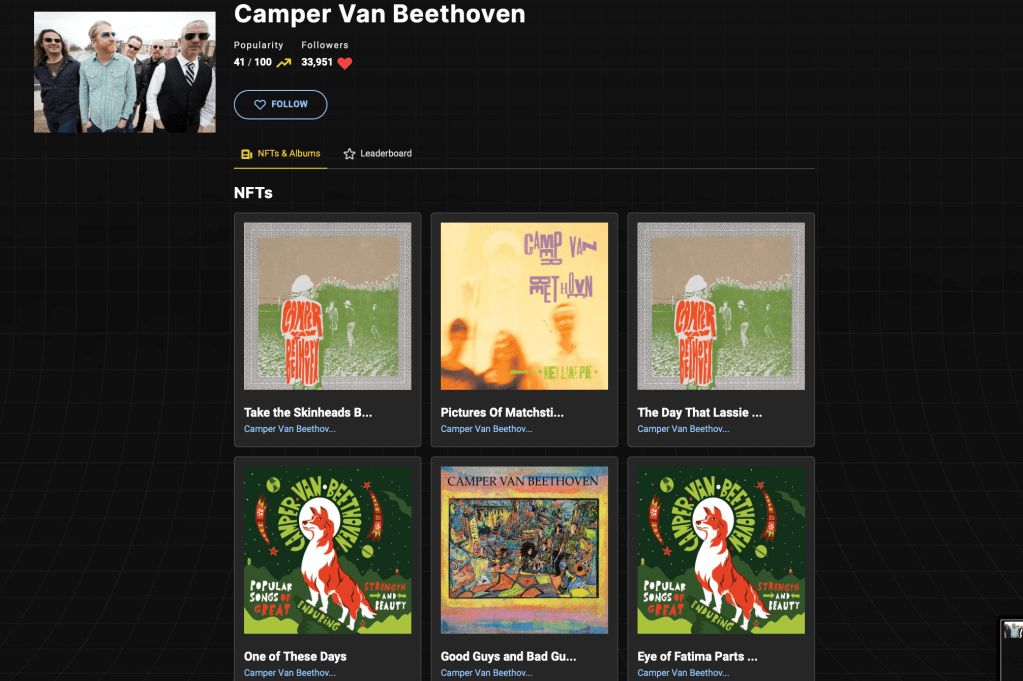
Founded by serial entrepreneur Rory Felton and investor Jeff Burningham, Hitpiece’s intent was to create NFTs of “every song,” according to the company’s pitch deck. Using Spotify’s API to gather information on artists of all sizes – from developing acts to Beatles members – HitPiece uploaded listings of NFTs from musicians it had never spoken to or partnered with, stating these non-fungible tokens were “available for auction” or “live” auctions. According to HitPiece’s FAQ section, the NFTs were said to operate on HitChain, a private Ethereum side chain which does not provide proof of work.”

If you are not even sure what an NFT is think of it as a sort of cryptocurrency like Bitcoin. But there is only one unique token. And this token can be associated with another digital asset, like a digital drawing, photograph, song or tweet. The issue is anyone can do this. Whether they have the rights to the associated file or piece of intellectual property. And that’s exactly where the problem starts.

On Feb 1st my twitter feed began to fill with outraged artists reporting that a website HitPiece.com was offering “NFTs” of their songs. I went and checked and sure enough the website was offering NFTs of virtually every one of my songs and recordings. Now I hadn’t authorized anyone to make NFTs of my songs and recordings and offer them to the public. Nor had I licensed anyone to use my album artwork, trademark, name, likeness or image to use on any products and especially not NFTs. I checked with my former labels on the outside chance they had licensed something but as I suspected they had not. And indeed even recordings which I exclusively hold the rights were on HitPiece.com.

I dug around on the site to see if I could figure out what was going on. Here I found the above paragraph. “Each HitPiece NFT is a One for One NFT for each unique song sound recording.” That sounds like they had minted or intended to mint a NFT of each one of my songs/sound recordings. Without any sort of authorization.

I even found a live auction of one of our tracks. Curiously it is an unreleased/unlicensed live radio broadcast that recently showed up on Spotify. From this I could confirm what I suspected: HitPiece was “scraping” Spotify to auto generate NFTs for every song on the platform. In addition they were sucking in promo photos and album art.

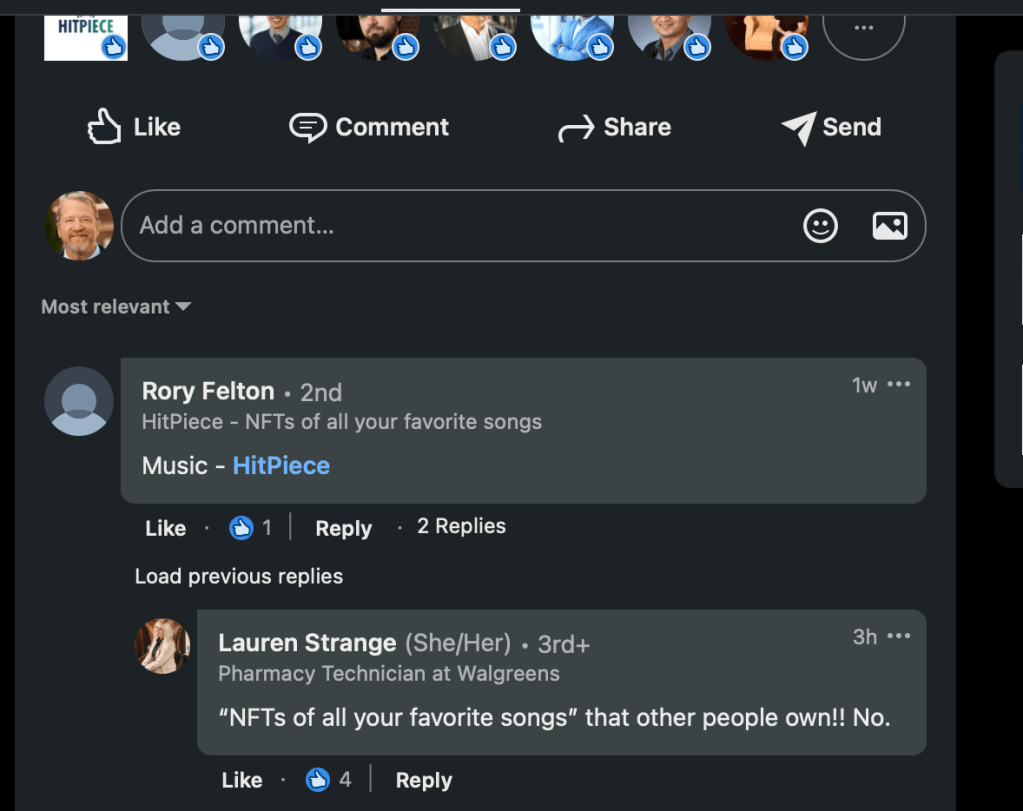
It appeared as if there were hundreds if not thousands of similarly situated artists, as when I went back on social media every artist I follow was posting screenshots of HitPiece NFTs. All of the artists noted (often in profane terms) that they had not authorized HitPiece to offer NFTs to the public. It became a true twitter shitstorm. By the end even civilians on LinkedIn were getting into the act (see above.)

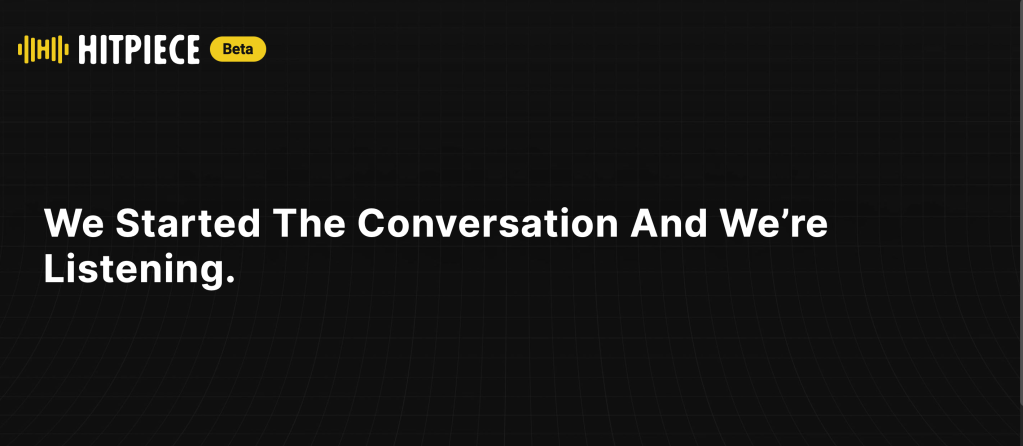
Late that evening the operators of the website, took the website down, or it crashed under the crush of traffic. They later put the website back up with the above note (minus the NFT offerings).

By Friday numerous artists had sent “cease and desist” letters, others were promising lawsuits and even the RIAA announced they were taking action on behalf of their artists. The RIAA letter asks HitPiece to preserve all relevant emails and documents, which is usually a prelude to legal action. And indeed the letter makes reference to a number of violations.

“…copyright infringement (17 U.S.C. § 101), trademark infringement (15 U.S.C. § 1114), federal unfair competition and false representation of affiliation (15 U.S.C. § 1125(a)), violations of state and common law rights of publicity, and unfair competition under applicable state law…”

The RIAA also asked HitPiece to permanently close their website and business.

So case closed let’s move on ,right? The big companies with the big lawyers are on the case. No one will ever try this again. Right?

I wouldn’t be so sure. Remember YouTube started out as (and still is) a massive infringer of copyrights. Sure they pay some royalties on some tracks, but at a rate 1/8 to 1/20th that of Apple Music. And now It’s just too big to do anything about it. Do we want the same thing to happen with something like NFTs? The audacity of HitPiece scam is that by promising to mint an NFT of every song they intended to corner the entire market for song NFTs. What if it had worked? We’d have no leverage. We’d be coming hat in hand to them begging for a few pennies like we do with YouTube.

No, the best thing to do is to make an example out of these folks. Bankrupt them. These are not poor hackers living in their parents’ basements. Two are former major label record executives and the other two are wealthy private equity executives (here and here). These folks have A LOT to lose. We should make it so no one ever does business with these folks again. And the best way to do this is not by banding together through the usual copyright class action (although we can do that too), the best way to make their lives miserable is to bury them under a blizzard of individual complaints. Who knows maybe you’ll find a state prosecutor that wants to charge them with a crime. (doesn’t this seem like a criminal fraud?).

Although there is likely a copyright claim if you have registered your artwork, copyright infringement must be adjudicated in federal court. Similarly with Trademark infringement. And over the last two decades congress and the courts have made life pretty easy for anyone infringing copyright and trademark via the internet. The deck is stacked against us. What we really want to do is rely on laws that we can pursue easily in our own states. The RIAA letter helpfully suggests a number of tactics at the state level.

I’m not an attorney and I certainly don’t know the laws in all 50 states, this is just one musician talking about the tactics I intend to investigate and pursue:

Fraud. By any common definition of the term, what HitPiece did was conduct a fraud. The website clearly misleads the public. I didn’t offer my songs up as an NFT for sale. Yet my picture and name is right there. They “palmed off” something as a genuine product that was not. Legally is this fraud? It sure feels like it but I’m not an expert. I intend to complain in person at the local state district attorney’s office.

Rights of publicity. Many states either have a law that recognizes a kind of property right in my own persona. Companies can’t make products or provide a service with my name, likeness or image. If your state doesn’t explicitly provide a statute, it’s likely a state court has recognized a “common law” right. I intend to mention this at the local state district attorney’s office cause it’s a key element of how HitPiece executed their apparent fraud. I may file a separate civil claim against them.

Implied Endorsement. My state may also have a specific law that doesn’t allow others to imply that I endorse their product. Again this is something I will mention at the local state attorney’s office as it’s key to their scheme. I may also file a separate civil claim against them.

Unfair Competition/Deceptive Practices: Most states have these laws. What’s more deceptive and unfair than using my own copyrights,trademarks, name image and likeness to sell a product I didn’t endorse. The principals at HitPiece knew they didn’t have licenses with me. Two had deep experience in the music business managing intellectual property rights They knew what they were doing. Talk to your local state district attorney about this as well.

If hundreds of artists did something similar in dozens of states, we could really make these folks lmiserable.

Now that ‘s just my take as an artist.

Here are some similar suggestions from real attorneys…


More on this later. This is still developing.

@SoundExchange CEO @mikehuppe Nails NAB Hypocrisy on Artist Pay for Radio Play–#IRespectMusic — Artist Rights Watch

The hearing on Groundhog Day (Feb. 2) for the American Music Fairness Act (or “AMFA”) was a fantastic opportunity for artists to be heard on the 100 year free ride the government has given broadcast radio. We know it went well because the National Association of Broadcasters sputtered like they do when they’ve got nothing to say.

But what’s really hysterical was how they talked out of both sides of their mouths in two different hearings–which makes you think that NAB president Curtis LeGeyt was doing his impression of Punxsutawney Phil. Yes, when it came to broadcasters getting paid by Big Tech, the broadcasters wanted their rights respected and to be paid fairly. But when the shoe was on the other foot, not so much. In the Senate, the NAB asked for more money for broadcasters in a hearing for the Journalism Competition and Preservation Act–to protect the mega radio broadcasters from the mega tech oligarchs. And if broadcasters don’t get more money, they want to be exempt from the antitrust laws so they can pull their content. Just like artists do to them…NOT.

Then the NAB comes over to the House Judiciary Committee–on the same day being Groundhog Day–and asks the government to continue their 100 year free ride. We call bullshit.

SoundExchange CEO Mike Huppe nailed this in his Billboard post:

The AMFA witnesses didn’t ask for an antitrust exemption, like the broadcasters did. They simply asked that recording artists be granted similar copyrights as others.

They didn’t ask for more money, like the broadcasters did. They simply asked for at least some payment, since they now receive none when broadcast radio stations air their music.

They didn’t ask for special treatment, like the broadcasters did. Rather they asked that they be treated the same as all other artists around the world, and even the same as artists on virtually all other media platforms in the U.S.

And they didn’t ask for rigts to negotiate and withhold content, like the broadcasters did. Under AMFA, radio stations would still be allowed to play music as they please. Artist advocates simply asked that the biggest-of-the-big stations pay a modest royalty set according to market rates. Stations making less than $1.5 million per year would pay a flat, annual royalty of $500 (less than $1.40 per day) for as much music as they choose to air. And the smallest stations’ payments would drop all the way down to $10.

No station is going to go bankrupt over these royalties.

Huppe has a very strong point here. This legislation has been picked over for years. AMFA bends over backwards to protect community radio and small broadcasters and repects everyone’s contribution to radio’s success.

But that’s the point–it respects everyone‘s contribution.

You can watch the hearing here:

Frozen Mechanicals Crisis: Twelve Songwriter Groups Reject Majors Position that Copyright Royalty Board MUST Ignore Songwriter Objections

Second Comments Submitted by the Songwriters Guild of America, Inc.,  the Society of Composers & Lyricists, Music Creators North America, and the individual music creators Rick Carnes and Ashley Irwin

These Comments Are Endorsed by the Following Music Creator Organizations:

Alliance for Women Film Composers (AWFC). https://theawfc.com

Alliance of Latin American Composers & Authors (AlcaMusica) https://www.alcamusica.org

Asia-Pacific Music Creators Alliance (APMA), https://musiccreatorsap.org/

European Composers and Songwriters Alliance (ECSA), https://composeralliance.org

The Ivors Academy (IVORS), https://ivorsacademy.com

Music Answers (M.A.), https://www.musicanswers.org

Pan-African Composers and Songwriters Alliance (PACSA), http://www.pacsa.org

Screen Composers Guild of Canada (SCGC), https://screencomposers.ca

Songwriters Association of Canada (SAC), http://www.songwriters.ca


Discussion

  1.  The Statutory Importance of Interested, Non-Participant Comments to CRB Decision Making

While Congress may have expressed enthusiasm for joint rate setting proposals being developed through arms-length, independent negotiations among the parties to a CRB rate-setting proceeding (which clearly may not have been what transpired in the present case among vertically integrated parties),[1] Congress was also crystal clear in another of its related statutory directives.  Namely, that the CRB also has a duty to ensure that interested, non-participating parties who would be bound by the terms of the negotiated agreement are given the full opportunity to comment upon the proposal as part of the record of the proceeding prior to the proposal’s adoption or rejection by the CRB. 

Section 801(b)(7)(a)(i) of the US Copyright Act stipulates that:

[T]he Copyright Royalty Judges shall [1] provide to those that would be bound by the terms, rates, or other determination set by any agreement in a proceeding to determine royalty rates an opportunity to comment on the agreement and shall [2] provide to participants in the proceeding under § 803(b)(2) that would be bound by the terms, rates, or other determination set by the agreement an opportunity to comment on the agreement and object to its adoption as a basis for statutory terms and rates.  (Bracketed numbers added for clarity)

More importantly for the purposes of these Comments, Section 801(b)(7)(a)(ii) explicitly sets forth the authority of the CRB to accept or reject the proposed agreements of parties to a proceeding based upon the combination of comments and objections filed both by participants in the proceeding and outside, interested party commenters:

[T]he Copyright Royalty Judges may decline to adopt the agreement as a basis for statutory terms and rates for participants that are not parties to the agreement, if any participant described in clause (i) objects to the agreement and the Copyright Royalty Judges conclude, based on the record before them if one exists, that the agreement does not provide a reasonable basis for setting statutory terms or rates. (emphasis added)

In the present case, the Major Music Conglomerates (once again counterintuitively joined by NSAI) have chosen to simply ignore the statutory requirements, set forth above, and focus solely on issuing a blanket rejection of the comments of pro se participant George Johnson (who formally objected to the proposed agreement).  In fact, in their submission to the CRB of August 10, 2021,[2] the Major Music Conglomerates did not even bother to mention the detailed comments of those many individuals and groups who, on behalf of their constituents comprising a large percentage of the US’ and the world’s music creators, filed detailed comments with the CRB objecting to the proposed frozen mechanical rate deal as unreasonable.  

Rather, the Conglomerates opted instead to stand solely on the following, naked assertion:

Mr. Johnson provides no basis for the Judges to reject the Settlement. Mr. Johnson makes unfounded accusations of fraud and inaccurate statements concerning the corporate structure of record companies, but provides no economic reason to believe that the rates in the Settlement are outside the “zone of reasonableness.” This is nothing more than a rehash of arguments he made and the Judges rejected when a similar settlement was presented in Phonorecords III….

Objections to a settlement that is substantially the same as the one adopted in Phonorecords III, absent a showing of changed market conditions that would support a change in the rates and terms for Subpart B configurations at this time, do not permit the Judges to “conclude that the agreement reached voluntarily between the Settling Parties does not provide a reasonable basis for setting statutory terms and rates.” (citation omitted). Thus, as in Phonorecords III, “the Judges must adopt the proposed regulations that codify the partial settlement.”[3] (emphasis added).

This evasive and misleading statement is counter-productive to upholding the Congressional mandate that all interested parties be heard –even those unable to afford the hundreds of thousands of dollars required to participate effectively in the formal rate-setting proceedings. 

To repeat the obvious, when they filed the above comments, the Major Music Conglomerates were fully aware that Mr. Johnson was by far not the only person or entity to have filed detailed objections with the CRB to the frozen mechanical proposal, including the extensive comments of the Independent Music Creator groups who are the signatories hereto that had been submitted some two weeks prior to the filing of the Major Music Conglomerates’ comments on August 10, 2021 and reported on and published in the press.[4] 

Specifically, some two dozen other organizations and individuals filed or endorsed comments[5] detailing with great specificity the unreasonable nature of the frozen royalty rate proposal made by the Major Music Conglomerates, owing to drastically changed market conditions that include the damage of long-term and now accelerating inflation, the growing length in time of the current freeze, and the demonstrably re-emerging physical phonorecord, download/Non-Fungible Token (NFT) markets amounting to tens of millions of dollars in annual royalty revenue for music creators.  Those issues were spelled out extensively in our own Comments of July 26, 2021, and later updated in our Letter of October 20, 2021. 

There is little mystery why the Major Music Conglomerates would choose not to acknowledge the existence of these many music creator dissenters, or to comment on what those dissenters had to say.  As the CRB itself noted presciently in its Phonorecords III determination, “NMPA and NSAI represent individual songwriters and publishers.”  For them to “engage in anti-competitive price-fixing at below-market rates,” would be against the interests of their potential constituents, who would likely “seek representation elsewhere” if they were so concerned.[6]  

In the current instance, the Major Music Conglomerates seem to be actively seeking to obfuscate the fact that this result, for whatever reason, is exactly what has transpired.  The multiple sets of comments received by the CRB from US and global music creator advocacy groups bluntly criticizing the frozen royalty rate proposal signify the raising of voices of those representing a vast portion of the world’s music creators against the proposal’s obvious inadvisability and irrationality.  The isolated support for the proposal by NSAI, an organization that represents only a tiny sliver of US songwriters and composers principally from a single genre and local geographic area (and whose underwritten presence in the proceeding raises significant questions about whether it can truly represent any collection of songwriters and composers – let alone the actual, diverse universe whose rights and livelihoods are presently at stake), has been drowned out by hundreds of thousands of other music creators arguing substantively through their organizational representatives against the thoroughly unreasonable nature of extending frozen rates for another five-year period. 

Thus is the specious nature of the Major Music Conglomerates’ central claim –that the CRB has neither the authority nor sufficient reason to reject the proposed mechanical rate freeze as unreasonable– demonstrated.  Fulfilling all statutory requirements, a participant in the proceedings (George Johnson) has objected to the privately negotiated deal concocted by the vertically integrated Conglomerates.  Further, numerous interested commentators who “would be bound by the terms, rates, or other determination set by the agreement” have joined with Johnson in providing to the CRB amply detailed comments demonstrating significant, multiple changes in circumstances that make the proposed agreement unreasonable and irrationally flawed in 2021. 

Under such circumstances, the CRB would be well within the scope of its statutory authority to either “decline to adopt the agreement as a basis for statutory terms and rates for participants that are not parties to the agreement,” or to reject it altogether.  We prefer the latter, but respectfully suggest that it should most certainly do one or the other.

Moreover, the assertion by the Major Music Conglomerates that the CRB lacks sufficient reason or authority to review the Memorandum of Understanding (“MOU”)[7] negotiated and agreed upon concurrently with the Frozen Rate Proposal for its effect on that rate proposal, is equally without merit.  In their submission of August 10, 2021, the Conglomerates go so far as to claim that they “did not present the MOU to the Judges because they viewed it as routine, and irrelevant to the Judges’ decision-making concerning the Settlement.”  To put it mildly, the Songwriter and Composer community views this statement with uneasiness as it pertains to the general issues of fairness and transparency in the Phonorecord IV proceeding, and hopes the CRB shares our concerns.

It suffices to say that two agreements –negotiated side by side with one another at the same time by the same parties regarding details of the same general matter—inarguably stand a substantial chance of being inter-related through both their content and potential quid pro quos.   We therefore believe it obvious that in evaluating the fairness and reasonableness of one, the terms and scope of the other should be considered as a matter of course for reasons of both best practices and common sense. 


[1] As stated in our Comments of July 26, 2021, it is by no means clear that the “negotiations” which took place among the vertically integrated participants in developing the frozen mechanical royalty rate proposal were at arm’s length.  “The circumstances under which the settlement negotiations were conducted that produced the proposed royalty rate freeze set forth in the May 25 Motion to Adopt can be fairly characterized  –under the above standards– as being exactly the opposite of what both Congress and the Executive Branch have in mind in defining “reasonability” under the “willing seller-willing buyer” formula.  Rather than arm’s length negotiations between parties on opposites sides of the table, the referenced discussions that produced the settlement agreement instead seem to have taken place solely among vertically integrated parties and their trade association agents, apparently with little or no input from independent music creators and copyright owners[1] upon whom “those rates and terms [will be] binding.”  See, Comments of July 26, 2021 at 8-9.  

[2]  https://app.crb.gov/document/download/25577

[3] https://app.crb.gov/document/download/25577 at 4-5.

[4] See, e.g., https://thetrichordist.com/2021/07/27/frozen-mechanicals-crisis-davidpoemusics-comment-to-the-copyright-royalty-board/ and https://thetrichordist.com/category/frozen-mechanicals/.

[5] See, https://app.crb.gov/case/detail/21-CRB-0001-PR%20%282023-2027%29 for comments filed between dates July 19 and August 2, 2021.

[6] Phonorecords III at 15298.

[7] According to the Major Music Conglomerates: “Specifically, this memorandum of understanding (“MOU”) provides for (1) participating record companies and music publishers to work collaboratively on licensing processes to improve clearance of new releases, (2) a procedure for bulk distribution of mechanical royalties accrued by participating record companies that are not otherwise payable, and (3) late fee waivers when participating record companies follow specified clearance procedures for new releases.” See, https://app.crb.gov/document/download/25577 at 6.

[Read the entire comment here]